A Multiband Study of the HR 4796A Disk in the Optical Using MagAO-X
Pith reviewed 2026-06-26 07:24 UTC · model grok-4.3
The pith
Multi-band images of the HR 4796A debris disk show scattering phase functions dominated by large, highly absorptive grains.
A machine-rendered reading of the paper's core claim, the machinery that carries it, and where it could break.
Core claim
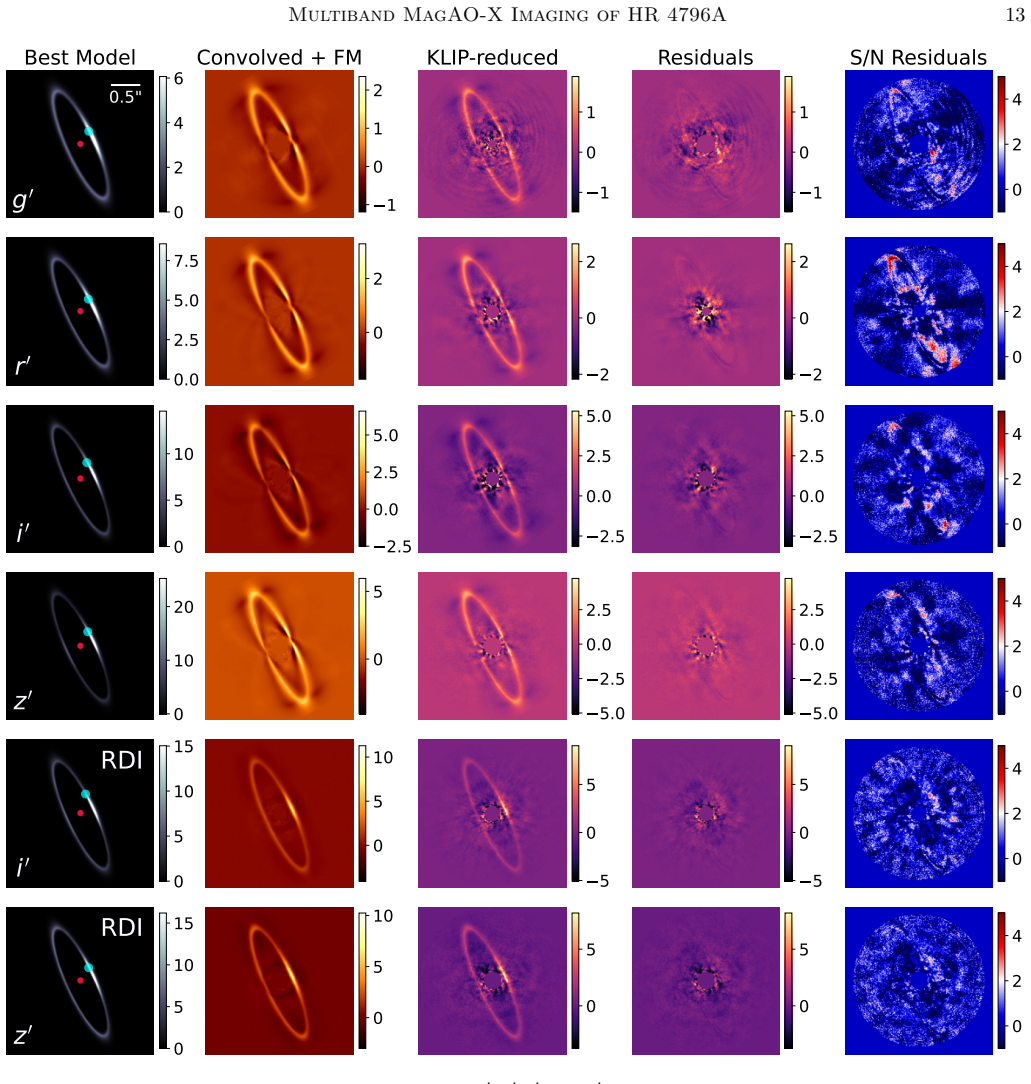
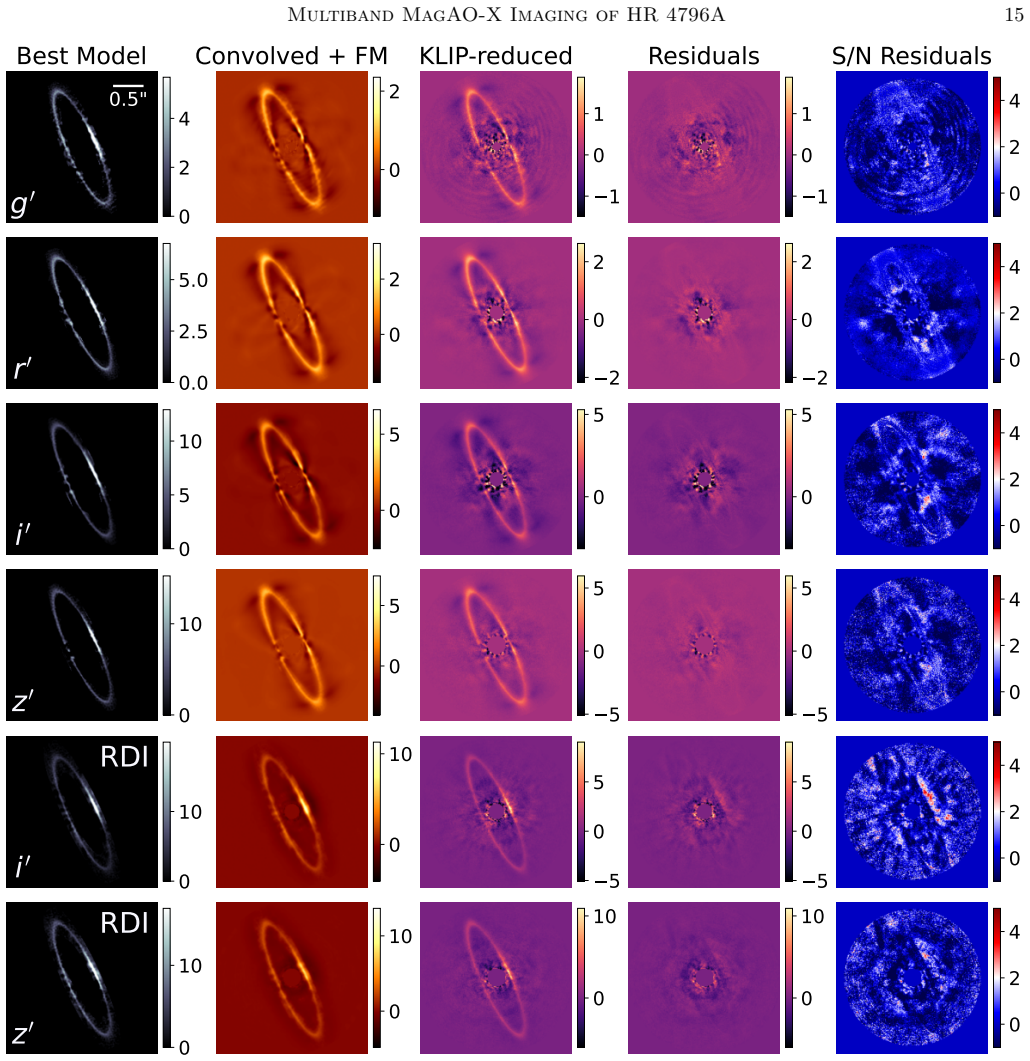
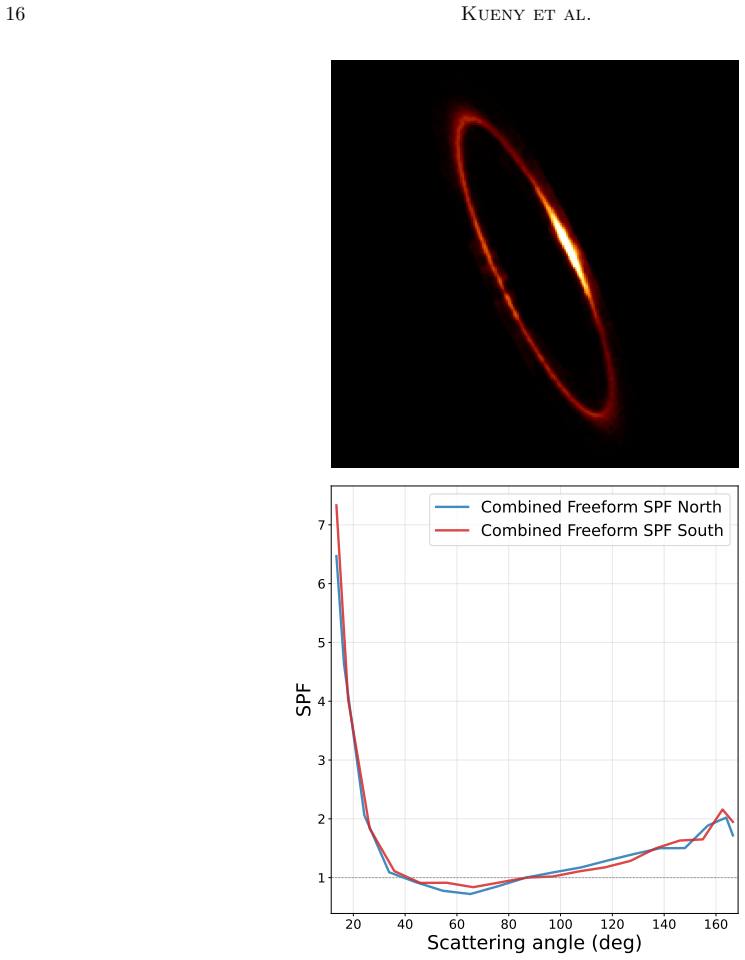
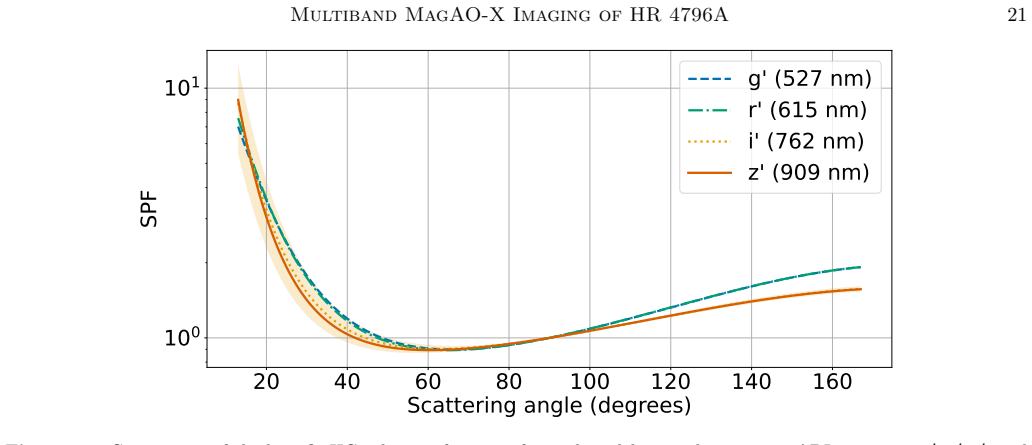
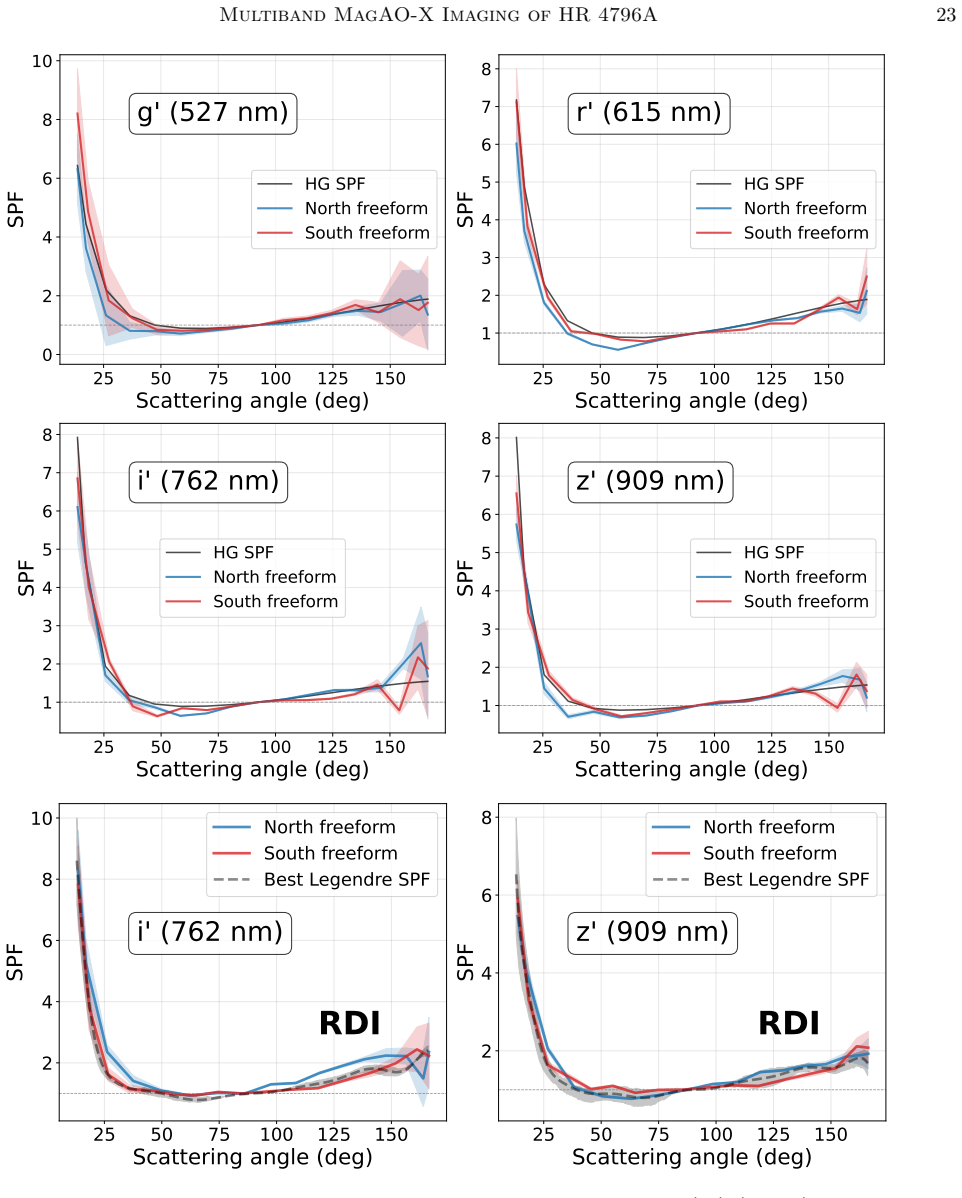
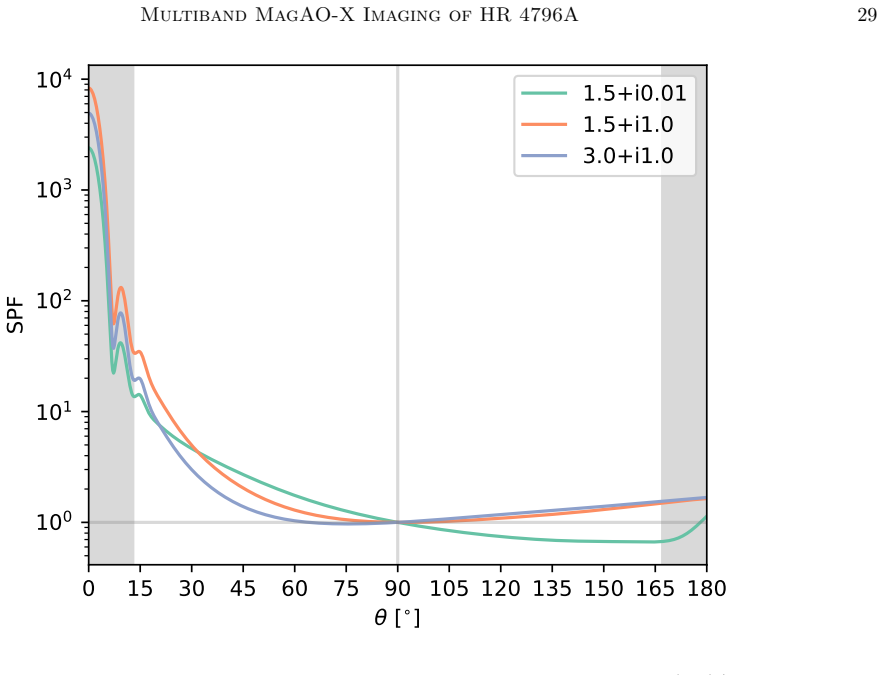
The authors detect the full extent of the HR 4796A disk, including its minor-axis forward-scattering lobes, in g', r', i', and z' bands. Modeling the scattering phase function with a Legendre polynomial basis produces highly forward-scattering curves whose shape and wavelength dependence indicate that large, highly absorptive grains dominate the scattering. Additional model features include a red spectral slope, an exterior dust halo not fit by a broken power law, and a localized clump in the freeform reconstruction.
What carries the argument
Scattering phase function modeled as a linear combination of Legendre polynomials, fitted to the observed angular brightness distribution after forward modeling to remove angular differential imaging artifacts.
If this is right
- The disk contains a faint halo of dust exterior to the main ring that requires density profiles beyond simple broken power laws.
- Dust in the system exhibits a red spectral slope across the optical bands.
- Freeform modeling reveals a compact, clump-like brightness enhancement along the disk.
- Future comparisons with irregular grain scattering models are required to extract specific size and composition constraints.
Where Pith is reading between the lines
- The measured phase functions provide a direct empirical template that can be applied to other debris disks observed at similar wavelengths to test whether large-grain dominance is common.
- If the absorptive grains are confirmed, the disk may retain a higher fraction of primordial material than disks dominated by small, icy scatterers.
- The clump feature could be monitored for orbital motion to test whether it traces a shepherding planet or a recent collision.
Load-bearing premise
The Legendre polynomial expansion of chosen order, combined with the regularization used in the fit, reproduces the true angular scattering behavior without introducing spurious features.
What would settle it
A new observation or re-reduction that yields a scattering phase function with a backscattering peak or a flat wavelength dependence at the same scattering angles would contradict the large-grain interpretation.
Figures
read the original abstract
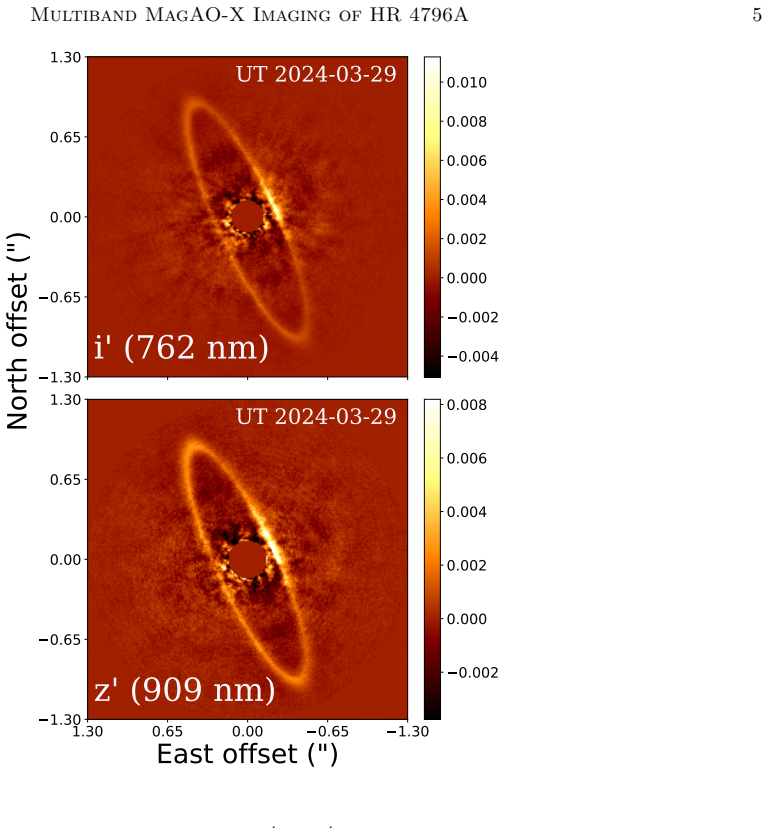
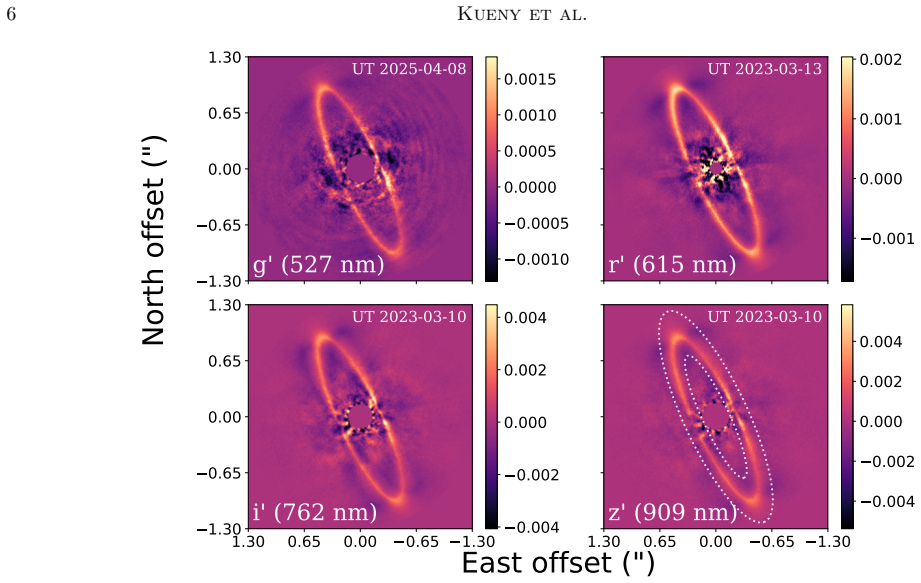
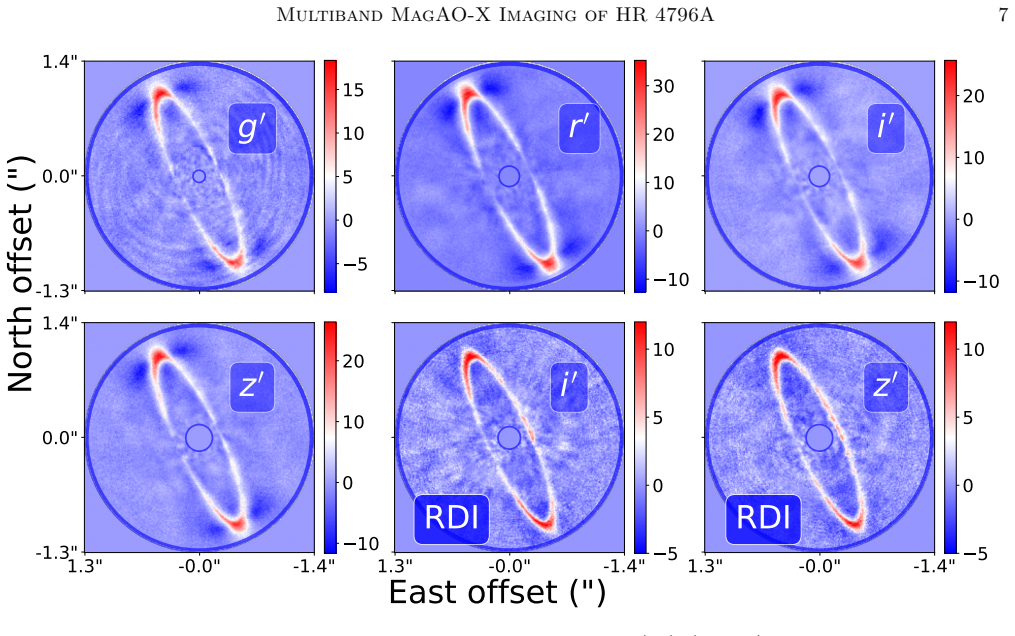
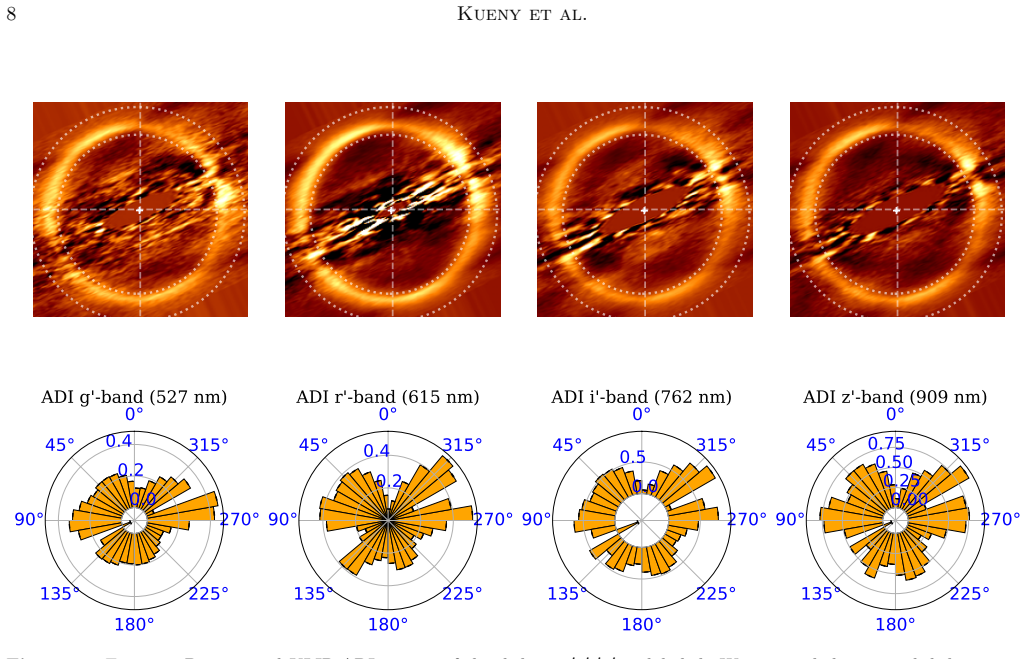
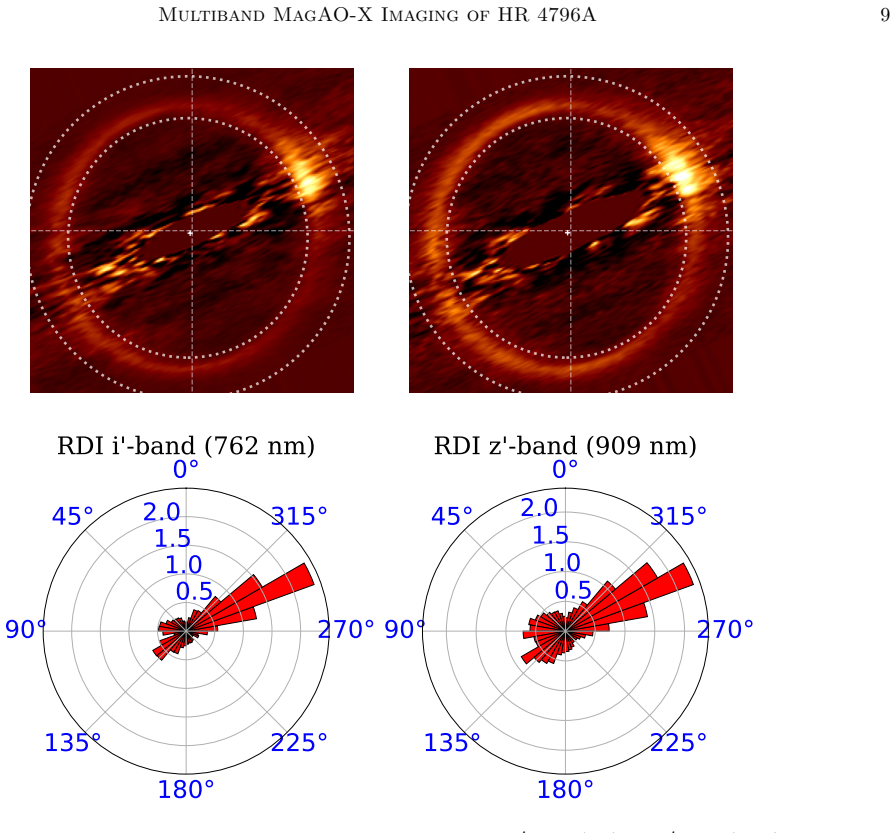
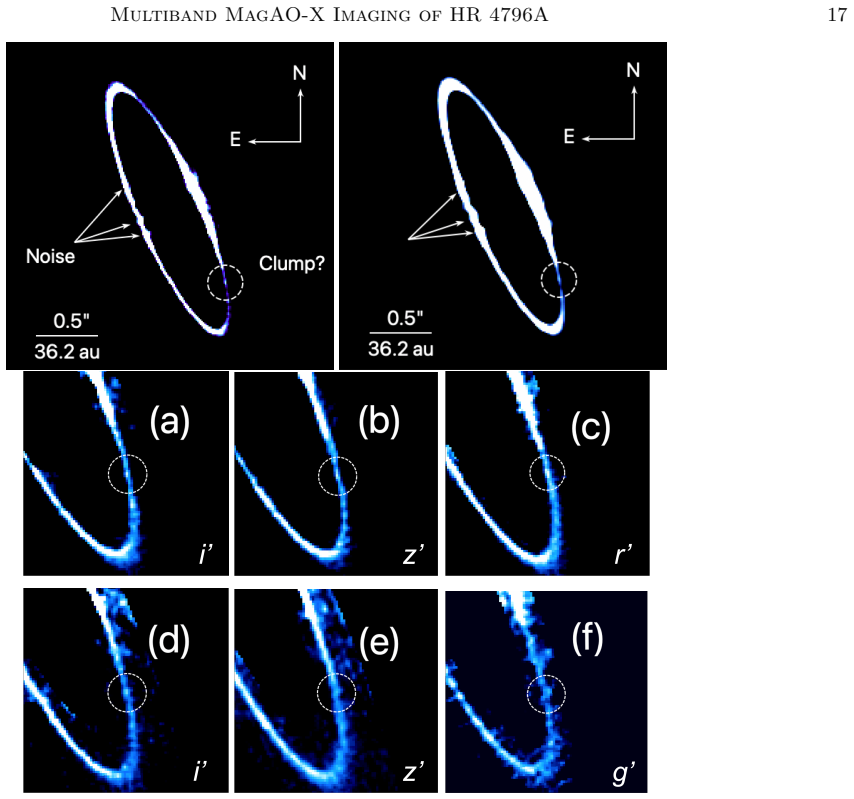
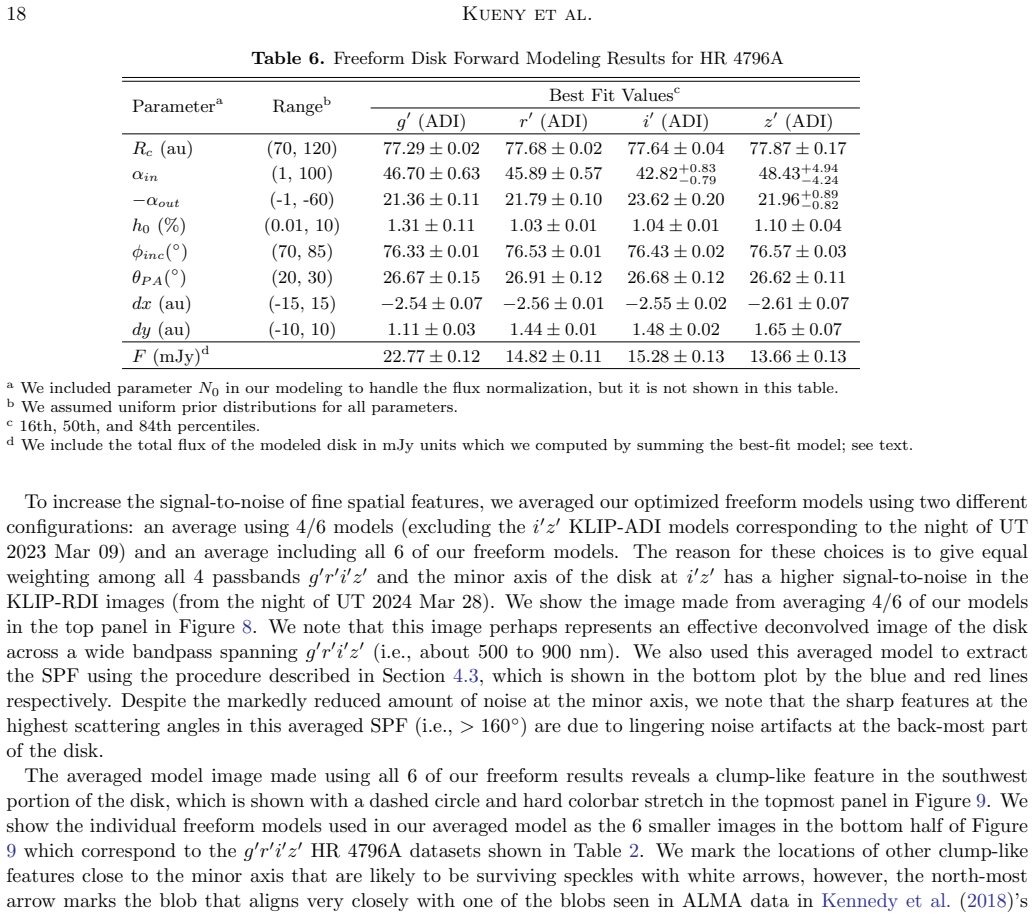
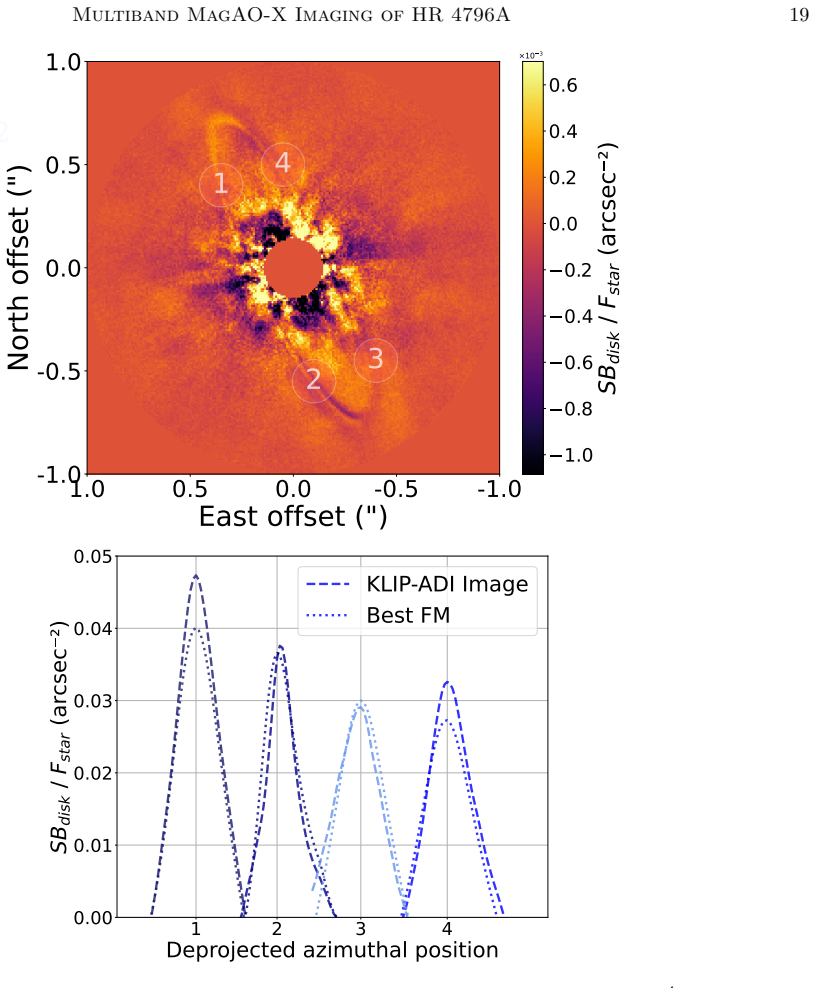
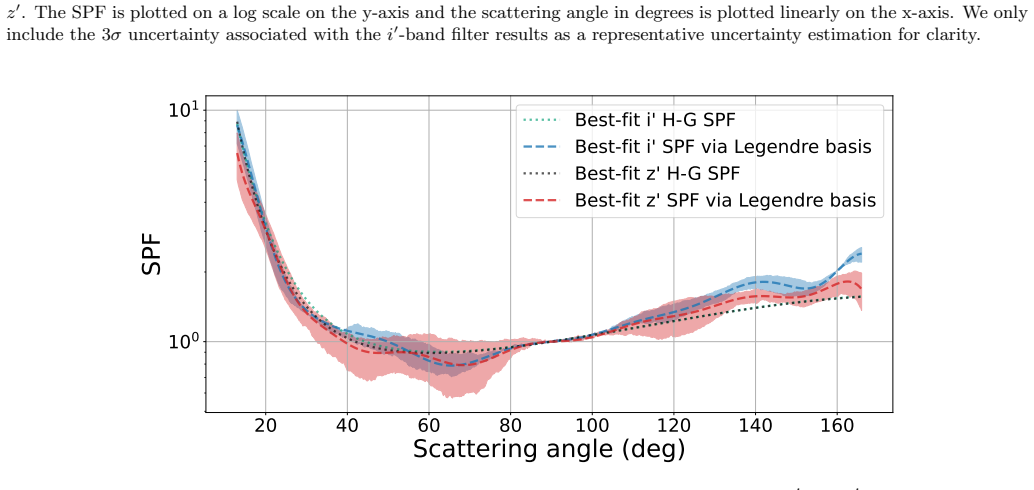
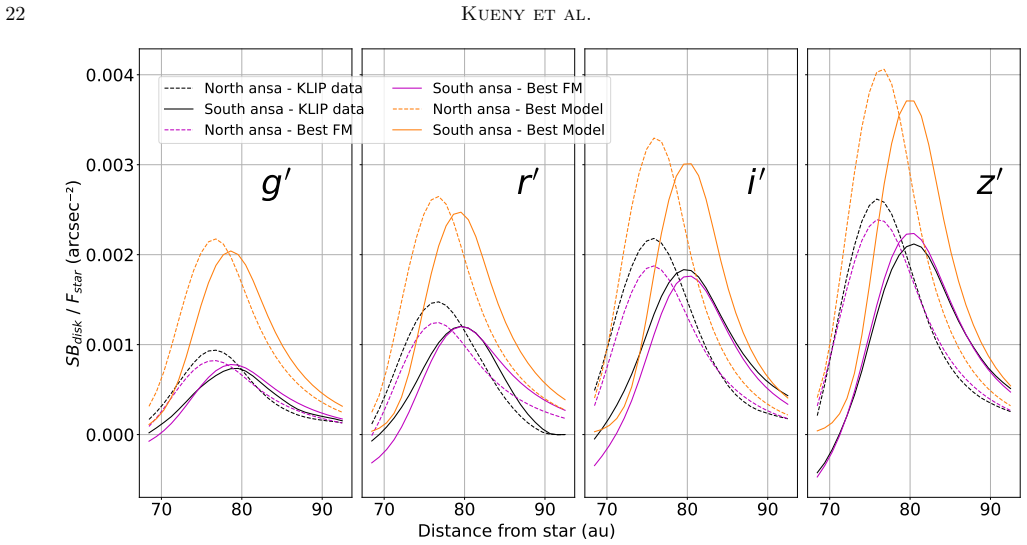
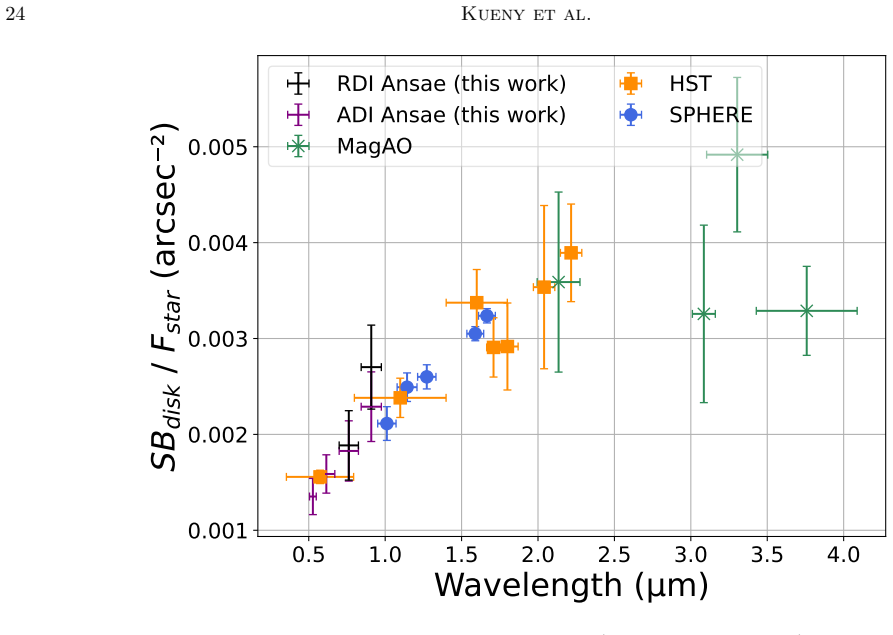
We present total intensity images of the debris disk around HR 4796A from observations spanning 2023 to 2025 with the Magellan extreme adaptive optics instrument (MagAO-X). We detected the disk at high signal-to-noise ratios at $g' (527$ nm), $r' (615$ nm), $i' (762$ nm), and $z' (909 $ nm). Additionally, we present images collected using the "star-hopping" technique that show the entirety of the disk, including the dramatic forward-scattering at the minor axis. We subjected our images to a battery of modeling techniques to constrain the geometry and photometry of the disk. Leveraging our clear detections of the disk's minor axis, we modeled the scattering phase function (SPF) using a basis of the Legendre polynomials. To mitigate self-subtraction artifacts in our angular differential imaging, we implemented a forward-modeling pipeline that generates a pixel-based freeform disk forward model leading to a deconvolved image of the disk. Our best-fit disk models reveal: (1) highly forward-scattering SPFs with a minimum at the $\sim65^{\circ}$ scattering angle, (2) a faint halo of dust just exterior to the spine of the disk that is not well-described by a broken power law density profile, (3) a red spectral slope for the dust, and finally (4) a compact, clump-like feature in the freeform disk models. Our empirically-measured SPFs suggest that the scattering is dominated by large, highly-absorptive grains. However, we emphasize the need for testing advanced irregular grain models using our SPFs to learn more about the physical and chemical properties of this complex system.
Editorial analysis
A structured set of objections, weighed in public.
Referee Report
Summary. The paper presents high-SNR total-intensity images of the HR 4796A debris disk obtained with MagAO-X in the g', r', i', and z' bands (2023–2025). It uses star-hopping observations to capture the full disk including the forward-scattering minor axis, applies a pixel-based freeform forward model to mitigate ADI self-subtraction, and fits the scattering phase function (SPF) with a Legendre polynomial basis. The resulting models show a highly forward-scattering SPF with a minimum near 65°, a faint exterior halo not captured by a broken power-law density profile, a red spectral slope, and a compact clump; the authors conclude that the SPF indicates scattering dominated by large, highly absorptive grains.
Significance. If the SPF shape is robust, the multiband empirical measurements supply new optical constraints on dust properties in a benchmark debris disk, complementing existing infrared data. Strengths include the high-SNR detections across four bands, the star-hopping technique for complete azimuthal coverage, and the forward-modeling pipeline that addresses a known ADI limitation.
major comments (2)
- [Modeling section] Modeling section (SPF fitting paragraph): The order of the Legendre polynomial basis is unspecified and no validation is described for truncation order, regularization strength, or comparison against alternatives such as a Henyey-Greenstein function or Mie-based models. Because the reported minimum at ~65° is used to infer that scattering is dominated by large, highly-absorptive grains, this choice is load-bearing for the central claim.
- [Results section] Results section (SPF and grain-size paragraph): The inference that the SPF minimum is physical rather than an artifact of the polynomial expansion or residual forward-model mismatch is not supported by any sensitivity tests; without such tests the grain-property conclusion rests on an unverified functional form.
minor comments (2)
- [Abstract] Abstract: Band notation contains typographic inconsistencies (e.g., '$g' (527$ nm)' and '$z' (909 $ nm)'); consistent LaTeX formatting would improve readability.
- [Abstract] Abstract: The phrase 'a battery of modeling techniques' is vague; listing the specific methods (forward modeling, Legendre fit, etc.) would clarify the scope of the analysis.
Simulated Author's Rebuttal
We thank the referee for their constructive comments on our manuscript. We address each major comment below and will revise the paper accordingly to improve clarity and robustness of the SPF analysis.
read point-by-point responses
-
Referee: [Modeling section] Modeling section (SPF fitting paragraph): The order of the Legendre polynomial basis is unspecified and no validation is described for truncation order, regularization strength, or comparison against alternatives such as a Henyey-Greenstein function or Mie-based models. Because the reported minimum at ~65° is used to infer that scattering is dominated by large, highly-absorptive grains, this choice is load-bearing for the central claim.
Authors: We agree that the manuscript should explicitly state the order of the Legendre polynomial basis, the truncation criterion, regularization strength, and provide some validation. The current text does not include these details. In revision we will specify the basis order used, describe how it was selected, report the regularization value, and add a short comparison to a Henyey-Greenstein fit to show that the ~65° minimum is not an artifact of the chosen functional form. We already caution in the abstract and conclusion that physical grain models are still needed; the added material will reinforce that the Legendre representation is an empirical measurement tool rather than a direct physical model. revision: yes
-
Referee: [Results section] Results section (SPF and grain-size paragraph): The inference that the SPF minimum is physical rather than an artifact of the polynomial expansion or residual forward-model mismatch is not supported by any sensitivity tests; without such tests the grain-property conclusion rests on an unverified functional form.
Authors: We agree that sensitivity tests are required to demonstrate that the ~65° minimum is robust. The present manuscript does not contain these tests. In the revised version we will add explicit checks that vary the polynomial order and assess the effect of plausible forward-model residuals on the recovered SPF shape. These tests will be described in the results section and will support that the minimum is not driven by the basis choice or residual artifacts. We note that the manuscript already qualifies the grain-size conclusion as suggestive and calls for further irregular-grain modeling; the new tests will make that qualification more quantitative. revision: yes
Circularity Check
No significant circularity; empirical SPF fit from observations is self-contained
full rationale
The paper reports direct imaging observations of the HR 4796A disk across multiple bands, applies forward-modeling to mitigate ADI self-subtraction, and fits a Legendre polynomial basis to the resulting SPF data. The reported SPF shape (forward-scattering with ~65° minimum) and grain-size inference are outputs of this data-driven process rather than reductions of the model inputs by construction. No self-citations, uniqueness theorems, or ansatzes are invoked as load-bearing steps; the Legendre basis is presented as a modeling choice whose adequacy is an assumption (not a definitional equivalence). The derivation chain remains independent of the target claims and is consistent with standard observational astronomy practice.
Axiom & Free-Parameter Ledger
Reference graph
Works this paper leans on
-
[1]
MODE=swspectr+INS.NAME=SKYCALC Astropy Collaboration, Robitaille, T
Astropy:. 2013 , note =. doi:10.1051/0004-6361/201322068 , journal =
-
[2]
Nature Methods , author =. 2020 , pages =. doi:10.1038/s41592-019-0686-2 , language =
-
[3]
Joye, W. A. and Mandel, E. , editor =. New. Astronomical. 2003 , pages =
2003
-
[4]
The Astronomical Journal , author =
The. The Astronomical Journal , author =. 2019 , note =. doi:10.3847/1538-3881/ab095e , abstract =
-
[5]
The Astrophysical Journal , author =
Limits of. The Astrophysical Journal , author =. 2005 , note =. doi:10.1086/431209 , abstract =
-
[6]
Males, Jared R. and Close, Laird M. and Guyon, Olivier and Hedglen, Alexander D. and Van Gorkom, Kyle and Long, Joseph D. and Kautz, Maggie Y. and Lumbres, Jennifer and Schatz, Lauren and Rodack, Alexander T. and Miller, Kelsey L. and Doelman, David S. and Snik, Frans and Knight, Justin M. and Morzinski, Katie M. and Gasho, Victor and Keller, Christoph U....
-
[7]
The Astrophysical Journal , author =
Angular. The Astrophysical Journal , author =. 2006 , note =. doi:10.1086/500401 , abstract =
-
[8]
and Chen, Christine and Wang, Jason J
Mazoyer, Johan and Arriaga, Pauline and Hom, Justin and Millar-Blanchaer, Maxwell A. and Chen, Christine and Wang, Jason J. and Duchêne, Gaspard and Patience, Jennifer and Pueyo, Laurent , editor =. Ground-based and. 2020 , pages =. doi:10.1117/12.2560091 , abstract =
-
[9]
The Astrophysical Journal , author =. 2015 , note =. doi:10.1088/0004-637X/811/1/18 , abstract =
-
[10]
The Astronomical Journal , author =. 2016 , note =. doi:10.3847/0004-6256/152/5/128 , abstract =
-
[11]
The Astrophysical Journal , author =. 2015 , note =. doi:10.1088/0004-637X/815/2/108 , abstract =
-
[12]
Astronomy & Astrophysics , author =
Discovery of concentric broken rings at sub-arcsec separations in the. Astronomy & Astrophysics , author =. 2016 , pages =. doi:10.1051/0004-6361/201628396 , abstract =
-
[13]
The Astrophysical Journal , author =. 2016 , note =. doi:10.3847/0004-637X/824/2/117 , abstract =
-
[14]
Publications of the Astronomical Society of the Pacific , author =
emcee:. Publications of the Astronomical Society of the Pacific , author =. 2013 , note =
2013
-
[15]
The Astrophysical Journal , author =
Diffuse radiation in the. The Astrophysical Journal , author =. 1941 , note =
1941
-
[16]
The Astrophysical Journal , author =
An. The Astrophysical Journal , author =. 2019 , note =
2019
-
[17]
and Ruffio, Jean-Baptise and De Rosa, Robert J
Wang, Jason J. and Ruffio, Jean-Baptise and De Rosa, Robert J. and Aguilar, Jonathan and Wolff, Schuyler G. and Pueyo, Laurent , year =
-
[18]
The Astrophysical Journal , author =
Stumbling over. The Astrophysical Journal , author =. 2022 , note =. doi:10.3847/1538-4357/ac63a9 , abstract =
-
[19]
Publications of the Astronomical Society of the Pacific , author =
Techniques and. Publications of the Astronomical Society of the Pacific , author =. 2014 , note =
2014
-
[20]
The Astrophysical Journal , author =
Scattering by. The Astrophysical Journal , author =. 2003 , note =
2003
-
[21]
The Astrophysical Journal , author =
Magellan. The Astrophysical Journal , author =. 2014 , note =
2014
-
[22]
Astronomy & Astrophysics , author =
On the. Astronomy & Astrophysics , author =. 1999 , note =
1999
-
[23]
The Astronomical Journal , author =
Reference. The Astronomical Journal , author =. 2019 , note =
2019
-
[24]
Astronomy & Astrophysics , author =
Impact of angular differential imaging on circumstellar disk images , volume =. Astronomy & Astrophysics , author =. 2012 , note =
2012
-
[25]
Wyatt, M. C. ; Panić , translator =. Five steps in the evolution from protoplanetary to debris disk , volume =. 2015 , note =
2015
-
[26]
Journal of Quantitative Spectroscopy and Radiative Transfer , author =
Effect of morphology on light scattering by agglomerates , volume =. Journal of Quantitative Spectroscopy and Radiative Transfer , author =. 2015 , note =
2015
-
[27]
Optics Letters , author =
Efficient subpixel image registration algorithms , volume =. Optics Letters , author =. 2008 , note =
2008
-
[28]
Nature Astronomy , author =
Spatially resolved imaging of the inner. Nature Astronomy , author =. 2023 , note =
2023
-
[29]
Astronomy & Astrophysics , author =
Gaia. Astronomy & Astrophysics , author =. 2023 , note =
2023
-
[30]
Science , author =
What makes a planet habitable? , volume =. Science , author =. 2019 , note =
2019
-
[31]
The Astronomical Journal , author =
The. The Astronomical Journal , author =. 2006 , note =
2006
-
[32]
The Astrophysical Journal , author =. 2014 , pages =. doi:10.1088/0004-637X/798/2/96 , abstract =
-
[33]
Astronomy & Astrophysics , author =
Revealing asymmetrical dust distribution in the inner regions of. Astronomy & Astrophysics , author =. 2021 , pages =. doi:10.1051/0004-6361/202140319 , abstract =
-
[34]
The Astrophysical Journal , author =. 2012 , pages =. doi:10.1088/2041-8205/755/2/L28 , abstract =
-
[35]
The Astronomical Journal , author =. 2020 , note =. doi:10.3847/1538-3881/ababa6 , number =
-
[36]
Milli, J. and Vigan, A. and Mouillet, D. and Lagrange, A. -M. and Augereau, J. -C. and Pinte, C. and Mawet, D. and Schmid, H. M. and Boccaletti, A. and Matrà, L. and Kral, Q. and Ertel, S. and Chauvin, G. and Bazzon, A. and Ménard, F. and Beuzit, J. -L. and Thalmann, C. and Dominik, C. and Feldt, M. and Henning, T. and Min, M. and Girard, J. H. and Galich...
-
[37]
The Astronomical Journal , author =
Debris. The Astronomical Journal , author =. 2020 , note =. doi:10.3847/1538-3881/ab9199 , number =
-
[38]
Milli, J. and Engler, N. and Schmid, H. M. and Olofsson, J. and Ménard, F. and Kral, Q. and Boccaletti, A. and Thébault, P. and Choquet, E. and Mouillet, D. and Lagrange, A. -M. and Augereau, J. -C. and Pinte, C. and Chauvin, G. and Dominik, C. and Perrot, C. and Zurlo, A. and Henning, T. and Beuzit, J. -L. and Avenhaus, H. and Bazzon, A. and Moulin, T. a...
-
[39]
Galicher, R. and Potier, A. and Mazoyer, J. and Wahhaj, Z. and Baudoz, P. and Chauvin, G. , month = jun, year =. Increasing the raw contrast of. doi:10.1051/0004-6361/202449196 , journal =
-
[40]
de Regt, S. and Ginski, C. and Kenworthy, M. A. and Caceres, C. and Garufi, A. and Gledhill, T. M. and Hales, A. S. and Huelamo, N. and Kóspál, Á. and Millar-Blanchaer, M. A. and Pérez, S. and Schreiber, M. R. , month = apr, year =. Polarimetric differential imaging with. doi:10.1051/0004-6361/202348736 , journal =
-
[41]
Monthly Notices of the Royal Astronomical Society , author =
A uniform analysis of debris discs with the. Monthly Notices of the Royal Astronomical Society , author =. 2024 , note =. doi:10.1093/mnras/stae368 , number =
-
[42]
Thebault, P. and Olofsson, J. and Kral, Q. , month = jun, year =. A reinvestigation of debris disc halos , volume =. doi:10.1051/0004-6361/202345995 , journal =
-
[43]
The Astrophysical Journal , author =
Multiband. The Astrophysical Journal , author =. 2020 , note =. doi:10.3847/1538-4357/ab9aba , number =
-
[44]
The Astrophysical Journal Letters , author =. 1999 , note =. doi:10.1086/311921 , number =
-
[45]
The Astronomical Journal , author =
The. The Astronomical Journal , author =. 2018 , note =. doi:10.3847/1538-3881/aaa3f3 , number =
-
[46]
The Astronomical Journal , author =
Astrometric. The Astronomical Journal , author =. 2025 , keywords =. doi:10.3847/1538-3881/ad924f , number =
-
[47]
McEwen, Eden A. and Males, Jared R. and Guyon, Olivier and Haffert, Sebastiaan Y. and Long, Joseph D. and Close, Laird M. and Van Gorkom, Kyle and Lumbres, Jennifer and Hedglen, Alexander D. and Schatz, Lauren and Kautz, Maggie Y. and Pearce, Logan A. and Kueny, Jay and McLeod, Avalon L. and Foster, Warren B. and Li, Jialin and Roberts, Roz and Weinberger...
-
[48]
Wahhaj, Z. and Milli, J. and Romero, C. and Cieza, L. and Zurlo, A. and Vigan, A. and Peña, E. and Valdes, G. and Cantalloube, F. and Girard, J. and Pantoja, B. , month = apr, year =. A search for a fifth planet around. doi:10.1051/0004-6361/202038794 , journal =
-
[49]
The Astrophysical Journal , author =
Probing. The Astrophysical Journal , author =. 2024 , note =. doi:10.3847/1538-4357/ad0f96 , number =
-
[50]
The Astronomical Journal , author =
The. The Astronomical Journal , author =. 2008 , note =. doi:10.1088/0004-6256/136/2/735 , number =
-
[51]
The Astrophysical Journal Letters , author =
Complex. The Astrophysical Journal Letters , author =. 2008 , note =. doi:10.1086/527546 , number =
-
[52]
Olofsson, J. and Milli, J. and Bayo, A. and Henning, Th. and Engler, N. , month = aug, year =. The challenge of measuring the phase function of debris discs. doi:10.1051/0004-6361/202038237 , journal =
-
[53]
Monthly Notices of the Royal Astronomical Society , author =. 2018 , note =. doi:10.1093/mnras/sty135 , number =
-
[54]
The Astrophysical Journal , author =
Polarimetry with the. The Astrophysical Journal , author =. 2015 , note =. doi:10.1088/0004-637X/799/2/182 , number =
-
[55]
Olofsson, J. and Milli, J. and Thébault, P. and Kral, Q. and Ménard, F. and Janson, M. and Augereau, J. -C. and Bayo, A. and Beamín, J. C. and Henning, Th. and Iglesias, D. and Kennedy, G. M. and Montesinos, M. and Pawellek, N. and Schreiber, M. R. and Zamora, C. and Carbillet, M. and Feautrier, P. and Fusco, T. and Madec, F. and Rabou, P. and Sevin, A. a...
-
[56]
The Astronomical Journal , author =. 2009 , note =. doi:10.1088/0004-6256/137/1/53 , number =
-
[57]
The Astrophysical Journal , author =
Dust. The Astrophysical Journal , author =. 2006 , note =. doi:10.1086/505736 , number =
-
[58]
The Astrophysical Journal , author =
Space. The Astrophysical Journal , author =. 2000 , note =. doi:10.1086/309188 , number =
-
[59]
Christiaens, V. and Samland, M. and Henning, Th. and Portilla-Revelo, B. and Perotti, G. and Matthews, E. and Absil, O. and Decin, L. and Kamp, I. and Boccaletti, A. and Tabone, B. and Marleau, G. -D. and van Dishoeck, E. F. and Güdel, M. and Lagage, P. -O. and Barrado, D. and Caratti o Garatti, A. and Glauser, A. M. and Olofsson, G. and Ray, T. P. and Sc...
-
[60]
Monthly Notices of the Royal Astronomical Society , author =. 2017 , note =. doi:10.1093/mnras/stw2867 , number =
-
[61]
The Astrophysical Journal Letters , author =. 2022 , note =. doi:10.3847/2041-8213/ac7729 , number =
-
[62]
Stauffer, John R. and Hartmann, Lee W. and Barrado y Navascues, David , month = dec, year =. An. doi:10.1086/176544 , journal =
-
[63]
The Astrophysical Journal , author =
A. The Astrophysical Journal , author =. 1998 , keywords =. doi:10.1086/306184 , number =
-
[64]
The Astrophysical Journal , author =
Modeling the. The Astrophysical Journal , author =. 2003 , note =. doi:10.1086/374865 , number =
-
[65]
Milli, J. and Mawet, D. and Pinte, C. and Lagrange, A. -M. and Mouillet, D. and Girard, J. H. and Augereau, J. -C. and De Boer, J. and Pueyo, L. and Choquet, É. , month = may, year =. New constraints on the dust surrounding. doi:10.1051/0004-6361/201423950 , journal =
-
[66]
The Astrophysical Journal , author =
Mid-. The Astrophysical Journal , author =. 1998 , note =. doi:10.1086/311525 , number =
-
[67]
Lagrange, A. -M. and Milli, J. and Boccaletti, A. and Lacour, S. and Thebault, P. and Chauvin, G. and Mouillet, D. and Augereau, J. C. and Bonnefoy, M. and Ehrenreich, D. and Kral, Q. , month = oct, year =. An insight in the surroundings of. doi:10.1051/0004-6361/201219187 , journal =
-
[68]
Moerchen, M. M. and Churcher, L. J. and Telesco, C. M. and Wyatt, M. and Fisher, R. S. and Packham, C. , month = feb, year =. Asymmetric heating of the. doi:10.1051/0004-6361/201014881 , journal =
-
[69]
The Astrophysical Journal Letters , author =
Images of the. The Astrophysical Journal Letters , author =. 2011 , note =. doi:10.1088/2041-8205/743/1/L6 , number =
-
[70]
Wahhaj, Zahed and Liu, Michael C. and Biller, Beth A. and Nielsen, Eric L. and Hayward, Thomas L. and Kuchner, Marc and Close, Laird M. and Chun, Mark and Ftaclas, Christ and Toomey, Douglas W. , month = jul, year =. The. doi:10.1051/0004-6361/201323335 , journal =
-
[71]
The Astronomical Journal , author =
Multiband. The Astronomical Journal , author =. 2020 , note =. doi:10.3847/1538-3881/ab91b1 , number =
-
[72]
Meredith and Duchêne, Gaspard and Matthews, Brenda C
Hughes, A. Meredith and Duchêne, Gaspard and Matthews, Brenda C. , month = sep, year =. Debris. doi:10.1146/annurev-astro-081817-052035 , journal =
-
[73]
The Astrophysical Journal , author =
Saturn's. The Astrophysical Journal , author =. 2015 , note =. doi:10.1088/0004-637X/811/1/67 , number =
-
[74]
Min, M. and Canovas, H. and Mulders, G. D. and Keller, C. U. , month = jan, year =. The effects of disk and dust structure on observed polarimetric images of protoplanetary disks , volume =. doi:10.1051/0004-6361/201117333 , journal =
-
[75]
Min, M. and Kama, M. and Dominik, C. and Waters, L. B. F. M. , month = jan, year =. The lunar phases of dust grains orbiting. doi:10.1051/0004-6361/200913065 , journal =
-
[76]
Purcell, Edward M. and Pennypacker, Carlton R. , month = dec, year =. Scattering and. doi:10.1086/152538 , journal =
-
[77]
Astronomy & Astrophysics , author =
The spin-orbit alignment of the. Astronomy & Astrophysics , author =. 2009 , note =. doi:10.1051/0004-6361/200911854 , number =
-
[78]
doi:10.48550/arXiv.2505.20070 , journal =
Roumesy, Maxime and Ménard, François and Tazaki, Ryo and Duchêne, Gaspard and Martinien, Laurine and Zerna, Rémi , month = may, year =. doi:10.48550/arXiv.2505.20070 , journal =
-
[79]
Berechnung verschiedener physikalischer. Annalen der Physik , author =. 1935 , pages =. doi:10.1002/andp.19354160705 , number =
-
[80]
Berechnung verschiedener physikalischer. Annalen der Physik , author =. 1936 , pages =. doi:10.1002/andp.19364170706 , number =
discussion (0)
Sign in with ORCID, Apple, or X to comment. Anyone can read and Pith papers without signing in.