REVIEW 2 major objections 4 minor 1 cited by
A triple-dot refrigerator that acts as an autonomous demon can cool with output fluctuations suppressed by an order of magnitude relative to the fluctuations of the nonthermal resource feeding it—whereas its information-based mode cannot.
Reviewed by Pith at T0; open to challenge. T0 means a machine referee read the full paper against a public rubric. the ladder, T0–T4 →
In a capacitively-coupled triple-dot refrigerator, the nonthermal-resource operating regime suppresses cooling-power noise by up to an order of magnitude relative to input heat-current noise, unlike the information-based regime.
T0 review reviewed 2026-08-04 challenge →
load-bearing objection Solid FCS study of noise in a triple-dot demon refrigerator; the headline noise-suppression claim is exact at the ideal operating point but its robustness to the tunneling asymmetry is not directly shown — an addressable gap. the 2 major comments →
Precision of an autonomous demon exploiting nonthermal resources and information
The pith
A machine-rendered reading of the paper's core claim, the machinery that carries it, and where it could break.
The reading
Core claim
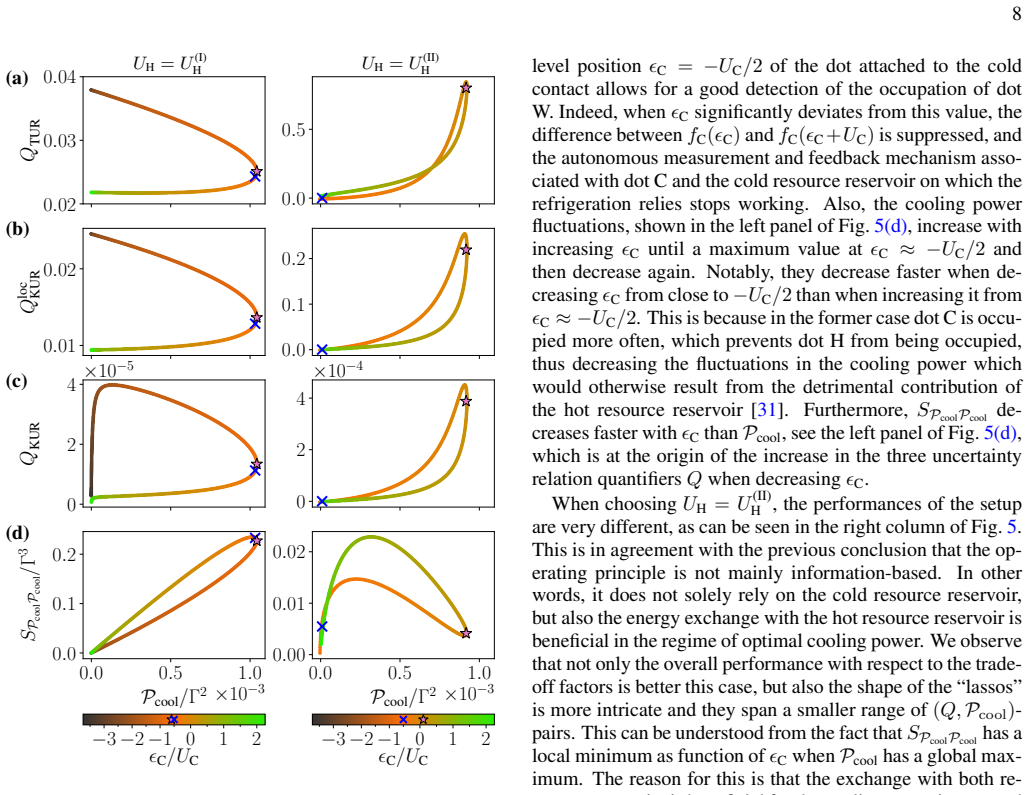
At the parameters of scenario (II), where the interaction between the working dot and the hot resource dot is weaker than that with the cold resource dot (UH < UC), the ratio of cooling-power noise to input heat-current noise, S_PcoolPcool / S_{Jin^Q Jin^Q}, reaches a minimum below 0.1 at the cooling-power maximum: the output is an order of magnitude quieter than the stochastic input that drives it. In scenario (I), where the cold-resource interaction dominates (UH > UC) and operation is information-based, this ratio stays above or near one. The paper further claims that the thermodynamic-uncertainty-relation quantifier can approach saturation (QTUR ≃ 0.89) in the nonthermal regime while the
What carries the argument
The central object is a triple quantum dot: two capacitively coupled resource dots (H and C), each connected to its own reservoir, form a nonthermal resource that modulates the energy of a working dot W in contact with cold (R) and hot (L) reservoirs. The demon condition J_in^Q = 0 (no average heat injection from the resource) is enforced by tuning the H level, and an ideal tunnel-rate asymmetry (electrons enter W from R only when the resource is in state h=c=0, and leave to L only when one resource dot is occupied) makes the feedback autonomous. The argument is carried by full counting statistics through an extended master equation with counting fields for particles, energy, activity, and i
Load-bearing premise
The order-of-magnitude noise suppression requires the ideal tunnel-rate asymmetry (electrons enter the working dot only when the resource is in the right configuration, Λ = 1) together with a resource that reacts much faster than the working substance; real devices deviating from these conditions will likely lose the suppression.
What would settle it
Using time-resolved charge detection to measure the heat-current statistics in a triple dot at the scenario-(II) parameters, record the ratio S_PcoolPcool / S_JinQJinQ at maximum cooling power while relaxing the forbidden tunnel rates (Γ00_R, Γ01_L, Γ10_L) away from zero; if the ratio rises above 0.1 for Λ appreciably below 1, the claimed order-of-magnitude suppression is an ideal-limit artifact.
If this is right
- In the nonthermal working regime, the refrigerator can operate at a large cooling power with output fluctuations an order of magnitude below the input fluctuations—a precision impossible in the information-based regime studied.
- The thermodynamic-uncertainty-relation quantifier can come close to saturation (about 0.89) in the nonthermal regime, meaning the cooling power is almost as precise as allowed for its entropy production; the kinetic-bound quantifier stays far from saturation.
- The two demonic working principles are distinguishable by measurable cross-correlations: information operation shows near-perfect anticorrelation between left and right heat currents and strong information–cooling coupling, while nonthermal operation suppresses those and correlates the cooling power with the transverse resource heat current instead.
- Cooling under the demon condition requires input fluctuations, but those fluctuations do not have to degrade the output; the required randomness is filtered by the cycle statistics.
- Deviating from the ideal tunnel asymmetry degrades cooling power and precision quantifiers, and the nonthermal regime degrades more gracefully than the information regime.
Where Pith is reading between the lines
- Because the noise-ratio suppression is explained by the sign structure of cycle-level heat and entropy production, a natural design rule follows that the paper does not state: arrange a machine so every forward cooling cycle has the same sign for extracted heat and entropy production, and its reverse is suppressed—then output noise can be minimized without suppressing the average output.
- The paper checks robustness of cooling power and tradeoff quantifiers against the tunnel asymmetry but not of the ratio S_PcoolPcool/S_JinQJinQ itself; an explicit calculation at Λ < 1 would show whether the order-of-magnitude claim survives realistic asymmetry.
- For the related noninteracting coherent 'nonthermal demon' (the quantum-Hall comparison), the same ratio is not evaluated; computing it would test whether the noise suppression is a general feature of nonthermal demons or requires the interaction-enabled autonomous feedback of the triple-dot system.
- The local kinetic-uncertainty-relation violation seen in scenario (I) shows that Coulomb correlations can suppress particle-current noise below local activity; in scenario (II) no violation occurs, suggesting that the nonthermal mechanism does not rely on this correlation-driven precision enhancement.
Editorial analysis
A structured set of objections, weighed in public.
Referee Report
Summary. The paper studies a six-state Markovian triple-dot refrigerator, using full counting statistics and stochastic-cycle/trajectory methods to compare two operational regimes: an information-driven Maxwell demon (I, UH>UC) and a nonthermal-resource demon (II, UH<UC). It reports that at the scenario-(II) cooling-power optimum the noise ratio S_{Pcool Pcool}/S_{J_in^Q J_in^Q} drops below ~0.1, whereas in scenario (I) it is always ≳1; it attributes the suppression to a sign-cancellation among stochastic cycles in the range -UC<ε_W<-UH, and supports the interpretation with Pearson cross-correlations.
Significance. The central quantitative claim is computed exactly within a stated Markovian FCS model: the kernel is given in Appendix B1, the recursive cumulant method in Sec. II C, and the results are cross-checked against stochastic trajectories in Fig. 12, with trajectory data available. The paper also provides a physical cycle-level mechanism (Sec. III C and Appendix C6) and compares with a noninteracting quantum-Hall demon. If the robustness gap identified below is filled, the result is significant: it demonstrates a qualitative precision advantage of nonthermal resources over information-based operation in an experimentally relevant quantum-dot setup.
major comments (2)
- [Sec. III C and Appendix B2, Fig. 10] The headline suppression R = S_{Pcool Pcool}/S_{J_in^Q J_in^Q} < 0.1 is only exhibited for ideal tunneling asymmetry Λ=1 and for Γ_R,Γ_L ≪ Γ_H,Γ_C. Fig. 10 varies Λ but plots P_cool^εmax, S_{Pcool Pcool}, and Q_TUR; since the denominator S_{J_in^Q J_in^Q} also changes with Λ, those curves do not constrain R. Because the mechanism in Sec. III C relies on cycle-level sign cancellations, and nonideal rates modify r_CC, r_CH, r_CHC (Eqs. C4), the order-of-magnitude suppression may disappear away from the ideal limit. Please add a robustness map of R in the same Λ / rate-ratio plane as Fig. 10, or explicitly state that the claimed suppression is an ideal-limit result.
- [Appendix C2, Eq. (C8)] The covariance generalization S_{J_X J_Y} = cov_C(X,Y)/\bar t_cycle + ... is used in Sec. III D and Fig. 12 to interpret cross-correlations, but the text states that its proof is beyond the scope of this article and will be published elsewhere. Since this analytical formula underpins the cycle interpretation, the omitted proof is a load-bearing gap in the present manuscript. Please include a derivation in an appendix, or explicitly label Eq. (C8) as an ansatz and ensure the main-text conclusions do not rely on it.
minor comments (4)
- [Abstract and Sec. III C, Fig. 2(c)] The abstract claims 'order of magnitude' suppression, but the paper does not state the numerical minimum value of R. Adding the value (and the corresponding parameter point) would make the claim precise.
- [Eq. (B4)] The definition of Λ is given for two pairs of rates, but the notation is slightly terse. Spell out explicitly which rates are held fixed and which are varied when Λ is changed in Fig. 10.
- [Table II] The notation Δβ_{αγ} is used in the table but defined only in the text after the table. Please define it directly in the table caption.
- [Sec. III A] The first occurrence of 'ideal tunnel-rate asymmetry' appears in Sec. III A, but the footnote near Fig. 1(b) is referenced later. Please add a cross-reference at first use.
Circularity Check
No significant circularity: the noise-suppression claim is a computed FCS output, not a fitted or self-defined quantity.
full rationale
The paper's central quantitative claim—that in scenario (II) the ratio S_PcoolPcool / S_Jin^Q Jin^Q can fall below 0.1 near maximum cooling power—is obtained from the full counting statistics cumulant generating function by differentiating the eigenvalue of the extended master equation (Sec. II C, Eqs. (12)-(15)), with the kernel spelled out in Appendix B 1. Neither the numerator nor the denominator is fitted to reproduce the target ratio; the ratio is a derived output. The same quantities are independently cross-checked against stochastic trajectories in Fig. 12. The use of Ref. [31] is contextual: it provides the model, the two representative scenarios, and the cycle decomposition used for interpretation, but the fluctuation ratio, TUR/KUR figures of merit, and Pearson correlations are newly computed here. The cycle-level explanation in Sec. III C and Appendix C 6 (e.g., Eq. (C18)) is an approximate interpretive decomposition of the exact FCS result, not the source of the headline number. The deferred proof of the generalized covariance formula Eq. (C8) is used only for trajectory cross-correlation interpretation, not for the headline noise ratio. The robustness concern about Lambda=1 and the rapid-demon time-scale separation is a question of parameter validity, not circularity: the derivation does not presuppose the order-of-magnitude suppression. Therefore no step reduces, by definition or by self-citation, to its own input.
Axiom & Free-Parameter Ledger
free parameters (4)
- UH/UC ratio =
47.22/12 (scenario I); 8.64/12 (scenario II)
- Dot level positions ϵW, ϵC, ϵH =
ϵW=7.59, ϵC=-7.08, ϵH=-4.96 (I); ϵW=-9.88, ϵC=1.24, ϵH=-14.38 (II)
- Tunneling asymmetry Λ =
Λ = 1 (ideal: Γ00_R = Γ01_L = Γ10_L = 0)
- Temperature scale =
TH=16, TC=4, T̄=8, δT=1 (in units of Γ)
axioms (5)
- domain assumption Sequential-tunneling (weak-coupling) regime with Markovian dynamics
- domain assumption Strong intradot and H–C Coulomb interactions (single occupation, U→∞ between resource dots)
- ad hoc to paper Demon condition J_Q^in = 0 enforced by tuning ϵH
- domain assumption Capacitive coupling exchanges only energy, not particles, between resource and working substance
- domain assumption Nonthermal resource emulated by two thermal reservoirs at different temperatures
Cite this review
Pith. "Pith review of Precision of an autonomous demon exploiting nonthermal resources and information." pith.science (2026). https://pith.science/paper/EEFS2XQB
@misc{pith2026251014578,
  author       = {Pith},
  title        = {Pith review of: Precision of an autonomous demon exploiting nonthermal resources and information},
  year         = {2026},
  howpublished = {\url{https://pith.science/paper/EEFS2XQB}},
  note         = {Machine review of arXiv:2510.14578}
}
read the original abstract
Quantum-dot systems serve as nanoscale heat engines exploiting thermal fluctuations to perform a useful task. Here, we investigate a multi-terminal triple-dot system, operating as a refrigerator that extracts heat from a cold electronic contact. In contrast to standard heat engines, this system exploits a nonthermal resource. This has the intriguing consequence that cooling can occur without extracting energy from the resource on average -- a seemingly demonic action -- while, however, requiring the resource to fluctuate. Using full counting statistics and stochastic trajectories, we analyze the performance of the device in terms of the cooling-power precision, employing performance quantifiers motivated by the thermodynamic and kinetic uncertainty relations. We focus on two regimes with large output power, which are based on two operational principles: exploiting information on one hand and the nonthermal properties of the resource on the other. We show that these regimes significantly differ in precision. In particular, the regime exploiting the nonthermal properties of the resource can have cooling-power fluctuations that are suppressed with respect to the input fluctuations by an order of magnitude. We also substantiate the interpretation of the two different working principles by analyzing cross-correlations between input and output heat currents and information flow.
Figures




Forward citations
Cited by 1 Pith paper
-
Stochastic entropy production in scattering theory
A stochastic framework for entropy production in coherent scattering theory is introduced that separates information and thermodynamic contributions and links them to transport fluctuations.
Reference graph
Works this paper leans on
-
[1]
2 P ϵmax cool /J Pendry (b) P ϵmax cool SPcoolPcool 10− 6 10− 4 Q (c) QTUR Qloc KUR − 2 0 2 4 6 ϵws/ ¯T − 1. 0 − 0. 5
-
[2]
0 ϱ (d) ϱJ Q L J Q R ϱJ Q in Pcool
-
[3]
4 SPcoolPcool/ ¯T 3 FIG. 8. (a) Noninteracting setup: four electronic reservoirs D 1, D 2, L, R are connected by a scattering region with chiral quantum Hall channels. Scattering processes are encoded by transmission func- tions τi(E) that could be implemented by quantum point contacts (see main text). (b) Cooling power and noise in the cooling power as f...
-
[4]
refrigerator
In the TUR case, this is due to the large entropy production in the resource re- gion (driven by a significant chemical potential bias), which is necessary to achieve a large cooling power in the work- ing substance. The low value of Qloc KUR can instead likely be attributed to the rather small temperature biases, as the KUR is typically closest to saturat...
-
[5]
4 K/ Γ 0 4 8 SJ N J N / Γ × 10− 4 (b) UH = U (II) H − 5 0 0 5 10ϵW/U C − 5 0 0 5 10ϵW/U C − 5 0 ϵC/U C 0 5 10ϵW/U C − 5 0 ϵC/U C 0 5 10ϵW/U C − 5 0 5 Pcool/ Γ 2 × 10− 4
-
[6]
6 K/ Γ 0 4 8 SJ N J N / Γ × 10− 4 FIG. 9. Qloc KUR [Eq. ( 8)], Pcool, K and SJ N J N in the (ϵC, ϵW)-plane with ϵH such that J Q in = 0 . All other parameters are chosen as in (a) scenario (I) and (b) scenario (II), see Table I. The white lines are isolines of Pcool and the solid red line highlights the area where Qloc KUR > 1 in panel (a). 14 through cor...
-
[7]
( 9) is similar, but not exactly equal, to the Pearson cor- relation coefficient defined in Ref
Pearson correlation coefficient Our definition of the Pearson correlation coefficient in Eq. ( 9) is similar, but not exactly equal, to the Pearson cor- relation coefficient defined in Ref. [ 54]. Indeed, in Ref. [ 54], the Pearson correlation coefficient is defined from stochastic quantities, namely as RJ Q L J Q R = covγ(QL, QR) √ varγ(QL)varγ(QR) (C19) for st...
-
[8]
Again, interactions are responsible for suppressing noise such that one can obtain SJ N J N ≤ K R
uses parti- cle current noise to approximate the local activity, something which can only work if SJ N J N ≥ K R. Again, interactions are responsible for suppressing noise such that one can obtain SJ N J N ≤ K R. Indeed, as displayed in Fig. 9, the activity and particle-current noise display rather different behavior, and it is clear that the violation of...
-
[9]
Full kernel for the full counting statistics Here, we give the full expression for the different terms of the extended kernel W (ξ) of the generalized master equation (
-
[10]
[ 31], we consider the ideal situation of maximal tunneling asymmetry, where Γ00 R , Γ01 L , and Γ10 L are fully suppressed
Influence of the tunneling asymmetry In the main text and in Ref. [ 31], we consider the ideal situation of maximal tunneling asymmetry, where Γ00 R , Γ01 L , and Γ10 L are fully suppressed. Here, we study the impact of a nonideal tunneling asymmetry on the performance of the refrigerator. For simplicity, we continue assuming that Γ00 L = Γ 01 R = Γ 10 R a...
-
[11]
11, can be reduced to an analysis of cycles starting at state 000 and end- ing at state 000
Definitions of cycle-related quantities The analysis of stochastic trajectories occurring in the state- space of the triple-dot system, as sketched in Fig. 11, can be reduced to an analysis of cycles starting at state 000 and end- ing at state 000. From a thermodynamic perspective, there are seven kinds of stochastic cycles (i.e., associated with distinct ...
-
[12]
used to compute the full counting statistics: WC(ξ) = −Γ0+ C Γ0− C ei[ξA−ε0 CξE C −I0 C ξI ] 0 0 0 0 Γ0+ C ei[ξA+ε0 CξE C +I0 C ξI ] −Γ0− C 0 0 0 0 0 0 −Γ1+ C Γ1− C ei[ξA−ε1 CξE C −I1 C ξI ] 0 0 0 0 Γ 1+ C ei[ξA+ε1 CξE C +I1 C ξI +iξA] −Γ1− C 0 0 0 0 0 0 0 0 0 0 0 0 0 0 , (B1) WH(ξ) = −Γ0+ H 0 0 0 Γ 0−...
-
[13]
001P ϵmax cool / Γ 2 (a)
-
[14]
2 SPcoolPcool/ Γ 3 (b) UH = U (I) H UH = U (II) H
-
[15]
2 0. 4 0. 6 0. 8 1. 0 Λ 10− 6 100 QTUR (c) FIG. 10. Impact of the tunneling asymmetry. (a) Cooling power maximized over ϵC and ϵW while ϵH is chosen such that J Q in = 0 , P ϵmax cool , (b) the corresponding power fluctuations, SPcoolPcool , and (c) performance quantifier QTUR as functions of the tunneling asym- metry Λ [Eq. ( B4)]. The solid lines were obt...
-
[16]
Only the points with P ϵmax cool > 0 are plotted. entropy, etc), cycles involving only the cold resource reservoir CC and ˜CC, cycles involving only the hot resource reservoir CH and ˜CH, and, finally, cycles involving both resource reservoirs CHC and ˜CHC. We have denoted ˜C the cycle corresponding to the reverse jump sequence compared to cycle C. In the ...
-
[17]
( 10) and ( 11)]
Relation between full counting statistics and stochastic cycles Let us consider a thermodynamic quantity of interest X = N, A, I, Eα, Qα, associated with the average current J X and noise SJ X J X , which can be obtained from full counting statis- tics [Eqs. ( 10) and ( 11)]. The average current and noise can also be expressed based on stochastic cycle qu...
-
[18]
2 SJ Q α J Q α / Γ 3, SJ IJ I/ Γ C H L R I C, HC, LC, RH, LH, RL, R − 0. 1
-
[19]
0 SJ Q α J Q γ / Γ 3 C, HC, LC, RH, LH, RL, R (a) (b) (c) FIG. 12. (a) Average currents, (b) noises, and (c) cross-correlations computed with full counting statistics (bars, see Sec. II C), and from the numerically generated trajectories (black crosses), using Eqs. ( C6) and ( C8), in scenarios (I) and (II). The labels on the x- axis indicate the reservoi...
-
[20]
(C6a) directly coincides with Eq
Approximation of the noise While Eq. (C6a) directly coincides with Eq. (16), Eq. (C6b) shows that the current fluctuations are not directly equal to 0.0 0.1 S/Γ 3, S≈ /Γ 3 SJ Q C J Q C SJ Q H J Q H S≈ J Q C J Q C S≈ J Q H J Q H 2.5 5.0 7.5 10.0 12.5 15.0 UH/UC 0.0 0.1 0.2 S/Γ 3, S≈ /Γ 3 SPcoolPcool SJ Q L J Q L S≈ PcoolPcool S≈ J Q L J Q L (a) (b) FIG. 13....
-
[21]
Using the expressions of the current and noise from Eqs
Tight coupling between some of the currents Even when the demon condition is not fulfilled, we find tight couplings between some of the currents, meaning that for two quantities of interest X and Y , J X = aJ Y and SJ X J X = a2SJ Y J Y where a can be expressed in terms of the system parameters (energies, temperatures and tunnel rates). Using the expression...
-
[22]
( 16) and in Appendix C 2, average values, vari- ances, and covariances are taken with respect to stochastic cy- cles
Link between trajectories and cycles In Eq. ( 16) and in Appendix C 2, average values, vari- ances, and covariances are taken with respect to stochastic cy- cles. Here, we make the link between these quantities and the stochastic trajectories γ of fixed duration t, which is what is typically generated by numerical simulations [ 88]. More con- cretely, sinc...
-
[23]
Output versus input noise dependence in ϵW Here, we provide more detailed insights concerning the ra- tio between input fluctuations and cooling-power fluctuations as discussed in Sec. III C. In Figs. 14(a) and 14(d), we show the numerator and denominator of the ratio SPcoolPcool/SJ Q in J Q in as function of ϵW for δT /Γ = 0 .05, in regimes (I) and (II) re...
-
[24]
2 S/ Γ 3 (a) Regime (I) SPcoolPcool SJ Q in J Q in Pcool 0 5 βRQR(C) (b) CC CH CHC 0 1 2 ϵW/U C − 4 0 Σ( C) (c)
-
[25]
08 S/ Γ 3 (d) Regime (II) SPcoolPcool SJ Q in J Q in Pcool − 2 0 βRQR(C) (e) CC CH CHC − 2 − 1 0 ϵW/U C − 2 0 Σ( C) (f)
-
[26]
001 Pcool/ Γ 2 FIG. 14. (a), (d) Current noises SPcoolPcool and SJ Q in J Q in (left axis) and cooling power Pcool (right axis) as functions of ϵW in regimes (I) and (II), see Table I, for δT /Γ = 0 .05. (b), (e) Corresponding heat QR extracted from the right reservoir (the reservoir in the working substance to be cooled) during cycles CC, CH and CHC. (c)...
-
[27]
In the following, we analyze the behavior of the trajectories contributing to this feature
The suppressed ratio between output and input noise is hence related to a distinct suppression of the cooling-power fluctuations. In the following, we analyze the behavior of the trajectories contributing to this feature. We have shaded in gray in Figs. 14(d)-14(f) the range of values of ϵW, −UC < ϵ W < −UH for which both QR(CC) Cycle QC QH QL QR Σ CC −UC ...
-
[28]
Heat currents out of the reservoirs are represented by the black ar- rows, and their cross-correlations are represented by the orange and purple beams connecting the different arrows corresponding to the pair of currents having a positive or negative Pearson coefficient. The insets show the direction of the nonzero heat transfer for the cycles with positiv...
-
[29]
To do this, we display the positive and negative Pearson coefficients for the pairs of heat currents as orange and purple beams in the sketch of the device of Fig
-
[30]
If the Pearson coefficient takes the extreme values {1, −1}, the correlation or anticorrelation is perfect
To begin with, we note that a positive Pearson coefficient between two currents indicates that the two heat flows tend to have the same sign at a fluctuating level, whereas a negative coefficient implies the opposite. If the Pearson coefficient takes the extreme values {1, −1}, the correlation or anticorrelation is perfect. For scenario (I), Fig. 15 indicates ...
-
[31]
Binder, L
F. Binder, L. A. Correa, C. Gogolin, J. Anders, and G. Adesso, eds., Thermodynamics in the Quantum Regime (Springer Inter- national Publishing, Cham, Switzerland, 2018)
2018
-
[32]
S. Campbell, I. D’Amico, M. A. Ciampini, J. Anders, N. Ares, S. Artini, A. Auff `eves, L. B. Oftelie, L. P . Bettmann, M. V . S. Bonanc ¸a, T. Busch, M. Campisi, M. F. Cavalcante, L. A. Cor- rea, E. Cuestas, C. B. Dag, S. Dago, S. Deffner, A. Del Campo, A. Deutschmann-Olek, S. Donadi, E. Doucet, C. Elouard, K. Ensslin, P . Erker, N. Fabbri, F. Fedele, G. ...
arXiv 2025
-
[33]
Benenti, G
G. Benenti, G. Casati, K. Saito, and R. S. Whitney, Fundamen- tal aspects of steady-state conversion of heat to work at the nanoscale, Phys. Rep. 694, 1–124 (2017)
2017
-
[34]
A. A. M. Staring, L. W. Molenkamp, B. W. Alphenaar, H. van Houten, O. J. A. Buyk, M. A. A. Mabesoone, C. W. J. Beenakker, and C. T. Foxon, Coulomb-Blockade Oscillations in the Thermopower of a Quantum Dot, Europhys. Lett. 22, 57 (1993)
1993
-
[35]
A. S. Dzurak, C. G. Smith, M. Pepper, D. A. Ritchie, J. E. F. Frost, G. A. C. Jones, and D. G. Hasko, Observation of Coulomb blockade oscillations in the thermopower of a quan- tum dot, Solid State Commun. 87, 1145 (1993)
1993
-
[36]
Scheibner, E
R. Scheibner, E. G. Novik, T. Borzenko, M. K ¨onig, D. Reuter, A. D. Wieck, H. Buhmann, and L. W. Molenkamp, Sequen- tial and cotunneling behavior in the temperature-dependent thermopower of few-electron quantum dots, Phys. Rev. B 75, 041301 (2007)
2007
-
[37]
S. F. Svensson, A. I. Persson, E. A. Hoffmann, N. Nakpath- omkun, H. A. Nilsson, H. Q. Xu, L. Samuelson, and H. Linke, Lineshape of the thermopower of quantum dots, New J. Phys. 14, 033041 (2012)
2012
-
[38]
Josefsson, A
M. Josefsson, A. Svilans, A. M. Burke, E. A. Hoffmann, S. Fahlvik, C. Thelander, M. Leijnse, and H. Linke, A quantum- dot heat engine operating close to the thermodynamic efficiency limits, Nat. Nanotechnol. 13, 920–924 (2018)
2018
-
[39]
Prete, P
D. Prete, P . A. Erdman, V . Demontis, V . Zannier, D. Ercolani, L. Sorba, F. Beltram, F. Rossella, F. Taddei, and S. Rod- daro, Thermoelectric Conversion at 30 K in InAs/InP Nanowire Quantum Dots, Nano Lett. 19, 3033 (2019)
2019
-
[40]
S. V olosheniuk, R. Conte, E. Pyurbeeva, T. Baum, M. Vilas- V arela, S. Fern ´andez, D. Pe ˜na, H. S. J. van der Zant, and P . Gehring, A Single-Molecule Quantum Heat Engine, arXiv:2508.17036 (2025)
Pith/arXiv arXiv 2025
-
[41]
Roche, P
B. Roche, P . Roulleau, T. Jullien, Y . Jompol, I. Farrer, D. A. Ritchie, and D. C. Glattli, Harvesting dissipated energy with a mesoscopic ratchet, Nat. Commun. 6, 1–5 (2015)
2015
-
[42]
Hartmann, P
F. Hartmann, P . Pfeffer, S. H ¨ofling, M. Kamp, and L. Worschech, V oltage Fluctuation to Current Converter with Coulomb-Coupled Quantum Dots, Phys. Rev. Lett.114, 146805 (2015)
2015
-
[43]
Thierschmann, R
H. Thierschmann, R. S ´anchez, B. Sothmann, F. Arnold, C. Heyn, W. Hansen, H. Buhmann, and L. W. Molenkamp, Three-terminal energy harvester with coupled quantum dots, Nat. Nanotechnol. 10, 854–858 (2015)
2015
-
[44]
Dorsch, A
S. Dorsch, A. Svilans, M. Josefsson, B. Goldozian, M. Kumar, C. Thelander, A. Wacker, and A. Burke, Heat Driven Transport in Serial Double Quantum Dot Devices, Nano Lett. 21, 988– 994 (2021)
2021
-
[45]
Dorsch, S
S. Dorsch, S. Fahlvik, and A. Burke, Characterization of elec- trostatically defined bottom-heated InAs nanowire quantum dot systems, New J. Phys. 23, 125007 (2021)
2021
-
[46]
Haldar, D
S. Haldar, D. Zenelaj, P . P . Potts, H. Havir, S. Lehmann, K. A. Dick, P . Samuelsson, and V . F. Maisi, Microwave power har- vesting using resonator-coupled double quantum dot photodi- ode, Phys. Rev. B 109, L081403 (2024)
2024
-
[47]
J. V . Koski, V . F. Maisi, T. Sagawa, and J. P . Pekola, Experi- mental Observation of the Role of Mutual Information in the Nonequilibrium Dynamics of a Maxwell Demon, Phys. Rev. Lett. 113, 030601 (2014)
2014
-
[48]
J. V . Koski, A. Kutvonen, I. M. Khaymovich, T. Ala-Nissila, and J. P . Pekola, On-Chip Maxwell’s Demon as an Information- Powered Refrigerator, Phys. Rev. Lett. 115, 260602 (2015)
2015
-
[49]
Chida, S
K. Chida, S. Desai, K. Nishiguchi, and A. Fujiwara, Power generator driven by Maxwell’s demon, Nat. Commun. 8, 1–7 (2017)
2017
-
[50]
R. S. Whitney, Illusory cracks in the second law of thermody- namics in quantum nanoelectronics, arXiv:2304.03106 (2023)
Pith/arXiv arXiv 2023
-
[51]
de Oliveira Junior, J
A. de Oliveira Junior, J. B. Brask, and R. Chaves, A Friendly Guide to Exorcising Maxwell’s Demon, PRX Quantum 6, 030201 (2025)
2025
-
[52]
S ´anchez, J
R. S ´anchez, J. Splettstoesser, and R. S. Whitney, Nonequilib- rium System as a Demon, Phys. Rev. Lett. 123, 216801 (2019)
2019
-
[53]
Ciliberto, Autonomous out-of-equilibrium Maxwell’s demon for controlling the energy fluxes produced by thermal fluctua- tions, Phys
S. Ciliberto, Autonomous out-of-equilibrium Maxwell’s demon for controlling the energy fluxes produced by thermal fluctua- tions, Phys. Rev. E 102, 050103 (2020)
2020
-
[54]
S. E. Deghi and R. A. Bustos-Mar ´un, Entropy current and effi- ciency of quantum machines driven by nonequilibrium incoher- ent reservoirs, Phys. Rev. B 102, 045415 (2020)
2020
-
[55]
Hajiloo, R
F. Hajiloo, R. S ´anchez, R. S. Whitney, and J. Splettstoesser, Quantifying nonequilibrium thermodynamic operations in a multiterminal mesoscopic system, Phys. Rev. B 102, 155405 (2020)
2020
-
[56]
Lu, J.-H
J. Lu, J.-H. Jiang, and Y . Imry, Unconventional four-terminal thermoelectric transport due to inelastic transport: Cooling by transverse heat current, transverse thermoelectric effect, and Maxwell demon, Phys. Rev. B 103, 085429 (2021)
2021
-
[57]
Y amazaki, M
H. Y amazaki, M. Uemura, H. Tanaka, T. Hata, C. Lin, T. Ak- iho, K. Muraki, and T. Fujisawa, Efficient heat-energy conver- sion from a non-thermal Tomonaga-Luttinger liquid, Commun. Phys. 8, 1–10 (2025)
2025
-
[58]
R. S. Whitney, R. S ´anchez, F. Haupt, and J. Splettstoesser, Ther- moelectricity without absorbing energy from the heat sources, Physica E 75, 257–265 (2016)
2016
-
[59]
S ´anchez, P
R. S ´anchez, P . Samuelsson, and P . P . Potts, Autonomous con- version of information to work in quantum dots, Phys. Rev. Re- search 1, 033066 (2019)
2019
-
[60]
Cao and J
Q. Cao and J. He, A four-terminal thermoelectric heat engine based on three coupled quantum dots, Eur. Phys. J. B 98, 136 (2025)
2025
-
[61]
Monsel, M
J. Monsel, M. Acciai, R. S ´anchez, and J. Splettstoesser, Au- tonomous demon exploiting heat and information at the trajec- tory level, Phys. Rev. B 111, 045419 (2025)
2025
-
[62]
Acciai, L
M. Acciai, L. Tesser, J. Eriksson, R. S ´anchez, R. S. Whitney, and J. Splettstoesser, Constraints between entropy production and its fluctuations in nonthermal engines, Phys. Rev. B 109, 075405 (2024)
2024
-
[63]
G. T. Landi, M. J. Kewming, M. T. Mitchison, and P . P . Potts, Current Fluctuations in Open Quantum Systems: Bridging the Gap Between Quantum Continuous Measurements and Full Counting Statistics, PRX Quantum 5, 020201 (2024)
2024
-
[64]
A. C. Barato and U. Seifert, Thermodynamic Uncertainty Rela- tion for Biomolecular Processes, Phys. Rev. Lett. 114, 158101 (2015)
2015
-
[65]
Di Terlizzi and M
I. Di Terlizzi and M. Baiesi, Kinetic uncertainty relation, J. Phys. A: Math. Theor. 52, 02LT03 (2018)
2018
-
[66]
Brandner, T
K. Brandner, T. Hanazato, and K. Saito, Thermodynamic Bounds on Precision in Ballistic Multiterminal Transport, Phys. Rev. Lett. 120, 090601 (2018)
2018
-
[67]
V . T. V o, T. V an Vu, and Y . Hasegawa, Unified thermodynamic– kinetic uncertainty relation, J. Phys. A: Math. Theor. 55, 405004 (2022)
2022
-
[68]
Brandner and K
K. Brandner and K. Saito, Thermodynamic Uncertainty Re- lations for Coherent Transport, Phys. Rev. Lett. 135, 046302 22 (2025)
2025
-
[69]
See Supplemental Material for additional plots covering alter- native observables and further parameter regimes
-
[70]
W. G. van der Wiel, S. De Franceschi, J. M. Elzerman, T. Fu- jisawa, S. Tarucha, and L. P . Kouwenhoven, Electron trans- port through double quantum dots, Rev. Mod. Phys. 75, 1–22 (2002)
2002
-
[71]
S ´anchez and M
R. S ´anchez and M. B ¨uttiker, Optimal energy quanta to current conversion, Phys. Rev. B 83, 085428 (2011)
2011
-
[72]
Levy and R
A. Levy and R. Kosloff, Quantum Absorption Refrigerator, Phys. Rev. Lett. 108, 070604 (2012)
2012
-
[73]
V enturelli, R
D. V enturelli, R. Fazio, and V . Giovannetti, Minimal Self- Contained Quantum Refrigeration Machine Based on Four Quantum Dots, Phys. Rev. Lett. 110, 256801 (2013)
2013
-
[74]
P . A. Erdman, B. Bhandari, R. Fazio, J. P . Pekola, and F. Taddei, Absorption refrigerators based on Coulomb-coupled single- electron systems, Phys. Rev. B 98, 045433 (2018)
2018
-
[75]
I. A. Picatoste and R. S ´anchez, All-thermal reversal of heat cur- rents using qutrits, Phys. Rev. A 110, 022210 (2024)
2024
-
[76]
Strasberg, G
P . Strasberg, G. Schaller, T. Brandes, and M. Esposito, Ther- modynamics of a Physical Model Implementing a Maxwell De- mon, Phys. Rev. Lett. 110, 040601 (2013)
2013
-
[77]
Ptaszy ´nski and M
K. Ptaszy ´nski and M. Esposito, Thermodynamics of Quantum Information Flows, Phys. Rev. Lett. 122, 150603 (2019)
2019
-
[78]
T. R. Gingrich, J. M. Horowitz, N. Perunov, and J. L. Eng- land, Dissipation Bounds All Steady-State Current Fluctua- tions, Phys. Rev. Lett. 116, 120601 (2016)
2016
-
[79]
J. M. Horowitz and T. R. Gingrich, Thermodynamic uncertainty relations constrain non-equilibrium fluctuations, Nat. Phys. 16, 15–20 (2020)
2020
-
[80]
D. Palmqvist, L. Tesser, and J. Splettstoesser, Kinetic un- certainty relations for quantum transport, arXiv:2410.10793 (2024)
Pith/arXiv arXiv 2024
This paper was first reviewed by deepseek-v4-flash on August 4, 2026.
discussion (0)
Sign in with ORCID, Apple, or X to comment. Anyone can read and Pith papers without signing in.