REVIEW 3 major objections 5 minor 1 cited by
Latent Reward: LLM-Empowered Credit Assignment in Episodic Reinforcement Learning
T0 review · 3 major / 5 minor · reviewed 2026-08-11 · deepseek-v4-flash
Pith's one-line read LLM-derived latent rewards, not more data, are claimed to be what makes episodic credit assignment work, outperforming return-decomposition methods and even dense-reward policies on some tasks.
desk verdict Solid empirical method using LLM-generated latent rewards for return decomposition; the theory, however, is conditional on an unverified exact-representability assumption. read the letter →
The pith
A machine-rendered reading of the paper's core claim, the machinery that carries it, and where it could break.
The reading
What carries the argument
The load-bearing object is the latent reward: a function $\varphi: \mathcal{S} \times \mathcal{A} \to \mathbb{D}$ with $\|\mathbb{D}\| < \|\mathcal{S}\|\,\|\mathcal{A}\|$ that maps each state-action pair to a short vector of interpretable performance factors. It is generated by prompting a large language model with a templated role instruction plus a task description, having the model write a Python evaluation function, then running candidate responses through self-prompting and pre-verification so the returned function is executable and stable. A neural decoder $f_\psi$ then turns $\varphi(s_t,a_t)$ into proxy rewards $\hat{r}_t$, trained by minimizing least-squares error against the episodic return, and any reinforcement learning algorithm can consume these proxy rewards. The same latent vector also supports per-agent credit by running the encoder separately for each agent's observation and decoding individual rewards.
What would settle it
Collect a dense dataset of $(s,a,r)$ triples from an environment and test whether the LLM's $\varphi$ admits an $f^*$ with $r = f^*(\varphi(s,a))$: if the best achievable prediction error of a powerful model on $\varphi(s,a)$ remains substantially above the noise level, the central representability assumption is violated. A second decisive check is whether a task-relevant cue deliberately hidden from the prompt but present in the state, once included in the true reward, goes undetected by LaRe and makes it match rather than beat raw-state return decomposition.
Extended reading notes
Core claim
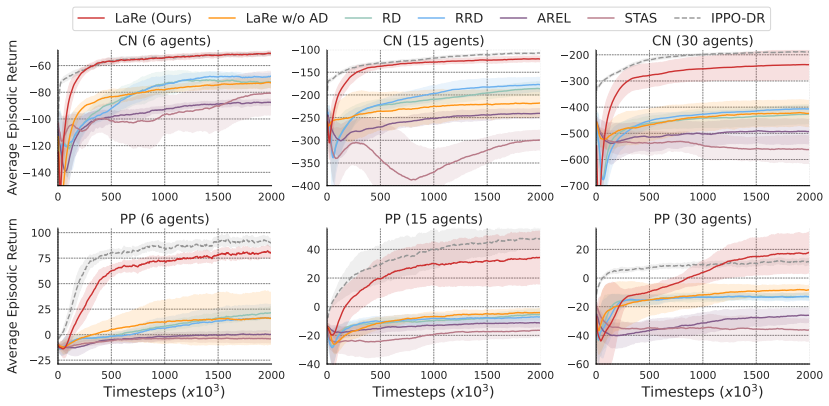
On its own terms, the paper's discovery is that a low-dimensional, semantically interpretable encoding of state-action information—the latent reward, written as $\mathbf{z}_r = \varphi(s,a)$—can carry the episodic reward decomposition, and that a large language model can supply that encoding as executable code without task-specific training. The paper formalizes the episodic reward as integrated over step rewards $r_t$ and latent rewards $\mathbf{z}_{r,t}$ with a decoder $f$ and an encoder $\varphi$, and proves that when the latent space has dimension $\|\mathbb{D}\| < \|\mathcal{S}\|\,\|\mathcal{A}\|$ and a function $f^*$ exists with $r = f^*(\varphi(s,a))$, the concentration bound on reward estimation and the regret bound both shrink by replacing the raw state-action space with the latent space. Empirically, LaRe is reported to beat state-of-the-art return-decomposition baselines on MuJoCo locomotion, MPE cooperative and competitive tasks, SMAC maps, and a novel task, and to match or exceed dense-reward policies where the latent reward's facets capture stability and safety that the ground-truth reward ignores.
Load-bearing premise
The argument rests on the assumption that the LLM-generated latent reward function keeps everything needed to predict the true step rewards while discarding only irrelevant details; if it omits a reward-relevant feature, the tighter theoretical bounds no longer apply and the empirical advantage has no supporting guarantee.
Editorial extensions
If this is right
- Episodic reward decomposition no longer has to start from raw state vectors; any task expressible in symbolic observations can get an LLM-written encoder that compresses the state before reward regression.
- The framework is agnostic to the choice of reinforcement learning backbone, so the latent reward can be dropped into TD3, SAC, DDPG, PPO, IPPO, or QMIX without changing the policy learner.
- In multi-agent settings the same mechanism assigns credit across agents, not just across time, which the paper shows is decisive in cooperative and competitive tasks.
- When the ground-truth reward misses factors such as stability or safety, latent rewards can encode those factors and yield policies that outperform dense-reward training, suggesting that the reward signal, not just the learning algorithm, limits current reinforcement learning.
Reading between the lines
- Editorial inference: beating dense ground-truth rewards on some tasks implies those benchmark rewards are misspecified relative to the intended objective; LaRe is implicitly doing reward design, not just redistribution, and this should be tested by evaluating final policies under a held-out task-success metric rather than the training reward.
- Editorial inference: the theory's benefit is conditional on $\varphi$ preserving all reward-relevant information; a practical validation would be to fit $f^*$ on a dense sample and check whether $r = f^*(\varphi(s,a))$ holds, since the paper does not verify this for its LLM-generated encoders.
- Editorial inference: the same code-as-bridge recipe should transfer to image observations using a vision-language model that emits object-level symbolic features, and to offline episodic reinforcement learning where replay data is fixed.
Signed reviews
Editorial analysis
A structured set of objections, weighed in public.
Referee Report
Summary. The paper proposes LaRe, an episodic-RL credit-assignment method in which an LLM-generated, executable function φ maps state-action pairs into a low-dimensional 'latent reward' vector; a learned decoder f_ψ redistributes the episodic return as proxy rewards, and these proxy rewards are used by any base RL algorithm. Self-prompting over n candidate responses and pre-verification of code executability are introduced to stabilize LLM inference. The analysis claims that, under an exact representability assumption r = f*(φ(s,a)) with ‖D‖ < ‖S‖‖A‖, replacing raw state-action features by φ yields tighter concentration and regret bounds (Propositions 1 and 2). Experiments on MuJoCo, MPE, SMAC, and a newly designed Triangle Area task compare LaRe with return-decomposition and multi-agent baselines and with dense-reward training, reporting consistent improvements across five seeds.
Significance. If the claims hold, LaRe is a practically useful and transferable way to inject LLM priors into episodic RL: it is algorithm-agnostic, applicable to single- and multi-agent settings, requires no per-task training of the encoder, and the released code together with five-seed evaluations across six benchmarks give the empirical claims unusual breadth. The newly designed Triangle Area task and the self-verification mechanism are also genuine strengths. The theoretical contribution, however, is conditional and inherits essentially all of its content from Efroni et al. (2021); the novelty rests on the unverified assumption that the LLM-produced φ is exactly reward-sufficient, so the significance of the theory depends on whether that assumption can be checked or relaxed.
major comments (3)
- [Analysis, before Proposition 1; Eq. (5); Table 1] The theoretical claims are conditional on the assumption that there exists f* with r = f*(φ(s,a)) and ‖D‖ < ‖S‖‖A‖, but the paper never verifies this exact representability condition for the LLM-generated φ that LaRe actually uses. Equation (5) checks only that φ is executable on pre-collected random state-action pairs, and the Pearson correlations in Table 1 do not rule out collisions, i.e., two state-action pairs with different rewards mapped to the same latent vector; if such collisions exist, the concentration and regret bounds in Propositions 1 and 2 do not apply to the actual encoder. I recommend adding a direct sufficiency check (for example, measuring residual reward variance conditional on φ, or quantifying reward-label collisions in φ on a large collected sample) or explicitly reframing the theory as conditional on a property that the empirical component supports only approximately.
- [Analysis, Propositions 1 and 2; Appendix B] These results are direct restatements of Efroni, Merlis, and Mannor (2021) with ‖S‖‖A‖ replaced by ‖D‖; once the assumption r = f*(φ(s,a)) is granted, the tighter bound follows by construction because ‖D‖ < ‖S‖‖A‖. The manuscript should state this inheritance more transparently and should not present the inequality as an independently established theoretical advantage. The sole load-bearing novelty is the assumed existence of such a φ, and that is exactly the part of the argument that the paper does not verify.
- [Appendix B, proof of Proposition 1 (definition of η_k)] The proof introduces a 'noisy version' ar r of the reward function and asserts that η_k = Σ_t (ar r(z_{k,t}) - r(z_{k,t})) is √(T/4)-sub-Gaussian as a centered sum of T conditionally independent [0,1]-bounded variables, but the data-generating process for ar r and the filtration are not specified sufficiently to derive this conditional independence. In the main text's episodic setting, R(τ) = Σ_t r(s_t,a_t) with a deterministic r, in which case η_k is zero unless an auxiliary stochastic reward model is assumed. Please clarify the stochastic model and either justify the conditional sub-Gaussian claim or state the bound only for stochastic rewards that satisfy that condition.
minor comments (5)
- [Eq. (5) and surrounding text] The notation is inconsistent: the text says φ takes a state-action pair (s,a), but Eq. (5) writes z_r = φ(s); please correct the argument list.
- [Appendix C, Baseline implementations] There is a typo, 'we repreduced Diaster', which should be 'we reproduced Diaster'.
- [Appendix D, Triangle Area] The sentence 'LaRe achieves superior performance compared to the baselines and is comparible with IPPO trained with dense rewards, , consistent with the main results' contains two typos ('comparible' and a doubled comma).
- [Appendix C, Task descriptions] In the Walker2d-v4 description, 'walk in the in the forward direction' contains a duplicated phrase; also, 'ground true rewards' appears in the main text and should be 'ground-truth rewards'.
- [Table 1] The header 'exerate' is unclear; it should be 'execution rate' or 'exe rate' with a space, and the table caption would benefit from defining what the percentage refers to.
Circularity Check
No significant circularity: LaRe's theoretical bounds are conditional corollaries of Efroni et al. (2021), and the unverified representability of phi is an assumption gap, not an input-output equivalence.
full rationale
The Analysis section explicitly frames Propositions 1 and 2 as built on Efroni, Merlis, and Mannor (2021): it assumes a latent reward phi with exists f* such that r = f*(phi(s,a)) and ||D|| < ||S||||A||, then substitutes ||D|| into the existing concentration and regret bounds. That is a valid conditional derivation, not a circular one: the assumption is a premise, not a fitted parameter or a definition of the conclusion. The paper does not verify that the LLM-generated phi is reward-sufficient--Eq. (5) only checks executability and Table 1 reports Pearson correlations, which do not imply Var(r|phi)=0--but this is a missing-support/correctness caveat, not a circular step. The self-citation to Wang et al. (2024) for the code-bridging rationale is not load-bearing because LaRe independently measures executability (Table 1) and its end-to-end performance against external baselines. Propositions 1 and 2 are derivative statements of an external theorem rather than renamed predictions whose inputs were fitted to their outputs, so no circularity is established.
Assumptions & free parameters
free parameters (2)
- Latent reward dimension ∥D∥ =
varies per task; LLM output (e.g., 5-6 factors)
- Number of candidate responses n =
5
assumptions (6)
- standard math Abbasi-Yadkori et al. (2011) Theorem 2 (linear bandit concentration bound)
- standard math Efroni et al. (2021) Lemma 8 (occupancy-measure regret bound)
- domain assumption Episodic rewards decompose as R(τ)=Σ_t r(s_t,a_t)
- ad hoc to paper There exists a latent reward function φ with ∥D∥<∥S∥∥A∥ and some f* such that r=f*(φ(s,a))
- ad hoc to paper The noise η_k is √(T/4)-sub-Gaussian as a centered sum of T conditionally independent [0,1]-bounded variables
- domain assumption Finite cardinalities ∥S∥, ∥A∥, ∥D∥ for the MDP spaces
invented entities (1)
-
Latent reward z_r
Cite this review
Pith. "Pith review of Latent Reward: LLM-Empowered Credit Assignment in Episodic Reinforcement Learning." pith.science (2026). https://pith.science/paper/EF3YWF7V
@misc{pith2026241211120,
  author       = {Pith},
  title        = {Pith review of: Latent Reward: LLM-Empowered Credit Assignment in Episodic Reinforcement Learning},
  year         = {2026},
  howpublished = {\url{https://pith.science/paper/EF3YWF7V}},
  note         = {Machine review of arXiv:2412.11120}
}
read the original abstract
Reinforcement learning (RL) often encounters delayed and sparse feedback in real-world applications, even with only episodic rewards. Previous approaches have made some progress in reward redistribution for credit assignment but still face challenges, including training difficulties due to redundancy and ambiguous attributions stemming from overlooking the multifaceted nature of mission performance evaluation. Hopefully, Large Language Model (LLM) encompasses fruitful decision-making knowledge and provides a plausible tool for reward redistribution. Even so, deploying LLM in this case is non-trivial due to the misalignment between linguistic knowledge and the symbolic form requirement, together with inherent randomness and hallucinations in inference. To tackle these issues, we introduce LaRe, a novel LLM-empowered symbolic-based decision-making framework, to improve credit assignment. Key to LaRe is the concept of the Latent Reward, which works as a multi-dimensional performance evaluation, enabling more interpretable goal attainment from various perspectives and facilitating more effective reward redistribution. We examine that semantically generated code from LLM can bridge linguistic knowledge and symbolic latent rewards, as it is executable for symbolic objects. Meanwhile, we design latent reward self-verification to increase the stability and reliability of LLM inference. Theoretically, reward-irrelevant redundancy elimination in the latent reward benefits RL performance from more accurate reward estimation. Extensive experimental results witness that LaRe (i) achieves superior temporal credit assignment to SOTA methods, (ii) excels in allocating contributions among multiple agents, and (iii) outperforms policies trained with ground truth rewards for certain tasks.
Figures


Figures from the paper (11 more)


Forward citations
Cited by 1 Pith paper
-
TRACE: Turn-level Reward Assignment via Credit Estimation for Long-Horizon Agents
Turn-level rewards from TD changes in a frozen reference model's gold-answer log-probability improve long-horizon search-agent RL on closed- and open-web benchmarks.
Reference graph
Works this paper leans on
-
[1]
Do not use information you are not given!
-
[2]
Focus on the most relevant evaluation factors and use information in observation as little as possible
-
[3]
arXiv preprint arXiv:2201.04612
Agent-temporal attention for reward redistribution in episodic multi-agent reinforcement learning. arXiv preprint arXiv:2201.04612. Yao, S.; Zhao, J.; Yu, D.; Du, N.; Shafran, I.; Narasimhan, K.; and Cao, Y . 2022. React: Synergizing reasoning and act- ing in language models. arXiv preprint arXiv:2210.03629. Yu, C.; Velu, A.; Vinitsky, E.; Gao, J.; Wang, ...
arXiv 2022
-
[4]
Avoid dividing by zero!
-
[5]
The input variable is in the form of (batch size, dim), please return a list of several evaluation factor arrays, each in the form of (batch size, 1). Please think step by step and adhere to the following JSON format (just replace the () with your answer): { Understand: (your thought about the task), Analyze: (think step by step and analyze potential posi...
-
[6]
The code should be generic, complete and not contain omissions!
-
[9]
The elevation of the torso (to see if the robot is standing)
-
[10]
The angles and angular velocities of the torso and limbs (to check for stability)
Show all 12 references
-
[11]
Reward Design
The direction and magnitude of torques (to ensure control and safety). Positive behaviors include the torso being at a higher position (indicating standing), angular velocities being small (indicating stability), and torques being within safe limits. Negative behaviors include...
2021
-
[500]
As shown in Fig
and used f inaltravel distance as the evaluation metric. As shown in Fig. 14, we compared LaRe against baseline methods and demonstrated that LaRe outperforms them. This superior performance may be attributed to the stronger correla- tion between latent rewards and task comple...
2000
-
[2022]
In ICML, 17156–17185
History compression via language models in rein- forcement learning. In ICML, 17156–17185. PMLR. Pathak, D.; Agrawal, P.; Efros, A. A.; and Darrell, T. 2017. Curiosity-driven exploration by self-supervised prediction. In ICML. Patil, V . P.; Hofmarcher, M.; Dinu, M.-C.; Dorfer...
2017 arXiv
-
[2023]
arXiv preprint arXiv:2309.06687
Self-Refined Large Language Model as Automated Reward Function Designer for Deep Reinforcement Learn- ing in Robotics. arXiv preprint arXiv:2309.06687. Su, J.; and Zhang, Q. 2023. Subgoal Proposition Using a Vision-Language Model. In CoRL Workshop on LEAP. Sutton, R. S.; Moday...
2023 arXiv
Reviewed August 11, 2026 · model on record in the stance chip above.
Discussion (0). Continue with ORCID to comment.