REVIEW 3 major objections 5 minor 52 references
Precise, Fast, and Low-cost Concept Erasure in Value Space: Orthogonal Complement Matters
T0 review · 3 major / 5 minor · reviewed 2026-08-11 · deepseek-v4-flash
Pith's one-line read A single projection erases a concept from a diffusion model with no retraining.
desk verdict A solid, training-free value-space projection for concept erasure that mostly works on literal token concepts, with an honest failure case when the concept is spread across other tokens. read the letter →
The pith
A machine-rendered reading of the paper's core claim, the machinery that carries it, and where it could break.
The reading
What carries the argument
The central object is the orthogonal-complement projection in cross-attention value space, $P_{\mathrm{span}^\perp(v_t^j)} v^j = v^j - \frac{v_t^{j\top} v^j}{v_t^{j\top} v_t^j} v_t^j$, applied token-wise in every cross-attention layer of the denoising UNet. This is paired with an adaptive erasing shift $\delta(x,y) = \frac{s}{1 + e^{-p(\cos(x,y)-\epsilon)}}$ with $0<\epsilon<1$, $s>0$, $p>0$, which dampens erasure when the prompt token's value vector is only weakly or generally related to the target. Token-wise target preprocessing duplicates the last subject token of the concept across all non-[SOT] positions, exploiting the causal CLIP text encoder so that one vector summarizes the whole target phrase. For multiple concepts, Gram-Schmidt orthogonalization produces a basis of the joint span and the projection subtracts each basis component, shifted per target. The mechanism works through the attention-matrix output: replacing V before the softmax-weighted aggregation redirects generation away from target semantics without altering the layout-controlling keys.
What would settle it
Regenerate "a photo of a teddy bear and a Snoopy doll" with the same seed before and after erasing "Snoopy", then compare the teddy-bear region with a detector or pixel distance: if the non-target object's pose or appearance changes noticeably, the projection is removing components beyond the target direction, contradicting the claimed prior preservation.
Extended reading notes
Core claim
AdaVD erases concept semantics directly in the value space of the UNet's cross-attention layers, on the view that values carry the "what" of generated content. For each token position j, the prompt's value vector $v_j$ is replaced by $v_j^r = v_j - \delta(v_t^j, v_j) \, \frac{v_t^{j\top} v_j}{v_t^{j\top} v_t^j} \, v_t^j$, where $v_t^j$ comes from a target embedding whose tokens are all replaced by the duplicated last subject token of the target concept and the [SOT] position is left untouched. The shift factor $\delta$ is a sigmoid of the cosine similarity between prompt and target value vectors, so strongly aligned tokens are erased while weak or general alignments are retained. Multi-concept erasure projects onto the orthogonal complement of the span of all target value vectors, using Gram-Schmidt orthogonalization. Applied layer-by-layer, this is reported to remove the target with minimal change to non-target priors, and to transfer to SDXL, SDv3, and community diffusion models with no retraining.
Load-bearing premise
The load-bearing premise is that a target concept is faithfully represented by the value vector of its duplicated last-subject token, and that prompt semantics decompose linearly enough that removing that one direction leaves non-target content intact; the paper's own failure case of "Van Gogh" coupled with "Starry Night" shows this premise does not always hold.
Editorial extensions
If this is right
- New concepts can be erased at inference time in tens of seconds, with no per-concept fine-tuning, making real-time moderation of emerging unsafe or copyrighted content practical.
- Erasing several concepts together does not degrade into catastrophic forgetting: the paper demonstrates consistent erasure and prior preservation when the target set grows to 40 concepts.
- The same value-space projection transfers across model families, including SDXL, SDv3, and community fine-tunes, without changing the erasure procedure.
- The operation doubles as an editing primitive: implicit concepts such as rainy or foggy, appearance attributes such as glasses or mustache, and coupled color attributes such as red on apples and roses can be suppressed by the same projection.
- NSFW erasure is handled through the same mechanism, with roughly 85% of detected nude items removed on the I2P benchmark while non-target content stays close to the original.
Reading between the lines
- If the value-space disentanglement is as clean as reported, attention-map editing could be reformulated as value projection, offering a unified algebra for concept editing, style transfer, and attribute suppression.
- The failure case of "Van Gogh" with "Starry Night" suggests the single-direction assumption breaks when a target is entangled with another multi-token phrase; a natural extension is to erase along the principal component of the span of all coupled tokens rather than the duplicated last-subject token alone.
- The paper leaves the layer-wise accumulation unanalyzed; a testable prediction is that applying the projection only in early or only in late cross-attention layers produces measurably different trade-offs between erasure and prior preservation.
- Because the shift factor thresholds on cosine similarity, per-layer or per-timestep epsilon schedules could reduce the small pixel drift that accumulates as the number of erased concepts grows.
Editorial analysis
A structured set of objections, weighed in public.
Referee Report
Summary. The paper proposes AdaVD, a training-free concept-erasure method for text-to-image diffusion models. The method pre-processes a target-concept prompt by duplicating the last subject token, computes the value matrix of this modified embedding in each cross-attention layer, and projects the prompt's value vectors onto the orthogonal complement of the target value vectors (Eqs. 2 and 3). A sigmoid shift factor (Eq. 6) modulates the projection strength token-wise. The authors evaluate single- and multi-concept erasure of instances, art styles, celebrities, and NSFW content on SD v1.4 and several other model versions, reporting strong erasure efficacy and 2 to 10 times FID improvement over baselines.
Significance. If the central claims hold, the method is practically valuable: it is training-free, simple, fast, and appears to transfer to SDXL, SDv3, and community SD models. The orthogonal-complement derivation is standard and clearly presented, and the experiments cover a wide range of concepts and baselines, including a concurrent orthogonal-decomposition method. The main risk is that the strong prior-preservation numbers are substantially produced by the conservative cosine threshold rather than by genuine semantic disentanglement, and Appendix H shows that the token-duplication premise breaks when the target concept is expressed through multiple coupled tokens. With those points addressed, the method would be a solid contribution.
major comments (3)
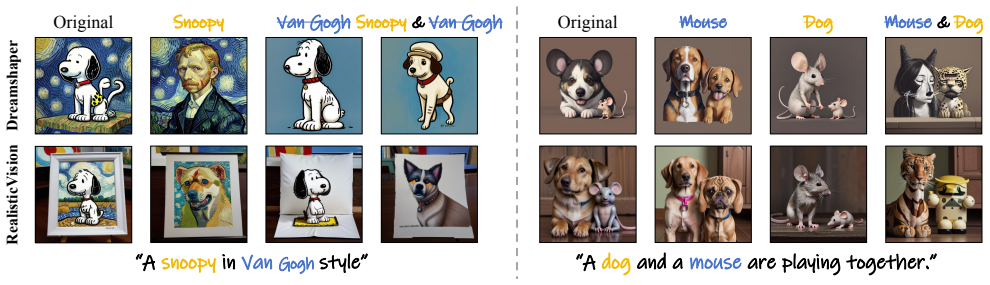
- [Sec. 3.2, Eq. (1), and Appendix H] The method's central premise is that the target concept is concentrated in the duplicated last-subject token's value vector and that projecting against this vector erases the concept. Appendix H directly contradicts this for 'Van Gogh' in the prompt 'The Starry Night is an iconic example of a masterpiece created in Van Gogh style': the default setting s=2 fails because other tokens such as 'Starry Night' are highly coupled with the target. This means the method erases the literal duplicated token, not the concept in general, unless the user manually adds additional target tokens or raises s. The abstract and introduction claim concept-level erasure; the paper should either qualify the claim to token-localized erasure or incorporate the Appendix H remedy automatically.
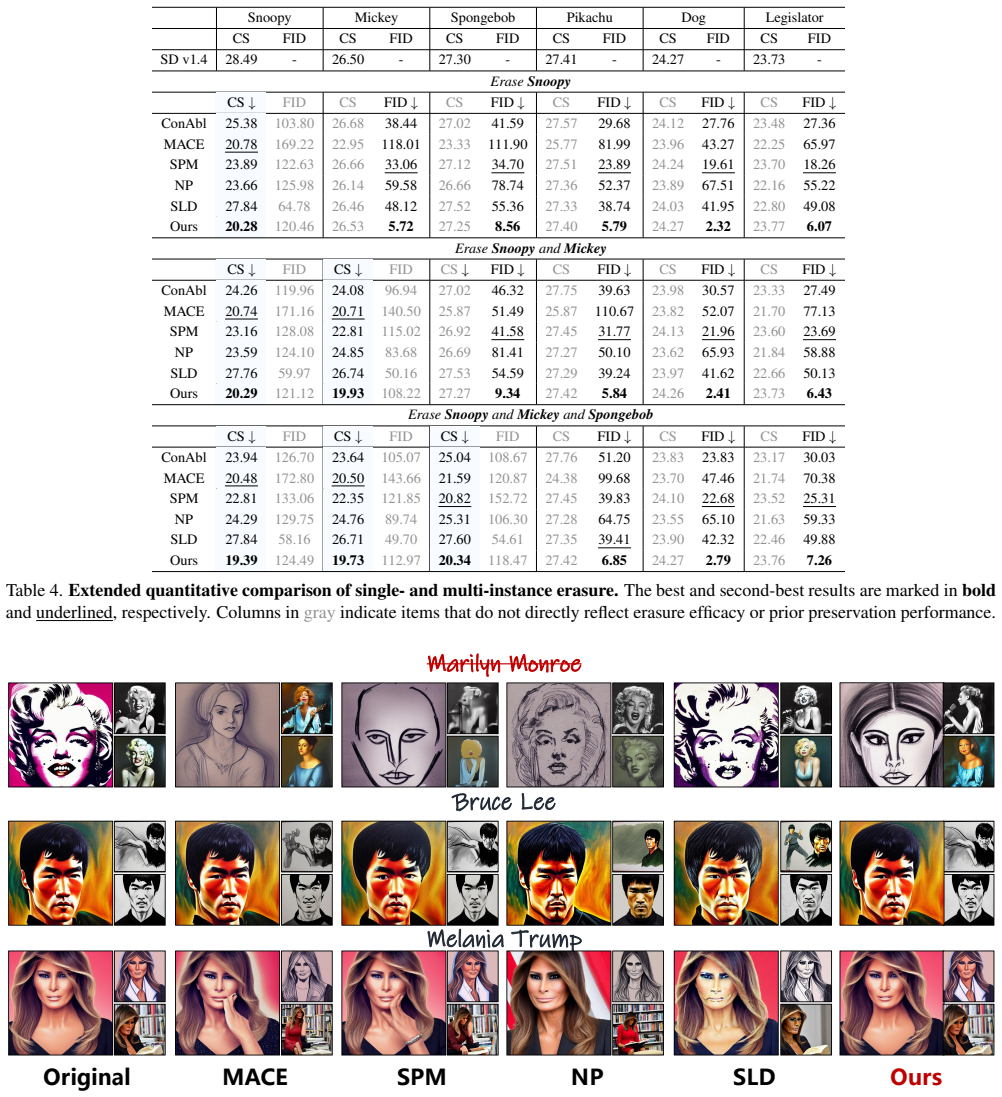
- [Sec. 3.4, Eq. (6), and Appendix C.2] The shift factor with epsilon=0.93 effectively disables erasure for any token pair whose cosine similarity is below 0.93; for the reported non-target concept 'Mickey' versus the target 'Snoopy', the cosine is 0.65, giving a shift factor of about 0.002, so no modification occurs by construction. The 2-10x FID improvement over baselines on non-target prompts is therefore partly a consequence of the hand-set threshold rather than evidence that the orthogonal complement separates target and non-target semantics in value space. To support the disentangling claim, the authors should ablate epsilon, for example by reporting FID and erasure CLIP scores at a matched erasure strength, and should show that low FID persists when erasure is actually applied to the non-target tokens.
- [Sec. 4.1 and Tables 1-6] All quantitative comparisons use 10 images per template and a single seed, and no error bars or significance tests are reported. Many of the claimed advantages are large, but some close comparisons, such as Table 2 'Erase Van Gogh' target CS (SPM 24.78 versus Ours 24.87), would be more convincing with confidence intervals or multiple seeds. Because prior-preservation FID is the paper's headline claim, the absence of variance estimates is a load-bearing gap in the empirical support.
minor comments (5)
- [Sec. 1, contribution bullet] The fourth contribution bullet contains a typo: 'AdaV A' should be 'AdaVD'.
- [Sec. 4.2] The text states that AdaVD's FID is 33% lower than the second-best method, but from Table 1, for 'Dog' after erasing 'Snoopy', Ours is 2.32 versus SPM's 19.61, which is about 88% lower; please verify the stated percentage or specify which comparison is intended.
- [Appendix C.2] The hyperparameter analysis is qualitative only; reporting the corresponding CS and FID values for the settings shown in Fig. 8 would make it more informative and would strengthen the claim that the chosen default hyperparameters are robust.
- [Tables 4-6] The gray columns are said not to directly reflect erasure efficacy or prior preservation; consider moving them to a supplement or explaining their role more explicitly in the captions to avoid confusion.
- [Fig. 8 and Sec. 3.4] Because the threshold behavior is central to the method, Figure 8 would benefit from explicitly listing the cosine similarities for the analyzed target/non-target token pairs.
Circularity Check
No significant circularity: AdaVD's value-space orthogonal-complement projection is an empirical intervention with fixed hyperparameters; the only self-citations are background, and the Appendix H failure is a robustness limitation, not a circular derivation.
full rationale
AdaVD's derivation chain is not circular. The erasing operation in Eqs. (2) and (4) explicitly projects each prompt token's value vector onto the orthogonal complement of the target token's value vector, scaled by a sigmoid shift factor; the target direction comes from the duplicated last-subject token in Eq. (1). No parameter is fitted to the reported metrics: Appendix C.1 fixes 'p = 100, ε = 0.93, and s = 2' as a unified configuration, and Appendix C.2 analyzes the resulting trade-off as hyperparameter behavior rather than as a learned prediction. Erasure efficacy and prior preservation are evaluated with external CLIP and FID metrics against generation outputs, not read off from the erased value vectors by construction. The load-bearing premises—values as the 'What' pathway [45], angular information as semantically critical [32], and the last subject token containing key information [28]—are cited from external prior work, not from the authors' own papers. The only self-citations ([22], [23]) appear in the introduction as examples of copyright/offensiveness concerns and are not load-bearing. Appendix H is an honest limitation: 'the challenge is likely to stem from the presence of multiple tokens, e.g., Starry Night, that is highly coupled with the target concept,' and the fix is to increase s or add related target tokens. This shows the duplicated-token premise is empirically contingent and sometimes fails, which is a correctness/robustness concern, not evidence that the method's output is equivalent to its input. The claim that prior preservation improves 2-10x is also a designed consequence of the high cosine threshold (δ≈0 for low-cosine tokens), but the FID numbers are non-zero and are measured against external baselines, so this is intended behavior rather than tautology. I therefore find no significant circularity and assign score 0.
Assumptions & free parameters
free parameters (3)
- epsilon (cosine threshold) =
0.93
- s (scale) =
2
- p (steepness) =
100
assumptions (4)
- domain assumption Cross-attention value vectors control visual content (the 'what' pathway), while keys control layout.
- domain assumption The last subject token of a CLIP-encoded concept embedding captures sufficient concept information.
- domain assumption Value vectors of different target concepts are linearly independent.
- domain assumption Angular (cosine) similarity between value vectors reflects semantic relevance.
Cite this review
Pith. "Pith review of Precise, Fast, and Low-cost Concept Erasure in Value Space: Orthogonal Complement Matters." pith.science (2026). https://pith.science/paper/EFCDV2AP
@misc{pith2026241206143,
  author       = {Pith},
  title        = {Pith review of: Precise, Fast, and Low-cost Concept Erasure in Value Space: Orthogonal Complement Matters},
  year         = {2026},
  howpublished = {\url{https://pith.science/paper/EFCDV2AP}},
  note         = {Machine review of arXiv:2412.06143}
}
read the original abstract
Recent success of text-to-image (T2I) generation and its increasing practical applications, enabled by diffusion models, require urgent consideration of erasing unwanted concepts, e.g., copyrighted, offensive, and unsafe ones, from the pre-trained models in a precise, timely, and low-cost manner. The twofold demand of concept erasure includes not only a precise removal of the target concept (i.e., erasure efficacy) but also a minimal change on non-target content (i.e., prior preservation), during generation. Existing methods face challenges in maintaining an effective balance between erasure efficacy and prior preservation, and they can be computationally costly. To improve, we propose a precise, fast, and low-cost concept erasure method, called Adaptive Value Decomposer (AdaVD), which is training-free. Our method is grounded in a classical linear algebraic operation of computing the orthogonal complement, implemented in the value space of each cross-attention layer within the UNet of diffusion models. We design a shift factor to adaptively navigate the erasure strength, enhancing effective prior preservation without sacrificing erasure efficacy. Extensive comparative experiments with both training-based and training-free state-of-the-art methods demonstrate that the proposed AdaVD excels in both single and multiple concept erasure, showing 2 to 10 times improvement in prior preservation than the second best, meanwhile achieving the best or near best erasure efficacy. AdaVD supports a series of diffusion models and downstream image generation tasks, with code available on: https://github.com/WYuan1001/AdaVD.
Figures


Figures from the paper (15 more)





Reference graph
Works this paper leans on
-
[1]
https : / / huggingface.co/CompVis/stable-diffusion- safety-checker, 2022
Safety checker nested in stable diffusion. https : / / huggingface.co/CompVis/stable-diffusion- safety-checker, 2022. 3
work page 2022
-
[2]
Stable diffusion. https : / / huggingface . co / CompVis/stable-diffusion-v1-4 , 2022. 2, 3, 6
work page 2022
-
[3]
https://huggingface.co/ stabilityai/stable-diffusion-2, 2022
Stable diffusion v2.0. https://huggingface.co/ stabilityai/stable-diffusion-2, 2022. 2
work page 2022
-
[4]
https://huggingface.co/ stabilityai/stable-diffusion-2-1 , 2022
Stable diffusion v2.1. https://huggingface.co/ stabilityai/stable-diffusion-2-1 , 2022. 8
work page 2022
-
[5]
Chilloutmix. https : / / huggingface . co / swl - models/chilloutmix, 2023. 1, 8, 19
work page 2023
-
[6]
https://huggingface.co/Lykon/ DreamShaper, 2023
Dreamshaper. https://huggingface.co/Lykon/ DreamShaper, 2023. 1, 8, 19, 22
work page 2023
-
[7]
Realisticvsion. https : / / huggingface . co / SG161222 / Realistic _ Vision _ V5 . 1 _ noVAE ,
-
[8]
Nudenet: Neural nets for nudity detec- tion and censoring, 2022
Praneeth Bedapudi. Nudenet: Neural nets for nudity detec- tion and censoring, 2022. URL https://github. com/notAI- tech/NudeNet. 2
work page 2022
Show all 52 references
-
[9]
Multimodal datasets: misogyny, pornography, and ma- lignant stereotypes
Abeba Birhane, Vinay Uday Prabhu, and Emmanuel Kahem- bwe. Multimodal datasets: misogyny, pornography, and ma- lignant stereotypes. arXiv preprint arXiv:2110.01963, 2021. 2
2021 arXiv
-
[10]
Extracting training data from diffu- sion models
Nicolas Carlini, Jamie Hayes, Milad Nasr, Matthew Jagiel- ski, Vikash Sehwag, Florian Tramer, Borja Balle, Daphne Ip- polito, and Eric Wallace. Extracting training data from diffu- sion models. In 32nd USENIX Security Symposium (USENIX Security 23), pages 5253–5270, 2023. 2
2023
-
[11]
Diffusion models beat gans on image synthesis
Prafulla Dhariwal and Alexander Nichol. Diffusion models beat gans on image synthesis. Advances in neural informa- tion processing systems, 34:8780–8794, 2021. 2
2021
-
[12]
Erasing concepts from diffusion models
Rohit Gandikota, Joanna Materzynska, Jaden Fiotto- Kaufman, and David Bau. Erasing concepts from diffusion models. In Proceedings of the IEEE/CVF International Con- ference on Computer Vision, pages 2426–2436, 2023. 2, 3, 6
2023
-
[13]
Unified concept editing in diffusion models
Rohit Gandikota, Hadas Orgad, Yonatan Belinkov, Joanna Materzy´nska, and David Bau. Unified concept editing in diffusion models. In Proceedings of the IEEE/CVF Win- ter Conference on Applications of Computer Vision , pages 5111–5120, 2024. 3
2024
-
[14]
Selective amnesia: A contin- ual learning approach to forgetting in deep generative mod- els
Alvin Heng and Harold Soh. Selective amnesia: A contin- ual learning approach to forgetting in deep generative mod- els. Advances in Neural Information Processing Systems, 36,
-
[15]
Prompt-to-prompt image editing with cross-attention control
Amir Hertz, Ron Mokady, Jay Tenenbaum, Kfir Aberman, Yael Pritch, and Daniel Cohen-or. Prompt-to-prompt image editing with cross-attention control. In The Eleventh Inter- national Conference on Learning Representations. 3
-
[16]
Gans trained by a two time-scale update rule converge to a local nash equilib- rium
Martin Heusel, Hubert Ramsauer, Thomas Unterthiner, Bernhard Nessler, and Sepp Hochreiter. Gans trained by a two time-scale update rule converge to a local nash equilib- rium. Advances in neural information processing systems , 30, 2017. 6
2017
-
[17]
Classifier-free diffusion guidance
Jonathan Ho and Tim Salimans. Classifier-free diffusion guidance. In NeurIPS 2021 Workshop on Deep Generative Models and Downstream Applications. 2, 3, 6
2021
-
[18]
Denoising dif- fusion probabilistic models
Jonathan Ho, Ajay Jain, and Pieter Abbeel. Denoising dif- fusion probabilistic models. Advances in neural information processing systems, 33:6840–6851, 2020. 2
2020
-
[19]
Auto-encoding variational bayes
Diederik P Kingma. Auto-encoding variational bayes. arXiv preprint arXiv:1312.6114, 2013. 3
2013 arXiv
-
[20]
Ablating con- cepts in text-to-image diffusion models
Nupur Kumari, Bingliang Zhang, Sheng-Yu Wang, Eli Shechtman, Richard Zhang, and Jun-Yan Zhu. Ablating con- cepts in text-to-image diffusion models. In Proceedings of the IEEE/CVF International Conference on Computer Vi- sion, pages 22691–22702, 2023. 2, 3, 6
2023
-
[21]
Deep nn for nsfw detection
Gant Laborde. Deep nn for nsfw detection. 2
-
[22]
Improving synthetic image detection to- wards generalization: An image transformation perspective
Ouxiang Li, Jiayin Cai, Yanbin Hao, Xiaolong Jiang, Yao Hu, and Fuli Feng. Improving synthetic image detection to- wards generalization: An image transformation perspective. arXiv preprint arXiv:2408.06741, 2024. 2
2024 arXiv
-
[23]
Model inversion attacks through target-specific conditional diffusion models
Ouxiang Li, Yanbin Hao, Zhicai Wang, Bin Zhu, Shuo Wang, Zaixi Zhang, and Fuli Feng. Model inversion attacks through target-specific conditional diffusion models. arXiv preprint arXiv:2407.11424, 2024. 2
2024 arXiv
-
[24]
Get what you want, not what you don’t: Image content suppression for text-to-image diffusion mod- els
Senmao Li, Joost van de Weijer, Fahad Khan, Qibin Hou, Yaxing Wang, et al. Get what you want, not what you don’t: Image content suppression for text-to-image diffusion mod- els. In The Twelfth International Conference on Learning Representations. 2, 3, 6, 21
-
[25]
Dpm-solver: A fast ode solver for diffusion probabilistic model sampling in around 10 steps
Cheng Lu, Yuhao Zhou, Fan Bao, Jianfei Chen, Chongxuan Li, and Jun Zhu. Dpm-solver: A fast ode solver for diffusion probabilistic model sampling in around 10 steps. Advances in Neural Information Processing Systems , 35:5775–5787,
-
[26]
Mace: Mass concept erasure in diffu- sion models
Shilin Lu, Zilan Wang, Leyang Li, Yanzhu Liu, and Adams Wai-Kin Kong. Mace: Mass concept erasure in diffu- sion models. In Proceedings of the IEEE/CVF Conference on Computer Vision and Pattern Recognition , pages 6430– 6440, 2024. 2, 3, 6
2024
-
[27]
One-dimensional adapter to rule them all: Concepts diffusion models and erasing applications
Mengyao Lyu, Yuhong Yang, Haiwen Hong, Hui Chen, Xuan Jin, Yuan He, Hui Xue, Jungong Han, and Guiguang Ding. One-dimensional adapter to rule them all: Concepts diffusion models and erasing applications. In Proceedings of the IEEE/CVF Conference on Computer Vision and Pattern R...
2024
-
[28]
Locating and editing factual associations in gpt
Kevin Meng, David Bau, Alex Andonian, and Yonatan Be- linkov. Locating and editing factual associations in gpt. Advances in Neural Information Processing Systems , 35: 17359–17372, 2022. 4
2022
-
[29]
Matrix analysis and applied linear algebra
Carl D Meyer. Matrix analysis and applied linear algebra . SIAM, 2023. 11
2023
-
[30]
Improved denoising diffusion probabilistic models
Alexander Quinn Nichol and Prafulla Dhariwal. Improved denoising diffusion probabilistic models. In International conference on machine learning, pages 8162–8171. PMLR,
-
[31]
Sdxl: Improving latent diffusion models for high-resolution image synthesis
Dustin Podell, Zion English, Kyle Lacey, Andreas Blattmann, Tim Dockhorn, Jonas M ¨uller, Joe Penna, and Robin Rombach. Sdxl: Improving latent diffusion models for high-resolution image synthesis. In The Twelfth Interna- tional Conference on Learning Representations. 1, 17
-
[32]
Controlling text-to-image diffusion by orthogo- nal finetuning
Zeju Qiu, Weiyang Liu, Haiwen Feng, Yuxuan Xue, Yao Feng, Zhen Liu, Dan Zhang, Adrian Weller, and Bernhard Sch¨olkopf. Controlling text-to-image diffusion by orthogo- nal finetuning. Advances in Neural Information Processing Systems, 36:79320–79362, 2023. 5
2023
-
[33]
Learning transferable visual models from natural language supervi- sion
Alec Radford, Jong Wook Kim, Chris Hallacy, Aditya Ramesh, Gabriel Goh, Sandhini Agarwal, Girish Sastry, Amanda Askell, Pamela Mishkin, Jack Clark, et al. Learning transferable visual models from natural language supervi- sion. In International conference on machine learning, ...
2021
-
[34]
Exploring the limits of transfer learning with a unified text-to-text transformer
Colin Raffel, Noam Shazeer, Adam Roberts, Katherine Lee, Sharan Narang, Michael Matena, Yanqi Zhou, Wei Li, and Peter J Liu. Exploring the limits of transfer learning with a unified text-to-text transformer. Journal of machine learning research, 21(140):1–67, 2020. 18
2020
-
[35]
Red-teaming the stable diffusion safety filter
Javier Rando, Daniel Paleka, David Lindner, Lennart Heim, and Florian Tram`er. Red-teaming the stable diffusion safety filter. arXiv preprint arXiv:2210.04610, 2022. 3
2022 arXiv
-
[36]
High-resolution image synthesis with latent diffusion models
Robin Rombach, Andreas Blattmann, Dominik Lorenz, Patrick Esser, and Bj ¨orn Ommer. High-resolution image synthesis with latent diffusion models. In Proceedings of the IEEE/CVF conference on computer vision and pattern recognition, pages 10684–10695, 2022. 2, 3
2022
-
[37]
U- net: Convolutional networks for biomedical image segmen- tation
Olaf Ronneberger, Philipp Fischer, and Thomas Brox. U- net: Convolutional networks for biomedical image segmen- tation. In Medical image computing and computer-assisted intervention–MICCAI 2015: 18th international conference, Munich, Germany, October 5-9, 2015, proceedings, pa...
2015
-
[38]
Patrick Schramowski, Christopher Tauchmann, and Kristian Kersting. Can machines help us answering question 16 in datasheets, and in turn reflecting on inappropriate content? In Proceedings of the 2022 ACM Conference on Fairness, Accountability, and Transparency, pages 1350–136...
2022
-
[39]
Safe latent diffusion: Mitigating inappro- priate degeneration in diffusion models
Patrick Schramowski, Manuel Brack, Bj ¨orn Deiseroth, and Kristian Kersting. Safe latent diffusion: Mitigating inappro- priate degeneration in diffusion models. In Proceedings of the IEEE/CVF Conference on Computer Vision and Pattern Recognition, pages 22522–22531, 2023. 1, 2, 3, 6
2023
-
[40]
Laion- 400m: Open dataset of clip-filtered 400 million image-text pairs
Christoph Schuhmann, Robert Kaczmarczyk, Aran Komat- suzaki, Aarush Katta, Richard Vencu, Romain Beaumont, Jenia Jitsev, Theo Coombes, and Clayton Mullis. Laion- 400m: Open dataset of clip-filtered 400 million image-text pairs. In NeurIPS Workshop Datacentric AI , number FZJ- ...
2022
-
[41]
Laion-5b: An open large-scale dataset for training next generation image-text models
Christoph Schuhmann, Romain Beaumont, Richard Vencu, Cade Gordon, Ross Wightman, Mehdi Cherti, Theo Coombes, Aarush Katta, Clayton Mullis, Mitchell Worts- man, et al. Laion-5b: An open large-scale dataset for training next generation image-text models. Advances in Neural In- f...
2022
-
[42]
Glaze: Protecting artists from style mimicry by {Text-to-Image} models
Shawn Shan, Jenna Cryan, Emily Wenger, Haitao Zheng, Rana Hanocka, and Ben Y Zhao. Glaze: Protecting artists from style mimicry by {Text-to-Image} models. In 32nd USENIX Security Symposium (USENIX Security 23) , pages 2187–2204, 2023. 2
2023
-
[43]
Im- proving image captioning with better use of captions
Zhan Shi, Xu Zhou, Xipeng Qiu, and Xiaodan Zhu. Im- proving image captioning with better use of captions. arXiv preprint arXiv:2006.11807, 2020. 2, 3
2006 arXiv
-
[44]
Diffusion art or digital forgery? investigating data replication in diffusion models
Gowthami Somepalli, Vasu Singla, Micah Goldblum, Jonas Geiping, and Tom Goldstein. Diffusion art or digital forgery? investigating data replication in diffusion models. In Pro- ceedings of the IEEE/CVF Conference on Computer Vision and Pattern Recognition, pages 6048–6058, 2023. 2
2023
-
[45]
Key-locked rank one editing for text-to-image personaliza- tion
Yoad Tewel, Rinon Gal, Gal Chechik, and Yuval Atzmon. Key-locked rank one editing for text-to-image personaliza- tion. In ACM SIGGRAPH 2023 Conference Proceedings , pages 1–11, 2023. 3
2023
-
[46]
Ring-a-bell! how reliable are concept removal methods for diffusion models? In The Twelfth International Conference on Learning Representations
Yu-Lin Tsai, Chia-Yi Hsu, Chulin Xie, Chih-Hsun Lin, Jia You Chen, Bo Li, Pin-Yu Chen, Chia-Mu Yu, and Chun- Ying Huang. Ring-a-bell! how reliable are concept removal methods for diffusion models? In The Twelfth International Conference on Learning Representations. 3
-
[47]
Attention is all you need
A Vaswani. Attention is all you need. Advances in Neural Information Processing Systems, 2017. 3
2017
-
[48]
Erasediff: Erasing data influence in diffusion models
Jing Wu, Trung Le, Munawar Hayat, and Mehrtash Harandi. Erasediff: Erasing data influence in diffusion models. arXiv preprint arXiv:2401.05779, 2024. 3
2024 arXiv
-
[49]
Mma-diffusion: Multimodal attack on diffusion models
Yijun Yang, Ruiyuan Gao, Xiaosen Wang, Tsung-Yi Ho, Nan Xu, and Qiang Xu. Mma-diffusion: Multimodal attack on diffusion models. In Proceedings of the IEEE/CVF Con- ference on Computer Vision and Pattern Recognition, pages 7737–7746, 2024. 3
2024
-
[50]
Ip- adapter: Text compatible image prompt adapter for text-to- image diffusion models
Hu Ye, Jun Zhang, Sibo Liu, Xiao Han, and Wei Yang. Ip- adapter: Text compatible image prompt adapter for text-to- image diffusion models. arXiv preprint arXiv:2308.06721,
-
[51]
Safree: Training-free and adaptive guard for safe text-to-image and video generation
Jaehong Yoon, Shoubin Yu, Vaidehi Patil, Huaxiu Yao, and Mohit Bansal. Safree: Training-free and adaptive guard for safe text-to-image and video generation. In The Thirteenth International Conference on Learning Representations . 3, 20
-
[52]
Mickey” exhibits a relatively large cosine similarity of 0.65 with the target concept “Snoopy
Lvmin Zhang, Anyi Rao, and Maneesh Agrawala. Adding conditional control to text-to-image diffusion models. In Proceedings of the IEEE/CVF International Conference on Computer Vision, pages 3836–3847, 2023. 2 A. Extra Preliminary on CA Layers The cross-attention (CA) layers in ...
2023
Reviewed August 11, 2026 · model on record in the stance chip above.
Discussion (0). Continue with ORCID to comment.