REVIEW 3 major objections 5 minor 26 references
ARIES-Mission2: A Zero-Shot Vision-Language-Action Framework for Fast Large-Scale Aerial Mission Generation
T0 review · 3 major / 5 minor · reviewed 2026-08-15 · deepseek-v4-flash
Pith's one-line read ARIES-Mission2 shows that separating VLM perception from TSP route optimization generates shorter drone missions than either raw VLA output or human planning, achieving 62.43 km over 30 tasks.
desk verdict Useful VLM+TSP systems combo, but the headline gains over human planning are unproven without target-set equivalence and error bars. read the letter →
The pith
A machine-rendered reading of the paper's core claim, the machinery that carries it, and where it could break.
The reading
What carries the argument
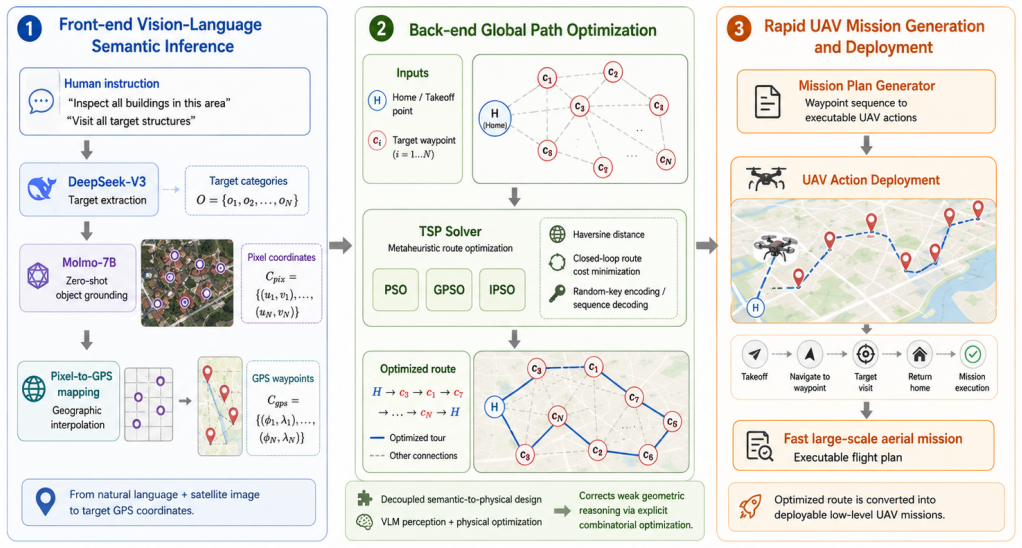
The load-bearing mechanism is the decoupled front-end/back-end architecture with an algorithmic competition selection rule. The front end chains DeepSeek-V3 (instruction parsing) with Molmo-7B (zero-shot target grounding) and maps pixel positions to GPS coordinates by linear interpolation using the image's geographic metadata. The back end formulates the waypoint set as a TSP whose objective is a closed-loop Haversine distance, then runs three particle-swarm variants—standard PSO, GPSO with a distance-based heuristic initialization and linearly decaying inertia weight, and IPSO with Tent-chaos initialization and Lévy-flight mutation—alongside the raw VLM order. The final route is simply the minimum-cost member of these four candidates, encoded as a MAVLink waypoint file locally. The mechanism's contribution is that the route optimization is fully decoupled from perception, so the optimizer's sub-second runtime (0.16 s/task) dwarfs the VLM inference time (19.02 s/task).
What would settle it
Count the targets the Molmo-7B pipeline detects per task and compare them with the benchmark's ground-truth waypoint set and with the waypoints the human planner visited. If on any task the VLM detects fewer or different waypoints, the reported 9.5% distance gain over human planning is an artifact of comparing different routes, not better planning.
Extended reading notes
Core claim
The paper's discovery is a workflow, not a new model: instead of asking a multimodal large language model to both locate targets and order them into a flight path, ARIES-Mission2 lets a language model parse the instruction, a vision model output pixel coordinates, and a deterministic geospatial interpolation convert those coordinates into GPS waypoints. It then treats the remaining multi-target traversal problem as a closed-loop Traveling Salesperson Problem over those waypoints, computes flight costs with the Haversine formula, and competes four candidate visiting orders—the raw VLM order plus routes from PSO, GPSO, and IPSO—selecting the shortest. The result is a 21.6% reduction in total flight distance relative to the pure VLA baseline and a 9.5% reduction relative to an experienced human planner, with the whole 30-task run taking about 575 seconds. The paper presents this as evidence that light metaheuristic optimization, not bigger models, is what closes the gap between semantic understanding and physically efficient flight.
Load-bearing premise
The comparisons assume the VLM detects exactly the same set of targets on every task that the human planner used, with no missed targets or hallucinated extra ones; the paper does not report detection recall or waypoint counts per task.
Editorial extensions
If this is right
- The raw VLM visiting order is the weakest candidate in every reported comparison, so direct VLM route generation is not enough even when perception is accurate.
- Because the TSP solver adds only 0.16 s per task, the approach scales to larger missions at negligible optimization cost; the bottleneck is image-to-waypoint grounding.
- Generating the final MAVLink mission file locally avoids the latency and hallucination risk of asking a large model to emit control code.
- The framework is zero-shot: no fine-tuning or task-specific training is needed to reach the reported route quality.
- If the detection parity assumption holds, decoupling perception from combinatorial optimization is a general recipe for spatial-instruction tasks beyond UAVs.
Reading between the lines
- A natural next experiment is to report detection precision and recall per task; if recall is high, the distance numbers are strong, and if not, the proper comparison is route cost per detected target.
- The same decoupling could be applied to ground robots or maritime vehicles, replacing the Haversine cost with the appropriate metric (road network, currents) and still keeping the perception module unchanged.
- One could test whether the four-candidate competition can be replaced by a single well-tuned optimizer or an exact TSP solver; if so, the metaheuristic choice matters less than the separation itself.
- The reported scalability analysis suggests a parameter-free prediction: on tasks with more than 20 targets the VLM will dominate runtime even more, so caching or smaller grounding models would improve end-to-end latency more than any solver change.
Signed reviews
Editorial analysis
A structured set of objections, weighed in public.
Referee Report
Summary. The paper proposes ARIES-Mission2, a zero-shot Vision-Language-Action (VLA) framework that decouples visual-semantic perception from physical route optimization. The front end uses DeepSeek-V3 for task parsing and Molmo-7B for zero-shot target grounding, converting detected pixel locations to GPS waypoints via geospatial interpolation. The back end formulates multi-target UAV traversal as a Traveling Salesperson Problem (TSP) and compares four candidate routes—the raw VLM visiting order and routes optimized by PSO, GPSO, and IPSO—selecting the minimum-cost closed-loop route. Experiments on the UAV-VLPA-nano-30 benchmark report a total flight distance of 62.43 km, a 21.6% reduction versus the unoptimized VLA baseline (79.66 km) and a 9.5% reduction versus manual human planning (69.00 km). The complete 30-task workflow takes 575.40 s, about 3.6 times faster than human expert planning. The paper also reports component-level timing and a scalability analysis indicating that the TSP solver's computation time grows more slowly than the VLM's as the number of targets increases.
Significance. If the quantitative claims are validated, the decoupled architecture is a practically interesting and lightweight contribution: it shows that a small metaheuristic TSP solver can repair the poor visiting orders produced by a zero-shot VLM, without retraining or fine-tuning. The pipeline is transparent and the components are standard, making the framework easy to reproduce. The paper also provides a useful decomposition of where latency actually resides (VLM inference dominates by two orders of magnitude). However, the central route-quality claims are not yet falsifiably supported because the paper does not establish that all compared planners used identical target waypoint sets, and the reported totals are best-of-four selections from single stochastic runs. These gaps are load-bearing for the headline conclusions, so the contribution is currently conditional.
major comments (3)
- [Section III.A, Table I] The headline route-length comparisons require that all compared planners visit exactly the same set of target waypoints, but the paper never establishes this. Section III.A defines the benchmark as requiring target-point extraction plus closed-loop trajectory planning, and Table I reports only route distances; there is no per-task count of detected waypoints, no detection precision or recall, and no explicit statement that ARIES-Mission2, ARIES-Mission2 w/o MAs, and HumanPlan all planned over identical target sets. The only detection evidence is the qualitative claim in Section III.B referencing Fig. 6. Because removing waypoints from a closed metric tour cannot increase the optimal tour length, the reported 21.6% and 9.5% reductions could be artifacts of visiting fewer or different points rather than of better routing. Please report per-task waypoint counts and detection metrics, and either enforce or explicitly verify identical target sets across all planners.
- [Section II.F, Eq. (16), Table I] The total distance of 62.43 km is the sum of the per-task minimum over the four candidate routes (Raw, PSO, GPSO, IPSO), i.e., a best-of-four selection. Since PSO, GPSO, and IPSO are stochastic optimizers and the paper reports a single run with no variance information, this headline number is an apparent minimum selection and may be an optimistic realization; the internal consistency of the numbers does not establish statistical robustness. The hyper-parameters (Pop=30, Iter_max=150) are fixed without sensitivity analysis. Please report multiple independent runs (e.g., 10–30 seeds) with means and standard deviations, and ideally compare against an exact TSP solver or a bound to quantify the optimality gap, as well as against the original UAV-VLA system (reference [17]).
- [Section III.B, Table II] The HumanPlan baseline is under-specified. The paper does not state how many human experts participated, what interface or instructions they were given, whether they used the same satellite imagery and target definitions as the automated pipeline, or whether the 2100 s in Table II represents a single expert's time for all 30 tasks. Without this protocol information, the claims of 9.5% shorter distance and 3.6 times faster than human expert planning are not robust. Please specify the planning protocol, number of experts, and how target sets were fixed for the human planners.
minor comments (5)
- [Section II.E, Eq. (12)] The Tent chaotic map formula is ambiguous: the '+ U(-0.001,0.001)' term appears to apply to only the second branch, and the initialization of X_{0,j} is not defined. Please clarify.
- [Section II.E, Eq. (15)] The position variable X_i^{(t+1)} is used on both sides of the update, which is an overloading of notation; consider using a temporary variable for the intermediate position.
- [Figure 10 and surrounding text] The text says the minimum target count of 4 is used as a baseline, but the horizontal axis starts at 6 targets; the figure also lacks error bars and a description of how the computation ratio was averaged. Please clarify.
- [Table I] The table is formatted in a run-on manner in the text; please reformat with clear per-task rows and columns, and add a column for target counts if available.
- [Section I] The phrase 'breakthrough flight efficiency' in the contribution list is promotional; consider a more neutral formulation.
Circularity Check
No significant circularity: external benchmark, measured distances, and explicit min-selection rule.
full rationale
The derivation chain is self-contained in the relevant sense. The front-end converts natural-language instructions and satellite imagery into GPS waypoints through externally specified deep models (DeepSeek-V3, Molmo-7B) and a deterministic geospatial interpolation (Eqs. 1-3), with no parameter fitted to the reported distances. Route cost is the standard Haversine closed-tour objective (Eqs. 4-6), and the PSO, GPSO, and IPSO update rules are stated explicitly (Eqs. 7-15). Equation (16) selects the minimum-cost route among the raw VLM order and the three optimizer outputs; this makes the final route distance no greater than the raw order by construction, but the paper states this selection mechanism openly rather than presenting it as an empirical discovery, and the numerically reported totals (62.43 km vs 79.66 km vs 69.00 km), timings, and scalability ratios are measured on the external UA V-VLPA-nano-30 benchmark. The comparison against HumanPlan is not forced by any equation in the paper. The heavy self-citation is not load-bearing: the benchmark (Ref. [17]), the textbook TSP formulation, and PSO (Ref. [14]) are independent bases, and no fitted parameter is renamed as a prediction. The absence of detection precision/recall is an evidence-quality and correctness-risk concern, not a circularity concern.
Assumptions & free parameters
free parameters (6)
- Population size (Pop) =
30
- Max iterations (Iter_max) =
150
- PSO learning factors c1, c2 =
2.0, 2.0
- Inertia weight bounds w_max, w_min =
0.9, 0.4
- Levy flight beta =
unspecified (Mantegna algorithm default implied)
- Levy mutation mask probability =
25%
assumptions (6)
- domain assumption Haversine distance with Earth radius 6371.0 km is the true flight cost between GPS waypoints.
- domain assumption Linear pixel-to-GPS interpolation using image metadata is accurate enough for mission generation.
- domain assumption All compared methods visit the same set of target waypoints in each task.
- domain assumption The UAV-VLPA-nano-30 benchmark and its human-plan baselines are representative and correctly transcribed.
- standard math Random-key encoding with ascending-order decoding is a valid representation for PSO on TSP.
- domain assumption PSO/GPSO/IPSO with 150 iterations and 30 particles finds near-optimal TSP tours.
Cite this review
Pith. "Pith review of ARIES-Mission2: A Zero-Shot Vision-Language-Action Framework for Fast Large-Scale Aerial Mission Generation." pith.science (2026). https://pith.science/paper/EG4UIJWQ
@misc{pith2026260812763,
  author       = {Pith},
  title        = {Pith review of: ARIES-Mission2: A Zero-Shot Vision-Language-Action Framework for Fast Large-Scale Aerial Mission Generation},
  year         = {2026},
  howpublished = {\url{https://pith.science/paper/EG4UIJWQ}},
  note         = {Machine review of arXiv:2608.12763}
}
read the original abstract
Multimodal Large Language Models (MLLMs) have shown strong semantic understanding capabilities, but their direct use in low-altitude Unmanned Aerial Vehicle (UAV) mission generation remains limited by weak spatial optimization and inefficient route planning. To address this issue, we propose ARIES-Mission2, a zero-shot Vision-Language-Action (VLA) framework that decouples visual-semantic perception from physical route optimization. Given natural-language instructions and satellite imagery, ARIES-Mission2 first uses DeepSeek-V3 for task parsing and Molmo-7B for zero-shot target grounding, and then converts detected pixel locations into GPS waypoints through geospatial interpolation. To reduce the redundant backtracking caused by raw VLM-generated visiting orders, the back end formulates multi-target UAV traversal as a Traveling Salesperson Problem (TSP) and compares four candidate routes, including the raw VLM order and the routes optimized by PSO, GPSO, and IPSO. The minimum-cost closed-loop route is then selected for mission generation. Experiments on the UAV-VLPA-nano-30 benchmark show that ARIES-Mission2 achieves a total flight distance of 62.43 km, reducing the route length by 21.6% compared with the unoptimized VLA baseline (79.66 km) and by 9.5% compared with manual human planning (69.00 km). The complete 30-task workflow takes 575.40 s, averaging 19.18 s per task, which is approximately 3.6 times faster than human expert planning. Component-level timing shows that VLM inference dominates the runtime with 19.02 s per task, while the TSP solver requires only 0.16 s per task. Scalability analysis further indicates that the TSP module maintains lower growth in computation time as the number of targets increases.
Figures


Figures from the paper (7 more)


Reference graph
Works this paper leans on
-
[17]
Sautenkov O, Yaqoot Y , Lykov A, et al. UA V-VLA: Vision-language- action system for large scale aerial mission generation[C]//2025 20th ACM/IEEE International Conference on Human-Robot Interaction (HRI). IEEE, 2025: 1588-1592
work page 2025
-
[1]
Typefly: Flying drones with large language model[J]
Chen G, Yu X, Ling N, et al. Typefly: Flying drones with large language model[J]. arXiv preprint arXiv:2312.14950, 2023
arXiv 2023
-
[2]
Zhang W, Gao C, Yu S, et al. Citynavagent: Aerial vision-and- language navigation with hierarchical semantic planning and global memory[C]//Proceedings of the 63rd Annual Meeting of the Association for Computational Linguistics (V olume 1: Long Papers). 2025: 31292- 31309
work page 2025
-
[3]
Dai S, Ma Z, Luo Z, et al. MM-UA VBench: How Well Do Multimodal Large Language Models See, Think, and Plan in Low-Altitude UA V Scenarios?[J]. arXiv preprint arXiv:2512.23219, 2025
arXiv 2025
-
[4]
Landscape-Aware Bandit Hyper-Heuristics for Online Operator Selection in UA V Inspection Routing[J]
Wei J, Li Y , Zhao Y , et al. Landscape-Aware Bandit Hyper-Heuristics for Online Operator Selection in UA V Inspection Routing[J]. arXiv preprint arXiv:2605.14620, 2026
arXiv 2026
-
[5]
Gu Y , Wei J, Li Z, Lu B, Pan S, Cheong N (2025) GWOA: A multi- strategy enhanced whale optimization algorithm for engineering design optimization. PLoS One 20(9)
work page 2025
-
[6]
Wei J, Gu Y , Zhang R, et al. An Enhanced Whale Optimization Algo- rithm with Log-Normal Distribution for Optimizing Coverage ofWireless Sensor Networks[C]//AIIPCC 2025; AIIPCC 2025. VDE, 2025: 138- 147
work page 2025
-
[7]
Zhao Y , Zou X, Wei J, et al. W ASHH: An Anchor-Aware Whale- Guided Selection Hyper-Heuristic for Continuous Optimization and SVC Configuration[J]. arXiv preprint arXiv:2605.28844, 2026
work page Pith review arXiv 2026
Show all 26 references
-
[8]
Low-Cost Labels, Reliable Choices: Rollout- Calibrated Hyper-Heuristics for Job Shop Scheduling[J]
Wei J, Li Y , Zhao Y , et al. Low-Cost Labels, Reliable Choices: Rollout- Calibrated Hyper-Heuristics for Job Shop Scheduling[J]. arXiv preprint arXiv:2605.23957, 2026
2026 arXiv
-
[9]
Wei J, Gu Y , Law K L E, et al. Adaptive position updating particle swarm optimization for UA V path planning[C]//2024 22nd International Symposium on Modeling and Optimization in Mobile, Ad Hoc, and Wireless Networks (WiOpt). IEEE, 2024: 124-131
2024
-
[10]
LSEWOA: an enhanced whale optimization algorithm with multi-strategy for numerical and engineering design optimization problems[J]
Wei J, Gu Y , Yan Y , et al. LSEWOA: an enhanced whale optimization algorithm with multi-strategy for numerical and engineering design optimization problems[J]. Sensors, 2025, 25(7): 2054
2025
-
[11]
MRBMO: An Enhanced Red-Billed Blue Magpie Optimization Algorithm for Solving Numerical Optimization Challenges[J]
Lu B, Xie Z, Wei J, et al. MRBMO: An Enhanced Red-Billed Blue Magpie Optimization Algorithm for Solving Numerical Optimization Challenges[J]. Symmetry, 2025, 17(8): 1295
2025
-
[12]
A Geometric Whale Optimization Algorithm with Triangular Flight for Numerical Optimization and En- gineering Design[J]
Wei J, Zhang R, Gu Y , et al. A Geometric Whale Optimization Algorithm with Triangular Flight for Numerical Optimization and En- gineering Design[J]. Scientific Reports, 2026
2026
-
[13]
DHCRWOA: adaptive whale optimization algorithm with Cauchy-Rayleigh distribution for numerical and engi- neering design optimization[J]
Li Y , Wei J, Zhao Y , et al. DHCRWOA: adaptive whale optimization algorithm with Cauchy-Rayleigh distribution for numerical and engi- neering design optimization[J]. Scientific Reports, 2026
2026
-
[14]
Particle swarm optimization[C]//Proceedings of ICNN’95-international conference on neural networks
Kennedy J, Eberhart R. Particle swarm optimization[C]//Proceedings of ICNN’95-international conference on neural networks. ieee, 1995, 4: 1942-1948
1995
-
[15]
(2025) LSWOA: An enhanced whale optimization algorithm with Levy flight and Spiral flight for numerical and engineering design optimization problems
Wei J, Gu Y , Xie Z, Yan Y , Lu B, Li Z, Cheong N, et al. (2025) LSWOA: An enhanced whale optimization algorithm with Levy flight and Spiral flight for numerical and engineering design optimization problems. PLoS One 20(9): e0322058
2025
-
[16]
Li Z, Zhu W, Zhang R, et al. ASKSSA-CNN-BiLSTM: A Novel Time Series Forecasting Model for Stock Price Prediction Based on An Enhanced Sparrow Search Algorithm[C]//2026 2026 6th Asia Confer- ence on Information Engineering (ACIE) ACIE. Nanyang Technological University, Singapor...
2026
-
[18]
GeoSSA: Geometric Sparrow Search Algo- rithm for UA V Path Planning and Engineering Design Optimization[J]
Wei J, Zhu W, Xu Q, et al. GeoSSA: Geometric Sparrow Search Algo- rithm for UA V Path Planning and Engineering Design Optimization[J]. arXiv preprint arXiv:2601.19346, 2026
2026
-
[19]
Application of ant colony optimization algorithm based on triangle inequality principle and partition method strategy in robot path planning[J]
Wu S, Li Q, Wei W. Application of ant colony optimization algorithm based on triangle inequality principle and partition method strategy in robot path planning[J]. Axioms, 2023, 12(6): 525
2023
-
[20]
CICDWOA: A Collective Cognitive Sharing Whale Optimization Algorithm with Cauchy Inverse Cumu- lative Distribution for 2D/3D Path Planning and Engineering Design Problems[J]
Wei J, Li Y , Mirjalili S, et al. CICDWOA: A Collective Cognitive Sharing Whale Optimization Algorithm with Cauchy Inverse Cumu- lative Distribution for 2D/3D Path Planning and Engineering Design Problems[J]. arXiv preprint arXiv:2603.20501, 2026
2026
-
[21]
Navrl: Learning safe flight in dynamic environments[J]
Xu Z, Han X, Shen H, et al. Navrl: Learning safe flight in dynamic environments[J]. IEEE Robotics and Automation Letters, 2025
2025
-
[22]
KIO-planner: Attention-Guided Single-Stage Motion Planning with Dual Mapping for UA V Navigation[J]
Yao D, Li H, Wei J, et al. KIO-planner: Attention-Guided Single-Stage Motion Planning with Dual Mapping for UA V Navigation[J]. arXiv preprint arXiv:2605.19703, 2026
2026 arXiv
-
[23]
Ego-planner: An esdf-free gradient-based local planner for quadrotors[J]
Zhou X, Wang Z, Ye H, et al. Ego-planner: An esdf-free gradient-based local planner for quadrotors[J]. IEEE Robotics and Automation Letters, 2020, 6(2): 478-485
2020
-
[24]
SAGA: A Robust Self-Attention and Goal- Aware Anchor-based Planner for Safe UA V Autonomous Navigation[J]
Wei J, Li Y , Yao D, et al. SAGA: A Robust Self-Attention and Goal- Aware Anchor-based Planner for Safe UA V Autonomous Navigation[J]. arXiv preprint arXiv:2605.02301, 2026
2026 arXiv
-
[25]
You only plan once: A learning-based one- stage planner with guidance learning[J]
Lu J, Zhang X, Shen H, et al. You only plan once: A learning-based one- stage planner with guidance learning[J]. IEEE Robotics and Automation Letters, 2024, 9(7): 6083-6090
2024
-
[26]
Research on UA V Applications in Public Administration: Based on an Improved RRT Algorithm[J]
Xie Z, Lu B, Gu Y , et al. Research on UA V Applications in Public Administration: Based on an Improved RRT Algorithm[J]. arXiv preprint arXiv:2508.14096, 2025
2025 arXiv
Reviewed August 15, 2026 · model on record in the stance chip above.
Discussion (0). Continue with ORCID to comment.