REVIEW 5 major objections 6 minor 1 cited by
OSMamba: Omnidirectional Spectral Mamba with Dual-Domain Prior Generator for Exposure Correction
T0 review · 5 major / 6 minor · reviewed 2026-08-12 · deepseek-v4-flash
Pith's one-line read OSMamba claims state-of-the-art exposure correction by pairing four-direction spectral Mamba scanning with a distilled dual-domain diffusion prior.
desk verdict Solid subfield-level engineering: Mamba in the Fourier domain plus a distilled diffusion prior buys 0.2–1.4 dB on exposure correction, but the diffusion-ablations misattribute part of the gain. read the letter →
The pith
A machine-rendered reading of the paper's core claim, the machinery that carries it, and where it could break.
The reading
What carries the argument
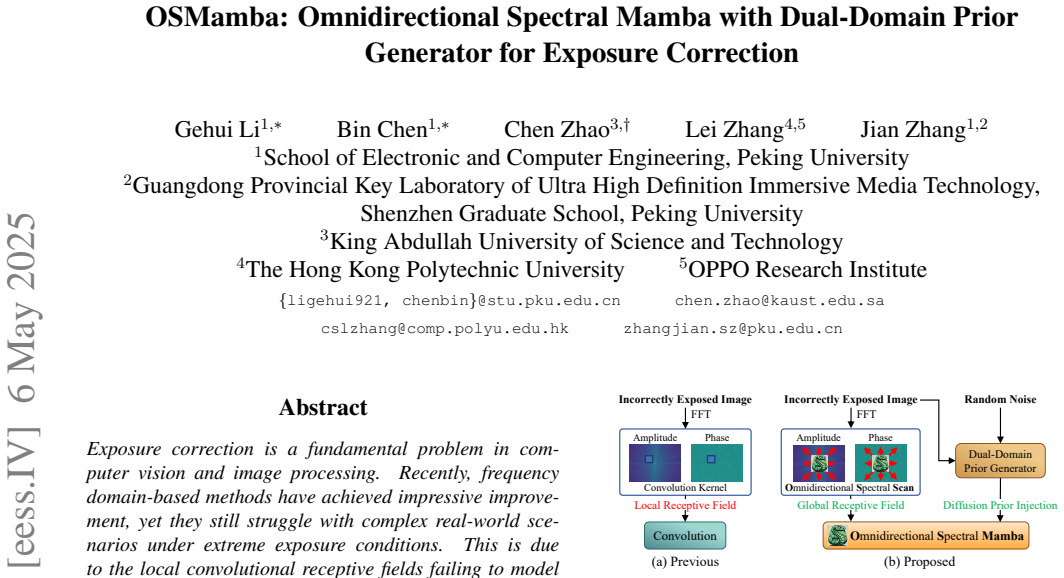
The key machinery is the Omnidirectional Spectral State Space Model (OS-SSM) together with the Dual-Domain Prior Generator (DDPG). OS-SSM takes the 2D FFT of deep features, keeps half the spectrum, and runs two parallel Mamba modules on the amplitude and phase with OS-Scan, four continuous symmetric scanning directions (row, column, positive diagonal, negative diagonal) that respect the spectrum's symmetry and continuity, before recombining with the inverse FFT and gating. DDPG is a conditional latent diffusion model that starts from random Gaussian noise and performs T=4 denoising steps conditioned on a dual-domain feature extracted from the input image alone, producing a prior vector that is injected into every OS-SSM via affine transformation; in training it distills the ground-truth-dependent DDPE prior. These two components carry the argument: the first provides global receptive fields in the frequency domain for illumination and structure correction, and the second supplies the external, degradation-free information needed to reconstruct details lost in extreme exposure.
What would settle it
Take the hardest quartile of under- and over-exposed test images, replace the DDPG prior at inference with a constant vector of the same shape, and measure whether PSNR drops by substantially more than the 0.52 dB ablation gap; a negligible drop would mean the distilled prior is not what restores the lost details.
Extended reading notes
Core claim
The central discovery claimed is that an exposure correction network built on an Omnidirectional Spectral State Space Model (OS-SSM) and a Dual-Domain Prior Generator (DDPG) achieves state-of-the-art results on multiple- and mixed-exposure benchmarks. OS-SSM treats the half-spectrum of deep features as two parallel streams, amplitude (lighting and color) and phase (structure), and applies Mamba's S6 selective scan along four symmetric trajectories: rows, columns, positive diagonals, and negative diagonals, exploiting the central symmetry of the Fourier spectrum. DDPG is a conditional diffusion model with only T=4 denoising steps that produces a compact prior vector from the input image alone; it is trained by distilling the prior extracted by the ground-truth-dependent DDPE teacher, and each OS-SSM applies the prior as an affine modulation. The paper reports best PSNR and SSIM of 23.78 and 0.8767 on MSEC, 22.82 and 0.7201 on SICE, and 24.53 and 0.8773 on LCDP, with visual comparisons showing restored detail and natural color in severely degraded regions.
Load-bearing premise
The load-bearing premise is that the distilled dual-domain prior generator, which learns from priors extracted with access to the ground-truth image, produces a prior from the input image alone that is as informative as the teacher prior at test time.
Editorial extensions
If this is right
- If the reported results hold, OSMamba becomes the reference point that future exposure correction methods must beat on MSEC, SICE, and LCDP.
- The four-direction spectral scan suggests that diagonal dependencies in the Fourier spectrum carry information that row- and column-only scans miss, which may transfer to other restoration tasks that decouple amplitude and phase.
- The two-stage teacher-to-student distillation shows a path for turning priors that need ground truth into deployable, input-only priors while keeping the detail-restoration benefit.
- Because Mamba scanning is linear in sequence length, the frequency-domain global modeling comes without the quadratic cost of attention, which matters for high-resolution images.
Reading between the lines
- The paper's own ablation (Table 4) attributes 0.52 dB of the LCDP gain to the latent diffusion model, but only on one dataset and without error bars; a reasonable next step is to test whether that gap is stable across random seeds and input severity levels.
- Since the prior is only 1x1xM, it may be that most of the correction signal carried by the prior is global, such as global illumination and color statistics, rather than spatially localized detail; a spatial breakdown of the prior's effect would settle this.
- The same distillation-from-a-dual-domain-teacher recipe could be applied to other ill-posed restoration problems such as deblurring or deraining, where high-frequency detail is also missing and could be supplied by a compact generative prior.
- For deployment, the T=4 denoising steps mean the generative prior adds little latency; an interesting extension would be to measure how prior quality changes as T is reduced to 1 or 2, which would reveal how much of the diffusion process is genuinely load-bearing.
Editorial analysis
A structured set of objections, weighed in public.
Referee Report
Summary. The paper proposes OSMamba, an exposure correction network that combines a frequency-domain Mamba with an omnidirectional spectral scanning mechanism (OS-Scan) and a dual-domain prior generator (DDPG). The model is trained in two stages: first, a teacher prior extractor (DDPE) uses ground-truth images to create compact priors that modulate the UNet; second, a student generator (DDPG) distills this teacher into a GT-free conditional diffusion model. Experiments on MSEC, SICE, and LCDP report state-of-the-art PSNR/SSIM, with ablations on LCDP supporting the contributions of OS-SSM and the prior generator.
Significance. If the results hold, OSMamba is a meaningful empirical advance: it is the first exposure correction network to apply Mamba with four-directional scanning in the Fourier domain, and the two-stage distillation of a GT-dependent prior into a GT-free diffusion generator is a clever way to inject generative detail restoration without inference-time ground truth. The reported gains over strong baselines such as CoTF are consistent across three datasets and the ablations show that both main components contribute. However, the evidence is weakened by a confounded ablation for the diffusion model, a train/inference distribution mismatch in the diffusion start, missing comparisons to a recent Mamba-based method, and the absence of error bars on small margins.
major comments (5)
- [Section 4.3, Table 4] The ablation isolating the contribution of the generative diffusion model is confounded. The text states that setting (b) 'removes the latent diffusion model' and attributes the 0.52 dB drop to that removal, but setting (b) uses the spatial-domain extractor SDPE, not the dual-domain DDPE. Therefore the 0.52 dB difference between OSMamba (DDPE+DDPG) and setting (b) conflates two changes: the extractor domain (spatial vs dual) and the presence of the diffusion generator. A proper control, e.g., DDPE without the diffusion generator, is needed to attribute the gain specifically to the diffusion process. This is load-bearing because the second contribution claim rests on this ablation.
- [Section 3.5, Algorithm 1, and Section 4.1] There is a train/inference mismatch in the diffusion start. Training initializes the reverse chain as N(sqrt(bar_alpha_T) Z, (1 - bar_alpha_T) I) with bar_alpha_T at most 0.01, so the start contains a non-negligible signal component from the ground-truth-based prior Z. Inference initializes from pure noise N(0, I), as stated in Section 3.5. With only T=4 steps and a two-layer denoiser, the model never sees a pure-noise starting point during training, and the paper does not analyze whether this distribution shift degrades the generated prior. This directly affects the validity of the DDPG at inference, which is critical for the SOTA claim on LCDP where removing the prior drops performance below CoTF.
- [Table 1 and Related Work] The paper does not compare quantitatively against ECMamba [15], a NeurIPS 2024 Mamba-based exposure correction method, even though the manuscript is a May 2025 version and cites this work in the related literature. Since the paper's central novelty is a Mamba variant, the SOTA claim requires a direct comparison to this concurrent method on at least the shared datasets (MSEC and SICE). Without it, the claim of state-of-the-art performance is incomplete.
- [Section 4.3] All ablations for the two main contributions are performed only on the LCDP dataset. The paper claims SOTA on MSEC and SICE, and the DDPG is a key component, but its benefit is not demonstrated on those datasets. Given that the margins over baselines vary across datasets, the authors should report at least one ablation (e.g., removing the prior or disabling the diffusion generator) on MSEC or SICE to support the generality of the contributions.
- [Tables 1-4] All reported metrics are from single runs with no error bars, confidence intervals, or significance tests. Several improvements are small (e.g., 0.18 dB in Table 3, 0.21 dB in Table 4). Without an estimate of run-to-run variance, it is impossible to judge whether these gains are reliable. At minimum, the authors should report results over multiple seeds (e.g., three) for the ablations and the final model, or provide a statistical test for the main comparisons.
minor comments (6)
- [Section 4.3, Table 2] The text says the baselines keep 'a comparable number of parameters,' but no parameter counts are given. Please report the actual parameter numbers for the OS-SSM, VSSM, and Attention variants to support this claim.
- [Section 3.3, Eq. (5)] The notation for the amplitude and phase features is inconsistent: the text uses Ah(X), Ph(X) for inputs and \tilde Ah(X), \tilde Ph(X) for outputs, but the equation later refers to these as A_h(X) and P_h(X). Please standardize the notation.
- [Figure 3 caption] The caption contains a typo: 'Spatial Featurae Refinement' should be 'Spatial Feature Refinement.'
- [Section 4.2] The claim of a 'significant improvement of 1.01 dB' on SICE should specify the baseline (the table shows the gain over MMHT, which is the second-best average PSNR).
- [Section 3.5] The DDPE* is described as 'same structure as DDPE except for the input convolution,' but DDPE takes two concatenated images (Ierror and Igt) while DDPE* takes one. Please clarify the exact input-channel adjustment.
- [Section 4.1] The paper reports 7.5M parameters but does not provide FLOPs or inference time. Since the method combines SSMs and diffusion, reporting computational cost would help practitioners assess its practicality.
Circularity Check
No significant circularity: the SOTA claim rests on held-out test-set evaluation, and the DDPG distillation is a standard student–teacher training procedure rather than a definitional identity.
full rationale
The paper's central claim is empirical: OSMamba reports PSNR/SSIM on held-out test splits of MSEC, SICE, and LCDP (Table 1). These numbers are not fitted constants or renamed training targets; the test images are not used in training, so the comparison to prior methods is an external benchmark rather than a construction. The Dual-Domain Prior Generator is trained by a distillation loss, LS2 = ||Igt - Icorrected||1 + ||Z - Zhat0||1, where the teacher Z = DDPE(Ierror, Igt) uses ground truth during training. This is a supervised student-teacher setup, not a tautology: at inference, DDPG receives only Ierror and a random Gaussian sample, so whether the distilled prior remains informative is an empirical question, not a logical consequence of the loss definition. The ablations in Tables 2-4 are genuine comparisons of architectural choices on the validation/test set; removing the prior or the OS-SSM lowers measured performance, which supports the contribution claims rather than assuming them. Self-citations in the reference list, including MMHT [37] by the first author, are not load-bearing: no central claim is justified solely by a self-citation, and no uniqueness theorem or prior result is invoked to forbid alternatives. The train/inference mismatch in the diffusion starting point (training starts at N(sqrt(alpha_T)Z, (1-alpha_T)I) while inference starts at N(0,I)) is a legitimate robustness and correctness concern, but it is not circularity: the model is still evaluated on unseen data and the reported gains could fail without making the derivation equivalent to its inputs. Overall, the derivation chain is self-contained as an empirical architecture paper, and no step reduces to its own presuppositions by definition.
Assumptions & free parameters
free parameters (5)
- Prior embedding dimension M =
256
- Diffusion steps T =
4
- Noise schedule alpha =
alpha_1=0.9, alpha_T=0.01, linear
- Channel width C =
36
- Number of OS-SSB blocks per level =
not stated
assumptions (5)
- standard math FFT/IFFT are differentiable and invertible, and zero-order hold discretization of SSMs is valid
- domain assumption Amplitude spectrum correlates with illumination and phase spectrum with structure
- domain assumption Fourier spectra of natural images exhibit central symmetry and continuity, so scanning half the spectrum with symmetric zig-zag trajectories captures relevant dependencies
- domain assumption A compact 256-dim prior Z can encode restoration information for severely degraded regions and can be distilled into a GT-free generator
- ad hoc to paper A 4-step conditional diffusion process with random Gaussian initialization yields priors as useful as the teacher's
Cite this review
Pith. "Pith review of OSMamba: Omnidirectional Spectral Mamba with Dual-Domain Prior Generator for Exposure Correction." pith.science (2026). https://pith.science/paper/EGEJDXKB
@misc{pith2026241115255,
  author       = {Pith},
  title        = {Pith review of: OSMamba: Omnidirectional Spectral Mamba with Dual-Domain Prior Generator for Exposure Correction},
  year         = {2026},
  howpublished = {\url{https://pith.science/paper/EGEJDXKB}},
  note         = {Machine review of arXiv:2411.15255}
}
read the original abstract
Exposure correction is a fundamental problem in computer vision and image processing. Recently, frequency domain-based methods have achieved impressive improvement, yet they still struggle with complex real-world scenarios under extreme exposure conditions. This is due to the local convolutional receptive fields failing to model long-range dependencies in the spectrum, and the non-generative learning paradigm being inadequate for retrieving lost details from severely degraded regions. In this paper, we propose Omnidirectional Spectral Mamba (OSMamba), a novel exposure correction network that incorporates the advantages of state space models and generative diffusion models to address these limitations. Specifically, OSMamba introduces an omnidirectional spectral scanning mechanism that adapts Mamba to the frequency domain to capture comprehensive long-range dependencies in both the amplitude and phase spectra of deep image features, hence enhancing illumination correction and structure recovery. Furthermore, we develop a dual-domain prior generator that learns from well-exposed images to generate a degradation-free diffusion prior containing correct information about severely under- and over-exposed regions for better detail restoration. Extensive experiments on multiple-exposure and mixed-exposure datasets demonstrate that the proposed OSMamba achieves state-of-the-art performance both quantitatively and qualitatively.
Figures


Figures from the paper (4 more)


Forward citations
Cited by 1 Pith paper
-
Adversarial Diffusion Compression for Real-World Image Super-Resolution
AdcSR distills OSEDiff into a pruned diffusion-GAN that cuts inference time 3.7x and parameters 74% while achieving comparable super-resolution quality.
Reference graph
Works this paper leans on
-
[15]
Wei Dong, Han Zhou, Yulun Zhang, Xiaohong Liu, and Jun Chen. Ecmamba: Consolidating selective state space model with retinex guidance for efficient multiple exposure correc- tion. Advances in Neural Information Processing Systems , 37:53438–53457, 2024. 3
work page 2024
-
[1]
Learning multi-scale photo expo- sure correction
Mahmoud Afifi, Konstantinos G Derpanis, Bjorn Ommer, and Michael S Brown. Learning multi-scale photo expo- sure correction. In Proceedings of the IEEE/CVF Conference on Computer Vision and Pattern Recognition , pages 9157– 9167, 2021. 1, 2, 6
work page 2021
-
[2]
Jimmy Lei Ba, Jamie Ryan Kiros, and Geoffrey E Hin- ton. Layer normalization. arXiv preprint arXiv:1607.06450,
-
[3]
Luminance-aware color transform for multiple exposure correction
Jong-Hyeon Baek, DaeHyun Kim, Su-Min Choi, Hyo-jun Lee, Hanul Kim, and Yeong Jun Koh. Luminance-aware color transform for multiple exposure correction. In Pro- ceedings of the IEEE/CVF International Conference on Computer Vision, pages 6156–6165, 2023. 2, 6
work page 2023
-
[4]
Transformers to ssms: Distilling quadratic knowledge to subquadratic models
Aviv Bick, Kevin Li, Eric Xing, J Zico Kolter, and Albert Gu. Transformers to ssms: Distilling quadratic knowledge to subquadratic models. Advances in Neural Information Pro- cessing Systems, 37:31788–31812, 2024. 3
work page 2024
-
[5]
Learning photographic global tonal adjustment with a database of input/output image pairs
Vladimir Bychkovsky, Sylvain Paris, Eric Chan, and Fr ´edo Durand. Learning photographic global tonal adjustment with a database of input/output image pairs. InCVPR 2011, pages 97–104. IEEE, 2011. 1
work page 2011
-
[6]
Learning a deep single image contrast enhancer from multi-exposure images
Jianrui Cai, Shuhang Gu, and Lei Zhang. Learning a deep single image contrast enhancer from multi-exposure images. IEEE Transactions on Image Processing, 27(4):2049–2062,
-
[7]
Towards hdr and hfr video from rolling-mixed-bit spikings
Yakun Chang, Yeliduosi Xiaokaiti, Yujia Liu, Bin Fan, Zhao- jun Huang, Tiejun Huang, and Boxin Shi. Towards hdr and hfr video from rolling-mixed-bit spikings. In Proceedings of the IEEE/CVF Conference on Computer Vision and Pattern Recognition, pages 25117–25127, 2024. 1
work page 2024
Show all 73 references
-
[8]
Practical compact deep com- pressed sensing
Bin Chen and Jian Zhang. Practical compact deep com- pressed sensing. IEEE Transactions on Pattern Analysis and Machine Intelligence, 47(03):1610–1626, 2025. 1
2025
-
[9]
Self-supervised scalable deep compressed sens- ing
Bin Chen, Xuanyu Zhang, Shuai Liu, Yongbing Zhang, and Jian Zhang. Self-supervised scalable deep compressed sens- ing. International Journal of Computer Vision, pages 1–36, 2024
2024
-
[10]
Invertible diffusion models for compressed sensing
Bin Chen, Zhenyu Zhang, Weiqi Li, Chen Zhao, Jiwen Yu, Shijie Zhao, Jie Chen, and Jian Zhang. Invertible diffusion models for compressed sensing. IEEE Transactions on Pat- tern Analysis and Machine Intelligence, 2025. 1
2025
-
[11]
Learning to see in the dark
Chen Chen, Qifeng Chen, Jia Xu, and Vladlen Koltun. Learning to see in the dark. In Proceedings of the IEEE con- ference on computer vision and pattern recognition , pages 3291–3300, 2018. 1, 6
2018
-
[12]
Dual pro- totype attention for unsupervised video object segmentation
Suhwan Cho, Minhyeok Lee, Seunghoon Lee, Dogyoon Lee, Heeseung Choi, Ig-Jae Kim, and Sangyoun Lee. Dual pro- totype attention for unsupervised video object segmentation. In Proceedings of the IEEE/CVF Conference on Computer Vision and Pattern Recognition, pages 19238–19247, 2024. 1
2024
-
[13]
You only need 90k parameters to adapt light: a light weight trans- former for image enhancement and exposure correction
Ziteng Cui, Kunchang Li, Lin Gu, Shenghan Su, Peng Gao, Zhengkai Jiang, Yu Qiao, and Tatsuya Harada. You only need 90k parameters to adapt light: a light weight trans- former for image enhancement and exposure correction. arXiv preprint arXiv:2205.14871, 2022. 2
2022 arXiv
-
[14]
Transformers are ssms: general- ized models and efficient algorithms through structured state space duality
Tri Dao and Albert Gu. Transformers are ssms: general- ized models and efficient algorithms through structured state space duality. In Proceedings of the 41st International Con- ference on Machine Learning, pages 10041–10071, 2024. 2
2024
-
[16]
Sigmoid- weighted linear units for neural network function approxima- tion in reinforcement learning
Stefan Elfwing, Eiji Uchibe, and Kenji Doya. Sigmoid- weighted linear units for neural network function approxima- tion in reinforcement learning. Neural networks, 107:3–11,
-
[17]
Fftw: An adaptive soft- ware architecture for the fft
Matteo Frigo and Steven G Johnson. Fftw: An adaptive soft- ware architecture for the fft. InProceedings of the 1998 IEEE International Conference on Acoustics, Speech and Signal Processing, ICASSP’98 (Cat. No. 98CH36181), pages 1381–
1998
-
[18]
Knowledge distillation: A survey
Jianping Gou, Baosheng Yu, Stephen J Maybank, and Dacheng Tao. Knowledge distillation: A survey. Interna- tional Journal of Computer Vision, 129(6):1789–1819, 2021. 5
2021
-
[19]
Mamba: Linear-time sequence modeling with selective state spaces
Albert Gu and Tri Dao. Mamba: Linear-time sequence modeling with selective state spaces. arXiv preprint arXiv:2312.00752, 2023. 2, 3, 4
2023 arXiv
-
[20]
Efficiently mod- eling long sequences with structured state spaces
Albert Gu, Karan Goel, and Christopher R´e. Efficiently mod- eling long sequences with structured state spaces. In The In- ternational Conference on Learning Representations (ICLR),
-
[21]
Zero-reference deep curve estimation for low-light image enhancement
Chunle Guo, Chongyi Li, Jichang Guo, Chen Change Loy, Junhui Hou, Sam Kwong, and Runmin Cong. Zero-reference deep curve estimation for low-light image enhancement. In Proceedings of the IEEE/CVF Conference on Computer Vi- sion and Pattern Recognition, pages 1780–1789, 2020. 6
2020
-
[22]
Mambair: A simple baseline for im- age restoration with state-space model
Hang Guo, Jinmin Li, Tao Dai, Zhihao Ouyang, Xudong Ren, and Shu-Tao Xia. Mambair: A simple baseline for im- age restoration with state-space model. In European Confer- ence on Computer Vision, pages 222–241. Springer, 2025. 2, 3, 4, 7
2025
-
[23]
Demystify mamba in vision: A linear attention per- spective
Dongchen Han, Ziyi Wang, Zhuofan Xia, Yizeng Han, Yifan Pu, Chunjiang Ge, Jun Song, Shiji Song, Bo Zheng, and Gao Huang. Demystify mamba in vision: A linear attention per- spective. Advances in Neural Information Processing Sys- tems, 37:127181–127203, 2025. 3
2025
-
[24]
Reti-diff: Illumination degradation image restora- tion with retinex-based latent diffusion model.arXiv preprint arXiv:2311.11638, 2023
Chunming He, Chengyu Fang, Yulun Zhang, Kai Li, Longx- iang Tang, Chenyu You, Fengyang Xiao, Zhenhua Guo, and Xiu Li. Reti-diff: Illumination degradation image restora- tion with retinex-based latent diffusion model.arXiv preprint arXiv:2311.11638, 2023. 5
2023 arXiv
-
[25]
Deep residual learning for image recognition
Kaiming He, Xiangyu Zhang, Shaoqing Ren, and Jian Sun. Deep residual learning for image recognition. In Proceed- ings of the IEEE conference on computer vision and pattern recognition, pages 770–778, 2016. 5, 8
2016
-
[26]
Denoising dif- fusion probabilistic models
Jonathan Ho, Ajay Jain, and Pieter Abbeel. Denoising dif- fusion probabilistic models. Advances in neural information processing systems, 33:6840–6851, 2020. 5
2020
-
[27]
Zigma: A dit-style zigzag mamba diffusion model
Vincent Tao Hu, Stefan Andreas Baumann, Ming Gui, Olga Grebenkova, Pingchuan Ma, Johannes Fischer, and Bj ¨orn Ommer. Zigma: A dit-style zigzag mamba diffusion model. In European Conference on Computer Vision , pages 148–
-
[28]
Exposure normalization and compensation for multiple-exposure correction
Jie Huang, Yajing Liu, Xueyang Fu, Man Zhou, Yang Wang, Feng Zhao, and Zhiwei Xiong. Exposure normalization and compensation for multiple-exposure correction. In Proceed- ings of the IEEE/CVF Conference on Computer Vision and Pattern Recognition, pages 6043–6052, 2022. 2, 6
2022
-
[29]
Deep fourier-based exposure correction network with spatial- frequency interaction
Jie Huang, Yajing Liu, Feng Zhao, Keyu Yan, Jinghao Zhang, Yukun Huang, Man Zhou, and Zhiwei Xiong. Deep fourier-based exposure correction network with spatial- frequency interaction. In European Conference on Computer Vision, pages 163–180. Springer, 2022. 1, 2, 4, 6
2022
-
[30]
Exposure-consistency representation learning for exposure correction
Jie Huang, Man Zhou, Yajing Liu, Mingde Yao, Feng Zhao, and Zhiwei Xiong. Exposure-consistency representation learning for exposure correction. In Proceedings of the 30th ACM International Conference on Multimedia, pages 6309– 6317, 2022. 2, 6
2022
-
[31]
Learning sam- ple relationship for exposure correction
Jie Huang, Feng Zhao, Man Zhou, Jie Xiao, Naishan Zheng, Kaiwen Zheng, and Zhiwei Xiong. Learning sam- ple relationship for exposure correction. In Proceedings of the IEEE/CVF conference on computer vision and pattern recognition, pages 9904–9913, 2023. 2, 6
2023
-
[32]
Localmamba: Visual state space model with windowed selective scan
Tao Huang, Xiaohuan Pei, Shan You, Fei Wang, Chen Qian, and Chang Xu. Localmamba: Visual state space model with windowed selective scan. arXiv preprint arXiv:2403.09338,
-
[33]
Chat-univi: Unified visual representation em- powers large language models with image and video un- derstanding
Peng Jin, Ryuichi Takanobu, Wancai Zhang, Xiaochun Cao, and Li Yuan. Chat-univi: Unified visual representation em- powers large language models with image and video un- derstanding. In Proceedings of the IEEE/CVF Conference on Computer Vision and Pattern Recognition, pages 137...
2024
-
[34]
Beyond im- age super-resolution for image recognition with task-driven perceptual loss
Jaeha Kim, Junghun Oh, and Kyoung Mu Lee. Beyond im- age super-resolution for image recognition with task-driven perceptual loss. In Proceedings of the IEEE/CVF Conference on Computer Vision and Pattern Recognition , pages 2651– 2661, 2024. 1
2024
-
[35]
Adam: A method for stochastic optimization
Diederik P Kingma and Jimmy Ba. Adam: A method for stochastic optimization. arXiv preprint arXiv:1412.6980 ,
-
[36]
Fouriermamba: Fourier learning integration with state space models for image deraining
Dong Li, Yidi Liu, Xueyang Fu, Senyan Xu, and Zheng- Jun Zha. Fouriermamba: Fourier learning integration with state space models for image deraining. arXiv preprint arXiv:2405.19450, 2024. 3, 4
2024 arXiv
-
[37]
Fearless luminance adaptation: A macro- micro-hierarchical transformer for exposure correction
Gehui Li, Jinyuan Liu, Long Ma, Zhiying Jiang, Xin Fan, and Risheng Liu. Fearless luminance adaptation: A macro- micro-hierarchical transformer for exposure correction. In Proceedings of the 31st ACM International Conference on Multimedia, pages 7304–7313, 2023. 2, 6
2023
-
[38]
Real-time expo- sure correction via collaborative transformations and adap- tive sampling
Ziwen Li, Feng Zhang, Meng Cao, Jinpu Zhang, Yuanjie Shao, Yuehuan Wang, and Nong Sang. Real-time expo- sure correction via collaborative transformations and adap- tive sampling. In Proceedings of the IEEE/CVF Conference on Computer Vision and Pattern Recognition , pages 2984–...
2024
-
[39]
Region-aware exposure consistency network for mixed ex- posure correction
Jin Liu, Huiyuan Fu, Chuanming Wang, and Huadong Ma. Region-aware exposure consistency network for mixed ex- posure correction. In Proceedings of the AAAI Conference on Artificial Intelligence, pages 3648–3656, 2024. 2
2024
-
[40]
Retinex-inspired unrolling with cooperative prior architecture search for low-light image enhancement
Risheng Liu, Long Ma, Jiaao Zhang, Xin Fan, and Zhongx- uan Luo. Retinex-inspired unrolling with cooperative prior architecture search for low-light image enhancement. InPro- ceedings of the IEEE/CVF Conference on Computer Vision and Pattern Recognition, pages 10561–10570, 2021. 6
2021
-
[41]
Compressive confocal microscopy imag- ing at the single-photon level with ultra-low sampling ratios
Shuai Liu, Bin Chen, Wenzhen Zou, Hao Sha, Xiaochen Feng, Sanyang Han, Xiu Li, Xuri Yao, Jian Zhang, and Yongbing Zhang. Compressive confocal microscopy imag- ing at the single-photon level with ultra-low sampling ratios. Communications Engineering, 3(1):88, 2024. 1
2024
-
[42]
Deep learning-enhanced snapshot hyperspectral con- focal microscopy imaging system
Shuai Liu, Wenzhen Zou, Hao Sha, Xiaochen Feng, Bin Chen, Jian Zhang, Sanyang Han, Xiu Li, and Yongbing Zhang. Deep learning-enhanced snapshot hyperspectral con- focal microscopy imaging system. Optics Express, 32(8): 13918–13931, 2024. 1
2024
-
[43]
Vmamba: Visual state space model
Yue Liu, Yunjie Tian, Yuzhong Zhao, Hongtian Yu, Lingxi Xie, Yaowei Wang, Qixiang Ye, Jianbin Jiao, and Yunfan Liu. Vmamba: Visual state space model. Advances in neural information processing systems , 37:103031–103063, 2024. 2, 3, 4, 7
2024
-
[44]
Sgdr: Stochas- tic gradient descent with warm restarts
Ilya Loshchilov and Frank Hutter. Sgdr: Stochas- tic gradient descent with warm restarts. arXiv preprint arXiv:1608.03983, 2016. 6
2016 arXiv
-
[45]
Toward fast, flexible, and robust low-light image enhancement
Long Ma, Tengyu Ma, Risheng Liu, Xin Fan, and Zhongx- uan Luo. Toward fast, flexible, and robust low-light image enhancement. In Proceedings of the IEEE/CVF conference on computer vision and pattern recognition , pages 5637– 5646, 2022. 1, 6
2022
-
[46]
Rectified linear units im- prove restricted boltzmann machines
Vinod Nair and Geoffrey E Hinton. Rectified linear units im- prove restricted boltzmann machines. In Proceedings of the 27th international conference on machine learning (ICML- 10), pages 807–814, 2010. 5
2010
-
[47]
Improved denoising diffusion probabilistic models
Alexander Quinn Nichol and Prafulla Dhariwal. Improved denoising diffusion probabilistic models. In International conference on machine learning, pages 8162–8171. PMLR,
-
[48]
Neural exposure fusion for high-dynamic range object detection
Emmanuel Onzon, Maximilian B ¨omer, Fahim Mannan, and Felix Heide. Neural exposure fusion for high-dynamic range object detection. In Proceedings of the IEEE/CVF Confer- ence on Computer Vision and Pattern Recognition , pages 17564–17573, 2024. 1
2024
-
[49]
Pytorch: An im- perative style, high-performance deep learning library
Adam Paszke, Sam Gross, Francisco Massa, Adam Lerer, James Bradbury, Gregory Chanan, Trevor Killeen, Zeming Lin, Natalia Gimelshein, Luca Antiga, et al. Pytorch: An im- perative style, high-performance deep learning library. Ad- vances in neural information processing systems ...
2019
-
[50]
Retinex processing for automatic image enhancement
Zia-ur Rahman, Daniel J Jobson, and Glenn A Woodell. Retinex processing for automatic image enhancement. Jour- nal of Electronic imaging, 13(1):100–110, 2004. 1
2004
-
[51]
U- net: Convolutional networks for biomedical image segmen- tation
Olaf Ronneberger, Philipp Fischer, and Thomas Brox. U- net: Convolutional networks for biomedical image segmen- tation. In International Conference on Medical image com- puting and computer-assisted intervention , pages 234–241. Springer, 2015. 1, 3
2015
-
[52]
Image super- resolution via iterative refinement
Chitwan Saharia, Jonathan Ho, William Chan, Tim Sali- mans, David J Fleet, and Mohammad Norouzi. Image super- resolution via iterative refinement. IEEE transactions on pattern analysis and machine intelligence, 45(4):4713–4726,
-
[53]
Groupmamba: Parameter-efficient and accurate group visual state space model
Abdelrahman Shaker, Syed Talal Wasim, Salman Khan, Juergen Gall, and Fahad Shahbaz Khan. Groupmamba: Parameter-efficient and accurate group visual state space model. arXiv preprint arXiv:2407.13772, 2024. 3
2024 arXiv
-
[54]
Vmambair: Visual state space model for image restoration
Yuan Shi, Bin Xia, Xiaoyu Jin, Xing Wang, Tianyu Zhao, Xin Xia, Xuefeng Xiao, and Wenming Yang. Vmambair: Visual state space model for image restoration. IEEE Trans- actions on Circuits and Systems for Video Technology, 2025. 3, 4
2025
-
[55]
The jpeg still picture compression stan- dard
Gregory K Wallace. The jpeg still picture compression stan- dard. IEEE transactions on consumer electronics , 38(1): xviii–xxxiv, 1992. 4
1992
-
[56]
Local color distributions prior for image enhancement
Haoyuan Wang, Ke Xu, and Rynson WH Lau. Local color distributions prior for image enhancement. In European Conference on Computer Vision , pages 343–359. Springer,
-
[57]
Underexposed photo enhance- ment using deep illumination estimation
Ruixing Wang, Qing Zhang, Chi-Wing Fu, Xiaoyong Shen, Wei-Shi Zheng, and Jiaya Jia. Underexposed photo enhance- ment using deep illumination estimation. In Proceedings of the IEEE/CVF Conference on Computer Vision and Pattern Recognition, pages 6849–6857, 2019. 1
2019
-
[58]
Deep retinex decomposition for low-light enhancement
Chen Wei, Wenjing Wang, Wenhan Yang, and Jiaying Liu. Deep retinex decomposition for low-light enhancement. arXiv preprint arXiv:1808.04560, 2018. 1, 6
2018 arXiv
-
[59]
Rainmamba: Enhanced locality learning with state space models for video deraining
Hongtao Wu, Yijun Yang, Huihui Xu, Weiming Wang, Jinni Zhou, and Lei Zhu. Rainmamba: Enhanced locality learning with state space models for video deraining. In Proceedings of the 32nd ACM International Conference on Multimedia , pages 7881–7890, 2024. 3
2024
-
[60]
Latent diffusion prior enhanced deep unfolding for snapshot spec- tral compressive imaging
Zongliang Wu, Ruiying Lu, Ying Fu, and Xin Yuan. Latent diffusion prior enhanced deep unfolding for snapshot spec- tral compressive imaging. In European Conference on Com- puter Vision, pages 164–181. Springer, 2024. 2, 5
2024
-
[61]
Diffir: Efficient diffusion model for image restoration
Bin Xia, Yulun Zhang, Shiyin Wang, Yitong Wang, Xing- long Wu, Yapeng Tian, Wenming Yang, and Luc Van Gool. Diffir: Efficient diffusion model for image restoration. In Proceedings of the IEEE/CVF International Conference on Computer Vision, pages 13095–13105, 2023. 2, 5
2023
-
[62]
Knowledge distilla- tion based degradation estimation for blind super-resolution
Bin Xia, Yulun Zhang, Yitong Wang, Yapeng Tian, Wenming Yang, Radu Timofte, and Luc Van Gool. Knowledge distilla- tion based degradation estimation for blind super-resolution. In The Eleventh International Conference on Learning Rep- resentations, 2023. 5
2023
-
[63]
Uveb: A large-scale bench- mark and baseline towards real-world underwater video en- hancement
Yaofeng Xie, Lingwei Kong, Kai Chen, Ziqiang Zheng, Xiao Yu, Zhibin Yu, and Bing Zheng. Uveb: A large-scale bench- mark and baseline towards real-world underwater video en- hancement. In Proceedings of the IEEE/CVF Conference on Computer Vision and Pattern Recognition, pages 2...
2024
-
[64]
Implicit neural representation for coopera- tive low-light image enhancement
Shuzhou Yang, Moxuan Ding, Yanmin Wu, Zihan Li, and Jian Zhang. Implicit neural representation for coopera- tive low-light image enhancement. In Proceedings of the IEEE/CVF international conference on computer vision , pages 12918–12927, 2023. 1
2023
-
[65]
Difflle: Diffusion-guided do- main calibration for unsupervised low-light image enhance- ment
Shuzhou Yang, Xuanyu Zhang, Yinhuai Wang, Jiwen Yu, Yuhan Wang, and Jian Zhang. Difflle: Diffusion-guided do- main calibration for unsupervised low-light image enhance- ment. International Journal of Computer Vision (IJCV) ,
-
[66]
From fidelity to perceptual quality: A semi- supervised approach for low-light image enhancement
Wenhan Yang, Shiqi Wang, Yuming Fang, Yue Wang, and Jiaying Liu. From fidelity to perceptual quality: A semi- supervised approach for low-light image enhancement. In Proceedings of the IEEE/CVF conference on computer vi- sion and pattern recognition, pages 3063–3072, 2020. 6
2020
-
[67]
Restormer: Efficient transformer for high-resolution image restoration
Syed Waqas Zamir, Aditya Arora, Salman Khan, Mu- nawar Hayat, Fahad Shahbaz Khan, and Ming-Hsuan Yang. Restormer: Efficient transformer for high-resolution image restoration. In Proceedings of the IEEE/CVF Conference on Computer Vision and Pattern Recognition , pages 5728– 573...
2022
-
[68]
Adding conditional control to text-to-image diffusion models
Lvmin Zhang, Anyi Rao, and Maneesh Agrawala. Adding conditional control to text-to-image diffusion models. In Proceedings of the IEEE/CVF International Conference on Computer Vision, pages 3836–3847, 2023. 5
2023
-
[69]
Rs-mamba for large remote sensing image dense prediction
Sijie Zhao, Hao Chen, Xueliang Zhang, Pengfeng Xiao, Lei Bai, and Wanli Ouyang. Rs-mamba for large remote sensing image dense prediction. IEEE Transactions on Geoscience and Remote Sensing, 2024. 3
2024
-
[70]
Vision mamba: Efficient visual representation learning with bidirectional state space model
Lianghui Zhu, Bencheng Liao, Qian Zhang, Xinlong Wang, Wenyu Liu, and Xinggang Wang. Vision mamba: Efficient visual representation learning with bidirectional state space model. arXiv preprint arXiv:2401.09417, 2024. 2, 3
2024 arXiv
-
[71]
Wave-mamba: Wavelet state space model for ultra- high-definition low-light image enhancement
Wenbin Zou, Hongxia Gao, Weipeng Yang, and Tongtong Liu. Wave-mamba: Wavelet state space model for ultra- high-definition low-light image enhancement. In Proceed- ings of the 32nd ACM International Conference on Multime- dia, pages 1534–1543, 2024. 3
2024
-
[72]
Freqmamba: Viewing mamba from a frequency perspective for image de- raining
Zhen Zou, Hu Yu, Jie Huang, and Feng Zhao. Freqmamba: Viewing mamba from a frequency perspective for image de- raining. In Proceedings of the 32nd ACM International Con- ference on Multimedia, pages 1905–1914, 2024. 3
1905
-
[166]
Springer, 2024. 3, 4
2024
Reviewed August 12, 2026 · model on record in the stance chip above.
Discussion (0). Continue with ORCID to comment.