FunKit: A computer algebra toolkit for functional approaches
Pith reviewed 2026-06-29 11:04 UTC · model grok-4.3
The pith
FunKit supplies an expression vocabulary and rules for deriving functional equations from arbitrary master equations in any field theory.
A machine-rendered reading of the paper's core claim, the machinery that carries it, and where it could break.
Core claim
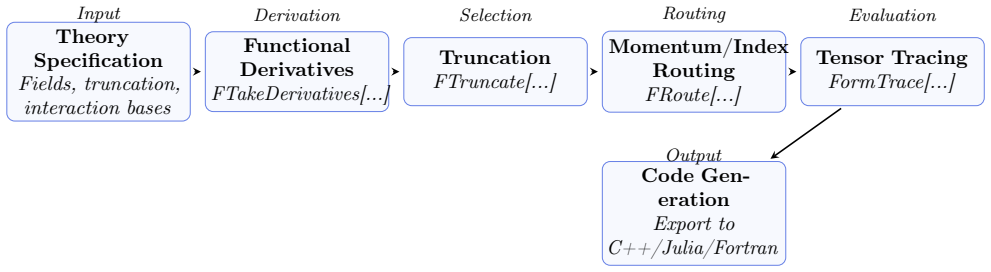
FunKit provides an expression vocabulary and a set of rules that allow for derivations in any given field theory and master equation. It can be used in a wide range of situations, for example Dyson-Schwinger or functional RG equations, flowing reparametrisations, nPI equations, (modified) STIs and WTIs, functional Polchinski and Wegner flows, functional master equations with sources, and many others. Besides interfacing with the FORM language to trace large tensor expressions efficiently, FunKit also provides facilities to export arbitrary Mathematica expressions to C++, Julia or Fortran code.
What carries the argument
The expression vocabulary and set of rules for performing derivations from arbitrary master equations.
If this is right
- Derivations in any field theory and master equation become possible using the supplied vocabulary and rules.
- Large tensor expressions can be traced efficiently via the built-in interface to FORM.
- Results of derivations can be exported directly to C++, Julia, or Fortran for numerical use.
- Users can add custom extensions to adapt the system to more specific equation setups.
- The tracing and code-generation features remain usable on their own or alongside other packages.
Where Pith is reading between the lines
- A general toolkit of this kind could reduce the incidence of transcription errors when moving between different functional methods.
- The export options open a direct path from symbolic derivation to high-performance numerical evaluation without intermediate manual rewriting.
- Community use might create shared libraries of extensions for common master equations.
- The independent tracing module could serve as a drop-in replacement for manual FORM scripting in existing workflows.
Load-bearing premise
The provided vocabulary and rules are general and correct enough to handle the listed wide range of master equations without further validation or specific implementations.
What would settle it
Applying the rules to derive a known functional equation from one of the listed master equations and finding a mismatch with an established manual result.
Figures
read the original abstract
We introduce FunKit, a Mathematica package for the derivation and tracing of functional equations from arbitrary master equations. FunKit provides an expression vocabulary and a set of rules that allow for derivations in any given field theory and master equation. It also allows users to add extensions for more specific equation systems. Therefore, it can be used in a wide range of situations, for example Dyson--Schwinger or functional RG equations, flowing reparametrisations, nPI equations, (modified) STIs and WTIs, functional Polchinski and Wegner flows, functional master equations with sources, and many others. Besides interfacing with the \FORM language to trace large tensor expressions efficiently, FunKit also provides facilities to export arbitrary Mathematica expressions to C++, Julia or Fortran code, including the results of derivations, which can then be evaluated numerically. Both the tracing and code generation can also be used independently and in combination with other packages.
Editorial analysis
A structured set of objections, weighed in public.
Referee Report
Summary. The paper introduces FunKit, a Mathematica package for deriving and tracing functional equations from arbitrary master equations. It supplies an expression vocabulary and rules claimed to support derivations across any field theory and master equation (Dyson-Schwinger, functional RG, nPI, STIs, WTIs, Polchinski/Wegner flows, etc.), with optional user extensions, a FORM interface for tensor tracing, and export of results to C++, Julia, or Fortran code.
Significance. If the core vocabulary and rules prove general and correct, FunKit could reduce manual effort in functional QFT calculations and enable faster numerical follow-up via code generation. The FORM interface and independent usability of tracing/export features are practical strengths for large expressions. However, the manuscript supplies no example derivations, output checks against known results, or error-validation data, so the practical significance remains unassessed.
major comments (2)
- [Abstract] Abstract and package description: the central claim that the provided vocabulary and rules suffice for derivations from any listed master equation (DSE, fRG, nPI, STIs, WTIs, Polchinski/Wegner flows) without further validation is unsupported; no concrete derivations, test cases, or comparisons with analytic results are shown anywhere in the manuscript.
- [Package description] The extensibility mechanism is described only at a high level; it is unclear whether the base rules already cover the full range of master equations cited or whether substantial additional definitions are required for each, undermining the claim of immediate applicability to arbitrary cases.
minor comments (1)
- Notation for the expression vocabulary and rule set should be introduced with a compact table or explicit list early in the text for readability.
Simulated Author's Rebuttal
We thank the referee for the careful review and constructive comments on the manuscript. We address each major comment below and will revise the manuscript to incorporate additional material where this strengthens the presentation of the toolkit's capabilities.
read point-by-point responses
-
Referee: [Abstract] Abstract and package description: the central claim that the provided vocabulary and rules suffice for derivations from any listed master equation (DSE, fRG, nPI, STIs, WTIs, Polchinski/Wegner flows) without further validation is unsupported; no concrete derivations, test cases, or comparisons with analytic results are shown anywhere in the manuscript.
Authors: We agree that the manuscript would benefit from explicit demonstrations to support the generality claim. The design of the vocabulary and rules targets the common algebraic structures appearing across the listed master equations, but concrete test cases were omitted to keep the focus on the package architecture. In the revised manuscript we will add a new section containing at least one fully worked derivation (e.g., a functional RG flow equation in a simple scalar theory) together with direct comparison to the corresponding analytic result obtained by hand. revision: yes
-
Referee: [Package description] The extensibility mechanism is described only at a high level; it is unclear whether the base rules already cover the full range of master equations cited or whether substantial additional definitions are required for each, undermining the claim of immediate applicability to arbitrary cases.
Authors: The base set of rules implements the generic operations (functional differentiation, integration by parts, source handling, etc.) that recur in all cited master equations; theory- or equation-specific adjustments are handled through the documented extension interface. We acknowledge that the current description leaves the boundary between base and extension unclear. The revision will expand this section with an explicit enumeration of the core rules and a worked example of a minimal user extension for a non-standard flow equation. revision: yes
Circularity Check
No circularity: software tool description with no derivation chain
full rationale
The manuscript introduces FunKit as a Mathematica package providing an expression vocabulary and rules for functional derivations. No mathematical predictions, fitted parameters, or derivation chains are present that could reduce to inputs by construction. Claims concern software capabilities and extensibility for listed master equations; these are not self-definitional, fitted-input predictions, or dependent on load-bearing self-citations. The paper is self-contained as a tool description without invoking uniqueness theorems or ansatze from prior work in a circular manner.
Axiom & Free-Parameter Ledger
Reference graph
Works this paper leans on
-
[1]
A. K. Cyrol, M. Mitter, N. Strodthoff, FormTracer - a Mathematica tracing package using FORM, Comput. Phys. Commun. 219 (2017) 346–352.arXiv:1610.09331,doi:10.1016/j.cpc.2017.05.024
work page internal anchor Pith review Pith/arXiv arXiv doi:10.1016/j.cpc.2017.05.024 2017
- [2]
-
[3]
C. D. Roberts, A. G. Williams, Dyson-Schwinger equations and their application to hadronic physics, Prog. Part. Nucl. Phys. 33 (1994) 477–575.arXiv:hep-ph/9403224,doi:10.1016/0146-6410(94)90049-3
work page internal anchor Pith review Pith/arXiv arXiv doi:10.1016/0146-6410(94)90049-3 1994
-
[4]
C. D. Roberts, S. M. Schmidt, Dyson-Schwinger equations: Density, temperature and continuum strong QCD, Prog. Part. Nucl. Phys. 45 (2000) S1–S103.arXiv:nucl-th/0005064, doi:10.1016/S0146-6410(00) 90011-5
work page internal anchor Pith review Pith/arXiv arXiv doi:10.1016/s0146-6410(00 2000
-
[5]
Non-Perturbative Renormalization Flow in Quantum Field Theory and Statistical Physics
J. Berges, N. Tetradis, C. Wetterich, Nonperturbative renormalization flow in quantum field theory and sta- tistical physics, Phys. Rept. 363 (2002) 223–386.arXiv:hep-ph/0005122, doi:10.1016/S0370-1573(01) 00098-9. 35
work page internal anchor Pith review Pith/arXiv arXiv doi:10.1016/s0370-1573(01 2002
-
[6]
Dyson-Schwinger equations: a tool for hadron physics
P. Maris, C. D. Roberts, Dyson-Schwinger equations: A tool for hadron physics, Int. J. Mod. Phys. E 12 (2003) 297–365.arXiv:nucl-th/0301049,doi:10.1142/S0218301303001326
work page internal anchor Pith review Pith/arXiv arXiv doi:10.1142/s0218301303001326 2003
-
[7]
J. M. Pawlowski, Aspects of the functional renormalisation group, Annals Phys. 322 (2007) 2831–2915. arXiv:hep-th/0512261,doi:10.1016/j.aop.2007.01.007
work page internal anchor Pith review Pith/arXiv arXiv doi:10.1016/j.aop.2007.01.007 2007
-
[8]
Introduction to the functional RG and applications to gauge theories
H. Gies, Introduction to the functional RG and applications to gauge theories, Lect. Notes Phys. 852 (2012) 287–348.arXiv:hep-ph/0611146,doi:10.1007/978-3-642-27320-9_6
work page internal anchor Pith review Pith/arXiv arXiv doi:10.1007/978-3-642-27320-9_6 2012
-
[9]
C. S. Fischer, Infrared properties of QCD from Dyson-Schwinger equations, J. Phys. G 32 (2006) R253–R291. arXiv:hep-ph/0605173,doi:10.1088/0954-3899/32/8/R02
work page internal anchor Pith review Pith/arXiv arXiv doi:10.1088/0954-3899/32/8/r02 2006
-
[10]
An Introduction to the Nonperturbative Renormalization Group
B. Delamotte, An introduction to the nonperturbative renormalization group, Lect. Notes Phys. 852 (2012) 49–132.arXiv:cond-mat/0702365,doi:10.1007/978-3-642-27320-9_2
work page internal anchor Pith review Pith/arXiv arXiv doi:10.1007/978-3-642-27320-9_2 2012
-
[11]
O. J. Rosten, Fundamentals of the exact renormalization group, Phys. Rept. 511 (2012) 177–272.arXiv: 1003.1366,doi:10.1016/j.physrep.2011.12.003
work page internal anchor Pith review Pith/arXiv arXiv doi:10.1016/j.physrep.2011.12.003 2012
-
[12]
W. Metzner, M. Salmhofer, C. Honerkamp, V. Meden, K. Schönhammer, Functional renormalization group approach to correlated fermion systems, Reviews of Modern Physics 84 (1) (2012) 299–352.doi: 10.1103/revmodphys.84.299. URLhttp://dx.doi.org/10.1103/RevModPhys.84.299
-
[13]
Collective perspective on advances in Dyson-Schwinger Equation QCD
A. Bashir, L. Chang, I. C. Cloet, B. El-Bennich, Y.-X. Liu, C. D. Roberts, P. C. Tandy, Collective perspective on advances in Dyson-Schwinger equation QCD, Commun. Theor. Phys. 58 (2012) 79–134. arXiv:1201.3366,doi:10.1088/0253-6102/58/1/16
work page internal anchor Pith review Pith/arXiv arXiv doi:10.1088/0253-6102/58/1/16 2012
-
[14]
C. S. Fischer, QCD at finite temperature and chemical potential from Dyson–Schwinger equations, Prog. Part. Nucl. Phys. 105 (2019) 1–60.arXiv:1810.12938,doi:10.1016/j.ppnp.2019.01.002
work page internal anchor Pith review Pith/arXiv arXiv doi:10.1016/j.ppnp.2019.01.002 2019
-
[15]
N. Dupuis, L. Canet, A. Eichhorn, W. Metzner, J. M. Pawlowski, M. Tissier, N. Wschebor, The nonperturba- tive functional renormalization group and its applications, Phys. Rept. 910 (2021) 1–114.arXiv:2006.04853, doi:10.1016/j.physrep.2021.01.001
-
[16]
J. M. Pawlowski, M. Reichert, Quantum gravity: A fluctuating point of view, Front. in Phys. 8 (2021) 551848.arXiv:2007.10353,doi:10.3389/fphy.2020.551848
-
[17]
Fu, QCD at finite temperature and density within the fRG approach: an overview, Commun
W.-j. Fu, QCD at finite temperature and density within the fRG approach: an overview, Commun. Theor. Phys. 74 (9) (2022) 097304.arXiv:2205.00468,doi:10.1088/1572-9494/ac86be
- [18]
-
[19]
Exact evolution equation for the effective potential
C. Wetterich, Exact evolution equation for the effective potential, Phys. Lett. B 301 (1993) 90–94.arXiv: 1710.05815,doi:10.1016/0370-2693(93)90726-X
work page internal anchor Pith review Pith/arXiv arXiv doi:10.1016/0370-2693(93)90726-x 1993
-
[20]
F. J. Dyson, Thes matrix in quantum electrodynamics, Phys. Rev. 75 (1949) 1736–1755.doi:10.1103/ PhysRev.75.1736. URLhttps://link.aps.org/doi/10.1103/PhysRev.75.1736
-
[21]
Schwinger, On the Green’s functions of quantized fields
J. Schwinger, On the Green’s functions of quantized fields. I, Proceedings of the National Academy of Sciences 37 (7) (1951) 452–455. arXiv:https://www.pnas.org/doi/pdf/10.1073/pnas.37.7.452, doi:10.1073/pnas.37.7.452. URLhttps://www.pnas.org/doi/abs/10.1073/pnas.37.7.452
-
[22]
Schwinger, On the Green’s functions of quantized fields
J. Schwinger, On the Green’s functions of quantized fields. II, Proceedings of the National Academy of Sciences 37 (7) (1951) 455–459. arXiv:https://www.pnas.org/doi/pdf/10.1073/pnas.37.7.455, doi:10.1073/pnas.37.7.455. URLhttps://www.pnas.org/doi/abs/10.1073/pnas.37.7.455
-
[23]
Braun, et al., Renormalised spectral flows, SciPost Phys
J. Braun, et al., Renormalised spectral flows, SciPost Phys. Core 6 (2023) 061. arXiv:2206.10232, doi:10.21468/SciPostPhysCore.6.3.061
- [24]
-
[25]
F. Ihssen, J. M. Pawlowski, Physics-informed renormalisation group flows, Annals Phys. 481 (2025) 170177. arXiv:2409.13679,doi:10.1016/j.aop.2025.170177. 36
-
[26]
Algorithmic derivation of Dyson-Schwinger Equations
R. Alkofer, M. Q. Huber, K. Schwenzer, Algorithmic derivation of Dyson-Schwinger equations, Comput. Phys. Commun. 180 (2009) 965–976.arXiv:0808.2939,doi:10.1016/j.cpc.2008.12.009
work page internal anchor Pith review Pith/arXiv arXiv doi:10.1016/j.cpc.2008.12.009 2009
-
[27]
M. Q. Huber, J. Braun, Algorithmic derivation of functional renormalization group equations and Dyson- Schwinger equations, Comput. Phys. Commun. 183 (2012) 1290–1320.arXiv:1102.5307, doi:10.1016/j. cpc.2012.01.014
work page internal anchor Pith review Pith/arXiv arXiv doi:10.1016/j 2012
-
[28]
M. Q. Huber, A. K. Cyrol, J. M. Pawlowski, DoFun 3.0: Functional equations in Mathematica, Comput. Phys. Commun. 248 (2020) 107058.arXiv:1908.02760,doi:10.1016/j.cpc.2019.107058
-
[29]
J. M. Pawlowski, C. S. Schneider, N. Wink, QMeS-Derivation: Mathematica package for the symbolic derivation of functional equations, Comput. Phys. Commun. 287 (2023) 108711. arXiv:2102.01410, doi:10.1016/j.cpc.2023.108711
-
[30]
J. A. M. Vermaseren, New features of FORM (10 2000).arXiv:math-ph/0010025
work page internal anchor Pith review Pith/arXiv arXiv 2000
-
[31]
B. Ruijl, T. Ueda, J. Vermaseren, FORM version 4.2 (7 2017).arXiv:1707.06453
work page internal anchor Pith review Pith/arXiv arXiv 2017
-
[32]
M. Q. Huber, A beginner’s guide to functional methods in particle physics (10 2025).arXiv:2510.18960
work page internal anchor Pith review Pith/arXiv arXiv 2025
-
[33]
F. R. Sattler, FunKit package,https://github.com/satfra/FunKit(2026)
2026
-
[34]
J. M. Martín-García, xAct (2025). URLhttps://www.xact.es
2025
-
[35]
Horvát, MaTeX, software package (Mar
S. Horvát, MaTeX, software package (Mar. 2024).doi:10.5281/zenodo.10828124. URLhttps://doi.org/10.5281/zenodo.10828124
-
[36]
A. K. Cyrol, M. Mitter, J. M. Pawlowski, N. Strodthoff, Nonperturbative quark, gluon, and meson correlators of unquenched QCD, Phys. Rev. D 97 (5) (2018) 054006.arXiv:1706.06326, doi:10.1103/PhysRevD.97. 054006
work page internal anchor Pith review Pith/arXiv arXiv doi:10.1103/physrevd.97 2018
- [37]
-
[38]
The three-gluon vertex in Landau gauge
G. Eichmann, R. Williams, R. Alkofer, M. Vujinovic, Three-gluon vertex in Landau gauge, Phys. Rev. D 89 (10) (2014) 105014.arXiv:1402.1365,doi:10.1103/PhysRevD.89.105014
work page internal anchor Pith review Pith/arXiv arXiv doi:10.1103/physrevd.89.105014 2014
-
[39]
Four-point functions and the permutation group S4
G. Eichmann, C. S. Fischer, W. Heupel, Four-point functions and the permutation group S4, Phys. Rev. D 92 (5) (2015) 056006.arXiv:1505.06336,doi:10.1103/PhysRevD.92.056006
work page internal anchor Pith review Pith/arXiv arXiv doi:10.1103/physrevd.92.056006 2015
-
[40]
G. Eichmann, R. D. Torres, Five-point functions and the permutation group S5 (2 2025).arXiv:2502.17225
- [41]
-
[42]
A. K. Cyrol, L. Fister, M. Mitter, J. M. Pawlowski, N. Strodthoff, Landau gauge Yang-Mills correlation functions, Phys. Rev. D 94 (5) (2016) 054005.arXiv:1605.01856,doi:10.1103/PhysRevD.94.054005
work page internal anchor Pith review Pith/arXiv arXiv doi:10.1103/physrevd.94.054005 2016
-
[43]
Lattice study of the infrared behavior of QCD Green's functions in Landau gauge
A. Sternbeck, E. M. Ilgenfritz, M. Müller-Preussker, A. Schiller, I. L. Bogolubsky, Lattice study of the infrared behavior of QCD Green’s functions in Landau gauge, PoS LAT2006 (2006) 076.arXiv:hep-lat/0610053, doi:10.22323/1.032.0076
work page internal anchor Pith review Pith/arXiv arXiv doi:10.22323/1.032.0076 2006
-
[44]
M. Q. Huber, M. Mitter, CrasyDSE: A Framework for solving Dyson-Schwinger equations, Comput. Phys. Commun. 183 (2012) 2441–2457.arXiv:1112.5622,doi:10.1016/j.cpc.2012.05.019
work page internal anchor Pith review Pith/arXiv arXiv doi:10.1016/j.cpc.2012.05.019 2012
-
[45]
Braun, Y.-r
J. Braun, Y.-r. Chen, W.-j. Fu, F. Gao, C. Huang, F. Ihssen, K. Kockler, Y. Lu, J. M. Pawlowski, F. Rennecke, F. R. Sattler, J. Stoll, Y.-y. Tan, Z.-n. Wang, R. Wen, J. Wessely, S. Yin, H.-w. Zheng, N. Zorbach, fQCD collaboration,https://fqcd-collaboration.github.io/(2026)
2026
-
[46]
S. P. Klevansky, The Nambu-Jona-Lasinio model of quantum chromodynamics, Rev. Mod. Phys. 64 (1992) 649–708.doi:10.1103/RevModPhys.64.649. 37
discussion (0)
Sign in with ORCID, Apple, or X to comment. Anyone can read and Pith papers without signing in.