REVIEW 3 major objections 6 minor 63 references
Predicting Brain Morphogenesis via Physics-Transfer Learning
T0 review · 3 major / 6 minor · reviewed 2026-08-05 · deepseek-v4-flash
Pith's one-line read A network trained on the growth physics of spheres and ellipsoids can map fetal brain surfaces to curvature maps and forecast one-week shape changes without brain-specific training data.
desk verdict Plausible transfer-learning pipeline, but the headline results are confounded by an unfair baseline and an averaged atlas. read the letter →
The pith
A machine-rendered reading of the paper's core claim, the machinery that carries it, and where it could break.
The reading
What carries the argument
The load-bearing mechanism is physics-transfer learning: a graph neural network pretrained on a dense digital library of tangential-growth simulations of spherical and ellipsoidal core-shell structures, with weights frozen when applied to human brain meshes. The network is an encoder-decoder graph architecture whose nodes carry spatial coordinates and normal vectors, whose decoder produces local curvature, and whose rollout module integrates nodal accelerations via Newton's second law to step morphology forward in time. The tangential growth model—where outer gray matter grows faster than inner white matter and the mismatch drives buckling instabilities—supplies the physical content that is
What would settle it
Take a cohort with repeated fetal MRI scans of the same individuals, run the PT model from a baseline scan, and compare one-week-ahead predictions to the actual follow-up surface. If predictions are no closer to the follow-up than a no-growth template or a statistical model trained on the same atlas, the transfer claim is falsified. A second check: remove normal-vector inputs from the PT model; if curvature error jumps to the statistical-learning level, the advantage is geometric preprocessing rather than learned elasticity.
Extended reading notes
Core claim
The paper's central claim is that the nonlinear-elasticity physics driving cortical pattern formation is geometry-transferable. Using a core-shell model with tangential cortical growth, the authors simulate morphogenesis on spheres and ellipsoids, then transfer the learned representations to human fetal brain surfaces. The transferred network predicts local curvature (sum of absolute mean and Gaussian curvatures) and short-horizon shape evolution with errors far below a statistical-learning control trained only on morphology. The authors further argue that the transferred model's internal representations—weight distributions and neuron activations—stay consistent across simple and brain geom
Load-bearing premise
The evaluation treats a population-averaged fetal brain atlas spanning 21 to 36 weeks of gestation as valid ground truth for testing prediction of individual brain morphogenesis; cross-sectional averages may not represent any individual's developmental trajectory.
Editorial extensions
If this is right
- Curvature characterization: the transferred model maps brain surface geometry to curvature maps with MAE below 0.5 mm^-1, versus 7.01 mm^-1 for a morphology-only statistical model.
- Short-horizon forecasting: one-week-ahead brain morphology is predicted with MAE below 0.01, and multi-step autoregressive rollouts preserve key structural features.
- Uncertainty estimation: the distance between test brain data and training sphere data in latent space correlates with prediction error, providing an a priori warning when the model is likely to fail.
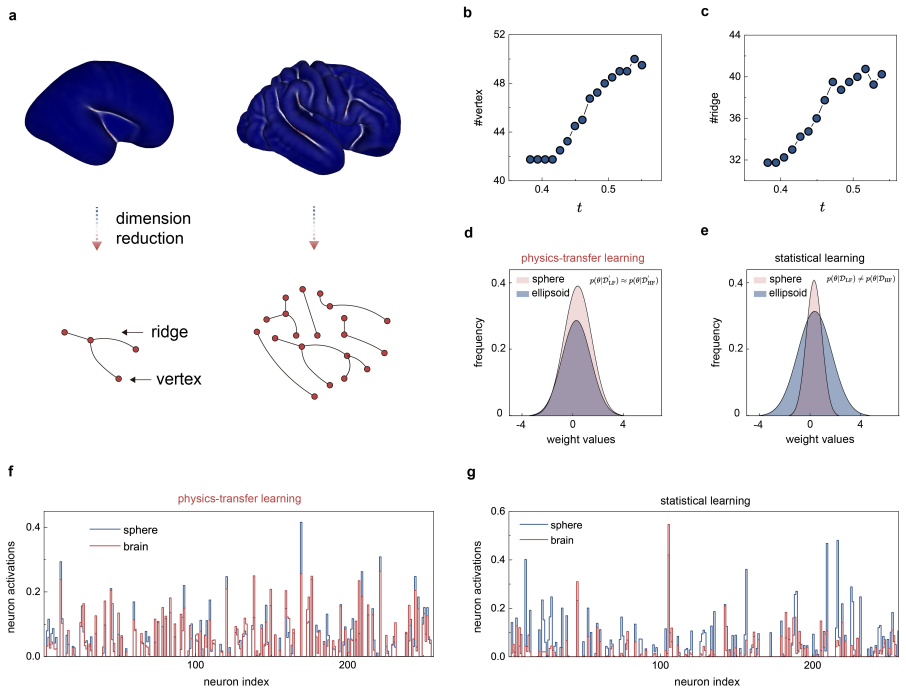
- Interpretability: PT-trained models show similar weight distributions and neuron activations on sphere and brain data, whereas statistical models diverge across domains.
- Scale separation: information-bottleneck analysis indicates that localized deformation curvature is more informative for morphogenesis than large-scale background curvature.
Reading between the lines
- A direct test of the clinical headline would require per-subject longitudinal MRI, not just a population-averaged atlas; until then, 'individual trajectory prediction' remains a transfer claim awaiting individual-level validation.
- The same recipe—a synthetic FEA library on simple shells, a frozen-weight graph network, zero-shot application to an organ mesh—should port to other growth-instability morphologies such as intestinal villi, tumor spheroids, or swelling gels, since the paper's own logic makes background geometry secondary.
- The normal-vector input features carry local orientation information, so the PT-versus-SL gap may partly reflect a geometric descriptor rather than learned elasticity; an ablation withholding normals from the PT model would isolate the physics contribution.
- The latent-distance/KDE metric could be deployed as a clinical early-warning system for when the digital twin is untrustworthy, but its calibration on real individual trajectories is not established in the paper.
Editorial analysis
A structured set of objections, weighed in public.
Referee Report
Summary. The paper proposes a physics-transfer (PT) learning framework for brain morphogenesis. A graph neural network is pretrained on finite-element simulations of growth-driven nonlinear elastic instabilities on spheres and ellipsoids, then applied zero-shot to human fetal brain surface meshes. The reported results are a curvature-prediction task, where PT achieves MAE below 0.5 mm^-1 versus 7.01 mm^-1 for a statistical-learning (SL) control, and a one-week-ahead morphogenesis prediction task with MAE below 0.01. The authors further analyze network weights and activations to argue that the PT model encodes transferable physics of cortical folding. The core claim is that nonlinear-elasticity physics learned on simple geometries transfers to complex brain geometries despite data scarcity.
Significance. If substantiated, the framework would be valuable: it addresses a real data-scarcity problem in fetal brain MRI, offers a computationally feasible route from mechanical simulations to patient-specific morphology prediction, and includes interpretability analyses that go beyond black-box accuracy. The digital-library idea and the explicit FEA-plus-GNN pipeline are strengths, and the paper is clearly written in its high-level structure. However, the current experimental design does not isolate physics transfer from geometric feature engineering, and the validation data cannot support the individual-level prediction claims. The significance of the contribution is therefore not established by the evidence presented.
major comments (3)
- [Results, 'Predictions of curvature maps and 3D morphology'; Methods, 'Machine learning models'] The head-to-head comparison between PT and SL (Figs. 3c,d) is confounded by an input-feature asymmetry. The PT node features are 'spatial coordinates and normal vectors', while the SL control 'excluded normal vectors from the inputs' (Methods, Machine learning models). For a smooth surface, mean curvature is half the divergence of the normal field and the full curvature tensor is determined by position and normals; hence a model supplied with normals can learn a generic discrete differential-geometry operator from any training corpus and does not require elasticity/growth physics. The reported MAE of <0.5 mm^-1 vs 7.01 mm^-1 therefore does not establish that nonlinear-elasticity physics transfers; it may simply reflect the availability of normals. A valid control would give SL the same input features or compare against a standard cotangent-Laplacian curvature estimator, and would train b
- [Methods, 'Collection of medical data'; Fig. 3f] The morphogenesis validation uses a population-averaged spatio-temporal atlas of the fetal brain spanning 21–36 weeks of gestation, with 32,492 vertices per hemisphere, not longitudinal scans of individual subjects. Consequently, the one-week-ahead MAE <0.01 measures how well the model tracks the population-mean developmental trajectory, not how well it predicts an individual brain's evolution. The Introduction and Discussion repeatedly claim individualized trajectory prediction and patient-specific digital twins; these claims are not supported by this dataset. Either individual longitudinal data are needed, or the claims must be explicitly restricted to population-mean morphogenesis.
- [Model interpretability; Eq. (8) and Fig. 4d-e] Equation (8) asserts p(θ|D'_L) ≈ p(θ|D'_H), but the supporting experiment reports only the mean layer-wise weight µ (Eq. 11). Equality of means is not equality of distributions; the identical mean could conceal very different variances or higher-order structure. Moreover, no quantitative distributional distance or statistical test is given, and the comparison appears to be based on a single training run. The claim of distributional similarity between PT models trained on spheres and ellipsoids is therefore unsupported. A proper analysis would compute, e.g., a Wasserstein distance between weight distributions across multiple random seeds and compare it with the same metric for SL.
minor comments (6)
- [Results, Fig. 3f] The units for the one-week-ahead MAE (<0.01) are not specified. If the coordinates are normalized or scaled, please state this explicitly; otherwise the reader cannot interpret the magnitude.
- [Methods, 'Machine learning models'] The composite loss includes a 'global gyrification index' but does not define it. Please specify how it is computed from the surface and how it enters the loss weighting.
- [Methods, 'Digital libraries'] The digital FEA library is not described in enough detail for reproducibility: no number of simulations, parameter sampling distributions, train/test splits, or mesh statistics are given. Please add these details or a reference to a public dataset.
- [Supplementary Note S2, Fig. S7d] The information-bottleneck comparison reports 34% versus 31% compression. Without error bars or significance testing, this small difference does not support the conclusion that deformation curvature 'plays a more critical role' in morphogenesis.
- [Equations (5)–(8)] The notation p(θ|D), D' ⊂ D, and p(θ|D_L') ≈ p(θ|D_H') is informal and not standard in machine learning. Clarify the intended probabilistic model, or replace these statements with precise definitions of the data domains and model parameter distributions.
- [General] No data or code availability statement is provided. Given the paper's reliance on FEA-generated data and GNN training, a public release or clear availability statement is essential for reproducibility.
Circularity Check
Curvature 'prediction' reduces to a learned geometric identity: positions+normals determine curvature, so the PT-vs-SL gap is an input-feature artifact, not evidence of physics transfer.
-
fitted input called prediction
[Results, 'Predictions of curvature maps and 3D morphology'; Methods, 'Machine learning models']
"Using an encoder-decoder graph neural network (GNN) architecture (Fig. S4), we represent morphology as a graph where each node encodes features including spatial coordinates and normal vectors. The model predicts local curvature values... As a control, we trained a statistical learning (SL) model that excluded normal vectors from the inputs, retaining only morphological data and thereby limiting its ability to capture the physics underlying curvature, which depends on nonlinear elasticity (see Methods for details)."
On a triangulated surface, mean curvature is half the divergence of the normal field and Gaussian curvature is fixed by the shape operator, so positions plus normals determine curvature locally. The PT model's target is therefore a deterministic function of its input features; a GNN can learn this discrete-geometry mapping from any training set, and the nonlinear-elasticity/growth physics in the digital library is not needed. The SL control omits normals, so the reported PT-vs-SL gain (MAE <0.5 vs 7.01 mm^-1) measures whether normals are informative, not whether physics transferred. The curvature 'prediction' reduces by construction to the input features.
full rationale
The central quantitative evidence for 'physics transfer' is the curvature result (Figs. 3c,d), but that evidence is confounded: the PT model receives spatial coordinates and normal vectors as node features, while the SL control excludes normals. Since curvature is a local differential function of positions and normals, the PT model can succeed by learning a generic discrete-geometry operator, independent of the sphere/ellipsoid growth simulations. The reported advantage over SL therefore does not establish that nonlinear-elasticity physics was transferred. This is a partial circularity: one of the two headline claims ('feature characterization') reduces to an input-feature artifact. The morphogenesis prediction, by contrast, is an independent supervised-learning task trained on FEA-generated trajectories and tested against MRI-derived data; it is not circular, though validation against a population-averaged atlas rather than individual longitudinal trajectories is a separate validity limitation. The self-citation to Ref. [28] for the PT concept is not load-bearing, because the present method is implemented and tested here; no uniqueness theorem or ansatz is smuggled in solely via that citation. Overall, the curvature prediction is forced by construction, while the morphogenesis claim retains independent content, warranting a score of 6 rather than higher.
Assumptions & free parameters
free parameters (4)
- growth coefficient α_t =
not specified
- cortical thickness range =
0.03 to 1.63 mm
- relative shear modulus G_shell/G_core =
0.65 to 1
- loss weights for composite loss =
not specified
assumptions (5)
- domain assumption Tangential growth (TG) model: differential growth of gray vs. white matter drives cortical folding via mechanical instability
- domain assumption Brain tissue behaves as a nonlinear Neo-Hookean hyperelastic material with bulk modulus K = 5G
- domain assumption Core-shell representation of the brain (outer gray matter shell, inner white matter core) with cortical thickness 0.03 to 1.63 mm
- ad hoc to paper Training on sphere/ellipsoid growth simulations produces a latent representation that transfers zero-shot to human brain meshes
- ad hoc to paper Models trained on different data complexities share similar parameter distributions when physics is transferred, p(θ|D'_L) ≈ p(θ|D'_H) (Eq. 8)
Cite this review
Pith. "Pith review of Predicting Brain Morphogenesis via Physics-Transfer Learning." pith.science (2026). https://pith.science/paper/EGQPOIEZ
@misc{pith2026250905305,
  author       = {Pith},
  title        = {Pith review of: Predicting Brain Morphogenesis via Physics-Transfer Learning},
  year         = {2026},
  howpublished = {\url{https://pith.science/paper/EGQPOIEZ}},
  note         = {Machine review of arXiv:2509.05305}
}
read the original abstract
Brain morphology is shaped by genetic and mechanical factors and is linked to biological development and diseases. Its fractal-like features, regional anisotropy, and complex curvature distributions hinder quantitative insights in medical inspections. Recognizing that the underlying elastic instability and bifurcation share the same physics as simple geometries such as spheres and ellipses, we developed a physics-transfer learning framework to address the geometrical complexity. To overcome the challenge of data scarcity, we constructed a digital library of high-fidelity continuum mechanics modeling that both describes and predicts the developmental processes of brain growth and disease. The physics of nonlinear elasticity from simple geometries is embedded into a neural network and applied to brain models. This physics-transfer approach demonstrates remarkable performance in feature characterization and morphogenesis prediction, highlighting the pivotal role of localized deformation in dominating over the background geometry. The data-driven framework also provides a library of reduced-dimensional evolutionary representations that capture the essential physics of the highly folded cerebral cortex. Validation through medical images and domain expertise underscores the deployment of digital-twin technology in comprehending the morphological complexity of the brain.
Figures


Figures from the paper (3 more)


Reference graph
Works this paper leans on
-
[1]
John C Silbereis, Sirisha Pochareddy, Ying Zhu, Mingfeng Li, and Nenad Sestan. The cellular and molecular landscapes of the developing human central nervous system.Neuron, 89(2):248–268, 2016
work page 2016
-
[2]
Deconstructing cortical folding: Genetic, cellular and mechan- ical determinants
Cristina Llinares-Benadero and Víctor Borrell. Deconstructing cortical folding: Genetic, cellular and mechan- ical determinants. Nat. Rev. Neurosci., 20(3):161–176, 2019
work page 2019
-
[3]
Structural and functional brain networks: From connections to cognition
Hae-Jeong Park and Karl Friston. Structural and functional brain networks: From connections to cognition. Science, 342(6158):1238411, 2013
work page 2013
-
[4]
Neural tuning and representational geometry
Nikolaus Kriegeskorte and Xue-Xin Wei. Neural tuning and representational geometry. Nat. Rev. Neurosci., 22(11):703–718, 2021
work page 2021
-
[5]
Geometric constraints on human brain function.Nature, 618(7965):566–574, 2023
James C Pang, Kevin M Aquino, Marianne Oldehinkel, Peter A Robinson, Ben D Fulcher, Michael Breakspear, and Alex Fornito. Geometric constraints on human brain function.Nature, 618(7965):566–574, 2023
work page 2023
-
[6]
Renske Oegema, Tahsin Stefan Barakat, Martina Wilke, Katrien Stouffs, Dina Amrom, Eleonora Aronica, Na- dia Bahi-Buisson, Valerio Conti, Andrew E Fry, Tobias Geis, et al. International consensus recommendations on the diagnostic work-up for malformations of cortical development. Nat. Rev. Neurosci., 16(11):618–635, 2020
work page 2020
-
[7]
Chloe Hutton, Bogdan Draganski, John Ashburner, and Nikolaus Weiskopf. A comparison between voxel- based cortical thickness and voxel-based morphometry in normal aging.Neuroimage, 48(2):371–380, 2009
work page 2009
-
[9]
Brain charts for the human lifespan
Richard AI Bethlehem, Jakob Seidlitz, Simon R White, Jacob W Vogel, Kevin M Anderson, Chris Adamson, Sophie Adler, George S Alexopoulos, Evdokia Anagnostou, Ariosky Areces-Gonzalez, et al. Brain charts for the human lifespan. Nature, 604(7906):525–533, 2022
work page 2022
Show all 63 references
-
[10]
Residual stress in the adult mouse brain
Gang Xu, Philip V Bayly, and Larry A Taber. Residual stress in the adult mouse brain. Biomech. Model. Mechanobiol., 8:253–262, 2009
2009
-
[11]
Axons pull on the brain, but tension does not drive cortical folding.J
Gang Xu, Andrew K Knutsen, Krikor Dikranian, Christopher D Kroenke, Philip V Bayly, and Larry A Taber. Axons pull on the brain, but tension does not drive cortical folding.J. Biomech. Eng., 132(7):071013, 2010
2010
-
[12]
Single subject prediction of brain disorders in neuroimaging: Promises and pitfalls.Neuroimage, 145:137–165, 2017
Mohammad R Arbabshirani, Sergey Plis, Jing Sui, and Vince D Calhoun. Single subject prediction of brain disorders in neuroimaging: Promises and pitfalls.Neuroimage, 145:137–165, 2017
2017
-
[13]
Machine learning for medical imaging: Methodological failures and recommendations for the future.NPJ Digit
Gaël Varoquaux and Veronika Cheplygina. Machine learning for medical imaging: Methodological failures and recommendations for the future.NPJ Digit. Med., 5:48, 2022
2022
-
[14]
Definitions and classi- fication of malformations of cortical development: Practical guidelines.Brain, 143(10):2874–2894, 2020
Mariasavina Severino, Ana Filipa Geraldo, Norbert Utz, Domenico Tortora, Ivana Pogledic, Wlodzimierz Klonowski, Fabio Triulzi, Filippo Arrigoni, Kshitij Mankad, Richard J Leventer, et al. Definitions and classi- fication of malformations of cortical development: Practical guid...
2020
-
[15]
Computational pipeline for the generation and validation of patient-specific mechanical models of brain development.Brain Multiphys., 3:100045, 2022
Mireia Alenyà, Xiaoyu Wang, Julien Lefèvre, Guillaume Auzias, Benjamin Fouquet, Elisenda Eixarch, François Rousseau, and Oscar Camara. Computational pipeline for the generation and validation of patient-specific mechanical models of brain development.Brain Multiphys., 3:100045...
2022
-
[16]
Validating the predictions of math- ematical models describing tumor growth and treatment response.arXiv preprint arXiv:2502.19333, 2025
Guillermo Lorenzo, David A Hormuth, Chengyue Wu, Graham Pash, Anirban Chaudhuri, Ernesto ABF Lima, Lois C Okereke, Reshmi Patel, Karen Willcox, Thomas E Yankeelov, et al. Validating the predictions of math- ematical models describing tumor growth and treatment response.arXiv p...
2025 arXiv
-
[17]
Computational models of cortical folding: A review of common approaches.J
Mohsen Darayi, Mia E Hoffman, John Sayut, Shuolun Wang, Nagehan Demirci, Jack Consolini, and Maria A Holland. Computational models of cortical folding: A review of common approaches.J. Biomech., 139:110851, 2022
2022
-
[18]
Gyrification from constrained cortical expansion
Tuomas Tallinen, Jun Young Chung, John S Biggins, and Lakshminarayanan Mahadevan. Gyrification from constrained cortical expansion. Proc. Natl. Acad. Sci. USA, 111(35):12667–12672, 2014
2014
-
[19]
On the growth and form of cortical convolutions.Nat
Tuomas Tallinen, Jun Young Chung, François Rousseau, Nadine Girard, Julien Lefèvre, and Lakshmi- narayanan Mahadevan. On the growth and form of cortical convolutions.Nat. Phys., 12(6):588–593, 2016
2016
-
[20]
On the influence of inhomogeneous stiffness and growth on mechanical instabilities in the developing brain
Silvia Budday and Paul Steinmann. On the influence of inhomogeneous stiffness and growth on mechanical instabilities in the developing brain. Int. J. Solids Struct., 132:31–41, 2018
2018
-
[21]
The role of thickness inhomogeneities in hierarchical cortical folding.NeuroImage, 231:117779, 2021
Lucas da Costa Campos, Raphael Hornung, Gerhard Gompper, Jens Elgeti, and Svenja Caspers. The role of thickness inhomogeneities in hierarchical cortical folding.NeuroImage, 231:117779, 2021
2021
-
[22]
The influence of biophysical parameters in a biomechanical model of cortical folding patterns
Xiaoyu Wang, Julien Lefèvre, Amine Bohi, Mariam Al Harrach, Mickaël Dinomais, and François Rousseau. The influence of biophysical parameters in a biomechanical model of cortical folding patterns. Sci. Rep., 11:7686, 2021
2021
-
[23]
Brain latent progression: Individual-based spatiotem- poral disease progression on 3D brain MRIs via latent diffusion.arXiv preprint arXiv:2502.08560, 2025
Lemuel Puglisi, Daniel C Alexander, and Daniele Ravì. Brain latent progression: Individual-based spatiotem- poral disease progression on 3D brain MRIs via latent diffusion.arXiv preprint arXiv:2502.08560, 2025
2025 arXiv
-
[24]
Physics- informed machine learning
George Em Karniadakis, Ioannis G Kevrekidis, Lu Lu, Paris Perdikaris, Sifan Wang, and Liu Yang. Physics- informed machine learning. Nat. Rev. Phys., 3(6):422–440, 2021
2021
-
[25]
Physics-informed neural networks: A deep learn- ing framework for solving forward and inverse problems involving nonlinear partial differential equations
Maziar Raissi, Paris Perdikaris, and George E Karniadakis. Physics-informed neural networks: A deep learn- ing framework for solving forward and inverse problems involving nonlinear partial differential equations. J. Comput. Phys., 378:686–707, 2019
2019
-
[26]
E(3)-equivariant graph neural networks for data-efficient and accurate interatomic potentials.Nat
Simon Batzner, Albert Musaelian, Lixin Sun, Mario Geiger, Jonathan P Mailoa, Mordechai Kornbluth, Nicola Molinari, Tess E Smidt, and Boris Kozinsky. E(3)-equivariant graph neural networks for data-efficient and accurate interatomic potentials.Nat. Commun., 13(1):2453, 2022
2022
-
[27]
Weak baselines and reporting biases lead to overoptimism in machine learning for fluid-related partial differential equations.Nat
Nick McGreivy and Ammar Hakim. Weak baselines and reporting biases lead to overoptimism in machine learning for fluid-related partial differential equations.Nat. Mach. Intell., 6(10):1256–1269, 2024
2024
-
[28]
Discov- ering high-strength alloys via physics-transfer learning.arXiv preprint arXiv:2403.07526, 2024
Yingjie Zhao, Hongbo Zhou, Zian Zhang, Zhenxing Bo, Baoan Sun, Minqiang Jiang, and Zhiping Xu. Discov- ering high-strength alloys via physics-transfer learning.arXiv preprint arXiv:2403.07526, 2024
2024 arXiv
-
[29]
Cortical folding: When, where, how, and why? Annu
Georg F Striedter, Shyam Srinivasan, and Edwin S Monuki. Cortical folding: When, where, how, and why? Annu. Rev. Neurosci., 38:291–307, 2015
2015
-
[30]
A model of tension-induced fiber growth predicts white matter organization during brain folding.Nat
Kara E Garcia, Xiaojie Wang, and Christopher D Kroenke. A model of tension-induced fiber growth predicts white matter organization during brain folding.Nat. Commun., 12:6681, 2021
2021
-
[31]
The ‘Digital Twin’ to enable the vision of precision cardiology.Eur
Jorge Corral-Acero, Francesca Margara, Maciej Marciniak, Cristobal Rodero, Filip Loncaric, Yingjing Feng, An- drew Gilbert, Joao F Fernandes, Hassaan A Bukhari, Ali Wajdan, et al. The ‘Digital Twin’ to enable the vision of precision cardiology.Eur. Heart J., 41(48):4556–4564, 2020. 13
2020
-
[32]
Fetal brain MRI atlases and datasets: A review.Neu- roImage, 292:120603, 2024
Tommaso Ciceri, Luca Casartelli, Florian Montano, Stefania Conte, Letizia Squarcina, Alessandra Bertoldo, Nivedita Agarwal, Paolo Brambilla, and Denis Peruzzo. Fetal brain MRI atlases and datasets: A review.Neu- roImage, 292:120603, 2024
2024
-
[33]
Chiral topographic instability in shrinking spheres
Fan Xu, Yangchao Huang, Shichen Zhao, and Xi-Qiao Feng. Chiral topographic instability in shrinking spheres. Nat. Comput. Sci., 2(10):632–640, 2022
2022
-
[34]
Stress-driven buckling patterns in spheroidal core/shell structures
Jie Yin, Zexian Cao, Chaorong Li, Izhak Sheinman, and Xi Chen. Stress-driven buckling patterns in spheroidal core/shell structures. Proc. Natl. Acad. Sci. USA, 105(49):19132–19135, 2008
2008
-
[35]
Bistable structures with controllable wrinkled surface.Extreme Mech
Junjie Lin, Qiaohang Guo, Shiwen Dou, Nengbin Hua, Chan Zheng, Yian Pan, Youting Huang, Zi Chen, and Wenzhe Chen. Bistable structures with controllable wrinkled surface.Extreme Mech. Lett., 36:100653, 2020
2020
-
[36]
Growth strain-induced wrinkled membrane morphology of white blood cells
Lifeng Wang, Carlos E Castro, and Mary C Boyce. Growth strain-induced wrinkled membrane morphology of white blood cells. Soft Matter, 7(24):11319–11324, 2011
2011
-
[37]
Measuring the thickness of the human cerebral cortex from magnetic res- onance images
Bruce Fischl and Anders M Dale. Measuring the thickness of the human cerebral cortex from magnetic res- onance images. Proc. Natl. Acad. Sci. USA, 97(20):11050–11055, 2000
2000
-
[38]
The role of reln in lissencephaly and neuropsychiatric disease
Bernard S Chang, Fusun Duzcan, Seonhee Kim, Mine Cinbis, Abha Aggarwal, Kira A Apse, Osman Ozdel, Munevver Atmaca, Sevil Zencir, Huseyin Bagci, et al. The role of reln in lissencephaly and neuropsychiatric disease. Am. J. Med. Genet. B Neuropsychiatr. Genet., 144:58–63, 2007
2007
-
[39]
Morphogenesis of growing soft tissues.Phys
Julien Dervaux and Martine Ben Amar. Morphogenesis of growing soft tissues.Phys. Rev. Lett., 101(6):068101, 2008
2008
-
[40]
Mechanical properties of gray and white matter brain tissue by indentation
Silvia Budday, Richard Nay, Rijk De Rooij, Paul Steinmann, Thomas Wyrobek, Timothy C Ovaert, and Ellen Kuhl. Mechanical properties of gray and white matter brain tissue by indentation. J. Mech. Behav. Biomed. Mater., 46:318–330, 2015
2015
-
[41]
Unraveling the morphological complexity of two- dimensional macromolecules
Yingjie Zhao, Jianshu Qin, Shijun Wang, and Zhiping Xu. Unraveling the morphological complexity of two- dimensional macromolecules. Patterns, 3(6):100497, 2022
2022
-
[42]
A data-driven approach to morphogenesis under structural instability
Yingjie Zhao and Zhiping Xu. A data-driven approach to morphogenesis under structural instability. Cell Rep. Phys. Sci., 5(3):101872, 2024
2024
-
[43]
Learning mesh-based simula- tion with graph networks
Tobias Pfaff, Meire Fortunato, Alvaro Sanchez-Gonzalez, and Peter Battaglia. Learning mesh-based simula- tion with graph networks. InInt. Conf. Learn. Represent. (ICLR), 2020
2020
-
[44]
A mechanical model predicts morphological abnormalities in the developing human brain.Sci
Silvia Budday, Charles Raybaud, and Ellen Kuhl. A mechanical model predicts morphological abnormalities in the developing human brain.Sci. Rep., 4:5644, 2014
2014
-
[45]
A density-based algorithm for discovering clusters in large spatial databases with noise
Martin Ester, Hans-Peter Kriegel, Jörg Sander, Xiaowei Xu, et al. A density-based algorithm for discovering clusters in large spatial databases with noise. In Knowl. Discov. Data Min. (KDD), volume 96, pages 226–231, 1996
1996
-
[46]
Physics-informed learning of governing equations from scarce data.Nat
Zhao Chen, Yang Liu, and Hao Sun. Physics-informed learning of governing equations from scarce data.Nat. Commun., 12:6136, 2021
2021
-
[47]
Connectionist learning procedures
Geoffrey E Hinton. Connectionist learning procedures. In Machine Learning, pages 555–610. Elsevier, 1990
1990
-
[48]
Deep neural networks via complex network theory: A perspective
Emanuele La Malfa, Gabriele La Malfa, Giuseppe Nicosia, and Vito Latora. Deep neural networks via complex network theory: A perspective. arXiv preprint arXiv:2404.11172, 2024. 14
2024 arXiv
-
[49]
A theory of learning from different domains.Mach
Shai Ben-David, John Blitzer, Koby Crammer, Alex Kulesza, Fernando Pereira, and Jennifer Wortman Vaughan. A theory of learning from different domains.Mach. Learn., 79:151–175, 2010
2010
-
[50]
The information bottleneck method
Naftali Tishby, Fernando C Pereira, and William Bialek. The information bottleneck method. arXiv preprint physics/0004057, 2000
2000 arXiv
-
[51]
Deep learning and the information bottleneck principle
Naftali Tishby and Noga Zaslavsky. Deep learning and the information bottleneck principle. In IEEE Inf. Theory Workshop (ITW), pages 1–5. IEEE, 2015
2015
-
[52]
Torgeir Hellstrøm, Lars Tjelta Westlye, Solrun Sigurdardottir, Cathrine Brunborg, HL Soberg, Øyvor Holthe, ANDRES Server, Martina Jonette Lund, Ole Andreas Andreassen, and Nada Andelic. Longitudinal changes in brain morphology from 4 weeks to 12 months after mild traumatic bra...
2017
-
[53]
MRI of Creutzfeldt– Jakob disease: Imaging features and recommended MRI protocol.Clin
Donald A Collie, Robin J Sellar, Martin Zeidler, Alan CF Colchester, R Knight, and RG Will. MRI of Creutzfeldt– Jakob disease: Imaging features and recommended MRI protocol.Clin. Radiol., 56(9):726–739, 2001
2001
-
[54]
Effect of spaceflight experience on human brain structure, microstructure, and function: Systematic review of neuroimaging studies.Brain Imaging Be- hav., 18:1256–1279, 2024
Sahar Rezaei, Homa Seyedmirzaei, Esmaeil Gharepapagh, Fateme Mohagheghfard, Zahra Hasankhani, Mahsa Karbasi, Sahar Delavari, and Mohammad Hadi Aarabi. Effect of spaceflight experience on human brain structure, microstructure, and function: Systematic review of neuroimaging stu...
2024
-
[55]
Automated model discovery for human brain using constitu- tive artificial neural networks.Acta Biomater., 160:134–151, 2023
Kevin Linka, Sarah R St Pierre, and Ellen Kuhl. Automated model discovery for human brain using constitu- tive artificial neural networks.Acta Biomater., 160:134–151, 2023
2023
-
[56]
The develop- ing human connectome project: A minimal processing pipeline for neonatal cortical surface reconstruction
Antonios Makropoulos, Emma C Robinson, Andreas Schuh, Robert Wright, Sean Fitzgibbon, Jelena Bozek, Serena J Counsell, Johannes Steinweg, Katy Vecchiato, Jonathan Passerat-Palmbach, et al. The develop- ing human connectome project: A minimal processing pipeline for neonatal co...
2018
-
[57]
Mapping the molecular and cellular com- plexity of cortical malformations.Science, 371(6527):eaba4517, 2021
Esther Klingler, Fiona Francis, Denis Jabaudon, and Silvia Cappello. Mapping the molecular and cellular com- plexity of cortical malformations.Science, 371(6527):eaba4517, 2021
2021
-
[58]
Real-Time Collision Detection
Christer Ericson. Real-Time Collision Detection. CRC Press, Florida, 2004
2004
-
[59]
Nonlinear Finite Elements for Continua and Structures
Ted Belytschko, Wing Kam Liu, Brian Moran, and Khalil Elkhodary. Nonlinear Finite Elements for Continua and Structures. John Wiley & Sons, New Jersey, 2014
2014
-
[60]
Developing Human Connectome Project spatio-temporal surface atlas of the fetal brain
Vycheslav Karolis, Logan Williams, Vanessa Kyriakopoulou, Jelena Bozek, Alena Uus, Antonios Makropoulos, Andreas Schuh, Lucilio Cordero Grande, Emer Hughes, Anthony Price, Maria Deprez, Mary Rutherford, et al. Developing Human Connectome Project spatio-temporal surface atlas o...
-
[61]
Karl Pearson. LIII. On lines and planes of closest fit to systems of points in space. Phil. Mag., 2(11):559–572, 1901
1901
-
[62]
On estimation of a probability density function and mode
Emanuel Parzen. On estimation of a probability density function and mode. Ann. Math. Stat., 33(3):1065– 1076, 1962
1962
-
[63]
Deep autoencoding Gaussian mixture model for unsupervised anomaly detection
Bo Zong, Qi Song, Martin Renqiang Min, Wei Cheng, Cristian Lumezanu, Daeki Cho, and Haifeng Chen. Deep autoencoding Gaussian mixture model for unsupervised anomaly detection. In Int. Conf. Learn. Represent. (ICLR), 2018. 15 Figures and Figure Captions Figure 1. Brain developme...
2018
-
[2023]
https://doi.org/10.12751/g-node.qj5hs7
Reviewed August 5, 2026 · model on record in the stance chip above.
Discussion (0). Sign in to comment.