REVIEW 2 major objections 6 minor 83 references
Eigenstate thermalization hypothesis and integrals of motion
T0 review · 2 major / 6 minor · reviewed 2026-08-14 · deepseek-v4-flash
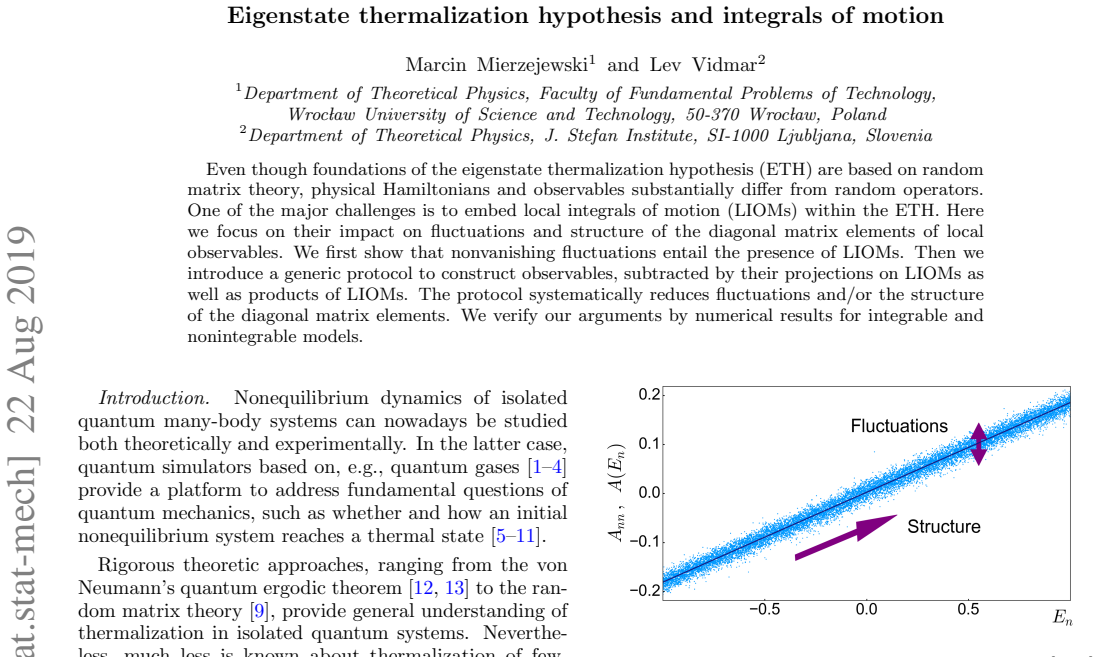
Pith's one-line read If the eigenstate fluctuations of a local observable do not vanish with system size, a local integral of motion must exist—and subtracting projections onto conserved operators removes those fluctuations order by order.
desk verdict A clean projection protocol and a plausible formal implication, but the main claim leans on a locality statement imported from the Mazur-bound literature; worth engaging and worth sending to referees. read the letter →
The pith
A machine-rendered reading of the paper's core claim, the machinery that carries it, and where it could break.
The reading
What carries the argument
The load-bearing object is the operator stiffness $\sigma^2_A = \langle \bar{A} \bar{A} \rangle$, the squared Hilbert-Schmidt norm of the infinite-time averaged observable, which equals the mean-square of the diagonal matrix elements $A_{nn}$. The key identity is that for the Hamiltonian-projected observable, $\langle A \bar{A}_\perp \rangle^2 / \langle \bar{A}_\perp \bar{A}_\perp \rangle = \sigma^2_{A\perp}$, which combines with the Mazur bound to convert a positive stiffness into the statement that $\bar{A}_\perp$ is a local or pseudolocal conserved operator. For products of LIOMs, the protocol is an orthogonalization: the $k$-products $H_{\perp k}$ are built by Gram-Schmidt from powers of $H$, projected observables subtract the best polynomial fit to the microcanonical average, and a Gaussian density of states identifies the orthogonal polynomials as Hermite polynomials, giving $r_k \sim 1/L^{k-1}$.
What would settle it
A concrete check: in a translationally invariant model whose only conserved operators are explicitly nonlocal, compute the stiffness $\sigma^2_{A\perp}$ and the support width of $\bar{A}_\perp$ for a local observable with nonvanishing fluctuations; if positive stiffness coexists with a $\bar{A}_\perp$ whose width grows linearly with $L$, the locality step collapses. In the hard-core boson example, any nonzero diagonal element of the two-projected observable at accessible system sizes would refute the exact-zero claim as stated.
Extended reading notes
Core claim
On the paper's own terms, the discovery is an implication: for a traceless, translationally invariant local observable with normalized norm, the condition $\lim_{L\to\infty} \Sigma^2_A(\Delta)>0$ forces the time-averaged operator $\bar{A}_\perp = \overline{A - p_A H}$ to have positive stiffness $\sigma^2_{A\perp} = (1/Z) \sum_n (A_{nn} - p_A E_n)^2$. Because only local or pseudolocal conserved operators contribute to the Mazur bound in the thermodynamic limit, the positive stiffness identifies this conserved operator as a LIOM; conversely, if a proposed set of LIOMs is complete, subtracting projections onto it drives the stiffness to zero. The paper then constructs $k$-projected observables whose stiffness decays as $1/L^{k-1}$ in generic systems, and in the hard-core boson chain the two-projected observable has all diagonal matrix elements exactly zero already in finite systems.
Load-bearing premise
The argument leans on the imported theorem that, in the thermodynamic limit, only local or pseudolocal conserved operators contribute to the Mazur bound for a translationally invariant local observable; if some nonlocal conserved operator could carry nonzero weight in that sum, positive fluctuation stiffness would not prove the existence of a local integral of motion.
Editorial extensions
If this is right
- For any local observable in a generic nonintegrable system, subtracting the projection onto the Hamiltonian and its powers removes the energy structure of the diagonal matrix elements, after which fluctuations decay exponentially with system size.
- If nonvanishing fluctuations always signal a LIOM, then ordinary ETH and generalized ETH are not competing descriptions: the latter is the former once hidden conserved operators are subtracted.
- The protocol gives a convergence test for a proposed set of LIOMs: if the stiffness of the projected observable does not vanish as $L\to\infty$, the set is incomplete.
- In integrable models, subtracting projections onto all LIOMs and their products can push the diagonal matrix elements to exactly zero at finite size, realizing a limiting strong ETH without fluctuations.
Reading between the lines
- This suggests a diagnostic use in reverse: measuring the stiffness of experimentally accessible observables could reveal hidden or approximate conserved quantities in systems not already known to be integrable.
- Because products of LIOMs are nonlocal few-body operators, the exact-zero result implies that the generalized ETH ansatz should be formulated with the full algebra generated by local charges, not just the charges themselves.
- For disordered or many-body-localized systems, where the Hamiltonian is not translationally invariant, a generalized version of this protocol would likely reduce fluctuations whenever approximate LIOMs exist; that extension is not worked out in the paper.
- A natural numerical test beyond the paper is to apply the projection protocol to other integrable chains, such as the XXZ model, and check whether the predicted $1/L^{k-1}$ scaling of the projections persists.
Signed reviews
Editorial analysis
A structured set of objections, weighed in public.
Referee Report
Summary. The manuscript studies the impact of local integrals of motion (LIOMs) on the diagonal matrix elements of local observables in translationally invariant quantum chains. The main theoretical claim is that if the fluctuations of the diagonal matrix elements of a normalized, traceless, translationally invariant local observable do not vanish in the thermodynamic limit (Eq. (5)), then there must exist a LIOM (or pseudolocal conserved operator) with positive overlap with the observable. The argument uses the Mazur bound and a stated known result that only LIOMs contribute to this bound in the thermodynamic limit. The authors then introduce a projection protocol that subtracts the overlap of the observable with LIOMs and their products, claiming a systematic reduction of fluctuations and/or structure, with explicit scaling r_k ~ 1/L^{k-1} for powers of the Hamiltonian in generic systems. Numerical results are presented for a nonintegrable spinless fermion chain and for an integrable hard-core boson chain, where the fully projected observable built from a complete set of LIOMs and their 2-products yields exactly zero diagonal matrix elements.
Significance. If the central implication is valid, the paper provides a concrete route to link finite-size eigenstate fluctuations with the existence of conserved local operators, and it offers a practical construction of observables with strongly suppressed fluctuations. The analytic derivation of the polynomial-fit optimality and the r_k scaling in the supplement is a useful contribution, and the exact cancellation of diagonal matrix elements in the hard-core boson model is a striking constructive result. The paper is explicit about its main assumptions (Gaussian density of states and the ETH form for diagonal matrix elements) and includes a supplement with derivations, which strengthens the presentation.
major comments (2)
- [Violation of ETH entails existence of LIOMs (Eq. (8) and following paragraph)] The central implication — that sigma^2_{A_\perp} > 0 forces the time-averaged operator A_bar_\perp to be a local or pseudolocal integral of motion — is logically equivalent to the assertion, stated after Eq. (8), that in the thermodynamic limit only LIOMs contribute to the Mazur bound for a local observable. This assertion is not proven in the manuscript, and the cited references do not appear to establish it as a general theorem for arbitrary translationally invariant local Hamiltonians: Ref. [61] treats transport in integrable models, Ref. [82] is Mazur's original inequality (which by itself says nothing about locality), and Ref. [83] defines quasilocality in integrable lattice systems. Without a precise statement and proof of this locality result (or a reference that supplies it), the conclusion of the theorem reduces to the near-tautology that nonvanishing fluctuations imply the existence of a nonvanishing conserved operator, namely A_bar_\perp itself, whose conservation holds for any observable. Please either prove the locality statement under clearly stated conditions, or explicitly mark it as an assumption and rephrase the central claim accordingly.
- [Size-dependence of the stiffness / Supplement S2] The analytical result r_k ~ 1/L^{k-1} is derived under the explicit assumptions of a Gaussian density of states (Eq. S7) and the ETH ansatz for diagonal matrix elements (Eq. S12). While these assumptions are stated clearly, the numerical demonstration of the protocol's effectiveness in Fig. 2(b) is limited to one nonintegrable model and to system sizes up to L=21, with the exponential decay presented as a 'guide to the eye' rather than a quantitatively fitted curve with uncertainties. For the protocol claim to be considered generic, additional numerical evidence (e.g., other nonintegrable models or error estimates on the exponential decay) would be needed, or the claim should be phrased more cautiously as a demonstration for the particular model.
minor comments (6)
- [Conclusions and Supplement S2] There are typos: 'nonintregrable' in the Conclusions should be 'nonintegrable', and 'Hemite' in Eq. (S11) of the Supplement should be 'Hermite'.
- [Figs. 2 and 3] The figures do not state the full set of system sizes used, nor do they provide error bars or a measure of the fit quality for the exponential and 1/L extrapolations. Please specify the system sizes and, where claims of scaling are made, provide quantitative fits or state the number of points used.
- [Eq. (8) and the following paragraph] The terms 'local' and 'pseudolocal' are used without precise definitions. This matters because the integrable example later uses operators T(n) and J(n) (Eqs. S16-S19) that are nonlocal in the original hard-core boson basis due to Jordan-Wigner strings; please clarify in which sense these operators are local or pseudolocal.
- [Eq. (3)] The energy window Delta used in the numerical evaluation of Sigma^2_A(Delta) is not specified. Please state the width and position of the window used in Fig. S1 and in the main-text analysis.
- [Introduction and Conclusions] The products of LIOMs are described as 'few-body but nonlocal conserved operators.' For fixed order k, these products are in fact sums of local terms with finite support (for powers of H), so the terminology may confuse readers; the Conclusions also refer to the projected observables as 'albeit nonlocal.' Clarifying the sense of locality/nonlocality here would improve readability.
- [Eq. (4)] The inequality in Eq. (4) is used in the derivation of Eq. (6) but is stated without proof. A brief justification (for instance, that within each microcanonical window the mean is the least-squares constant, so any other smooth function cannot reduce the sum of squares) would make the argument more self-contained.
Circularity Check
No significant circularity: the central implication is exact projection algebra plus an externally cited Mazur-bound locality theorem; the protocol reductions are by-design Gram-Schmidt steps, and the scaling results are derived from stated assumptions rather than fitted to the target.
full rationale
The derivation chain is not circular. The implication from ETH violation to nonzero stiffness of the projected observable is algebraic: Eq. (5) together with the minimization inequality (4) yields Eq. (10), and Eq. (9) is an exact identity for the time-averaged projected operator. The only non-algebraic step is the locality identification of the conserved operator, which rests on the quoted Mazur-bound statement that in the thermodynamic limit only (pseudo)local conserved operators contribute. That statement is cited to external works (Mazur; Zotos-Naef-Prelovsek; Prosen; Ilievski et al.), not to the present authors, so it is imported mathematical support rather than a self-citation or a definitional shortcut. Doubts about that theorem would be a correctness or rigor concern, not circularity. The projection protocol (Eqs. 13-15 and Supplement S4-S6) is an explicit Gram-Schmidt orthogonal projection: subtracting components from a subspace cannot increase the norm, and the paper presents this as the protocol's design rather than as a disguised empirical prediction. The independent predictive content, r_k ~ 1/L^{k-1}, is derived in the Supplement from the stated Gaussian density-of-states and ETH diagonal-form assumptions (S7, S12); neither assumption includes the target result. The HCB exact-zero example is an exact algebraic consequence for the chosen operator after projection onto the complete LIOM and product-of-LIOM space, not a fitted claim. Minor self-citations (e.g., Refs. 30, 42, 46, 73, 74, 76) are contextual or numerical and do not carry the central argument. Hence there is no circular step to report.
Assumptions & free parameters
assumptions (4)
- domain assumption In the thermodynamic limit, only local or pseudolocal conserved operators contribute to the Mazur bound for translationally invariant local observables.
- domain assumption Many-body density of states is Gaussian (Eq. S7).
- domain assumption Diagonal matrix elements of the generic observable obey the ETH form ⟨n|Â|n⟩ = √L A(E_n/L) + O(e^{-L}) (Eq. S12).
- domain assumption The set of one-body conserved operators in Eqs. (S16)-(S19) is complete for the integrable hard-core boson model.
Cite this review
Pith. "Pith review of Eigenstate thermalization hypothesis and integrals of motion." pith.science (2026). https://pith.science/paper/EH4VHSWN
@misc{pith2026190808569,
  author       = {Pith},
  title        = {Pith review of: Eigenstate thermalization hypothesis and integrals of motion},
  year         = {2026},
  howpublished = {\url{https://pith.science/paper/EH4VHSWN}},
  note         = {Machine review of arXiv:1908.08569}
}
read the original abstract
Even though foundations of the eigenstate thermalization hypothesis (ETH) are based on random matrix theory, physical Hamiltonians and observables substantially differ from random operators. One of the major challenges is to embed local integrals of motion (LIOMs) within the ETH. Here we focus on their impact on fluctuations and structure of the diagonal matrix elements of local observables. We first show that nonvanishing fluctuations entail the presence of LIOMs. Then we introduce a generic protocol to construct observables, subtracted by their projections on LIOMs as well as products of LIOMs. The protocol systematically reduces fluctuations and/or the structure of the diagonal matrix elements. We verify our arguments by numerical results for integrable and nonintegrable models.
Figures


Reference graph
Works this paper leans on
-
[61]
Zotos, F
X. Zotos, F. Naef, and P. Prelovsek, Transport and con- servation laws, Phys. Rev. B 55, 11029 (1997)
1997
-
[82]
Mazur, Non-ergodicity of phase functions in certain systems, Physica 43, 533 (1969)
P. Mazur, Non-ergodicity of phase functions in certain systems, Physica 43, 533 (1969)
1969
-
[83]
E. Ilievski, M. Medenjak, T. Prosen, and L. Zadnik, Quasilocal charges in integrable lattice systems, J. Stat. Mech. (2016), 064008. 8 Supplemental Material: Eigenstate thermalization hypothesis and integrals of motion Marcin Mierzejewski1 and Lev Vidmar 2 1Department of Theoretical Physics, Faculty of Fundamental Problems of Technology, Wroc law Universi...
work page 2016
-
[1]
Trotzky, Y.-A
S. Trotzky, Y.-A. Chen, A. Flesch, I. P. McCulloch, U. Schollw¨ ock, J. Eisert, and I. Bloch, Probing the re- laxation towards equilibrium in an isolated strongly cor- related 1D Bose gas, Nat. Phys. 8, 325 (2012)
2012
-
[2]
A. M. Kaufman, M. E. Tai, A. Lukin, M. Rispoli, R. Schittko, P. M. Preiss, and M. Greiner, Quantum ther- malization through entanglement in an isolated many- body system, Science 353, 794 (2016)
2016
-
[3]
Neill, P
C. Neill, P. Roushan, M. Fang, Y. Chen, M. Kolodru- betz, Z. Chen, A. Megrant, R. Barends, B. Campbell, B. Chiaro, A. Dunsworth, E. Jeffrey, J. Kelly, J. Mutus, P. J. J. O’Malley, C. Quintana, D. Sank, A. Vainsencher, J. Wenner, T. C. White, A. Polkovnikov, and J. M. Mar- tinis, Ergodic dynamics and thermalization in an isolated quantum system, Nat. Phys. ...
2016
-
[4]
Y. Tang, W. Kao, K.-Y. Li, S. Seo, K. Mallayya, M. Rigol, S. Gopalakrishnan, and B. L. Lev, Thermal- ization near integrability in a dipolar quantum Newton’s cradle, Phys. Rev. X 8, 021030 (2018)
2018
-
[5]
Bloch, J
I. Bloch, J. Dalibard, and W. Zwerger, Many-body physics with ultracold gases, Rev. Mod. Phys. 80, 885 (2008)
2008
Show all 83 references
-
[6]
Polkovnikov, K
A. Polkovnikov, K. Sengupta, A. Silva, and M. Vengalat- tore, Colloquium: Nonequilibrium dynamics of closed in- teracting quantum systems, Rev. Mod. Phys. 83, 863 (2011)
2011
-
[7]
Langen, R
T. Langen, R. Geiger, and J. Schmiedmayer, Ultracold atoms out of equilibrium, Ann. Rev. Cond. Matt. Phys. 6, 201 (2015)
2015
-
[8]
Eisert, M
J. Eisert, M. Friesdorf, and C. Gogolin, Quantum many- body systems out of equilibrium, Nat. Phys. 11, 124 (2015)
2015
-
[9]
D’Alessio, Y
L. D’Alessio, Y. Kafri, A. Polkovnikov, and M. Rigol, From quantum chaos and eigenstate thermalization to statistical mechanics and thermodynamics, Adv. Phys. 65, 239 (2016)
2016
-
[10]
T. Mori, T. N. Ikeda, E. Kaminishi, and M. Ueda, Ther- malization and prethermalization in isolated quantum systems: a theoretical overview, J. Phys. B 51, 112001 (2018)
2018
-
[11]
J. M. Deutsch, Eigenstate thermalization hypothesis, Rep. Prog. Phys. 81, 082001 (2018)
2018
-
[12]
von Neumann, Beweis des Ergodensatzes und des H- Theorems, Z
J. von Neumann, Beweis des Ergodensatzes und des H- Theorems, Z. Phys. 57, 30 (1929)
1929
-
[13]
Goldstein, J
S. Goldstein, J. L. Lebowitz, R. Tumulka, and N. Zangh` ı, Long-time behavior of macroscopic quantum systems, Eur. Phys. J. H 35, 173 (2010)
2010
-
[14]
Hamazaki and M
R. Hamazaki and M. Ueda, Atypicality of most few-body observables, Phys. Rev. Lett. 120, 080603 (2018)
2018
-
[15]
In this defini- tion, any local observable is also a few-body observable
With local observables we have in mind an extensive sum of observables with support on O(1) sites. In this defini- tion, any local observable is also a few-body observable
-
[16]
J. M. Deutsch, Quantum statistical mechanics in a closed system, Phys. Rev. A 43, 2046 (1991)
1991
-
[17]
Srednicki, Chaos and quantum thermalization, Phys
M. Srednicki, Chaos and quantum thermalization, Phys. Rev. E 50, 888 (1994)
1994
-
[18]
Srednicki, The approach to thermal equilibrium in quantized chaotic systems, J
M. Srednicki, The approach to thermal equilibrium in quantized chaotic systems, J. Phys. A. 32, 1163 (1999)
1999
-
[19]
Rigol, V
M. Rigol, V. Dunjko, and M. Olshanii, Thermalization and its mechanism for generic isolated quantum systems, Nature (London) 452, 854 (2008)
2008
-
[20]
Rigol and M
M. Rigol and M. Srednicki, Alternatives to eigenstate thermalization, Phys. Rev. Lett. 108, 110601 (2012)
2012
-
[21]
Prosen, Ergodic properties of a generic nonintegrable quantum many-body system in the thermodynamic limit, Phys
T. Prosen, Ergodic properties of a generic nonintegrable quantum many-body system in the thermodynamic limit, Phys. Rev. E 60, 3949 (1999)
1999
-
[22]
Rigol, Breakdown of thermalization in finite one- dimensional systems, Phys
M. Rigol, Breakdown of thermalization in finite one- dimensional systems, Phys. Rev. Lett. 103, 100403 (2009)
2009
-
[23]
Rigol, Quantum quenches and thermalization in one- dimensional fermionic systems, Phys
M. Rigol, Quantum quenches and thermalization in one- dimensional fermionic systems, Phys. Rev. A 80, 053607 (2009)
2009
-
[24]
Rigol and L
M. Rigol and L. F. Santos, Quantum chaos and ther- malization in gapped systems, Phys. Rev. A 82, 011604 (2010)
2010
-
[25]
Neuenhahn and F
C. Neuenhahn and F. Marquardt, Thermalization of interacting fermions and delocalization in Fock space, Phys. Rev. E 85, 060101 (2012)
2012
-
[26]
Steinigeweg, J
R. Steinigeweg, J. Herbrych, and P. Prelovˇ sek, Eigenstate thermalization within isolated spin-chain systems, Phys. Rev. E 87, 012118 (2013)
2013
-
[27]
Khatami, G
E. Khatami, G. Pupillo, M. Srednicki, and M. Rigol, Fluctuation-dissipation theorem in an isolated system of quantum dipolar bosons after a quench, Phys. Rev. Lett. 111, 050403 (2013)
2013
-
[28]
Beugeling, R
W. Beugeling, R. Moessner, and M. Haque, Finite-size scaling of eigenstate thermalization, Phys. Rev. E 89, 042112 (2014). 6
2014
-
[29]
Steinigeweg, A
R. Steinigeweg, A. Khodja, H. Niemeyer, C. Gogolin, and J. Gemmer, Pushing the limits of the eigenstate thermal- ization hypothesis towards mesoscopic quantum systems, Phys. Rev. Lett. 112, 130403 (2014)
2014
-
[30]
S. Sorg, L. Vidmar, L. Pollet, and F. Heidrich-Meisner, Relaxation and thermalization in the one-dimensional bose-hubbard model: A case study for the interaction quantum quench from the atomic limit, Phys. Rev. A 90, 033606 (2014)
2014
-
[31]
H. Kim, T. N. Ikeda, and D. A. Huse, Testing whether all eigenstates obey the eigenstate thermalization hypothe- sis, Phys. Rev. E 90, 052105 (2014)
2014
-
[32]
Khodja, R
A. Khodja, R. Steinigeweg, and J. Gemmer, Relevance of the eigenstate thermalization hypothesis for thermal relaxation, Phys. Rev. E 91, 012120 (2015)
2015
-
[33]
Beugeling, R
W. Beugeling, R. Moessner, and M. Haque, Off-diagonal matrix elements of local operators in many-body quan- tum systems, Phys. Rev. E 91, 012144 (2015)
2015
-
[34]
K. R. Fratus and M. Srednicki, Eigenstate thermalization in systems with spontaneously broken symmetry, Phys. Rev. E 92, 040103 (2015)
2015
-
[35]
Chandran, M
A. Chandran, M. D. Schulz, and F. J. Burnell, The eigen- state thermalization hypothesis in constrained Hilbert spaces: A case study in non-Abelian anyon chains, Phys. Rev. B 94, 235122 (2016)
2016
-
[36]
Mondaini, K
R. Mondaini, K. R. Fratus, M. Srednicki, and M. Rigol, Eigenstate thermalization in the two-dimensional trans- verse field ising model, Phys. Rev. E 93, 032104 (2016)
2016
-
[37]
Mondaini and M
R. Mondaini and M. Rigol, Eigenstate thermalization in the two-dimensional transverse field Ising model. II. Off- diagonal matrix elements of observables, Phys. Rev. E 96, 012157 (2017)
2017
-
[38]
Lan and S
Z. Lan and S. Powell, Eigenstate thermalization hypoth- esis in quantum dimer models, Phys. Rev. B 96, 115140 (2017)
2017
-
[39]
J. R. Garrison and T. Grover, Does a single eigenstate encode the full Hamiltonian?, Phys. Rev. X 8, 021026 (2018)
2018
-
[40]
I. M. Khaymovich, M. Haque, and P. A. McClarty, Eigen- state thermalization, random matrix theory, and behe- moths, Phys. Rev. Lett. 122, 070601 (2019)
2019
-
[41]
Hamazaki and M
R. Hamazaki and M. Ueda, Random-matrix behavior of quantum nonintegrable many-body systems with Dyson’s three symmetries, Phys. Rev. E 99, 042116 (2019)
2019
-
[42]
Jansen, J
D. Jansen, J. Stolpp, L. Vidmar, and F. Heidrich- Meisner, Eigenstate thermalization and quantum chaos in the Holstein polaron model, Phys. Rev. B 99, 155130 (2019)
2019
-
[43]
Richter, J
J. Richter, J. Gemmer, and R. Steinigeweg, Impact of eigenstate thermalization on the route to equilibrium, Phys. Rev. E 99, 050104 (2019)
2019
-
[44]
A. Chan, A. De Luca, and J. T. Chalker, Eigenstate cor- relations, thermalization, and the butterfly effect, Phys. Rev. Lett. 122, 220601 (2019)
2019
-
[45]
A. C. Cassidy, C. W. Clark, and M. Rigol, Generalized thermalization in an integrable lattice system, Phys. Rev. Lett. 106, 140405 (2011)
2011
-
[46]
Vidmar and M
L. Vidmar and M. Rigol, Generalized Gibbs ensemble in integrable lattice models, J. Stat. Mech. (2016), 064007
2016
-
[47]
Rigol, Fundamental asymmetry in quenches between integrable and nonintegrable systems, Phys
M. Rigol, Fundamental asymmetry in quenches between integrable and nonintegrable systems, Phys. Rev. Lett. 116, 100601 (2016)
2016
-
[48]
K. He, L. F. Santos, T. M. Wright, and M. Rigol, Single- particle and many-body analyses of a quasiperiodic inte- grable system after a quench, Phys. Rev. A 87, 063637 (2013)
2013
-
[49]
Caux and F
J.-S. Caux and F. H. L. Essler, Time evolution of local observables after quenching to an integrable model, Phys. Rev. Lett. 110, 257203 (2013)
2013
-
[50]
Wouters, J
B. Wouters, J. De Nardis, M. Brockmann, D. Fioretto, M. Rigol, and J.-S. Caux, Quenching the anisotropic Heisenberg chain: Exact solution and generalized Gibbs ensemble predictions, Phys. Rev. Lett. 113, 117202 (2014)
2014
-
[51]
Brockmann, B
M. Brockmann, B. Wouters, D. Fioretto, J. D. Nardis, R. Vlijm, and J.-S. Caux, Quench action approach for releasing the N´ eel state into the spin-1/2 XXZ chain, J. Stat. Mech. (2014), P12009
2014
-
[52]
Pozsgay, M
B. Pozsgay, M. Mesty´ an, M. A. Werner, M. Kormos, G. Zar´ and, and G. Tak´ acs, Correlations after quantum quenches in the XXZ spin chain: Failure of the gen- eralized Gibbs ensemble, Phys. Rev. Lett. 113, 117203 (2014)
2014
-
[53]
Mesty´ an, B
M. Mesty´ an, B. Pozsgay, G. Tak´ acs, and M. A. Werner, Quenching the XXZ spin chain: quench action approach versus generalized Gibbs ensemble, J. Stat. Mech. (2015), P04001
2015
-
[54]
Alba and P
V. Alba and P. Calabrese, The quench action approach in finite integrable spin chains, J. Stat. Mech. (2016), 043105
2016
-
[55]
Caux, The quench action, J
J.-S. Caux, The quench action, J. Stat. Mech. (2016), 064006
2016
-
[56]
Rigol, V
M. Rigol, V. Dunjko, V. Yurovsky, and M. Olshanii, Re- laxation in a completely integrable many-body quantum system: An Ab Initio study of the dynamics of the highly excited states of 1D lattice hard-core bosons, Phys. Rev. Lett. 98, 050405 (2007)
2007
-
[57]
Ishii and T
T. Ishii and T. Mori, Strong eigenstate thermalization within a generalized shell in noninteracting integrable systems, Phys. Rev. E 100, 012139 (2019)
2019
-
[58]
T. N. Ikeda, Y. Watanabe, and M. Ueda, Finite-size scal- ing analysis of the eigenstate thermalization hypothesis in a one-dimensional interacting Bose gas, Phys. Rev. E 87, 012125 (2013)
2013
-
[59]
M. P. Grabowski and P. Mathieu, Structure of the conser- vation laws in quantum integrable spin chains with short range interactions, Ann. Phys. (N.Y.) 243, 299 (1995)
1995
-
[60]
Zotos and P
X. Zotos and P. Prelovˇ sek, Evidence for ideal insulat- ing or conducting state in a one-dimensional integrable system, Phys. Rev. B 53, 983 (1996)
1996
-
[62]
Zotos, Finite temperature Drude weight of the one- dimensional spin- 1/2 Heisenberg model, Phys
X. Zotos, Finite temperature Drude weight of the one- dimensional spin- 1/2 Heisenberg model, Phys. Rev. Lett. 82, 1764 (1999)
1999
-
[63]
Hawkins, M
M. Hawkins, M. Long, and X. Zotos, Long-time asymp- totics and conservation laws in integrable systems, arXiv:0812.3096v1 (2008)
2008 arXiv
-
[64]
J. Benz, T. Fukui, A. Kl¨ umper, and C. Scheeren, On the finite temperature Drude weight of the anisotropic Heisenberg chain, J. Phys. Soc. Jpn. 74, 181 (2005)
2005
-
[65]
Heidrich-Meisner, A
F. Heidrich-Meisner, A. Honecker, and W. Brenig, Trans- port in quasi one-dimensional spin-1/2 systems, Eur. Phys. J. Spec. Top. 151, 135 (2007)
2007
-
[66]
Rigol and B
M. Rigol and B. S. Shastry, Drude weight in systems with open boundary conditions, Phys. Rev. B 77, 161101 (2008). 7
2008
-
[67]
Sirker, R
J. Sirker, R. G. Pereira, and I. Affleck, Diffusion and ballistic transport in one-dimensional quantum systems, Phys. Rev. Lett. 103, 216602 (2009)
2009
-
[68]
Prosen, Open XXZ spin chain: Nonequilibrium steady state and a strict bound on ballistic transport, Phys
T. Prosen, Open XXZ spin chain: Nonequilibrium steady state and a strict bound on ballistic transport, Phys. Rev. Lett. 106, 217206 (2011)
2011
-
[69]
Prosen, Exact nonequilibrium steady state of a strongly driven open XXZ chain, Phys
T. Prosen, Exact nonequilibrium steady state of a strongly driven open XXZ chain, Phys. Rev. Lett. 107, 137201 (2011)
2011
-
[70]
Prosen, Quantum invariants of motion in a generic many-body system, J
T. Prosen, Quantum invariants of motion in a generic many-body system, J. Phys. A. 31, L645 (1998)
1998
-
[71]
Herbrych, P
J. Herbrych, P. Prelovˇ sek, and X. Zotos, Finite- temperature Drude weight within the anisotropic Heisen- berg chain, Phys. Rev. B 84, 155125 (2011)
2011
-
[72]
ˇZnidariˇ c, Spin transport in a one-dimensional anisotropic Heisenberg model, Phys
M. ˇZnidariˇ c, Spin transport in a one-dimensional anisotropic Heisenberg model, Phys. Rev. Lett. 106, 220601 (2011)
2011
-
[73]
Steinigeweg, J
R. Steinigeweg, J. Herbrych, P. Prelovˇ sek, and M. Mierzejewski, Coexistence of anomalous and normal diffusion in integrable Mott insulators, Phys. Rev. B 85, 214409 (2012)
2012
-
[74]
Vidmar, S
L. Vidmar, S. Langer, I. P. McCulloch, U. Schneider, U. Schollw¨ ock, and F. Heidrich-Meisner, Sudden expan- sion of Mott insulators in one dimension, Phys. Rev. B 88, 235117 (2013)
2013
-
[75]
Steinigeweg, J
R. Steinigeweg, J. Gemmer, and W. Brenig, Spin- current autocorrelations from single pure-state propaga- tion, Phys. Rev. Lett. 112, 120601 (2014)
2014
-
[76]
Crivelli, P
D. Crivelli, P. Prelovˇ sek, and M. Mierzejewski, Energy and particle currents in a driven integrable system, Phys. Rev. B 90, 195119 (2014)
2014
-
[77]
J. J. Mendoza-Arenas, S. R. Clark, and D. Jaksch, Co- existence of energy diffusion and local thermalization in nonequilibrium XXZ spin chains with integrability break- ing, Phys. Rev. E 91, 042129 (2015)
2015
-
[78]
See Supplemental Material for details on finite-size scal- ing of observables in integrable systems, products of LI- OMs in generic systems, and LIOMs in integrable sys- tems
-
[79]
Biroli, C
G. Biroli, C. Kollath, and A. M. L¨ auchli, Effect of rare fluctuations on the thermalization of isolated quantum systems, Phys. Rev. Lett. 105, 250401 (2010)
2010
-
[80]
G. P. Brandino, A. De Luca, R. M. Konik, and G. Mus- sardo, Quench dynamics in randomly generated extended quantum models, Phys. Rev. B 85, 214435 (2012)
2012
-
[81]
Alba, Eigenstate thermalization hypothesis and in- tegrability in quantum spin chains, Phys
V. Alba, Eigenstate thermalization hypothesis and in- tegrability in quantum spin chains, Phys. Rev. B 91, 155123 (2015)
2015
Reviewed August 14, 2026 · model on record in the stance chip above.
Discussion (0). Continue with ORCID to comment.