REVIEW 4 major objections 6 minor 98 references
The thread embodiment of holographic quantum entanglement
T0 review · 4 major / 6 minor · reviewed 2026-08-10 · deepseek-v4-flash
Pith's one-line read Holographic entanglement can be encoded by a unique collection of bulk threads whose trajectories are exactly geodesics, turning kinematic space into a circuit board.
desk verdict A coherent and honest framework proposal for holographic entanglement threads, but the central geodesic claim is a labeled conjecture and its verification runs in circles; worth refereeing, not worth treating as derived. read the letter →
The pith
A machine-rendered reading of the paper's core claim, the machinery that carries it, and where it could break.
The reading
What carries the argument
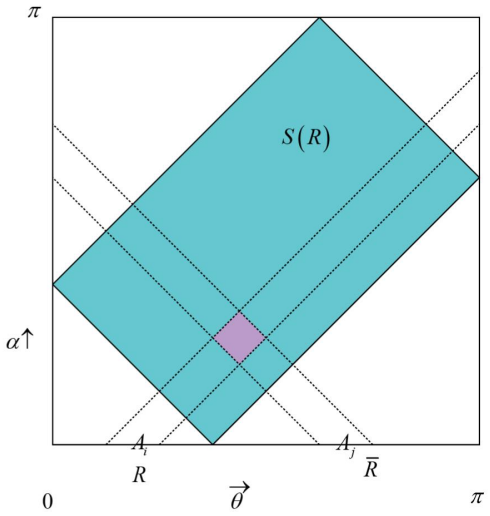
The load-bearing objects are the entanglement threads themselves: boundary-anchored bulk curves with fluxes fixed by $F_{ij} = \frac{1}{2}I(A_i, A_j | L)$. The argument's engine is the no-return rule—an entanglement thread may not cross a given simply connected RT surface more than once, because each unit area of that surface accommodates exactly one thread connecting the two complementary boundary regions; squeezing two boundary regions small confines the intervening thread to a narrowing channel between RT surfaces, so in the limit its trajectory must be a geodesic. Kinematic space, the space of all boundary-anchored geodesics equipped with the Crofton form, then acts as the organizing board: each geodesic is a wire, each geodesic intersection a quantum gate, and the integral formula $\mathrm{vol}(X)/4G_N = \frac{1}{2\pi}\int_{G_X}\lambda_X\,\omega$ converts bulk volume into gate count, giving complexity a circuit meaning. Thread-state correspondence assigns each thread the state $|\zeta\rangle$, so the entire configuration is a tensor product state whose reduced density matrices yield generalized RT entropies.
What would settle it
Compute the unique thread fluxes $F_{ij}$ from Eq. (5) for a fine boundary partition in a non-simply-connected or time-dependent bulk, such as a BTZ geometry or a multi-boundary wormhole, and check whether the minimal thread configuration consistent with all entropies necessarily contains a thread crossing some simply connected RT surface twice; if such a configuration exists, the no-return rule fails and the geodesic-trajectory conclusion falls, while if every satisfying configuration obeys the rule, the central claim is supported.
Extended reading notes
Core claim
The discovery, on the paper's own terms, is a complete geometric embodiment of holographic entanglement: define an entanglement thread as a one-dimensional curve in a codimension-one bulk slice with endpoints on the boundary, populated so that each unit area of an RT surface carries one thread. The paper argues that for any partition of the boundary into elementary regions, the number of threads connecting regions $A_i$ and $A_j$ is fixed by $F_{ij} = \frac{1}{2}I(A_i, A_j | L)$, half the conditional mutual information, and that the 'no-return' rule—a thread cannot pass through a given simply connected RT surface more than once—forces each thread's actual trajectory to be a geodesic. From there it shows that kinematic space organizes the threads: each geodesic is a wire, intersecting geodesics are coupled by a quantum gate, and the CV complexity of a bulk region equals the total number of gates in this canonical circuit. Interpreting each thread as the state $|\zeta\rangle = \frac{1}{\sqrt{2}}(|0_1\cdots 0_n\rangle + |1_1\cdots 1_n\rangle)$ makes the full thread configuration a tensor product state whose partial traces reproduce the generalized RT formula for arbitrary bulk surfaces, and distinguishes entanglement threads from bit threads because the entanglement-thread configuration is unique.
Load-bearing premise
The argument rests on the no-return rule: an entanglement thread cannot cross a given simply connected Ryu-Takayanagi surface more than once, a rule inferred from matching thread count to surface area rather than derived; if a thread could legally cross an RT surface twice, the limiting trajectory need not be a geodesic and the uniqueness of the thread configuration would collapse.
Editorial extensions
If this is right
- Every boundary entanglement entropy and every generalized RT entropy is reproduced by one unique thread configuration, so the thread picture is a complete refinement of the RT formula rather than one of many equivalent decompositions.
- Kinematic space functions as a canonical circuit board: geodesic wires, gates at intersections, and CV complexity equal to the gate count make holographic complexity a derived circuit quantity.
- The thread configuration provides a partial-order scaffold on which the true holographic state is built by inserting quantum gates, so the entanglement structure is fixed before the details of gates or metric are specified.
- Entanglement threads and bit threads differ in uniqueness: bit threads are non-unique optimal flows with a density bound, while entanglement threads are unique geodesics; different bit-thread configurations correspond to different apparent-wire conventions in the same quantum circuit.
Reading between the lines
- If the geodesic-trajectory claim is right, the no-return rule effectively selects a preferred foliation of holographic entanglement: the unique thread configuration gives a canonical reference point for comparing different tensor-network and surface-state constructions.
- A concrete testable extension is to apply the same no-return construction to BTZ or multi-boundary wormhole geometries, where the paper notes the flux computation requires kinematic-space integral geometry rather than sums of RT areas; a direct calculation there would probe whether geodesic trajectories survive.
- Treating a thread's trajectory as a partial order rather than a metric geodesic suggests the thread picture may persist in metric-free or discrete settings, offering a way to discuss entanglement structure before geometry emerges—an idea the paper gestures at without developing quantitatively.
Editorial analysis
A structured set of objections, weighed in public.
Referee Report
Summary. The paper develops a 'thread' picture of holographic entanglement. It argues that the number of entanglement threads connecting boundary regions is given by half the conditional mutual information (Eq. 5); that each thread's trajectory in the bulk is precisely a geodesic (Section 3.1); and that kinematic space provides a canonical quantum circuit representation in which each thread is a wire, each geodesic intersection is a gate, and holographic complexity becomes a gate count (Section 4.2). The paper also proposes a thread-state correspondence (Section 5.1) and compares the construction with bit threads (Section 5.2). The presentation is clear and connects many existing ideas, but the central derivation relies on the unproven 'no-return' rule and the kinematic-space verification is circular.
Significance. If the central claims held, the paper would provide a concrete, unique, geodesic encoding of holographic entanglement that reproduces entanglement entropies, the generalized RT formula, and the CV complexity as a gate count. The paper is ambitious and clearly written, and it offers a unified perspective on bit threads, kinematic space, surface-state correspondence, and HaPPY tensor networks, with a falsifiable circuit interpretation of complexity. It also makes explicit predictions, such as the thread-state product form (14) and the generalized RT formula via thread flux, which could in principle be tested against tensor-network models. However, the geodesic-trajectory claim is not established: it rests on the no-return rule, which is introduced as a 'phenomenological fact' and acknowledged by the authors as a conjecture (Sections 3.1, 3.2, 4.2, 5.2), and Section 4.1's verification assumes geodesics from the outset. As it stands, the paper is best viewed as a proposal with consistency checks rather than a derivation from established holographic entanglement data.
major comments (4)
- [Section 3.1, Figure 4] The claim that thread trajectories are precisely geodesics depends entirely on the 'no-return' rule, which is stated as a phenomenological fact but not derived from the area-matching prescription of Section 2.1. The limiting argument in Figure 4b requires that a thread connecting A_i and A_j cross each of γ_L and γ_R exactly once; without the no-return rule, a thread could cross one of these surfaces multiple times, and the 'narrow channel' confinement would not follow. The paper itself flags the status of this step ('it is not hard to conjecture' in Section 3.1, 'we boldly conjectured' in Section 3.2, 'a non-trivial assertion' in Section 4.2, 'we have asserted' in Section 5.2). Since the geodesic claim underlies the uniqueness of the thread configuration, the kinematic-space circuit, and the complexity interpretation, this is load-bearing. Please either derive the no-return rule from more basic assumptions or explicitly present the geodesic trajectory as a conjecture throughout, and adjust the language of 'demonstration' and 'verification' accordingly.
- [Section 4.1, Eqs. (9) and (11)] Section 4.1 claims to 'verify that the trajectories of entanglement threads are indeed geodesics' by computing F^{σ1σ4}_{13} with kinematic-space integrals and finding consistency with Eq. (9). However, Eq. (9) was derived in Section 3.2 using the no-return rule and the thread fluxes from Section 2.1, and the computation in Section 4.1 assumes from the start that threads are geodesics. The agreement is therefore a consistency check of the geodesic ansatz with the already-assumed flux formulas, not an independent verification. Please rephrase this section as a consistency check under the geodesic assumption, and state explicitly what evidence would count against the geodesic assumption.
- [Section 5.1, Eqs. (13), (14), (22)] The thread-state correspondence is introduced by stipulation: each thread is assigned the state |ζ> = (|0...0>+|1...1>)/√2 and the full configuration is the product state (14). The subsequent derivation of the density matrix (22) and the 'generalized RT formula' uses the fact that only threads with one endpoint on a surface contribute to its entanglement entropy; this is essentially the same area-matching condition used to define the threads in Section 2.1. The closing claim that the generalized RT formula is 'satisfied everywhere' is therefore a consistency property of the construction, not a prediction derived from independent data. Please state explicitly which elements are definitions, which are consistency checks, and which are falsifiable predictions.
- [Section 5.2] The uniqueness assertion ('our entanglement thread configuration is unique—since we have asserted that each thread's trajectory is precisely a bulk geodesic') is presented without proof. Even accepting the geodesic ansatz, the construction involves choices: the regularization of kinematic space into 'unit-volume diamonds' (Section 4.2), the mapping from continuous geodesics to discrete threads, and the gluing of boundary-anchored geodesics into a complete set of threads all require conventions. Please state the precise sense in which the configuration is unique and identify which elements are fixed by the entropy data and which are conventional.
minor comments (6)
- [Abstract and title page] The phrase 'a elegant circuit interpretation' should be 'an elegant circuit interpretation'.
- [Section 3.1] There is a missing space in 'the entanglement threadζij' and 'a serious of adjacent arrows' should be 'a series of adjacent arrows'.
- [Section 5.1] The word 'didentity' appears in the sentence about trivial identity evolution; this appears to be a typo for 'identity'.
- [Section 5.2] There is a missing space in 'the concept ofbit threads'; it should be 'the concept of bit threads'.
- [Eq. (13) and surrounding text] The paper uses 'qudit' dimensions d in some places and writes the thread state as a two-level |0>/|1> superposition; please clarify whether each thread carries a qubit or a qudit, and whether Eq. (13) holds for general d or only for d=2.
- [Section 4.2] The regularization 'divide kinematic space into small diamonds with volume equal to 1' is invoked but not specified; please state how the volume normalization is fixed relative to the Crofton form (34), and whether the results depend on the chosen cell size.
Circularity Check
The geodesic-trajectory claim is verified only under its own assumption, and the generalized RT result is built into the thread-state definition; the derivation chain is partially circular.
-
other
[Section 3.1 (no-return rule and geodesic conjecture) and Section 4.1 (Eqs. 9-11)]
"According to this "no-return" rule of entanglement threads on RT surfaces, it is not hard to conjecture that the trajectories of entanglement threads in the bulk should coincide with geodesics. ... Since we now assume that the trajectories of these entanglement threads precisely coincide with geodesics, it becomes relatively straightforward ... Thus, (11) is completely consistent with (9)."
The geodesic conclusion is inferred from the no-return rule, which is itself an extra stipulation introduced to make the area-matching prescription work, not derived from entanglement data. The Section 4.1 'verification' then takes the geodesic hypothesis as an input: it computes a flux in kinematic space by assuming threads are geodesics and checks that the result equals Eq. (9), a combination already fixed by the area constraints and no-return routing in Section 3.2. Matching Eq. (11) to Eq. (9) is therefore a consistency check between two calculations sharing the same inputs, not an independent confirmation that threads are geodesics. The paper itself repeatedly calls the geodesic statement a conjecture, so the central claim remains assumed rather than derived.
-
self definitional
[Section 5.1, Eqs. (13)-(22) and the generalized RT paragraph]
"while for a thread passing through σ3, its endpoint qubits (one on σ3, one on its complement) entangled in a Bell state, which leads to: ρσ3 = ... The exponent here denotes the number of threads with one end on surface σ3 and the other on its complement. Clearly, the von Neumann entropy of σ3 is exactly equal to this number. ... We thus obtain a formulation of the generalized Ryu-Takayanagi (RT) formula."
The thread state |ζ> is defined in Eq. (13) as a Bell-like superposition over all qudits a thread traverses, and the full state |Ψ> in Eq. (14) is the tensor product of such states. Tracing out the complement then yields a reduced density matrix whose entropy is one unit per thread by construction (Eq. (22)). The thread fluxes appearing in the exponent were previously solved in Section 3.2 to reproduce area combinations (Eqs. (7)-(9)). Hence the 'generalized RT formula' obtained here — entropy of σ̃3 equals area(σ3)/4GN — is an identity assembled from the definitions: the reduced state was engineered to have Bell-pair entropy, and the thread count was set equal to the area. The agreement is a self-consistency check, not a prediction from independent ingredients.
full rationale
The paper is transparent about the conjectural status of its central geometric claim: the geodesic trajectory is introduced via an unproved 'no-return' rule and is later checked rather than derived. That check (Eq. (11) reproducing Eq. (9)) assumes the geodesic hypothesis in the kinematic-space calculation, so it cannot independently establish the hypothesis; the uniqueness of the thread configuration asserted in Section 5.2 therefore rests on that assumption. Likewise, the thread-state correspondence is defined so that each thread contributes one Bell pair to any surface it crosses, and the thread fluxes were fixed to area values earlier, so the generalized RT entropy formula follows by construction rather than as an independent result. The half-CMI flux formula (Eq. (5)) is imported from the author's own [24]; this is a load-bearing self-citation, but since the underlying linear-system solution is a mathematical identity and the paper does not otherwise redefine it, I do not count it as the main circular step. Overall, the derivations are largely consistency demonstrations of an ansatz; because the paper is explicit about their conditional character, the circularity is partial rather than total.
Assumptions & free parameters
assumptions (8)
- domain assumption RT formula: S(A)=Area(γ_A)/(4G_N), with 4G_N=1.
- domain assumption Thread count F_ij=1/2 I(A_i,A_j|L) is the unique solution for thread fluxes from interval entropies.
- ad hoc to paper No-return rule: an entanglement thread crosses a given simply connected RT surface at most once.
- ad hoc to paper Trajectories of entanglement threads are geodesics in the bulk.
- domain assumption Surface-state correspondence: a bulk subregion bounded by RT surfaces corresponds to a pure state whose boundary regions have entropies equal to their areas.
- ad hoc to paper Thread-state correspondence: each thread carries |ζ>=(|0...0>+|1...1>)/√2, and the whole configuration is the product state |Ψ> = ⊗_ζ |ζ>.
- ad hoc to paper Kinematic space can be regularized into unit-volume diamonds, each representing one thread, and each geodesic intersection becomes a quantum gate.
- ad hoc to paper The holographic state is obtained by adding gates on top of the thread state |Ψ>, and complexity is the number of gates.
invented entities (3)
-
Entanglement thread as a unique geodesic wire with unit flux
-
Thread-state |ζ> = (|0...0>+|1...1>)/√2
-
Kinematic space as a circuit input board
Cite this review
Pith. "Pith review of The thread embodiment of holographic quantum entanglement." pith.science (2026). https://pith.science/paper/EHMRRX5G
@misc{pith2026250110691,
  author       = {Pith},
  title        = {Pith review of: The thread embodiment of holographic quantum entanglement},
  year         = {2026},
  howpublished = {\url{https://pith.science/paper/EHMRRX5G}},
  note         = {Machine review of arXiv:2501.10691}
}
read the original abstract
This paper systematically develops the concept of entanglement threads that characterize the entanglement structure of holographic duality. Behind this framework lies a simple philosophy: holographic quantum entanglement can be visualized using thread-like objects. Inspired by the fact that tensor network models can be deformed into a quantum circuit form with flow-conserving features, we abstract the concept of entanglement threads. These entanglement threads can be understood as a pre-set ensemble of wires in a holographic quantum circuit, and we propose that they characterize the underlying partially ordered structure of holographic quantum entanglement. Combining the concepts of entanglement threads and kinematic space, a elegant circuit interpretation for the holographic complexity is provided. We also clarify the connection and distinction between entanglement threads and the previously proposed concept of bit threads.
Figures


Figures from the paper (11 more)


Reference graph
Works this paper leans on
-
[1]
The Large N limit of superconformal field theories and supergrav- ity,
J. M. Maldacena, “The Large N limit of superconformal field theories and supergrav- ity,” Adv. Theor. Math. Phys. 2, 231-252 (1998) [arXiv:hep-th/9711200 [hep-th]]
arXiv 1998
-
[2]
Gauge theory correlators from noncritical string theory,
S. S. Gubser, I. R. Klebanov and A. M. Polyakov, “Gauge theory correlators from noncritical string theory,” Phys. Lett. B 428, 105-114 (1998) [arXiv:hep-th/9802109 [hep-th]]
arXiv 1998
-
[3]
Anti-de Sitter space and holography,
E. Witten, “Anti-de Sitter space and holography,” Adv. Theor. Math. Phys. 2, 253- 291 (1998) [arXiv:hep-th/9802150 [hep-th]]
arXiv 1998
-
[4]
Holographic derivation of entanglement entropy from AdS/CFT,
S. Ryu and T. Takayanagi, “Holographic derivation of entanglement entropy from AdS/CFT,” Phys. Rev. Lett. 96, 181602 (2006) [arXiv:hep-th/0603001 [hep-th]]
arXiv 2006
-
[5]
Aspects of Holographic Entanglement Entropy,
S. Ryu and T. Takayanagi, “Aspects of Holographic Entanglement Entropy,” JHEP 08, 045 (2006) [arXiv:hep-th/0605073 [hep-th]]
arXiv 2006
-
[6]
A Covariant holographic entan- glement entropy proposal,
V. E. Hubeny, M. Rangamani and T. Takayanagi, “A Covariant holographic entan- glement entropy proposal,” JHEP 07, 062 (2007) [arXiv:0705.0016 [hep-th]]
arXiv 2007
-
[7]
Entanglement Renormalization and Holography,
B. Swingle, “Entanglement Renormalization and Holography,” Phys. Rev. D 86, 065007 (2012) [arXiv:0905.1317 [cond-mat.str-el]]
arXiv 2012
-
[8]
Constructing holographic spacetimes using entanglement renormaliza- tion,
B. Swingle, “Constructing holographic spacetimes using entanglement renormaliza- tion,” [arXiv:1209.3304 [hep-th]]. 41
Show all 98 references
-
[9]
Entanglement Renormalization,
G. Vidal, “Entanglement Renormalization,” Phys. Rev. Lett. 99, no.22, 220405 (2007) [arXiv:cond-mat/0512165 [cond-mat]]
2007 arXiv
-
[10]
Class of Quantum Many-Body States That Can Be Efficiently Simulated,
G. Vidal, “Class of Quantum Many-Body States That Can Be Efficiently Simulated,” Phys. Rev. Lett. 101, 110501 (2008) [arXiv:quant-ph/0610099 [quant-ph]]
2008 arXiv
-
[11]
Tensor network renormalization yields the multiscale entangle- ment renormalization ansatz,
E. Glen, G. Vidal, “Tensor network renormalization yields the multiscale entangle- ment renormalization ansatz,” Phys. Rev. Lett. 115,200401 (2015)
2015
-
[12]
Bit threads and holographic entanglement,
M. Freedman and M. Headrick, “Bit threads and holographic entanglement,” Com- mun. Math. Phys. 352, no.1, 407-438 (2017) [arXiv:1604.00354 [hep-th]]
2017 arXiv
-
[13]
Bit Threads and Holographic Monogamy,
S. X. Cui, P. Hayden, T. He, M. Headrick, B. Stoica and M. Walter, “Bit Threads and Holographic Monogamy,” Commun. Math. Phys. 376, no.1, 609-648 (2019) [arXiv:1808.05234 [hep-th]]
2019 arXiv
-
[14]
Riemannian and Lorentzian flow-cut theorems,
M. Headrick and V. E. Hubeny, “Riemannian and Lorentzian flow-cut theorems,” Class. Quant. Grav. 35, no.10, 10 (2018) [arXiv:1710.09516 [hep-th]]
2018 arXiv
-
[15]
Covariant bit threads,
M. Headrick and V. E. Hubeny, “Covariant bit threads,” JHEP 07, 180 (2023) [arXiv:2208.10507 [hep-th]]
2023 arXiv
-
[16]
Maximal Flow Through a Network,
L. R. Ford, D. R. Fulkerson, “ Maximal Flow Through a Network,” Canad. J. Math. 8 (1956) 399–404
1956
-
[17]
Note on maximal flow through a network,
P. Elias, A. Feinstein, and C. Shannon, “ Note on maximal flow through a network,” IRE Transactions on Information Theory IT-2 (1956) 117–199
1956
-
[18]
Concentrating partial entanglement by local operations,
C. H. Bennett, H. J. Bernstein, S. Popescu and B. Schumacher, “Concentrating partial entanglement by local operations,” Phys. Rev. A 53, 2046-2052 (1996) [arXiv:quant- ph/9511030 [quant-ph]]
1996
-
[19]
Purification of noisy entanglement and faithful teleportation via noisy chan- nels,
C. H. Bennett, G. Brassard, S. Popescu, B. Schumacher, J. A. Smolin and W. K. Woot- ters, “Purification of noisy entanglement and faithful teleportation via noisy chan- nels,” Phys. Rev. Lett. 76, 722-725 (1996) [arXiv:quant-ph/9511027 [quant-ph]]
1996 arXiv
-
[20]
Mixed state entanglement and quantum error correction,
C. H. Bennett, D. P. DiVincenzo, J. A. Smolin and W. K. Wootters, “Mixed state entanglement and quantum error correction,” Phys. Rev. A 54, 3824-3851 (1996) [arXiv:quant-ph/9604024 [quant-ph]]. 42
1996 arXiv
-
[21]
Integral Geometry and Hologra- phy,
B. Czech, L. Lamprou, S. McCandlish and J. Sully, “Integral Geometry and Hologra- phy,” JHEP 10, 175 (2015) [arXiv:1505.05515 [hep-th]]
2015 arXiv
-
[22]
Tensor Networks from Kinematic Space,
B. Czech, L. Lamprou, S. McCandlish and J. Sully, “Tensor Networks from Kinematic Space,” JHEP 07, 100 (2016) [arXiv:1512.01548 [hep-th]]
2016 arXiv
-
[23]
Distilled density matrices of holographic partial entanglement en- tropy from thread-state correspondence,
Y. Y. Lin, “Distilled density matrices of holographic partial entanglement en- tropy from thread-state correspondence,” Phys. Rev. D 108, no.10, 106010 (2023) [arXiv:2305.02895 [hep-th]]
2023 arXiv
-
[24]
Deriving the PEE proposal from the locking bit thread configuration,
Y. Y. Lin, J. R. Sun and J. Zhang, “Deriving the PEE proposal from the locking bit thread configuration,” JHEP 10, 164 (2021) [arXiv:2105.09176 [hep-th]]
2021 arXiv
-
[25]
The Holographic Entropy Cone,
N. Bao, S. Nezami, H. Ooguri, B. Stoica, J. Sully and M. Walter, “The Holographic Entropy Cone,” JHEP 09, 130 (2015) [arXiv:1505.07839 [hep-th]]
2015 arXiv
-
[26]
The holographic entropy arrangement,
V. E. Hubeny, M. Rangamani and M. Rota, “The holographic entropy arrangement,” Fortsch. Phys. 67, no.4, 1900011 (2019) [arXiv:1812.08133 [hep-th]]
2019 arXiv
-
[27]
Holographic entropy relations,
V. E. Hubeny, M. Rangamani and M. Rota, “Holographic entropy relations,” Fortsch. Phys. 66, no.11-12, 1800067 (2018) [arXiv:1808.07871 [hep-th]]
2018 arXiv
-
[28]
Holographic entropy cone for five regions,
S. Hern´ andez Cuenca, “Holographic entropy cone for five regions,” Phys. Rev. D100, no.2, 026004 (2019) [arXiv:1903.09148 [hep-th]]
2019 arXiv
-
[29]
Entanglement contour,
G. Vidal and Y. Chen, “Entanglement contour,” J. Stat. Mech. 2014, no.10, P10011 (2014) [arXiv:1406.1471 [cond-mat.str-el]]
2014 arXiv
-
[30]
Formulas for Partial Entanglement Entropy,
Q. Wen, “Formulas for Partial Entanglement Entropy,” Phys. Rev. Res. 2, no.2, 023170 (2020) [arXiv:1910.10978 [hep-th]]
2020 arXiv
-
[31]
Fine structure in holographic entanglement and entanglement contour,
Q. Wen, “Fine structure in holographic entanglement and entanglement contour,” Phys. Rev. D 98, no.10, 106004 (2018) [arXiv:1803.05552 [hep-th]]
2018 arXiv
-
[32]
Holographic entanglement contour, bit threads, and the entanglement tsunami,
J. Kudler-Flam, I. MacCormack and S. Ryu, “Holographic entanglement contour, bit threads, and the entanglement tsunami,” J. Phys. A 52, no.32, 325401 (2019) [arXiv:1902.04654 [hep-th]]
2019 arXiv
-
[33]
Bulk Locality and Quantum Error Correction in AdS/CFT,
A. Almheiri, X. Dong and D. Harlow, “Bulk Locality and Quantum Error Correction in AdS/CFT,” JHEP 04, 163 (2015) [arXiv:1411.7041 [hep-th]]. 43
2015 arXiv
-
[34]
Reconstruction of Bulk Operators within the Entanglement Wedge in Gauge-Gravity Duality,
X. Dong, D. Harlow and A. C. Wall, “Reconstruction of Bulk Operators within the Entanglement Wedge in Gauge-Gravity Duality,” Phys. Rev. Lett. 117, no.2, 021601 (2016) [arXiv:1601.05416 [hep-th]]
2016 arXiv
-
[35]
Holographic quantum error- correcting codes: Toy models for the bulk/boundary correspondence,
F. Pastawski, B. Yoshida, D. Harlow and J. Preskill, “Holographic quantum error- correcting codes: Toy models for the bulk/boundary correspondence,” JHEP 06, 149 (2015) [arXiv:1503.06237 [hep-th]]
2015 arXiv
-
[36]
Maximally multipartite entangled states,
P. Facchi, G. Florio, G. Parisi and S. Pascazio, “Maximally multipartite entangled states,” Phys. Rev. A 77, no.6, 060304 (2008)
2008
-
[37]
Absolute Maximal Entangle- ment and Quantum Secret Sharing,
W. Helwig, W. Cui, A. Riera, J. I. Latorre and H. K. Lo, “Absolute Maximal Entangle- ment and Quantum Secret Sharing,” Phys. Rev. A86, 052335 (2012) [arXiv:1204.2289 [quant-ph]]
2012 arXiv
-
[38]
Absolutely Maximally Entangled States: Existence and Applications,
W. Helwig and W. Cui, “Absolutely Maximally Entangled States: Existence and Applications,” [arXiv:1306.2536 [quant-ph]]
-
[39]
Absolutely Maximally Entangled Qudit Graph States,
W. Helwig, “Absolutely Maximally Entangled Qudit Graph States,” [arXiv:1306.2879 [quant-ph]]
-
[40]
Continuous Multiscale Entanglement Renormalization Ansatz as Holographic Surface-State Cor- respondence,
M. Miyaji, T. Numasawa, N. Shiba, T. Takayanagi and K. Watanabe, “Continuous Multiscale Entanglement Renormalization Ansatz as Holographic Surface-State Cor- respondence,” Phys. Rev. Lett. 115, no.17, 171602 (2015) [arXiv:1506.01353 [hep-th]]
2015 arXiv
-
[41]
Surface/State Correspondence as a Generalized Holog- raphy,
M. Miyaji and T. Takayanagi, “Surface/State Correspondence as a Generalized Holog- raphy,” PTEP 2015, no.7, 073B03 (2015) [arXiv:1503.03542 [hep-th]]
2015 arXiv
-
[42]
Tensor network decompositions for absolutely maxi- mally entangled states,
B. Pozsgay and I. M. Wanless, “Tensor network decompositions for absolutely maxi- mally entangled states,” Quantum 8, 1339 (2024) [arXiv:2308.07042 [quant-ph]]
2024 arXiv
-
[43]
Crossing Versus Locking: Bit Threads and Continuum Multiflows,
M. Headrick, J. Held and J. Herman, “Crossing Versus Locking: Bit Threads and Continuum Multiflows,” Commun. Math. Phys. 396, no.1, 265-313 (2022) [arXiv:2008.03197 [hep-th]]
2022 arXiv
-
[44]
Majorana dimers and holo- graphic quantum error-correcting codes,
A. Jahn, M. Gluza, F. Pastawski and J. Eisert, “Majorana dimers and holo- graphic quantum error-correcting codes,” Phys. Rev. Research. 1, 033079 (2019) [arXiv:1905.03268 [hep-th]]
2019 arXiv
-
[45]
Bidirectional holographic codes and sub-AdS locality,
Z. Yang, P. Hayden and X. L. Qi, “Bidirectional holographic codes and sub-AdS locality,” JHEP 01, 175 (2016) [arXiv:1510.03784 [hep-th]]. 44
2016 arXiv
-
[46]
Geodesic string condensation from symmetric tensor gauge theory: a unify- ing framework of holographic toy models,
H. Yan, “Geodesic string condensation from symmetric tensor gauge theory: a unify- ing framework of holographic toy models,” Phys. Rev. B 102, no.16, 161119 (2020) [arXiv:1911.01007 [cond-mat.str-el]]
2020 arXiv
-
[47]
Partial entanglement network and bulk geometry recon- struction in AdS/CFT,
J. Lin, Y. Lu and Q. Wen, “Partial entanglement network and bulk geometry recon- struction in AdS/CFT,” [arXiv:2401.07471 [hep-th]]
-
[48]
Geometrizing the partial entanglement entropy: from PEE threads to bit threads,
J. Lin, Y. Lu and Q. Wen, “Geometrizing the partial entanglement entropy: from PEE threads to bit threads,” JHEP 2024, no.02, 191 (2024) [arXiv:2311.02301 [hep-th]]
2024 arXiv
-
[49]
Comments on Holographic Complexity,
D. Carmi, R. C. Myers and P. Rath, “Comments on Holographic Complexity,” JHEP 03, 118 (2017) [arXiv:1612.00433 [hep-th]]
2017 arXiv
-
[50]
Holographic Complexity,
M. Alishahiha, “Holographic Complexity,” Phys. Rev. D 92, no.12, 126009 (2015) [arXiv:1509.06614 [hep-th]]
2015 arXiv
-
[51]
Computational Complexity and Black Hole Horizons,
L. Susskind, “Computational Complexity and Black Hole Horizons,” Fortsch. Phys. 64, 24-43 (2016) [arXiv:1403.5695 [hep-th]]
2016 arXiv
-
[52]
Complexity and Shock Wave Geometries,
D. Stanford and L. Susskind, “Complexity and Shock Wave Geometries,” Phys. Rev. D 90, no.12, 126007 (2014) [arXiv:1406.2678 [hep-th]]
2014 arXiv
-
[53]
Holographic Complexity Equals Bulk Action?,
A. R. Brown, D. A. Roberts, L. Susskind, B. Swingle and Y. Zhao, “Holographic Complexity Equals Bulk Action?,” Phys. Rev. Lett. 116, no.19, 191301 (2016) [arXiv:1509.07876 [hep-th]]
2016 arXiv
-
[54]
Complexity, action, and black holes,
A. R. Brown, D. A. Roberts, L. Susskind, B. Swingle and Y. Zhao, “Complexity, action, and black holes,” Phys. Rev. D 93, no.8, 086006 (2016) [arXiv:1512.04993 [hep-th]]
2016 arXiv
-
[55]
Holographic Subregion Complexity from Kinematic Space,
R. Abt, J. Erdmenger, M. Gerbershagen, C. M. Melby-Thompson and C. Northe, “Holographic Subregion Complexity from Kinematic Space,” JHEP 01, 012 (2019) [arXiv:1805.10298 [hep-th]]
2019 arXiv
-
[56]
Topological Complexity in AdS 3/CFT2,
R. Abt, J. Erdmenger, H. Hinrichsen, C. M. Melby-Thompson, R. Meyer, C. Northe and I. A. Reyes, “Topological Complexity in AdS 3/CFT2,” Fortsch. Phys. 66, no.6, 1800034 (2018) [arXiv:1710.01327 [hep-th]]
2018 arXiv
-
[57]
Integral Geometry and Geometric Probability,
L. A. Santal´o, “Integral Geometry and Geometric Probability,” Addison-Wesley Pub- lishing Company, Reading Massachusetts U.S.A. (1976). 45
1976
-
[58]
Thread/State correspondence: from bit threads to qubit threads,
Y. Y. Lin and J. C. Jin, “Thread/State correspondence: from bit threads to qubit threads,” JHEP 02, 245 (2023) [arXiv:2210.08783 [hep-th]]
2023 arXiv
-
[59]
Thread/State correspondence: the qubit threads model of holographic gravity,
Y. Y. Lin and J. C. Jin, “Thread/State correspondence: the qubit threads model of holographic gravity,” [arXiv:2208.08963 [hep-th]]
-
[60]
Exact and asymptotic measures of multipartite pure state entanglement,
C. H. Bennett, S. Popescu, D. Rohrlich, J. A. Smolin, and A. V. Thapliyal, “Exact and asymptotic measures of multipartite pure state entanglement,” Phys. Rev. A 63(1):012307
-
[61]
Cali- brated Entanglement Entropy,
I. Bakhmatov, N. S. Deger, J. Gutowski, E. ´O. Colg´ ain and H. Yavartanoo, “Cali- brated Entanglement Entropy,” JHEP 07, 117 (2017) [arXiv:1705.08319 [hep-th]]
2017 arXiv
-
[62]
Geometric Aspects of Holographic Bit Threads,
C. A. Ag´ on, J. De Boer and J. F. Pedraza, “Geometric Aspects of Holographic Bit Threads,” JHEP 05, 075 (2019) [arXiv:1811.08879 [hep-th]]
2019 arXiv
-
[63]
Geometry of the (2+1) black hole,
M. Banados, M. Henneaux, C. Teitelboim and J. Zanelli, “Geometry of the (2+1) black hole,” Phys. Rev. D 48, 1506-1525 (1993) [erratum: Phys. Rev. D 88, 069902 (2013)] [arXiv:gr-qc/9302012 [gr-qc]]
1993 arXiv
-
[64]
New holographic generalization of entanglement entropy,
Y. Nakata, T. Takayanagi, Y. Taki, K. Tamaoka and Z. Wei, “New holographic generalization of entanglement entropy,” Phys. Rev. D 103, no.2, 026005 (2021) [arXiv:2005.13801 [hep-th]]
2021 arXiv
-
[65]
Timelike entanglement entropy,
K. Doi, J. Harper, A. Mollabashi, T. Takayanagi and Y. Taki, “Timelike entanglement entropy,” JHEP 05, 052 (2023) [arXiv:2302.11695 [hep-th]]
2023 arXiv
-
[66]
Lorentzian Threads as Gatelines and Holographic Complexity,
J. F. Pedraza, A. Russo, A. Svesko and Z. Weller-Davies, “Lorentzian Threads as Gatelines and Holographic Complexity,” Phys. Rev. Lett. 127, no.27, 271602 (2021) [arXiv:2105.12735 [hep-th]]
2021 arXiv
-
[67]
Sewing spacetime with Lorentzian threads: complexity and the emergence of time in quantum gravity,
J. F. Pedraza, A. Russo, A. Svesko and Z. Weller-Davies, “Sewing spacetime with Lorentzian threads: complexity and the emergence of time in quantum gravity,” JHEP 02, 093 (2022) [arXiv:2106.12585 [hep-th]]
2022 arXiv
-
[68]
Lorentzian threads and generalized complex- ity,
E. Caceres, R. Carrasco and V. Patil, “Lorentzian threads and generalized complex- ity,” JHEP 04, 010 (2024) [arXiv:2312.10606 [hep-th]]
2024 arXiv
-
[69]
Entanglement islands read perfect-tensor entan- glement,
Y. Y. Lin, J. Zhang and J. C. Jin, “Entanglement islands read perfect-tensor entan- glement,” JHEP 04, 113 (2024) [arXiv:2312.14486 [hep-th]]. 46
2024 arXiv
-
[70]
The PEE aspects of entanglement islands from bit threads,
Y. Y. Lin, J. R. Sun, Y. Sun and J. C. Jin, “The PEE aspects of entanglement islands from bit threads,” JHEP 07, 009 (2022) [arXiv:2203.03111 [hep-th]]
2022 arXiv
-
[71]
Partial entanglement entropy threads in the island phase,
Q. Wen, M. Xu and H. Zhong, “Partial entanglement entropy threads in the island phase,” Phys. Rev. D 111, no.4, 046027 (2025) [arXiv:2408.13535 [hep-th]]
2025 arXiv
-
[72]
Holographic definition of points and distances,
B. Czech and L. Lamprou, “Holographic definition of points and distances,” Phys. Rev. D 90, 106005 (2014) [arXiv:1409.4473 [hep-th]]
2014 arXiv
-
[73]
Holographic coarse-grained states and the necessity of perfect entanglement,
Y. Y. Lin and J. Zhang, “Holographic coarse-grained states and the necessity of perfect entanglement,” Phys. Rev. D 109, no.12, 126012 (2024) [arXiv:2312.14498 [hep-th]]
2024 arXiv
-
[74]
Bit thread, entanglement distillation, and entan- glement of purification,
Y. Y. Lin, J. R. Sun and Y. Sun, “Bit thread, entanglement distillation, and entan- glement of purification,” Phys. Rev. D 103, no.12, 126002 (2021) [arXiv:2012.05737 [hep-th]]
2021 arXiv
-
[75]
Tensor networks as conformal transformations,
A. Milsted and G. Vidal, “Tensor networks as conformal transformations,” [arXiv:1805.12524 [cond-mat.str-el]]
-
[76]
Tensor networks as path integral geometry,
A. Milsted and G. Vidal, “Tensor networks as path integral geometry,” [arXiv:1807.02501 [cond-mat.str-el]]
-
[77]
Geometric interpretation of the multi-scale entanglement renormalization ansatz,
A. Milsted and G. Vidal, “Geometric interpretation of the multi-scale entanglement renormalization ansatz,” [arXiv:1812.00529 [hep-th]]
-
[78]
A holographic duality from lifted tensor networks,
N. A. McMahon, S. Singh and G. K. Brennen, “A holographic duality from lifted tensor networks,” npj Quantum Inf. 6, 36 (2020) [arXiv:1812.11644 [cond-mat.str- el]]
2020 arXiv
-
[79]
Hyperinvariant Tensor Networks and Holography,
G. Evenbly, “Hyperinvariant Tensor Networks and Holography,” Phys. Rev. Lett. 119, no.14, 141602 (2017) [arXiv:1704.04229 [quant-ph]]
2017 arXiv
-
[80]
Holographic duality from random tensor networks,
P. Hayden, S. Nezami, X. L. Qi, N. Thomas, M. Walter and Z. Yang, “Holographic duality from random tensor networks,” JHEP 11, 009 (2016) [arXiv:1601.01694 [hep- th]]
2016 arXiv
-
[81]
Space-time random tensor networks and holographic duality,
X. L. Qi and Z. Yang, “Space-time random tensor networks and holographic duality,” [arXiv:1801.05289 [hep-th]]
-
[82]
Multipartite Entanglement in Stabilizer Tensor Networks,
S. Nezami and M. Walter, “Multipartite Entanglement in Stabilizer Tensor Networks,” Phys. Rev. Lett. 125, 241602 (2020) [arXiv:1608.02595 [quant-ph]]. 47
2020 arXiv
-
[83]
Tensor network and ( p-adic) AdS/CFT,
A. Bhattacharyya, L. Y. Hung, Y. Lei and W. Li, “Tensor network and ( p-adic) AdS/CFT,” JHEP 01, 139 (2018) [arXiv:1703.05445 [hep-th]]
2018 arXiv
-
[84]
p-adic CFT is a holographic tensor network,
L. Y. Hung, W. Li and C. M. Melby-Thompson, “ p-adic CFT is a holographic tensor network,” JHEP 04, 170 (2019) [arXiv:1902.01411 [hep-th]]
2019 arXiv
-
[85]
Emergent Einstein Equation in p-adic Confor- mal Field Theory Tensor Networks,
L. Chen, X. Liu and L. Y. Hung, “Emergent Einstein Equation in p-adic Confor- mal Field Theory Tensor Networks,” Phys. Rev. Lett. 127, no.22, 221602 (2021) [arXiv:2102.12022 [hep-th]]
2021 arXiv
-
[86]
Bending the Bruhat-Tits tree. Part I. Tensor network and emergent Einstein equations,
L. Chen, X. Liu and L. Y. Hung, “Bending the Bruhat-Tits tree. Part I. Tensor network and emergent Einstein equations,” JHEP 06, 094 (2021) [arXiv:2102.12023 [hep-th]]
2021 arXiv
-
[87]
Bending the Bruhat-Tits tree. Part II. The p-adic BTZ black hole and local diffeomorphism on the Bruhat-Tits tree,
L. Chen, X. Liu and L. Y. Hung, “Bending the Bruhat-Tits tree. Part II. The p-adic BTZ black hole and local diffeomorphism on the Bruhat-Tits tree,” JHEP 09, 097 (2021) [arXiv:2102.12024 [hep-th]]
2021 arXiv
-
[88]
CFT D from TQFTD+1 via Holographic Tensor Network, and Precision Discretisation of CFT 2,
L. Chen, H. Zhang, K. Ji, C. Shen, R. Wang, X. Zeng and L. Y. Hung, “CFT D from TQFTD+1 via Holographic Tensor Network, and Precision Discretisation of CFT 2,” [arXiv:2210.12127 [hep-th]]
-
[89]
It from ETH: Multi-interval Entanglement and Replica Wormholes from Large-c BCFT Ensemble,
H. Geng, L. Y. Hung and Y. Jiang, “It from ETH: Multi-interval Entanglement and Replica Wormholes from Large-c BCFT Ensemble,” [arXiv:2505.20385 [hep-th]]
-
[90]
Building up quantum spacetimes with BCFT Legos,
L. Y. Hung and Y. Jiang, “Building up quantum spacetimes with BCFT Legos,” [arXiv:2404.00877 [hep-th]]
-
[91]
Group field theory and tensor networks: towards a Ryu–Takayanagi formula in full quantum gravity,
G. Chirco, D. Oriti and M. Zhang, “Group field theory and tensor networks: towards a Ryu–Takayanagi formula in full quantum gravity,” Class. Quant. Grav. 35, no.11, 115011 (2018) [arXiv:1701.01383 [gr-qc]]
2018 arXiv
-
[92]
Loop Quantum Gravity, Exact Holographic Mapping, and Holographic Entanglement Entropy,
M. Han and L. Y. Hung, “Loop Quantum Gravity, Exact Holographic Mapping, and Holographic Entanglement Entropy,” Phys. Rev. D 95, no.2, 024011 (2017) [arXiv:1610.02134 [hep-th]]
2017 arXiv
-
[93]
Holographic maps from quantum gravity states as tensor networks,
E. Colafranceschi, G. Chirco and D. Oriti, “Holographic maps from quantum gravity states as tensor networks,” Phys. Rev. D 105, no.6, 066005 (2022) [arXiv:2105.06454 [hep-th]]. 48
2022 arXiv
-
[94]
Holographic entanglement in spin network states: A focused review,
E. Colafranceschi and G. Adesso, “Holographic entanglement in spin network states: A focused review,” A VS Quantum Sci.4, no.2, 025901 (2022) [arXiv:2202.05116 [hep- th]]
2022 arXiv
-
[95]
Holographic spin networks from tensor network states,
S. Singh, N. A. McMahon and G. K. Brennen, “Holographic spin networks from tensor network states,” Phys. Rev. D97, no.2, 026013 (2018) [arXiv:1702.00392 [cond- mat.str-el]]
2018 arXiv
-
[96]
Tensor network state correspondence and holography,
S. Singh, “Tensor network state correspondence and holography,” Phys. Rev. D 97, no.2, 026012 (2018) [arXiv:1701.04778 [cond-mat.str-el]]
2018 arXiv
-
[97]
Beyond Toy Models: Distilling Tensor Networks in Full AdS/CFT,
N. Bao, G. Penington, J. Sorce and A. C. Wall, “Beyond Toy Models: Distilling Tensor Networks in Full AdS/CFT,” JHEP 11, 069 (2019) [arXiv:1812.01171 [hep-th]]
2019 arXiv
-
[98]
Surface growth scheme for bulk reconstruction and tensor network,
Y. Y. Lin, J. R. Sun and Y. Sun, “Surface growth scheme for bulk reconstruction and tensor network,” JHEP 12, 083 (2020) [arXiv:2010.01907 [hep-th]]. 49
2020 arXiv
Reviewed August 10, 2026 · model on record in the stance chip above.
Discussion (0). Continue with ORCID to comment.