Feedback-Free Star Formation in Clusters within a Galaxy Simulated at High Resolution in Cosmic Dawn
Pith reviewed 2026-06-27 08:46 UTC · model grok-4.3
The pith
High-resolution zoom-in simulation of a z~10 galaxy captures feedback-free starbursts in dense clusters and matches JWST super-bright galaxy observations.
A machine-rendered reading of the paper's core claim, the machinery that carries it, and where it could break.
Core claim
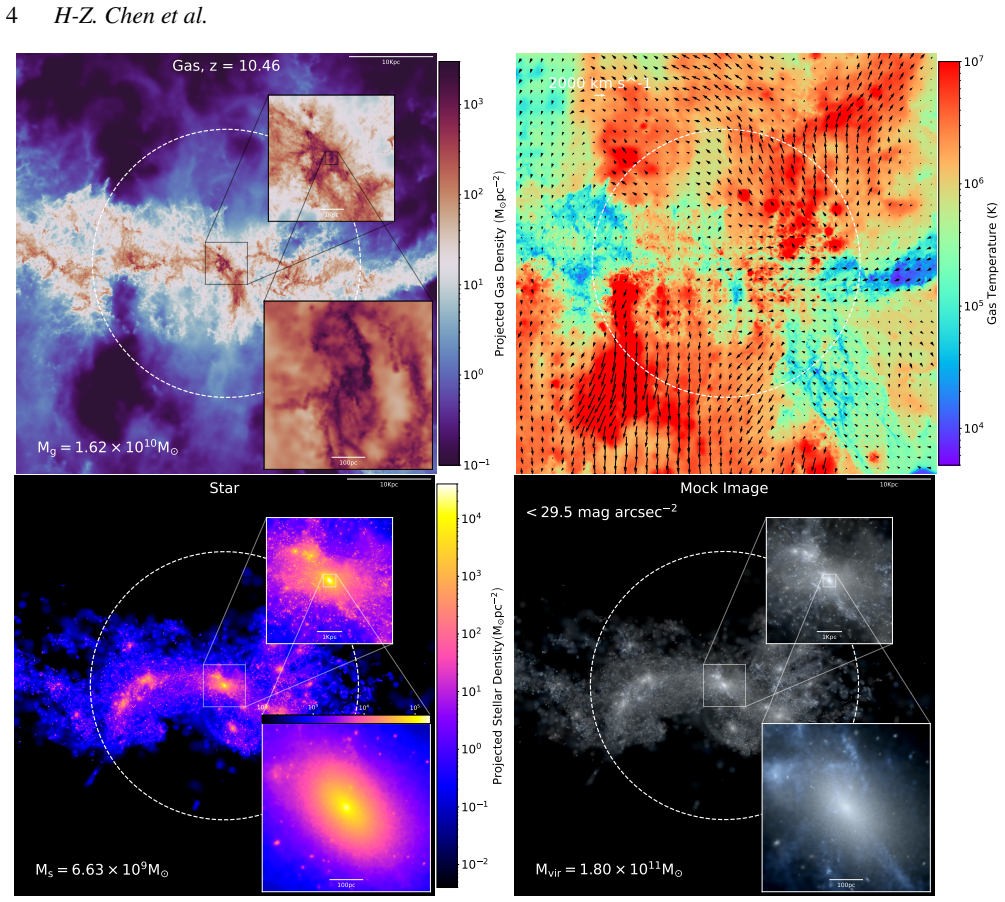
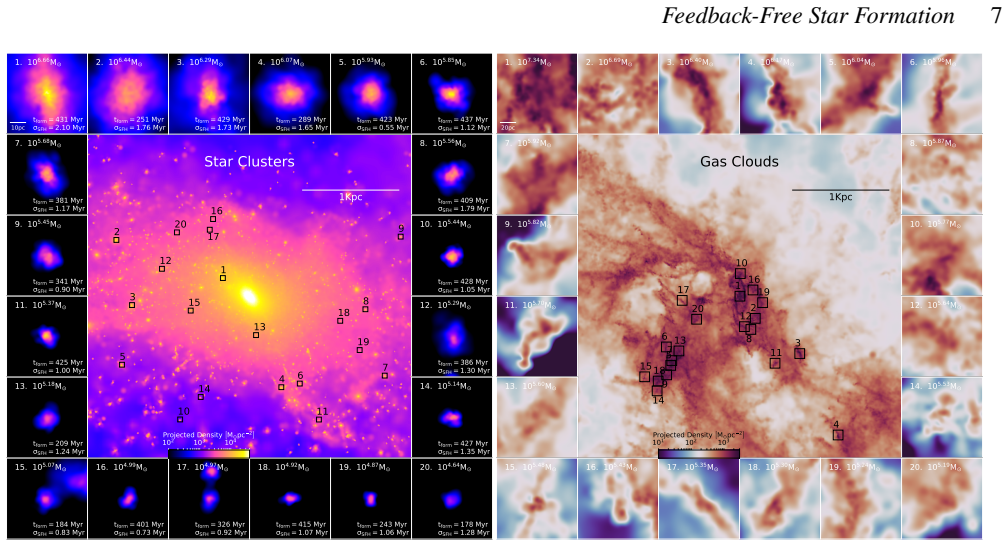
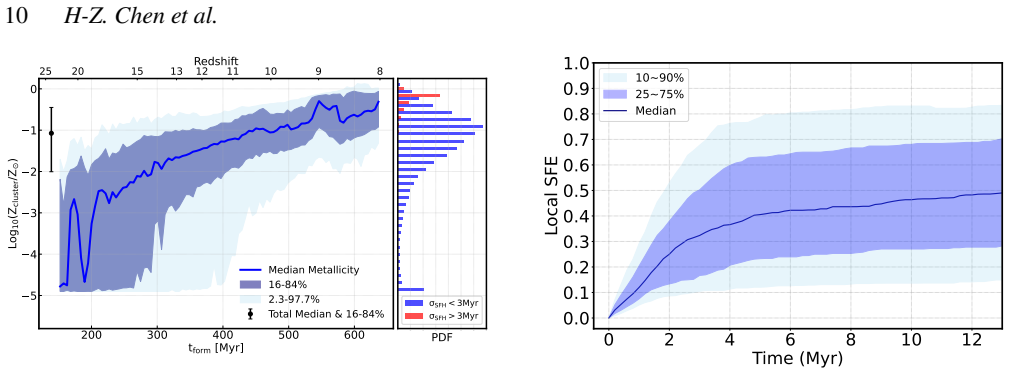
At z~10 cold streams feed a compact galaxy whose central densities exceed FFB thresholds, enabling over 10^5 star clusters in which 90% of star formation occurs; these clusters show local SFE ~0.5, short bursts, and metallicities from -2.01 to -0.45 in log(Z/Zsun), while feedback outflows reach typical temperatures of 10^7 K and velocities of ~2000 km/s, and the clusters merge to form an oblate nuclear stellar cluster consistent with JWST observations.
What carries the argument
Feedback-free starburst (FFB) regime in dense molecular gas, realized by combining <=3 pc resolution with a 3.4 Myr supernova feedback delay that permits rapid star formation before feedback acts.
If this is right
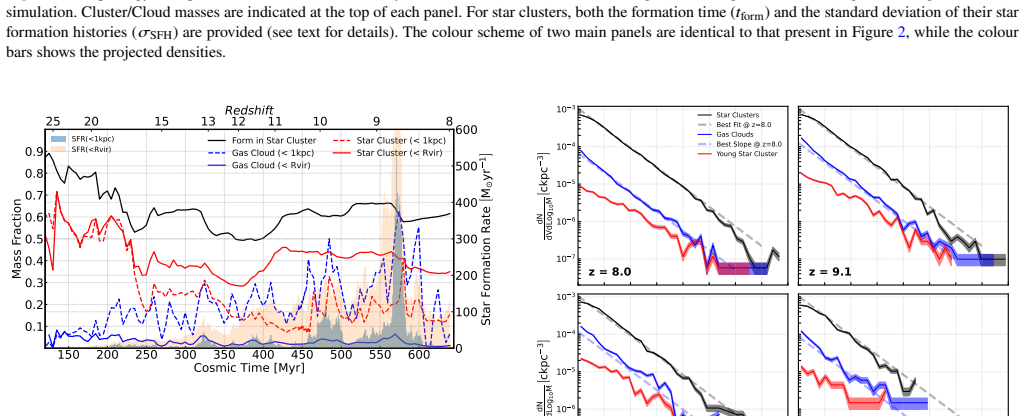
- Approximately 90 percent of star formation occurs inside clusters that at any instant hold 30-40 percent of the total stellar mass.
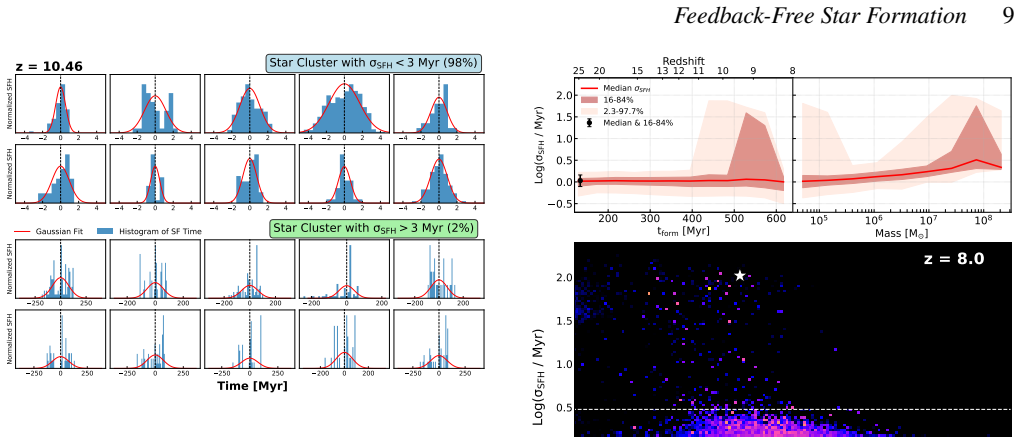
- Most clusters below 10^7 solar masses form their stars in bursts shorter than 3 Myr at local efficiencies of 0.5 plus or minus 0.2.
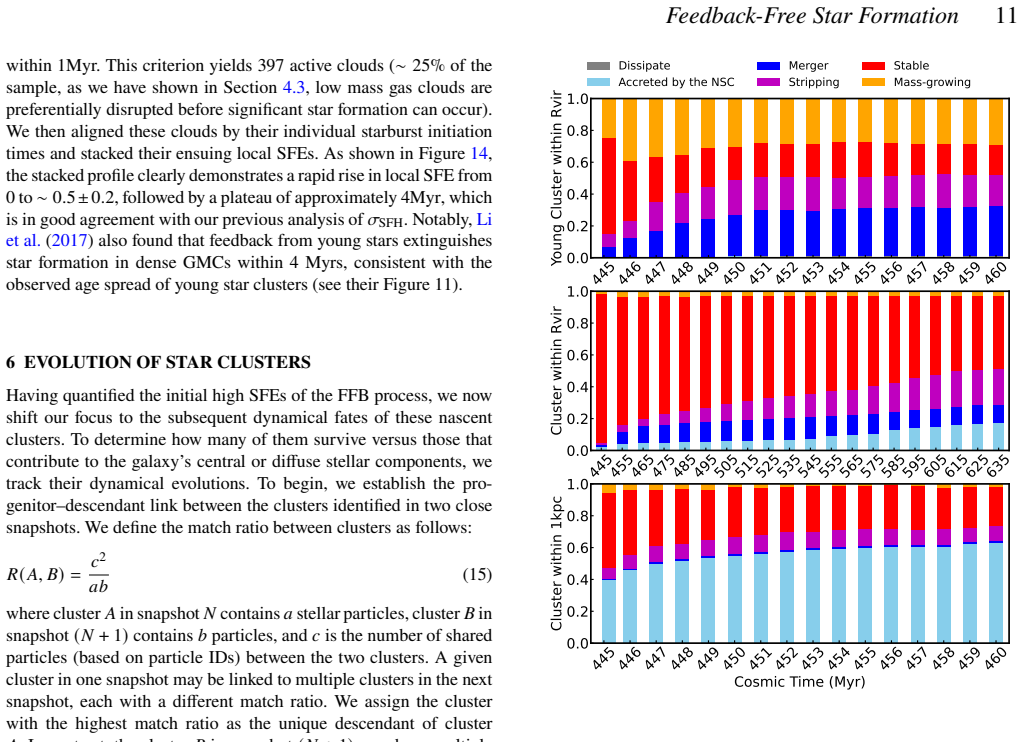
- Clusters undergo rapid orbital decay and merging inside the central kiloparsec, building an oblate nuclear stellar cluster.
- Outflows driven by the starbursts reach typical temperatures of 10^7 K and speeds of 2000 km/s.
- A fraction of the simulated clusters have properties that could allow survival as globular clusters at low redshift.
Where Pith is reading between the lines
- If the FFB regime dominates at z>10, standard sub-grid feedback prescriptions in large-volume simulations may systematically underpredict the brightness of the earliest galaxies.
- The scale-free cluster mass function and high clustered fraction could be tested directly with deeper JWST imaging of lensed fields at z~10.
- Rapid baryon recycling implied by the cluster metallicities suggests that metal enrichment proceeds faster than assumed in many semi-analytic models of the first galaxies.
Load-bearing premise
The chosen 3.4 Myr supernova delay together with <=3 pc resolution is enough to let the simulation enter the feedback-free regime without other unmodeled processes regulating star formation.
What would settle it
A rerun of the same initial conditions at lower resolution or with zero supernova delay that fails to reach the reported central densities, global SFE of 0.2-0.3, or cluster mass function slope near -1.06.
Figures
read the original abstract
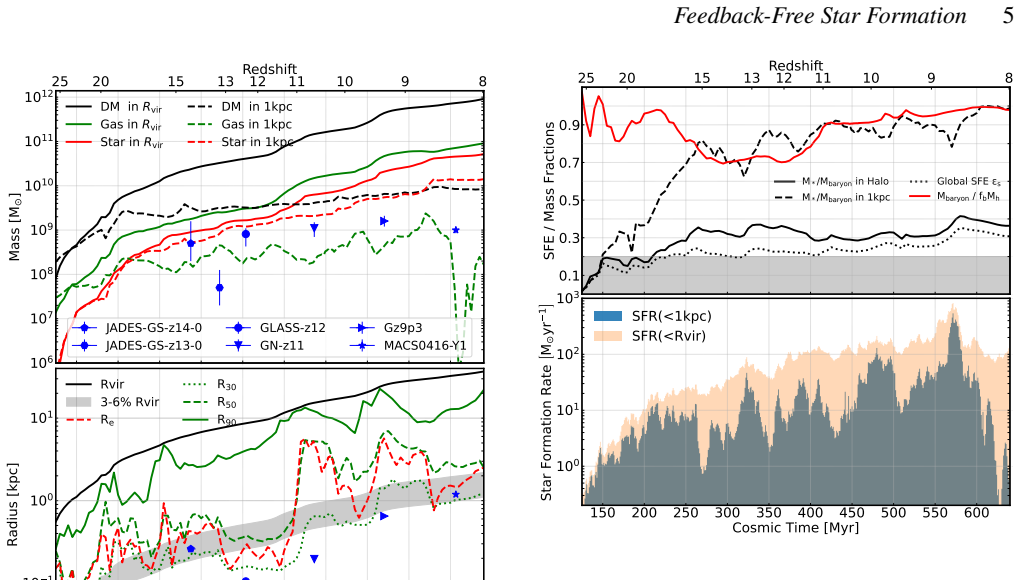
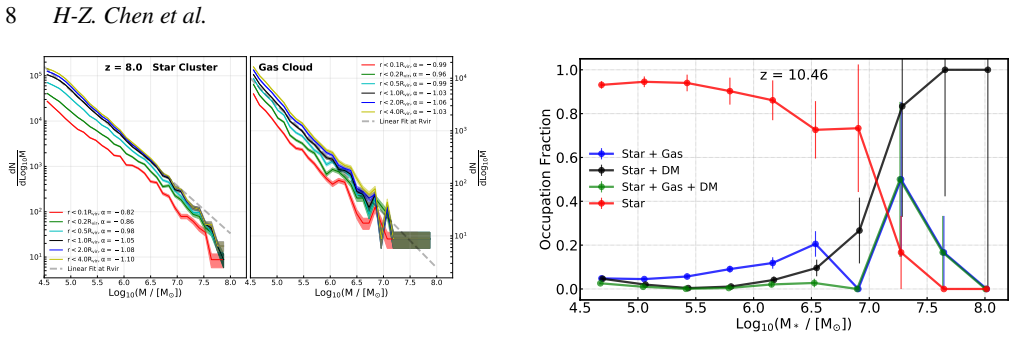
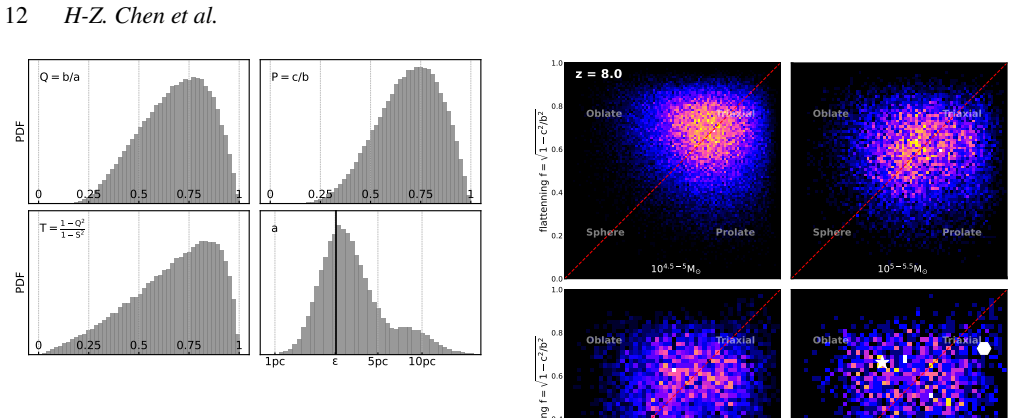
We perform a cosmological zoom-in simulation of a massive galaxy ($M_s\sim10^{10}\rm M_\odot$ at $z\sim10$) using the GIZMO code. By employing $\leq 3\rm pc$ resolution and a $3.4\rm Myr$ supernova feedback delay, we capture the feedback-free starbursts (FFB) in clusters. The simulation reproduces FFB model predictions and super-bright galaxies observed by JWST. At $z\sim10$, cold streams feed a compact galaxy ($R_{\rm e}\sim1\rm kpc$), with stellar and surface densities ($>10^5\rm cm^{-3}$, $>10^5\rm M_\odot pc^{-2}$) exceeding FFB thresholds. The global star-formation efficiency (SFE) is $\varepsilon_s\sim0.2\text{--}0.3$, associated with a fluctuating star-formation history. We identified over $10^5$ star clusters ($M_{\star}>10^{4.5}\rm M_\odot$) with a nearly scale-free mass distribution (${\rm d}N/{{\rm d}\log M}\propto M^{-1.06}$). Approximately 90\% of star formation occurs in clusters, which at a given time constitute $30\text{--}40\%$ of the total stellar mass. The star formation in most of the clusters of masses $<10^7\rm M_\odot$, occurs in bursts of $<3\rm Myr$ and a local SFE $\sim0.5\pm 0.2$. Cluster metallicities ($-2.01<\log (Z/Z_\odot)<-0.45$) indicate rapid baryon recycling. Feedback-driven outflows exhibit typical temperature of $10^7\rm K$ and typical velocities of $\sim 2000\rm km\ s^{-1}$. In the highly dynamic central $1\rm kpc$, clusters undergo rapid orbital decay and merge to assemble the oblate nuclear stellar cluster. Cluster shapes range from oblate to prolate, with a triaxial median. These clusters are consistent with JWST observations, and a fraction of them may survive to yield the globular clusters (GCs) at low redshifts.
Editorial analysis
A structured set of objections, weighed in public.
Referee Report
Summary. The paper presents a cosmological zoom-in GIZMO simulation of a ~10^10 M_⊙ galaxy at z~10 with ≤3 pc resolution and a fixed 3.4 Myr supernova feedback delay, claiming that this setup captures feedback-free starbursts (FFB) that reproduce analytic FFB model predictions (high gas densities, local SFE~0.5, short bursts) and JWST-observed super-bright galaxies, while also reporting global SFE 0.2–0.3, a cluster mass function slope of –1.06, 90% clustered star formation, and rapid cluster merging.
Significance. If the central claim is validated, the work would supply the first high-resolution cosmological demonstration of emergent FFB in a realistic galactic environment, directly linking sub-pc cluster physics to the bright z>10 population and providing quantitative predictions for cluster demographics and outflows that can be tested against JWST data.
major comments (2)
- [Abstract] Abstract: the claim that the simulation 'reproduces FFB model predictions' is predicated on employing a 3.4 Myr supernova feedback delay and ≤3 pc resolution 'to capture' FFB, yet the manuscript contains no convergence tests, no runs with alternate delay times or resolutions, and no quantitative comparison of the reported quantities (densities >10^5 cm^{-3}, local SFE ~0.5, bursts <3 Myr, global ε_s = 0.2–0.3) against the analytic FFB thresholds or against a control simulation lacking the delay.
- [Abstract] Abstract: the reported burst durations (<3 Myr) are comparable to the imposed 3.4 Myr feedback delay, so the short bursts and high local SFE may be partly imposed by the subgrid timing choice rather than fully emergent; explicit tests (e.g., varying the delay while holding resolution fixed) are required to substantiate that the feedback-free regime has been captured.
minor comments (2)
- [Abstract] Abstract: the cluster mass function is stated as dN/dlogM ∝ M^{-1.06} without specifying the mass range or noting any high-mass cutoff or low-mass turnover; adding this information would strengthen the comparison to observations.
- [Abstract] Abstract: the metallicities are given as –2.01 < log(Z/Z_⊙) < –0.45; clarifying whether this range applies to all clusters or only a subset, and how it was measured, would improve clarity.
Simulated Author's Rebuttal
We thank the referee for their thorough review and valuable comments. We respond to each major comment below and indicate the revisions we will make to the manuscript.
read point-by-point responses
-
Referee: [Abstract] Abstract: the claim that the simulation 'reproduces FFB model predictions' is predicated on employing a 3.4 Myr supernova feedback delay and ≤3 pc resolution 'to capture' FFB, yet the manuscript contains no convergence tests, no runs with alternate delay times or resolutions, and no quantitative comparison of the reported quantities (densities >10^5 cm^{-3}, local SFE ~0.5, bursts <3 Myr, global ε_s = 0.2–0.3) against the analytic FFB thresholds or against a control simulation lacking the delay.
Authors: We agree with the referee that the current manuscript lacks explicit convergence tests and direct quantitative comparisons to the analytic FFB model. The resolution and delay time were selected to resolve the relevant physical scales and to allow star formation to proceed for the lifetime of massive stars before SN feedback. In the revised manuscript, we will add quantitative comparisons of our simulated gas densities, local star formation efficiencies, burst durations, and global SFE to the specific thresholds outlined in the analytic FFB literature. We will also include a discussion of the parameter choices and note the absence of control simulations as a limitation. However, new simulations with different parameters are beyond the scope of the current work due to high computational demands. revision: partial
-
Referee: [Abstract] Abstract: the reported burst durations (<3 Myr) are comparable to the imposed 3.4 Myr feedback delay, so the short bursts and high local SFE may be partly imposed by the subgrid timing choice rather than fully emergent; explicit tests (e.g., varying the delay while holding resolution fixed) are required to substantiate that the feedback-free regime has been captured.
Authors: The referee is correct that the burst durations are limited by the feedback delay time. This is intentional in modeling the FFB regime, where the key is that star formation occurs before feedback activates. The high local SFE and the scale-free cluster mass function emerge from the resolved hydrodynamics and gravity. We will revise the abstract and add clarifying text in the methods and discussion sections to better distinguish between the imposed subgrid delay and the emergent properties of the simulation. We will also state that varying the delay time would require new simulations, which we plan to pursue in follow-up work. revision: yes
- Performing new high-resolution simulations with varied supernova feedback delay times to explicitly test the sensitivity of the FFB capture.
Circularity Check
No significant circularity; results from forward hydro simulation compared to external models
full rationale
The paper reports outcomes from a GIZMO cosmological zoom-in run with fixed inputs (≤3 pc resolution, 3.4 Myr SN delay) chosen to enable FFB conditions. Measured quantities (global ε_s ~0.2-0.3, cluster mass function slope -1.06, local SFE ~0.5, burst durations <3 Myr) are extracted from the evolved simulation and compared to independent FFB analytic predictions and JWST observations. No central result is defined in terms of itself, no fitted parameter is relabeled as a prediction, and no load-bearing step reduces to a self-citation chain. The derivation is self-contained against external benchmarks.
Axiom & Free-Parameter Ledger
free parameters (2)
- supernova feedback delay =
3.4 Myr
- spatial resolution =
≤3 pc
axioms (2)
- standard math Lambda-CDM cosmology governs the initial conditions and large-scale evolution
- domain assumption GIZMO hydrodynamics and subgrid feedback modules correctly represent the unresolved physics
Reference graph
Works this paper leans on
-
[1]
Bursty Star Formation Naturally Explains the Abundance of Bright Galaxies at Cosmic Dawn. , keywords =. doi:10.3847/2041-8213/acf85a , archivePrefix =. 2307.15305 , primaryClass =
-
[2]
Two Remarkably Luminous Galaxy Candidates at z 10-12 Revealed by JWST. , keywords =. doi:10.3847/2041-8213/ac9b22 , archivePrefix =. 2207.09434 , primaryClass =
-
[3]
doi:10.1038/s41586-023-05786-2
A population of red candidate massive galaxies 600 Myr after the Big Bang. , keywords =. doi:10.1038/s41586-023-05786-2 , archivePrefix =. 2207.12446 , primaryClass =
-
[4]
2023, Monthly Notices of the Royal Astronomical Society, 523, 3201, doi: 10.1093/mnras/stad1557
Efficient formation of massive galaxies at cosmic dawn by feedback-free starbursts. , keywords =. doi:10.1093/mnras/stad1557 , archivePrefix =. 2303.04827 , primaryClass =
-
[5]
Clustering and halo abundances in early dark energy cosmological models. , keywords =. doi:10.1093/mnras/stab769 , archivePrefix =. 2006.14910 , primaryClass =
-
[6]
FOREVER22: galaxy formation in protocluster regions. , keywords =. doi:10.1093/mnras/stab3092 , archivePrefix =. 2011.11663 , primaryClass =
-
[7]
On the stunning abundance of super-early, luminous galaxies revealed by JWST. , keywords =. doi:10.1093/mnras/stad1095 , archivePrefix =. 2208.00720 , primaryClass =
-
[8]
Early galaxies and early dark energy: a unified solution to the hubble tension and puzzles of massive bright galaxies revealed by JWST. , keywords =. doi:10.1093/mnras/stae1932 , archivePrefix =. 2406.15548 , primaryClass =
-
[9]
Enhanced Subkiloparsec-scale Star Formation: Results from a JWST Size Analysis of 341 Galaxies at 5 < z < 14. , keywords =. doi:10.3847/1538-4357/ad1404 , archivePrefix =. 2308.05018 , primaryClass =
-
[10]
GIZMO: A New Class of Accurate, Mesh-Free Hydrodynamic Simulation Methods
A new class of accurate, mesh-free hydrodynamic simulation methods. , keywords =. doi:10.1093/mnras/stv195 , archivePrefix =. 1409.7395 , primaryClass =
work page internal anchor Pith review Pith/arXiv arXiv doi:10.1093/mnras/stv195
-
[11]
Planck 2013 results. XVI. Cosmological parameters. , keywords =. doi:10.1051/0004-6361/201321591 , archivePrefix =. 1303.5076 , primaryClass =
work page internal anchor Pith review Pith/arXiv arXiv doi:10.1051/0004-6361/201321591 2013
-
[12]
Multi-scale initial conditions for cosmological simulations. , keywords =. doi:10.1111/j.1365-2966.2011.18820.x , archivePrefix =. 1103.6031 , primaryClass =
-
[13]
A catalogue of masses, structural parameters, and velocity dispersion profiles of 112 Milky Way globular clusters. , keywords =. doi:10.1093/mnras/sty1057 , archivePrefix =. 1804.08359 , primaryClass =
work page internal anchor Pith review Pith/arXiv arXiv doi:10.1093/mnras/sty1057
-
[14]
F., Wetzel, A., Kereˇs, D., et al
FIRE-2 simulations: physics versus numerics in galaxy formation. , keywords =. doi:10.1093/mnras/sty1690 , archivePrefix =. 1702.06148 , primaryClass =
work page internal anchor Pith review Pith/arXiv arXiv doi:10.1093/mnras/sty1690
-
[15]
Non-equilibrium chemistry and cooling in the diffuse interstellar medium - II. Shielded gas
Non-equilibrium chemistry and cooling in the diffuse interstellar medium - II. Shielded gas. , keywords =. doi:10.1093/mnras/stu1046 , archivePrefix =. 1403.6155 , primaryClass =
work page internal anchor Pith review Pith/arXiv arXiv doi:10.1093/mnras/stu1046
-
[16]
Non-equilibrium chemistry and cooling in the diffuse interstellar medium - I. Optically thin regime
Non-equilibrium chemistry and cooling in the diffuse interstellar medium - I. Optically thin regime. , keywords =. doi:10.1093/mnras/stu525 , archivePrefix =. 1401.4719 , primaryClass =
work page internal anchor Pith review Pith/arXiv arXiv doi:10.1093/mnras/stu525
-
[17]
Monthly Notices of the Royal Astronomical Society , author =
Galaxies on FIRE (Feedback In Realistic Environments): stellar feedback explains cosmologically inefficient star formation. , keywords =. doi:10.1093/mnras/stu1738 , archivePrefix =. 1311.2073 , primaryClass =
work page internal anchor Pith review Pith/arXiv arXiv doi:10.1093/mnras/stu1738 2073
-
[18]
How To Model Supernovae in Simulations of Star and Galaxy Formation
How to model supernovae in simulations of star and galaxy formation. , keywords =. doi:10.1093/mnras/sty674 , archivePrefix =. 1707.07010 , primaryClass =
work page internal anchor Pith review Pith/arXiv arXiv doi:10.1093/mnras/sty674
-
[19]
pynbody: N-Body/SPH analysis for python
-
[20]
NIHAO-RiNG: A Comparison of Simulated Disk Galaxies from GASOLINE and GIZMO. , keywords =. doi:10.3847/1538-4357/ad924e , archivePrefix =. 2310.13069 , primaryClass =
-
[21]
The evolution of large-scale structure in a universe dominated by cold dark matter. , keywords =. doi:10.1086/163168 , adsurl =
-
[22]
An observational test for star formation prescriptions in cosmological hydrodynamical simulations
An observational test for star formation prescriptions in cosmological hydrodynamical simulations. , keywords =. doi:10.1093/mnras/stz969 , archivePrefix =. 1812.05613 , primaryClass =
work page internal anchor Pith review Pith/arXiv arXiv doi:10.1093/mnras/stz969
-
[23]
Galaxy bimodality due to cold flows and shock heating. , keywords =. doi:10.1111/j.1365-2966.2006.10145.x , archivePrefix =. astro-ph/0412300 , primaryClass =
-
[24]
On the variation of the initial mass function. , keywords =. doi:10.1046/j.1365-8711.2001.04022.x , archivePrefix =. astro-ph/0009005 , primaryClass =
-
[25]
The Structure of Cold Dark Matter Halos
The Structure of Cold Dark Matter Halos. , keywords =. doi:10.1086/177173 , archivePrefix =. astro-ph/9508025 , primaryClass =
work page internal anchor Pith review Pith/arXiv arXiv doi:10.1086/177173
-
[26]
The Ordered Nature of Elliptical Galaxies: Implications for Their Intrinsic Angular Momenta and Shapes. , keywords =. doi:10.1086/170769 , adsurl =
-
[27]
, keywords =
Chemical composition of globular cluster stars. , keywords =
-
[28]
2020, MNRAS, 498, 5652, doi: 10.1093/mnras/staa2276
Very high redshift quasars and the rapid emergence of supermassive black holes. , keywords =. doi:10.1093/mnras/staa2276 , archivePrefix =. 2007.14402 , primaryClass =
-
[29]
Galactic Dark Matter Halos and Globular Cluster Populations. III. Extension to Extreme Environments. , keywords =. doi:10.3847/1538-4357/836/1/67 , archivePrefix =. 1701.04845 , primaryClass =
work page internal anchor Pith review Pith/arXiv arXiv doi:10.3847/1538-4357/836/1/67
-
[30]
The structure of star clusters. I. an empirical density law. , year = 1962, month = oct, volume =. doi:10.1086/108756 , adsurl =
-
[31]
title Radiation pressure and absorption in AGN: results from a complete unbiased sample from Swift
A maximum stellar surface density in dense stellar systems. , keywords =. doi:10.1111/j.1745-3933.2009.00777.x , archivePrefix =. 0908.4088 , primaryClass =
-
[32]
A CEERS Discovery of an Accreting Supermassive Black Hole 570 Myr after the Big Bang: Identifying a Progenitor of Massive z > 6 Quasars. , keywords =. doi:10.3847/2041-8213/ace619 , archivePrefix =. 2303.08918 , primaryClass =
-
[33]
Feedback-free starbursts at cosmic dawn: Observable predictions for JWST. , keywords =. doi:10.1051/0004-6361/202348727 , archivePrefix =. 2311.14662 , primaryClass =
-
[34]
JWST, ALMA, and Keck Spectroscopic Constraints on the UV Luminosity Functions at z 7 14: Clumpiness and Compactness of the Brightest Galaxies in the Early Universe. , keywords =. doi:10.3847/1538-4357/ad9b2c , archivePrefix =. 2406.18352 , primaryClass =
-
[35]
Accelerating Early Massive Galaxy Formation with Primordial Black Holes. , keywords =. doi:10.3847/2041-8213/ac927f , archivePrefix =. 2208.13178 , primaryClass =
-
[36]
Starburst99: Synthesis Models for Galaxies with Active Star Formation
Starburst99: Synthesis Models for Galaxies with Active Star Formation. , keywords =. doi:10.1086/313233 , archivePrefix =. astro-ph/9902334 , primaryClass =
work page internal anchor Pith review Pith/arXiv arXiv doi:10.1086/313233
-
[37]
SIEGE III: The formation of dense stellar clusters in sub-parsec resolution cosmological simulations with individual star feedback. arXiv e-prints , keywords =. doi:10.48550/arXiv.2411.02502 , archivePrefix =. 2411.02502 , primaryClass =
-
[38]
Density modulated star formation efficiency: implications for the observed abundance of ultra-violet luminous galaxies at z>10. arXiv e-prints , keywords =. doi:10.48550/arXiv.2505.05442 , archivePrefix =. 2505.05442 , primaryClass =
-
[39]
Cold Filamentary Accretion and the Formation of Metal Poor Globular Clusters and Halo Stars
Cold Filamentary Accretion and the Formation of Metal-poor Globular Clusters and Halo Stars. , keywords =. doi:10.3847/1538-4357/aaca98 , archivePrefix =. 1711.09108 , primaryClass =
work page internal anchor Pith review Pith/arXiv arXiv doi:10.3847/1538-4357/aaca98
-
[40]
A Catalog of Parameters for Globular Clusters in the Milky Way. , keywords =. doi:10.1086/118116 , adsurl =
-
[41]
Resolved Massive Star Clusters in the Milky Way and Its Satellites: Brightness Profiles and a Catalog of Fundamental Parameters. , keywords =. doi:10.1086/497429 , archivePrefix =. astro-ph/0605132 , primaryClass =
work page internal anchor Pith review Pith/arXiv arXiv doi:10.1086/497429
-
[42]
Survival and mass growth of cold gas in a turbulent, multiphase medium. , keywords =. doi:10.1093/mnras/stab3351 , archivePrefix =. 2107.13012 , primaryClass =
-
[43]
The cosmological simulation code GADGET-2. , keywords =. doi:10.1111/j.1365-2966.2005.09655.x , archivePrefix =. astro-ph/0505010 , primaryClass =
-
[44]
The Effect of Age and Stellar Model Choice on Globular Cluster Color-to-metallicity Conversions. , keywords =. doi:10.3847/1538-3881/ad57bc , archivePrefix =. 2406.09596 , primaryClass =
-
[45]
Galactic inflow and wind recycling rates in the EAGLE simulations. , keywords =. doi:10.1093/mnras/staa2252 , archivePrefix =. 2005.10262 , primaryClass =
-
[46]
The Cosmic Baryon Cycle and Galaxy Mass Assembly in the FIRE Simulations
The cosmic baryon cycle and galaxy mass assembly in the FIRE simulations. , keywords =. doi:10.1093/mnras/stx1517 , archivePrefix =. 1610.08523 , primaryClass =
work page internal anchor Pith review Pith/arXiv arXiv doi:10.1093/mnras/stx1517
-
[47]
Constraining galactic baryon cycle using the galaxy stellar-to-halo mass relations. , keywords =. doi:10.1093/mnras/stac3628 , archivePrefix =. 2212.05007 , primaryClass =
-
[48]
Growth of massive black holes in FFB galaxies at cosmic dawn. , keywords =. doi:10.1051/0004-6361/202452393 , archivePrefix =. 2409.18605 , primaryClass =
-
[49]
On the origin of the high star formation efficiency in massive galaxies at Cosmic Dawn. , keywords =. doi:10.1093/mnras/staf930 , archivePrefix =. 2410.20530 , primaryClass =
-
[50]
2023, ApJS, 265, 5, doi: 10.3847/1538-4365/acaaa9
A Comprehensive Study of Galaxies at z 9-16 Found in the Early JWST Data: Ultraviolet Luminosity Functions and Cosmic Star Formation History at the Pre-reionization Epoch. , keywords =. doi:10.3847/1538-4365/acaaa9 , archivePrefix =. 2208.01612 , primaryClass =
-
[51]
A Census of the Bright z = 8.5-11 Universe with the Hubble and Spitzer Space Telescopes in the CANDELS Fields. , keywords =. doi:10.3847/1538-4357/ac3aed , archivePrefix =. 2106.13813 , primaryClass =
-
[52]
CEERS Key Paper. I. An Early Look into the First 500 Myr of Galaxy Formation with JWST. , keywords =. doi:10.3847/2041-8213/acade4 , archivePrefix =. 2211.05792 , primaryClass =
-
[53]
Life beyond 30: Probing the -20 < M _ UV < -17 Luminosity Function at 8 < z < 13 with the NIRCam Parallel Field of the MIRI Deep Survey. , keywords =. doi:10.3847/2041-8213/acd9d0 , archivePrefix =. 2302.02429 , primaryClass =
-
[54]
The impact of UV variability on the abundance of bright galaxies at z 9. , keywords =. doi:10.1093/mnras/stad2508 , archivePrefix =. 2305.05679 , primaryClass =
-
[55]
Studies in astronomical time series analysis. II. Statistical aspects of spectral analysis of unevenly spaced data. , keywords =. doi:10.1086/160554 , adsurl =
-
[56]
Least-Squares Frequency Analysis of Unequally Spaced Data. , keywords =. doi:10.1007/BF00648343 , adsurl =
-
[57]
Evolution of Galaxy Shapes from Prolate to Oblate through Compaction Events
Evolution of galaxy shapes from prolate to oblate through compaction events. , keywords =. doi:10.1093/mnras/stw606 , archivePrefix =. 1512.06268 , primaryClass =
work page internal anchor Pith review Pith/arXiv arXiv doi:10.1093/mnras/stw606
-
[58]
Bound star clusters observed in a lensed galaxy 460 Myr after the Big Bang. , keywords =. doi:10.1038/s41586-024-07703-7 , archivePrefix =. 2401.03224 , primaryClass =
-
[59]
The Next Generation Virgo Cluster Survey. VIII. The Spatial Distribution of Globular Clusters in the Virgo Cluster. , keywords =. doi:10.1088/0004-637X/794/2/103 , archivePrefix =. 1408.2821 , primaryClass =
work page internal anchor Pith review Pith/arXiv arXiv doi:10.1088/0004-637x/794/2/103
-
[60]
The HST/ACS Coma Cluster Survey. IV. Intergalactic Globular Clusters and the Massive Globular Cluster System at the Core of the Coma Galaxy Cluster. , keywords =. doi:10.1088/0004-637X/730/1/23 , archivePrefix =. 1101.1000 , primaryClass =
work page internal anchor Pith review Pith/arXiv arXiv doi:10.1088/0004-637x/730/1/23
-
[61]
From FFB starbursts at cosmic dawn to quenching at cosmic morning: Hi-z galaxy bimodality. , keywords =. doi:10.1093/mnras/staf1692 , archivePrefix =. 2506.11664 , primaryClass =
-
[62]
Photometric detection at 7.7 m of a galaxy beyond redshift 14 with JWST/MIRI. Nature Astronomy , keywords =. doi:10.1038/s41550-025-02503-z , archivePrefix =. 2405.18462 , primaryClass =
-
[63]
2024, Nature Astronomy, 8, 657, 10.1038/s41550-024-02218-7
A massive interacting galaxy 510 million years after the Big Bang. Nature Astronomy , keywords =. doi:10.1038/s41550-024-02218-7 , archivePrefix =. 2303.00306 , primaryClass =
-
[64]
Detailed Study of Stars and Gas in a z = 8.3 Massive Merger with Extreme Dust Conditions. , keywords =. doi:10.3847/2041-8213/ad9741 , archivePrefix =. 2408.12310 , primaryClass =
-
[65]
Identification and properties of intense star-forming galaxies at redshifts z > 10. Nature Astronomy , keywords =. doi:10.1038/s41550-023-01921-1 , archivePrefix =. 2212.04480 , primaryClass =
-
[66]
JADES NIRSpec Spectroscopy of GN-z11: Lyman- emission and possible enhanced nitrogen abundance in a z = 10.60 luminous galaxy. , keywords =. doi:10.1051/0004-6361/202346159 , archivePrefix =. 2302.07256 , primaryClass =
-
[67]
JADES Imaging of GN-z11: Revealing the Morphology and Environment of a Luminous Galaxy 430 Myr after the Big Bang. , keywords =. doi:10.3847/1538-4357/acdbc6 , archivePrefix =. 2302.07234 , primaryClass =
-
[68]
Evidence of Extreme Ionization Conditions and Low Metallicity in GHZ2/GLASS-Z12 from a Combined Analysis of NIRSpec and MIRI Observations. , keywords =. doi:10.3847/1538-4357/ad7602 , archivePrefix =. 2403.12683 , primaryClass =
-
[69]
Searching for Emission Lines at z > 11: The Role of Damped Ly and Hints About the Escape of Ionizing Photons. , keywords =. doi:10.3847/1538-4357/ad8447 , archivePrefix =. 2404.04325 , primaryClass =
-
[70]
In Situ Formation of Star Clusters at z > 7 via Galactic Disk Fragmentation: Shedding Light on Ultracompact Clusters and Overmassive Black Holes Seen by JWST. , keywords =. doi:10.3847/2041-8213/adadfe , archivePrefix =. 2411.00670 , primaryClass =
-
[71]
The formation of globular clusters as a case of overcooling. , keywords =. doi:10.1093/mnras/stac973 , archivePrefix =. 2203.03002 , primaryClass =
-
[72]
Multiple Stellar Populations in Globular Clusters
Multiple Stellar Populations in Globular Clusters. , keywords =. doi:10.1146/annurev-astro-081817-051839 , archivePrefix =. 1712.01286 , primaryClass =
work page internal anchor Pith review Pith/arXiv arXiv doi:10.1146/annurev-astro-081817-051839
-
[73]
Formation of Globular Clusters in Atomic-cooling Halos Via Rapid Gas Condensation and Fragmentation during the Epoch of Reionization. , keywords =. doi:10.3847/0004-637X/823/1/52 , archivePrefix =. 1510.05671 , primaryClass =
work page internal anchor Pith review Pith/arXiv arXiv doi:10.3847/0004-637x/823/1/52
-
[74]
Star Cluster Formation in Cosmological Simulations. I. Properties of Young Clusters. , keywords =. doi:10.3847/1538-4357/834/1/69 , archivePrefix =. 1608.03244 , primaryClass =
work page internal anchor Pith review Pith/arXiv arXiv doi:10.3847/1538-4357/834/1/69
discussion (0)
Sign in with ORCID, Apple, or X to comment. Anyone can read and Pith papers without signing in.