REVIEW 2 major objections 6 minor 102 references
Daily Earth-shielding modulation can disentangle sub-GeV dark matter's nuclear and electron couplings.
Reviewed by Pith at T0; open to challenge. T0 means a machine referee read the full paper against a public rubric. the ladder, T0–T4 →
T0 review · deepseek-v4-flash
2026-08-01 09:50 UTC pith:EJ7ZLYGB
load-bearing objection A solid two-interaction framework that makes a real case for daily Earth-shielding modulation as a discriminator of DM-electron vs DM-nucleon couplings, with an unquantified annual-velocity approximation that should be tested before the projections are trusted. the 2 major comments →
Dark Matter Weather: Probing Sub-GeV Interactions with Earth-Shielding Modulation
The pith
A machine-rendered reading of the paper's core claim, the machinery that carries it, and where it could break.
Core claim
The central claim is that Earth attenuation and detector ionization are governed by different couplings of the same dark-matter particle, so the time-dependent signal separates them. The spin-independent DM–nucleon cross section sets the daily isoangle modulation pattern through Earth scattering, while the DM–electron cross section sets the overall ionization yield; a shape-based statistic (the integrated absolute CDF distance in isoangle space) combined with the ionization spectrum can therefore measure the nuclear cross section even when only electron recoils are detected. The paper demonstrates this for liquid argon and liquid xenon, and illustrates the method with a case study using 653
What carries the argument
The central object is the isoangle Θ, the angle between the detector's position vector and the apparent dark-matter wind; detectors at equal Θ receive the same attenuated flux. The framework separates two cross sections: the spin-independent DM–nucleon cross section controls the Θ-dependent attenuation and hence the daily modulation shape, while the DM–electron cross section controls the overall ionization signal. The statistical engine is D_isoang, the integrated absolute difference between the background-only and signal-plus-background cumulative isoangle distributions (a one-dimensional Wasserstein distance), which is robust to isolated fluctuations and can be combined with the ionization
Load-bearing premise
The analysis fixes the Earth's orbital velocity to its March 9 value for both the signal model and the event timestamps; over a full year the daily modulation curve shifts phase with the seasons, so a long exposure sees a smeared shape that the projections do not account for.
What would settle it
Take one year of timestamped events from a low-threshold liquid-noble detector, bin them by the true day-by-day seasonally varying isoangle, and compare the observed daily modulation phase and amplitude against the fixed-March-9 prediction; if the phase shifts measurably across the year, the paper's fixed-velocity projections are optimistic, and if it does not, the approximation holds.
If this is right
- A daily modulation with the predicted phase, shape, target dependence, and site dependence would be difficult for most detector backgrounds to mimic, giving a validation handle on any sub-GeV candidate.
- The isoangle shape test can place 90% C.L. limits on the DM–nucleon cross section using only electron-recoil ionization data, complementary to Migdal-based atomic-ionization searches.
- Because Northern and Southern Hemisphere detectors sample different isoangle ranges, comparing sites sharpens the interpretation of any signal.
- The method is ready for tonne-scale liquid-noble exposures, which can accumulate the required statistics in days to months.
- In light-mediator models, screening and forward-peaked scattering suppress the daily modulation at fixed reference cross section, so the effect primarily probes contact interactions at the quoted cross sections.
Where Pith is reading between the lines
- The paper fixes the Earth's orbital velocity to a single date; a natural extension would model the full seasonal drift of the isoangle curve, letting a combined daily-plus-annual analysis use the complete time morphology rather than a smeared daily average.
- The same two-cross-section logic should transfer to semiconductor or scintillator targets, where different ionization thresholds would probe different mass windows and provide cross-material consistency checks.
- The D_isoang statistic is a Wasserstein-1 distance; higher-order Wasserstein metrics or harmonic decompositions of the isoangle PDF might capture subtler shape information that the integrated CDF difference averages out.
- The separation between rate and shape could also be used as a diagnostic after a candidate excess appears: a rate-only excess with no daily shape distortion would point toward pure DM–electron coupling, whereas a distorted shape would indicate significant Earth attenuation.
Editorial analysis
A structured set of objections, weighed in public.
Referee Report
Summary. The paper studies daily modulation of sub-GeV dark-matter signals caused by DM–nucleus scattering inside the Earth, in a scenario where DM also scatters off electrons in the detector. Using DaMaSCUS to obtain the Earth-modified speed distribution f(v|Θ) and density ρ(Θ) for a grid of (mχ, σ_SI_χn), and DarkArt for atomic ionization form factors, it computes the Θ-dependent ionization rates in argon and xenon targets through Eq. (11). It introduces a location-dependent isoangle exposure w(Θ) (Eq. 13) and a shape statistic D_isoang (Eq. 20) that quantifies the daily-modulation shape, with p-values calibrated by Poisson pseudoexperiments and a CL_s procedure. It presents projected 90% C.L. exclusions on σ_SI_χn for 1–10 tonne-month argon/xenon at LNGS/SUPL and for XENONnT/LZ-like exposures, claiming sensitivity competitive with or up to an order of magnitude better than Migdal searches in certain mass windows. It also applies the framework to DarkSide-50 by combining spectral and isoangle-shape constraints, assuming no observed daily modulation because public timestamps are unavailable. The analysis fixes the Earth’s orbital velocity to its March 9 value (Eq. 9) for both signal modeling and timestamp-to-Θ mapping.
Significance. The proposed two-interaction interpretation is conceptually novel and, if the projected sensitivity is correct, practically valuable: it turns Earth shielding into a diagnostic for interaction structure rather than a nuisance rate correction, and it explicitly incorporates the location-dependent isoangle exposure, which previous work did not include. Strengths of the paper are the parameter-free signal model for fixed input cross sections, the use of public DaMaSCUS and DarkArt outputs, the standard CL_s calibration with Poisson pseudoexperiments, and the explicit model benchmarks (heavy dark photon and U(1)_B × U(1)_L). The DarkSide-50 case study is honest about the lack of public timing information. The main caveat is that the annual-variation approximation is unquantified and could affect exactly the long-exposure projections that support the headline comparison with Migdal searches.
major comments (2)
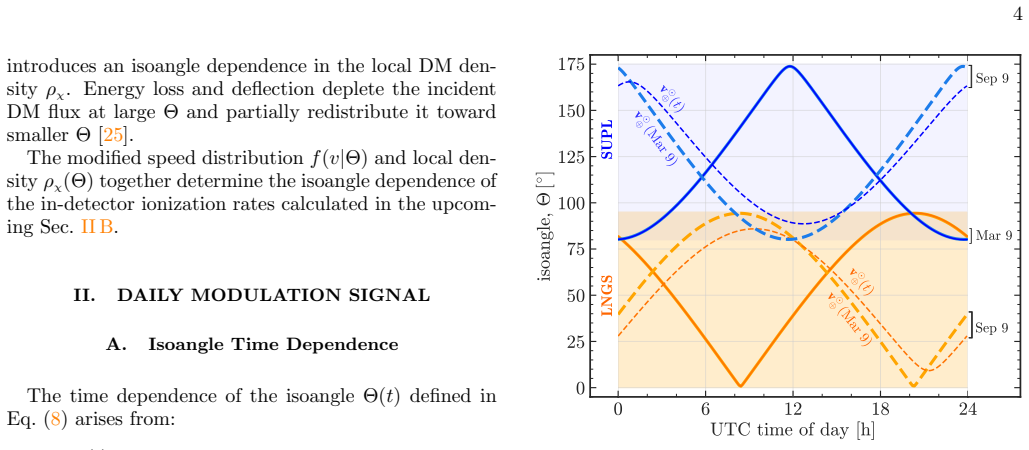
- [Sec. II.A, Eq. (9); Figs. 5, 13–15] The fixed March-9 orbital velocity is load-bearing for the claimed sensitivity. The text acknowledges that the resulting Θ(t) “does not capture the full seasonal dependence,” but no bias estimate is given. Fig. 5 shows that switching to the true September velocity (thin dashed vs thick dashed) shifts the daily Θ(t) curve by an amount that is not small compared with the modulation features, and for XENONnT-like exposures (94 tm ≈ 16 months) or LZ-like exposures (50 tm ≈ 7 months) a single fixed mapping will smear the predicted daily phase. Since D_isoang and the CL_s contours in Figs. 13–15 are computed entirely under this fixed mapping, the projected reach—including the claimed order-of-magnitude improvement over DAMIC-M—could be degraded precisely in the long-exposure regime. Please recompute with the full time-dependent v_orb(t), or provide a quantitative seasonal-smearing estimate (e.
- [Sec. II.B, Figs. 6–8] The rate-shape input to D_isoang is built from 6° DaMaSCUS bins smoothed with a four-parameter tanh (or parabolic) fit. The entire CL_s calculation uses these fitted interpolators, but no closure test is shown for the full (mχ, σ_SI_χn) grid used in the projections; Fig. 8 demonstrates only a single representative mass, mχ = 40 MeV, at two cross sections. If the analytic parameterization is inaccurate in some region of the grid, the predicted isoangle shape—and hence the projected exclusions—could be biased. Please add a closure test comparing the interpolated Θ shapes to the direct DaMaSCUS outputs for a few points spanning the contours in Figs. 13–15, or propagate the Monte Carlo outputs directly through the statistical analysis.
minor comments (6)
- [Sec. VI] Typo: “side-real modulation” should be “sidereal modulation”.
- [Fig. 12 caption] The labels p_sb and p_b in the bottom-center panel are not defined in the caption; please define them or refer explicitly to Eqs. (23)–(25).
- [Fig. 5 caption] The legend notation “v⊙⊕(t) v⊙⊕(Mar9)” is garbled; please clarify which curves correspond to the fixed March-9 velocity and which to the season-dependent velocity.
- [Table I] Please state the provenance of the argon N_e=1 and N_e=2 background rates more explicitly. In particular, the argon N_e=1 rate is extrapolated from DarkSide-50 data via the spurious-electron model of Eq. (B3); the caption should say so and give the associated uncertainty, since these rates directly set the projected reach in Figs. 13–14.
- [Sec. IV.A, Eq. (27)] The conversion σ_SI_χn = σ_χp (Z/A)^2 with Z/A = 0.5 for all terrestrial nuclei is an approximation. A brief comment on the spread in Z/A over realistic Earth composition (e.g., Fe has Z/A ≈ 0.46) and its effect on the σ_SI_χn normalization would help interpret the contours.
- [Fig. 9 caption] Please note in the caption that w(Θ) is computed with the fixed March-9 velocity of Eq. (9); this is important because the exposure density itself becomes season-dependent in a full treatment.
Circularity Check
No significant circularity: the signal model and statistical calibration are self-contained, and the paper's acknowledged approximations are modeling limitations, not circular reductions.
full rationale
The central derivation chain is self-contained. Given (mχ, σ̄e, σ_SI_χn), the ionization rates follow from Eq. (11) using public DaMaSCUS outputs for f(v|Θ) and ρχ(Θ) and DarkArt RHF form factors; no parameter is fitted to the quantity being predicted. The D_isoang shape statistic (Eq. 20) is a distance between background-only and signal-plus-background isoangle CDFs, and its p-value is calibrated with Poisson pseudoexperiments under stated hypotheses (Eqs. 21-25), so the exclusion contours in Figs. 13-15 are not forced by construction. The DarkSide-50 case study is explicitly illustrative: timestamps are unavailable, and the paper assumes an Asimov background-only isoangle distribution (Sec. V.A), while the fitted SE background parameters (Eq. B5) are a background model, not a DM prediction. The only author self-citations (Refs. [56,57] for DM-electron scattering and Ref. [100] for an anomaly-free baryon model in Appendix A) are not load-bearing for the modulation formalism. The paper's own limitation statement, that fixing v_⊙⊕ to March 9 in Eq. (9) 'does not capture the full seasonal dependence,' is an acknowledged modeling approximation and a potential systematic bias in the reach estimates, but it is not a circular reduction of the predictions to their inputs.
Axiom & Free-Parameter Ledger
free parameters (6)
- R_SE (spurious-electron background normalization) =
4.07 (kg^-1 day^-1)
- p_SE (spurious-electron pile-up probability) =
0.21
- F_SE (Gaussian width scale for SE reconstruction) =
1.37
- Radiogenic background pulls σ_39Ar, σ_85Kr, σ_PMT =
0.17, 0.10, 0.23
- 15% bin-to-bin uncorrelated background systematic =
0.15
- Rate-interpolator coefficients (4-parameter tanh or parabolic) =
not quoted
axioms (10)
- domain assumption Standard Halo Model: unattenuated DM is an isotropic truncated Maxwell–Boltzmann distribution with v0=238 km/s, vesc=544 km/s, ρ=0.3 GeV/cm^3 (Eqs. 1–7).
- domain assumption Heavy-mediator (contact) interaction is the default for the signal grid; light mediators are deferred to Appendix C.
- ad hoc to paper DaMaSCUS Earth composition assumes Z/A = 0.5 for all terrestrial nuclei, used to convert σ_χp to σ_SI_χn via Eq. (27).
- ad hoc to paper Fixed orbital velocity v⊙⊕(March 9); annual variation of the Earth's orbital velocity is neglected (Eq. 9).
- domain assumption DaMaSCUS v1.1 correctly simulates Earth propagation (free-nucleus scattering, energy loss, deflection) for sub-GeV DM.
- domain assumption Roothaan–Hartree–Fock non-relativistic orbitals and ionization form factors (DarkArt) with the listed binding energies; spin-orbit splitting neglected.
- domain assumption Ionization yield models: argon continuous N_e (Refs. [78, 82]), xenon integer-N_e probability mass function (Refs. [79, 83]).
- standard math Poisson property: for a Poisson process, total event count and the isoangle distribution are statistically independent (used for Fisher's combination, Eq. 29).
- standard math CLs prescription and Poisson pseudoexperiment calibration of p-values (Sec. III.C).
- domain assumption Background model for DS-50: spurious electrons (Eq. B3), 39Ar, 85Kr, PMT components with published uncertainties (Ref. [82]).
read the original abstract
Daily modulation from Earth shielding provides a powerful search handle for sub-GeV dark matter (DM) in low-threshold experiments. We use this effect as a probe of interaction structure in scenarios where DM couples to both electrons and nuclei. Nuclear scattering in the Earth alters the incident DM flux, while electron scattering produces the observable ionization signal, so the total rate and modulation pattern encode different aspects of the underlying interactions. We develop this two-interaction framework for argon and xenon targets and introduce a new statistical analysis that tests the modulation shape, including the location-dependent exposure of underground detectors to different Earth-crossing trajectories, alone and in combination with the ionization spectrum. We demonstrate the method for liquid-noble detectors at underground sites SURF (USA), LNGS (Italy), and SUPL (Australia), and apply it to DarkSide-50 data as a concrete case study. Our results show that Earth-scattering modulation can help disentangle electron and nuclear DM interactions and provide a validation handle for low-threshold liquid-noble searches.
Figures




Reference graph
Works this paper leans on
-
[1]
J. I. Collar and F. T. Avignone, Phys. Lett. B275, 181 (1992)
1992
-
[2]
J. I. Collar and F. T. Avignone, Phys. Rev. D47, 5238 (1993)
1993
-
[3]
F. Hasenbalg, D. Abriola, F. T. Avignone, J. I. Col- lar, D. E. Di Gregorio, A. O. Gattone, H. Huck, D. Tomasi, and I. Urteaga, Phys. Rev. D55, 7350 (1997), arXiv:astro-ph/9702165
Pith/arXiv arXiv 1997
-
[4]
R. Essig, G. K. Giovanetti, N. Kurinsky, D. McKin- sey, K. Ramanathan, K. Stifter, and T.-T. Yu, in 2022 Snowmass Summer Study(2022) arXiv:2203.08297 [hep-ph]
Pith/arXiv arXiv 2022
-
[5]
Alfonso-Pitaet al., inSnowmass 2021(2022) arXiv:2207.12400 [physics.ins-det]
E. Alfonso-Pitaet al., inSnowmass 2021(2022) arXiv:2207.12400 [physics.ins-det]
Pith/arXiv arXiv 2021
-
[6]
Krnjaicet al., (2022), arXiv:2207.00597 [hep-ph]
G. Krnjaicet al., (2022), arXiv:2207.00597 [hep-ph]
Pith/arXiv arXiv 2022
-
[7]
M. F. Albakryet al.(SuperCDMS), inSnowmass 2021 (2022) arXiv:2203.08463 [physics.ins-det]
Pith/arXiv arXiv 2021
-
[8]
˚Akessonet al., inSnowmass 2021(2022) arXiv:2203.08192 [hep-ex]
T. ˚Akessonet al., inSnowmass 2021(2022) arXiv:2203.08192 [hep-ex]
Pith/arXiv arXiv 2021
-
[9]
A. Mitridate, T. Trickle, Z. Zhang, and K. M. Zurek, Phys. Dark Univ.40, 101221 (2023), arXiv:2203.07492 [hep-ph]
Pith/arXiv arXiv 2023
-
[10]
G. Wang, C. L. Chang, M. Lisovenko, V. Novosad, V. G. Yefremenko, and J. Zhang, J. Low Temp. Phys.209, 379 (2022), arXiv:2201.04219 [physics.ins-det]
Pith/arXiv arXiv 2022
-
[11]
M. Battaglieriet al., inU.S. Cosmic Visions: New Ideas in Dark Matter(2017) arXiv:1707.04591 [hep-ph]
Pith/arXiv arXiv 2017
-
[12]
R. Essig, J. Mardon, and T. Volansky, Phys. Rev. D 85, 076007 (2012), arXiv:1108.5383 [hep-ph]
Pith/arXiv arXiv 2012
-
[13]
P. W. Graham, D. E. Kaplan, S. Rajendran, and M. T. Walters, Phys. Dark Univ.1, 32 (2012), arXiv:1203.2531 [hep-ph]
Pith/arXiv arXiv 2012
-
[14]
R. Essig, M. Fernandez-Serra, J. Mardon, A. Soto, T. Volansky, and T.-T. Yu, JHEP05, 046 (2016), arXiv:1509.01598 [hep-ph]
Pith/arXiv arXiv 2016
-
[15]
Y. Hochberg, Y. Zhao, and K. M. Zurek, Phys. Rev. Lett.116, 011301 (2016), arXiv:1504.07237 [hep-ph]
Pith/arXiv arXiv 2016
-
[16]
Y. Hochberg, M. Pyle, Y. Zhao, and K. M. Zurek, JHEP08, 057 (2016), arXiv:1512.04533 [hep-ph]
Pith/arXiv arXiv 2016
-
[17]
Y. Hochberg, I. Charaev, S.-W. Nam, V. Verma, M. Colangelo, and K. K. Berggren, Phys. Rev. Lett. 123, 151802 (2019), arXiv:1903.05101 [hep-ph]
Pith/arXiv arXiv 2019
-
[18]
S. Derenzo, R. Essig, A. Massari, A. Soto, and T.-T. Yu, Phys. Rev. D96, 016026 (2017), arXiv:1607.01009 [hep-ph]
Pith/arXiv arXiv 2017
-
[19]
K. Schutz and K. M. Zurek, Phys. Rev. Lett.117, 121302 (2016), arXiv:1604.08206 [hep-ph]
Pith/arXiv arXiv 2016
-
[20]
Y. Hochberg, Y. Kahn, M. Lisanti, C. G. Tully, and K. M. Zurek, Phys. Lett. B772, 239 (2017), arXiv:1606.08849 [hep-ph]
Pith/arXiv arXiv 2017
-
[21]
R. Essig, J. Mardon, O. Slone, and T. Volansky, Phys. Rev. D95, 056011 (2017), arXiv:1608.02940 [hep-ph]
Pith/arXiv arXiv 2017
-
[22]
Y. Hochberg, Y. Kahn, M. Lisanti, K. M. Zurek, A. G. Grushin, R. Ilan, S. M. Griffin, Z.-F. Liu, S. F. We- ber, and J. B. Neaton, Phys. Rev. D97, 015004 (2018), arXiv:1708.08929 [hep-ph]
Pith/arXiv arXiv 2018
-
[23]
G. Cavoto, F. Luchetta, and A. D. Polosa, Phys. Lett. B776, 338 (2018), arXiv:1706.02487 [hep-ph]
Pith/arXiv arXiv 2018
-
[24]
T. Emken, C. Kouvaris, and I. M. Shoemaker, Phys. Rev. D96, 015018 (2017), arXiv:1702.07750 [hep-ph]
Pith/arXiv arXiv 2017
-
[25]
T. Emken and C. Kouvaris, JCAP10, 031 (2017), arXiv:1706.02249 [hep-ph]
Pith/arXiv arXiv 2017
-
[26]
S. Griffin, S. Knapen, T. Lin, and K. M. Zurek, Phys. Rev. D98, 115034 (2018), arXiv:1807.10291 [hep-ph]
Pith/arXiv arXiv 2018
-
[27]
M.-A. S´ anchez-Mart ´ ınez, I. n. Robredo, A. Bidauzarraga, A. Bergara, F. de Juan, A. G. Grushin, and M. G. Vergniory, Materials3, 014001 (2019), arXiv:1905.04805 [cond-mat.mtrl-sci]
Pith/arXiv arXiv 2019
-
[28]
R. Essig, J. Pradler, M. Sholapurkar, and T.-T. Yu, Phys. Rev. Lett.124, 021801 (2020), arXiv:1908.10881 [hep-ph]
Pith/arXiv arXiv 2020
-
[29]
T. Emken, R. Essig, C. Kouvaris, and M. Sholapurkar, JCAP09, 070 (2019), arXiv:1905.06348 [hep-ph]
Pith/arXiv arXiv 2019
-
[30]
N. A. Kurinsky, T. C. Yu, Y. Hochberg, and B. Cabrera, Phys. Rev. D99, 123005 (2019), arXiv:1901.07569 [hep- ex]
Pith/arXiv arXiv 2019
-
[31]
R. M. Geilhufe, F. Kahlhoefer, and M. W. Winkler, Phys. Rev. D101, 055005 (2020), arXiv:1910.02091 [hep-ph]
Pith/arXiv arXiv 2020
-
[32]
C. Blanco, J. I. Collar, Y. Kahn, and B. Lillard, Phys. Rev. D101, 056001 (2020), arXiv:1912.02822 [hep-ph]
Pith/arXiv arXiv 2020
-
[33]
D. Baxter, Y. Kahn, and G. Krnjaic, Phys. Rev. D101, 076014 (2020), arXiv:1908.00012 [hep-ph]
Pith/arXiv arXiv 2020
-
[34]
R. Catena, T. Emken, N. A. Spaldin, and W. Tarantino, Phys. Rev. Res.2, 033195 (2020), [Erratum: Phys.Rev.Res. 7, 019001 (2025)], arXiv:1912.08204 [hep-ph]
Pith/arXiv arXiv 2020
-
[35]
A. Radick, A.-M. Taki, and T.-T. Yu, JCAP02, 004 (2021), arXiv:2011.02493 [hep-ph]
Pith/arXiv arXiv 2021
-
[36]
G. B. Gelmini, V. Takhistov, and E. Vitagliano, Phys. Lett. B809, 135779 (2020), arXiv:2006.13909 [hep-ph]
Pith/arXiv arXiv 2020
-
[37]
T. Trickle, Z. Zhang, and K. M. Zurek, Phys. Rev. D 105, 015001 (2022), arXiv:2009.13534 [hep-ph]
Pith/arXiv arXiv 2022
-
[38]
N. Kurinsky, D. Baxter, Y. Kahn, and G. Krnjaic, Phys. Rev. D102, 015017 (2020), arXiv:2002.06937 [hep-ph]
Pith/arXiv arXiv 2020
-
[39]
S. M. Griffin, Y. Hochberg, K. Inzani, N. Kurinsky, T. Lin, and T. Chin, Phys. Rev. D103, 075002 (2021), arXiv:2008.08560 [hep-ph]
Pith/arXiv arXiv 2021
-
[40]
C. Blanco, Y. Kahn, B. Lillard, and S. D. McDermott, Phys. Rev. D104, 036011 (2021), arXiv:2103.08601 [hep-ph]
Pith/arXiv arXiv 2021
-
[41]
S. Knapen, J. Kozaczuk, and T. Lin, Phys. Rev. D104, 015031 (2021), arXiv:2101.08275 [hep-ph]
Pith/arXiv arXiv 2021
-
[42]
Y. Hochberg, E. D. Kramer, N. Kurinsky, and B. V. Lehmann, Phys. Rev. D107, 076015 (2023), arXiv:2109.04473 [hep-ph]
Pith/arXiv arXiv 2023
-
[43]
Y. Hochberg, B. V. Lehmann, I. Charaev, J. Chiles, M. Colangelo, S. W. Nam, and K. K. Berggren, Phys. Rev. D106, 112005 (2022), arXiv:2110.01586 [hep-ph]
Pith/arXiv arXiv 2022
-
[44]
Hochberg, Y
Y. Hochberg, Y. F. Kahn, R. K. Leane, S. Rajendran, K. Van Tilburg, T.-T. Yu, and K. M. Zurek, Nature Rev. Phys.4, 637 (2022)
2022
-
[45]
A. Das, N. Kurinsky, and R. K. Leane, Phys. Rev. Lett. 132, 121801 (2024), arXiv:2210.09313 [hep-ph]
Pith/arXiv arXiv 2024
-
[46]
A. Das, N. Kurinsky, and R. K. Leane, JHEP07, 233 (2024), arXiv:2405.00112 [hep-ph]
Pith/arXiv arXiv 2024
-
[47]
S. M. Griffin, G. D. Hadas, Y. Hochberg, K. Inzani, and B. V. Lehmann, (2024), arXiv:2412.16283 [hep-ph]
Pith/arXiv arXiv 2024
-
[48]
C. Cook, C. Blanco, and J. Smirnov, (2024), arXiv:2501.00091 [hep-ph]
arXiv 2024
-
[49]
Simchonyet al., J
A. Simchonyet al., J. Low Temp. Phys.216, 363 (2024)
2024
-
[50]
Baudiset al.(QROCODILE), (2024), 20 arXiv:2412.16279 [hep-ph]
L. Baudiset al.(QROCODILE), (2024), 20 arXiv:2412.16279 [hep-ph]
arXiv 2024
-
[51]
C. Blanco, R. Essig, M. Fernandez-Serra, H. Ra- mani, and O. Slone, Phys. Rev. D107, 095035 (2023), arXiv:2208.05967 [hep-ph]
Pith/arXiv arXiv 2023
-
[52]
Y. Hochberg, M. Khalaf, A. Lenoci, and R. Ovadia, (2025), arXiv:2510.25835 [hep-ph]
arXiv 2025
-
[53]
K. V. Berghaus, R. Essig, and M. H. McDuffie, (2026), arXiv:2603.13052 [hep-ph]
arXiv 2026
- [54]
-
[55]
Abbamonteet al., (2025), arXiv:2507.17782 [physics.ins-det]
P. Abbamonteet al., (2025), arXiv:2507.17782 [physics.ins-det]
Pith/arXiv arXiv 2025
-
[56]
R. K. Leane and J. F. Beacom, Phys. Rev. Lett.135, 191003 (2025), arXiv:2503.09685 [hep-ph]
arXiv 2025
-
[57]
L. Santos-Olmsted, R. K. Leane, C. Blanco, and J. F. Beacom, Phys. Rev. D113, 103007 (2026), arXiv:2512.13779 [hep-ph]
arXiv 2026
-
[58]
A. K. Drukier, K. Freese, and D. N. Spergel, Phys. Rev. D33, 3495 (1986)
1986
-
[59]
P. Sikivie and S. Wick, Phys. Rev. D66, 023504 (2002), arXiv:astro-ph/0203448
Pith/arXiv arXiv 2002
-
[60]
M. S. Alenazi and P. Gondolo, Phys. Rev. D74, 083518 (2006), arXiv:astro-ph/0608390
Pith/arXiv arXiv 2006
-
[61]
C. Kouvaris and N. G. Nielsen, Phys. Rev. D92, 075016 (2015), arXiv:1505.02615 [hep-ph]
Pith/arXiv arXiv 2015
-
[62]
T. Emken, C. Kouvaris, and N. G. Nielsen, Phys. Rev. D97, 063007 (2018), arXiv:1709.06573 [hep-ph]
Pith/arXiv arXiv 2018
-
[63]
B. J. Kavanagh, R. Catena, and C. Kouvaris, JCAP 01, 012 (2017), arXiv:1611.05453 [hep-ph]
Pith/arXiv arXiv 2017
-
[64]
B. J. Kavanagh, Phys. Rev. D97, 123013 (2018), arXiv:1712.04901 [hep-ph]
Pith/arXiv arXiv 2018
-
[65]
T. Emken and C. Kouvaris, Phys. Rev. D97, 115047 (2018), arXiv:1802.04764 [hep-ph]
Pith/arXiv arXiv 2018
-
[66]
C. V. Cappiello, Phys. Rev. Lett.130, 221001 (2023), arXiv:2301.07728 [hep-ph]
Pith/arXiv arXiv 2023
- [67]
-
[68]
I. M. Blochet al.(SENSEI), (2025), arXiv:2510.20889 [hep-ex]
Pith/arXiv arXiv 2025
-
[69]
Aggarwalet al.(DAMIC-M), (2025), arXiv:2511.13962 [hep-ex]
K. Aggarwalet al.(DAMIC-M), (2025), arXiv:2511.13962 [hep-ex]
arXiv 2025
-
[70]
D. Baxteret al., Eur. Phys. J. C81, 907 (2021), arXiv:2105.00599 [hep-ex]
Pith/arXiv arXiv 2021
-
[71]
Bland-Hawthorn and O
J. Bland-Hawthorn and O. Gerhard, Annual Review of Astronomy and Astrophysics54, 529–596 (2016)
2016
-
[72]
Abuteret al., Astronomy and Astrophysics647, A59 (2021)
R. Abuteret al., Astronomy and Astrophysics647, A59 (2021)
2021
-
[73]
M. C. Smithet al., Mon. Not. Roy. Astron. Soc.379, 755 (2007), arXiv:astro-ph/0611671
Pith/arXiv arXiv 2007
-
[74]
Darvishiet al.(QUEST-DMC), JCAP04, 017 (2025), arXiv:2502.10251 [hep-ph]
N. Darvishiet al.(QUEST-DMC), JCAP04, 017 (2025), arXiv:2502.10251 [hep-ph]
Pith/arXiv arXiv 2025
-
[75]
R. Sch¨ onrich, J. Binney, and W. Dehnen, Monthly Notices of the Royal Astronomical Society403, 1829 (2010), arXiv:0912.3693 [astro-ph.GA]
Pith/arXiv arXiv 2010
-
[76]
temken/damascus: Version 1.1,
T. Emken, “temken/damascus: Version 1.1,” (2020)
2020
-
[77]
A. Bandyopadhyay and D. Majumdar, Astrophys. J. 746, 107 (2012), arXiv:1006.3231 [hep-ph]
Pith/arXiv arXiv 2012
-
[78]
P. Agneset al.(DarkSide), Phys. Rev. Lett.130, 101002 (2023), arXiv:2207.11968 [hep-ex]
arXiv 2023
-
[79]
R. Essig, T. Volansky, and T.-T. Yu, Phys. Rev. D96, 043017 (2017), arXiv:1703.00910 [hep-ph]
Pith/arXiv arXiv 2017
-
[80]
C. F. Bunge, J. A. Barrientos, and A. V. Bunge, Atom. Data Nucl. Data Tabl.53, 113 (1993)
1993
discussion (0)
Sign in with ORCID, Apple, or X to comment. Anyone can read and Pith papers without signing in.