REVIEW 3 major objections 5 minor 1 cited by
Meta-Learning in Self-Play Regret Minimization
T0 review · 3 major / 5 minor · reviewed 2026-08-16 · deepseek-v4-flash
Pith's one-line read This paper claims that regret minimizers for a distribution of two-player zero-sum games can be meta-learned in self-play, and that the resulting NPCFR+ algorithm reaches exploitability 0.1 in river poker in 19 iterations, versus 33 for…
desk verdict Extends meta-learned regret minimization to self-play with a new loss and impressive speedups, but the claimed loss-exploitability equivalence is wrong and the key architectural choice isn't ablated. read the letter →
The pith
A machine-rendered reading of the paper's core claim, the machinery that carries it, and where it could break.
The reading
What carries the argument
The central object is the self-play meta-loss $L(\theta)=\mathbb{E}_{g\in\mathcal{G}}\left[\sum_{i\in N}\sum_{s_i\in S_i(g)}\sum_{t=1}^{T}\left\|r_i(\sigma^t_\theta(s_i),x^t(s_i|\theta))\right\|_\infty\right]$, a sum of maximal instantaneous counterfactual regrets over players, infostates, and time. Its key property is that the rewards $x^t$ depend on $\theta$ through the opponent's strategy, so gradients flow through both players; this stands in contrast to the oblivious loss used in prior work. The machinery also includes a two-layer LSTM controller shared across infostates, with a max-pooling gate over actions, which enables cross-infostate communication; for NPCFR(+) the network predicts the next instantaneous regret inside the PCFR update, preserving the $O(1/\sqrt{T})$ regret guarantee.
What would settle it
Run the same meta-training with a fixed, pre-registered hyperparameter grid on a random train/test split of the river_poker belief distribution, and check whether NPCFR+ still reaches exploitability 0.1 in 19 iterations on the test split; if the advantage over CFR+ shrinks to CFR+ levels, the reported speedup would be an artifact of hyperparameter selection on the evaluation games.
Extended reading notes
Core claim
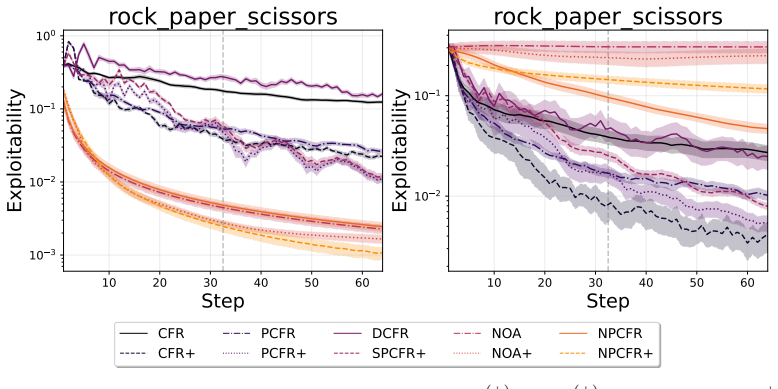
The central discovery is that the self-play meta-loss, which backpropagates through the opponent's strategy instead of treating the game as an oblivious environment, converts the meta-learning problem into minimizing the expected exploitability of the current strategy along every step of the trajectory. In normal-form games the loss equals the expected exploitability of the selected strategy, so its gradient points at the opponent's best-response value; in extensive-form games the same loss aggregates per-infostate counterfactual regret and, because the recurrent controller sees all infostates at once, permits global communication across infostates. The authors show that the loss bounds the cumulative external regret via the counterfactual regret decomposition, so NPCFR(+) remains a regret minimizer with the usual convergence guarantee. Empirically, this yields algorithms that reach a given exploitability threshold in roughly half to a third of the iterations of the best hand-designed baselines, and the advantage extends past the training horizon.
Load-bearing premise
The load-bearing premise is that minimizing the surrogate self-play meta-loss by gradient descent on a training distribution of games produces a controller whose speed advantage transfers to the specific evaluation games, and that the grid-searched hyperparameters are not effectively tuned on those evaluation instances.
Editorial extensions
If this is right
- NPCFR+ is a meta-learned regret minimizer with the same worst-case convergence guarantee as PCFR, so the large empirical speedup does not sacrifice the sublinear-regret property.
- In online search, where each iteration evaluates a neural value function that dominates the cost, cutting iterations from 33 to 19, or by larger margins in normal-form games, translates directly into wall-clock savings; the paper reports wall-time experiments with 10–100 ms per-step delays.
- Because the loss is computed over both players, the resulting algorithms are specifically adapted to self-play equilibrium finding rather than to best-responding in an adversarial environment.
- The generalization results show the learned algorithms remain effective beyond their 32 training iterations up to 2T, meaning they have learned a reusable update rule rather than a memorized final strategy.
- Out-of-distribution tests show the same algorithms lose most of their advantage on a different game distribution, so the method's promise is domain adaptation rather than a universal replacement for CFR variants.
Reading between the lines
- The reported gains compare algorithms at equal iteration count but not equal wall-clock: the meta-learned networks are about three times slower per step, and the paper only claims wall-clock superiority when terminal evaluation is expensive, so an apples-to-apples benchmark with cheap leaf evaluation would likely narrow the gap.
- The authors observe that NPCFR+'s regret predictions are not more accurate than the baseline's, which suggests the speedup comes from shaping the strategy trajectory rather than from predictive accuracy; a natural experiment is to replace the learned predictor with a fixed schedule to see how much of the gain survives.
- Because the loss equals exploitability along the trajectory in normal-form games, the method can be viewed as a differentiable form of exploitability descent, and combining the meta-loss with explicit exploitability regularization might close the reported gap between the loss and exploitability in extensive-form games.
- If the trained controller generalizes across the river-poker belief distribution, the same recipe could be applied to subgame resolving in full no-limit poker by training on an abstraction; a concrete test would be to deploy NPCFR+ inside a search algorithm and compare solve quality per unit wall-time against CFR+.
Signed reviews
Editorial analysis
A structured set of objections, weighed in public.
Referee Report
Summary. The paper extends the offline 'learning not to regret' meta-learning framework to self-play regret minimization in two-player zero-sum games. The main proposal is a new meta-loss, Eq. (2), which sums, over players, infostates, and time steps, the maximum instantaneous counterfactual regret; the paper shows this loss bounds the players' cumulative regret. Two instantiations are trained: a general neural online algorithm (NOA/NOA+) and a neural predictive counterfactual regret minimizer (NPCFR/NPCFR+) that retains regret-minimization guarantees. The architecture uses an LSTM with a max-pooling gate, which the paper describes as the first cross-infostate communication mechanism in extensive-form regret minimization. Experiments on perturbed rock-paper-scissors and river poker subgames report that the meta-learned algorithms reach low exploitability in substantially fewer iterations than CFR/CFR+, PCFR/PCFR+, DCFR, and SPCFR+, for example NPCFR+ reaching exploitability 0.1 in 19 steps versus 33 for CFR+ and 41 for PCFR+ on river poker. The paper also reports out-of-distribution degradation and discusses computation-time trade-offs.
Significance. If the claims hold, the paper provides a principled way to meta-learn regret minimizers that are specialized to a distribution of games, which is potentially useful for subgame solving and online search where each iteration is costly. The strengths of the manuscript include a correct derivation that loss (2) bounds cumulative regret via convexity and the counterfactual regret decomposition; the preservation of external-regret guarantees in the NPCFR variants; the inclusion of several strong baselines; and an explicit out-of-distribution sanity check. However, the central theoretical motivation is weakened by an incorrect algebraic equivalence between loss (2) and exploitability in normal-form games, and the claimed contribution of cross-infostate communication is not isolated by any ablation. Hyperparameters for the meta-learned methods are grid-searched on the evaluation distribution, which further complicates interpretation of the empirical speedups. The work is potentially important, but the load-bearing motivation and the attribution of the improvement need to be repaired.
major comments (3)
- [Section 3, Eq. (2)] The displayed equality after Eq. (2) ("we get \sum_i\|r_i(\sigma^t,x^t)\|_\infty = \sum_i\|x_i^t\|_\infty = expl(\sigma^t)") is algebraically false. Since r_i(a)=x_i(a)-\langle\sigma_i,x_i\rangle, the left-hand side is \sum_i\max_a |x_i(a)-u_i(\sigma)|, whereas exploitability is (1/|N|)\sum_i\max_a [x_i(a)-u_i(\sigma)]_+. These quantities differ whenever some action is worse than the current mixed-strategy value; at a Nash equilibrium of a game with a dominated action, the absolute-regret loss is strictly positive while exploitability is zero. The same algebraic slip appears in Appendix A.2, where the baseline terms \langle\sigma_i^l,x_i^l\rangle are dropped inside the infinity norm even though they do not cancel term-by-term. Section 5's Future Work concedes "there is typically a large gap between our meta-loss and the exploitability of the strategy." Consequently, the claim that minimizing loss (2) is equivalent to minimizing the expected exploitability of the trajectory is unsupported. The regret bound in Eq. (2) still holds, but it is a loose worst-case bound and does not establish that meta-gradient steps reduce exploitability on the training distribution. The paper should replace the equality with a correct inequality or a positive-part variant, and re-examine the motivation for the self-play loss accordingly.
- [Section 3 and Section 4] The claimed unique contribution of cross-infostate communication is not isolated experimentally. The architecture in Figure 4 uses a max-pooling gate across infostates, and Section 3 argues that this allows the network to "directly access information from all infostates," in contrast to the local counterfactual regret decomposition. However, no experiment ablates this mechanism: the paper does not compare NPCFR or NPCFR+ with a version in which each infostate is processed independently while keeping loss (2) and the predictive update fixed. The faster iteration-level convergence reported in Table 1 and Figure 2 could therefore be due entirely to the new self-play loss or to the learned predictor rather than to global communication. Since the abstract and Section 1.2 advertise this feature as a main contribution, the paper should include an ablation that disables or removes the cross-infostate communication on the same evaluation distribution.
- [Section 4 and Appendix C] The hyperparameters of the meta-learned methods are selected on the same distribution used for the headline comparisons. Appendix C reports that the LSTM size, batch size, and prediction-scaling \alpha were searched over the sets {64,128,256}, {4,8}, and {1,2} respectively, and Section 4 states only that "other hyperparameters were found via a grid search." No held-out split for hyperparameter selection, no sensitivity analysis, and no confidence intervals for Table 1 are provided. Since the non-meta-learned baselines use their default parameters, the comparison in Figure 2 and Table 1 is not fully controlled. The authors should either tune the baselines in the same way, report the performance across the full grid, or evaluate on a separate validation distribution.
minor comments (5)
- [Section 3] The infinity norm in Eq. (2) is not explicitly defined as being taken over the action set at each infostate; please add a sentence defining the norm and its domain.
- [Section 4, Table 1] Table 1 reports expected steps to reach each exploitability threshold, but no standard errors or number of sampled games are given; error bars or confidence intervals would strengthen the comparison.
- [Section 2.1] The paper uses "incomplete information games" while most related work uses "imperfect-information games"; please unify the terminology with the cited literature.
- [Section 4.1 and Figure 3] The phrase "region of equilibria" in Figure 3 is not defined in the main text; please define it or cite the relevant appendix result.
- [Section 4.2.1] The wall-time comparison in Figure 12 would benefit from a statement of the hardware and implementation details for all algorithms, since the meta-learned methods are about three times slower per step and the claimed advantage depends on the assumed leaf-evaluation cost.
Circularity Check
No significant circularity: the regret-bound derivation in Eq. (2) is self-contained, and the empirical claims are tested against external baselines, a longer-horizon generalization regime, and an out-of-distribution control.
full rationale
The paper's derivation chain is not circular. The central inequality in Section 3, L(theta) >= E[sum_i ||R^T_i||_inf] >= E[sum_i Rext^T_i], follows from convexity of the infinity norm and the standard counterfactual regret decomposition (Zinkevich et al., 2007); it does not assume the conclusion that meta-learned algorithms converge faster. NPCFR retains the external PCFR-style guarantee cited to Farina et al. (2021), with the prior same-author framework (Sychrovsky et al., 2024) serving as a starting point rather than as a uniqueness theorem that forces the result. The reported speedups are empirical comparisons against non-meta-learned baselines (CFR+, PCFR+, DCFR, SPCFR+), and the paper includes both a beyond-horizon regime (2T steps) and an out-of-distribution experiment showing that performance deteriorates, so the in-distribution advantage is not presented as a general theorem obtained by definition. The paper also explicitly concedes in Future Work that 'there is typically a large gap between our meta-loss and the exploitability of the strategy' in extensive-form games, which further undercuts any claim that the objective is merely the evaluation metric renamed. The normal-form statement that sum_i ||r_i||_inf = sum_i ||x_i||_inf = exploitability is algebraically incorrect in general, since absolute-value regrets and positive-part exploitability differ, but that is a correctness flaw in the motivating equivalence, not a circular reduction: the loss is not defined in terms of the evaluation metric, and the false equality cannot be used to exhibit an input-output identity. Hyperparameter grid search on the same game distribution is a potential overfitting risk, but it is not the kind of fitted-input-called-prediction reduction that would make the central claim circular. Overall, no load-bearing step reduces to its own inputs by construction.
Assumptions & free parameters
free parameters (5)
- Neural network weights theta =
learned via Adam on meta-loss (2)
- LSTM hidden size =
chosen from {64, 128, 256} via grid search
- Batch size =
chosen from {4, 8} via grid search
- NPCFR prediction scaling alpha =
chosen from {1, 2} via grid search
- Training horizon T and epochs =
T=32, 256 epochs
assumptions (4)
- standard math Regret decomposition bound: sum of per-infostate positive counterfactual regrets upper-bounds normal-form external regret (Zinkevich et al., 2007).
- domain assumption PCFR guarantees O(1/sqrt(T)) external regret for arbitrary bounded predictions (Farina et al., 2021).
- ad hoc to paper The meta-gradient through the opponent's strategy (non-oblivious environment) is computable and a valid descent direction for the loss (2).
- ad hoc to paper Minimizing the surrogate loss (2) is a faithful proxy for reducing exploitability along the trajectory.
Cite this review
Pith. "Pith review of Meta-Learning in Self-Play Regret Minimization." pith.science (2026). https://pith.science/paper/EJMEA6LW
@misc{pith2026250418917,
  author       = {Pith},
  title        = {Pith review of: Meta-Learning in Self-Play Regret Minimization},
  year         = {2026},
  howpublished = {\url{https://pith.science/paper/EJMEA6LW}},
  note         = {Machine review of arXiv:2504.18917}
}
read the original abstract
Regret minimization is a general approach to online optimization which plays a crucial role in many algorithms for approximating Nash equilibria in two-player zero-sum games. The literature mainly focuses on solving individual games in isolation. However, in practice, players often encounter a distribution of similar but distinct games. For example, when trading correlated assets on the stock market, or when refining the strategy in subgames of a much larger game. Recently, offline meta-learning was used to accelerate one-sided equilibrium finding on such distributions. We build upon this, extending the framework to the more challenging self-play setting, which is the basis for most state-of-the-art equilibrium approximation algorithms for domains at scale. When selecting the strategy, our method uniquely integrates information across all decision states, promoting global communication as opposed to the traditional local regret decomposition. Empirical evaluation on normal-form games and river poker subgames shows our meta-learned algorithms considerably outperform other state-of-the-art regret minimization algorithms.
Figures


Figures from the paper (9 more)




Forward citations
Cited by 1 Pith paper
-
Correlated Chance Sampling for Monte Carlo Counterfactual Regret Minimization
Persistent randomized Weyl streams at each chance node cut MCCFR exploitability 19–34% on Kuhn and Leduc poker with local O(log N/N) frequency guarantees and no new hyperparameters.
Reference graph
Works this paper leans on
-
[1]
This would mean ∂ ˜L ∂σ2 1 = ∂ ∂σ2 1 (σ1 1 +σ2 1)· 1 −1 = (1,−1)⊤
But in this case, it forces us to minimize the first element ofx2 2, or the reward of player two for playing only the first action. This would mean ∂ ˜L ∂σ2 1 = ∂ ∂σ2 1 (σ1 1 +σ2 1)· 1 −1 = (1,−1)⊤. However, this is exactly the opposite direction than what we would need to approach the equilibrium. The meta-loss (4) is ‘consistent’ since if σ1 is sufficie...
work page 2017
-
[2024]
Proceedings of the AAAI Conference on Artificial Intelligence 38, 14 (Mar
Learning Not to Regret. Proceedings of the AAAI Conference on Artificial Intelligence 38, 14 (Mar. 2024), 15202–15210. https://doi.org/10.1609/aaai.v38i14.29443 Oskari Tammelin. 2014. Solving large imperfect information games using CFR+. https: //arxiv.org/abs/1407.5042 Oskari Tammelin, Neil Burch, Michael Johanson, and Michael Bowling. 2015. Solving head...
arXiv 2024
Reviewed August 16, 2026 · model on record in the stance chip above.
Discussion (0). Continue with ORCID to comment.