Applications of quantum annealing to magnetic dipole hyperfine structure constants: First results beyond energies for atoms
Pith reviewed 2026-06-30 10:39 UTC · model grok-4.3
The pith
Quantum annealing on D-Wave hardware computes magnetic dipole hyperfine structure constants for Li, Be, Na, and Mg atoms to three decimal places, matching GRASP relativistic calculations.
A machine-rendered reading of the paper's core claim, the machinery that carries it, and where it could break.
Core claim
The modified QAE algorithm, run on the D-Wave QPU, produces magnetic dipole HFS constants for neutral Li, Li-like Be, neutral Na, and Na-like Mg that remain consistent with full GRASP calculations when the H_DC matrix is limited to eleven or fewer CSFs or to a truncated set of twelve significant CSFs, with all values agreeing to three decimal places.
What carries the argument
Modified Quantum Annealer Eigensolver (QAE) with zooming-and-sigma-annealing and floating-point encoding, applied to small relativistic Dirac-Coulomb Hamiltonian matrices constructed from truncated sets of configuration state functions.
If this is right
- Hardware QPU output for the four atomic systems agrees with GRASP at three decimal places for the chosen matrix sizes.
- The accuracy achieved depends on the specific atom and on the dimension of the H_DC matrix.
- The CSF truncation scheme permits use of extended correlation orbital sets while preserving the reported precision.
- Quantum annealing supplies an alternative route to hyperfine constants once the ground-state eigenvector is obtained.
Where Pith is reading between the lines
- Scaling the same encoding to matrices larger than twelve CSFs would require more qubits or improved precision schemes.
- The method could be tested on electric quadrupole or magnetic octupole constants using the same Hamiltonian matrices.
- If the truncation error remains small for heavier atoms, the approach might serve as a hybrid quantum-classical tool for selected atomic properties.
Load-bearing premise
Retaining only the twelve configuration state functions that contribute most to the ground-state wavefunction keeps the magnetic dipole HFS constant accurate to three decimal places.
What would settle it
A GRASP run that includes the full untruncated CSF basis for any of the four systems and produces an HFS constant differing by more than 0.001 from the QAE result would falsify the accuracy claim.
Figures
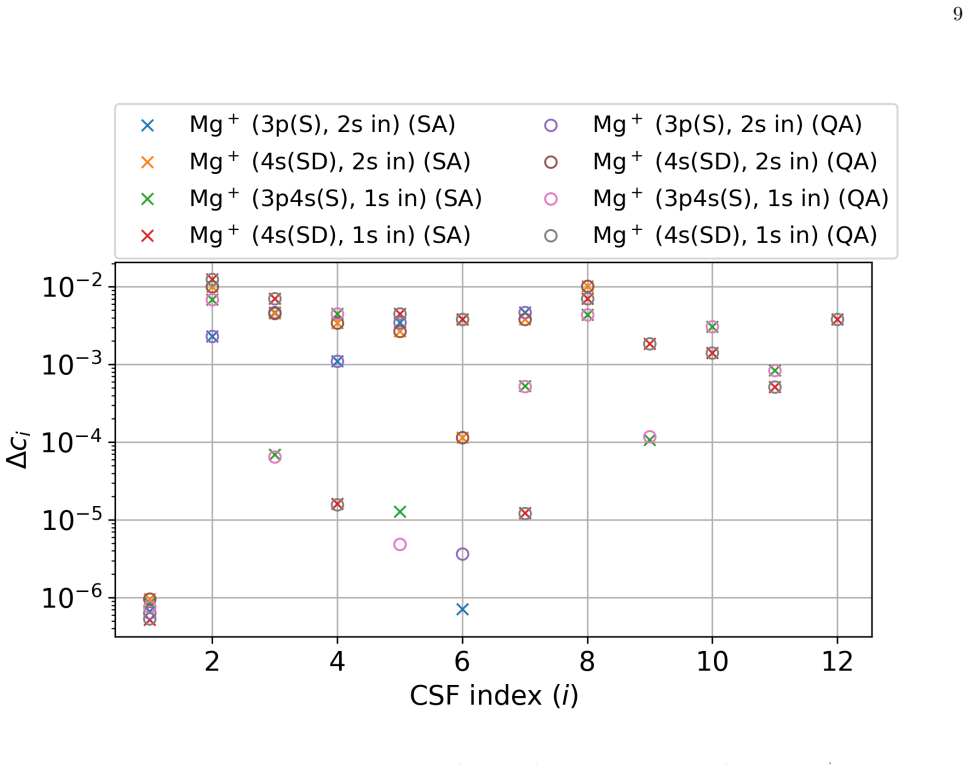
read the original abstract
We report the first results of the magnetic dipole hyperfine structure (HFS) constants of neutral $\mathrm{Li}$, Li-like $\mathrm{Be}$, neutral $\mathrm{Na}$, and Na-like $\mathrm{Mg}$ using a modified version of the Quantum Annealer Eigensolver (QAE) algorithm on D-Wave's quantum hardware. The results are benchmarked against relativistic configuration interaction with multiconfiguration Dirac Hartree-Fock (MCDHF) calculations using the General-purpose Relativistic Atomic Structure Package (GRASP), and simulated annealing. In our modified QAE, a zooming-and-sigma-annealing approach with a floating-point encoding scheme is adopted to estimate the ground-state eigenvalue and eigenvector of the relativistic Dirac-Coulomb Hamiltonian matrices ($H_{\mathrm{DC}}$) constructed from 11 or fewer configuration state functions (CSFs). For calculations with extended correlation orbital sets, we applied a CSF truncation scheme, retaining only CSFs (up to 12) that make significant contributions to the ground-state wavefunction. Our modified QAE precision is kept limited to three decimal places (up to 10 qubits). Hardware demonstrations on the D-Wave quantum processing unit (QPU) yielded results that were completely consistent with GRASP (at the chosen precision) in determining the magnetic dipole HFS constants, with accuracy varying across systems and $H_{\mathrm{DC}}$ matrix dimensions.
Editorial analysis
A structured set of objections, weighed in public.
Referee Report
Summary. The manuscript reports the first application of a modified Quantum Annealer Eigensolver (QAE) on D-Wave hardware to compute magnetic dipole hyperfine structure (HFS) constants for neutral Li, Li-like Be, neutral Na, and Na-like Mg. It employs a zooming-and-sigma-annealing approach with floating-point encoding on Dirac-Coulomb Hamiltonian matrices constructed from at most 12 configuration state functions (CSFs), applies an energy-based CSF truncation for larger orbital sets, and claims that hardware results are fully consistent with GRASP relativistic CI calculations at the chosen three-decimal-place precision.
Significance. If the central claims hold, the work provides an initial hardware demonstration that quantum annealing can be extended from energy eigenvalues to a distinct one-body observable (magnetic dipole HFS) in relativistic atomic structure. The explicit benchmarking against an independent classical code (GRASP) and the use of actual QPU runs are positive features. However, the restriction to very small truncated bases and three-decimal precision limits the immediate impact on atomic physics.
major comments (2)
- [Method (CSF truncation scheme)] Method section on CSF truncation: the scheme retains at most 12 CSFs chosen by their contribution to the ground-state wavefunction of the Dirac-Coulomb Hamiltonian, yet no direct comparison (full vs. truncated basis) is shown to confirm that the truncation error on the magnetic dipole HFS constant remains below 0.001. Because the HFS operator has different radial weighting (especially near the nucleus) from the energy functional, energy-based selection does not automatically guarantee the reported precision for the HFS observable.
- [Results and abstract] Results and abstract: the floating-point encoding scheme and the precise mapping of eigenvector components to the HFS expectation value are only sketched; without an explicit error analysis or reported uncertainty for each system and matrix dimension, it is difficult to assess whether the claimed three-decimal consistency with GRASP is robust or an artifact of the limited precision (up to 10 qubits).
minor comments (1)
- [Abstract] Abstract: the statement that 'accuracy varying across systems and H_DC matrix dimensions' is not accompanied by any tabulated values or quantitative measure of that variation.
Simulated Author's Rebuttal
We thank the referee for the constructive feedback. We address each major comment below.
read point-by-point responses
-
Referee: Method section on CSF truncation scheme: the scheme retains at most 12 CSFs chosen by their contribution to the ground-state wavefunction of the Dirac-Coulomb Hamiltonian, yet no direct comparison (full vs. truncated basis) is shown to confirm that the truncation error on the magnetic dipole HFS constant remains below 0.001. Because the HFS operator has different radial weighting (especially near the nucleus) from the energy functional, energy-based selection does not automatically guarantee the reported precision for the HFS observable.
Authors: We agree the truncation criterion is energy-based and that a direct full-vs-truncated comparison for the HFS constant is not shown. Given the deliberately small bases (≤12 CSFs) used for this hardware demonstration, the dominant contributions are retained, but we acknowledge the different radial weighting of the HFS operator. In revision we will add an explicit statement noting this limitation and that quantitative truncation-error checks for the observable are left to future work with larger resources. revision: partial
-
Referee: Results and abstract: the floating-point encoding scheme and the precise mapping of eigenvector components to the HFS expectation value are only sketched; without an explicit error analysis or reported uncertainty for each system and matrix dimension, it is difficult to assess whether the claimed three-decimal consistency with GRASP is robust or an artifact of the limited precision (up to 10 qubits).
Authors: The floating-point encoding and the mapping of the extracted eigenvector to the HFS expectation value are described in the Methods. The reported consistency is at the three-decimal precision level matching our QAE implementation. We will expand the Results section with a clearer step-by-step description of the mapping together with per-system uncertainty estimates tied to the qubit precision and annealing parameters. revision: yes
Circularity Check
No significant circularity; external benchmark against independent GRASP code
full rationale
The paper solves the Dirac-Coulomb eigenvalue problem on D-Wave hardware via modified QAE, extracts the ground-state vector, and evaluates the magnetic dipole HFS operator as an expectation value on that vector. Results are compared directly to independent MCDHF calculations performed with the external GRASP package. The CSF truncation (retaining up to 12 functions by ground-state energy contribution) is an approximation whose effect on the distinct HFS observable is checked by the external benchmark rather than being forced by definition or by a self-citation chain. No load-bearing step reduces to a fitted parameter, a self-referential uniqueness theorem, or an ansatz imported from the authors' prior work.
Axiom & Free-Parameter Ledger
Reference graph
Works this paper leans on
-
[1]
Kadowaki and H
T. Kadowaki and H. Nishimori, Quantum annealing in the transverse ising model, Phys. Rev. E58, 5355 (1998)
1998
-
[2]
Hauke, H
P. Hauke, H. G. Katzgraber, W. Lechner, H. Nishimori, and W. D. Oliver, Perspectives of quantum annealing: methods and implementations, Reports on Progress in Physics83, 054401 (2020)
2020
-
[3]
B. K. Chakrabarti, H. Leschke, P. Ray, T. Shirai, and S. Tanaka, Quantum annealing and computation: chal- lenges and perspectives, Philosophical Transactions of the Royal Society A: Mathematical, Physical and En- gineering Sciences381, 20210419 (2022)
2022
-
[4]
Yarkoni, E
S. Yarkoni, E. Raponi, T. B¨ ack, and S. Schmitt, Quan- tum annealing for industry applications: introduction and review, Reports on Progress in Physics85, 104001 (2022)
2022
-
[5]
E. J. Crosson and D. A. Lidar, Prospects for quantum enhancement with diabatic quantum annealing, Nature Reviews Physics3, 466 (2021)
2021
-
[6]
A. D. King, A. Nocera, M. M. Rams, J. Dziarmaga, R. Wiersema, W. Bernoudy, J. Raymond, N. Kaushal, N. Heinsdorf, R. Harris, K. Boothby, F. Altomare, M. Asad, A. J. Berkley, M. Boschnak, K. Chern, H. Christiani, S. Cibere, J. Connor, M. H. Dehn, R. Desh- pande, S. Ejtemaee, P. Farre, K. Hamer, E. Hoskinson, S. Huang, M. W. Johnson, S. Kortas, E. Ladizinsky...
2025
-
[7]
Teplukhin, B
A. Teplukhin, B. K. Kendrick, and D. Babikov, Calcula- 6 tion of molecular vibrational spectra on a quantum an- nealer, Journal of Chemical Theory and Computation15, 4555 (2019)
2019
-
[8]
Kumar, N
V. Kumar, N. Baskaran, V. S. Prasannaa, K. Sugisaki, D. Mukherjee, K. Dyall, and B. Das, Computation of relativistic and many-body effects in atomic systems us- ing quantum annealing, Physical Review A109, 042808 (2024)
2024
-
[9]
Teplukhin, B
A. Teplukhin, B. K. Kendrick, and D. Babikov, Solving complex eigenvalue problems on a quantum annealer with applications to quantum scattering resonances, Phys. Chem. Chem. Phys.22, 26136 (2020)
2020
-
[10]
A. A. Zade, K. Sugisaki, M. Werner, A. Palacios, J. Riu, J. Nogu´ e, A. Garcia-Saez, A. Riera, and V. S. Prasan- naa, Quantum annealing eigensolver as a nisq era tool for probing strong correlation effects in quantum chemistry, The European Physical Journal Plus140, 930 (2025)
2025
-
[11]
Teplukhin, B
A. Teplukhin, B. K. Kendrick, S. Tretiak, and P. A. Dub, Electronic structure with direct diagonalization on a d-wave quantum annealer, Scientific Reports10, 20753 (2020)
2020
-
[12]
Teplukhin, B
A. Teplukhin, B. K. Kendrick, S. M. Mniszewski, Y. Zhang, A. Kumar, C. F. A. Negre, P. M. Anisimov, S. Tretiak, and P. A. Dub, Computing molecular excited states on a d-wave quantum annealer, Scientific Reports 11, 18796 (2021)
2021
-
[13]
Illa and M
M. Illa and M. J. Savage, Basic elements for simula- tions of standard-model physics with quantum annealers: Multigrid and clock states, Phys. Rev. A106, 052605 (2022)
2022
-
[14]
A Rahman, R
S. A Rahman, R. Lewis, E. Mendicelli, and S. Powell, Su(2) lattice gauge theory on a quantum annealer, Phys. Rev. D104, 034501 (2021)
2021
- [15]
-
[16]
Schwartz, Theory of hyperfine structure, Phys
C. Schwartz, Theory of hyperfine structure, Phys. Rev. 97, 380 (1955)
1955
-
[17]
L. J. Armstrong,Theory of the hyperfine structure of free atoms(John Wiley and Sons, Inc., 1971)
1971
-
[18]
T. P. Das,Relativistic Quantum Mechanics of Electrons, Harper’s Physics Series (Harper and Row, New York, 1973)
1973
-
[19]
M. Kaur, R. Nakra, B. Arora, C.-B. Li, and B. K. Sahoo, Accurate determination of energy levels, hyperfine struc- ture constants, lifetimes and dipole polarizabilities of triply ionized tin isotopes, Journal of Physics B: Atomic, Molecular and Optical Physics53, 065002 (2020)
2020
-
[20]
Essen and J
L. Essen and J. V. L. Parry, An atomic standard of fre- quency and time interval: A cæsium resonator, Nature 176, 280 (1955)
1955
-
[21]
N. F. Ramsey, History of atomic clocks, Journal of Re- search of the National Bureau of Standards88, 301 (1983)
1983
-
[22]
A. D. Ludlow, M. M. Boyd, J. Ye, E. Peik, and P. O. Schmidt, Optical atomic clocks, Rev. Mod. Phys.87, 637 (2015)
2015
-
[23]
Beloy, M
K. Beloy, M. I. Bodine, T. Bothwell, S. M. Brewer, S. L. Bromley, J.-S. Chen, J.-D. Deschˆ enes, S. A. Diddams, R. J. Fasano, T. M. Fortier, Y. S. Hassan, D. B. Hume, D. Kedar, C. J. Kennedy, I. Khader, A. Koepke, D. R. Leibrandt, H. Leopardi, A. D. Ludlow, W. F. McGrew, W. R. Milner, N. R. Newbury, D. Nicolodi, E. Oelker, T. E. Parker, J. M. Robinson, S....
2021
-
[24]
Vrbanec,Exploring the Epoch of Reionization with the 21 cm line, Ph.d
D. Vrbanec,Exploring the Epoch of Reionization with the 21 cm line, Ph.d. thesis, Ludwig-Maximilians-Universit¨ at M¨ unchen (2019)
2019
-
[25]
M. H. Anderson, J. R. Ensher, M. R. Matthews, C. E. Wieman, and E. A. Cornell, Observation of bose-einstein condensation in a dilute atomic vapor, Science269, 198 (1995)
1995
-
[26]
K. B. Davis, M. O. Mewes, M. R. Andrews, N. J. van Druten, D. S. Durfee, D. M. Kurn, and W. Ketterle, Bose-einstein condensation in a gas of sodium atoms, Phys. Rev. Lett.75, 3969 (1995)
1995
-
[27]
Vajed-Samii, J
M. Vajed-Samii, J. Andriessen, B. P. Das, S. N. Ray, T. Lee, and T. P. Das, Accurate values of nuclear mag- netic moments of francium isotopes, Phys. Rev. Lett.48, 1330 (1982)
1982
-
[28]
Vajed-Samii, J
M. Vajed-Samii, J. Andriessen, B. P. Das, S. N. Ray, T. Lee, and T. P. Das, Trends in hyperfine fields in al- kali series, Journal of Physics B: Atomic and Molecular Physics15, L379 (1982)
1982
-
[29]
B. K. Sahoo, B. P. Das, and H. Spiesberger, New physics constraints from atomic parity violation in 133Cs, Phys. Rev. D103, L111303 (2021)
2021
-
[30]
A. P. Singh, K. Sugisaki, S. Prasannaa, B. K. Sahoo, B. P. Das, and Y. Nakamura, Experimental computa- tions of atomic properties on a superconducting quantum processor, Phys. Rev. A110, 062620 (2024)
2024
-
[31]
B. K. Sahoo, R. K. Chaudhuri, B. P. Das, H. Merlitz, and D. Mukherjee, Application of relativistic coupled-cluster theory to heavy atomic systems with strongly interacting configurations: Hyperfine interactions in 207Pb+, Phys. Rev. A72, 032507 (2005)
2005
-
[32]
P. J¨ onsson, M. Godefroid, G. Gaigalas, J. Ekman, J. Grumer, W. Li, J. Li , T. Brage, I. P. Grant, J. Biero´ n, and C. F. Fischer, An introduction to rel- ativistic theory as implemented in grasp, Atoms11, 10.3390/atoms11010007 (2023)
-
[33]
Froese Fischer, G
C. Froese Fischer, G. Gaigalas, P. J¨ onsson, and J. Biero´ n, Grasp2018—a fortran 95 version of the general relativis- tic atomic structure package, Computer Physics Commu- nications237, 184 (2019)
2019
-
[34]
Kirkpatrick, C
S. Kirkpatrick, C. D. Gelatt, and M. P. Vecchi, Optimiza- tion by simulated annealing, Science220, 671 (1983)
1983
-
[35]
F. A. Parpia, C. F. Fischer, and I. P. Grant, Grasp92: A package for large-scale relativistic atomic structure calculations, Computer physics communications94, 249 (1996)
1996
-
[36]
Pelofske, 4-clique network minor embedding for quan- tum annealers, Phys
E. Pelofske, 4-clique network minor embedding for quan- tum annealers, Phys. Rev. Appl.21, 034023 (2024)
2024
-
[37]
Next-generation topology of D-Wave quantum processors
K. Boothby, P. Bunyk, J. Raymond, and A. Roy, Next-generation topology of d-wave quantum processors (2020), arXiv:2003.00133 [quant-ph]
-
[38]
D-Wave Systems Inc.,Setting the Chain Strength, Tech. Rep. 14-1041A-A (D-Wave Systems Inc., 2022)
2022
-
[39]
D-Wave Systems Inc., Ocean software development kit,https://docs.ocean.dwavesys.com/en/stable/ (2023), accessed: 2026-03-21
2023
-
[40]
Boothby, A
K. Boothby, A. D. King, and J. Raymond,Zephyr Topol- ogy of D-Wave Quantum Processors, Technical Report (D-Wave Systems, 2022). 7
2022
-
[41]
E. Osaba and P. Miranda-Rodriguez, D-wave’s nonlinear- program hybrid solver: Description and performance analysis (2024), arXiv:2410.07980 [cs.ET]
- [42]
-
[43]
Raymond, M
J. Raymond, M. H. Amin, A. D. King, R. Harris, W. Bernoudy, A. J. Berkley, K. Boothby, A. Smirnov, F. Altomare, M. Babcock, C. Baron, J. Connor, M. H. Dehn, C. Enderud, E. Hoskinson, S. Huang, M. W. Johnson, E. Ladizinsky, T. Lanting, A. J. R. MacDon- ald, G. Marsden, R. Molavi, T. Oh, G. Poulin-Lamarre, H. Ramp, C. Rich, B. T. Clavera, N. Tsai, M. Volkma...
2025
-
[44]
H. N. Djidjev, Replication-based quantum annealing er- ror mitigation, Proceedings of the 21st ACM Interna- tional Conference on Computing Frontiers (2024). Supplemental Materials 2 LIST OF T ABLES I CSF coefficients for Li with 2p as correlation orbital. . . . . . . . . . . . . . . . . . . . . . . . . . . . . . . . . . . . . . . . . . . . 3 II CSF coeffi...
2024
discussion (0)
Sign in with ORCID, Apple, or X to comment. Anyone can read and Pith papers without signing in.