REVIEW 1 major objections 1 minor 20 references
Decoupling image and text encoders with server-client alignment and two-stage local fine-tuning balances global task adaptation and generalization in federated vision-language models.
Reviewed by Pith at T0; open to challenge. T0 means a machine referee read the full paper against a public rubric. the ladder, T0–T4 →
T0 review · grok-4.3
2026-06-29 13:33 UTC pith:ELLRM245
load-bearing objection FedDTL decouples image and text encoders with server-client alignment plus a two-stage local SFT-then-RL fine-tune to handle FL heterogeneity in VLMs; the combination is reasonable but incremental. the 1 major comments →
Decoupled Training with Local Reinforcement Fine-Tuning in Federated Learning
The pith
A machine-rendered reading of the paper's core claim, the machinery that carries it, and where it could break.
Core claim
FedDTL decouples the image encoder and text encoder across clients and the server. Through decoupled encoder training with server-client modality alignment, it promotes coherent global semantic update and reduces inter-client optimization inconsistency, improving global task adaptation. To further mitigate intra-client over-specialization, it introduces a two-stage local fine-tuning where a supervised fine-tuning stage enables rapid and reliable warm-start, followed by a reinforcement learning stage that enhances generalization. Experiments on label skew and feature shift benchmarks show it achieves an effective balance between global task adaptation and generalization under various FL data
What carries the argument
Decoupled encoder training with server-client modality alignment plus two-stage local fine-tuning (supervised warm-start followed by reinforcement learning).
Load-bearing premise
That separating image and text encoder training plus inserting a reinforcement learning stage will reduce both inter-client inconsistency and intra-client over-specialization without creating offsetting problems in full heterogeneous data settings.
What would settle it
A controlled run on a full-data heterogeneous federated benchmark in which FedDTL fails to improve global adaptation or generalization over standard parameter aggregation.
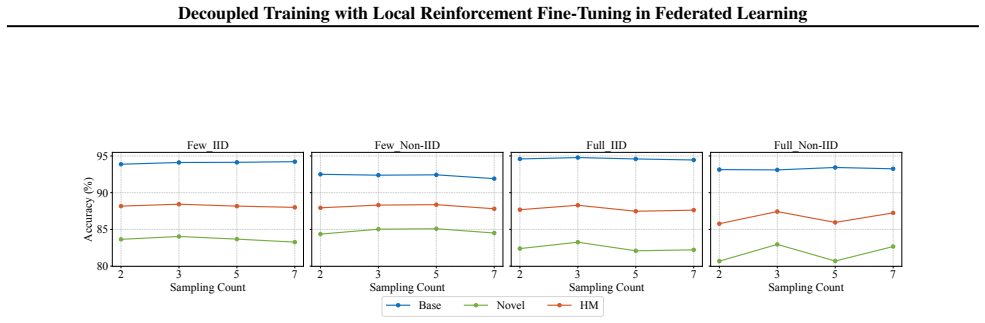
If this is right
- Reduces inter-client optimization inconsistency through modality alignment.
- Improves global task adaptation by maintaining coherent semantic updates.
- Enhances generalization via the reinforcement learning stage after supervised warm-start.
- Maintains the adaptation-generalization balance across label skew and feature shift distributions.
- Operates effectively in both few-shot and full-data federated regimes.
Where Pith is reading between the lines
- The decoupling pattern could transfer to other multimodal federated settings that pair separate modality encoders.
- The reinforcement learning stage might be adjusted to target different generalization metrics without changing the supervised warm-start.
- Server-client alignment could help stabilize training when client count or data heterogeneity increases beyond the tested cases.
Editorial analysis
A structured set of objections, weighed in public.
Referee Report
Summary. The paper introduces FedDTL, a federated learning framework for Vision-Language Models. It decouples the image encoder and text encoder training, uses server-client modality alignment to reduce inter-client optimization inconsistency, and applies a two-stage local fine-tuning (supervised warm-start followed by reinforcement learning) to mitigate intra-client over-specialization. The authors claim this balances global task adaptation and generalization, with extensive experiments on benchmarks under label skew, feature shift, few-shot, and full-data regimes.
Significance. If the results hold, this could be a significant contribution to federated VLM adaptation by providing a method to handle heterogeneity without sacrificing generalization. The use of reinforcement learning in the local fine-tuning stage is a distinctive element that may enhance robustness.
major comments (1)
- [Abstract] Abstract: The abstract asserts that 'Extensive experiments on multiple benchmarks... demonstrate that FedDTL achieves an effective balance...' but provides no quantitative results, error bars, baselines, or ablation details; the central empirical claim cannot be evaluated from the available text.
minor comments (1)
- The manuscript would benefit from explicit definitions or examples of 'inter-client optimization inconsistency' and 'intra-client over-specialization' in the introduction to improve clarity.
Simulated Author's Rebuttal
We thank the referee for the constructive comment on the abstract. We address it point-by-point below and will revise the manuscript accordingly.
read point-by-point responses
-
Referee: [Abstract] Abstract: The abstract asserts that 'Extensive experiments on multiple benchmarks... demonstrate that FedDTL achieves an effective balance...' but provides no quantitative results, error bars, baselines, or ablation details; the central empirical claim cannot be evaluated from the available text.
Authors: We agree that the abstract would benefit from including key quantitative highlights to make the central empirical claims more concrete and evaluable at a glance. In the revised version we will add specific results such as average accuracy improvements over strong baselines (e.g., +X% on label-skew and +Y% on feature-shift benchmarks), mention of error bars across runs, and reference to the main ablation findings, while keeping the abstract within length limits. revision: yes
Circularity Check
No significant circularity detected
full rationale
The paper is a method proposal describing FedDTL, a federated VLM framework using decoupled image/text encoders, server-client modality alignment, and two-stage local fine-tuning (supervised then reinforcement). No equations, fitted parameters, or derivations are presented that reduce to their own inputs by construction. Claims rest on experimental results across regimes rather than self-referential logic or load-bearing self-citations. The derivation chain is self-contained as an engineering approach without mathematical circularity.
Axiom & Free-Parameter Ledger
axioms (2)
- domain assumption Heterogeneous data distributions across clients cause optimization inconsistency and over-specialization in VLM fine-tuning.
- domain assumption Server-client modality alignment can produce coherent global semantic updates.
invented entities (1)
-
FedDTL framework
no independent evidence
read the original abstract
Federated Learning (FL) with pre-trained Vision-Language Models (VLMs) has emerged as a promising paradigm for various downstream tasks. By leveraging its strong representations, recent studies improve task adaptation under insufficient local data while preserving generalization. However, these methods emphasize fully local optimization with simple parameter aggregation,which can amplify inter-client optimization inconsistency and intra-client over-specialization under heterogeneous and full-data FL settings, making it difficult to balance global task adaptation and generalization. To address these challenges, we propose FedDTL, a novel federated VLM framework that decouples the image encoder and text encoder across clients and the server. Through decoupled encoder training with server-client modality alignment, FedDTL promotes coherent global semantic update and reduces inter-client optimization inconsistency, improving global task adaptation.To further mitigate intra-client over-specialization,we introduce a two-stage local fine-tuning, where a supervised fine-tuning stage enables rapid and reliable warm-start, followed by a reinforcement learning stage that enhances generalization. Extensive experiments on multiple benchmarks, including label skew and feature shift, demonstrate that FedDTL achieves an effective balance between global task adaptation and generalization under various FL data distributions in both few-shot and full-data regimes.
Figures




Reference graph
Works this paper leans on
-
[1]
Bossard, L., Guillaumin, M., and Gool, L. V . Food-101– mining discriminative components with random forests. InComputer Vision–ECCV 2014: 13th European Con- ference, Zurich, Switzerland, September 6-12, 2014, Pro- ceedings, Part VI, pp. 446–461. Springer,
2014
-
[2]
Chen, X., Li, Q., Cai, H., and Wang, T. Heterogeneity-aware personalized federated learning via adaptive dual-agent reinforcement learning.arXiv preprint arXiv:2501.16966,
-
[3]
Geodesic flow kernel for unsupervised domain adaptation
Gong, B., Shi, Y ., Sha, F., and Grauman, K. Geodesic flow kernel for unsupervised domain adaptation. In2012 IEEE conference on Computer Vision and Pattern Recognition, pp. 2066–2073,
2066
-
[4]
pfedprompt: Learning per- sonalized prompt for vision-language models in federated learning
Guo, T., Guo, S., and Wang, J. pfedprompt: Learning per- sonalized prompt for vision-language models in federated learning. InProceedings of the ACM Web Conference 2023, pp. 1364–1374. ACM,
2023
-
[5]
Dcp: Dual-cue pruning for efficient large vision-language models
Jiang, L., Zhang, Z., Zeng, Y ., Xie, C., Liu, T., Li, Z., Cheng, L., and Xu, X. Dcp: Dual-cue pruning for efficient large vision-language models. InProceedings of the 2025 Conference on Empirical Methods in Natural Language Processing, pp. 21202–21215,
2025
-
[6]
Federated reinforcement learning with constraint heterogeneity.arXiv preprint arXiv:2405.03236,
Jin, H., Zhang, L., and Zhang, Z. Federated reinforcement learning with constraint heterogeneity.arXiv preprint arXiv:2405.03236,
-
[7]
Nguyen, D. P., Munoz, J. P., and Jannesari, A. Flora: En- hancing vision-language models with parameter-efficient federated learning.arXiv preprint arXiv:2404.15182,
-
[8]
Proximal Policy Optimization Algorithms
Schulman, J., Wolski, F., Dhariwal, P., Radford, A., and Klimov, O. Proximal policy optimization algorithms. arXiv preprint arXiv:1707.06347,
work page internal anchor Pith review Pith/arXiv arXiv
-
[9]
DeepSeekMath: Pushing the Limits of Mathematical Reasoning in Open Language Models
Shao, Z., Wang, P., Zhu, Q., Xu, R., Song, J., Bi, X., Zhang, H., Zhang, M., Li, Y . K., Wu, Y ., and Guo, D. Deepseek- math: Pushing the limits of mathematical reasoning in open language models.arXiv preprint arXiv:2402.03300,
work page internal anchor Pith review Pith/arXiv arXiv
-
[10]
DAPO: An Open-Source LLM Reinforcement Learning System at Scale
Yu, Q., Zhang, Z., Zhu, R., Yuan, Y ., Zuo, X., YuYue, Dai, W., Fan, T., Liu, G., Liu, J., Liu, L., Liu, X., Lin, H., Lin, Z., Ma, B., Sheng, G., Tong, Y ., Zhang, C., Zhang, M., Zhang, R., Zhang, W., Zhu, H., Zhu, J., Chen, J., Chen, J., Wang, C., Yu, H., Song, Y ., Wei, X., et al. DAPO: An open-source LLM reinforcement learning system at scale. arXiv pr...
work page internal anchor Pith review Pith/arXiv arXiv
-
[11]
Zhang, Y ., Guo, K., Lu, Z., Wang, Y ., and Liang, J. Person- alized federated learning via dual-prompt optimization and cross fusion.arXiv preprint arXiv:2506.21144,
-
[12]
37 3680 1785 3669 1 Flower102 (Nilsback & Zisserman, 2008)102 7169 2983 1020 1 Caltech101 (Fei-Fei et al.,
2008
-
[13]
10 1969 1969 413 4 DomainNet (Peng et al.,
1969
-
[14]
Ablation Study.We conduct ablation studies on seven datasets (CIFAR100, Tiny-ImageNet, OxfordPet, Flower102, Caltech101, Caltech256, Food101)
shot=4 Non-IID Dirichlet(0.1) Dirichlet(0.3) Dirichlet(0.5) IID Local Base Novel Local Base Novel Local Base Novel Local Base Novel Local Base Novel CLIP 80.22 79.62 81.99 79.44 79.76 82.12 79.83 79.76 82.12 79.77 79.76 82.12 79.76 79.76 82.12 pFedDC 95.19 47.66 61.53 87.73 73.28 72.91 85.68 81.11 75.78 86.49 84.72 77.04 86.83 86.83 76.64 FedPGP 80.42 79....
2083
-
[15]
More Performance Comparison.We further perform new experiments on the DomainNet dataset to investigate model performance in the feature shift with label skew setting under different data distributions. We further introduce label skew (IID, Dirichlet(0.1), Dirichlet(0.3), Dirichlet(0.5)) on top of the feature shift. Data from each domain are distributed to...
-
[16]
As a result, the simple accuracy-based signal is sufficient for stage transition
We observe that varyingεacc can cause moderate changes in model performance on base and novel classes across all settings, indicating that the proposed transition criterion is not sensitive to the training accuracy threshold. As a result, the simple accuracy-based signal is sufficient for stage transition. Notably, the sample size, data distribution, and ...
2025
-
[17]
For numerical stability, both the product and clipping operations are implemented in log space
RL Algorithm FewIID FewNon-IID FullIID FullNon-IID Base Novel HM Base Novel HM Base Novel HM Base Novel HM GRPO 94.11 84.04 88.43 92.38 85.03 88.31 94.78 83.26 88.29 93.10 82.96 87.43 DRGRPO 94.2282.87 87.72 92.18 83.76 87.41 94.55 82.35 87.67 93.2081.59 86.67 GMPO 94.14 83.27 87.99 92.25 84.79 88.16 94.5383.2788.24 93.00 81.90 86.67 DAPO 94.06 84.10 88.4...
-
[18]
Per-dataset results in Table
TE Backbone FewIID FewNon-IID FullIID FullNon-IID Base Novel HM Base Novel HM Base Novel HM Base Novel HM ViT-B/32 94.6556.37 69.33 91.02 47.00 60.95 94.8752.81 66.27 93.1946.57 60.90 ViT-L/14 94.36 54.20 67.84 90.44 47.64 61.51 94.82 54.26 67.65 93.01 46.73 61.63 ViT-B/16 94.11 84.04 88.43 92.38 85.03 88.31 94.78 83.26 88.29 93.10 82.96 87.43 Table 12.Th...
1946
-
[19]
Client Number FewIID FewNon-IID FullIID FullNon-IID Base Novel HM Base Novel HM Base Novel HM Base Novel HM K=5 93.64 80.80 86.41 91.6682.2086.43 94.42 79.75 86.18 92.62 79.56 85.34 K=10 94.56 80.70 86.72 92.04 81.47 86.14 94.73 79.93 86.29 91.81 79.65 84.86 K=15 94.70 81.20 87.14 93.0381.6086.58 95.11 80.71 86.98 94.90 79.95 86.41 ViT-L/14 in IID setting...
-
[20]
one”) and the feature shift with label skew (Dirichlet(α=0.1)) setting (“Dir(0.1)
23 Decoupled Training with Local Reinforcement Fine-Tuning in Federated Learning E. Full Experiment Results Table 13.The per-dataset accuracy comparison results (%) under 16-shot with IID and Non-IID data distributions. IID Average CIFAR10 CIFAR100 EuroSAT Tiny-ImageNet Local Base Novel Local Base Novel Local Base Novel Local Base Novel Local Base Novel C...
discussion (0)
Sign in with ORCID, Apple, or X to comment. Anyone can read and Pith papers without signing in.