REVIEW 3 major objections 4 minor 1 cited by
A 3:1 U(1) gauge model shows that the Z3 domain wall vanishes through a bias-angle merger: stable and unstable solutions annihilate at R12 ≈ 0.7677, leaving fractional-winding strings behind.
Reviewed by Pith at T0; open to challenge. T0 means a machine referee read the full paper against a public rubric. the ladder, T0–T4 →
T0 review · deepseek-v4-flash
2026-08-02 07:30 UTC pith:EMW44ASZ
load-bearing objection A careful numerical study of a 3:1 U(1) model showing the Z3 wall becomes a metastable biased wall as v1/v2 drops and annihilates at R12 ≈ 0.768; the central claim is plausible but rests on a search whose completeness is not proven. the 3 major comments →
One-Dimensional Simulations of the Topological Defects in a 3:1 U(1) Model
The pith
A machine-rendered reading of the paper's core claim, the machinery that carries it, and where it could break.
Core claim
On the paper's own terms: in the 3:1 U(1) model, the usual two-step symmetry-breaking picture — U(1)→Z3→1 with the heavier VEV v1 'integrating out' first — is only the R12→∞ limit. As v1 is lowered toward v2, the vacuum on one side of the domain wall acquires a phase β while the other side is kept at φ1=0, φ2=2π/3; the wall is then an interface between vacua related by a U(1) rotation, not by a discrete subgroup. The paper finds that for a fixed R12 there can be two static wall solutions, one a metastable minimum of the tension σ(β) for β below about 1.378 and one an unstable maximum; these two solutions converge as R12 drops and vanish together at the critical ratio R12≈0.7677, below which
What carries the argument
The load-bearing object is the bias angle β, defined by the boundary conditions (11)-(12): one side of the wall approaches the vacuum (φ1=0, φ2=2π/3), the other approaches (φ1=β, φ2=β/3). This single parameter converts the question 'does a Z3 wall exist?' into a variational problem in which the wall tension σ(β) is computed for each β by static one-dimensional solutions of the coupled scalar equations. The paper's two numerical procedures — a shooting method matched to linearized asymptotic solutions and a path-deformation minimization of the action — are used to map σ(β); the disappearance of the wall is signalled by the annihilation of the local minimum and maximum of σ(β) at β≈1.378, and
Load-bearing premise
The load-bearing premise is that every static domain wall of the model is captured by the one-parameter boundary family in which the two asymptotic vacua are locked to the exact phase relation φ2=φ1/3 with a single global bias angle β (searched over 0<β<6π); walls with independent endpoint phases for φ1 and φ2, non-monotonic orbits, or genuinely higher-dimensional paths through field space are excluded, and the paper itself notes that full verification needs 2D or 3D simulati
What would settle it
Set R12=0.70 and perform a numerical search for static planar solutions without the ansatz (11)-(12): allow the endpoint phases φ1(±∞) and φ2(±∞) to be any pair of the model's symmetry-related vacuum minima independently, and relax the equations on a 2D strip with those boundary conditions. If any finite-tension profile with a planar interface and no gauge winding survives, the claimed critical ratio R12≈0.7677 is wrong; equivalently, a lattice quench simulation at v1/v2=0.7 that retains long-lived wall sheets would contradict the disappearance claim.
If this is right
- For v1/v2 in the comparable regime, the standard Z3-bounded-by-strings treatment (β=0, integer windings) is not the correct description; string-like rim profiles must be recomputed with the fractional winding n1=1+3n−β/(2π).
- Below R12≈0.7677 there is no static planar domain wall in the model, so the wall-string hybrid network can no longer include long-lived wall sheets; the defect content is purely string-like (rims and conjunctions with fractional effective winding).
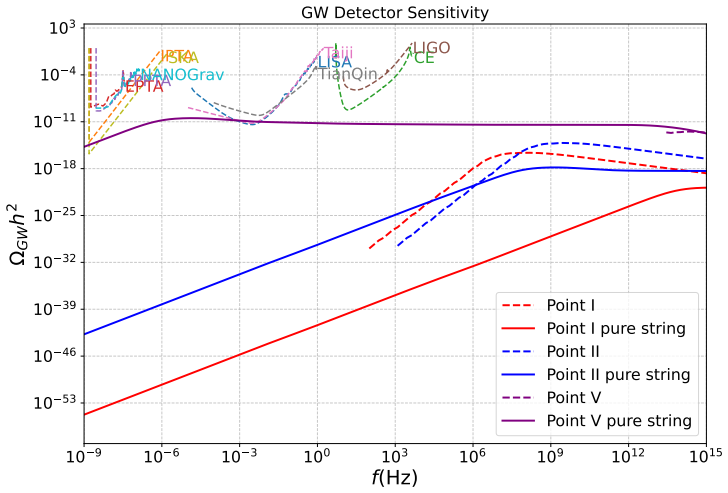
- In the v1∼v2 'strings eating walls' scenario the estimated gravitational-wave background can fall within reach of planned detectors at the benchmark points considered, whereas the 'walls eating strings' scenario requires a scaling regime starting at temperatures far above the VEV scale and is judged physically implausible by the paper.
- In the hierarchical limit v1≫v2, the 'strings eating walls' scenario yields a wall lifetime vastly longer than the age of the universe, so only the 'walls eating strings' channel is viable there, and the spectra are correspondingly different from the comparable-VEV case.
Where Pith is reading between the lines
- Beyond the paper: if the disappearance threshold survives a full 2D/3D search, then for v1≲0.77 v2 the domain-wall 'problem' is avoided kinematically — no wall ever forms — without invoking tunneling decay, a region that standard cosmological bounds would otherwise exclude.
- Beyond the paper: the bias-angle mechanism should be generic to other charge-ratio U(1) models (e.g., 2:1) and to non-Abelian embeddings of discrete subgroups: whenever the heavier VEV is not much larger than the lighter one, the effective discrete symmetry is blurred and effective windings become fractional.
- Beyond the paper: a testable discriminator follows from the GW spectra: a detection of the high-frequency peak would favour comparable VEVs and the 'strings eating walls' channel, while a null result would be consistent either with hierarchical VEVs or with R12 below the critical value; the paper does not state this dichotomy explicitly.
- Beyond the paper: the paper leaves open the metastable wall's tunneling decay rate per unit area for β>0; computing that rate would give the actual lifetime of the surviving walls in the 0.77≲R12≲1 region and sharpen the GW predictions.
Editorial analysis
A structured set of objections, weighed in public.
Referee Report
Summary. The paper studies a gauged 3:1 U(1) model with two complex scalars and computes static one-dimensional profiles of domain walls and cosmic strings as functions of the VEV ratio R12 = v1/v2. The central claim is that as R12 decreases, the Z3 domain-wall configuration develops a non-negligible bias angle β; a stable and an unstable wall branch meet at β ≈ 1.378 and annihilate at a critical point R12 ≈ 0.7677, so that no static one-dimensional domain wall exists below that ratio. The paper also introduces fractional winding numbers n1 = 1 + 3n − β/(2π) for rims in hybrid wall-string networks and presents preliminary gravitational-wave spectra for the resulting network scenarios.
Significance. If the central disappearance claim holds, the paper revises the standard treatment of Z3 walls bounded by strings in the v1 ∼ v2 regime and provides a concrete toy model for the continuous disappearance of a discrete-symmetry wall. The main numerical result is cross-checked by two independent algorithms, a shooting method and a modified CosmoTransitions path-deformation code, and β is obtained from tension minimization rather than fitted to the phase diagram. The scaling rules in Sec. IV.D usefully reduce the parameter space, and the authors are explicit that several parts of the gravitational-wave estimate rest on assumptions inherited from Ref. [4]. However, the central claim is an absence-of-solution statement, and the support is numerical rather than topological or exhaustive; this is the main weakness that needs to be addressed.
major comments (3)
- [Sec. IV.E, Eqs. (11)–(12), Sec. VI] The claim that no static domain wall exists for R12 ≲ 0.7677 is an absence-of-solution statement, but the evidence is a continuation-based search. The shooting method starts from manually constructed initial guesses (Sec. IV.B) and the path-deformation algorithm fails to converge outside a limited β range (Sec. IV.E). These methods can miss disconnected branches, non-monotonic orbits, or solutions with different phase locking. The paper itself states that precise hybrid-rim solutions require 2D/3D simulations (Sec. III.C and Sec. VI). To make the headline claim load-bearing, the authors should either provide a global/exhaustive search with quantified tolerances and branch tracking, give a topological or analytic argument excluding other solutions, or explicitly replace the phrase “no domain wall” by “no domain wall within the searched one-dimensional ansatz and numerical resolution.”
- [Sec. IV.E, Fig. 8] The saddle-node interpretation is inferred from the disappearance of extrema in σ(β) for v1 = 99√2 GeV. For β outside the plotted range, the path-deformation algorithm fails to converge, and the text states that solutions for those β are “no longer conditional minima.” Non-convergence of a descent algorithm is not by itself evidence of nonexistence. The authors should demonstrate that the two branches genuinely merge, for example by continuing the solution branch in R12 and showing that the Jacobian of the shooting target becomes singular at the critical point, and by reporting the convergence tolerance and the β sampling density used near the critical point.
- [Sec. III.A, Eqs. (11)–(12)] The boundary ansatz locks the two asymptotic vacua to a single global bias angle β through φ2(+∞) = φ1(+∞)/3, and the search is further restricted by the central-plane/highest-point construction in Sec. IV.B. This excludes by construction walls that interpolate between vacua with an extra 2π winding in φ2, or field orbits that pass through multiple maxima or have independent phase rotations on the two sides. If such a solution exists below R12 ≈ 0.7677, the disappearance claim fails. This is a completeness-of-search assumption, not a computational detail; it should be stated as an explicit limitation in the abstract or Sec. I, or removed by a broader numerical search.
minor comments (4)
- [Sec. IV.A.1, Eq. (21)] The text says m_{1,2,3,4}^2 > 0, but the matrix has one zero eigenvalue (the Goldstone mode). It should read m_{1,2,3}^2 > 0, with the zero eigenvalue listed separately.
- [Sec. II; Fig. 11; Tab. I] The model sets Q1:Q2 = 3:1 and g = 1, but Fig. 11 uses Q1 = 2.7, Q2 = 0.9, while Tab. I lists a different Q1. Please clarify whether these are rescaled charge assignments or separate parameter choices, and make the notation consistent.
- [Sec. V.A–V.D] The gravitational-wave formulas depend on several undetermined parameters (x = 1, α ≈ 0.1, ξ = π) and on the one-scale/velocity-one-scale ansatz of Ref. [4]. The paper does state that these are preliminary, but the captions of Figs. 13 and 14 should explicitly repeat that the v1 ∼ v2 'walls eating strings' curves are not physically realizable in this model, since the text admits this only in Sec. V.D.
- [Sec. IV.B.1] The target-function notation is hard to follow: W_0, W_d, W_z, W_c, and W_G appear without a table or a single explicit combined target function. A compact definition of the full objective minimized at each shooting step would improve reproducibility.
Circularity Check
No significant circularity: beta is an energy-minimized free parameter, Eq. (18) is a topological consistency relation, and the paper's own caveats are completeness limitations, not circular reasoning.
full rationale
Walking the derivation chain: the model is defined by the Lagrangian and scalar potential (Eqs. (1)-(7)); the wall solutions are obtained by solving the EOMs (Eq. (10)) under the stated boundary conditions (11)-(12). beta is not fitted to any conclusion: it is a free asymptotic phase determined by minimizing the wall tension sigma(beta) in Eq. (13), cross-checked by two independent numerical methods (shooting and path deformation). The beta(R12) curve and the saddle-node disappearance at R12 ~ 0.7677 are outputs of those EOMs, not inputs. Equation (18), n1 = 1 + 3n - beta/(2 pi), is a topological consistency relation forced by the phase increment (beta - 2 pi)/3 across the wall combined with single-valuedness of the fields around a loop; it is derived from the boundary condition, not assumed as a fit. The gravitational-wave estimates import external formulas from Refs. [4,48,49,52,53] and contain no parameter fitted to the paper's own claims. The only genuine weak point is the completeness of the 1D numerical search for wall solutions. The paper itself flags this explicitly: Sec. III.C states 'Precise solutions to these hybrid structures require at least two-dimensional simulations, which are beyond the scope of this paper,' and Sec. VI states 'these preliminary evaluations depend on different assumptions, which are undetermined from our one-dimensional static simulations.' These are acknowledged limitations on the absence-of-solution claim and on the GW scenarios, not a reduction of any result to its inputs. The self-citations (e.g., Refs. [18,26,33]) are illustrative literature pointers, not load-bearing. No step reduces to a fitted parameter, a self-citation chain, or a definitional identity, so none of the enumerated circularity patterns applies.
Axiom & Free-Parameter Ledger
free parameters (6)
- R12 = v1/v2 (VEV ratio) =
critical value ≈ 0.7677
- lambda2/lambda1 = 1.6, lambda3/lambda1 = 1, lambda12 = 0 =
as listed in Fig. 7 caption and Tab. I
- bias angle beta (boundary-condition parameter) =
0 → 1.378 (branch-dependent)
- GW conversion efficiency x =
1
- loop formation fraction alpha =
0.1
- loop spectrum argument xi =
pi
axioms (7)
- domain assumption The two asymptotic vacua in the wall ansatz are restricted to the phase-locked family phi1 → e^{i beta}, phi2 → e^{i beta/3} with a single global beta (Eqs. 11-12).
- domain assumption Static one-dimensional solutions (Eqs. 9, 15) capture the wall's existence and stability; time dependence and 2D/3D dynamics are beyond scope (Secs. III.C, V, VI).
- ad hoc to paper CP conservation, g = 1, lambda3 > 0 (Sec. II).
- domain assumption Perturbative unitarity bounds |lambda_i| ≲ pi and alpha1 ≲ 2.5 (Sec. IV.C).
- domain assumption Velocity one-scale network model and the GW formulas of Refs. [4,48,49,52,53] (Eqs. 43-54).
- standard math Kibble mechanism produces the hybrid defect network (Secs. I, III).
- standard math Asymptotic matching: the linearized solutions (24) and (29)-(32) are valid at finite z0/r0 with the Goldstone-correction trick (25).
read the original abstract
The domain wall is a kind of topological defect that can appear when a discrete symmetry is broken. If the discrete symmetry appears as an intermediate symmetry during a $U(1)$ symmetry breaking, the domain walls are connected to cosmic strings, forming walls bounded by strings. Intuitively, the domain wall disappears if the breaking scale of the discrete symmetry is comparable to that of the $U(1)$ symmetry. In this paper, relying on a 3:1 $U(1)$ model, we show the detailed processes of the disappearance of the domain wall. Due to the existence of the non-negligible ``bias angle'' $\beta$, the relevance of the ``$Z_3$ symmetry'' and the domain wall is blurred, and thereby the evaluations of the string profiles in a hybrid wall-string network should be revised. We also made some preliminary calculations of the gravitational waves generated by the wall-string network created in the early universe.
Figures






Forward citations
Cited by 1 Pith paper
-
Monopoles, Strings, Walls and Gravitational waves
Breaking SU(2) flavor gauge symmetry stepwise to nothing leaves monopoles, strings, and walls; collapsing walls can form composite strings whose gravitational-wave spectra fit PTA data and lie within reach of LVK and ...
Reference graph
Works this paper leans on
-
[1]
Asymptotic Solutions for the Domain Wall 13
-
[2]
Shooting Problems and the Target Function Constructions 16
Asymptotic Solutions for the Cosmic String 14 B. Shooting Problems and the Target Function Constructions 16
-
[3]
Domain Wall Target Functions 17
-
[4]
discrete
Cosmic String Target Functions 18 C. Parameter Selections and Constraints 19 D. Scaling rules 20 E. Parts of the Results: Phases and Profiles of the Walls and Strings 21 V. Gravitational wave from hybrid defects 24 A. Strings Eating Domain Walls 25 B. Domain Walls Eating Strings 26 C. Pure String Scenario 28 D. Parts of the Numerical Results for the Gravi...
-
[5]
initial point
Asymptotic Solutions for the Domain Wall Asz→ ±∞, expanded around the potential minimum according to (3) whereφ= 2π 3 or φ=βare given by (12), the constant terms in (10) vanish automatically which is guaranteed by the stationary equations (5). Preserving only the linear terms as an approximation, we can change the form of (10) into Φ′′ =M 2 4×4Φ,(20) wher...
-
[6]
initial” and “final
Asymptotic Solutions for the Cosmic String Starting fromr= 0 when solving (15) encounters a 1 r singularity in the equations. Alter- natively one has to begin at a smallr s >0, and the solutions off 1,2 there are estimated to 14 bef i(r)≈C irαi whereC 1,2 are constants. Substitute these into (15), and neglect the higher order terms, we have Ci αi (αi −1) ...
-
[7]
highest point
Domain Wall Target Functions For the CP-conserving potential described in (2), usually the profile of the cosmic string has a reflection symmetry according to its central plane. This can be realized if we rotate the real axis of bothϕ 1,2 parallel to the central value of the profile, and the field values of the two corresponding symmetric points at both s...
-
[8]
distance
Cosmic String Target Functions As we have addressed around (28), we start at a smallr=r s >0 to estimate the field values to begin each shooting process.C 0,1,2 there are the initial parameters. For ther→ ∞ limit, we have to match with the asymptotic solution (29) at somer m, while neglecting all the exponent terms inf 1,2 anda, so it is appropriate for u...
-
[9]
strings eating walls
if rims are rare compared with conjunctions, the merging process exhausts the available rims quickly, leaving behind a network of conjunctions. The surviving domain walls then decay only by nucleating new cosmic strings on their surface — the “strings eating walls” scenario of Ref. [4]
-
[10]
walls eating strings
if rims are instead abundant, they consume essentially all of the walls and conjunctions before the walls can dominate, leaving a pure string network — the “walls eating strings” scenario of Ref. [4]. A third possibility is that a stable domain wall never forms at all, depending on the details of the symmetry-breaking history; this includes the case where...
2025
-
[11]
T. W. B. Kibble, J. Phys. A9, 1387 (1976)
1976
-
[12]
Y. B. Zeldovich, I. Y. Kobzarev, and L. B. Okun, Zh. Eksp. Teor. Fiz.67, 3 (1974)
1974
-
[13]
Vilenkin, Nucl
A. Vilenkin, Nucl. Phys. B196, 240 (1982)
1982
-
[14]
D. I. Dunsky, A. Ghoshal, H. Murayama, Y. Sakakihara, and G. White, Phys. Rev. D106, 075030 (2022), arXiv:2111.08750 [hep-ph]
Pith/arXiv arXiv 2022
-
[15]
R. Zhou and L. Bian, Chin. Phys. C49, 115110 (2025), arXiv:2501.09596 [hep-ph]
Pith/arXiv arXiv 2025
-
[16]
Y. Jia and L. Bian, Phys. Rev. D111, 063552 (2025), arXiv:2412.04218 [hep-ph]
Pith/arXiv arXiv 2025
-
[17]
R. Zhou, J.-W. Wang, and L. Bian, (2026), arXiv:2604.09081 [hep-ph]
Pith/arXiv arXiv 2026
- [18]
-
[19]
Vilenkin, Phys
A. Vilenkin, Phys. Rept.121, 263 (1985)
1985
-
[20]
G. Lazarides, R. Maji, and Q. Shafi, JCAP05, 128 (2024), arXiv:2402.03128 [hep-ph]
Pith/arXiv arXiv 2024
-
[21]
Lazarides, Q
G. Lazarides, Q. Shafi, and T. F. Walsh, Nucl. Phys. B195, 157 (1982)
1982
-
[22]
T. W. B. Kibble, G. Lazarides, and Q. Shafi, Phys. Lett. B113, 237 (1982)
1982
-
[23]
G. Lazarides, Q. Shafi, and A. Tiwari, JHEP05, 119 (2023), arXiv:2303.15159 [hep-ph]
Pith/arXiv arXiv 2023
-
[24]
A. Afzal, Q. Shafi, and A. Tiwari, Phys. Lett. B850, 138516 (2024), arXiv:2311.05564 [hep- ph]
Pith/arXiv arXiv 2024
-
[25]
R. Maji, Q. Shafi, and A. Tiwari, JHEP08, 060 (2024), arXiv:2406.06308 [hep-ph]
Pith/arXiv arXiv 2024
-
[26]
R. Maji and Q. Shafi, JHEP06, 217 (2025), arXiv:2504.09055 [hep-ph]
Pith/arXiv arXiv 2025
- [27]
-
[28]
B. Fu, A. Ghoshal, S. F. King, and M. H. Rahat, JHEP08, 237 (2024), arXiv:2404.16931 [hep-ph]
Pith/arXiv arXiv 2024
-
[29]
F. W. Stecker and Q. Shafi, Phys. Rev. Lett.50, 928 (1983)
1983
-
[30]
M. Eto, T. Hiramatsu, I. Saito, and Y. Sakakihara, Phys. Rev. D108, 116004 (2023), arXiv:2309.04248 [hep-th]
Pith/arXiv arXiv 2023
-
[31]
Y. Bao, K. Harigaya, and L.-T. Wang, JHEP11, 032 (2024), arXiv:2407.17525 [hep-ph]
Pith/arXiv arXiv 2024
-
[32]
J. Lee, K. Murai, F. Takahashi, and W. Yin, JCAP04, 002 (2025), arXiv:2409.09749 [hep-ph]
Pith/arXiv arXiv 2025
- [33]
-
[34]
L. Tranchedone, E. Carragher, E. Hardy, and N. Koscelansk´ a van IJcken, (2026), 33 arXiv:2601.04320 [hep-ph]
Pith/arXiv arXiv 2026
-
[35]
Y. Wu, K.-P. Xie, and Y.-L. Zhou, Phys. Rev. D106, 075019 (2022), arXiv:2205.11529 [hep-ph]
Pith/arXiv arXiv 2022
-
[36]
B. Fu, S. F. King, L. Marsili, S. Pascoli, J. Turner, and Y.-L. Zhou, JHEP04, 142 (2025), arXiv:2409.16359 [hep-ph]
Pith/arXiv arXiv 2025
-
[37]
Y.-J. Li, J. Liu, and Z.-K. Guo, Phys. Rev. D112, 103510 (2025), arXiv:2502.13644 [astro- ph.CO]
arXiv 2025
-
[38]
Y. Wu, K.-P. Xie, and Y.-L. Zhou, Phys. Rev. D105, 095013 (2022), arXiv:2204.04374 [hep-ph]
Pith/arXiv arXiv 2022
-
[39]
G. Barreto, I. de Medeiros Varzielas, and Y.-L. Zhou, (2026), arXiv:2603.04496 [hep-ph]
Pith/arXiv arXiv 2026
-
[40]
A. Jueid, M. A. Loualidi, S. Nasri, and M. A. Ouahid, Phys. Rev. D109, 055048 (2024), arXiv:2312.04388 [hep-ph]
Pith/arXiv arXiv 2024
-
[41]
M.-C. Chen, H. J. Matias, and C. Moffett-Smith, (2026), arXiv:2601.14394 [hep-ph]
arXiv 2026
-
[42]
N. J. Jobu and K. Nishiwaki, Phys. Rev. D112, 115009 (2025), arXiv:2508.18713 [hep-ph]
arXiv 2025
-
[43]
B. Fu, S. F. King, L. Marsili, J. Turner, and Y.-L. Zhou, (2025), arXiv:2512.13784 [hep-ph]
arXiv 2025
-
[44]
C. L. Wainwright, Comput. Phys. Commun.183, 2006 (2012), arXiv:1109.4189 [hep-ph]
Pith/arXiv arXiv 2006
-
[45]
N. Chen, T. Li, and Y. Wu, JHEP08, 117 (2020), arXiv:2004.10148 [hep-ph]
Pith/arXiv arXiv 2020
-
[46]
N. Chen, T. Li, Z. Teng, and Y. Wu, JHEP10, 081 (2020), arXiv:2006.06913 [hep-ph]
Pith/arXiv arXiv 2020
-
[47]
T. W. B. Kibble, G. Lazarides, and Q. Shafi, Phys. Rev. D26, 435 (1982)
1982
-
[48]
J. T. M¨ akinen, V. V. Dmitriev, J. Nissinen, J. Rysti, G. E. Volovik, A. N. Yudin, K. Zhang, and V. B. Eltsov, Nature Commun.10, 237 (2019), arXiv:1807.04328 [cond-mat.other]
Pith/arXiv arXiv 2019
-
[49]
M. B. Hindmarsh and T. W. B. Kibble, Rept. Prog. Phys.58, 477 (1995), arXiv:hep- ph/9411342
arXiv 1995
-
[50]
J. Preskill and A. Vilenkin, Phys. Rev. D47, 2324 (1993), arXiv:hep-ph/9209210
Pith/arXiv arXiv 1993
-
[51]
Finger, D
J. Finger, D. Horn, and J. E. Mandula, Phys. Rev. D20, 3253 (1979)
1979
-
[52]
Ni, Y.-p
G.-j. Ni, Y.-p. Wang, and S.-x. Ren, Phys. Rev. D27, 969 (1983)
1983
-
[53]
Ni and Y.-p
G.-j. Ni and Y.-p. Wang, Science Bulletin , 748 (1983)
1983
-
[54]
B. W. Lee, C. Quigg, and H. B. Thacker, Phys. Rev. D16, 1519 (1977)
1977
-
[55]
B. W. Lee, C. Quigg, and H. B. Thacker, Phys. Rev. Lett.38, 883 (1977)
1977
-
[56]
G. Cynolter, E. Lendvai, and G. Pocsik, Acta Phys. Polon. B36, 827 (2005), arXiv:hep- ph/0410102. 34
arXiv 2005
-
[57]
M. Aoki and S. Kanemura, Phys. Rev. D77, 095009 (2008), [Erratum: Phys.Rev.D 89, 059902 (2014)], arXiv:0712.4053 [hep-ph]
Pith/arXiv arXiv 2008
-
[58]
L. Sousa and P. P. Avelino, Phys. Rev. D88, 023516 (2013), arXiv:1304.2445 [astro-ph.CO]
Pith/arXiv arXiv 2013
-
[59]
T. Hiramatsu, M. Kawasaki, and K. Saikawa, JCAP02, 031 (2014), arXiv:1309.5001 [astro- ph.CO]
Pith/arXiv arXiv 2014
-
[60]
J. J. Blanco-Pillado and K. D. Olum, Phys. Rev. D96, 104046 (2017), arXiv:1709.02693 [astro-ph.CO]
Pith/arXiv arXiv 2017
-
[61]
J. J. Blanco-Pillado, K. D. Olum, and B. Shlaer, Phys. Rev. D89, 023512 (2014), arXiv:1309.6637 [astro-ph.CO]
Pith/arXiv arXiv 2014
-
[62]
Vilenkin and E
A. Vilenkin and E. P. S. Shellard,Cosmic Strings and Other Topological Defects(Cambridge University Press, 2000)
2000
-
[63]
Y. Cui, M. Lewicki, D. E. Morrissey, and J. D. Wells, JHEP01, 081 (2019), arXiv:1808.08968 [hep-ph]
Pith/arXiv arXiv 2019
-
[64]
B. P. Abbottet al.(KAGRA, LIGO Scientific, Virgo), Living Rev. Rel.19, 1 (2016), arXiv:1304.0670 [gr-qc]
Pith/arXiv arXiv 2016
-
[65]
B. P. Abbottet al.(LIGO Scientific), Class. Quant. Grav.34, 044001 (2017), arXiv:1607.08697 [astro-ph.IM]
Pith/arXiv arXiv 2017
-
[66]
Amaro-Seoaneet al.(LISA), (2017), arXiv:1702.00786 [astro-ph.IM]
P. Amaro-Seoaneet al.(LISA), (2017), arXiv:1702.00786 [astro-ph.IM]
Pith/arXiv arXiv 2017
-
[67]
W.-H. Ruan, Z.-K. Guo, R.-G. Cai, and Y.-Z. Zhang, Int. J. Mod. Phys. A35, 2050075 (2020), arXiv:1807.09495 [gr-qc]
Pith/arXiv arXiv 2020
-
[68]
Z.-C. Liang, Y.-M. Hu, Y. Jiang, J. Cheng, J.-d. Zhang, and J. Mei, Phys. Rev. D105, 022001 (2022), arXiv:2107.08643 [astro-ph.CO]
Pith/arXiv arXiv 2022
-
[69]
Janssenet al., PoSAASKA14, 037 (2015), arXiv:1501.00127 [astro-ph.IM]
G. Janssenet al., PoSAASKA14, 037 (2015), arXiv:1501.00127 [astro-ph.IM]
Pith/arXiv arXiv 2015
-
[70]
Arzoumanianet al.(NANOGRA V), Astrophys
Z. Arzoumanianet al.(NANOGRA V), Astrophys. J.859, 47 (2018), arXiv:1801.02617 [astro- ph.HE]
Pith/arXiv arXiv 2018
-
[71]
R. M. Shannonet al., Science349, 1522 (2015), arXiv:1509.07320 [astro-ph.CO]
Pith/arXiv arXiv 2015
-
[72]
G. Hobbset al., Class. Quant. Grav.27, 084013 (2010), arXiv:0911.5206 [astro-ph.SR]
Pith/arXiv arXiv 2010
-
[73]
L. Lentatiet al.(EPTA), Mon. Not. Roy. Astron. Soc.453, 2576 (2015), arXiv:1504.03692 [astro-ph.CO]
Pith/arXiv arXiv 2015
-
[74]
Allen, inLes Houches School of Physics: Astrophysical Sources of Gravitational Radiation (1996) pp
B. Allen, inLes Houches School of Physics: Astrophysical Sources of Gravitational Radiation (1996) pp. 373–417, arXiv:gr-qc/9604033. 35
Pith/arXiv arXiv 1996
-
[75]
B. Allen and J. D. Romano, Phys. Rev. D59, 102001 (1999), arXiv:gr-qc/9710117
Pith/arXiv arXiv 1999
- [76]
-
[77]
E. Thrane and J. D. Romano, Phys. Rev. D88, 124032 (2013), arXiv:1310.5300 [astro-ph.IM]
Pith/arXiv arXiv 2013
-
[78]
Schmitz, JHEP01, 097 (2021), arXiv:2002.04615 [hep-ph]
K. Schmitz, JHEP01, 097 (2021), arXiv:2002.04615 [hep-ph]
Pith/arXiv arXiv 2021
-
[79]
N. Aghanimet al.(Planck), Astron. Astrophys.641, A6 (2020), [Erratum: Astron.Astrophys. 652, C4 (2021)], arXiv:1807.06209 [astro-ph.CO]
Pith/arXiv arXiv 2020
-
[80]
Calabreseet al.(Atacama Cosmology Telescope), JCAP11, 063 (2025), arXiv:2503.14454 [astro-ph.CO]
E. Calabreseet al.(Atacama Cosmology Telescope), JCAP11, 063 (2025), arXiv:2503.14454 [astro-ph.CO]
Pith/arXiv arXiv 2025
discussion (0)
Sign in with ORCID, Apple, or X to comment. Anyone can read and Pith papers without signing in.