REVIEW 2 major objections 1 minor 30 references
A three-component superconducting state in twisted bilayer cuprates stays topological even with large s-wave mixing and is stable over a wide range of parameters.
Reviewed by Pith at T0; open to challenge. T0 means a machine referee read the full paper against a public rubric. the ladder, T0–T4 →
A three-component s+d1 e^{iφ1}+d2 e^{iφ2} state in twisted bilayer cuprates is topologically nontrivial when the relative d-wave phase is neither 0 nor π, and is stabilized over a broad parameter range despite sizable s-wave admixture.
T0 review reviewed 2026-07-12 challenge →
load-bearing objection Wrong manuscript in the cache: we only have the abstract of the cuprate paper, so the stability and topology claims cannot be checked. the 2 major comments →
Topological multicomponent superconductivity with sizable $s$-wave admixture in twisted bilayer cuprates
The pith
A machine-rendered reading of the paper's core claim, the machinery that carries it, and where it could break.
The reading
Core claim
The three-component order parameter s + d1 e^{iφ₁} + d2 e^{iφ₂} with φ₁ − φ₂ ≠ 0, π is topologically nontrivial, breaks time-reversal and C4 symmetries, and is stabilized over a broad parameter regime by combined Ginzburg–Landau and self-consistent mean-field calculations, even when the s-wave component is sizable.
What carries the argument
The multicomponent Ginzburg–Landau free energy for the three order-parameter components, supplemented by self-consistent microscopic mean-field solutions on the twisted bilayer, that both establishes energetic stability and confirms topological nontriviality of the chiral state.
Load-bearing premise
The continuum free-energy analysis plus mean-field treatment of the twisted bilayer is assumed sufficient to guarantee both energetic stability and topological character over a broad physical regime.
What would settle it
Observation (or non-observation) of the predicted nematic Kerr anisotropy that is unique to the three-component state and absent in s+id or pure d1+e^{iφ}d2 candidates, measured on twisted bilayer cuprate samples whose pairing is independently known to contain a sizable s-wave admixture.
Editorial analysis
A structured set of objections, weighed in public.
Referee Report
Summary. The submission is identified as arXiv:2604.08235 on topological multicomponent superconductivity in twisted bilayer cuprates, with order parameter s + d1 e^{iφ1} + d2 e^{iφ2}. The abstract claims that when φ1−φ2 ≠ 0, π the state breaks time-reversal and C4, is topologically nontrivial, is stabilized over a broad regime by Ginzburg–Landau plus self-consistent mean-field theory even with sizable s-wave admixture, and is distinguished by nematic Kerr anisotropy from s+id and d1+e^{iφ}d2. The body of the provided manuscript, however, is an entirely different work (IPMU26-0014 / arXiv:2604.08237) on multi-fermion SU(5) GUTs, gauge-coupling unification, Froggatt–Nielsen flavor, and proton decay. No Ginzburg–Landau free energy, microscopic Hamiltonian, BdG spectrum, Chern/winding calculation, or Kerr response for twisted bilayer cuprates appears in the supplied text.
Significance. If the cuprate claims in the abstract were substantiated, they would be of clear interest to the condensed-matter community: they would argue that a sizable s-wave component need not destroy chiral topological superconductivity in twisted cuprates and would offer a concrete optical signature (nematic Kerr anisotropy). That significance cannot be assessed from the manuscript actually provided, which addresses an unrelated high-energy topic (multi-fermion SU(5) unification and nucleon decay). The mismatch itself is the load-bearing obstacle to any scientific evaluation of the stated paper.
major comments (2)
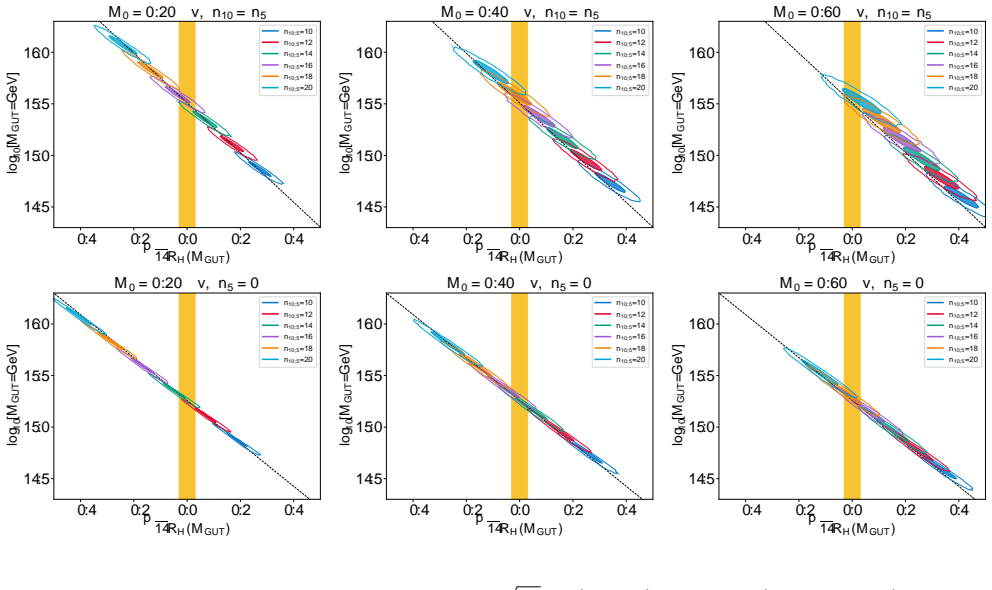
- Title/abstract vs. full text: the abstract and paper_id claim twisted-bilayer-cuprate multicomponent superconductivity (s+d1 e^{iφ1}+d2 e^{iφ2}, GL + mean-field, topology, Kerr anisotropy), but the entire body (Secs. 1–5, Appendices A–D, all equations and figures) is the unrelated GUT paper “Fermion Multiplicities at the GUT Scale” (arXiv:2604.08237). None of the load-bearing calculations advertised in the abstract—GL free energy, self-consistent mean-field gap equations, topological invariants, or Kerr anisotropy—are present. The central claim of 2604.08235 is therefore unverifiable from the supplied manuscript.
- Because the correct technical content is missing, the referee cannot check the abstract’s key assertions: (i) that φ1−φ2 ≠ 0, π implies topological nontriviality and TR/C4 breaking; (ii) that the three-component state is energetically stable over a broad physical regime with sizable s-wave admixture; (iii) that nematic Kerr anisotropy is a smoking-gun distinguisher from s+id and d1+e^{iφ}d2. These are precisely the points on which a referee report for 2604.08235 would have to rest.
minor comments (1)
- The provided GUT manuscript itself is internally coherent as a high-energy theory paper, but that is irrelevant to refereeing 2604.08235; no minor presentation comments on the cuprate claims are possible without the correct text.
Circularity Check
No circularity can be exhibited: the cached full manuscript is a different paper (GUT multi-fermions), so the cuprate derivation chain is not present to audit.
full rationale
The abstract of arXiv:2604.08235 claims that the three-component order parameter s+d1 e^{iφ1}+d2 e^{iφ2} with φ1−φ2≠0,π is topologically nontrivial and is stabilized over a broad regime by Ginzburg–Landau plus self-consistent mean-field, with nematic Kerr anisotropy as a distinguisher. Those claims are not self-definitional on their face: topology from broken time-reversal for a multicomponent chiral state is a standard consequence of the stated symmetry breaking, and stability is presented as an output of free-energy and BdG calculations rather than as a quantity fitted to itself. However, the CACHEABLE full-manuscript text is not that paper; it is instead “Fermion Multiplicities at the GUT Scale” (arXiv:2604.08237), a statistical SU(5) analysis of vector-like fermions, gauge matching, and proton decay. Hard rule 1 forbids asserting circularity without quoting the paper’s own equations and exhibiting a concrete reduction (Eq. X = Eq. Y by construction, or a fitted parameter renamed as prediction). Because the load-bearing GL free-energy coefficients, microscopic Hamiltonian, self-consistency equations, Chern/winding evaluation, and Kerr response for the cuprate state are absent from the provided text, no such reduction can be shown. The honest outcome is therefore score 0 with empty steps: no circularity identified, and the cuprate derivation chain is simply not available to walk.
Axiom & Free-Parameter Ledger
free parameters (2)
- Relative phases φ1, φ2 and s/d amplitude ratios
- Ginzburg–Landau coefficients and microscopic interaction parameters
axioms (3)
- domain assumption Twisted bilayer cuprates are well described by a three-component order parameter s + d1 e^{iφ1} + d2 e^{iφ2} with s = s1 + s2 symmetric.
- domain assumption Ginzburg–Landau analysis plus self-consistent microscopic mean-field is sufficient to establish energetic stability and topological nontriviality.
- ad hoc to paper When φ1 − φ2 ≠ 0, π the state breaks time-reversal and C4 and is topologically nontrivial.
Cite this review
Pith. "Pith review of Topological multicomponent superconductivity with sizable $s$-wave admixture in twisted bilayer cuprates." pith.science (2026). https://pith.science/paper/ENHLVGQG
@misc{pith2026260408235,
  author       = {Pith},
  title        = {Pith review of: Topological multicomponent superconductivity with sizable $s$-wave admixture in twisted bilayer cuprates},
  year         = {2026},
  howpublished = {\url{https://pith.science/paper/ENHLVGQG}},
  note         = {Machine review of arXiv:2604.08235}
}
abstract
We investigate multicomponent superconductivity in twisted bilayer cuprates with order parameter $s+d_1 e^{i\phi_1}+d_2 e^{i\phi_2}$, where $s=s_1+s_2$ is the symmetric layer-resolved $s$-wave component and $d_i$ denotes the $d$-wave pairing in layer $i$. When $\phi_1-\phi_2\neq 0,\pi$, this three-component state breaks time-reversal and $C_4$ rotational symmetries and is topologically nontrivial. Combining Ginzburg--Landau analysis with self-consistent microscopic mean-field calculations, we show that this topological state is stabilized over a broad parameter regime. We further identify nematic Kerr anisotropy as a smoking-gun signature distinguishing it from $s+id$ and $d_1+e^{i\phi}d_2$ states. Our results show that a sizable $s$-wave component does not preclude chiral topological superconductivity, pointing to twisted cuprates as a more robust platform than previously appreciated.
Figures




Reference graph
Works this paper leans on
-
[1]
Georgi and S
H. Georgi and S. L. Glashow, Phys. Rev. Lett.32, 438 (1974)
1974
-
[2]
Georgi, H
H. Georgi, H. R. Quinn, and S. Weinberg, Phys. Rev. Lett.33, 451 (1974)
1974
-
[3]
A. J. Buras, J. R. Ellis, M. K. Gaillard, and D. V. Nanopoulos, Nucl. Phys.B135, 66 (1978)
1978
-
[4]
Navas et al
S. Navas et al. (Particle Data Group), Phys. Rev. D110, 030001 (2024)
2024
-
[5]
Georgi and C
H. Georgi and C. Jarlskog, Phys. Lett. B86, 297 (1979)
1979
-
[6]
Witten, Phys
E. Witten, Phys. Lett. B91, 81 (1980)
1980
-
[7]
Hempfling, Phys
R. Hempfling, Phys. Rev. D49, 6168 (1994)
1994
-
[8]
Q. Shafi and Z. Tavartkiladze, Phys. Lett. B459, 563 (1999), arXiv:hep-ph/9904249
Pith/arXiv arXiv 1999
-
[9]
B. Fornal and B. Grinstein, Phys. Rev. Lett.119, 241801 (2017), arXiv:1706.08535 [hep-ph] . 37
Pith/arXiv arXiv 2017
-
[10]
S. Antusch, K. Hinze, and S. Saad, Phys. Rev. D108, 095010 (2023), arXiv:2308.08585 [hep-ph]
Pith/arXiv arXiv 2023
-
[11]
Georgi, Nucl
H. Georgi, Nucl. Phys. B156, 126 (1979)
1979
-
[12]
Barbieri and D
R. Barbieri and D. V. Nanopoulos, Phys. Lett. B91, 369 (1980)
1980
-
[13]
M. Ibe, S. Shirai, M. Suzuki, and T. T. Yanagida, Phys. Rev. D100, 055024 (2019), arXiv:1906.02977 [hep-ph]
Pith/arXiv arXiv 2019
-
[14]
M. Ibe, S. Shirai, M. Suzuki, K. Watanabe, and T. T. Yanagida, JHEP07, 087 (2022), arXiv:2205.01336 [hep-ph]
Pith/arXiv arXiv 2022
-
[15]
Weinberg, Phys
S. Weinberg, Phys. Lett. B91, 51 (1980)
1980
-
[16]
L. J. Hall, Nucl. Phys. B178, 75 (1981)
1981
- [17]
-
[18]
D. R. T. Jones, Nucl. Phys. B75, 531 (1974)
1974
-
[19]
M. Ibe, S. Shirai, and K. Watanabe, JHEP03, 150 (2025), arXiv:2412.19484 [hep-ph]
Pith/arXiv arXiv 2025
-
[20]
Y. Aoki, T. Izubuchi, E. Shintani, and A. Soni, Phys. Rev. D96, 014506 (2017), arXiv:1705.01338 [hep-lat]
Pith/arXiv arXiv 2017
-
[21]
J.-S. Yoo, Y. Aoki, P. Boyle, T. Izubuchi, A. Soni, and S. Syritsyn, Phys. Rev. D105, 074501 (2022), arXiv:2111.01608 [hep-lat]
Pith/arXiv arXiv 2022
-
[22]
A. Takenaka et al. (Super-Kamiokande), Phys. Rev. D102, 112011 (2020), arXiv:2010.16098 [hep-ex]
arXiv 2020
-
[23]
C. D. Froggatt and H. B. Nielsen, Nucl. Phys. B147, 277 (1979)
1979
-
[24]
K. Abe et al. (Super-Kamiokande), Phys. Rev. D90, 072005 (2014), arXiv:1408.1195 [hep-ex]
Pith/arXiv arXiv 2014
-
[25]
S. Jung et al. (Super-Kamiokande), Phys. Rev. D113, 012015 (2026), arXiv:2510.26232 [hep-ex]
arXiv 2026
-
[26]
K. Abe et al. (Hyper-Kamiokande), (2018), arXiv:1805.04163 [physics.ins-det]
Pith/arXiv arXiv 2018
-
[27]
M. Ibe, S. Shirai, and K. Watanabe, JHEP03, 044 (2025), arXiv:2411.05398 [hep-ph]
Pith/arXiv arXiv 2025
-
[28]
A. Chitose, M. Ibe, and S. Shirai, JHEP02, 183 (2026), arXiv:2510.13617 [hep-ph]
arXiv 2026
-
[29]
L. F. Abbott and M. B. Wise, Phys. Rev. D22, 2208 (1980)
1980
-
[30]
N. Nagata and S. Shirai, JHEP03, 049 (2014), arXiv:1312.7854 [hep-ph] . 38
Pith/arXiv arXiv 2014
This paper was first reviewed by grok-4.5 on July 12, 2026.
discussion (0)
Sign in with ORCID, Apple, or X to comment. Anyone can read and Pith papers without signing in.