REVIEW 3 major objections 5 minor 48 references
Frustrated $J_1-J_2$ Diamond Lattice Antiferromagnet Co$_2$Ti$_3$O$_8$ with a Vacancy-ordered Spinel Structure Synthesized via a Topochemical Reaction
T0 review · 3 major / 5 minor · reviewed 2026-08-07 · deepseek-v4-flash
Pith's one-line read Co2Ti3O8 orders at 4.4 K despite a -27 K Weiss temperature, pointing to a possible spiral ground state.
desk verdict The new compound and its bulk characterization are solid; the spiral-order conclusion rests on an algebra mistake in Eq. (8) and should be withdrawn pending corrected analysis. read the letter →
The pith
A machine-rendered reading of the paper's core claim, the machinery that carries it, and where it could break.
The reading
What carries the argument
Two pieces of machinery carry the argument. The first is the topochemical reaction Li2CoTi3O8 + CoSO4 → Co2Ti3O8 + Li2SO4, a low-temperature ion exchange that removes lithium from the octahedral sites while cobalt fills the tetrahedral sites; this is what bypasses the compound's $\Delta H = -157$ kJ/mol decomposition into CoTiO3 and TiO2. The second is a molecular-field analysis of the classical $J_1$-$J_2$ diamond-lattice model: Eqs. (3) and (4) link the measured $T_N$ and $\theta_W$ to $J_1$ and $J_2$; Eqs. (5) through (8) give the transition temperature for helical states with wavevectors $(q,0,0)$ and $(q,q,0)$. Only the $(q,q,0)$ helix has a real solution, $J_2/J_1 = 0.519$, and the authors place this value in the spiral region of the published phase diagram for the $J_1$-$J_2$ diamond lattice. A supporting electronic-structure argument points to hybridized Ti $3d$–O $2p$ states at the Fermi level as the origin of an enhanced antiferromagnetic $J_2$ in this ordered spinel.
What would settle it
A neutron diffraction experiment on a large enough sample to determine the magnetic propagation vector and spin arrangement would settle the claim: observation of any ordering wavevector other than $(q,q,0)$, or of a non-helical spin structure, would rule out the proposed spiral ground state. Independent first-principles or inelastic-scattering estimates of $J_2/J_1$ that deviate substantially from 0.52 would likewise undercut the molecular-field analysis.
Extended reading notes
Core claim
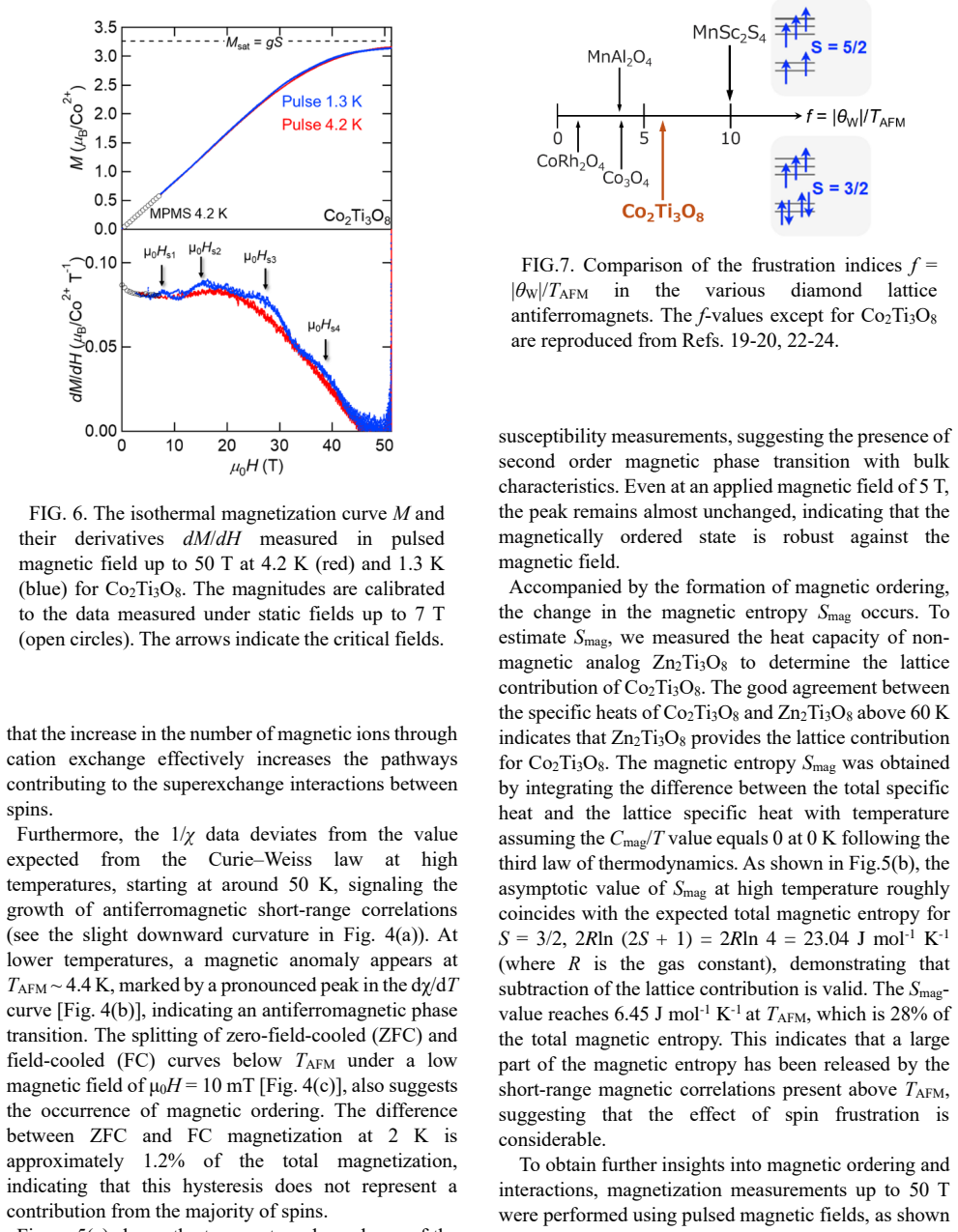
The central discovery is a material realization of a frustrated $J_1$-$J_2$ diamond lattice with a candidate spiral ground state. In the $P4_132$ / $P4_332$ ordered spinel structure, Co$^{2+}$ occupies only the tetrahedral A-site, so the magnetic sublattice is a diamond lattice of $S = 3/2$ moments, with the symmetry-lowered structure splitting the exchange into $J_{1a}$, $J_{1b}$, $J_{2a}$, and $J_{2b}$. The compound orders antiferromagnetically at $T_N = 4.4$ K, far below the Curie-Weiss temperature $\theta_W = -27.0(4)$ K, and its 1.3 K magnetization shows anomalies at 7.6, 15.0, 27.1, and about 39 T. Solving molecular-field equations that link $T_N$ and $\theta_W$ to the exchange constants gives a real, physically acceptable solution only for a helix with propagation vector $(q, q, 0)$: $J_2/J_1 = 0.519$, which is consistent with the spiral region of the theoretical phase diagram. The authors therefore propose Co2Ti3O8 as a candidate for spiral order and, because the chiral ordered-spinel space group lacks inversion symmetry, a potential host for frustration-driven skyrmion phases.
Load-bearing premise
The load-bearing assumption is that the four distinct exchange paths of the real $P4_132$ structure can be collapsed into two equal pairs ($J_{1a}=J_{1b}$, $J_{2a}=J_{2b}$) and that the ordered state is a classical helix with wavevector $(q,q,0)$; if exchange inequivalence or higher-order interactions are significant, the inferred $J_2/J_1 = 0.519$ and the spiral conclusion do not follow.
Editorial extensions
If this is right
- A confirmed spiral ground state in Co2Ti3O8 would make the vacancy-ordered $A_2B_3X_8$ spinel family a new materials platform for frustration-driven magnetism.
- The four magnetization steps at 7.6, 15.0, 27.1, and 39 T imply a cascade of field-induced spin-reorientation transitions, and any of them is a place to look for a skyrmion or other topological spin texture.
- The frustration index $f \approx 6.1$ puts Co2Ti3O8 on par with MnSc2S4, a known spiral magnet and skyrmion host, so similar physics could be sought in this compound.
- The success of the topochemical route suggests other thermodynamically unstable ordered-spinel magnets can be made by low-temperature cation exchange, expanding the search space for frustrated quantum magnets.
Reading between the lines
- Editorial extension: the assumption that $J_{1a}=J_{1b}$ and $J_{2a}=J_{2b}$ could be tested by computing the four exchange constants from first principles; if the two pairs are not close, the actual ground state may be a different spiral than the $(q,q,0)$ helix even if the measured $J_2/J_1$ is near 0.5.
- Editorial extension: the regular spacing of the magnetization steps is reminiscent of a sequence of spin-flop or multi-step transitions; measuring the magnetocaloric effect or the field dependence of $T_N$ across each step would test whether these are first-order transitions and whether a topological phase appears in a narrow field window.
- Editorial extension: the same topochemical exchange could be tried with other magnetic divalent cations on the A-site or with B-site cations whose empty $d$ levels vary, providing a direct test of the proposed $J_2$-enhancement mechanism and a way to tune $J_2/J_1$ through the spiral region.
- Editorial extension: because the space group is chiral, the sample could be a racemic mixture of $P4_132$ and $P4_332$ domains; a single crystal would let Lorentz imaging distinguish a simple spiral from a skyrmion lattice and also measure the handedness.
Editorial analysis
A structured set of objections, weighed in public.
Referee Report
Summary. The manuscript reports the topochemical synthesis of a metastable ordered-spinel compound Co2Ti3O8 with the P4132/P4332 vacancy-ordered structure, and characterizes its magnetic properties. The authors find that Co2+ ions occupy the tetrahedral A-site diamond lattice, with antiferromagnetic order at T_N = 4.4 K and a Weiss temperature θ_W = -27.0(4) K, giving a frustration index f ≈ 6.1. Pulsed-field magnetization shows successive transitions at approximately 7.6, 15.0, 27.1, and 39 T. Using a molecular-field approximation for the J1-J2 diamond-lattice model with a (q, q, 0) helix, the authors extract J2/J1 ≈ 0.519 and suggest a spiral ground state. The experimental synthesis and bulk characterization are mutually consistent and represent a useful contribution, but the central quantitative inference for the spiral state relies on an algebraic error in Eq. (8).
Significance. If the experimental results stand, Co2Ti3O8 is a new frustrated S = 3/2 diamond-lattice antiferromagnet in a vacancy-ordered spinel, and the topochemical synthesis route is a notable advance for metastable oxides. The frustration index of ~6.1, the strongly reduced entropy release at T_N, and the multi-step high-field magnetization make the compound a promising candidate for further study, possibly including skyrmion physics. However, the paper's quantitative claim of a spiral ground state through J2/J1 ≈ 0.519 is currently unsupported because it follows from an incorrect algebraic substitution in the molecular-field derivation. The corrected calculation yields no real positive J2/J1 solution for the measured T_N and θ_W under the same assumptions, so the phase-diagram comparison and the abstract's 'spiral ground state' suggestion need substantial revision.
major comments (3)
- [Section IV, Eq. (8)] The minimization of Eq. (7) with respect to φ is incorrect. Substituting cosφ = (J1 - 4J2)/(4J2) into Eq. (7) gives Tqq = C(-J1^2/(4J2) - 4J2), not the printed C(3J1^2/(4J2) - 6J2). With Tqq = 4.4 K and θ_W = -27.0 K, the corrected expression leads to the quadratic 50.18r^2 - 16r + 6.136 = 0 (r = J2/J1 > 0), whose discriminant is negative. Therefore no real positive J2/J1 exists for the (q, q, 0) helix under the paper's own molecular-field assumptions. The reported value J2/J1 = 0.519 is an artifact of this algebraic error, and the statement that the material lies in the 1/2 < J2/J1 < 2/3 spiral region is unsupported.
- [Section IV, Eqs. (5)-(8)] The corrected expression for Tqq is identical to the corrected expression for Tq in the (q, 0, 0) case, namely C(-J1^2/(4J2) - 4J2). Consequently, the paper's contrast between a physically impossible (q, 0, 0) solution (complex J2/J1) and a supposedly real (q, q, 0) solution does not reflect a difference between the two helix directions; it is solely the result of the algebraic mistake in Eq. (8). Both cases are equally incompatible with the measured T_N and θ_W under the stated assumptions.
- [Abstract and Summary] Since the abstract, discussion, and summary all present the spiral-ordered-ground-state possibility as a central result ('suggests the possibility of a spiral ordered ground state'), the manuscript's main quantitative claim rests on the erroneous Eq. (8). The experimental part (synthesis, structure, susceptibility, heat capacity, high-field magnetization) remains valuable, but the theoretical inference must be corrected or substantially qualified. If a corrected molecular-field treatment with modified assumptions (e.g., relaxing J1a = J1b or J2a = J2b) yields a valid solution, that should be shown; otherwise the spiral claim should be removed or clearly labeled as not supported by the present analysis.
minor comments (5)
- [Abstract] The phrase 'J2/J1 ration' should be corrected to 'J2/J1 ratio'.
- [Section IV, paragraph after Eq. (4)] The sentence contains a duplicated phrase: 'the coordination numbers for the coordination numbers for J1 and J2 are 4 and 12, respectively.'
- [Section III, Fig. 2 caption and text] The identification of the 6.9 wt% impurity as a nonmagnetic spinel is inferred only from the absence of a 40 K anomaly in susceptibility. This is an indirect argument; the text should state explicitly that the impurity's magnetic state is not directly determined, since the lattice constant and structure alone do not fix its composition.
- [Section IV, paragraph on chemical trends] The sentence 'indicating that Co2Ti3O8 as may line beyond the simple Néel ordering regime' contains a typographical error; it should likely read 'may lie beyond the simple Néel ordering regime.'
- [Section IV, paragraph after Eq. (8)] The statement 'This agreement confirms coherence between our assumptions and the calculated results' is misleading because the measured T_N and θ_W are used as inputs to determine J2/J1; the comparison with the phase diagram is a consistency check, not an independent confirmation. This is especially problematic given the algebraic error.
Circularity Check
No significant circularity: J2/J1 is an openly acknowledged molecular-field parameter estimate, and the only self-citation supplies coordination numbers.
full rationale
The paper's central empirical claims (AFM order at T_AFM = 4.4 K, Weiss temperature theta_W = -27.0(4) K, entropy release, field-induced magnetization steps) are direct measurements and do not depend on the molecular-field model. The J2/J1 estimate is presented as an extraction from those measured temperatures using an explicitly stated molecular-field approximation (Eqs. 3-8), not as a first-principles prediction or as a quantity fitted to itself. The comparison against the J1-J2 diamond-lattice phase diagram of Ref. [28] is an external, independent benchmark rather than a restatement of the inputs. The only self-citation, Ref. [33], is invoked for the coordination numbers 4 and 12 in Eqs. (3)-(4), which are elementary diamond-lattice counting facts and do not carry the spiral conclusion; thus it is not load-bearing. No uniqueness theorem is imported from the authors' prior work, and no ansatz is smuggled in via citation: the (q, q, 0) helix is an explicitly stated working assumption, with the paper itself noting the need for neutron diffraction to determine the structure. The algebraic issue raised about Eq. (8) is a mathematical-correctness concern, not circularity, because an incorrect minimization does not make the claimed estimate equivalent to its inputs by construction.
Assumptions & free parameters
free parameters (2)
- J1 and J2 exchange constants (reported as J2/J1) =
J2/J1 = 0.519 for the (q, q, 0) helix; 0.24 for the Neel solution
- Hubbard U_eff on Co 3d states =
5 eV
assumptions (5)
- domain assumption Classical molecular-field approximation with only J1 and J2 is adequate; the four distinct exchange paths in P4132 are collapsed by setting J1a = J1b and J2a = J2b.
- domain assumption The assumed helical spin structures with propagation vectors (q, 0, 0) and (q, q, 0) exhaust the relevant symmetry-breaking orders; the (q, q, q) case is excluded because it requires an additional angle.
- domain assumption Zn2Ti3O8 is a faithful nonmagnetic analog for the lattice heat capacity of Co2Ti3O8.
- domain assumption Co and Ti are fully ordered on the A and B sites despite nearly equal X-ray scattering factors.
- ad hoc to paper The 6.9 wt% Fd-3m impurity is a nonmagnetic spinel with a lattice constant close to Co3O4, inferred only from the absence of a 40 K anomaly.
Cite this review
Pith. "Pith review of Frustrated $J_1-J_2$ Diamond Lattice Antiferromagnet Co$_2$Ti$_3$O$_8$ with a Vacancy-ordered Spinel Structure Synthesized via a Topochemical Reaction." pith.science (2026). https://pith.science/paper/EOEWRAQD
@misc{pith2026250605099,
  author       = {Pith},
  title        = {Pith review of: Frustrated $J_1-J_2$ Diamond Lattice Antiferromagnet Co$_2$Ti$_3$O$_8$ with a Vacancy-ordered Spinel Structure Synthesized via a Topochemical Reaction},
  year         = {2026},
  howpublished = {\url{https://pith.science/paper/EOEWRAQD}},
  note         = {Machine review of arXiv:2506.05099}
}
abstract
Metastable Co$_2$Ti$_3$O$_8$ was synthesized through a topochemical reaction using Li$_2$CoTi$_3$O$_8$ as the precursor, resulting in a vacancy-ordered spinel structure. Crystal structure analysis confirmed that Co ions selectively occupy the A-site, giving rise to a frustrated diamond lattice. Magnetic susceptibility and heat capacity measurements revealed antiferromagnetic order at 4.4 K, which is markedly suppressed compared to the negative Weiss temperature of ${\sim}-27$ K, indicating a high degree of frustration effects. Pulsed high-field magnetization measurements revealed a four-step successive magnetic phase transition, demonstrating that Co$_2$Ti$_3$O$_8$ is a promising candidate for a frustrated $J_1-J_2$ diamond lattice. Additionally, the $J_2/J_1$ ration estimated from the molecular field approximation suggests the possibility of a spiral ordered ground state. These observations highlight the potential of frustrated magnetism in ordered spinel structures to expand the material search space for quantum magnetism, including magnetic skyrmions.
Figures

Reference graph
Works this paper leans on
- [1]
-
[2]
Assuming a helical order in Co2Ti3O8 with a wavevector along (q, 0, 0), we solve Eqs
(6) under the condition cosφ = J1/(8J2). Assuming a helical order in Co2Ti3O8 with a wavevector along (q, 0, 0), we solve Eqs. (4) and (6) using Tq = 4.4 K and θw = −27.0 K. These resulting solutions, J2/J1 = 0.15 ± i0.31, are complex, implying that there is no real solution in this scenario. Therefore, the magnetic ground state of Co2Ti3O8 is not consist...
-
[3]
(8) We assume a ( q, q, 0) helical order in Co 2Ti3O8 and solve Eqs. (4) and (8) with Tq = 4.4 K and θw = −27.0 K, obtaining two real solutions for J2/J1. Given that magnetization measurements suggest both J1 and J2 are antiferromagnetic (J1 < 0 and J2 < 0), the physically meaningful solution is J2/J1 = 0.519. This value places Co2Ti3O8 in the range 1/2 <...
-
[4]
A. Fert, V . Cros, and J. Sampaio, Nat. Nanotechnol. 8, 152 (2013)
2013
-
[5]
W. Kang, Y . Huang, C. Zheng, W. Lv, N. Lei, Y . Zhang, X. Zhang, Y . Zhou, and W. Zhao, Sci. Rep. 6, 23164 (2016)
work page 2016
- [6]
- [7]
-
[8]
Mühlbauer, B
S. Mühlbauer, B. Binz, F. Jonietz, C. Pfleiderer, A. Rosch, A. Neubauer, R. Georgii, and P. Böni, Science 323, 915 (2009)
2009
Show all 48 references
-
[9]
Q. Tong, F. Liu, J. Xiao, and W. Yao, Nano Lett. 18, 7194 (2018)
2018
-
[10]
Dzyaloshinsky, J
I. Dzyaloshinsky, J. Phys. Chem. Sol. 4, 241 (1958)
1958
-
[11]
A. N. Bogdanov and D. A. Yablonskii, Zh. Eksp. Teor. Fiz. 95, 178 (1989)
1989
-
[12]
Bogdanov and A
A. Bogdanov and A. Hubert, J. Magn. Magn. Mater. 138, 255 (1994)
1994
-
[13]
Kurumaji, T
T. Kurumaji, T. Nakajima, M. Hirschberger, A. Kikkawa, Y . Yamasaki, H. Sagayama, H. Nakao, Y . Taguchi, T.-h. Arima, and Y . Tokura, Science 365, 914 (2019)
2019
-
[14]
Moriya, Phys
T. Moriya, Phys. Rev. 120, 91 (1960)
1960
-
[15]
Okubo, S
T. Okubo, S. Chung, and H. Kawamura, Phys. Rev. Lett. 108, 017206 (2012)
2012
-
[16]
N. D. Khanh, T. Nakajima, X. Yu, S. Gao, K. Shibata, M. Hirschberger, Y . Yamasaki, H. Sagayama, H. Nakao, L. Peng, K. Nakajima, R. Takagi, T.-h. Arima, Y . Tokura, and S. Seki, Nat. Nanotech. 15, 444 (2020)
2020
-
[17]
Hirschberger, L
M. Hirschberger, L. Spitz, T. Nomoto, T. Kurumaji, S. Gao, J. Masell, T. Nakajima, A. Kikkawa, Y . Yamasaki, H. Sagayama, H. Nakao, Y . Taguchi, R. Arita, T.-h. Arima, and Y . Tokura, Phys. Rev. Lett. 125, 076602 (2020)
2020
-
[18]
Hirschberger, T
M. Hirschberger, T. Nakajima, S. Gao, L. Peng, A. Kikkawa, T. Kurumaji, M. Kriener, Y . Yamasaki, H. Sagayama, H. Nakao, K. Ohishi, K. Kakurai, Y . Taguchi, X. Y u, T.-h. Arima, and Y . Tokura, Nat. Commun. 10, 5831 (2019)
2019
-
[19]
Fritsch, J
V . Fritsch, J. Hemberger, N. B ̈uttgen, E. -W. Scheidt, H. -A. Krug von Nidda, A. Loidl, and V . Tsurkan, Phys. Rev. Lett. 92, 116401 (2004)
2004
-
[20]
S. Gao, H. D. Rosales, F. A. G. Albarracin, G. K. Tsurkan, T. Fennell, P. Steffens, M. Boehm, P. Cermak, A. Schneldewind, E. Ressouche, D. Cabra, C. Rüegg, and O. Zaharko, Nature (London) 586, 37 (2020)
2020
-
[21]
S. Reil, H. -J. Stork, and H. Haeuseler, J. Alloy. Compd. 334, 92 (2002)
2002
-
[22]
L. Ge, J. Flynn, J. A. M. Paddison, M. B. Stone, S. Calder, M. A. Subramanian, A. P . Ramirez, and M. Mourigal, Phys. Rev. B 96, 064413 (2017)
2017
-
[23]
S. Gao, O. Zaharko, V . Tsurkan, Y . Su, J. White, G. Tucker, B. Roessli, F. Bourdarot, R. Sibille, D. Chernyshov, T. Fennell, A. Loidl, D.C., and C. Rüegg, Nat. Phys. 13, 157 (2017)
2017
-
[24]
W. Roth, J. Phys. Chem. Sol. 25, 1 (1964)
1964
-
[25]
H. S. Nair, Z. Fu, J. V oigt, Y . Su, and Th. Brückel, Phys. Rev. B 89, 174431 (2014)
2014
-
[26]
Tristan, J
N. Tristan, J. Hemberger, A. Krimmel, H. -A. K. von Nidda, V . Tsurkan, and A. Loidl, Phys. Rev. B 72, 174404 (2005)
2005
-
[27]
Krimmel, H
A. Krimmel, H. Mutka, M. M. Koza, V . Tsurkan, and A. Loidl, Phys. Rev. B 79, 134406 (2009)
2009
-
[28]
Bergman, J
D. Bergman, J. Alicea, E. Gull, S. Trebst, and L. Balents, Nat. Phys. 3, 487 (2007)
2007
-
[29]
J. G. MacDougall, D. Gout, J. L. Zarestky, G. Ehlers, A. Podlesnyak, M. A. McGuire, D. Mandrus, and S. E. Nagler, Proc. Natl. Acad. Sci. 108, 15693 (2011)
2011
-
[30]
B. Roy, A. Pandey, Q. Zhang, T. W. Heitmann, D. Vaknin, D. C. Johnston, and Y . Furukawa, Phys. Rev. B 88, 174415 (2013)
2013
-
[31]
Biffin, Ch
A. Biffin, Ch. Rüegg, J. Embs, T. Guidi, D. Cheptiakov, A. Loidl, V . Tsurkan, and R. Coldea, Phys. Rev. Lett. 118, 067205 (2017)
2017
-
[32]
P. G. Radaelli, Y . Horibe, M. J. Gutmann, H. Ishibashi, C. H. Chen, R. M. Ibberson, Y . Koyama, Y .- S. Hor, V . Kiryukhin, and S. -W. Cheong, Nature (London) 416, 155 (2002)
2002
-
[33]
K. W. Plumb, J. R. Morey, J. A. Rodriguez-Rivera, H. Wu, A. A. Podlesnyak, T. M. McQueen, and C. L. Broholm, Phys. Rev. X 6, 041055 (2016)
2016
-
[34]
J. N. Graham, N. Qureshi, C. Ritter, P. Manuel, A. R. Wildes, and L. Clark, Phys. Rev. Lett. 130, 166703 (2023)
2023
-
[35]
J. R. Chamorro, L. Ge, J. Flynn, M. A. Subramanian, M. Mourigal, and T. M. McQueen, Phys. Rev. Mater. 2, 034404 (2018)
2018
-
[36]
Haraguchi, D
Y. Haraguchi, D. Nishio-Hamane, H. Aruga Katori Phys. Rev. Mater. 7, 084413 (2023)
2023
-
[37]
left -handed
are classified as chirality-ordered spinel compounds. Specifically, in Zn2Ti3O8, the Ti ions and vacancies are arranged in an ordered manner to form a Ti hyperkagome lattice, while the divalent Zn ions establish a diamond lattice. Hypothetically, in Co2Ti3O8 [Fig. 1(b)], an an...
-
[38]
M. M. Bordelon, J. D. Bocarsly, L. Posthuma, A. Banerjee, Q. Zhang, and S. D. Wilson, Phys. Rev. B 103, 024430 (2021)
2021
-
[39]
Kitani, T
S. Kitani, T. Yajima, and H. Kawaji, Phys. Rev. Mater. 5, 094411 (2021)
2021
-
[40]
F. H. Dulin, D.E. Rase, J. Amer. Ceram. Soc. 43, 12 (1960)
1960
-
[41]
Giannozzi, O
P. Giannozzi, O. Andreussi, T. Brumme, O. Bunau, M. B. Nardelli, M. Calandra, R. Car, C. Cavazzoni, D. Ceresoli, M. Cococcioni, N. Colonna, I. Carnimeo, A. D. Corso, S. de Gironcoli, P. Delugas, R. A. DiStasio Jr., A. Ferretti, A. Floris, G. Fratesi, G. Fu gallo et al., J. Phy...
2017
-
[42]
Reeves, D
N. Reeves, D. Pasero, A.R. West, J. Solid State Chem. 180, 1894 (2007)
2007
-
[43]
Momma and F
K. Momma and F. Izumi, J. Appl. Crystallogr. 44, 1272 (2011)
2011
-
[44]
Oishi, M
R. Oishi, M. Yonemura, Y . Nishimaki, S. Torii, A. Hoshikawa, T. Ishigaki, T. Morishima, K. Mori, and T. Kamiyama, Nucl. Instrum. Methods Phys. Res., Sect. A 600, 94 (2009)
2009
-
[45]
Gawali, A.C
S.R. Gawali, A.C. Gandhi, S.S. Gaikwad, J. Pant, T.-S. Chan, C.-L. Cheng, Y .-R. Ma, S.Y . Wu, Sci. Rep. 8, 249 (2018)
2018
-
[46]
(Supplemental material) For comparison of the magnetic susceptibility of Co 2Ti3O8 and the precursor Li2CoTi3O8, and the calculated pDOS of MnSc 2S4, MnAl2O4, Co3O4 and CoRh2O4
-
[47]
Holloway, Phys
H. Holloway, Phys. Rev. B 37, 874 (1988)
1988
-
[48]
Takeda, M
H. Takeda, M. Kawano, K. Tamura, M. Akazawa, J. Yan, T. Waki, H. Nakamura, K. Sato, Y . Narumi, M. Hagiwara, M. Yamashita, and C. Hotta, Nat. Commun. 15, 566 (2024)
2024
Reviewed August 7, 2026 · model on record in the stance chip above.
Discussion (0). Continue with ORCID to comment.