REVIEW 2 major objections 4 minor 37 references
StreamBP: Memory-Efficient Exact Backpropagation for Long Sequence Training of LLMs
T0 review · 2 major / 4 minor · reviewed 2026-08-07 · deepseek-v4-flash
Pith's one-line read StreamBP splits the chain rule along the sequence so that activation and logits memory drop to about one chunk's worth, while gradients stay exact.
desk verdict Good idea, honest experiments, but the central memory claim omits H_in and needs a clear fix before the 1/D scaling and 2.8–5.5x numbers can be taken at face value. read the letter →
The pith
A machine-rendered reading of the paper's core claim, the machinery that carries it, and where it could break.
The reading
What carries the argument
The load-bearing object is the linear decomposition of the chain rule, Equation (1) in the paper: $\partial L/\partial \mathrm{vec}(W) = \sum_{i=1}^D (\partial \mathrm{vec}(Z_{out}^{(i)})/\partial W)^\top \partial L/\partial \mathrm{vec}(Z_{out}^{(i)})$. This identity lets the backward pass process the output in $D$ sequential chunks, keeping memory proportional to one chunk at a time. Its companion for causal transformers is Property 3.1, which limits each chunk's needed activations to $O^{(i)}, Q^{(i)}, K^{(:i)}, V^{(:i)}$; compared with full checkpointed reforwarding, the per-chunk working set is much smaller, and the attention-score computation uses the prefix rather than the full key and value sequences.
What would settle it
Fix the sequence length, increase the number of chunks $D$, and compare peak memory and gradients of StreamBP against a full-precision standard backward pass. If the memory attributed to layer activations does not fall roughly as $1/D$, or if the gradient error exceeds the error from reordering the same floating-point additions, the claimed memory scaling or exactness fails.
Extended reading notes
Core claim
The central claim is that exact gradients can be obtained by linearly decomposing the chain rule along the sequence dimension, processing one partition at a time, and accumulating the partial contributions. Concretely, the gradient of a weight $W$ is written as a sum over chunks $i$ of $(\partial \mathrm{vec}(Z_{out}^{(i)})/\partial W)^\top \partial L/\partial \mathrm{vec}(Z_{out}^{(i)})$, so only one chunk's activations are alive at once. For transformer layers, the paper isolates Property 3.1: the $i$-th output chunk's weight gradient needs only $O^{(i)}$, $Q^{(i)}$, $K^{(:i)}$, and $V^{(:i)}$; because attention is causal, keys and values are computed once per layer and cached. The language-modeling head is streamed by partitioning logits along the sequence, with separate accumulation rules for SFT, GRPO, and DPO, where DPO requires a final scalar correction after accumulation. The paper verifies numerical equivalence to standard backpropagation at FP32 precision and reports sequence-length scaling of 2.8-5.5 times relative to gradient checkpointing on models from 4B to 32B parameters.
Load-bearing premise
The load-bearing premise is that the gradient for each sequence chunk can be formed from that chunk's query and output plus all keys and values up to that point, without also keeping the chunk's input hidden states in memory; if those inputs are required for the query, key, and value weight gradients and are not cached, the actual memory or time cost differs from the reported 1/D scaling.
Editorial extensions
If this is right
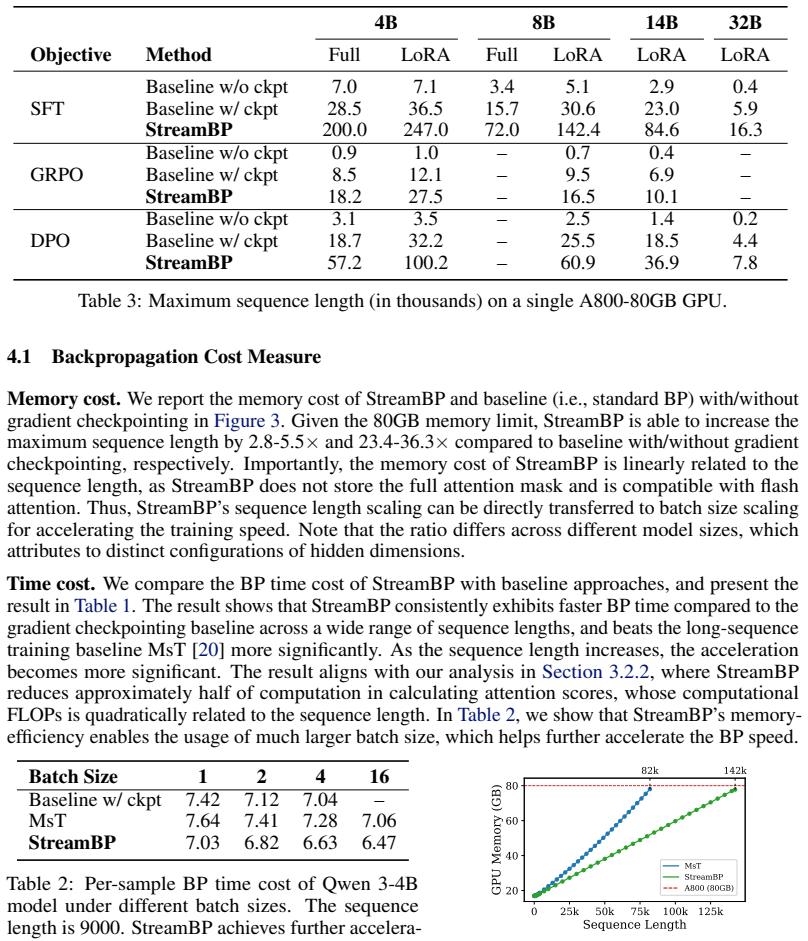
- A fixed GPU can train on sequences 2.8-5.5 times longer than with gradient checkpointing, and 23-36 times longer than without checkpointing, across model sizes from 4B to 32B parameters.
- The memory saving is linear in sequence length, so at a fixed sequence length the same saving becomes a batch-size multiplier that accelerates training rather than only extending length.
- SFT, GRPO, and DPO all receive exact gradients, so StreamBP can replace the backward pass in reasoning-model training without changing the optimization target.
- Causal attention reduces attention-score FLOPs by about half relative to standard checkpointed backward passes, and the backward-time advantage grows as the sequence length grows.
- A distributed variant under sharded optimizer states keeps standard gradient-communication patterns and reaches 5-5.6 times longer sequences than gradient checkpointing on 8 GPUs.
Reading between the lines
- One design question the paper leaves implicit is how the query, key, and value projection gradients accumulate: Property 3.1 lists $O^{(i)}, Q^{(i)}, K^{(:i)}, V^{(:i)}$ as sufficient, but $dW_q, dW_k, dW_v$ formally also multiply the chunk input $H_{in}^{(i)}$, so whether the implementation caches or recomputes that input changes the precise memory-time trade-off.
- An editor's extension: the same decomposition should transfer to any sequence layer whose per-position output Jacobian is triangular in the partition variable, such as recurrent or state-space layers, not only causal attention.
- An editor's extension: the paper's ablation shows that very small partitions add time overhead from repeated weight loads and kernel launches, so the practical recipe is to choose the largest partition that fits in memory and fuse the per-chunk backward kernels.
- An editor's extension: because StreamBP's memory scales linearly with sequence length, it composes naturally with sequence-parallel and activation-offloading schemes, potentially pushing single-GPU sequence lengths beyond the demonstrated 200k range.
Editorial analysis
A structured set of objections, weighed in public.
Referee Report
Summary. The paper proposes StreamBP, an exact backpropagation algorithm for causal transformer LLMs that partitions the sequence dimension into chunks and accumulates weight gradients chunk-by-chunk in a running sum. The method is developed for the language-modeling head under SFT, GRPO, and DPO objectives, and for transformer attention/MLP layers under a partitioned, prefix-only computation. The authors report that StreamBP reduces activation and logit memory to roughly 1/D of the standard cost, scales maximum sequence length by 2.8–5.5x compared with gradient checkpointing, and achieves comparable or faster backward time while computing mathematically exact gradients. They also propose a communication-efficient distributed version for ZeRO-style training and provide an implementation link.
Significance. If the memory and timing claims were correct, StreamBP would be a practically valuable systems contribution: it gives exact gradients (empirically verified against FP32 baselines in §B.1), supports SFT, GRPO, and DPO, ships open-source code, and improves over the logits-only Mini-Sequence Transformer baseline by also reducing transformer-layer activation memory. The exact-gradient decomposition in Eq. (1) and the head-level derivations in §3.2.1 are sound in exact arithmetic. However, the central memory-efficiency claim is currently overstated because the transformer-layer dependency analysis omits the input activations H_in required to form the attention weight gradients, and it also undercounts the cost of caching full K and V. These omissions affect the headline sequence-length scaling and speedup numbers, so the central contribution needs substantial revision before the claims can be accepted at face value.
major comments (2)
- [§3.2.2, Property 3.1 and “Memory efficiency of StreamBP”] Property 3.1 states that ∂H_out^(i)/∂W depends only on O^(i), Q^(i), K^(:i), and V^(:i), and the subsequent stored-activation list excludes H_in. This is not correct for the attention weight gradients: dW_q^(i) = (H_in^(i))^T dQ^(i), dW_k^(i) = (H_in^(:i))^T dK^(:i), and dW_v^(i) = (H_in^(:i))^T dV^(:i), so every partition requires input activations for the full prefix up to position iT/D. If H_in is cached per layer, the activation memory is O(Td) per layer rather than roughly 1/D of standard activation memory, and the 2.8–5.5x sequence-length gains in Figure 3 and Table 3 are measured with an unstated memory term. If H_in is instead recomputed, the additional forward FLOPs and wall-clock time are absent from the FLOPs analysis in §3.2.2 and from Tables 1, 2, and 5. Moreover, K and V are cached in full even in the stated list, costing O(Td) (or O(Td/G) with GQA) and not scaling with D. The paper must state which cost it pays for H_in and must revise the memory, scaling, and timing claims accordingly.
- [§3.2.2, “Computational efficiency of StreamBP”] The claimed FLOPs saving compares “the standard implementation S=QK^⊤” at 2T^2 d^2 FLOPs with StreamBP’s prefix-only computation at (1+D)T^2 d^2/D FLOPs, but a causal language model does not compute the upper-triangular entries of S in a standard causal implementation with flash attention or masked attention; such implementations already compute only about half the scores. The reported FLOPs advantage over the baseline is therefore an artifact of comparing against a full-mask dense attention baseline rather than a causal-attention baseline. The wall-clock speedups in Table 1 may still arise from reduced activation recomputation or memory pressure, but they do not support the stated “leveraging the causal structure” FLOPs argument. Please rebenchmark against a causal flash-attention checkpointing baseline or qualify the FLOPs claim.
minor comments (4)
- [§1 and throughout] There are several typographical errors, including “finetuing” in the introduction, “distribuetd” in contribution (C.2), and “containg” in §3.3; a careful proofread is needed.
- [§3.2.2, Eq. (13)] The mask partition M^(i) used in softmax(S^(i), M^(i)) is not explicitly defined; please specify its dimensions and how it is derived from the causal mask.
- [§3.2.2, Property 3.1] Property 3.1 is stated as an observation without proof; because it is the load-bearing dependency claim for the algorithm, a short derivation or a formal statement with a proof sketch would make the paper more self-contained.
- [§C.1] The text says “we draw a subfigure to interpret during the 2nd backward process,” but the referenced subfigure is not clearly located or labeled in Figure 1; please add the subfigure or remove the reference.
Circularity Check
No circularity: StreamBP derives exact gradients by partitioning the chain rule and evaluates against external baselines; the noted Property 3.1 issue is a correctness concern, not a circular reduction.
full rationale
StreamBP is not circular. The core identity (Eq. 1) is a direct application of the chain rule: the gradient of the loss with respect to a weight is written as a sum over sequence partitions, which holds for any partition of Z_out by linearity of the transpose-Jacobian product. The language-model-head sections derive SFT, GRPO, and DPO gradients by differentiating the stated losses and accumulating per-chunk contributions; DPO's non-separable log-sigmoid term is handled by the exact gradient identity in Eq. (8)-(10), not by fitting a parameter to a target. The transformer-layer development in Eqs. (12)-(14) computes partitioned attention and MLP gradients from Q, K, V, and O and accumulates them as a running sum, which is the ordinary backward pass restricted to sequence chunks; caching K and V is an explicit implementation choice, not a circular redefinition. The reported 2.8-5.5x memory and time advantages are empirical measurements against gradient checkpointing, MsT, and standard BP, not quantities fitted from those baselines, and no load-bearing assumption is justified solely by a self-citation. The possible omission of H_in from the dependency list in Property 3.1 would be a correctness or memory-accounting flaw, but it does not make any predicted quantity equal to its own input by construction; the derivation chain from the chain rule to the gradient accumulation is mathematically exposed and externally verifiable.
Assumptions & free parameters
free parameters (2)
- transformer layer partition size ps =
500 for maximum sequence length; T/3 for time measurements
- lm_head partition size ps_head =
100
assumptions (5)
- standard math Chain rule and linearity of Jacobians allow the gradient to be decomposed into a sum over chunks of the output (Eq. 1).
- domain assumption In a causal transformer, the i-th output chunk depends only on Q^(i), K^(:i), V^(:i); no future tokens contribute (Property 3.1).
- domain assumption LayerNorm, RMSNorm, residual connections, and MLP nonlinearities act per token or are compatible with sequence partitioning.
- domain assumption SFT, GRPO, and DPO losses or gradients are separable over sequence positions as written in Eqs. (3), (6), (8)-(10).
- domain assumption FlashAttention's tiling yields operations compatible with the partitioned computations.
Cite this review
Pith. "Pith review of StreamBP: Memory-Efficient Exact Backpropagation for Long Sequence Training of LLMs." pith.science (2026). https://pith.science/paper/EOR3QYZX
@misc{pith2026250603077,
  author       = {Pith},
  title        = {Pith review of: StreamBP: Memory-Efficient Exact Backpropagation for Long Sequence Training of LLMs},
  year         = {2026},
  howpublished = {\url{https://pith.science/paper/EOR3QYZX}},
  note         = {Machine review of arXiv:2506.03077}
}
read the original abstract
Training language models on long sequence data is a demanding requirement for enhancing the model's capability on complex tasks, e.g., long-chain reasoning. However, as the sequence length scales up, the memory cost for storing activation values becomes huge during the Backpropagation (BP) process, even with the application of gradient checkpointing technique. To tackle this challenge, we propose a memory-efficient and exact BP method called StreamBP, which performs a linear decomposition of the chain rule along the sequence dimension in a layer-wise manner, significantly reducing the memory cost of activation values and logits. The proposed method is applicable to common objectives such as SFT, GRPO, and DPO. From an implementation perspective, StreamBP achieves less computational FLOPs and faster BP speed by leveraging the causal structure of the language model. Compared to gradient checkpointing, StreamBP scales up the maximum sequence length of BP by 2.8-5.5 times larger, while using comparable or even less BP time. Note that StreamBP's sequence length scaling ability can be directly transferred to batch size scaling for accelerating training. We further develop a communication-efficient distributed StreamBP to effectively support multi-GPU training and broaden its applicability. Our code can be easily integrated into the training pipeline of any transformer models and is available at https://github.com/Ledzy/StreamBP.
Figures


Figures from the paper (5 more)


Reference graph
Works this paper leans on
-
[1]
GPT-4 technical report.arXiv preprint arXiv:2303.08774, 2023
Josh Achiam, Steven Adler, Sandhini Agarwal, Lama Ahmad, Ilge Akkaya, Florencia Leoni Aleman, Diogo Almeida, Janko Altenschmidt, Sam Altman, Shyamal Anadkat, et al. GPT-4 technical report.arXiv preprint arXiv:2303.08774, 2023
arXiv 2023
-
[2]
Gqa: Training generalized multi-query transformer models from multi-head checkpoints
Joshua Ainslie, James Lee-Thorp, Michiel de Jong, Yury Zemlyanskiy, Federico Lebron, and Sumit Sanghai. Gqa: Training generalized multi-query transformer models from multi-head checkpoints. InProceedings of the 2023 Conference on Empirical Methods in Natural Language Processing, pages 4895–4901, 2023
2023
-
[3]
Sébastien Bubeck, Varun Chandrasekaran, Ronen Eldan, Johannes Gehrke, Eric Horvitz, Ece Kamar, Peter Lee, Yin Tat Lee, Yuanzhi Li, Scott Lundberg, et al. Sparks of artificial general intelligence: Early experiments with GPT-4.arXiv preprint arXiv:2303.12712, 2023
arXiv 2023
-
[4]
Training deep nets with sublinear memory cost.arXiv preprint arXiv:1604.06174, 2016
Tianqi Chen, Bing Xu, Chiyuan Zhang, and Carlos Guestrin. Training deep nets with sublinear memory cost.arXiv preprint arXiv:1604.06174, 2016
arXiv 2016
-
[5]
Tim Dettmers, Artidoro Pagnoni, Ari Holtzman, and Luke Zettlemoyer. QLoRA: Efficient finetuning of quantized LLMs.Advances in Neural Information Processing Systems, 36, 2023
work page 2023
-
[6]
The llama 3 herd of models.arXiv preprint arXiv:2407.21783, 2024
Abhimanyu Dubey, Abhinav Jauhri, Abhinav Pandey, Abhishek Kadian, Ahmad Al-Dahle, Aiesha Letman, Akhil Mathur, Alan Schelten, Amy Yang, Angela Fan, et al. The llama 3 herd of models.arXiv preprint arXiv:2407.21783, 2024
arXiv 2024
-
[7]
Open R1: A fully open reproduction of deepseek-r1, January 2025
Hugging Face. Open R1: A fully open reproduction of deepseek-r1, January 2025
work page 2025
-
[8]
Daya Guo, Dejian Yang, Haowei Zhang, Junxiao Song, Ruoyu Zhang, Runxin Xu, Qihao Zhu, Shirong Ma, Peiyi Wang, Xiao Bi, et al. Deepseek-r1: Incentivizing reasoning capability in llms via reinforcement learning.arXiv preprint arXiv:2501.12948, 2025
arXiv 2025
Show all 37 references
-
[9]
LoRA: Low-rank adaptation of large language models.ICLR, 1(2):3, 2022
Edward J Hu, Yelong Shen, Phillip Wallis, Zeyuan Allen-Zhu, Yuanzhi Li, Shean Wang, Lu Wang, Weizhu Chen, et al. LoRA: Low-rank adaptation of large language models.ICLR, 1(2):3, 2022
2022
-
[10]
Open-reasoner-zero: An open source approach to scaling up reinforcement learning on the base model.arXiv preprint arXiv:2503.24290, 2025
Jingcheng Hu, Yinmin Zhang, Qi Han, Daxin Jiang, Xiangyu Zhang, and Heung-Yeung Shum. Open-reasoner-zero: An open source approach to scaling up reinforcement learning on the base model.arXiv preprint arXiv:2503.24290, 2025
2025 arXiv
-
[11]
Deepspeed ulysses: System optimizations for enabling training of extreme long sequence transformer models.arXiv preprint arXiv:2309.14509, 2023
Sam Ade Jacobs, Masahiro Tanaka, Chengming Zhang, Minjia Zhang, Shuaiwen Leon Song, Samyam Rajbhandari, and Yuxiong He. Deepspeed ulysses: System optimizations for enabling training of extreme long sequence transformer models.arXiv preprint arXiv:2309.14509, 2023
2023 arXiv
-
[12]
Openai o1 system card.arXiv preprint arXiv:2412.16720, 2024
Aaron Jaech, Adam Kalai, Adam Lerer, Adam Richardson, Ahmed El-Kishky, Aiden Low, Alec Helyar, Aleksander Madry, Alex Beutel, Alex Carney, et al. Openai o1 system card.arXiv preprint arXiv:2412.16720, 2024
2024 arXiv
-
[13]
Adam: A method for stochastic optimization.arXiv preprint arXiv:1412.6980, 2014
Diederik P Kingma and Jimmy Ba. Adam: A method for stochastic optimization.arXiv preprint arXiv:1412.6980, 2014. 10
2014 arXiv
-
[14]
Reducing activation recomputation in large transformer models.Proceedings of Machine Learning and Systems, 5:341–353, 2023
Vijay Anand Korthikanti, Jared Casper, Sangkug Lym, Lawrence McAfee, Michael Ander- sch, Mohammad Shoeybi, and Bryan Catanzaro. Reducing activation recomputation in large transformer models.Proceedings of Machine Learning and Systems, 5:341–353, 2023
2023
-
[15]
Llms can easily learn to reason from demonstrations structure, not content, is what matters!arXiv preprint arXiv:2502.07374, 2025
Dacheng Li, Shiyi Cao, Tyler Griggs, Shu Liu, Xiangxi Mo, Eric Tang, Sumanth Hegde, Kourosh Hakhamaneshi, Shishir G Patil, Matei Zaharia, et al. Llms can easily learn to reason from demonstrations structure, not content, is what matters!arXiv preprint arXiv:2502.07374, 2025
2025 arXiv
-
[16]
Sequence paral- lelism: Long sequence training from system perspective.arXiv preprint arXiv:2105.13120, 2021
Shenggui Li, Fuzhao Xue, Chaitanya Baranwal, Yongbin Li, and Yang You. Sequence paral- lelism: Long sequence training from system perspective.arXiv preprint arXiv:2105.13120, 2021
2021 arXiv
-
[17]
Dora: Weight-decomposed low-rank adaptation
Shih-Yang Liu, Chien-Yi Wang, Hongxu Yin, Pavlo Molchanov, Yu-Chiang Frank Wang, Kwang-Ting Cheng, and Min-Hung Chen. Dora: Weight-decomposed low-rank adaptation. In Forty-first International Conference on Machine Learning, 2024
2024
-
[18]
Understanding r1-zero-like training: A critical perspective.arXiv preprint arXiv:2503.20783, 2025
Zichen Liu, Changyu Chen, Wenjun Li, Penghui Qi, Tianyu Pang, Chao Du, Wee Sun Lee, and Min Lin. Understanding r1-zero-like training: A critical perspective.arXiv preprint arXiv:2503.20783, 2025
2025 arXiv
-
[19]
Decoupled weight decay regularization
Ilya Loshchilov and Frank Hutter. Decoupled weight decay regularization. InInternational Conference on Learning Representations
-
[20]
Mini-sequence transformer: Optimizing intermediate memory for long sequences training.arXiv preprint arXiv:2407.15892, 2024
Cheng Luo, Jiawei Zhao, Zhuoming Chen, Beidi Chen, and Anima Anandkumar. Mini-sequence transformer: Optimizing intermediate memory for long sequences training.arXiv preprint arXiv:2407.15892, 2024
2024 arXiv
-
[21]
Tang, Manan Roongta, Colin Cai, Jeffrey Luo, Li Erran Li, Raluca Ada Popa, and Ion Stoica
Michael Luo, Sijun Tan, Justin Wong, Xiaoxiang Shi, William Y . Tang, Manan Roongta, Colin Cai, Jeffrey Luo, Li Erran Li, Raluca Ada Popa, and Ion Stoica. DeepScaleR: Surpassing o1-preview with a 1.5b model by scaling rl, 2025. Notion Blog
2025
-
[22]
BAdam: A memory efficient full parameter optimization method for large language models.Advances in Neural Information Processing Systems, 37:24926–24958, 2024
Qijun Luo, Hengxu Yu, and Xiao Li. BAdam: A memory efficient full parameter optimization method for large language models.Advances in Neural Information Processing Systems, 37:24926–24958, 2024
2024
-
[23]
s1: Simple test-time scaling.arXiv preprint arXiv:2501.19393, 2025
Niklas Muennighoff, Zitong Yang, Weijia Shi, Xiang Lisa Li, Li Fei-Fei, Hannaneh Hajishirzi, Luke Zettlemoyer, Percy Liang, Emmanuel Candès, and Tatsunori Hashimoto. s1: Simple test-time scaling.arXiv preprint arXiv:2501.19393, 2025
2025 arXiv
-
[24]
Tinyzero
Jiayi Pan, Junjie Zhang, Xingyao Wang, Lifan Yuan, Hao Peng, and Alane Suhr. Tinyzero. https://github.com/Jiayi-Pan/TinyZero, 2025. Accessed: 2025-01-24
2025
-
[25]
Zero-offload: Democratizing billion-scale model training.arXiv preprint arXiv:2101.06840, 2021
Jie Ren, Samyam Rajbhandari, Reza Yazdani Aminabadi, Olatunji Ruwase, Shuangyan Yang, Minjia Zhang, Dong Li, and Yuxiong He. Zero-offload: Democratizing billion-scale model training.arXiv preprint arXiv:2101.06840, 2021
2021 arXiv
-
[26]
Trl: Transformer reinforce- ment learning.https://github.com/huggingface/trl, 2020
Leandro von Werra, Younes Belkada, Lewis Tunstall, Edward Beeching, Tristan Thrush, Nathan Lambert, Shengyi Huang, Kashif Rasul, and Quentin Gallouédec. Trl: Transformer reinforce- ment learning.https://github.com/huggingface/trl, 2020
2020
-
[27]
Reinforcement learning for reasoning in large language models with one training example.arXiv preprint arXiv:2504.20571, 2025
Yiping Wang, Qing Yang, Zhiyuan Zeng, Liliang Ren, Lucas Liu, Baolin Peng, Hao Cheng, Xuehai He, Kuan Wang, Jianfeng Gao, et al. Reinforcement learning for reasoning in large language models with one training example.arXiv preprint arXiv:2504.20571, 2025
2025 arXiv
-
[28]
Chain-of-thought prompting elicits reasoning in large language models
Jason Wei, Xuezhi Wang, Dale Schuurmans, Maarten Bosma, Fei Xia, Ed Chi, Quoc V Le, Denny Zhou, et al. Chain-of-thought prompting elicits reasoning in large language models. Advances in neural information processing systems, 35:24824–24837, 2022
2022
-
[29]
Light-R1: Curriculum sft, dpo and rl for long cot from scratch and beyond.arXiv preprint arXiv:2503.10460, 2025
Liang Wen, Yunke Cai, Fenrui Xiao, Xin He, Qi An, Zhenyu Duan, Yimin Du, Junchen Liu, Lifu Tang, Xiaowei Lv, et al. Light-R1: Curriculum sft, dpo and rl for long cot from scratch and beyond.arXiv preprint arXiv:2503.10460, 2025. 11
2025 arXiv
-
[30]
Thomas Wolf, Lysandre Debut, Victor Sanh, Julien Chaumond, Clement Delangue, Anthony Moi, Pierric Cistac, Tim Rault, Rémi Louf, Morgan Funtowicz, Joe Davison, Sam Shleifer, Patrick von Platen, Clara Ma, Yacine Jernite, Julien Plu, Canwen Xu, Teven Le Scao, Sylvain Gugger, Mari...
2020
-
[31]
An Yang, Baosong Yang, Beichen Zhang, Binyuan Hui, Bo Zheng, Bowen Yu, Chengyuan Li, Dayiheng Liu, Fei Huang, Haoran Wei, et al. Qwen2. 5 technical report.arXiv preprint arXiv:2412.15115, 2024
2024 arXiv
-
[32]
Limo: Less is more for reasoning.arXiv preprint arXiv:2502.03387, 2025
Yixin Ye, Zhen Huang, Yang Xiao, Ethan Chern, Shijie Xia, and Pengfei Liu. Limo: Less is more for reasoning.arXiv preprint arXiv:2502.03387, 2025
2025 arXiv
-
[33]
Demystifying long chain-of-thought reasoning in llms.arXiv preprint arXiv:2502.03373, 2025
Edward Yeo, Yuxuan Tong, Morry Niu, Graham Neubig, and Xiang Yue. Demystifying long chain-of-thought reasoning in llms.arXiv preprint arXiv:2502.03373, 2025
2025 arXiv
-
[34]
Dapo: An open-source llm reinforcement learning system at scale.arXiv preprint arXiv:2503.14476, 2025
Qiying Yu, Zheng Zhang, Ruofei Zhu, Yufeng Yuan, Xiaochen Zuo, Yu Yue, Tiantian Fan, Gaohong Liu, Lingjun Liu, Xin Liu, et al. Dapo: An open-source llm reinforcement learning system at scale.arXiv preprint arXiv:2503.14476, 2025
2025 arXiv
-
[35]
Does reinforcement learning really incentivize reasoning capacity in llms beyond the base model? arXiv preprint arXiv:2504.13837, 2025
Yang Yue, Zhiqi Chen, Rui Lu, Andrew Zhao, Zhaokai Wang, Shiji Song, and Gao Huang. Does reinforcement learning really incentivize reasoning capacity in llms beyond the base model? arXiv preprint arXiv:2504.13837, 2025
2025 arXiv
-
[36]
Simplerl-zoo: Investigating and taming zero reinforcement learning for open base models in the wild.arXiv preprint arXiv:2503.18892, 2025
Weihao Zeng, Yuzhen Huang, Qian Liu, Wei Liu, Keqing He, Zejun Ma, and Junxian He. Simplerl-zoo: Investigating and taming zero reinforcement learning for open base models in the wild.arXiv preprint arXiv:2503.18892, 2025
2025 arXiv
-
[37]
Model parameters
Jiawei Zhao, Zhenyu Zhang, Beidi Chen, Zhangyang Wang, Anima Anandkumar, and Yuandong Tian. Galore: Memory-efficient llm training by gradient low-rank projection.arXiv preprint arXiv:2403.03507, 2024. 12 Contents 1 Introduction 1 2 Preliminary: Peak Memory Cost during Backprop...
2024 arXiv
Reviewed August 7, 2026 · model on record in the stance chip above.
Discussion (0). Sign in to comment.