REVIEW 5 major objections 5 minor 23 references
Scaling Laws for State Dynamics in Large Language Models
T0 review · 5 major / 5 minor · reviewed 2026-08-07 · deepseek-v4-flash
Pith's one-line read This paper sets out to establish that transformer LLMs' next-state prediction accuracy degrades with larger state spaces and sparser transitions, and that state tracking arises from distributed attention heads rather than a dedicated…
desk verdict The DFA task is underspecified, so the headline scaling claim mostly measures trajectory coverage; the paper still has useful measurements and an honest discussion. read the letter →
The pith
A machine-rendered reading of the paper's core claim, the machinery that carries it, and where it could break.
The reading
What carries the argument
The paper's central object is the deterministic finite automaton (DFA), a state machine with states, actions, and a transition function, used to formalize all three tasks (Box Tracking, Abstract DFA Sequences, Complex Text Games). The empirical methods are activation patching based on logit differences, which locates the attention heads and token positions that carry state information, and aggregated attention-pattern analysis over the final token position, which shows what those heads attend to. Together these reveal the two-phase account: induction heads form in early layers to copy previous state occurrences, then mid-layer heads optimize or inhibit them, producing name-mover heads that link an object to its state.
What would settle it
Run the Abstract DFA task with the full transition table written out in the prompt, keeping state count above 10 and transitions below 30; if accuracy rises sharply above the reported ~50% ceiling for Pythia-1B, the bottleneck is sparse-example inference rather than state-space cardinality.
Extended reading notes
Core claim
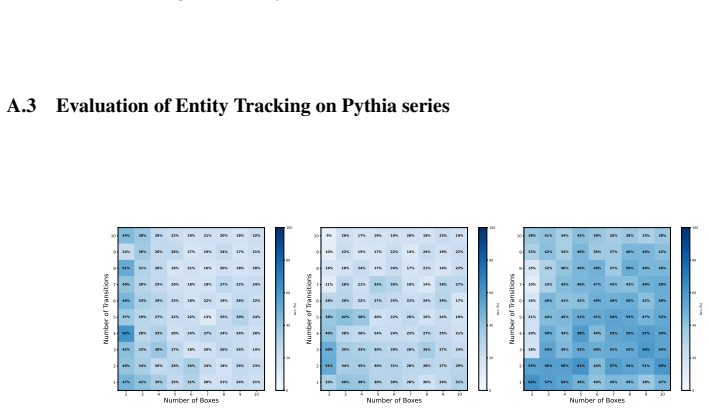
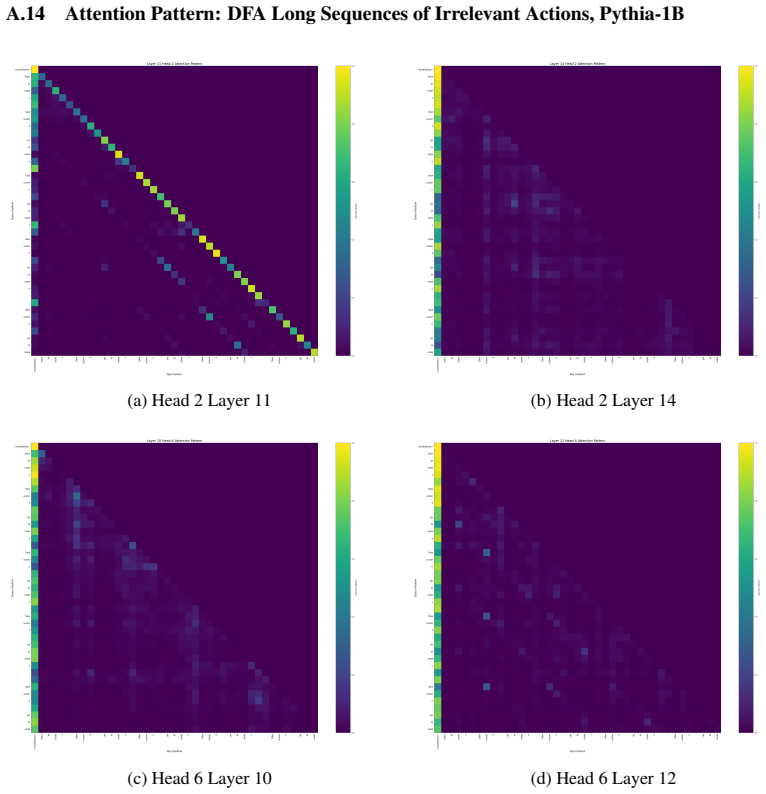
The central discovery, as the paper states it, is that LLM ability to predict the next state in a deterministic finite-state system degrades predictably with the size of the state space and the sparsity of the transition function, across model families from 8M to 1.5B parameters. In the Box Tracking task, GPT-2 XL reaches about 70% accuracy in low-complexity settings but falls below 30% when the number of boxes exceeds 5; in the Abstract DFA task, Pythia-1B cannot exceed 50% accuracy when there are more than 10 states and fewer than 30 transitions. Activation patching shows that heads such as GPT-2 XL Layer 22 Head 20 and Pythia-1B heads at Layers 10, 11, 12, and 14 propagate state features, but action information is not reliably moved to the final token, indicating weak joint state-action reasoning. The paper interprets this as evidence that state tracking emerges from the distributed interaction of induction heads and next-token heads rather than from any explicit symbolic computation.
Load-bearing premise
In the Abstract DFA task, the prompt shows only a single sampled path of transitions, so poor next-state accuracy is taken as evidence of limited state-tracking capacity rather than of the model being unable to infer an arbitrary randomly generated DFA from one trajectory.
Editorial extensions
If this is right
- Next-state prediction accuracy follows a scaling trend: larger state spaces and sparser transitions lower accuracy in every family tested, so LLM world models inherit this predictable degradation.
- Scale helps within a family, but the tested range up to 1.5B parameters does not remove the ceiling; GPT-2 XL falls below 30% once boxes or states exceed about 5 or 10.
- Mechanistically, the same heads that propagate state features fail to route action information to the final token, so joint state-action reasoning is the bottleneck, not state memory alone.
- State tracking in these models is a distributed effect of multiple next-token heads, meaning interventions that target a single head are unlikely to create reliable state updating.
- The two-phase formation-optimization account suggests that improving state tracking may require strengthening the mid-layer heads that refine induction heads, rather than adding parameters blindly.
Reading between the lines
- Editorial inference: the same degradation probably appears in larger frontier models, because the failure is in how attention routes action tokens, an architectural property that parameter scaling does not obviously fix.
- Editorial inference: an explicit scratchpad that rewrites the current state into the prompt after each transition would be a direct test of memory routing versus reasoning; if accuracy recovers, the limit is state-action routing rather than reasoning capacity.
- Editorial inference: tasks like board-game play and interactive fiction likely show a similar cliff once the number of tracked entities passes the model's effective tracking budget, which the paper's three domains bracket at roughly 5-10 states.
- Editorial inference: the identified name-mover heads are candidates for causal intervention; strengthening them via fine-tuning on state-tracking data might improve performance without changing the prompt or model size.
Editorial analysis
A structured set of objections, weighed in public.
Referee Report
Summary. The paper investigates how transformer-based LLMs track deterministic state dynamics across three domains (Box Tracking, Abstract DFA Sequences, and Complex Text Games). It reports next-state prediction accuracy as a function of the number of states and transitions for several model families (TinyStories, GPT-2, Pythia), uses activation patching to identify attention heads that propagate state information, and concludes that state tracking degrades with increasing state-space size and sparse transitions and emerges from distributed interactions of next-token heads rather than explicit symbolic computation.
Significance. If the central claim were established, the paper would be a useful empirical contribution on the limits of LLM state-tracking, with practical implications for using LLMs as world models. The strengths are the systematic sweep over multiple model families, the use of activation patching on 100 clean/corrupted pairs to localize relevant heads, and the transparent presentation of accuracy heatmaps. However, the Abstract DFA task is information-theoretically underspecified, the term 'scaling laws' is never backed by fitted quantitative relationships, and several internal inconsistencies prevent reproduction. The paper currently delivers descriptive measurements and preliminary mechanistic observations, not the stated scaling laws.
major comments (5)
- [§3.1, §4.2] The Abstract DFA prompt provides only a single observed trajectory of state-action transitions, not the full transition function delta. For a query pair (q, a) that does not appear in the trajectory, the correct next state is not determined by the prompt, since the transition function is randomly generated and unspecified. In the sparse-transition, large-state regime, accuracy therefore measures how well the model covers the observed trajectory via next-token matching, not its capacity to track state dynamics. The paper itself concedes in §4.2 that 'evidence of state tracking is most-likely limited to pattern matching (without attention across state-action history) in the DFA domain.' This confound undermines the abstract's central claim that 'next-state prediction accuracy degrades with increasing state-space size and sparse transitions' as a property of state tracking. A control condition that supplies the full transition function, or that restricts queries to state-action pairs actually present in the trajectory, is required before the degradation can be attributed to state-tracking ability.
- [Title, §4.1-§4.3] The title and abstract promise 'scaling laws,' which normally denote fitted quantitative relationships such as power-law or log-linear forms with estimated exponents. The paper reports no such fits anywhere: the results are unparameterized accuracy heatmaps over discrete grid points (Figures 1, 4-6, 11-13). There is no functional form, no fitted constants, no extrapolation, and no quantitative law. Either the authors should reframe the contribution as an empirical study of accuracy versus state-space size and transition sparsity, or they should provide actual scaling-law fits. As written, the central quantitative claim is unsupported.
- [§3.3, Appendix A.3] The model list is internally inconsistent. Section 3.3 states Pythia sizes as 14M, 70M, and 1B, but Appendix A.3's caption reports 'Pythia Model Performance (70M, 1B, 6.9B).' Additionally, §4.2 identifies 'Pythia-1B Layer 6 Head 12' as a next-token head, but this head is never introduced earlier; the preceding patching results list 'Layer 14, Head 2; Layer 12, Head 6; Layer 10, Head 6; and Layer 11, Head 2.' These discrepancies prevent a reader from reproducing the reported experiments from the text.
- [§4.1, Figures 1, 4-6] The accuracy results are presented as single percentages per heatmap cell with no sample sizes, confidence intervals, or variance measures. The patching experiments mention 100 clean/corrupted pairs, but the main accuracy sweeps do not report how many prompts were used per condition or across seeds. Without this information, the reader cannot assess whether differences between model sizes or between adjacent grid points (e.g., 54% versus 60%) are statistically meaningful or are noise.
- [§4.1.1, §4.3, Figure 10] The Box Tracking patching analysis in §4.1.1 references 'Figure 10a' and 'Figure 10b,' but Figure 10 is defined only later in §4.3 for the Fruit Store task. The correct figures for the Box Tracking patching results appear to be Figure 2a and 2b. This cross-referencing error obscures which heatmaps support the claims about residual-stream and attention-head effects in the Box Tracking domain.
minor comments (5)
- [§1] The first sentence contains a typo: 'imposesconstraints' should be 'imposes constraints'.
- [Appendix A.1] The sentence 'This evaluate's the LLMs ability' should be 'This evaluates the LLM's ability'.
- [§4.2] The model name is written inconsistently as 'GPT-XL' in several places ('GPT-XL Layer 22 Head 20') and 'GPT2-XL' elsewhere. Please standardize.
- [§3.1, Complex Text Game] The Complex Text Game example is ambiguous: with only the clue 'Sarah gives Jack the peach,' the answer 'grape, apple, pear' is a set of three possibilities, not a unique assignment. The description 'provided [1, x < n] number of clues' is also vague. The evaluation metric for this task should be defined more precisely.
- [Appendix A.11-A.14] The captions for Figures 20-23 say 'attention head patching,' but the text describes analysis of aggregated attention patterns of the identified heads. The captions should be corrected to 'attention patterns.'
Circularity Check
No significant circularity: the paper reports measurements rather than derivations; the DFA coverage confound is a validity concern, not a circular reduction.
full rationale
This is a measurement study. No parameter is fitted and then relabeled as a prediction; the headline accuracies are direct evaluations of frozen models. The related-work citations, including the authors' own prior interpretability work, are background and do not carry the argument. Activation patching is used to locate heads and then the same heads' attention patterns are described, but this is standard causal attribution and does not define the conclusion into the input. The one genuinely fragile point is the Abstract DFA task: the prompt provides only a sampled trajectory, so for a queried (state, action) pair not previously seen the correct transition is information-theoretically unavailable; the reported degradation with state count and transition sparsity is therefore partly a coverage curve of the probe, and Section 4.2 itself concedes that DFA behavior is 'most-likely limited to pattern matching.' This is an experimental confound and a threat to the generality of the abstract's DFA-based numbers, but it is not a circular derivation: the Box Tracking and Fruit Store tasks are fully specified by their prompts, and no fitted constant or self-citation forces the paper's conclusions. Accordingly the circularity score is 0.
Assumptions & free parameters
assumptions (3)
- domain assumption Next-state prediction accuracy measures state-tracking ability.
- domain assumption Activation patching with logit difference identifies the causal components for state tracking.
- domain assumption Randomly generated DFAs are a fair probe of state tracking.
Cite this review
Pith. "Pith review of Scaling Laws for State Dynamics in Large Language Models." pith.science (2026). https://pith.science/paper/EPD7KZJA
@misc{pith2026250514892,
  author       = {Pith},
  title        = {Pith review of: Scaling Laws for State Dynamics in Large Language Models},
  year         = {2026},
  howpublished = {\url{https://pith.science/paper/EPD7KZJA}},
  note         = {Machine review of arXiv:2505.14892}
}
read the original abstract
Large Language Models (LLMs) are increasingly used in tasks requiring internal state tracking, yet their ability to model state transition dynamics remains poorly understood. We evaluate how well LLMs capture deterministic state dynamics across 3 domains: Box Tracking, Abstract DFA Sequences, and Complex Text Games, each formalizable as a finite-state system. Across tasks, we find that next-state prediction accuracy degrades with increasing state-space size and sparse transitions. GPT-2 XL reaches about 70% accuracy in low-complexity settings but drops below 30% when the number of boxes or states exceeds 5 or 10, respectively. In DFA tasks, Pythia-1B fails to exceed 50% accuracy when the number of states is > 10 and transitions are < 30. Through activation patching, we identify attention heads responsible for propagating state information: GPT-2 XL Layer 22 Head 20, and Pythia-1B Heads at Layers 10, 11, 12, and 14. While these heads successfully move relevant state features, action information is not reliably routed to the final token, indicating weak joint state-action reasoning. Our results suggest that state tracking in LLMs emerges from distributed interactions of next-token heads rather than explicit symbolic computation.
Figures


Figures from the paper (20 more)




Reference graph
Works this paper leans on
-
[4]
URL http: //dx.doi.org/10.1109/SMC52423.2021.9658917
doi: 10.1109/smc52423.2021.9658917. URL http: //dx.doi.org/10.1109/SMC52423.2021.9658917. DeepSeek-AI, Daya Guo, Dejian Yang, Haowei Zhang, Junxiao Song, Ruoyu Zhang, Runxin Xu, Qihao Zhu, Shirong Ma, Peiyi Wang, Xiao Bi, Xiaokang Zhang, Xingkai Yu, Yu Wu, Z. F. Wu, Zhibin Gou, Zhihong Shao, Zhuoshu Li, Ziyi Gao, Aixin Liu, Bing Xue, Bingxuan Wang, Bochao...
arXiv 2021
-
[10]
URLhttps://arxiv.org/abs/2503.02854. Kenneth Li, Aspen K. So, Catherine Olah, and Martin Wattenberg. Emergent world representations: Exploring a sequence model trained on a synthetic task.arXiv preprint arXiv:2210.13382,
-
[11]
Odalric-Ambrym Maillard, Rémi Munos, and Daniil Ryabko
URL https://arxiv.org/abs/2304.11477. Odalric-Ambrym Maillard, Rémi Munos, and Daniil Ryabko. Selecting the state-representation in reinforcement learning,
-
[13]
URL https://arxiv. org/abs/2402.14811. Alec Radford, Jeff Wu, Rewon Child, David Luan, Dario Amodei, and Ilya Sutskever. Language models are unsupervised multitask learners
-
[14]
URL https://api.semanticscholar.org/ CorpusID:160025533. Nikolai Rozanov and Marek Rei. Stateact: State tracking and reasoning for acting and planning with large language models.arXiv preprint arXiv:2410.02810,
-
[15]
Are emergent abilities of large language models a mirage?arXiv preprint arXiv:2304.15004,
Rylan Schaeffer, Brando Miranda, and Sanmi Koyejo. Are emergent abilities of large language models a mirage?arXiv preprint arXiv:2304.15004,
-
[16]
doi: 10.1038/s41586-020-03051-4
ISSN 1476-4687. doi: 10.1038/s41586-020-03051-4. URL http://dx.doi.org/10.1038/s41586-020-03051-4. Tom Silver, Soham Dan, Kavitha Srinivas, Joshua B. Tenenbaum, Leslie Pack Kaelbling, and Michael Katz. Generalized planning in pddl domains with pretrained large language models,
-
[17]
URL https://arxiv.org/abs/2305.11014. Prateek Sun and Neel Nanda. The emergent world models of othellogpt are lin- early represented.Emergent Linear Representations in World Models of Self- Supervised Sequence Models,
Show all 23 references
-
[18]
Chen Feng Tsai, Xiaochen Zhou, Sierra S
URLhttps://arxiv.org/abs/2302.13971. Chen Feng Tsai, Xiaochen Zhou, Sierra S. Liu, Jing Li, Mo Yu, and Hongyuan Mei. Can large language models play text games well? current state-of-the-art and open questions,
-
[19]
Karthik Valmeekam, Sarath Ma, Shivam Tannady, and Subbarao Kambhampati
URL https://arxiv.org/abs/2304.02868. Karthik Valmeekam, Sarath Ma, Shivam Tannady, and Subbarao Kambhampati. On the planning abilities of large language models: A critical investigation.arXiv preprint arXiv:2305.15771,
-
[20]
Martin Wattenberg, Fernanda Viégas, and Ian Johnson
URL https://arxiv.org/abs/ 1706.03762. Martin Wattenberg, Fernanda Viégas, and Ian Johnson. The gradient published on large language model: world models or surface statistics?The Gradient,
-
[21]
pub/othello/
URL https://thegradient. pub/othello/. Jason Wei, Yi Tay, Rishi Bommasani, Colin Raffel, Barret Zoph, Sebastian Borgeaud, Dani Yogatama, Maarten Bosma, Denny Zhou, Donald Metzler, Ed H Chi, Tatsunori Hashimoto, Orhan Cubuk, Jiahui Chung, Quoc V . Le, et al. Emergent abilities ...
-
[22]
Hongyu Zhao, Xinyun Yu, Zhe Tan, and John Canny
URL https://research.google/blog/ react-synergizing-reasoning-and-acting-in-language-models/. Hongyu Zhao, Xinyun Yu, Zhe Tan, and John Canny. Explicit planning helps language models in logical reasoning.arXiv preprint arXiv:2303.15714,
-
[23]
watch” was initially in “Box A
URLhttps://arxiv.org/abs/2407.03321. A Appendix A.1 Explained Experimental Procedures A.1.1 Attribution of state-tracking Our activation patching experiment involves pairs of clean and corrupted prompts. Aclean prompt is a standard scenario generated using the DFA specified fo...
-
[2013]
Nikhil Prakash, Tamar Rott Shaham, Tal Haklay, Yonatan Belinkov, and David Bau
URLhttps://arxiv.org/abs/1302.2552. Nikhil Prakash, Tamar Rott Shaham, Tal Haklay, Yonatan Belinkov, and David Bau. Fine-tuning enhances existing mechanisms: A case study on entity tracking,
-
[2018]
URL https://zenodo.org/record/1207631
doi: 10.5281/ZENODO.1207631. URL https://zenodo.org/record/1207631. Danijar Hafner, Timothy Lillicrap, Ian Fischer, Ruben Villegas, David Ha, Honglak Lee, and James Davidson. Learning latent dynamics for planning from pixels,
-
[2019]
Danijar Hafner, Jurgis Pasukonis, Jimmy Ba, and Timothy Lillicrap
URL https://arxiv.org/ abs/1811.04551. Danijar Hafner, Jurgis Pasukonis, Jimmy Ba, and Timothy Lillicrap. Mastering diverse domains through world models,
-
[2020]
Center for Security and Emerging Technology
URL https: //arxiv.org/abs/2005.14165. Center for Security and Emerging Technology. Emergent abilities in large language models: An explainer.Georgetown University,
2005 arXiv
-
[2021]
Omid Davoodi and Majid Komeili
URLhttps://arxiv.org/abs/2106.01345. Omid Davoodi and Majid Komeili. Feature-based interpretable reinforcement learning based on state-transition models. In2021 IEEE International Conference on Systems, Man, and Cybernetics (SMC), page 301–308. IEEE, October
-
[2022]
URL https://arxiv.org/abs/2204.01691. Tom B. Brown, Benjamin Mann, Nick Ryder, Melanie Subbiah, Jared Kaplan, Prafulla Dhariwal, Arvind Neelakantan, Pranav Shyam, Girish Sastry, Amanda Askell, Sandhini Agarwal, Ariel Herbert-V oss, Gretchen Krueger, Tom Henighan, Rewon Child, ...
-
[2023]
URL https: //arxiv.org/abs/2305.02363. S. C. Kleene.Representation of Events in Nerve Nets and Finite Automata. RAND Corporation, Santa Monica, CA,
-
[2024]
Shibo Hao, Yi Zhang, Yutao Kai, Haotian Tu, Juntian Zhou, Qingwei Wang, Yufei Jin, and Xuezhi Hu
URLhttps://arxiv.org/abs/2301.04104. Shibo Hao, Yi Zhang, Yutao Kai, Haotian Tu, Juntian Zhou, Qingwei Wang, Yufei Jin, and Xuezhi Hu. Reasoning with language model is planning with world model.arXiv preprint arXiv:2305.14992,
-
[2025]
8 Zichuan Guo, Ziyang Xu, Chuanyang Liu, Enyu Qin, Xiaoyu Zhang, Tao Jiang, Chenguang Xia, Yixin Chen, and Joyce Chai
URLhttps://arxiv.org/abs/2501.12948. 8 Zichuan Guo, Ziyang Xu, Chuanyang Liu, Enyu Qin, Xiaoyu Zhang, Tao Jiang, Chenguang Xia, Yixin Chen, and Joyce Chai. Unlocking reasoning potential in large language models by scaling code-form planning.arXiv preprint arXiv:2409.12452,
Reviewed August 7, 2026 · model on record in the stance chip above.
Discussion (0). Sign in to comment.