REVIEW 4 major objections 4 minor 51 references
Learning to play the Chess Variant Crazyhouse above World Champion Level with Deep Neural Networks and Human Data
T0 review · 4 major / 4 minor · reviewed 2026-08-14 · deepseek-v4-flash
Pith's one-line read A supervised-only neural engine beat the 2017 crazyhouse world champion 4-1.
desk verdict Solid systems paper with real MCTS and representation contributions; the 'above World Champion Level' title rests on five informal games and is statistically weak, but the rest of the evidence and the released code make it worth a serious referee. read the letter →
The pith
A machine-rendered reading of the paper's core claim, the machinery that carries it, and where it could break.
The reading
What carries the argument
The load-bearing machinery is a dual-head deep convolutional network whose shared residual tower feeds a policy head over all legal-sounding moves and a value head returning a win/loss estimate in $[-1,1]$, coupled with PUCT, an upper-confidence-bound tree search guided by the learned policy prior. The input is a fully Markovian 34-plane $8\times 8$ encoding of the current position only, covering pieces, pocket contents, promoted pieces, en-passant, castling, repetition, and move counters, with each non-binary plane divided by a maximum value. The search is made sample-efficient by Q-value-aware final move selection, principal-variation Q updates, a transposition table, time-dependent search, and a prior-enhancement step that raises the probability of checking moves; these modifications are what let a low node budget compete against engines searching thousands of times more nodes.
What would settle it
Run a controlled match between CrazyAra 0.6.0 and a top human crazyhouse player at a slow time control (for example 30 minutes plus 30 seconds increment) from balanced openings and check whether the 4-1 result survives; separately, compute the value head's accuracy on positions from bullet games where the winner flagged in a materially losing position.
Extended reading notes
Core claim
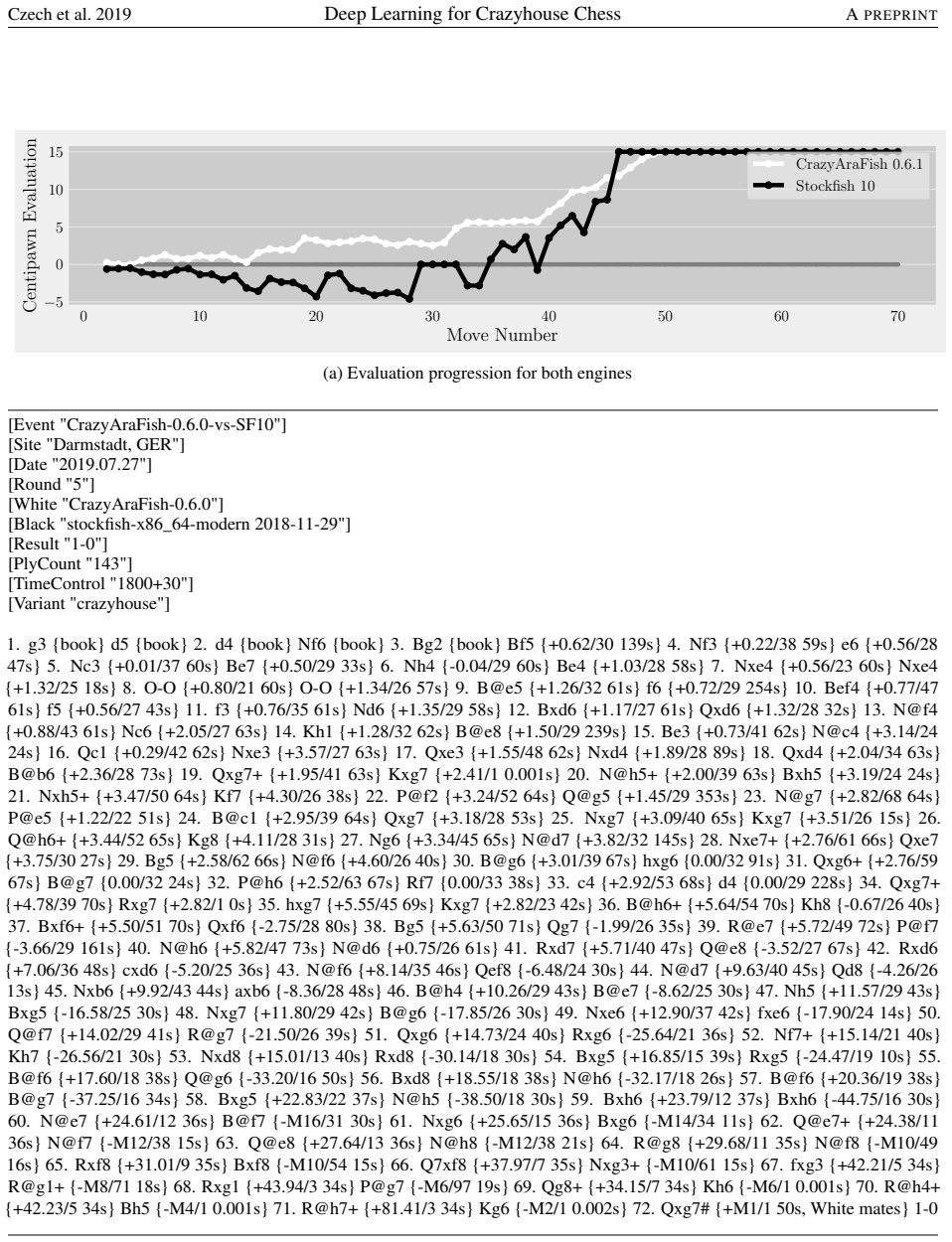
On its own terms, the paper's claim is that a single shared neural network predicting both a move policy and a position value, combined with an adapted Monte-Carlo tree search, reaches world-champion-level crazyhouse after supervised training on 569,537 human games. The network reaches 60.4% move-prediction accuracy after 1.5 days of training, and the engine's strength is demonstrated in two ways: a 4-1 informal match win over the 2017 human world champion and a 12-1 record against the field of the 2017 crazyhouse computer championship on CPU hardware. A later version, fine-tuned on engine-generated games, wins three and draws one of ten long-time-control games against a strong alpha-beta engine, which the paper presents as supporting the same underlying approach rather than as evidence that reinforcement learning is required.
Load-bearing premise
The value labels are taken from each game's final outcome and assigned to every position, on the assumption that a player with a large advantage will almost surely win; the paper states this is heavily violated because many games are low-time-control bullet games decided by blunders or time forfeits.
Editorial extensions
If this is right
- A supervised-only training pipeline can produce an elite engine in a tactic-heavy game with a higher branching factor than chess, so massive self-play computation is not the only route to top strength.
- The search modifications that add Q-values, principal-variation information, transposition reuse, and check-move priors each raise playing strength at low node counts, which suggests they are transferable improvements for other neural-guided MCTS engines.
- Beginning with human games and then continuing training on engine-generated games yields a model that takes 3.5 of 10 points from a strong alpha-beta engine at long time control, indicating the human-data model is a viable base for further refinement.
- At roughly 330 nodes per second on CPU, the engine beat most opponents despite their searching roughly 3,000 to 14,000 times more nodes, so node count alone is not a reliable proxy for playing strength in this setting.
Reading between the lines
- If the final-outcome value labels are as noisy as the paper admits, then much of CrazyAra's playing strength may come from the policy head and search priors rather than from the value head; an ablation that feeds a constant value to the search would isolate the value head's contribution.
- The 4-1 human result is informal and short-time-controlled; a slower, controlled match against the same champion from balanced openings would be the sharper test of 'above world champion level.'
- The same recipe, supervised training on human games, a compact Markovian encoding, and sample-efficient search, could be applied to other games with sparse human data and large branching factors, such as bughouse or shogi variants with drops.
Signed reviews
Editorial analysis
A structured set of objections, weighed in public.
Referee Report
Summary. The paper presents CrazyAra, a deep neural network engine for the chess variant crazyhouse, trained purely by supervised learning on 569,537 human games from lichess.org. The authors introduce a compact Markovian board representation, an input normalization scheme, a mobile-friendly residual network architecture, and several Monte-Carlo Tree Search (MCTS) modifications (Q-value-based move selection, principal-variation adjustment, transposition table, dynamic exploration parameters, and check-move boosting). They report a move-prediction accuracy of 60.4% on the validation set, a 4-1 win over 2017 crazyhouse world champion Justin Tan in an informal match, victories against twelve of thirteen participants of the 2017 CCVA Computer Championships on CPU hardware, and, after continued training on Stockfish self-play games (CrazyAraFish), three wins and one draw in ten long-time-control games against Stockfish 10. The central claim, stated in the title and abstract, is that CrazyAra plays 'above World Champion Level'.
Significance. If the strength claims are accepted, the paper would be a notable demonstration that supervised learning from modest amounts of human data, combined with a carefully engineered MCTS variant, can produce an engine competitive with strong human and computer crazyhouse players. The work is also useful for its engineering contributions: the compact input representation, the normalization study, the efficient network design, and the detailed ablation of MCTS components are clearly presented and empirically evaluated. The authors provide open-source code, data-processing scripts, and supplementary match records, which is a strength for reproducibility. The move-prediction and mate-finding metrics give concrete, falsifiable performance numbers. However, the headline 'above World Champion Level' claim rests on evidence that is not statistically robust and is partially in-distribution, so the significance of the paper as a claim about super-human play is not established by the current analysis.
major comments (4)
- [Title and Section 11.1, Table 12] The central claim that CrazyAra plays 'above World Champion Level' is supported only by a 4-1 result in five informal games against Justin Tan. Under the null hypothesis of equal strength (win probability 0.5 per game), the probability of winning four or five of five games is 6/32 = 0.1875, which is not statistically significant evidence of superiority. The match is explicitly described as 'informal games', and the opponent (LM JannLee) is one of the most active players in the training data, appearing in Figure 6 and contributing to the 46.03% of games played by the top-20 players. This means the evaluation is partly in-distribution for the network. To support the title claim, the authors need either a larger and more formal match, a statistical analysis with confidence intervals or a Bayes factor, or a revised claim that accurately reflects the evidence, e.g., 'wins an informal match against the 2017 world champion' rather than 'above World Champion Level'.
- [Section 3.1] The value labels are assigned from final game outcomes to every board position, based on the assumption that a large advantage almost surely leads to a win. The paper itself states this assumption 'is, however, heavily violated in our data set partly due to the popularity of low time control games' (Section 3.1), and Section 7 reports that 45.15% of games are one-minute bullet games. Since the value head directly guides the MCTS search, noisy value labels can systematically bias move selection. The paper does not quantify the impact of this label noise or test whether filtering or reweighting low-time-control games changes the results. Please provide an analysis of the value-label reliability (e.g., accuracy as a function of game length or time control) or discuss why the observed engine strength is not substantially affected.
- [Section 11.2, Table 13] The engine evaluation, while showing strong results against twelve of thirteen CCVA participants, does not provide a bound on human world-champion level. Most of the defeated engines have Elo ratings well below 3,000 (and several are over 1,000 Elo below Stockfish), and CrazyAra lost all ten games to Stockfish 10. The abstract and conclusion use these results in a way that suggests they corroborate the human-match claim, but they are not evidence about the human champion level. The paper should separate more carefully the claims 'wins against most CCVA participants on CPU' from 'plays above human world-champion level', and the latter should be supported by the human-match evidence, which is currently insufficient.
- [Section 11.2 and Table 14] The CrazyAraFish results against Stockfish 10 are presented as 'wins three games and draws one out of ten', but the paper does not report the statistical significance of this match either. With 3 wins, 1 draw, and 6 losses, the result is consistent with Stockfish being stronger over the match; the three wins are notable but do not demonstrate overall superiority. The discussion of these results in Section 10 should be phrased with appropriate uncertainty, and the abstract's emphasis on this result should be tempered accordingly.
minor comments (4)
- [Throughout] There are several typographical errors: 'soley' should be 'solely', 'Neterov' should be 'Nesterov', 'Consquently' should be 'Consequently', 'mis-leading' should be 'misleading', and 'crazhouse' (Section 3.1) should be 'crazyhouse'.
- [Section 7, Figure 6] The caption of Figure 6 says 'matches≥2,000 Elo', but the text says the training data consists of games with 'Elo≥2,000 for both players'. Please clarify the exact filtering criterion and ensure the caption is consistent.
- [Section 9.2.1] In Equation (5), the notation Q'(s0,a) is used for the thresholded Q-values, but the definition says 'we set all Q-values with a visit count < Qthresh * max_a(N(s0,a)) to 0'; it would be clearer to write the formula for Q'(s0,a) explicitly, including the re-scaling to [0,1].
- [Section 11.1] The text says the match was played by 'CrazyAra 0.3.1' but Table 12 lists 'CrazyAra 0.3.0'. Please correct this inconsistency.
Circularity Check
No significant circularity: the derivation chain is empirical and benchmarked externally; the small-match caveats do not reduce any prediction to its training input.
full rationale
The paper's training pipeline (Sections 3-8) fits a policy and value network to final game outcomes (Eq. 1) and validates it on held-out positions; no parameter is fitted to the quantity later advertised as a prediction. The headline strength claim is an empirical match result (Section 11.1, 4-1 against Justin Tan) and a tournament sweep on CPU (Section 11.2), both evaluated against external opponents. Justin Tan's lichess handle appears among the top-20 players in Figure 6, so the match is partly in-distribution; however, beating a player represented in the training set is not a construction-level equivalence, and the match result is never used as a training label or optimization target. Similarly, MCTS hyperparameters were tuned through self-play comparisons (Section 9.2), which is standard engineering iteration, not a claim that the search improvement follows by definition from the network. The paper explicitly flags the noisy value-label assumption (Section 3.1: 'This assumption is, however, heavily violated in our data set partly due to the popularity of low time control games'), a data-quality limitation that weakens the value signal but does not make the evaluation circular. No load-bearing self-citation chain, imported uniqueness theorem, or ansatz-by-citation carries the derivation. The five-game match is too small to establish superiority statistically, but that is an evidentiary weakness, not circularity.
Assumptions & free parameters
free parameters (12)
- alpha (value loss weight) =
0.01
- cpuct-init =
2.5
- cpuct-base =
19652
- Qfactor =
0.7
- Qthresh schedule =
init=0.5, max=0.9, base=1965
- udivisor schedule =
umin=0.25, uinit=1, ubase=1965
- checkfactor =
0.5
- max learning rate =
0.35
- weight decay =
1e-4
- input normalization maxima =
pocket=32, moves=500, no-progress=40
- network depth and width =
13-19 blocks, 256 channels; heads 8/8
- data quality filter =
Elo >= 2000
assumptions (4)
- domain assumption Game outcome labels are usable training targets for every position despite blunders and time forfeits.
- domain assumption A history-free Markovian board representation is sufficient for strong crazyhouse play.
- domain assumption Self-play Elo gains of MCTS variants transfer to strength against external engines and humans.
- standard math Standard deep learning and tree-search background results hold as used.
Cite this review
Pith. "Pith review of Learning to play the Chess Variant Crazyhouse above World Champion Level with Deep Neural Networks and Human Data." pith.science (2026). https://pith.science/paper/EPO6CWDF
@misc{pith2026190806660,
  author       = {Pith},
  title        = {Pith review of: Learning to play the Chess Variant Crazyhouse above World Champion Level with Deep Neural Networks and Human Data},
  year         = {2026},
  howpublished = {\url{https://pith.science/paper/EPO6CWDF}},
  note         = {Machine review of arXiv:1908.06660}
}
read the original abstract
Deep neural networks have been successfully applied in learning the board games Go, chess and shogi without prior knowledge by making use of reinforcement learning. Although starting from zero knowledge has been shown to yield impressive results, it is associated with high computationally costs especially for complex games. With this paper, we present CrazyAra which is a neural network based engine solely trained in supervised manner for the chess variant crazyhouse. Crazyhouse is a game with a higher branching factor than chess and there is only limited data of lower quality available compared to AlphaGo. Therefore, we focus on improving efficiency in multiple aspects while relying on low computational resources. These improvements include modifications in the neural network design and training configuration, the introduction of a data normalization step and a more sample efficient Monte-Carlo tree search which has a lower chance to blunder. After training on 569,537 human games for 1.5 days we achieve a move prediction accuracy of 60.4%. During development, versions of CrazyAra played professional human players. Most notably, CrazyAra achieved a four to one win over 2017 crazyhouse world champion Justin Tan (aka LM Jann Lee) who is more than 400 Elo higher rated compared to the average player in our training set. Furthermore, we test the playing strength of CrazyAra on CPU against all participants of the second Crazyhouse Computer Championships 2017, winning against twelve of the thirteen participants. Finally, for CrazyAraFish we continue training our model on generated engine games. In ten long-time control matches playing Stockfish 10, CrazyAraFish wins three games and draws one out of ten matches.
Figures


Figures from the paper (15 more)



Reference graph
Works this paper leans on
-
[1]
Baier, H. and Winands, M. (2016). Time management for monte carlo tree search. IEEE Transactions on Computational Intelligence and AI in Games , 8:301--314
work page 2016
-
[2]
Baier, H. and Winands, M. H. M. (2015). MCTS--Minimax hybrids. IEEE Transations on Computational Intelligence and AI in Games , 7(2):167--179
work page 2015
-
[3]
Baxter, J., Tridgell, A., and Weaver, L. (2000). Learning to play chess using temporal differences. Machine Learning , 40(3):243--263
work page 2000
-
[4]
Botev, A., Lever, G., and Barber, D. (2017). Nesterov's accelerated gradient and momentum as approximations to regularised update descent. In 2017 International Joint Conference on Neural Networks (IJCNN) , pages 1899--1903. IEEE
work page 2017
-
[5]
B., Powley, E., Whitehouse, D., Lucas, S
Browne, C. B., Powley, E., Whitehouse, D., Lucas, S. M., Cowling, P. I., Rohlfshagen, P., Tavener, S., Perez, D., Samothrakis, S., and Colton, S. (2012). A survey of monte carlo tree search methods. IEEE Transactions on Computational Intelligence and AI in Games (TCIAG '12) , 4(1):1--43
work page 2012
-
[6]
Campbell, M., Hoane, A. J., and Hsu, F.-H. (2002). Deep blue. Artificial intelligence , 134(1):57--83
work page 2002
-
[7]
Chen, T., Li, M., Li, Y., Lin, M., Wang, N., Wang, M., Xiao, T., Xu, B., Zhang, C., and Zhang, Z. (2015). Mxnet: A flexible and efficient machine learning library for heterogeneous distributed systems. arXiv preprint arXiv:1512.01274
arXiv 2015
-
[8]
Chi, G. (2018). A deep learning Crazyhouse chess program that uses a Monte Carlo Tree Search ( MCTS ) based evaluation system and reinforcement to enhance its play style.: FTdiscovery /64crazyhousedeeplearning. original-date: 2018-08-13T04:34:13Z
work page 2018
Show all 51 references
-
[9]
Dong, X., Kang, G., Zhan, K., and Yang, Y. (2017). Eraserelu: A simple way to ease the training of deep convolution neural networks. arXiv preprint arXiv:1709.07634
2017 arXiv
-
[10]
and F \"u rnkranz, J
Droste, S. and F \"u rnkranz, J. (2008). Learning the piece values for three chess variants. ICGA Journal , 31(4):209--233
2008
-
[11]
Fichter, F. (2018). SPSA Tuner for multi-variant fork of Stockfish Chess Engine : ianfab/spsa. https://github.com/ianfab/spsa . [accessed 2019-07-21]
2018
-
[12]
Free Software Foundation (2017). gnu.org. https://www.gnu.org/licenses/gpl-3.0.en.html . [accessed 2019-07-30]
2017
-
[13]
F \" u rnkranz, J. (1996). Machine learning in computer chess: The next generation. International Computer Chess Association Journal , 19(3):147--161
1996
-
[14]
F \" u rnkranz, J. (2017). Machine learning and game playing. In Sammut, C. and Webb, G. I., editors, Encyclopedia of Machine Learning and Data Mining , pages 783--788. Springer
2017
-
[15]
Gelly, S., Schoenauer, M., Sebag, M., Teytaud, O., Kocsis, L., Silver, D., and Szepesv \' a ri, C. (2012). The Grand Challenge of Computer Go: Monte Carlo Tree Search and Extensions . Communications of the ACM , 55(3):106--113
2012
-
[16]
Han, D., Kim, J., and Kim, J. (2017). Deep pyramidal residual networks. In Proceedings of the IEEE Conference on Computer Vision and Pattern Recognition , pages 5927--5935
2017
-
[17]
He, K., Zhang, X., Ren, S., and Sun, J. (2016a). Deep residual learning for image recognition. In Proceedings of the IEEE Conference on Computer Vision and Pattern Recognition , pages 770--778
2016
-
[18]
He, K., Zhang, X., Ren, S., and Sun, J. (2016b). Identity mappings in deep residual networks. In European conference on computer vision , pages 630--645. Springer
2016
-
[19]
G., Zhu, M., Chen, B., Kalenichenko, D., Wang, W., Weyand, T., Andreetto, M., and Adam, H
Howard, A. G., Zhu, M., Chen, B., Kalenichenko, D., Wang, W., Weyand, T., Andreetto, M., and Adam, H. (2017). Mobilenets: Efficient convolutional neural networks for mobile vision applications. arXiv preprint arXiv:1704.04861
2017 arXiv
-
[20]
Hu, J., Shen, L., and Sun, G. (2018). Squeeze-and-excitation networks. In Proceedings of the IEEE conference on computer vision and pattern recognition , pages 7132--7141
2018
-
[21]
Iglberger, K., Hager, G., Treibig, J., and R \"u de, U. (2012a). Expression templates revisited: a performance analysis of current methodologies. SIAM Journal on Scientific Computing , 34(2):C42--C69
2012
-
[22]
Iglberger, K., Hager, G., Treibig, J., and R \"u de, U. (2012b). High performance smart expression template math libraries. In 2012 International Conference on High Performance Computing & Simulation (HPCS) , pages 367--373. IEEE
2012
-
[23]
Julliard, A. (1994). WineHQ - Run Windows applications on Linux , BSD , Solaris and macOS . https://www.winehq.org/ . [accessed 2019-06-03]
1994
-
[24]
and Muller, G
Kahlen, S.-M. and Muller, G. H. (2004). UCI protocol. http://wbec-ridderkerk.nl/html/UCIProtocol.html. [accessed 2019-06-05]
2004
-
[25]
Kaindl, H. (1982). Quiescence search in computer chess. SIGART Newsletter , 80:124--131
1982
-
[26]
Keskar, N. S. and Socher, R. (2017). Improving generalization performance by switching from Adam to SGD . arXiv preprint arXiv:1712.07628
2017 arXiv
-
[27]
Kiiski, J. (2014). SPSA Tuner for Stockfish Chess Engine . https://github.com/zamar/spsa. accessed, 2019-06-03
2014
-
[28]
Kingma, D. P. and Ba, J. (2015). Adam: A method for stochastic optimization. In Proceedings of the 3rd International Conference on Learning Representations (ICLR)
2015
-
[29]
and Szepesv \' a ri, C
Kocsis, L. and Szepesv \' a ri, C. (2006). Bandit based monte-carlo planning. In Proceedings of the 17th European Conference on Machine Learning (ECML'06) , pages 282--293, Berlin, Heidelberg. Springer-Verlag
2006
-
[30]
Ma, N., Zhang, X., Zheng, H.-T., and Sun, J. (2018). Shufflenet v2: Practical guidelines for efficient cnn architecture design. In Proceedings of the European Conference on Computer Vision (ECCV) , pages 116--131
2018
-
[31]
Mishkin, D., Sergievskiy, N., and Matas, J. (2017). Systematic evaluation of convolution neural network advances on the Imagenet . Computer Vision and Image Understanding , 161:11--19
2017
-
[32]
Mosca, F. (2017). 2nd CCVA Computer Championships - Crazyhouse Chess Variant Association . https://sites.google.com/site/zhassociation/computers/tournaments/2nd-ccva-computer-championships . [accessed 2019-06-05]
2017
-
[33]
Ramanujan, R., Sabharwal, A., and Selman, B. (2010). On adversarial search spaces and sampling-based planning. In Brafman, R. I., Geffner, H., Hoffmann, J., and Kautz, H. A., editors, Proceedings of the 20th International Conference on Automated Planning and Scheduling ( ICAPS...
2010
-
[34]
Russakovsky, O., Deng, J., Su, H., Krause, J., Satheesh, S., Ma, S., Huang, Z., Karpathy, A., Khosla, A., Bernstein, M., et al. (2015). Imagenet large scale visual recognition challenge. International Journal of Computer Vision , 115(3):211--252
2015
-
[35]
Samuel, A. L. (1959). Some studies in machine learning using the game of checkers. IBM Journal on Research and Development , 3:210--229
1959
-
[36]
Sandler, M., Howard, A., Zhu, M., Zhmoginov, A., and Chen, L.-C. (2018). Mobilenetv2: Inverted residuals and linear bottlenecks. In Proceedings of the IEEE Conference on Computer Vision and Pattern Recognition (CVPR) , pages 4510--4520
2018
-
[37]
J., Guez, A., Sifre, L., Van Den Driessche, G., Schrittwieser, J., Antonoglou, I., Panneershelvam, V., Lanctot, M., et al
Silver, D., Huang, A., Maddison, C. J., Guez, A., Sifre, L., Van Den Driessche, G., Schrittwieser, J., Antonoglou, I., Panneershelvam, V., Lanctot, M., et al. (2016). Mastering the game of Go with deep neural networks and tree search. Nature , 529(7587):484--489
2016
-
[38]
Silver, D., Hubert, T., Schrittwieser, J., Antonoglou, I., Lai, M., Guez, A., Lanctot, M., Sifre, L., Kumaran, D., Graepel, T., et al. (2017a). Mastering chess and shogi by self-play with a general reinforcement learning algorithm. arXiv preprint arXiv:1712.01815
2017 arXiv
-
[39]
Silver, D., Hubert, T., Schrittwieser, J., Antonoglou, I., Lai, M., Guez, A., Lanctot, M., Sifre, L., Kumaran, D., Graepel, T., et al. (2018). A general reinforcement learning algorithm that masters chess, shogi, and go through self-play. Science , 362(6419):1140--1144
2018
-
[40]
Silver, D., Schrittwieser, J., Simonyan, K., Antonoglou, I., Huang, A., Guez, A., Hubert, T., Baker, L., Lai, M., Bolton, A., Chen, Y., Lillicrap, T., Hui, F., Sifre, L., van den Driessche, G., Graepel, T., and Hassabis, D. (2017b). Mastering the game of Go without human knowl...
2017
-
[41]
Skiena, S. S. (1986). An overview of machine learning in computer chess. International Computer Chess Association Journal , 9(1):20--28
1986
-
[42]
Smith, L. N. (2018). A disciplined approach to neural network hyper-parameters: Part 1--learning rate, batch size, momentum, and weight decay. arXiv preprint arXiv:1803.09820
2018 arXiv
-
[43]
Smith, L. N. and Topin, N. (2019). Super-convergence: Very fast training of neural networks using large learning rates. In Artificial Intelligence and Machine Learning for Multi-Domain Operations Applications , volume 11006, page 1100612. International Society for Optics and Photonics
2019
-
[44]
Szegedy, C., Ioffe, S., Vanhoucke, V., and Alemi, A. A. (2017). Inception-v4, inception-resnet and the impact of residual connections on learning. In Proceedings of the 31st AAAI Conference on Artificial Intelligence
2017
-
[45]
Szegedy, C., Vanhoucke, V., Ioffe, S., Shlens, J., and Wojna, Z. (2016). Rethinking the inception architecture for computer vision. In Proceedings of the IEEE Conference on Computer Vision and Pattern Recognition (CVPR) , pages 2818--2826
2016
-
[46]
Tesauro, G. (1995). Temporal D ifference L earning and TD -gammon. Communications of the ACM , 38(3):58--68
1995
-
[47]
and S olak, R
Vu c kovi \'c , V. and S olak, R. (2009). Time management procedure in computer chess. Facta Universitatis Series: Automatic Control and Robotics , 8(1):75--87
2009
-
[48]
Wang, E., Zhang, Q., Shen, B., Zhang, G., Lu, X., Wu, Q., and Wang, Y. (2014). Intel math kernel library. In High-Performance Computing on the Intel Xeon Phi™ , pages 167--188. Springer
2014
-
[49]
Xie, S., Girshick, R., Doll \'a r, P., Tu, Z., and He, K. (2017). Aggregated residual transformations for deep neural networks. In Proceedings of the IEEE Conference on Computer Vision and Pattern Recognition , pages 1492--1500
2017
-
[50]
and Komodakis, N
Zagoruyko, S. and Komodakis, N. (2016). Wide residual networks. In Proceedings of the British Machine Vision Conference (BMVC)
2016
-
[51]
Zhao, G., Zhang, Z., Guan, H., Tang, P., and Wang, J. (2017). Rethink ReLU to Training Better CNNs . arXiv:1709.06247 [cs]
2017 arXiv
Reviewed August 14, 2026 · model on record in the stance chip above.
Discussion (0). Continue with ORCID to comment.