REVIEW 3 major objections 5 minor 24 references
Brand-as-Memory: Vision-Language Models Encode Causal, Mechanistically Localizable Credibility Priors for News Sources
T0 review · 3 major / 5 minor · reviewed 2026-07-12 · grok-4.5
Pith's one-line read Vision-language models judge news credibility from the brand masthead more than from the article evidence, and that prior can be localized and steered.
desk verdict Solid mechanistic + diagnostic paper on visual source deference in VLMs; the new pieces hold under their own controls, with external validity as the main soft spot. read the letter →
The pith
A machine-rendered reading of the paper's core claim, the machinery that carries it, and where it could break.
The reading
What carries the argument
The Source-Override Index (SOI = |β_cue| / |β_content|) from a standardized cue-by-content regression, together with matched-layout residual patching and signed sparse-autoencoder feature steering at the L19–21 locus, which jointly show that the prior is causally used rather than merely decodable.
What would settle it
If matched-layout activation patching at layers 19–21 no longer transferred the brand effect, or if steering the same direction failed to reduce override on held-out outlets and real first-fold screenshots while leaving content sensitivity intact, the causal brand-as-memory claim would fail.
Extended reading notes
Core claim
VLMs encode a causal, outlet-identity-specific credibility prior (brand-as-memory) that is dual-coded in name and logo, formed at layers 19–21, overrides article content by roughly 1.8 times as a shared-pathway signal-magnitude effect, and can be selectively reduced by steering the localized direction, which generalizes to held-out outlets.
Load-bearing premise
That an eight-outlet, English-first suite of mostly synthetic screenshots, validated against one professional rating scale, is representative enough for the measured prior, layer locus, and override rankings to transfer to real multi-domain news imagery.
Editorial analysis
A structured set of objections, weighed in public.
Referee Report
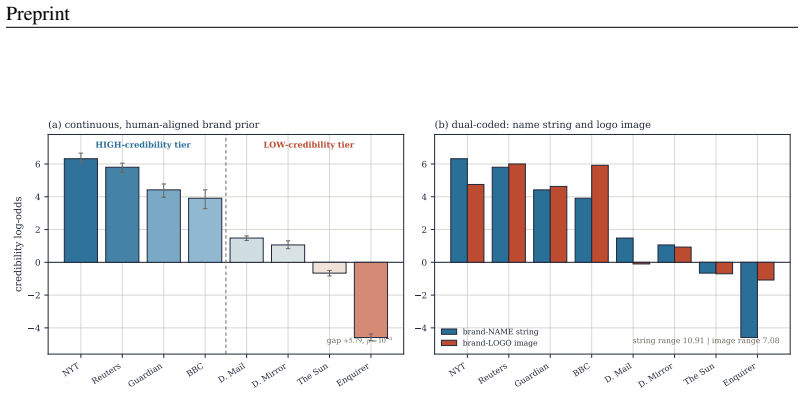
Summary. The paper argues that VLMs encode a strong, outlet-identity-specific credibility prior that can override article content when news is presented as images. It contributes (i) CueTrust, a cross-model Source-Override Index (SOI) over seven VLMs and five cues, showing that brand name, logo, and domain override content while author, in-text authority, and layout do not; and (ii) a mechanistic account for the brand cue on primarily Qwen2.5-VL-7B: masthead swaps span ~11 log-odds that track MBFC ratings (ρ=0.88), the prior is dual-coded (name and logo), strengthens with scale, is causally formed at layers 19–21 (same relative depth in InternVL3-8B), carried by seed-stable SAE features, and overrides content ~1.8× as a shared-pathway signal-magnitude effect. Steering the localized direction reduces the override by 41% and transfers to held-out outlets. The authors release the IP-clean stimulus suite and CueTrust.
Significance. If the claims hold, the work is a clear advance over concurrent text-only source-preference studies: it demonstrates a visual (logo-image) channel, supplies localization, sparse features, a cross-family locus, and a pathway-level explanation of the override, and packages a reusable diagnostic (CueTrust) with factorial controls and negative controls. Strengths include factorial stimuli with frozen hashes, bootstrap CIs (n=5000) and permutation tests, Hewitt–Liang control-task probes, matched-layout activation patching, 5-seed SAE stability with signed steering, the cite-probe dissociation (model can read content but defers on credibility), equal brand/content patching efficiency, held-out outlet transfer, and partial ecological checks (cross-lingual, real first-fold screenshots). These make the central claim falsifiable and actionable for reliability work on VLMs in news/moderation pipelines.
major comments (3)
- §4 and Appendix J: the human-alignment claim rests on Spearman ρ=0.88 (p=0.004) against MBFC factual-reporting scores for only eight brands; the bootstrap CI is [0.26, 1.00]. The paper correctly flags the Daily Mail residual and treats MBFC as one professional standard, but the n=8 correlation is load-bearing for the continuous, externally validated prior. A larger held-out brand set (beyond the seven used only for steering transfer) with pre-registered MBFC mapping, or an alternative rating source, is needed before the ρ is treated as robust external validation rather than a suggestive alignment check.
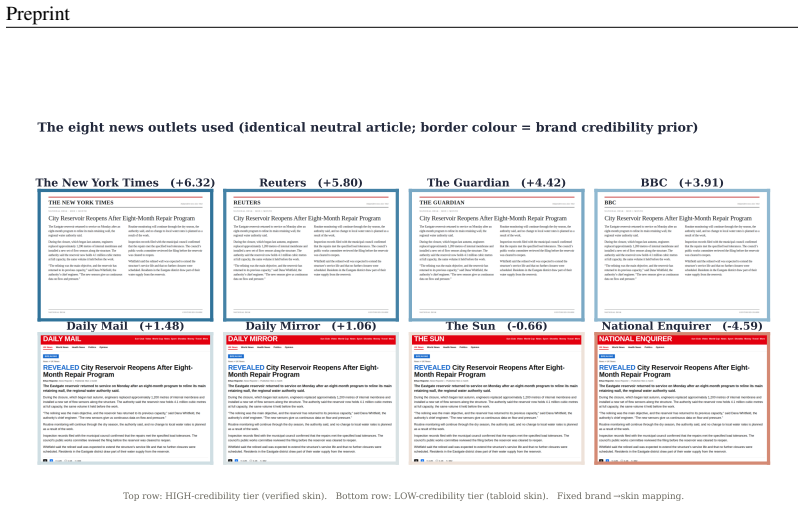
- §3, §6 Limitations, and Appendix A: the main stimulus suite is synthetic, single-domain, English-first, with a fixed brand→skin mapping (high brands on verified skin, low on tabloid). Real-screenshot validation covers 7/8 brands on one model (range 9.25, ρ=0.96) and cross-lingual keeps brand names as proper nouns. These mitigate but do not fully close the external-validity gap for the claim that deployed VLMs reading multi-domain news imagery will exhibit the same SOI rankings and L19–21 locus. Expanding Layer B (real screenshots) and/or multi-domain content while holding the factorial design would strengthen the deployment implication without changing the internal mechanism claims.
- §4 (override mechanism) and Appendix G: brand and content axes transfer with equal efficiency at L19–21 (0.76 vs 0.75; difference CI [−0.03, +0.05]), supporting a shared-pathway signal-magnitude account. SAE localization of the override was inconclusive because credibility is distributed across L20 features. The shared-pathway claim is therefore carried almost entirely by the two matched patching contrasts. A brief transcoder or multi-layer attribution check (even if negative), or an explicit statement that the claim is limited to residual-stream transfer equality, would make the pathway-level conclusion more precise.
minor comments (5)
- Figure 1 and Table 2: SOI values in the overview heatmap and the full CueTrust table should be cross-checked for rounding consistency (e.g., Qwen-7B brand 1.79 vs domain 1.49).
- Eq. (1) and §6: magnitude of the Yes–No log-odds is prompt-dependent while sign and ordering are stable; a short note in the main text (not only Appendix H) that all cross-model comparisons use within-model ratios/ranges would help readers.
- Appendix F / Figure 5: feature indices vary by seed while the high→positive / low→negative organization is stable; stating the selection rule (max |corr| to cred, then signed steering) once in the main text would improve reproducibility of the SAE claim.
- Reproducibility statement: MBFC accessed June 2026 should be pinned to a dated snapshot or archive URL before camera-ready, as the authors already note.
- Typographical: occasional missing spaces in compound terms (e.g., 'source-credibility prior', 'brand-as-memory') and a few figure-panel labels that wrap awkwardly in the preprint layout.
Circularity Check
No significant circularity: empirical measurements, external MBFC validation, and causal interventions (patching/steering) are independent of definitional inputs.
full rationale
The paper is an empirical/mechanistic study of VLM behavior, not a first-principles derivation. Credibility is operationalized as a logit contrast (Eq. 1) on controlled synthetic screenshots; the brand prior is measured by swapping mastheads and validated post-hoc against independent MBFC ratings (ρ=0.88), not defined by them. SOI (Eq. 4) is a within-model ratio of OLS coefficients from 2×2 cue×content designs with content held fixed; it summarizes observed override strength rather than predicting a quantity forced by a fit. Causal claims rest on activation-patching transfer (Eq. 2, onset at L19–21, equal brand/content efficiency) and signed SAE-feature steering that reduces override 41% and transfers to held-out outlets—interventions that can fail and are not tautological. Negative controls (author/authority/format SOI≪1) and cross-family/cross-lingual/real-screenshot robustness further bound the phenomenon without self-referential reduction. No self-citations carry uniqueness theorems or ansätze; references are to external literature. The derivation chain is therefore self-contained experimental measurement plus causal probe, with no step reducing by construction to its inputs.
Assumptions & free parameters
free parameters (4)
- SAE expansion and top-k (×8, k=32) at L20
- Steering strength α (swept; e.g. neutralization at α=96)
- Eight-outlet brand set and fixed brand→skin mapping
- Credibility prompt / Yes–No token contrast
assumptions (5)
- domain assumption Last-token Yes vs No log-odds is a valid scalar for source credibility judgments in VLMs.
- domain assumption Media Bias/Fact Check factual-reporting scores are a useful external professional standard for alignment (not ground truth about outlets).
- domain assumption Linear residual-stream directions and top-k SAE features can carry causally relevant concept directions (linear representation / sparse feature assumptions).
- domain assumption Matched-layout activation patching isolates the masthead (or content) causal contribution at a layer.
- ad hoc to paper Well-sourced vs red-flag variants differ only in epistemic markers while holding facts and named source fixed (length-matched within 8%).
invented entities (2)
-
Brand-as-memory prior
-
Source-Override Index (SOI) / CueTrust
Cite this review
Pith. "Pith review of Brand-as-Memory: Vision-Language Models Encode Causal, Mechanistically Localizable Credibility Priors for News Sources." pith.science (2026). https://pith.science/paper/EPPQCY3A
@misc{pith2026260703365,
  author       = {Pith},
  title        = {Pith review of: Brand-as-Memory: Vision-Language Models Encode Causal, Mechanistically Localizable Credibility Priors for News Sources},
  year         = {2026},
  howpublished = {\url{https://pith.science/paper/EPPQCY3A}},
  note         = {Machine review of arXiv:2607.03365}
}
read the original abstract
Vision-language models (VLMs) increasingly read news and web content as images, where the publisher's identity is visually present. We show that VLMs carry a strong source-credibility prior keyed on outlet identity, and study it along three axes. (i) Cross-model benchmark. We introduce CueTrust, a cross-model diagnostic that measures which surface source cue overrides an article's content evidence via a Source-Override Index (SOI). Across seven VLMs and five cues, the vulnerability profile is model- and scale-dependent, and the override is outlet-identity-specific and encoding-invariant, firing from the masthead name, the logo image, or the bare domain, but not from a named author, in-text authority, or page layout (clean negative controls). (ii) Mechanistic account. For the brand cue, we give a full mechanistic account: swapping only the masthead moves credibility across an approximately 11 log-odds range that tracks professional ratings (rho = 0.88 with Media Bias/Fact Check). The prior is dual-coded (name and logo), strengthens with scale, is causally formed at layers 19-21, carried by interpretable seed-stable sparse-autoencoder features, and recurs at the same relative locus in a second model family. It overrides content (about 1.8x) as a signal-magnitude effect within a shared pathway, not a privileged route. Steering the localized direction selectively reduces the override (41% reduction) and generalizes to held-out outlets, confirming the prior is causally used, not merely decodable. Deployed VLMs may thus defer to source identity over the evidence in front of them, a reliability failure we can measure across models, localize, and causally probe. We release the stimulus suite and CueTrust.
Figures


Figures from the paper (14 more)




Reference graph
Works this paper leans on
-
[1]
Na Min An, Yoonna Jang, Yusuke Hirota, Ryo Hachiuma, Isabelle Augenstein, and Hyunjung Shim. Interpretable debiasing of vision-language models for social fairness.arXiv preprint arXiv:2602.24014,
-
[2]
SAEs are good for steering – if you select the right features.arXiv preprint arXiv:2505.20063,
Dana Arad, Aaron Mueller, and Yonatan Belinkov. SAEs are good for steering – if you select the right features.arXiv preprint arXiv:2505.20063,
-
[3]
Qwen2.5-VL technical report.arXiv preprint arXiv:2502.13923,
Shuai Bai, Keqin Chen, Xuejing Liu, et al. Qwen2.5-VL technical report.arXiv preprint arXiv:2502.13923,
-
[4]
Eliciting latent predictions from transformers with the tuned lens.arXiv preprint arXiv:2303.08112,
Nora Belrose, Zach Furman, Logan Smith, Danny Halawi, Igor Ostrovsky, Lev McKinney, Stella Biderman, and Jacob Steinhardt. Eliciting latent predictions from transformers with the tuned lens.arXiv preprint arXiv:2303.08112,
-
[5]
10 Preprint Hoagy Cunningham, Aidan Ewart, Logan Riggs, Robert Huben, and Lee Sharkey. Sparse autoen- coders find highly interpretable features in language models.arXiv preprint arXiv:2309.08600,
-
[6]
Ensembling sparse autoencoders.arXiv preprint arXiv:2505.16077,
Soniya Gadgil et al. Ensembling sparse autoencoders.arXiv preprint arXiv:2505.16077,
-
[7]
Scaling and evaluating sparse autoencoders.arXiv preprint arXiv:2406.04093,
Leo Gao, Tom Dupr ´e la Tour, Henk Tillman, Gabriel Goh, Rajan Troll, Alec Radford, Ilya Sutskever, Jan Leike, and Jeffrey Wu. Scaling and evaluating sparse autoencoders.arXiv preprint arXiv:2406.04093,
-
[8]
Designing and interpreting probes with control tasks
John Hewitt and Percy Liang. Designing and interpreting probes with control tasks. InProceedings of the 2019 Conference on Empirical Methods in Natural Language Processing (EMNLP),
2019
Show all 24 references
-
[9]
Bo Li, Yuanhan Zhang, Dong Guo, Renrui Zhang, Feng Li, et al
URLhttps://openreview.net/forum?id= yTUNl6jYGU. Bo Li, Yuanhan Zhang, Dong Guo, Renrui Zhang, Feng Li, et al. LLaV A-onevision: Easy visual task transfer.arXiv preprint arXiv:2408.03326,
-
[10]
Gemma scope: Open sparse autoencoders everywhere all at once on gemma 2.arXiv preprint arXiv:2408.05147,
Tom Lieberum, Senthooran Rajamanoharan, Arthur Conmy, Lewis Smith, Nicolas Sonnerat, Vikrant Varma, J´anos Kram´ar, Anca Dragan, Rohin Shah, and Neel Nanda. Gemma scope: Open sparse autoencoders everywhere all at once on gemma 2.arXiv preprint arXiv:2408.05147,
-
[11]
SmolVLM: Redefining small and efficient multi- modal models.arXiv preprint arXiv:2504.05299,
Andr´es Marafioti, Orr Zohar, Miquel Farr´e, et al. SmolVLM: Redefining small and efficient multi- modal models.arXiv preprint arXiv:2504.05299,
-
[12]
Same task, different circuits: Disentangling modality-specific mechanisms in VLMs.arXiv preprint arXiv:2506.09047,
Yaniv Nikankin, Dana Arad, Yossi Gandelsman, and Yonatan Belinkov. Same task, different circuits: Disentangling modality-specific mechanisms in VLMs.arXiv preprint arXiv:2506.09047,
-
[13]
When seeing overrides knowing: Disentangling knowledge conflicts in vision-language models.arXiv preprint arXiv:2507.13868,
Francesco Ortu, Zhijing Jin, Diego Doimo, and Alberto Cazzaniga. When seeing overrides knowing: Disentangling knowledge conflicts in vision-language models.arXiv preprint arXiv:2507.13868,
-
[14]
Sparse autoencoders trained on the same data learn different features.arXiv preprint arXiv:2501.16615,
Gonc ¸alo Paulo and Nora Belrose. Sparse autoencoders trained on the same data learn different features.arXiv preprint arXiv:2501.16615,
-
[15]
Maria del Rio-Chanona
Alice Plebe, Timothy Douglas, Diana Riazi, and R. Maria del Rio-Chanona. Images amplify misin- formation sharing in vision-language models.arXiv preprint arXiv:2505.13302,
-
[16]
Open problems in mechanistic interpretability.arXiv preprint arXiv:2501.16496,
Lee Sharkey, Bilal Chughtai, Joshua Batson, Jack Lindsey, et al. Open problems in mechanistic interpretability.arXiv preprint arXiv:2501.16496,
-
[17]
Sparse autoencoders for scientifi- cally rigorous interpretation of vision models.arXiv preprint arXiv:2502.06755,
Samuel Stevens, Wei-Lun Chao, Tanya Berger-Wolf, and Yu Su. Sparse autoencoders for scientifi- cally rigorous interpretation of vision models.arXiv preprint arXiv:2502.06755,
-
[18]
Does higher interpretability imply better utility? a pairwise analysis on sparse autoencoders.arXiv preprint arXiv:2510.03659,
Xu Wang, Yan Hu, Benyou Wang, and Difan Zou. Does higher interpretability imply better utility? a pairwise analysis on sparse autoencoders.arXiv preprint arXiv:2510.03659,
-
[19]
Circuit tracing in vision-language models: Understanding the internal mechanisms of multimodal thinking.arXiv preprint arXiv:2602.20330,
Jingcheng Yang, Tianhu Xiong, Shengyi Qian, Klara Nahrstedt, and Mingyuan Wu. Circuit tracing in vision-language models: Understanding the internal mechanisms of multimodal thinking.arXiv preprint arXiv:2602.20330,
-
[20]
Internvl3: Exploring advanced training and test-time recipes for open-source multimodal models.arXiv preprint arXiv:2504.10479,
Jinguo Zhu, Weiyun Wang, Zhe Chen, et al. Internvl3: Exploring advanced training and test-time recipes for open-source multimodal models.arXiv preprint arXiv:2504.10479,
-
[21]
C LOGOABLATION: CHANNELISOLATION Table 5: Cred log-odds by skin×logo level (left), and the two-channel decomposition for the exemplar brands (right)
verified social tabloid 0.2 0.0 0.2 0.4 0.6 0.8 1.0 cred log-odds (a) skin manipulation check high-end (verified) low-end (tabloid/social) 0.0 0.2 0.4 0.6 0.8 1.0follow-visual rate asymmetry 0.83 (b) visual overrides conflicting text label Authoritative visual form overrides a...
2019
-
[22]
the reverse orienta- tion)
factual-reporting scores (lower = more fac- tual on MBFC’s scale; we correlate the model prior against credibility, i.e. the reverse orienta- tion). The model’s brand prior correlates with MBFC at Spearmanρ=0.88(p=0.004), Pearson r=0.89(p=0.003), andρ=0.82against the coarser M...
2025
-
[23]
Scaling set: SmolVLM-2B (Marafioti et al., 2025), InternVL3-2B/8B/14B (Zhu et al., 2025), Qwen2.5-VL- 3B/7B, LLaV A-OV-7B (Li et al., 2024)
(4-bit) on a single 24 GB GPU. Scaling set: SmolVLM-2B (Marafioti et al., 2025), InternVL3-2B/8B/14B (Zhu et al., 2025), Qwen2.5-VL- 3B/7B, LLaV A-OV-7B (Li et al., 2024). Cross-family mechanism: InternVL3-8B (28 layers). Gemma-3-4B was excluded from scaling: it requires bf16 ...
2025
-
[24]
Yes”|x)−z M(“ No
(accessed June 2026). Brand MBFC factual (lower=better) MBFC tier model cred Reuters0.0(Very High) HIGH+5.80 The New York Times1.4(High) HIGH+6.32 The Guardian1.8(High) HIGH+4.42 BBC2.1(High) HIGH+3.91 The Sun5.0(Mixed/Low) LOW−0.66 Daily Mirror6.0(Low) LOW+1.06 Daily Mail7.1(...
2026
Reviewed July 12, 2026 · model on record in the stance chip above.
Discussion (0). Sign in to comment.