VLM-CASE: Vision-Language Model Enabled Context-Adaptive Safety Envelopes for Anticipatory Safe Autonomous Driving
Reviewed by Pith2026-07-08 00:48 UTCglm-5.2pith:EPRSMREBopen to challenge →
The pith
VLM sets the safety envelope, not just the driving plan
A machine-rendered reading of the paper's core claim, the machinery that carries it, and where it could break.
Core claim
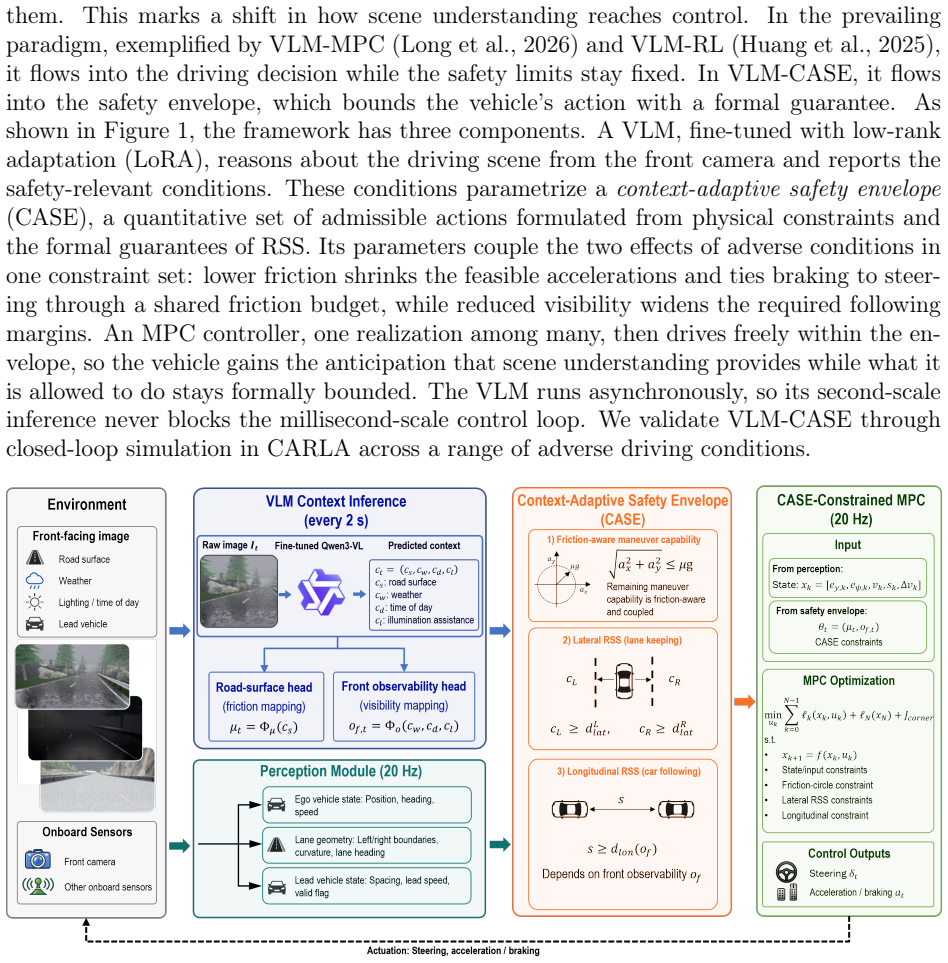
The central discovery is that routing VLM-derived scene understanding into the vehicle's formal safety envelope parameters — rather than into driving decisions alone — preserves the formal safety guarantee while enabling anticipatory adaptation. The context-adaptive safety envelope (CASE) is the object that carries this: it takes friction μ and observability o_f from the VLM's scene classification and uses them to set three coupled constraint sets (friction circle, visibility-aware following distance, lane-keeping drift bound) that bound all admissible actions. The shared friction budget is the mechanism that captures how adverse conditions couple braking and steering — lateral demand in a曲线
What carries the argument
Context-Adaptive Safety Envelope (CASE): an intersection of three constraint sets — U_fric (friction circle coupling braking and steering), U_lon (RSS-derived following distance with visibility margin), and U_lat (lane-keeping drift bound) — parametrized by θ = [μ, o_f] from the VLM. The VLM runs asynchronously (2 s update) while MPC runs at 20 Hz, so semantic inference never blocks real-time control.
Load-bearing premise
The formal safety guarantee depends on the VLM correctly classifying road surface and visibility conditions, because the envelope's friction coefficient and following-distance margins are set from a discrete lookup table keyed on the VLM's output. If the VLM reports 'dry' on a snow-covered road, the envelope assumes more grip than exists and the guarantee silently fails. The 98.3% accuracy was measured on CARLA test images; real-world distribution shift would likely lower it,
What would settle it
A single VLM misclassification at the wrong moment — e.g., reporting dry (μ=0.8) on snow (actual μ=0.2) — would set the RSS stopping distance too short and void the formal guarantee without any detectable alarm.
Figures




read the original abstract
Adverse driving conditions, such as bad weather, remain a principal barrier to autonomous driving because they degrade two things at once: what the vehicle can perceive and what it can physically do. Human drivers cope by anticipation, reasoning about the scene and re-budgeting speed, following distance, and steering before grip or sight is lost, whereas current autonomous driving systems at best react after the fact. This paper proposes VLM-CASE, a framework that gives an autonomous vehicle this anticipatory capacity while keeping its motion bounded by a formal safety model at all times. A vision-language model (VLM), fine-tuned with low-rank adaptation (LoRA), reasons about the scene from the front-camera image and reports the road surface and visibility conditions. This output parametrizes a context-adaptive safety envelope (CASE), derived from physical limits and the guarantees of responsibility-sensitive safety, that couples braking and steering through a shared friction budget. A model predictive controller then drives freely within the envelope, while the VLM runs asynchronously so it never blocks the real-time control loop. We validate the framework in closed-loop CARLA simulation on tasks that demand both lateral and longitudinal control, across a range of weather, road-surface, and lighting conditions. The resulting controller, VLM-CASE-MPC, completes all trials, outperforming a conventional MPC baseline and a state-of-the-art VLM-integrated controller. Ablations confirm that the gains come from context adaptation, with the friction and visibility adaptations proving complementary. Furthermore, the framework is controller-agnostic and pairs with almost any low-level controller, offering a promising direction for safe autonomous driving. The dataset and supplementary materials for VLM-CASE are available at https://github.com/ytj254/VLM-CASE.
Editorial analysis
A structured set of objections, weighed in public.
Referee Report
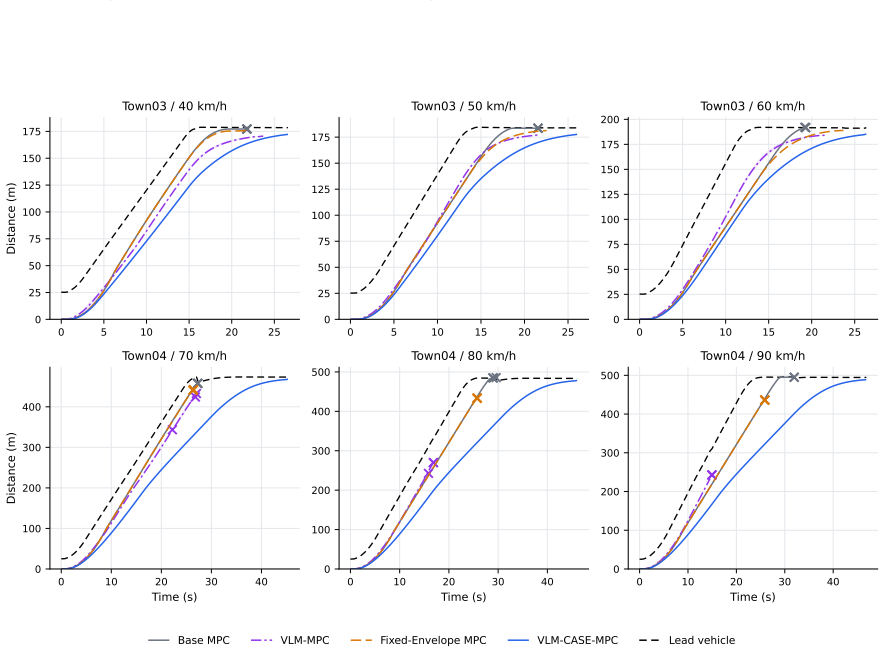
Summary. The paper proposes VLM-CASE, a framework in which a vision-language model (VLM) fine-tuned with LoRA classifies road surface and visibility conditions from a front-camera image, and these classifications are mapped to physical parameters (friction coefficient μ, forward observability o_f) that parametrize a context-adaptive safety envelope derived from RSS principles. The envelope couples longitudinal and lateral safety through a shared friction budget (Eq. 10) and widens following distance under degraded visibility (Eq. 13). An MPC controller then operates within this envelope at 20 Hz while the VLM runs asynchronously every 2 seconds. The system is evaluated in CARLA simulation across 198 runs spanning three experiment groups (no-lead, constant-lead, lead-braking) with ablations isolating friction and visibility adaptations. VLM-CASE-MPC achieves 100% success across all runs, compared to 52% for Base MPC, 76% for VLM-MPC, and 82% for Fixed-Envelope MPC.
Significance. The paper's core architectural idea — routing VLM-derived scene understanding into the formal safety envelope rather than only into the planning objective — is a genuine and well-motivated contribution. The RSS-derived envelope with friction-circle coupling (Eq. 10–11) is physically grounded, and the re-derivation of lateral RSS against lane boundaries (Eq. 15–17) with braking-dependent lateral drift is a non-trivial extension. The asynchronous architecture cleanly separates second-scale semantic inference from millisecond-scale control. The experimental design is thorough: 198 runs, three experiment groups isolating friction and visibility, ablations (Table 5), and multiple baselines including a reproduction of VLM-MPC (Long et al., 2026). The 100% success rate against 50–82% baselines on adverse conditions, with the ablation confirming complementarity of the two adaptations, is a compelling empirical result. The code and dataset are publicly available, which supports reproducibility.
major comments (1)
- The central claim is that the framework 'preserves a formal safety guarantee' (§1, §3.1, §6). However, the guarantee chain is conditional on the VLM correctly classifying the road surface: the RSS-derived envelope uses b(μ) = min{μg, b_max} (Eq. 12) and the friction circle (Eq. 10), both of which assume the VLM-reported μ upper-bounds the actual friction. If the VLM misclassifies snow as dry (μ=0.8 instead of 0.2), the envelope assumes 4× the available grip, the RSS stopping distance is too short, and the friction circle permits accelerations the surface cannot support. The paper's own Fixed-Envelope MPC baseline demonstrates this: on snow (C3, Table 2), it achieves only 50% success with lane departures and minimum boundary clearance of 0.08 m — exactly the failure mode that would result from a surface misclassification. The paper does not analyze the safety implications of VLM misclassi
minor comments (8)
- §3.3.2, Eq. (13): The observability margin Δ_lon uses parameters d_0, τ, and α, but their values are not reported in the main text or tables. Please include the calibrated values.
- §3.3.3, Eq. (15): The lateral drift formula uses a_resp_y = sqrt((μg)² - a_x²), which couples lateral and longitudinal through the friction budget. This is a key design choice. Please clarify whether a_x is the commanded or achieved acceleration, and how feasibility is ensured when braking demand leaves no residual lateral authority.
- Table 2: The note states lateral metrics are omitted for VLM-MPC because it has no lateral control. However, VLM-MPC is supplemented with a basic waypoint-following lateral controller (§4.2). Please report lateral metrics for VLM-MPC or clarify why the supplemented controller does not perform lane keeping.
- Table 3, N3 snow row: The mean lateral error for VLM-CASE-MPC is 0.20 m, substantially higher than the 0.02–0.03 m on dry/wet. The paper attributes this to the full-route scoring effect, but the boundary clearance (0.18 m) is also much lower than on dry/wet (0.65–0.72 m). Please discuss whether this represents a genuine degradation in tracking quality on snow or a deliberate speed-position tradeoff.
- §4.3: The fine-tuning dataset (10,560 frames) is collected in CARLA and evaluated on CARLA test images. The 98.3% accuracy (Table 1) thus reflects in-distribution performance. Please note this limitation explicitly near the accuracy claim.
- §3.4.2, Eq. (20): The cornering penalty uses parameters w_c and η, but their values are not reported. Please include them.
- Figure 4: The condition labels are small and difficult to read. Consider enlarging or providing a higher-resolution version.
- The paper uses 'Qwen3-VL' as the backbone model (§4.3). At the time of this manuscript, the publicly known model is Qwen2-VL. Please verify the model name and version.
Simulated Author's Rebuttal
We thank the referee for the careful reading and for identifying the most important conceptual gap in the paper. The referee is correct that the safety guarantee is conditional on the VLM's classification being correct, and that the paper does not adequately analyze the consequences of misclassification. We agree this must be addressed.
read point-by-point responses
-
Referee: The central claim is that the framework 'preserves a formal safety guarantee' (§1, §3.1, §6). However, the guarantee chain is conditional on the VLM correctly classifying the road surface: the RSS-derived envelope uses b(μ) = min{μg, b_max} (Eq. 12) and the friction circle (Eq. 10), both of which assume the VLM-reported μ upper-bounds the actual friction. If the VLM misclassifies snow as dry (μ=0.8 instead of 0.2), the envelope assumes 4× the available grip, the RSS stopping distance is too short, and the friction circle permits accelerations the surface cannot support. The paper's own Fixed-Envelope MPC baseline demonstrates this: on snow (C3, Table 2), it achieves only 50% success with lane departures and minimum boundary clearance of 0.08 m — exactly the failure mode that would result from a surface misclassification. The paper does not analyze the safety implications of VLM misclassi
Authors: The referee is correct on all counts. The safety guarantee in VLM-CASE is conditional: it holds given that the VLM-reported friction coefficient μ upper-bounds the true available friction. If the VLM misclassifies snow as dry, the envelope assumes μ=0.8 against a true μ=0.2, and the guarantee breaks — the RSS stopping distance is too short and the friction circle permits accelerations the surface cannot support. The Fixed-Envelope MPC baseline on snow (C3, Table 2) is precisely this failure mode: it assumes dry grip on a snow surface and achieves only 50% success with lane departures and 0.08 m minimum clearance. A VLM misclassification would produce the same result. We will make the following revisions: (1) Qualify the safety guarantee language throughout the paper (§1, §3.1, §6) to state explicitly that the guarantee is conditional on the VLM classification being a correct upper bound on the true friction, rather than claiming an unconditional guarantee. (2) Add a dedicated subsection in §6 analyzing the misclassification failure mode, including: the measured 98.3% all-fields accuracy (Table 1) implies that approximately 1.7% of frames carry an incorrect context; the asynchronous 2-second update means a misclassification persists for multiple control steps; and the specific failure mode for each misclassification type (e.g., snow→dry produces the Fixed-Envelope failure mode; dry→snow produces over-conservative but safe behavior). (3) Discuss mitigations that preserve a conditional guarantee under bounded classification error: conservative friction assignment (e.g., reporting the lower bound of a confidence interval rather than a point estimate), fallback to a worst-case μ when VLM confidence is low, and cross-checking VLM-derived μ against runtime friction estimators. revision: yes
Circularity Check
No significant circularity; the derivation is self-contained and the one self-citation is not load-bearing.
full rationale
The paper's central claim—that routing VLM-derived scene understanding into the safety envelope preserves a formal safety guarantee—is derived from RSS (Shalev-Shwartz et al., 2017, an external citation) and standard vehicle dynamics (the friction circle, Eq. 10). The envelope equations (Eqs. 9-17) follow from RSS worst-case braking arguments with context-dependent parameters substituted in. The friction values (µ_dry=0.8, µ_wet=0.4, µ_snow=0.2) are calibrated to CARLA surfaces and then the system is validated in CARLA on those same surfaces; this is a fitted-input concern (the specific performance numbers depend on the calibration matching the simulator), but the paper transparently states 'The three values are calibrated in CARLA' (Section 3.2.3) and acknowledges 'transferring the framework to real vehicles will require...validating the friction calibration on real surfaces' (Section 6). This is a generalization limitation, not circularity—the derivation chain itself (RSS → context-dependent envelope → MPC) is not tautological. The one self-citation (Yang et al., 2025, SimLKAS) appears in the literature review for lane-keeping verification and is not load-bearing for any derivation step. No equation reduces to its own inputs by construction, no prediction is a renamed fit, and no uniqueness theorem is invoked from the authors' own prior work. The 100% success rate is an empirical result, not a 'prediction' derived from a fitted parameter. The conditional nature of the safety guarantee (it holds only if the VLM classifies correctly) is a correctness/robustness concern, not a circularity concern—the guarantee is not defined in terms of its own conclusion. Score 1 reflects the minor fitted-input issue that is transparently disclosed but does not undermine the derivation's logical structure.
Axiom & Free-Parameter Ledger
free parameters (7)
- µ_dry, µ_wet, µ_snow =
0.8, 0.4, 0.2
- d0, τ, α (visibility margin) =
Not stated in paper
- ρ_lon, ρ_lat (response times) =
Not explicitly stated
- b_max, b_L (braking limits) =
Not explicitly stated
- MPC weights (w_y, w_ψ, w_v, w_s, w_a, w_δ, w_Δa, w_Δδ, w_c, β, η) =
Not explicitly stated
- Visibility scores s_w, s_d, s_l =
Not explicitly stated
- LoRA rank r, scaling α =
r=16, α=32
axioms (5)
- domain assumption RSS proper-response framework: a vehicle executing the proper response never causes a collision, given worst-case assumptions about other vehicles' accelerations
- standard math Friction circle: total tire force is bounded by √(a_x² + a_y²) ≤ µg
- domain assumption Kinematic bicycle model adequately represents vehicle dynamics for control purposes
- domain assumption Lead vehicle maintains constant speed over the MPC prediction horizon
- ad hoc to paper VLM classification of scene conditions is sufficiently accurate to set safety parameters
invented entities (1)
-
Forward observability o_f
no independent evidence
Reference graph
Works this paper leans on
-
[1]
IEEE Transactions on Control Systems Technology 31, 2744–2759
Control Barrier Functions and Input-to-State Safety With Application to Automated Vehicles. IEEE Transactions on Control Systems Technology 31, 2744–2759. doi:10.1109/TCST.2023.3286090. Ames, A.D., Grizzle, J.W., Tabuada, P.,
-
[2]
Control barrier function based quadratic pro- grams with application to adaptive cruise control, in: 53rd IEEE Conference on Decision and Control, pp. 6271–6278. doi:10.1109/CDC.2014.7040372. 23 Ames, A.D., Xu, X., Grizzle, J.W., Tabuada, P.,
-
[3]
IEEE Transactions on Automatic Control 62, 3861–3876
Control Barrier Function Based Quadratic Programs for Safety Critical Systems. IEEE Transactions on Automatic Control 62, 3861–3876. doi:10.1109/TAC.2016.2638961. Bijelic, M., Gruber, T., Mannan, F., Kraus, F., Ritter, W., Dietmayer, K., Heide, F.,
-
[4]
Perception-Aware Chance-Constrained Model Predictive Control for Uncertain Environments, in: 2021 American Control Con- ference (ACC), pp. 2082–2087. doi:10.23919/ACC50511.2021.9483203. Boyapati, R.K., Eddy, M.M., Seitz, T.,
-
[5]
Transportation Re- search Record 2674, 662–673
Evaluation and Optimization of Responsibility- Sensitive Safety Models on Autonomous Car-Following Maneuvers. Transportation Re- search Record 2674, 662–673. doi:10.1177/0361198120948507. Dean, S., Matni, N., Recht, B., Ye, V.,
-
[6]
Artificial Intelligence for Transportation 6, 100061
From clear to adverse: A survey of all-weather LiDAR semantic segmentation for autonomous driving. Artificial Intelligence for Transportation 6, 100061. doi:10.1016/j.ait.2026.100061. He, S., Zeng, J., Zhang, B., Sreenath, K.,
-
[7]
Rule-Based Safety-Critical Control De- sign using Control Barrier Functions with Application to Autonomous Lane Change, in: 2021 American Control Conference (ACC), pp. 178–185. doi:10.23919/ACC50511.2021. 9482848. Heinzler, R., Piewak, F., Schindler, P., Stork, W.,
-
[8]
IEEE Robotics and Automation Letters 5, 2514–2521
CNN-Based Lidar Point Cloud De-Noising in Adverse Weather. IEEE Robotics and Automation Letters 5, 2514–2521. doi:10.1109/LRA.2020.2972865. Hu, E.J., Shen, Y., Wallis, P., Allen-Zhu, Z., Li, Y., Wang, S., Wang, L., Chen, W.,
-
[9]
EMMA: End-to-End Multimodal Model for Autonomous Driving
EMMA: End-to-End Multimodal Model for Autonomous Driving.arXiv:2410.23262. 24 Jiang, S., Huang, Z., Qian, K., Luo, Z., Zhu, T., Zhong, Y., Tang, Y., Kong, M., Wang, Y., Jiao, S.,
work page internal anchor Pith review Pith/arXiv arXiv
-
[10]
A technical survey on tire-road friction esti- mation. Friction 5, 123–146. doi:10.1007/s40544-017-0151-0. Kim, M.J., Pertsch, K., Karamcheti, S., Xiao, T., Balakrishna, A., Nair, S., Rafailov, R., Foster, E., Lam, G., Sanketi, P.,
-
[11]
OpenVLA: An Open-Source Vision-Language-Action Model
Openvla: An open-source vision-language-action model. arXiv preprint arXiv:2406.09246arXiv:2406.09246. Koopman, P., Osyk, B., Weast, J.,
work page internal anchor Pith review Pith/arXiv arXiv
-
[12]
Robotics and Autonomous Systems 173, 104621
Path tracking of varying-velocity 4WS autonomous vehicles un- der tire force friction ellipse constraints. Robotics and Autonomous Systems 173, 104621. doi:10.1016/j.robot.2024.104621. Li, X., Liu, C., Chen, B., Jiang, J.,
-
[13]
IEEE Transac- tions on Intelligent Transportation Systems 23, 20798–20809
Robust Adaptive Learning-Based Path Tracking Control of Autonomous Vehicles Under Uncertain Driving Environments. IEEE Transac- tions on Intelligent Transportation Systems 23, 20798–20809. doi:10.1109/TITS.2022. 3176970. Liu, J., Liu, Y., Wang, L., Qu, X.,
-
[14]
IEEE Transactions on Intelligent Transportation Systems 26, 12819–12833
A Survey and Comprehensive Taxonomy of Tire-Road Adhesion Coefficient Estimation for Intelligent Vehicles. IEEE Transactions on Intelligent Transportation Systems 26, 12819–12833. doi:10.1109/TITS.2025.3565542. Liu, S., Wang, X., Hassanin, O., Xu, X., Yang, M., Hurwitz, D., Wu, X.,
-
[15]
Transportation Research Part C: Emerging Technologies 125, 103037
Calibration and evaluation of responsibility-sensitive safety (RSS) in automated vehicle performance during cut-in scenarios. Transportation Research Part C: Emerging Technologies 125, 103037. doi:10.1016/j.trc.2021.103037. Long, K., Shi, H., Liu, J., Xiao, C., Li, X.,
-
[16]
Lyu, Y., Luo, W., Dolan, J.M.,
doi:10.1016/j.trc.2025.105487. Lyu, Y., Luo, W., Dolan, J.M.,
-
[17]
Adaptive Safe Merging Control for Heterogeneous Au- tonomous Vehicles using Parametric Control Barrier Functions, in: 2022 IEEE Intelligent Vehicles Symposium (IV), pp. 542–547. doi:10.1109/IV51971.2022.9827329. Neumeister, D.M., Pape, D.B.,
-
[18]
Systems & Control Letters 196, 106021
Robust responsibility-sensitive safety: Noise disturbed adaptive cruise control. Systems & Control Letters 196, 106021. doi:10.1016/j.sysconle.2025.106021. 25 Salvi, A., Weiss, G., Trapp, M., Oboril, F., Buerkle, C.,
-
[19]
Safety implications of runtime adaptation to changing operating conditions, in: 2022 IEEE 25th International Conference on Intelligent Transportation Systems (ITSC), IEEE. pp. 2444–2449. Sapkota, R., Cao, Y., Roumeliotis, K.I., Karkee, M.,
work page 2022
-
[20]
arXiv preprint arXiv:2505.04769 arXiv:2505.04769
Vision-language-action mod- els: Concepts, progress, applications and challenges. arXiv preprint arXiv:2505.04769 arXiv:2505.04769. Sezgin, F., Vriesman, D., Steinhauser, D., Lugner, R., Brandmeier, T.,
-
[21]
Safe Au- tonomous Driving in Adverse Weather: Sensor Evaluation and Performance Monitoring, in: 2023 IEEE Intelligent Vehicles Symposium (IV), pp. 1–6. doi:10.1109/IV55152.2023. 10186596. Shalev-Shwartz, S., Shammah, S., Shashua, A.,
-
[22]
On a Formal Model of Safe and Scalable Self-driving Cars
On a formal model of safe and scalable self-driving cars. doi:10.48550/arXiv.1708.06374. Song, Z., Liu, L., Jia, F., Luo, Y., Jia, C., Zhang, G., Yang, L., Wang, L.,
work page internal anchor Pith review Pith/arXiv arXiv doi:10.48550/arxiv.1708.06374
-
[23]
IEEE Transactions on Intelligent Transportation Systems 25, 15407–15436
Robustness- Aware 3D Object Detection in Autonomous Driving: A Review and Outlook. IEEE Transactions on Intelligent Transportation Systems 25, 15407–15436. doi:10.1109/TITS. 2024.3439557. Tian, X., Gu, J., Li, B., Liu, Y., Wang, Y., Zhao, Z., Zhan, K., Jia, P., Lang, X., Zhao, H.,
-
[24]
Vehicle System Dynamics 62, 347–371
Friction-Adaptive Stochastic Nonlinear Model Predictive Control for Autonomous Vehicles. Vehicle System Dynamics 62, 347–371. doi:10.1080/00423114.2023.2219791,arXiv:2305.03798. Wang, Y., Hu, J., Wang, F., Dong, H., Yan, Y., Ren, Y., Zhou, C., Yin, G.,
-
[25]
Xu, X., Wang, X., Wu, X., Hassanin, O., Chai, C.,
doi:10.1186/s10033-021-00675-z. Xu, X., Wang, X., Wu, X., Hassanin, O., Chai, C.,
-
[26]
Transportation Research Part C: Emerging Technologies 123, 102988
Calibration and evaluation of the Responsibility-Sensitive Safety model of autonomous car-following maneuvers using naturalistic driving study data. Transportation Research Part C: Emerging Technologies 123, 102988. doi:10.1016/j.trc.2021.102988. Xu, Z., Zhang, Y., Xie, E., Zhao, Z., Guo, Y., Wong, K.Y.K., Li, Z., Zhao, H.,
-
[27]
IEEE Robotics and Automation Letters 9, 8186–8193
DriveGPT4: Interpretable End-to-End Autonomous Driving Via Large Language Model. IEEE Robotics and Automation Letters 9, 8186–8193. doi:10.1109/LRA.2024.3440097. Yang, T., Ding, Y., Li, K., Pan, Y., Qin, R., Yin, Z., Hu, X.,
-
[28]
Journal of Intelligent Transportation Systems , 1–25doi:10.1080/15472450
SimLKAS: A simulation-based framework for the verification and validation of lane keeping assistance systems. Journal of Intelligent Transportation Systems , 1–25doi:10.1080/15472450. 2025.2559224. 26 Zang, S., Ding, M., Smith, D., Tyler, P., Rakotoarivelo, T., Kaafar, M.A.,
-
[29]
IEEE Vehicular Technology Magazine 14, 103–111
The Impact of Adverse Weather Conditions on Autonomous Vehicles: How Rain, Snow, Fog, and Hail Affect the Performance of a Self-Driving Car. IEEE Vehicular Technology Magazine 14, 103–111. doi:10.1109/MVT.2019.2892497. Zhang, Y., Carballo, A., Yang, H., Takeda, K.,
-
[30]
ISPRS Journal of Photogrammetry and Remote Sensing 196, 146–177
Perception and sensing for autonomous vehicles under adverse weather conditions: A survey. ISPRS Journal of Photogrammetry and Remote Sensing 196, 146–177. doi:10.1016/j.isprsjprs.2022.12.021. Zhao, S., Zhang, J., Jiang, Y., He, C., Han, J.,
-
[31]
Mechanical Systems and Signal Processing 224, 112039
Tire-Road friction coefficients adaptive estimation through image and vehicle dynamics integration. Mechanical Systems and Signal Processing 224, 112039. doi:10.1016/j.ymssp.2024.112039. Zhao, T., Guo, P., Wei, Y.,
-
[32]
Mechanical Systems and Signal Processing 208, 111019
Road friction estimation based on vision for safe au- tonomous driving. Mechanical Systems and Signal Processing 208, 111019. doi:10.1016/ j.ymssp.2023.111019. Zhou, X., Liu, M., Yurtsever, E., Zagar, B.L., Zimmer, W., Cao, H., Knoll, A.C.,
-
[33]
IEEE Transactions on Intelligent Vehicles doi:10.1109/TIV.2024.3402136
Vision Language Models in Autonomous Driving: A Survey and Outlook. IEEE Transactions on Intelligent Vehicles doi:10.1109/TIV.2024.3402136. Zhou, Z., Cai, T., Zhao, S.Z., Zhang, Y., Huang, Z., Zhou, B., Ma, J.,
-
[34]
Au- toVLA: A Vision-Language-Action Model for End-to-End Autonomous Driving with Adaptive Reasoning and Reinforcement Fine-Tuning. arXiv preprint arXiv:2506.13757 arXiv:2506.13757. 27
work page internal anchor Pith review Pith/arXiv arXiv
discussion (0)
Sign in with ORCID, Apple, or X to comment. Anyone can read and Pith papers without signing in.