REVIEW 3 major objections 3 minor 35 references
First measurement of Ξ_c^0 production in Pb–Pb collisions finds nuclear modification factor up to 3, the largest yet seen for charm hadrons.
Reviewed by Pith at T0; open to challenge. T0 means a machine referee read the full paper against a public rubric. the ladder, T0–T4 →
T0 review · deepseek-v4-flash
2026-08-01 16:37 UTC pith:EPYID2HK
load-bearing objection Solid first measurement of Ξ_c^0 in Pb-Pb; the headline R_AA peak depends on an energy-scaled pp reference that needs validation. the 3 major comments →
First measurement of mathbf{rm Xi_(rm c)⁰} production in Pb-Pb collisions at mathbf{sqrt{textit{s}_(rm NN)}} = 5.02 TeV
The pith
A machine-rendered reading of the paper's core claim, the machinery that carries it, and where it could break.
Core claim
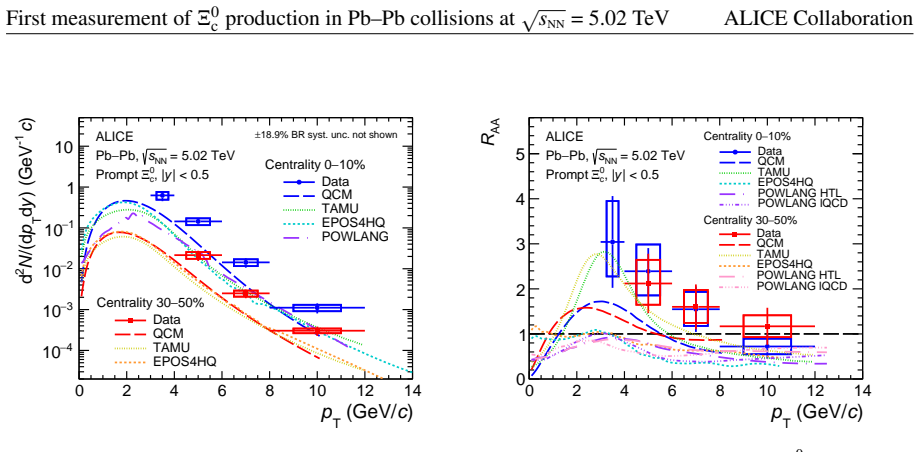
The central discovery is the first measurement of prompt Ξ_c^0 baryon production in heavy-ion collisions. In the 0–10% most central Pb–Pb events, the nuclear modification factor R_AA reaches 3.0±1.0(stat.)+0.9−0.8(syst.) at 3<pT<4 GeV/c, claimed as the largest value measured so far for charm hadrons. The production spectra and the baryon-to-meson ratios Ξ_c^0/D^0, Ξ_c^0/D_s^+, and Ξ_c^0/Λ_c^+ are all systematically higher in Pb–Pb than in pp collisions, and models that include coalescence or statistical hadronization capture some qualitative trends but underestimate the measured yields.
What carries the argument
The measurement reconstructs Ξ_c^0 through the decay chain Ξ_c^0 → π+Ξ−, followed by Ξ− → π−Λ and Λ → π−p, using the detector described in the paper at midrapidity. A boosted decision tree trained on simulated signal and real-data sidebands separates signal from combinatorial background. The central object is the nuclear modification factor R_AA, the ratio of the Pb–Pb yield to a pp reference obtained by scaling the 13 TeV pp cross section down to 5.02 TeV.
Load-bearing premise
The pp reference used to compute R_AA is not a direct measurement at 5.02 TeV; it is obtained by scaling the pp cross section measured at 13 TeV down to 5.02 TeV, so an error in that scaling would shift the absolute R_AA and could weaken the claim that it is the largest ever seen for charm hadrons.
What would settle it
A direct measurement of the prompt Ξ_c^0 cross section in pp collisions at √s=5.02 TeV would replace the scaled reference; if it differs from the scaled value by more than the quoted uncertainties, the R_AA curve would shift accordingly. Alternatively, a measurement of R_AA in the same centrality but with a larger branching-ratio determination would test whether the observed peak is robust.
If this is right
- If the R_AA≈3 result holds, charm baryons receive a stronger radial boost than charm mesons, consistent with coalescence as the dominant hadronization mechanism at intermediate pT.
- The enhanced Ξ_c^0/D_s^+ and Ξ_c^0/Λ_c^+ ratios imply that strange-quark abundance in the quark–gluon plasma plays a measurable role in charm hadronization.
- Models that reproduce the Λ_c^+ data but underestimate Ξ_c^0 production will need to incorporate extra strangeness or diquark correlations.
- The measured ratios provide new constraints on the hadronization temperature and on the presence of excited charmed-baryon states in statistical hadronization models.
- Extending these measurements to lower pT and to more peripheral collisions is required to pin down the peak shape and the pT-integrated enhancement.
Where Pith is reading between the lines
- Because the pp reference at 5.02 TeV is a scaled extrapolation rather than a direct measurement, the absolute scale of R_AA should be re-examined when a direct 5.02 TeV pp measurement becomes available; the centrality-dependent ratios are less sensitive to this scaling.
- The pattern of ratios—Ξ_c^0/D^0 enhanced more than Λ_c^+/D^0—suggests that color-recombination models with a (us) diquark preference could naturally produce the observed hierarchy, and could be tested in p–Pb collisions where cold-nuclear-matter effects are smaller.
- If the R_AA peak persists with more statistics, it would imply that the charm quark's spatial distribution is strongly correlated with the expanding partonic matter, a signature that could be sharpened by measuring the elliptic flow of Ξ_c^0.
Editorial analysis
A structured set of objections, weighed in public.
Referee Report
Summary. This paper reports the first measurement of prompt Ξ_c^0 baryon production in nucleus–nucleus collisions, using Pb–Pb data at √s_NN = 5.02 TeV recorded by ALICE. The Ξ_c^0 is reconstructed via Ξ_c^0 → Ξ^− π^+ (and charge conjugate) in the 0–10% and 30–50% centrality classes, with p_T intervals 3–12 and 4–12 GeV/c, respectively. The paper presents the p_T-differential yield, the nuclear modification factor R_AA, and the ratios Ξ_c^0/D^0, Ξ_c^0/D_s^+, and Ξ_c^0/Λ_c^+, comparing them with the QCM, TAMU, EPOS4HQ, and POWLANG models. The main quantitative claims are that R_AA reaches 3.0 ± 1.0 (stat) +0.9/−0.8 (syst) in the 3 < p_T < 4 GeV/c bin for 0–10% centrality — described as the largest charm-hadron R_AA measured so far — and that the measured Ξ_c^0/D^0, Ξ_c^0/D_s^+, and Ξ_c^0/Λ_c^+ ratios exceed pp values by factors of 2–10, while models underestimate them.
Significance. If correct, this is a qualitatively new measurement: it is the first charmed-strange baryon production measurement in heavy-ion collisions and provides a direct test of coalescence and strangeness-enhancement mechanisms in the QGP. The analysis has several genuine strengths: the signal is observed with good significance (6.3σ and 4.6σ), the raw-yield extraction is cross-checked with unbinned fits, the BDT-based selection is tuned separately in each p_T and centrality interval, the non-prompt contribution is estimated to be below 3%, and the efficiency model dependence is tested with TAMU and EPOS4HQ spectra, giving a <6% effect. The systematic uncertainties are described in detail and are generally at the level expected for a first measurement of this kind. However, the headline R_AA claim depends on a pp reference obtained by scaling the 13 TeV measurement rather than using the existing direct 5.02 TeV measurement, and no uncertainty is quoted for that scaling. This is a load-bearing issue that must be addressed before the result can be considered fully supported.
major comments (3)
- [R_AA computation, paragraph after Fig. 1] The R_AA values, including the headline value 3.0 in 3<p_T<4 GeV/c, are computed using a pp reference obtained by collision-energy scaling of the 13 TeV measurement following Ref. [9]. A direct ALICE measurement of prompt Ξ_c^0 in pp at √s = 5.02 TeV exists and is cited as Ref. [5], but it is not used and no cross-check against it is presented. No systematic uncertainty is assigned to the energy-scaling procedure. Since a 20–30% bias in the scaled pp cross section in this p_T bin would reduce R_AA from ~3.0 to ~2.3, the central 'largest R_AA' claim rests on an unquantified assumption. The authors should either use the direct 5.02 TeV reference or justify the scaling and show that it agrees with Ref. [5] within a quoted uncertainty.
- [Energy-scaling procedure, text following Fig. 1] The scaling procedure is only cited ('following the procedure described in Ref. [9]'), not described. The referee cannot judge whether the 13 TeV→5.02 TeV scaling is valid at p_T = 3–4 GeV/c, where the pp cross section is steeply falling and where the R_AA peak is reported. The manuscript should state the scaling variable and functional form, the inputs used, and the resulting systematic uncertainty. As a minimum, a comparison of the scaled reference with the direct 5.02 TeV measurement of Ref. [5] in the same p_T bins should be shown; if the two differ by more than the quoted systematic, the R_AA values should be revised.
- [Abstract and R_AA discussion] The claim that R_AA ≈ 3 is 'the largest value measured so far for charm hadrons' is asserted without a comparison to other charm-hadron R_AA measurements (e.g., D^0, D_s^+, Λ_c^+) in the same collision system and centrality. Given the pp-reference issue above, this superlative is not yet substantiated. The authors should either provide an explicit quantitative comparison to existing charm-hadron R_AA data or soften the claim to a statement about the measured Ξ_c^0 R_AA.
minor comments (3)
- [Figure 1] The legend labels 'Centrality 10%' and 'Centrality 30' are truncated; they should read '0–10%' and '30–50%'. Also, the left-panel caption notes that the 18.9% branching-ratio systematic is not shown; this should also be stated in the text where the absolute yield is discussed, since it dominates the normalization.
- [Signal significance paragraph] The integrated significances 6.3 and 4.6 are quoted for the summed p_T ranges, but the text says the signal is extracted with significance larger than three in the individual intervals 3–4, 4–6, 6–8, and 8–12 GeV/c. It would be helpful to list the per-bin significances or at least state the minimum bin significance, so that the claim of a significant signal in each bin can be verified.
- [Figure 2 caption] The caption lists both 'pp 13 TeV' and 'pp 5.02 TeV' but does not define the symbols or line styles used in the figure. Please add a clear legend description so that the pp references can be distinguished from the Pb–Pb data and model curves.
Circularity Check
No circularity: a direct measurement with model comparisons; no fitted quantity is relabeled as prediction.
full rationale
The paper reports a first measurement of prompt Xi_c^0 production in Pb-Pb collisions. The raw yields are extracted from invariant-mass fits to data, corrected with Monte Carlo efficiency calculations, and then compared with model predictions. The only model input that enters the correction chain is the pT spectrum used to generate the injected MC signal, which is taken from the QCM model. However, the paper explicitly tests alternative spectra from TAMU and EPOS4HQ and finds the resulting efficiency uncertainty to be smaller than 6%, so the final corrected yields and the conclusion that models underestimate the data are not forced by the QCM input. The pp reference used for R_AA is an external measurement at 13 TeV scaled to 5.02 TeV following Ref. [9]; it is not fitted to the Pb-Pb data and is not derived from the same measurement, so this is a systematic/reference uncertainty rather than a circular step. Self-citations to earlier ALICE measurements and analysis procedures are standard experimental practice and are not load-bearing in a definitional sense. No uniqueness theorem, ansatz, or fitted parameter is invoked to replace an independent derivation. Therefore no specific circular reduction can be exhibited, and the appropriate finding is no significant circularity.
Axiom & Free-Parameter Ledger
axioms (4)
- domain assumption The pp reference cross section at √s=5.02 TeV is obtained by energy scaling from the measured pp cross section at 13 TeV using the procedure of Ref. [9].
- domain assumption The non-prompt (beauty-decay) contribution is estimated using R_non-prompt_AA equal to the prompt Λ_c R_AA and a pp non-prompt cross section from FONLL plus LHCb fragmentation fractions.
- domain assumption The detector acceptance and efficiency are computed using MC events with the Ξ_c^0 pT spectrum set to the QCM model prediction; alternate spectra from TAMU and EPOS4HQ are used as a cross-check.
- domain assumption The branching ratio BR(Ξ_c^0 → π+ Ξ^-) = (1.43 ± 0.27)% is taken from the PDG [47].
read the original abstract
The ALICE Collaboration reports the first measurement of the production of prompt $\Xi_{\mathrm c}^{0}$ baryons in nucleus$-$nucleus collisions by analyzing data from $\mathrm{Pb}-\mathrm{Pb}$ collisions at $\sqrt{s_{\mathrm{NN}}}~=5.02~\mathrm{TeV}$. The production and transverse-momentum ($p_{\mathrm T}$) differential spectra of $\Xi_{\mathrm c}^{0}$ are particularly sensitive to the hadronization process and to strangeness production in the quark--gluon plasma formed in high-energy heavy-ion collisions. The $\Xi_{\mathrm c}^{0}$ baryons are reconstructed at midrapidity ($|y|<0.5$) in the transverse-momentum intervals $3<p_{\mathrm T}~<12~\mathrm{GeV}/c$ and $4<p_{\mathrm T}~<12~\mathrm{GeV}/c$ in the 0$-$10\% and 30$-$50\% centrality intervals, respectively. The nuclear modification factor ($R_{\mathrm{AA}}$) reaches values up to 3 in the interval $3<p_{\mathrm T}~<4~\mathrm{GeV}/c$, which is the largest value measured so far for charm hadrons. Model predictions are compatible with the measured $R_{\mathrm{AA}}$, while, in the measured $p_{\mathrm T}$ intervals, they underestimate the production yield as well as the measured $\Xi_{\mathrm c}^{0}/\mathrm{D}^{0}$, $\Xi_{\mathrm c}^{0}/\Lambda_{\mathrm c}^{+}$, and $\Xi_{\mathrm c}^{0}/\mathrm{D}^{+}_{\mathrm s}$ yield ratios.
Figures

Reference graph
Works this paper leans on
-
[2]
J. Zhaoet al., “Hadronization of heavy quarks”,Phys. Rev. C109(2024) 054912, arXiv:2311.10621 [hep-ph]
Pith/arXiv arXiv 2024
-
[3]
Towards the understanding of heavy quarks hadronization: from leptonic to heavy-ion collisions
J. Altmann, A. Dubla, V . Greco, A. Rossi, and P. Skands, “Towards the understanding of heavy quarks hadronization: from leptonic to heavy-ion collisions”,Eur . Phys. J. C85(2025) 16, arXiv:2405.19137 [hep-ph]. [4]ALICECollaboration, S. Acharyaet al., “First measurement ofΞ 0 c production in pp collisions at√s= 7 TeV”,Phys. Lett. B781(2018) 8–19,arXiv:171...
Pith/arXiv arXiv 2025
-
[16]
Charm hadrons in pp collisions at LHC energy within a coalescence plus fragmentation approach
V . Minissale, S. Plumari, and V . Greco, “Charm hadrons in pp collisions at LHC energy within a coalescence plus fragmentation approach”,Phys. Lett. B821(2021) 136622,arXiv:2012.12001 [hep-ph]
arXiv 2021
-
[17]
H.-H. Li, F.-L. Shao, J. Song, and R.-Q. Wang, “Production of single-charm hadrons by quark combination mechanism in p–Pb collisions at √sNN =5.02 TeV”,Phys. Rev. C97(2018) 064915, arXiv:1712.08921 [hep-ph]
Pith/arXiv arXiv 2018
-
[18]
New feature of lowp T charm quark hadronization in pp collisions at √s=7 TeV
J. Song, H.-h. Li, and F.-l. Shao, “New feature of lowp T charm quark hadronization in pp collisions at √s=7 TeV”,Eur . Phys. J. C78(2018) 344,arXiv:1801.09402 [hep-ph]
Pith/arXiv arXiv 2018
-
[19]
H. Li, F. Shao, and J. Song, “Production of light-flavor and single-charmed hadrons in pp collisions at √s=5.02 TeV in an equal-velocity quark combination model”,Chin. Phys. C45 (2021) 113105,arXiv:2103.14900 [hep-ph]
Pith/arXiv arXiv 2021
-
[20]
Heavy-flavor transport and hadronization in pp collisions
A. Beraudo, A. De Pace, D. Pablos, F. Prino, M. Monteno, and M. Nardi, “Heavy-flavor transport and hadronization in pp collisions”,Phys. Rev. D109(2024) L011501,arXiv:2306.02152 [hep-ph]
Pith/arXiv arXiv 2024
-
[21]
Charm-baryon production in proton-proton collisions
M. He and R. Rapp, “Charm-baryon production in proton-proton collisions”,Phys. Lett. B795 (2019) 117–121,arXiv:1902.08889 [nucl-th]
Pith/arXiv arXiv 2019
-
[22]
Spectroscopy and Regge trajectories of heavy baryons in the relativistic quark-diquark picture
D. Ebert, R. N. Faustov, and V . O. Galkin, “Spectroscopy and Regge trajectories of heavy baryons in the relativistic quark-diquark picture”,Phys. Rev. D84(2011) 014025,arXiv:1105.0583 [hep-ph]. [23]CMSCollaboration, A. Hayrapetyanet al., “Overview of high-density QCD studies with the CMS experiment at the LHC”,Phys. Rept.1115(2025) 219–367,arXiv:2405.107...
Pith/arXiv arXiv 2011
-
[27]
S. Plumari, V . Minissale, S. K. Das, G. Coci, and V . Greco, “Charmed Hadrons from Coalescence plus Fragmentation in relativistic nucleus-nucleus collisions at RHIC and LHC”,Eur . Phys. J. C 78(2018) 348,arXiv:1712.00730 [hep-ph]
Pith/arXiv arXiv 2018
-
[28]
Hadronization and charm-hadron ratios in heavy-ion collisions
M. He and R. Rapp, “Hadronization and charm-hadron ratios in heavy-ion collisions”,Phys. Rev. Lett.124(2020) 042301,arXiv:1905.09216 [nucl-th]
Pith/arXiv arXiv 2020
-
[29]
A. Beraudo, A. De Pace, M. Monteno, M. Nardi, and F. Prino, “In-medium hadronization of heavy quarks and its effect on charmed meson and baryon distributions in heavy-ion collisions”,Eur . Phys. J. C82(2022) 607,arXiv:2202.08732 [hep-ph]
Pith/arXiv arXiv 2022
-
[30]
Strangeness Production in the Quark - Gluon Plasma
J. Rafelski and B. Muller, “Strangeness Production in the Quark - Gluon Plasma”,Phys. Rev. Lett. 48(1982) 1066. [Erratum: Phys.Rev.Lett. 56, 2334 (1986)]
1982
-
[31]
Strangeness in Relativistic Heavy Ion Collisions
P. Koch, B. Muller, and J. Rafelski, “Strangeness in Relativistic Heavy Ion Collisions”,Phys. Rept.142(1986) 167–262
1986
-
[32]
Statistical hadronization of charm in heavy ion collisions at SPS, RHIC and LHC
A. Andronic, P. Braun-Munzinger, K. Redlich, and J. Stachel, “Statistical hadronization of charm in heavy ion collisions at SPS, RHIC and LHC”,Phys. Lett. B571(2003) 36–44, arXiv:nucl-th/0303036
Pith/arXiv arXiv 2003
-
[33]
Heavy flavor hadrons in statistical hadronization of strangeness-rich QGP
I. Kuznetsova and J. Rafelski, “Heavy flavor hadrons in statistical hadronization of strangeness-rich QGP”,Eur . Phys. J. C51(2007) 113–133,arXiv:hep-ph/0607203. [34]ALICECollaboration, S. Acharyaet al., “Measurement of prompt D + s -meson production and azimuthal anisotropy in Pb–Pb collisions at √sNN =5.02 TeV”,Phys. Lett. B827(2022) 136986, arXiv:2110....
Pith/arXiv arXiv 2007
-
[36]
The multiple-charm hierarchy in the statistical hadronization model
A. Andronic, P. Braun-Munzinger, M. K. Köhler, A. Mazeliauskas, K. Redlich, J. Stachel, and V . Vislavicius, “The multiple-charm hierarchy in the statistical hadronization model”,JHEP07 (2021) 035,arXiv:2104.12754 [hep-ph]
Pith/arXiv arXiv 2021
-
[37]
Diquarks and the production of charmed baryons
H. Yun, S. Noh, S. Lim, T. Song, J. Hong, A. Park, S. H. Lee, and B. Dönigus, “Diquarks and the production of charmed baryons”,Phys. Lett. B851(2024) 138569,arXiv:2308.06760 [hep-ph]. [38]ALICECollaboration, B. Abelevet al., “Performance of the ALICE Experiment at the CERN LHC”,Int. J. Mod. Phys. A29(2014) 1430044,arXiv:1402.4476 [nucl-ex]. [39]ALICEColla...
Pith/arXiv arXiv 2024
-
[41]
J. Almeet al., “The ALICE TPC, a large 3-dimensional tracking device with fast readout for ultra-high multiplicity events”,Nucl. Instrum. Meth. A622(2010) 316–367,arXiv:1001.1950 [physics.ins-det]
Pith/arXiv arXiv 2010
-
[42]
Performance of the ALICE Time-Of-Flight detector at the LHC
A. Akindinovet al., “Performance of the ALICE Time-Of-Flight detector at the LHC”,Eur . Phys. J. Plus128(2013) 44. [43]ALICECollaboration, E. Abbaset al., “Performance of the ALICE VZERO system”,JINST8 (2013) P10016,arXiv:1306.3130 [nucl-ex]
Pith/arXiv arXiv 2013
-
[44]
The Zero Degree Calorimeters for the ALICE experiment
R. Arnaldiet al., “The Zero Degree Calorimeters for the ALICE experiment”,Nucl. Instrum. Meth. A581(2007) 397–401. [Erratum:Nucl.Instrum.Meth.A604(2009) 765]. [45]ALICECollaboration, J. Adamet al., “Centrality dependence of the charged-particle multiplicity density at midrapidity in Pb–Pb collisions at √sNN =5.02 TeV”,Phys. Rev. Lett.116(2016) 222302,arXi...
Pith/arXiv arXiv 2007
-
[49]
Standalone first level event selection package for the CBM experiment
I. Kisel, I. Kulakov, and M. Zyzak, “Standalone first level event selection package for the CBM experiment”,IEEE Transactions on Nuclear Science60(2013) 3703–3708
2013
-
[50]
XGBoost: A scalable tree boosting system
T. Chen and C. Guestrin, “XGBoost: A scalable tree boosting system”,Proceedings of the 22nd ACM SIGKDD International Conference on Knowledge Discovery and Data Mining(2016) 785–794,arXiv:1603.02754 [cs.LG]
Pith/arXiv arXiv 2016
-
[51]
L. Barioglio, F. Catalano, M. Concas, P. Fecchio, F. Grosa, F. Mazzaschi, and M. Puccio, “hipe4ml/hipe4ml”, v0.0.10. Zenodo, July, 2021. https://doi.org/10.5281/zenodo.5070132
-
[52]
T. Sjöstrand, S. Mrenna, and P. Z. Skands, “PYTHIA 6.4 Physics and Manual”,JHEP05(2006) 026,arXiv:hep-ph/0603175 [hep-ph]
Pith/arXiv arXiv 2006
-
[53]
HIJING: A Monte Carlo model for multiple jet production in pp, pA and AA collisions
X.-N. Wang and M. Gyulassy, “HIJING: A Monte Carlo model for multiple jet production in pp, pA and AA collisions”,Phys. Rev. D44(1991) 3501–3516
1991
-
[54]
CERN Program Library Long Write-up, W5013 GEANT Detector Description and Simulation Tool
R. Brun, F. Carminati, and S. Giani, “CERN Program Library Long Write-up, W5013 GEANT Detector Description and Simulation Tool”, Tech. Rep. CERN-W-5013, 1994. https://cds.cern.ch/record/1082634
arXiv 1994
-
[55]
R.-Q. Wang, J. Song, F.-L. Shao, and Z.-T. Liang, “Charmed hadron production via equal-velocity quark combination in ultrarelativistic heavy ion collisions”,Phys. Rev. C101(2020) 054903, arXiv:1911.00823 [hep-ph]
Pith/arXiv arXiv 2020
-
[56]
Thep T spectrum in heavy flavor hadroproduction
M. Cacciari, M. Greco, and P. Nason, “Thep T spectrum in heavy flavor hadroproduction”,JHEP 05(1998) 007,arXiv:hep-ph/9803400. 11 First measurement ofΞ 0 c production in Pb–Pb collisions at √sNN = 5.02 TeV ALICE Collaboration
Pith/arXiv arXiv 1998
-
[57]
Theoretical predictions for charm and bottom production at the LHC
M. Cacciari, S. Frixione, N. Houdeau, M. L. Mangano, P. Nason, and G. Ridolfi, “Theoretical predictions for charm and bottom production at the LHC”,JHEP10(2012) 137, arXiv:1205.6344 [hep-ph]. [58]LHCbCollaboration, R. Aaijet al., “Measurement of b hadron fractions in 13 TeV pp collisions”, Phys. Rev. D100(2019) 031102,arXiv:1902.06794 [hep-ex]
Pith/arXiv arXiv 2012
-
[59]
T. Sjöstrand, S. Ask, J. R. Christiansen, R. Corke, N. Desai, P. Ilten, S. Mrenna, S. Prestel, C. O. Rasmussen, and P. Z. Skands, “An introduction to PYTHIA 8.2”Comput. Phys. Commun.191 (2015) 159–177,arXiv:1410.3012 [hep-ph]
Pith/arXiv arXiv 2015
-
[60]
Heavy Flavor at the Large Hadron Collider in a Strong Coupling Approach
M. He, R. J. Fries, and R. Rapp, “Heavy Flavor at the Large Hadron Collider in a Strong Coupling Approach”,Phys. Lett. B735(2014) 445–450,arXiv:1401.3817 [nucl-th]
Pith/arXiv arXiv 2014
-
[61]
J. Zhao, J. Aichelin, P. B. Gossiaux, V . Ozvenchuk, and K. Werner, “Heavy-flavor hadron production in relativistic heavy ion collisions at energies available at BNL RHIC and at the CERN LHC in the EPOS4HQ framework”,Phys. Rev. C110(2024) 024909,arXiv:2401.17096 [hep-ph]. [62]ALICECollaboration, S. Acharyaet al., “Prompt D 0, D+, and D∗+ production in Pb–...
Pith/arXiv arXiv 2024
-
[63]
R. J. Fries, V . Greco, and R. Rapp, “Quark Recombination”,arXiv:2506.24023 [hep-ph]
-
[64]
Heavy flavor as a probe of hot QCD matter produced in proton-proton collisions
J. Zhao, J. Aichelin, P. B. Gossiaux, and K. Werner, “Heavy flavor as a probe of hot QCD matter produced in proton-proton collisions”,Phys. Rev. D109(2024) 054011,arXiv:2310.08684 [hep-ph]. [65]ALICECollaboration, S. Acharyaet al., “First measurement ofΛ + c production down top T =0 in pp and p–Pb collisions at √sNN =5.02 TeV”,Phys. Rev. C107(2023) 064901...
Pith/arXiv arXiv 2024
discussion (0)
Sign in with ORCID, Apple, or X to comment. Anyone can read and Pith papers without signing in.