REVIEW 3 major objections 6 minor 35 references
LINR-PCGC: Lossless Implicit Neural Representations for Point Cloud Geometry Compression
T0 review · 3 major / 6 minor · reviewed 2026-08-06 · deepseek-v4-flash
Pith's one-line read An overfitted neural network, transmitted once per group of frames, compresses point cloud geometry losslessly and beats G-PCC and SparsePCGC by about 21% on MVUB.
desk verdict The lossless claim is not verified: the paper never shows encoder/decoder probability agreement and reports no bit-exact check, though the core idea is a plausible first INR lossless geometry codec. read the letter →
The pith
A machine-rendered reading of the paper's core claim, the machinery that carries it, and where it could break.
The reading
What carries the argument
The load-bearing mechanism is Child Node Prediction (CNP), an octree-based upsampler that reconstructs a high-scale point cloud by predicting, in eight stages, the occupancy of the eight child nodes of a two-layer octree. Each stage fuses global deep features (GDFE) with local features from already decoded child nodes (LDFE), then a small SparseConv+MLP+Sigmoid stack outputs an occupancy probability; that probability is simultaneously the cross-entropy training target and the arithmetic-coding model. Scale Context Extraction (SCE) adds an 8-channel scale embedding so one shared network can handle all scales, and Adaptive Quantization plus Model Compression shrink the transmitted weights using Laplace-prior arithmetic coding. A group-of-pictures level framework shares the network across 32 frames and initializes each group from the previous one, cutting encoding time by about 65.3% versus random initialization of each group.
What would settle it
Take a LINR-PCGC bitstream, decode it with the transmitted quantized decoder parameters, and compare every reconstructed voxel coordinate to the original point cloud; any mismatch falsifies the lossless claim. A more targeted test would be to compute occupancy probabilities on the encoder side with both the full-precision trained weights and the quantized-dequantized weights and check that the arithmetic-coded bitstream is identical in both cases.
Extended reading notes
Core claim
The central claim is that lossless point cloud geometry compression can be built on an implicit neural representation. The point cloud is max-pooled down to a few dozen points; the lowest scale is stored directly as bytes, while every higher scale is reconstructed through octree child-node occupancy prediction by a shared multiscale SparseConv network. An 8-stage Child Node Prediction module uses previously decoded child nodes as context, and the resulting occupancy probabilities drive arithmetic coding of the true occupancy; the network parameters, quantized to 8 bits and entropy-coded with a Laplace model, are transmitted once per 32-frame group and shared across frames. Because each scale is either stored exactly or entropy-coded, the authors claim exact reconstruction, and the experiments report consistent bitrate reductions over G-PCC, V-PCC, and SparsePCGC across 8iVFB, Owlii, and MVUB, with decoding time about half that of G-PCC or SparsePCGC.
Load-bearing premise
The lossless claim rests on the encoder and decoder forming occupancy probabilities from exactly the same quantized network parameters; the paper describes quantizing and transmitting the decoder weights but never states that the encoder uses those same quantized weights, and it reports no bit-exact reconstruction check.
Editorial extensions
If this is right
- If the central claim holds, INR-based codecs can target lossless geometry compression, not only lossy, and can do so without relying on fixed training distributions.
- Sharing one tiny network across a group of frames means the per-frame parameter cost is amortized, so long dynamic sequences incur only a small fixed overhead per group.
- The reported decode speeds, about half of G-PCC or SparsePCGC, suggest the lightweight SparseConv design is suitable at playback time, a key requirement for dynamic point cloud content.
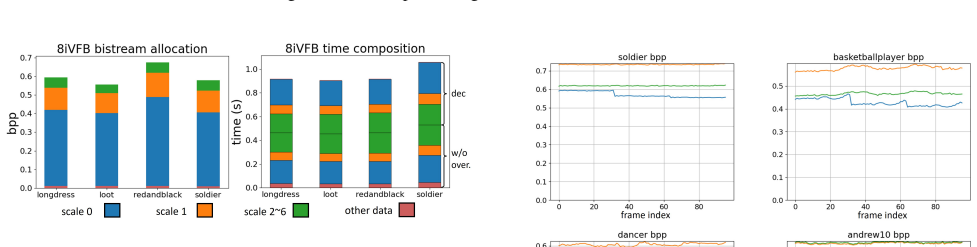
- Since the bitstream analysis shows higher spatial scales consume most bits, further compression gains are most likely to come from better high-scale occupancy prediction.
- The ablation results indicate that the quantization and entropy coding of parameters (8.1% bpp saving) and the scale embedding (3.1% further saving) are separable improvements that could be adopted by other octree-based lossless codecs.
Reading between the lines
- The paper never reports a bit-exact decode check, so the 'lossless' claim should be treated as contingent on the encoder and decoder using identical quantized weights; a quick test is to decode an actual LINR-PCGC bitstream and compare coordinates exactly.
- For very short sequences or single frames, the per-group parameter overhead will not be amortized, so the advantage over G-PCC may shrink; the paper's experiments all use 96-frame sequences with 32-frame groups, leaving this boundary untested.
- The channel-wise 8-stage prediction creates a first-child bottleneck, and the paper's own heatmap shows higher bitrate for the first stage; predicting the first child with a cheaper context or reordering stages is a natural extension the authors do not explore.
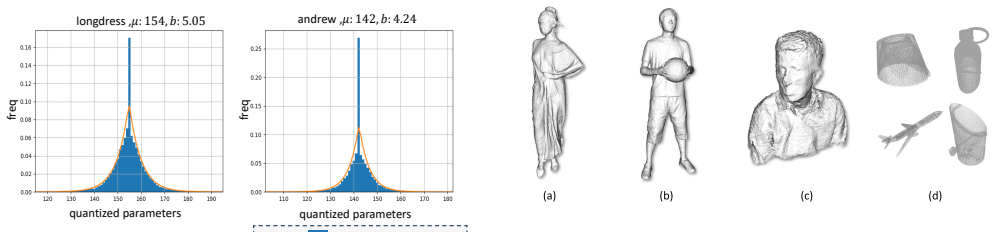
- Because the Laplace prior for model entropy coding is fitted only with mean and scale, content that produces a non-Laplace parameter distribution after few training epochs would inflate the model bitstream; this risk is not analyzed beyond two example histograms.
Editorial analysis
A structured set of objections, weighed in public.
Referee Report
Summary. The paper proposes LINR-PCGC, an implicit neural representation (INR) framework for lossless point cloud geometry compression of dynamic sequences. The method overfits a lightweight multiscale SparseConv network per group of pictures (GoP), shares network parameters across frames, is initialized from the previous GoP to reduce encoding time, quantizes and entropy-codes the decoder parameters, and uses a child-node octree prediction scheme with arithmetic coding for occupancy. Experiments on 8iVFB, Owlii, and MVUB report bitrates lower than G-PCC TMC13v23 and SparsePCGC under comparable encoding time. The core novelty claimed is that this is the first INR-based method for lossless point cloud geometry compression.
Significance. If the lossless claim is fully verified, the paper is significant for learned point cloud compression: it displaces the common assumption that INR-based methods are limited to lossy coding, and the GoP-level parameter sharing plus initialization strategy addresses the traditional encoding-time bottleneck of INR methods. The paper also contributes a useful engineering design (SCE, CNP, AQ/MC) and a sensible training objective that directly optimizes the arithmetic-coding bitrate estimate. The empirical gains over G-PCC and SparsePCGC are substantial on the tested datasets. However, the significance is conditional: the paper must demonstrate bit-exact reconstruction and that the encoder and decoder use identical probability models, because arithmetic coding is not lossless otherwise.
major comments (3)
- [§3.4, §3.3.3, Algorithm 1] The paper never states that the encoder computes the occupancy probabilities P_occ using the quantized/dequantized network parameters pdequant (Eq. 6). The pipeline in §3.1 says the teacher captures the point cloud with the pc-encoder and then encodes the pc-decoder parameters, while Algorithm 1 and §3.3.3 define P_occ using the trained network and the loss function. For arithmetic coding to be lossless, the encoder and decoder must partition the unit interval using bit-identical probabilities. If the encoder range-codes with full-precision parameters and the decoder reconstructs only pdequant, the intervals differ and the bitstream cannot be decoded. This is load-bearing for the central 'lossless' claim; the paper should explicitly specify that both encoder and decoder use pdequant, and should provide a matching bit-exact round-trip test.
- [§4.2, Tables 1–3] No bit-exact reconstruction check is reported. The tables report bpp and encoding/decoding times, but a lossless codec claim requires that the decoded occupancy coincides exactly with the original geometry on every tested frame. The paper should state the verification procedure (e.g., exact coordinate equality or hash comparison) and report that it passed for all sequences and settings, including the 'ours 2' configurations. Without this, the reported bpp values are not evidence of losslessness, only of the encoder-side entropy estimate.
- [§3.5, Eq. (7)–(9)] The Laplace model for quantized parameters is a fitted prior and its mean and scale are transmitted as side information, which is a standard and legitimate entropy-coding choice. The paper should clarify, however, that the arithmetic coder for the parameters uses the same Laplace model parameters on the decoder side, and should report the overhead of transmitting mu and b. This is not a correctness problem, but it is needed to support the claim that the model-compression module is part of a complete lossless pipeline.
minor comments (6)
- [Algorithm 1] Line 8 contains 'LDEF', which appears to be a typo for 'LDFE' used elsewhere.
- [§3.3.3, Algorithm 1] The notation x_j_cum is used before it is formally introduced in the main text; please define it in a numbered equation when it first appears in §3.3.3.
- [§4.1] The hyperparameter table in the appendix lists 'epochs' as 6–60 for subsequent GoPs, while the main text says 1 to 6 epochs; these numbers should be reconciled.
- [§4.3.1, Table 5] The caption and text refer to 'average time saving' but the table reports relative time percentages; please clarify that the entries are relative times, not savings.
- [Abstract and §1] The abstract and introduction state that existing AI-based methods 'struggle with dependence on specific training data distributions,' but the experimental section only compares against SparsePCGC with a ShapeNet-pretrained model; a direct distribution-shift experiment would strengthen the claim, but this is not a blocker.
- [Appendix, Table 11] The row 'Laplace' reports values for MVUB that appear inconsistent with the average (248490, 251360, 240352.9; average 251360); please double-check the reported numbers.
Circularity Check
No circularity found: bitrate-driven loss, transmitted side information, and external baselines keep the derivation self-contained.
full rationale
The paper's derivation chain is self-contained and does not reduce any prediction to its inputs. The training loss (Eq. 11) is the sum of per-scale, per-stage binary cross-entropy between the predicted occupancy probabilities P_occ and the ground-truth child-node occupancy; because the same probabilities P_occ are used for arithmetic coding of the occupancy (Sec. 3.3.3, Algorithm 1), minimizing this loss is standard rate estimation rather than a circular prediction. The Laplace model used for entropy-coding quantized decoder parameters is fitted to the observed quantized-parameter histogram, and its mean and scale are explicitly transmitted as side information (Eqs. 7-9), so nothing fitted is silently assumed at the decoder. The reported comparisons are measured against external baselines: G-PCC TMC13v23, V-PCC v23, and SparsePCGC with publicly provided pretrained models. Several cited works share authors with this paper (e.g., SparsePCGC [32] and [10], [31]), but these citations support architectural lineage and baseline availability; they are not invoked as a uniqueness theorem or as evidence for a derived result, so they are not load-bearing. The paper's 'lossless' claim does rely on the encoder and decoder using bit-identical occupancy probability models after the AQ/MC quantization of Sec. 3.4, and the paper does not explicitly state that the encoder recomputes probabilities from pdequant nor does it report a bit-exact round-trip check; that is an unverified correctness assumption, but it is not a circular reduction of a claim to its own inputs.
Assumptions & free parameters
free parameters (6)
- lambda (L2 regularization weight) =
0.0001
- Quantization bit depth B =
8
- GoP size T =
32
- Hidden channel counts (Cmlp, Csconv, CEMB) =
24, 8, 8
- Training epochs for first and subsequent GoPs =
6 (or up to 60), 1 to 6
- Laplace model parameters (mu, b) =
estimated per model (e.g., mu=142, b=4.24 in example)
assumptions (5)
- standard math Arithmetic coding with matched occupancy probabilities is lossless.
- standard math Cross-entropy between predicted and true occupancy equals expected bitstream length.
- domain assumption Frames in a GoP are similar enough that one shared network is efficient.
- domain assumption Quantized network parameters follow a Laplace distribution.
- domain assumption Multiscale sparse convolutions can capture occupancy correlations.
Cite this review
Pith. "Pith review of LINR-PCGC: Lossless Implicit Neural Representations for Point Cloud Geometry Compression." pith.science (2026). https://pith.science/paper/EQKZ6UR5
@misc{pith2026250715686,
  author       = {Pith},
  title        = {Pith review of: LINR-PCGC: Lossless Implicit Neural Representations for Point Cloud Geometry Compression},
  year         = {2026},
  howpublished = {\url{https://pith.science/paper/EQKZ6UR5}},
  note         = {Machine review of arXiv:2507.15686}
}
read the original abstract
Existing AI-based point cloud compression methods struggle with dependence on specific training data distributions, which limits their real-world deployment. Implicit Neural Representation (INR) methods solve the above problem by encoding overfitted network parameters to the bitstream, resulting in more distribution-agnostic results. However, due to the limitation of encoding time and decoder size, current INR based methods only consider lossy geometry compression. In this paper, we propose the first INR based lossless point cloud geometry compression method called Lossless Implicit Neural Representations for Point Cloud Geometry Compression (LINR-PCGC). To accelerate encoding speed, we design a group of point clouds level coding framework with an effective network initialization strategy, which can reduce around 60% encoding time. A lightweight coding network based on multiscale SparseConv, consisting of scale context extraction, child node prediction, and model compression modules, is proposed to realize fast inference and compact decoder size. Experimental results show that our method consistently outperforms traditional and AI-based methods: for example, with the convergence time in the MVUB dataset, our method reduces the bitstream by approximately 21.21% compared to G-PCC TMC13v23 and 21.95% compared to SparsePCGC. Our project can be seen on https://huangwenjie2023.github.io/LINR-PCGC/.
Figures


Figures from the paper (10 more)




Reference graph
Works this paper leans on
-
[1]
ISO/IEC JTC1/SC29/WG7 MDS20352/N00100, 2021
V-pcc codec description. ISO/IEC JTC1/SC29/WG7 MDS20352/N00100, 2021. 1
work page 2021
-
[2]
ISO/IEC JTC1/SC29/WG7 MDS24176/N00942, 2024
G-pcc 2nd edition codec description. ISO/IEC JTC1/SC29/WG7 MDS24176/N00942, 2024. 1
work page 2024
-
[3]
8 End-to-end optimized image compression
Johannes Ball ´e, Valero Laparra, and Eero P Simoncelli. 8 End-to-end optimized image compression. arXiv preprint arXiv:1611.01704, 2016. 2
arXiv 2016
-
[4]
Variational image compression with a scale hyperprior
Johannes Ball ´e, David Minnen, Saurabh Singh, Sung Jin Hwang, and Nick Johnston. Variational image compression with a scale hyperprior. arXiv preprint arXiv:1802.01436 ,
-
[5]
Muscle: Multi sweep compression of lidar using deep entropy models
Sourav Biswas, Jerry Liu, Kelvin Wong, Shenlong Wang, and Raquel Urtasun. Muscle: Multi sweep compression of lidar using deep entropy models. In Advances in Neural In- formation Processing Systems, pages 22170–22181. Curran Associates, Inc., 2020. 1
work page 2020
-
[6]
3d point cloud compression: A survey
Chao Cao, Marius Preda, and Titus Zaharia. 3d point cloud compression: A survey. In Proceedings of the 24th Inter- national Conference on 3D Web Technology, page 1–9, New York, NY , USA, 2019. Association for Computing Machin- ery. 1, 2
work page 2019
-
[7]
Compression of sparse and dense dynamic point clouds—methods and standards
Chao Cao, Marius Preda, Vladyslav Zakharchenko, Euee S Jang, and Titus Zaharia. Compression of sparse and dense dynamic point clouds—methods and standards. Proceedings of the IEEE, 109(9):1537–1558, 2021. 1
work page 2021
-
[8]
4d spatio-temporal convnets: Minkowski convolutional neu- ral networks
Christopher Choy, JunYoung Gwak, and Silvio Savarese. 4d spatio-temporal convnets: Minkowski convolutional neu- ral networks. In Proceedings of the IEEE/CVF Conference on Computer Vision and Pattern Recognition , pages 3075– 3084, 2019. 2, 6
work page 2019
Show all 35 references
-
[9]
Eugene d’Eon, Bob Harrison, Taos Myers, and Philip A. Chou. 8i voxelized full bodies: a voxelized point cloud dataset. ISO/IEC JTC1/SC29 Joint WG11/WG1 (MPEG/JPEG) m40059/M74006, 2017. 6
2017
-
[10]
Multiscale latent-guided entropy model for lidar point cloud compression
Tingyu Fan, Linyao Gao, Yiling Xu, Dong Wang, and Zhu Li. Multiscale latent-guided entropy model for lidar point cloud compression. IEEE Transactions on Circuits and Sys- tems for Video Technology, 33(12):7857–7869, 2023. 1
2023
-
[11]
Oc- tattention: Octree-based large-scale contexts model for point cloud compression
Chunyang Fu, Ge Li, Rui Song, Wei Gao, and Shan Liu. Oc- tattention: Octree-based large-scale contexts model for point cloud compression. In Proceedings of the AAAI conference on artificial intelligence, pages 625–633, 2022. 1
2022
-
[12]
An overview of ongoing point cloud compression standardiza- tion activities: video-based (v-pcc) and geometry-based (g- pcc)
Danillo Graziosi, Ohji Nakagami, Shinroku Kuma, Alexan- dre Zaghetto, Teruhiko Suzuki, and Ali Tabatabai. An overview of ongoing point cloud compression standardiza- tion activities: video-based (v-pcc) and geometry-based (g- pcc). APSIPA Transactions on Signal and Information...
2020
-
[13]
An overview of ongoing point cloud compression standardiza- tion activities: Video-based (v-pcc) and geometry-based (g- pcc)
Danillo Graziosi, Ohji Nakagami, Shinroku Kuma, Alexan- dre Zaghetto, Teruhiko Suzuki, and Ali Tabatabai. An overview of ongoing point cloud compression standardiza- tion activities: Video-based (v-pcc) and geometry-based (g- pcc). APSIPA Transactions on Signal and Information...
2024
-
[14]
Mpeg-pcc-tmc13
MPEG Group. Mpeg-pcc-tmc13. https://github. com / MPEGGroup / mpeg - pcc - tmc13 / releases / tag/release- v23.0- rc2, . Accessed: 2024-09-10. 6
2024
-
[15]
Mpeg-pcc-tmc2
MPEG Group. Mpeg-pcc-tmc2. https://github. com / MPEGGroup / mpeg - pcc - tmc2 / releases / tag/release-v23.0, . Accessed: 2024-09-10. 6
2024
-
[16]
Learning neural volumetric field for point cloud geometry compression
Yueyu Hu and Yao Wang. Learning neural volumetric field for point cloud geometry compression. In 2022 Picture Cod- ing Symposium, pages 127–131, 2022. 2
2022
-
[17]
Octsqueeze: Octree-structured en- tropy model for lidar compression
Lila Huang, Shenlong Wang, Kelvin Wong, Jerry Liu, and Raquel Urtasun. Octsqueeze: Octree-structured en- tropy model for lidar compression. In Proceedings of the IEEE/CVF Conference on Computer Vision and Pattern Recognition, pages 1313–1323, 2020. 1
2020
-
[18]
Lvac: Learned volumetric at- tribute compression for point clouds using coordinate based networks
Berivan Isik, Philip A Chou, Sung Jin Hwang, Nick John- ston, and George Toderici. Lvac: Learned volumetric at- tribute compression for point clouds using coordinate based networks. Frontiers in Signal Processing, 2:1008812, 2022. 2
2022
-
[19]
Jang, Marius Preda, Khaled Mammou, Alexis M
Euee S. Jang, Marius Preda, Khaled Mammou, Alexis M. Tourapis, Jungsun Kim, Danillo B. Graziosi, Sungryeul Rhyu, and Madhukar Budagavi. Video-based point-cloud- compression standard in mpeg: From evidence collection to committee draft [standards in a nutshell]. IEEE Signal Pro...
2019
-
[20]
Owlii dy- namic human mesh sequence dataset
Cao Keming, Xu Yi, Lu Yao, and Wen Ziyu. Owlii dy- namic human mesh sequence dataset. Document ISO/IEC JTC1/SC29/WG11 m42816, 2018. 6
2018
-
[21]
Adam: A method for stochastic optimization
Diederick P Kingma and Jimmy Ba. Adam: A method for stochastic optimization. In International Conference on Learning Representations , pages 1–15, San Diego, CA, USA, 2015. ICLR. 6
2015
-
[22]
Charles Loop, Qin Cai, Sergio Orts Escolano, and Philip A. Chou. Microsoft voxelized upper bodies - a voxelized point cloud dataset. ISO/IEC JTC1/SC29 Joint WG11/WG1 (MPEG/JPEG) m38673/M72012, 2016. 6
2016
-
[23]
Multiscale deep context modeling for lossless point cloud geometry compression
Dat Thanh Nguyen, Maurice Quach, Giuseppe Valenzise, and Pierre Duhamel. Multiscale deep context modeling for lossless point cloud geometry compression. In 2021 IEEE International Conference on Multimedia & Expo Workshops, pages 1–6. IEEE, 2021. 1
2021
-
[24]
Sparsepcgc
NJUVISION. Sparsepcgc. https://github.com/ NJUVISION/SparsePCGC. Accessed: 2025-03-01. 6
2025
-
[25]
Pytorch: An im- perative style, high-performance deep learning library
Adam Paszke, Sam Gross, Francisco Massa, Adam Lerer, James Bradbury, Gregory Chanan, Trevor Killeen, Zeming Lin, Natalia Gimelshein, Luca Antiga, et al. Pytorch: An im- perative style, high-performance deep learning library. Ad- vances in neural information processing systems ...
2019
-
[26]
Signal compression via neural implicit represen- tations
Francesca Pistilli, Diego Valsesia, Giulia Fracastoro, and En- rico Magli. Signal compression via neural implicit represen- tations. In 2022 IEEE International Conference on Acous- tics, Speech and Signal Processing, pages 3733–3737, 2022. 2
2022
-
[27]
Survey on deep learning-based point cloud compression
Maurice Quach, Jiahao Pang, Dong Tian, Giuseppe Valen- zise, and Fr ´ed´eric Dufaux. Survey on deep learning-based point cloud compression. Frontiers in Signal Processing, 2: 846972, 2022. 1
2022
-
[28]
Point cloud compression with implicit neural representations: A unified framework
Hongning Ruan, Yulin Shao, Qianqian Yang, Liang Zhao, and Dusit Niyato. Point cloud compression with implicit neural representations: A unified framework. In 2024 IEEE/CIC International Conference on Communications in China, pages 1709–1714, 2024. 2 9
2024
-
[29]
Emerging mpeg standards for point cloud compression
Sebastian Schwarz, Marius Preda, Vittorio Baroncini, Mad- hukar Budagavi, Pablo Cesar, Philip A Chou, Robert A Co- hen, Maja Krivoku ´ca, S ´ebastien Lasserre, Zhu Li, et al. Emerging mpeg standards for point cloud compression. IEEE Journal on Emerging and Selected Topics in C...
2018
-
[30]
Efficient hier- archical entropy model for learned point cloud compression
Rui Song, Chunyang Fu, Shan Liu, and Ge Li. Efficient hier- archical entropy model for learned point cloud compression. In Proceedings of the IEEE/CVF Conference on Computer Vision and Pattern Recognition, pages 14368–14377, 2023. 1
2023
-
[31]
Multi- scale point cloud geometry compression
Jianqiang Wang, Dandan Ding, Zhu Li, and Zhan Ma. Multi- scale point cloud geometry compression. In2021 Data Com- pression Conference, pages 73–82, 2021. 2
2021
-
[32]
Sparse tensor-based multi- scale representation for point cloud geometry compression
Jianqiang Wang, Dandan Ding, Zhu Li, Xiaoxing Feng, Chuntong Cao, and Zhan Ma. Sparse tensor-based multi- scale representation for point cloud geometry compression. IEEE Transactions on Pattern Analysis and Machine Intelli- gence, 45(7):9055–9071, 2023. 2, 4
2023
-
[33]
A versatile point cloud compressor using universal multiscale conditional coding – part i: Geometry
Jianqiang Wang, Ruixiang Xue, Jiaxin Li, Dandan Ding, Yi Lin, and Zhan Ma. A versatile point cloud compressor using universal multiscale conditional coding – part i: Geometry. IEEE Transactions on Pattern Analysis and Machine Intelli- gence, 47(1):269–287, 2025. 1, 3
2025
-
[34]
Lightweight super resolution network for point cloud geometry compres- sion
Wei Zhang, Dingquan Li, Ge Li, and Wen Gao. Lightweight super resolution network for point cloud geometry compres- sion. In 2024 Data Compression Conference , pages 602– 602, 2024. 2 10 LINR-PCGC: Lossless Implicit Neural Representations for Point Cloud Geometry Compression Su...
2024
-
[35]
Detail of parameters The details of the parameters in our experiment are listed in Tab
Appendix 1.1. Detail of parameters The details of the parameters in our experiment are listed in Tab. 7. Symbol Description Value lr0 Initial learning rate 0.01 lrmin Minimum learning rate 0.0004 γ Multiplicative factor of learning rate decay in StepLR 0.992 step size Period o...
Reviewed August 6, 2026 · model on record in the stance chip above.
Discussion (0). Continue with ORCID to comment.