Feedback in Extragalactic Star Clusters (FEAST): Spectral Energy Distributions and the Physical Properties of Star Clusters in NGC 628 with CIGALE
Pith reviewed 2026-06-27 06:30 UTC · model grok-4.3
The pith
Star clusters in NGC 628 clear surrounding dust in about 4 million years.
A machine-rendered reading of the paper's core claim, the machinery that carries it, and where it could break.
Core claim
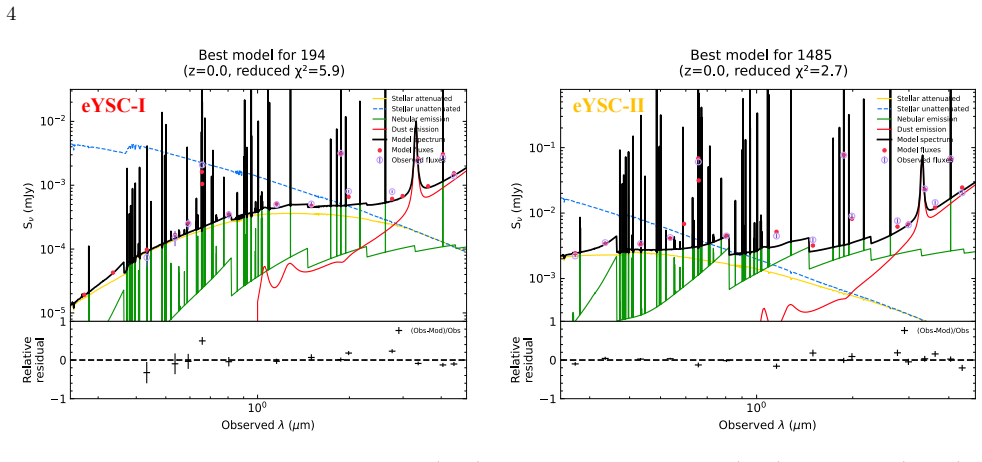
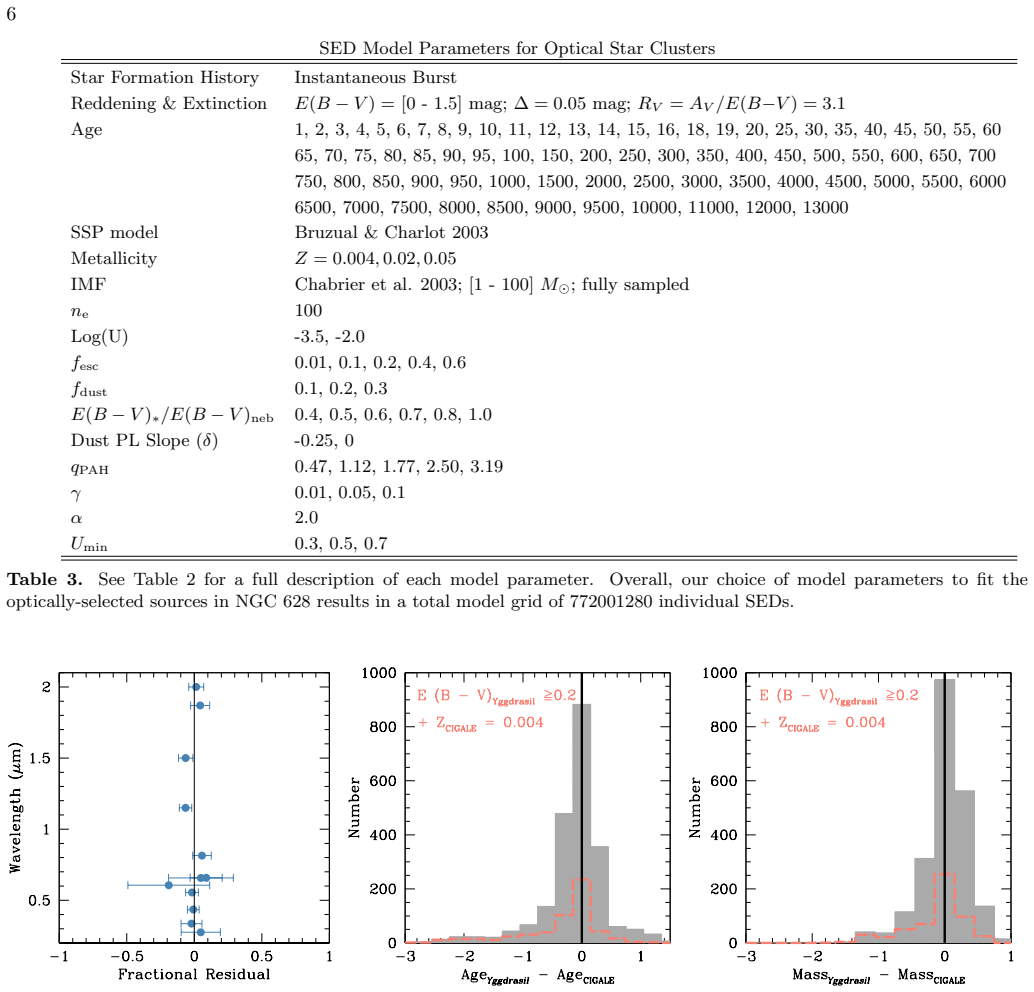
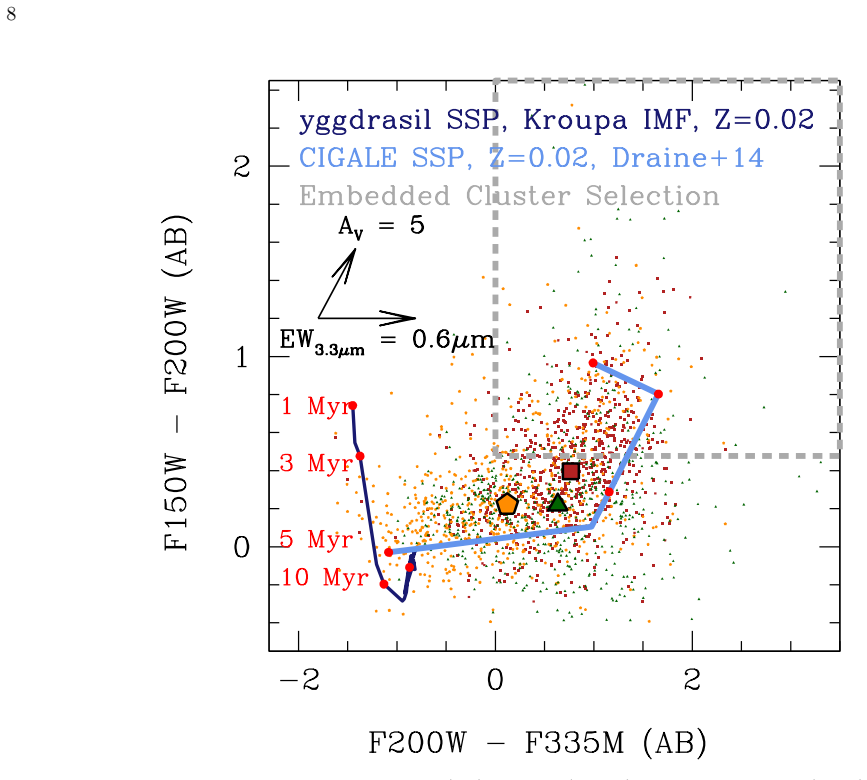
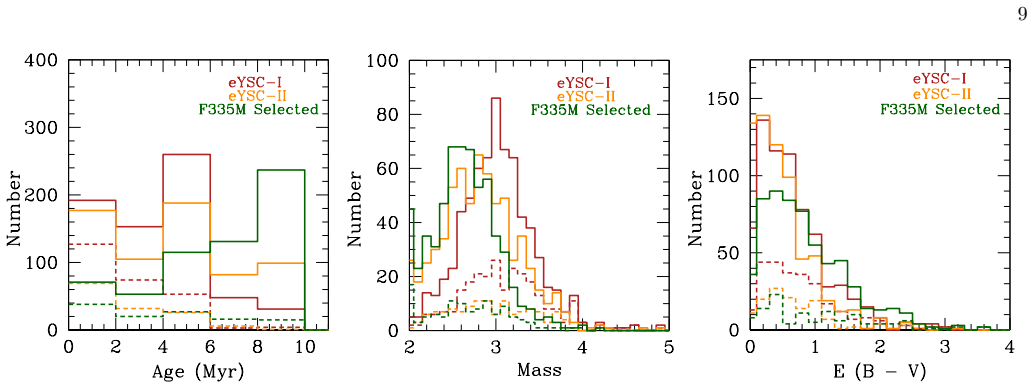
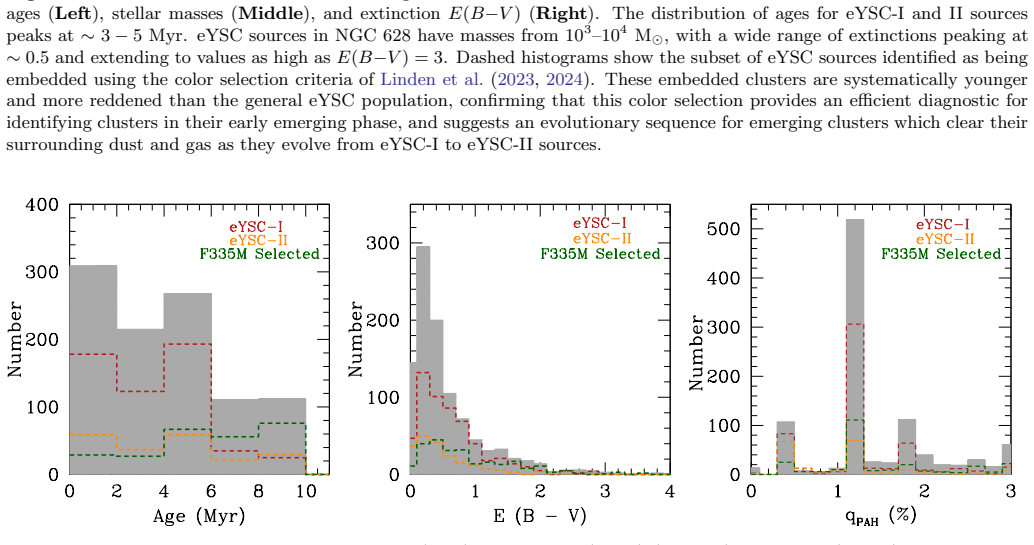
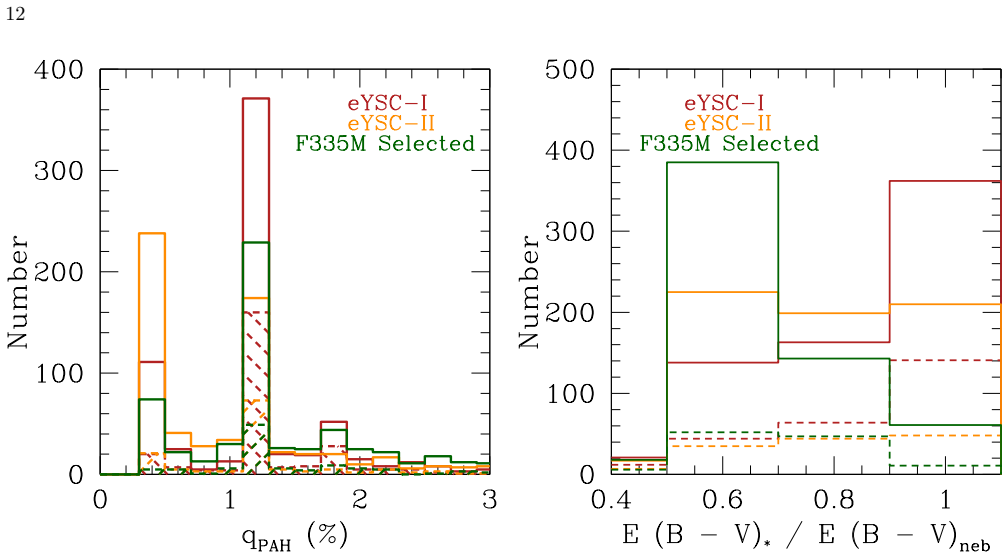
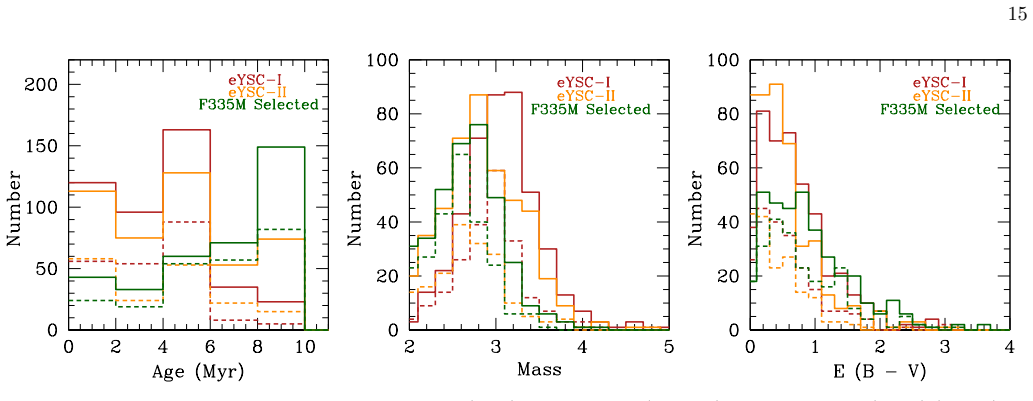
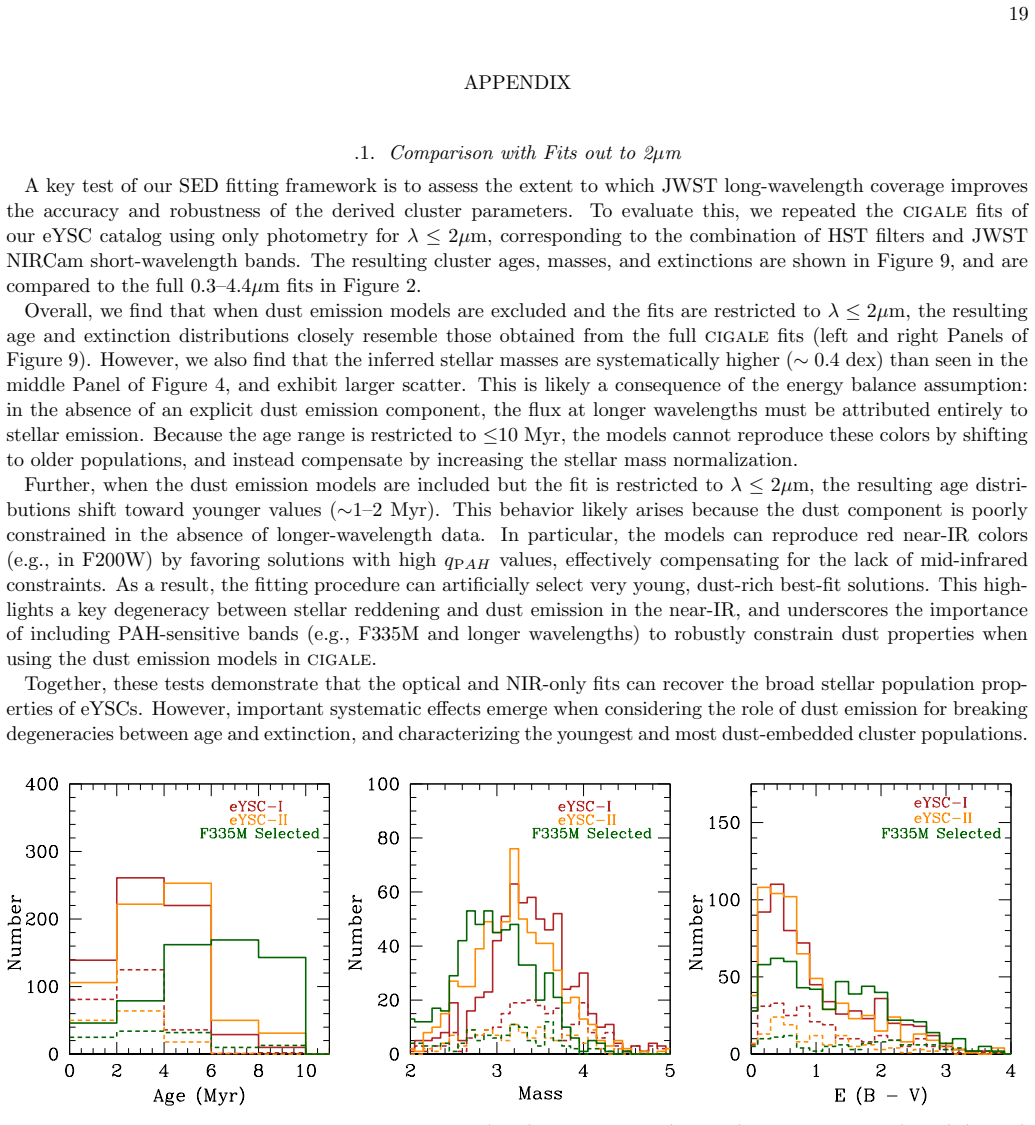
SED fitting with CIGALE on HST and JWST data from 0.3 to 7.7 microns shows eYSC-I and eYSC-II populations peak at 3-5 Myr, with 12 percent having E(B-V) > 2. Distributions of q_PAH and the stellar-to-nebular attenuation ratio E(B-V)_star/E(B-V)_neb indicate an evolutionary sequence from eYSC-I to eYSC-II. The ratio of eYSC-I to optically visible clusters implies a PDR clearing timescale of ~4 Myr. Spiral-arm clusters are preferentially more massive and dust-reddened, and ~65 percent of eYSC-I align with F770W peaks.
What carries the argument
The number ratio of eYSC-I sources to optically visible stellar clusters, which directly yields the photo-dissociation region clearing timescale of ~4 Myr.
If this is right
- Spiral-arm clusters form more massive and dust-reddened than inter-arm clusters.
- ~65% of eYSC-I, ~27% of eYSC-II, and ~40% of F335M sources coincide with F770W peaks, confirming they trace the youngest regions.
- The evolutionary sequence from eYSC-I to eYSC-II follows from shifts in PAH fraction and attenuation ratio as dust clears.
- JWST data plus CIGALE grids can isolate the brief embedded phase of cluster emergence.
Where Pith is reading between the lines
- The same ratio method could be applied to other galaxies to test whether the 4 Myr clearing time is universal.
- The arm-interarm mass and reddening difference may reflect higher gas densities driving more embedded formation in arms.
- Higher-resolution or spectroscopic follow-up could confirm whether the q_PAH and attenuation trends hold across the full cluster population.
Load-bearing premise
That the CIGALE SED model grids accurately represent the physical properties of young, dust-embedded star clusters without significant systematic biases in derived ages, extinctions, or evolutionary classifications.
What would settle it
Spectroscopic age measurements that fail to show eYSC-I and eYSC-II populations peaking at 3-5 Myr, or a number ratio of eYSC-I to visible clusters that deviates from the value expected for a 4 Myr clearing time under steady formation.
Figures
read the original abstract
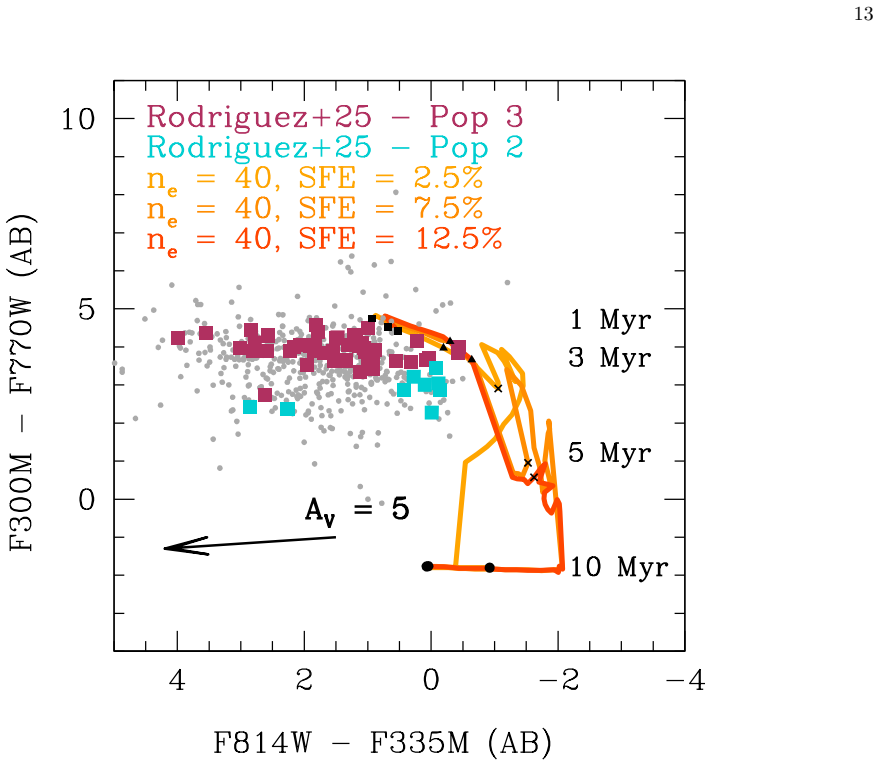
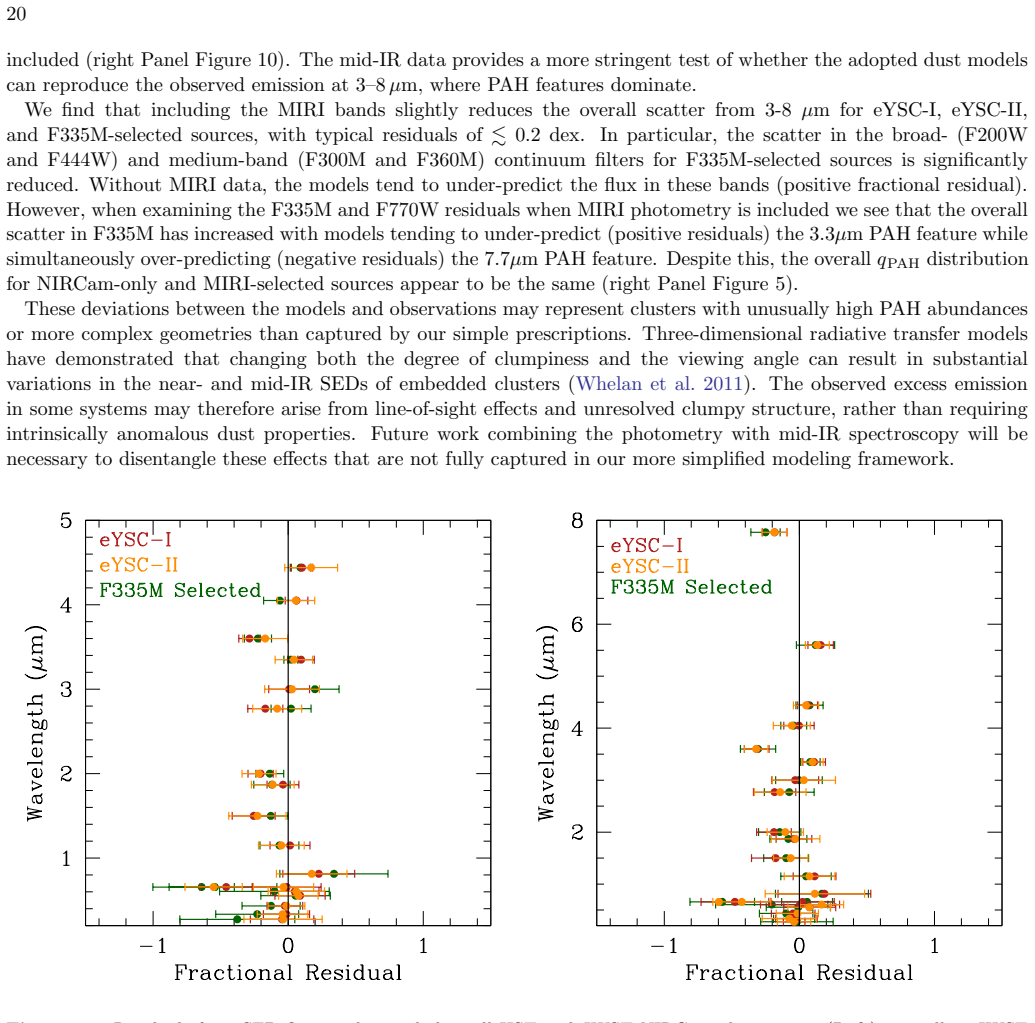
With Hubble Space Telescope (HST) and James Webb Space Telescope (JWST) observations of NGC~628 spanning 0.3--7.7\,$\mu$m, we fit the spectral energy distributions (SEDs) of over 12,000 optically-selected star clusters, emerging young star clusters (eYSCs), and MIRI-selected sources with \textsc{cigale} to derive their ages, masses, extinctions, and dust properties. We find that near-infrared selected eYSC-I (compact Pa$\alpha$ and 3.3,$\mu$m PAH emission) and eYSC-II (compact Pa$\alpha$ and diffuse 3.3,$\mu$m PAH emssion) sources peak at $\sim$3--5~Myr, where $\sim 12\%$ of the clusters have an $E(B{-}V)>2$, demonstrating the presence of dust-embedded populations as clusters emerge. Further, the distributions of the fractional polycyclic aromatic hydrocarbon (PAH) abundance ($q_{\mathrm PAH}$) and stellar-to-nebular attenuation ratio ($E(B{-}V)_{{\rm \star}}/E(B{-}V)_{\rm neb}$) suggest an evolutionary sequence in which sources evolve from eYSC-I to eYSC-II as clusters clear their surrounding dust and gas. The photo-dissociation region (PDR) clearing timescale inferred from the ratio of eYSC-I to optically visible stellar clusters is $\sim$4~Myr. Additionally, we find that star clusters in the spiral arms of NGC 628 are preferentially more massive and more dust-reddened than those in inter-arm regions.~Finally, we find that $\sim$65\% of eYSC-I, $\sim$27\% of eYSC-II, and $\sim$40\% of F335M-selected sources coincide with an F770W peak in our MIRI-selected catalog within 4 pixels, confirming that F770W-bright sources preferentially trace the youngest and dustiest regions. Overall, our results highlight the ability of JWST together with \textsc{cigale} model grids to identify and characterize eYSCs during their short-lived embedded phases, and provide constraints on the feedback mechanisms that govern the emergence of stellar clusters.
Editorial analysis
A structured set of objections, weighed in public.
Referee Report
Summary. The manuscript fits SEDs of over 12,000 star clusters, eYSCs, and MIRI sources in NGC 628 using CIGALE on 0.3–7.7 μm HST/JWST photometry. It reports ages, masses, extinctions, and dust properties, with eYSC-I and eYSC-II populations peaking at ∼3–5 Myr and ∼12% of clusters having E(B−V)>2. The paper infers a ∼4 Myr PDR clearing timescale from the eYSC-I to optically visible cluster ratio, proposes an evolutionary sequence from the q_PAH and E(B−V)_star/E(B−V)_neb distributions, notes arm/inter-arm differences, and reports spatial coincidences with F770W peaks.
Significance. If the CIGALE-derived parameters and classifications are robust, the large sample and JWST-enabled identification of embedded phases provide useful empirical constraints on cluster feedback and emergence timescales. The multi-wavelength coverage and focus on the short-lived embedded stage are strengths.
major comments (2)
- [Abstract] Abstract: the PDR clearing timescale of ∼4 Myr is inferred directly from the observed ratio of eYSC-I to optically visible clusters; this ratio is load-bearing on the CIGALE age and classification assignments, yet the manuscript supplies no validation (e.g., recovery tests on mock SEDs with clumpy dust or bursty SFH) that the standard modules do not systematically bias ages or extinctions for compact, embedded sources.
- [Abstract] Abstract: the claimed evolutionary sequence from the q_PAH and E(B−V)_star/E(B−V)_neb distributions likewise rests on the fidelity of the fitted parameters; without explicit checks that the model grids (continuous/exponentially declining SFH, screen/mixed geometries) accurately recover input values for dust-embedded clusters, the sequence could be an artifact of fitting biases.
minor comments (2)
- [Abstract] Abstract: 'emssion' is a typo and should read 'emission'.
- [Abstract] Abstract: '3.3,$μm$' uses an incorrect comma separator; standard notation is 3.3 μm.
Simulated Author's Rebuttal
We thank the referee for their thoughtful review and for highlighting the importance of validating the CIGALE-derived parameters. We respond to each major comment below, providing clarification on how the classifications and inferences are supported by the data while acknowledging areas where additional discussion can be added.
read point-by-point responses
-
Referee: [Abstract] Abstract: the PDR clearing timescale of ∼4 Myr is inferred directly from the observed ratio of eYSC-I to optically visible clusters; this ratio is load-bearing on the CIGALE age and classification assignments, yet the manuscript supplies no validation (e.g., recovery tests on mock SEDs with clumpy dust or bursty SFH) that the standard modules do not systematically bias ages or extinctions for compact, embedded sources.
Authors: The eYSC-I population is defined observationally by the presence of compact Paα and 3.3 μm PAH emission, independent of the CIGALE age or extinction outputs. The PDR clearing timescale is derived from the ratio of the number of these observationally selected eYSC-I sources to the number of optically visible clusters; the CIGALE ages are reported separately and show a peak at 3–5 Myr that is consistent with the selection but not required for the ratio itself. We agree that explicit mock recovery tests for clumpy dust geometries would strengthen confidence in the fitted parameters for the most embedded sources. In the revised manuscript we will add a dedicated paragraph discussing the applicability of the standard CIGALE modules to embedded clusters and citing existing validation studies in the literature. revision: partial
-
Referee: [Abstract] Abstract: the claimed evolutionary sequence from the q_PAH and E(B−V)_star/E(B−V)_neb distributions likewise rests on the fidelity of the fitted parameters; without explicit checks that the model grids (continuous/exponentially declining SFH, screen/mixed geometries) accurately recover input values for dust-embedded clusters, the sequence could be an artifact of fitting biases.
Authors: The q_PAH and stellar-to-nebular attenuation ratio distributions are indeed outputs of the CIGALE fits. However, the proposed evolutionary sequence is also corroborated by the independent observational distinction between eYSC-I (compact PAH) and eYSC-II (diffuse PAH) sources. We acknowledge that the current manuscript does not present dedicated recovery tests using mock SEDs with the exact model grid choices for highly embedded objects. We will therefore expand the methods and discussion sections to include a brief assessment of possible fitting biases for dust-embedded clusters and to note how the multi-wavelength constraints (including the Paα and PAH imaging) help mitigate such biases. revision: yes
Circularity Check
No circularity: standard SED fitting to independent multi-band observations yields derived properties and ratios
full rationale
The derivation chain begins with direct observational classifications (eYSC-I/II defined by compact Paα + 3.3 μm PAH features) and number counts from HST/JWST imaging, followed by CIGALE fits to the same independent photometry to extract ages, E(B-V), q_PAH, and attenuation ratios. The ~4 Myr PDR timescale is computed from the observed eYSC-I to optically visible cluster ratio; the evolutionary sequence is read from the empirical distributions of fitted q_PAH and E(B-V)_star/E(B-V)_neb. None of these steps reduce a claimed prediction to a fitted input by construction, invoke self-citation for a uniqueness theorem, or smuggle an ansatz. The analysis is self-contained against external data and standard model grids.
Axiom & Free-Parameter Ledger
free parameters (4)
- cluster age
- stellar mass
- E(B-V) extinction
- q_PAH
axioms (2)
- domain assumption CIGALE model grids provide unbiased representations of the SEDs of star clusters aged 1-10 Myr with varying dust content.
- domain assumption Source selection criteria reliably identify star clusters in NGC 628 rather than contaminants or background objects.
Reference graph
Works this paper leans on
-
[1]
, archivePrefix = "arXiv", eprint =
Fermi Large Area Telescope observations of Local Group galaxies: detection of M 31 and search for M 33. , archivePrefix = "arXiv", eprint =. doi:10.1051/0004-6361/201015759 , adsurl =
-
[2]
Observations of the Large Magellanic Cloud with Fermi. , keywords =. doi:10.1051/0004-6361/200913474 , adsurl =
-
[3]
, archivePrefix = "arXiv", eprint =
An anomalous positron abundance in cosmic rays with energies 1.5-100GeV. , archivePrefix = "arXiv", eprint =. doi:10.1038/nature07942 , adsurl =
-
[4]
Physical Review Letters , keywords =
First Result from the Alpha Magnetic Spectrometer on the International Space Station: Precision Measurement of the Positron Fraction in Primary Cosmic Rays of 0.5-350 GeV. Physical Review Letters , keywords =. doi:10.1103/PhysRevLett.110.141102 , adsurl =
-
[5]
Physical Review Letters , keywords =
Electron and Positron Fluxes in Primary Cosmic Rays Measured with the Alpha Magnetic Spectrometer on the International Space Station. Physical Review Letters , keywords =. doi:10.1103/PhysRevLett.113.121102 , adsurl =
-
[6]
, eprint =
Broad-band diffuse gamma ray emission of the galactic disk. , eprint =
-
[7]
The X-Ray Spectral Properties of SCUBA Galaxies. , eprint =. doi:10.1086/444342 , adsurl =
-
[8]
A refined model for spinning dust radiation. , archivePrefix = "arXiv", eprint =. doi:10.1111/j.1365-2966.2009.14599.x , adsurl =
-
[9]
Near-Infrared and Star-forming Properties of Local Luminous Infrared Galaxies. , eprint =. doi:10.1086/506958 , adsurl =
-
[10]
Dust in radio galaxies and quasars
Far-infrared/millimetre emission in 3C sources. Dust in radio galaxies and quasars. , eprint =. doi:10.1051/0004-6361:20011509 , adsurl =
-
[11]
, archivePrefix = "arXiv", eprint =
Common-Resolution Convolution Kernels for Space- and Ground-Based Telescopes. , archivePrefix = "arXiv", eprint =. doi:10.1086/662219 , adsurl =
-
[12]
ArXiv e-prints , archivePrefix = "arXiv", eprint =
Large gas reservoirs and free-free emission in two lensed star-forming galaxies at z=2.7. ArXiv e-prints , archivePrefix = "arXiv", eprint =
-
[13]
Multicolor optical imaging of powerful far-infrared galaxies - More evidence for a link between galaxy mergers and far-infrared emission. , keywords =. doi:10.1086/114517 , adsurl =
-
[14]
The detection of Wolf-Rayet stars in a very powerful far-infrared galaxy - Direct evidence for a starburst. , keywords =. doi:10.1086/185120 , adsurl =
-
[15]
Long-slit optical spectroscopy of powerful far-infrared galaxies - The nature of the nuclear energy source. , keywords =. doi:10.1086/168164 , adsurl =
-
[16]
The optical emission-line nebulae of powerful far-infrared galaxies. , keywords =. doi:10.1086/169431 , adsurl =
-
[17]
Observations of Ultraluminous Infrared Galaxies with the Infrared Spectrograph on the Spitzer Space Telescope. II. The IRAS Bright Galaxy Sample. , eprint =. doi:10.1086/510107 , adsurl =
-
[18]
The Large Area Telescope on the Fermi Gamma-Ray Space Telescope Mission. , archivePrefix = "arXiv", eprint =. doi:10.1088/0004-637X/697/2/1071 , adsurl =
-
[19]
The molecular bar and star formation in the nucleus of NGC 6946. , keywords =. doi:10.1086/184559 , adsurl =
-
[20]
, archivePrefix = "arXiv", eprint =
A Highly Complete Spectroscopic Survey of the GOODS-N Field1,. , archivePrefix = "arXiv", eprint =. doi:10.1086/592735 , adsurl =
-
[21]
, archivePrefix = "arXiv", eprint =
Magnetism in the spiral galaxy NGC 6946: magnetic arms, depolarization rings, dynamo modes, and helical fields. , archivePrefix = "arXiv", eprint =. doi:10.1051/0004-6361:20066988 , adsurl =
-
[22]
Astronomische Nachrichten , eprint =
Revised equipartition and minimum energy formula for magnetic field strength estimates from radio synchrotron observations. Astronomische Nachrichten , eprint =. doi:10.1002/asna.200510366 , adsurl =
-
[23]
Evidence for Reionization at z\ 6: Detection of a Gunn-Peterson Trough in a z=6.28 Quasar. , eprint =. doi:10.1086/324231 , adsurl =
-
[24]
Estimating Star Formation Rates from Infrared and Radio Luminosities: The Origin of the Radio-Infrared Correlation. , eprint =. doi:10.1086/367829 , adsurl =
-
[25]
, archivePrefix = "arXiv", eprint =
The identification of dust heating mechanisms in nearby galaxies using Herschel 160/250 and 250/350 m surface brightness ratios. , archivePrefix = "arXiv", eprint =. doi:10.1093/mnras/stu1841 , adsurl =
-
[26]
Investigations of dust heating in M81, M83 and NGC 2403 with the Herschel Space Observatory. , archivePrefix = "arXiv", eprint =. doi:10.1111/j.1365-2966.2011.19735.x , adsurl =
-
[27]
, archivePrefix = "arXiv", eprint =
The Herschel Space Observatory view of dust in M81. , archivePrefix = "arXiv", eprint =. doi:10.1051/0004-6361/201014568 , adsurl =
-
[28]
Kinetic theory of cosmic rays and gamma rays in supernova remnants. I. Uniform interstellar medium. Astroparticle Physics , year = 1997, month = aug, volume = 7, pages =. doi:10.1016/S0927-6505(97)00016-9 , adsurl =
-
[29]
The 60 micron to 20 centimeter infrared-to-radio ratio within spiral galaxies. , keywords =. doi:10.1086/169243 , adsurl =
-
[30]
High-resolution radio observations of submillimetre galaxies. , archivePrefix = "arXiv", eprint =. doi:10.1111/j.1365-2966.2008.12869.x , adsurl =
-
[31]
The CO-to-H _ 2 Conversion Factor. , archivePrefix = "arXiv", eprint =. doi:10.1146/annurev-astro-082812-140944 , adsurl =
work page internal anchor Pith review doi:10.1146/annurev-astro-082812-140944
-
[32]
, archivePrefix = "arXiv", eprint =
Tracking the impact of environment on the galaxy stellar mass function up to z \ 1 in the 10 k zCOSMOS sample. , archivePrefix = "arXiv", eprint =. doi:10.1051/0004-6361/200912801 , adsurl =
-
[33]
The Hubble Deep Field North SCUBA Super-map - I. Submillimetre maps, sources and number counts. , eprint =. doi:10.1046/j.1365-8711.2003.06818.x , adsurl =
-
[34]
Submillimeter to centimeter excess emission from the Magellanic Clouds. II. On the nature of the excess. , archivePrefix = "arXiv", eprint =. doi:10.1051/0004-6361/201014986 , adsurl =
-
[35]
Galactic hydrostatic equilibrium with magnetic tension and cosmic-ray diffusion. , keywords =. doi:10.1086/169509 , adsurl =
-
[36]
, archivePrefix = "arXiv", eprint =
UV Luminosity Functions at z\ 4, 5, and 6 from the Hubble Ultra Deep Field and Other Deep Hubble Space Telescope ACS Fields: Evolution and Star Formation History. , archivePrefix = "arXiv", eprint =. doi:10.1086/521811 , adsurl =
-
[37]
, archivePrefix = "arXiv", eprint =
z \ 7-10 Galaxies in the HUDF and GOODS Fields: UV Luminosity Functions. , archivePrefix = "arXiv", eprint =. doi:10.1086/590103 , adsurl =
-
[38]
, archivePrefix = "arXiv", eprint =
UV Continuum Slope and Dust Obscuration from z \ 6 to z \ 2: The Star Formation Rate Density at High Redshift. , archivePrefix = "arXiv", eprint =. doi:10.1088/0004-637X/705/1/936 , adsurl =
-
[39]
Society of Photo-Optical Instrumentation Engineers (SPIE) Conference Series , year = 2010, series =
The background-limited infrared-submillimeter spectrograph (BLISS) for SPICA: a design study. Society of Photo-Optical Instrumentation Engineers (SPIE) Conference Series , year = 2010, series =. doi:10.1117/12.857779 , adsurl =
-
[40]
A molecular gas bridge between the Taffy galaxies. , eprint =. doi:10.1051/0004-6361:20031148 , adsurl =
-
[41]
The Mid-Infrared Properties of Starburst Galaxies from Spitzer-IRS Spectroscopy. , eprint =. doi:10.1086/508849 , adsurl =
-
[42]
The Westerbork SINGS survey. I. Overview and image atlas. , eprint =. doi:10.1051/0004-6361:20066092 , adsurl =
-
[43]
Stellar population synthesis at the resolution of 2003. , eprint =. doi:10.1046/j.1365-8711.2003.06897.x , adsurl =
-
[44]
Stellar Populations as Building Blocks of Galaxies , year = 2007, series =
On TP-AGB stars and the mass of galaxies. Stellar Populations as Building Blocks of Galaxies , year = 2007, series =. doi:10.1017/S1743921307007624 , adsurl =
-
[45]
The Local Universe as Seen in the Far-Infrared and Far-Ultraviolet: A Global Point of View of the Local Recent Star Formation. , eprint =. doi:10.1086/516645 , adsurl =
-
[46]
Measures of star formation rates from infrared (Herschel) and UV (GALEX) emissions of galaxies in the HerMES fields. , archivePrefix = "arXiv", eprint =. doi:10.1111/j.1745-3933.2010.00916.x , adsurl =
-
[47]
, archivePrefix = "arXiv", eprint =
Spectral energy distributions of an AKARI-SDSS-GALEX sample of galaxies. , archivePrefix = "arXiv", eprint =. doi:10.1051/0004-6361/201015944 , adsurl =
-
[48]
, archivePrefix = "arXiv", eprint =
Herschel PEP/HerMES: the redshift evolution (0 z 4) of dust attenuation and of the total (UV+IR) star formation rate density. , archivePrefix = "arXiv", eprint =. doi:10.1051/0004-6361/201321651 , adsurl =
-
[49]
Advances in Space Research , year = 2008, month = aug, volume = 42, pages =
The variability of the proton cosmic ray flux on the Sun s way around the galactic center. Advances in Space Research , year = 2008, month = aug, volume = 42, pages =. doi:10.1016/j.asr.2007.05.051 , adsurl =
-
[50]
A determination of the spectra of Galactic components observed by the Wilkinson Microwave Anisotropy Probe. , eprint =. doi:10.1111/j.1365-2966.2006.10572.x , adsurl =
-
[51]
The Dust Content and Opacity of Actively Star-forming Galaxies. , eprint =. doi:10.1086/308692 , adsurl =
work page internal anchor Pith review doi:10.1086/308692
-
[52]
The Dust Opacity of Star-forming Galaxies. , eprint =. doi:10.1086/324269 , adsurl =
-
[53]
Star Formation in NGC 5194 (M51a): The Panchromatic View from GALEX to Spitzer. , eprint =. doi:10.1086/466518 , adsurl =
-
[54]
The Calibration of Mid-Infrared Star Formation Rate Indicators. , archivePrefix = "arXiv", eprint =. doi:10.1086/520082 , adsurl =
-
[55]
Spitzer Observations of the Supergiant Shell Region in IC 2574. , eprint =. doi:10.1086/491671 , adsurl =
-
[56]
Warm Dust and Spatially Variable Polycyclic Aromatic Hydrocarbon Emission in the Dwarf Starburst Galaxy NGC 1705. , eprint =. doi:10.1086/505339 , adsurl =
-
[57]
, archivePrefix = "arXiv", eprint =
Spectroscopic Confirmation of an Extreme Starburst at Redshift 4.547. , archivePrefix = "arXiv", eprint =. doi:10.1086/590555 , adsurl =
-
[58]
, keywords =
Extinction and reddening of H II regions in the Large Magellanic Cloud. , keywords =
-
[59]
The Infrared Luminosity Function of Galaxies at Redshifts z = 1 and z \ 2 in the GOODS Fields. , eprint =. doi:10.1086/512667 , adsurl =
-
[60]
, archivePrefix = "arXiv", eprint =
Cosmic-ray acceleration in supernova remnants: non-linear theory revised. , archivePrefix = "arXiv", eprint =. doi:10.1088/1475-7516/2012/07/038 , adsurl =
-
[61]
Comparison of different methods for non-linear diffusive shock acceleration. , archivePrefix = "arXiv", eprint =. doi:10.1111/j.1365-2966.2010.17013.x , adsurl =
-
[62]
The gas content of peculiar galaxies: Strongly interacting systems. , eprint =. doi:10.1051/0004-6361:20040283 , adsurl =
-
[63]
Molecular Gas in NUclei of GAlaxies (NUGA). XIV. The barred LINER/Seyfert 2 galaxy NGC 3627. , archivePrefix = "arXiv", eprint =. doi:10.1051/0004-6361/201015680 , adsurl =
-
[64]
, archivePrefix = "arXiv", eprint =
The resolved star-formation relation in nearby active galactic nuclei. , archivePrefix = "arXiv", eprint =. doi:10.1051/0004-6361/201425313 , adsurl =
-
[65]
Galactic Stellar and Substellar Initial Mass Function
Galactic Stellar and Substellar Initial Mass Function. , eprint =. doi:10.1086/376392 , adsurl =
work page internal anchor Pith review doi:10.1086/376392
-
[66]
Hubble Space Telescope Images of Submillimeter Sources: Large Irregular Galaxies at High Redshift. , eprint =. doi:10.1086/379120 , adsurl =
-
[67]
, archivePrefix = "arXiv", eprint =
Do Submillimeter Galaxies Really Trace the Most Massive Dark-Matter Halos? Discovery of a High-z Cluster in a Highly Active Phase of Evolution. , archivePrefix = "arXiv", eprint =. doi:10.1088/0004-637X/691/1/560 , adsurl =
-
[68]
Herschel-SPIRE, far-infrared properties of millimetre-bright and -faint radio galaxies. , archivePrefix = "arXiv", eprint =. doi:10.1111/j.1745-3933.2010.00956.x , adsurl =
-
[69]
, archivePrefix = "arXiv", eprint =
The Stellar Initial Mass Function at the Epoch of Reionization. , archivePrefix = "arXiv", eprint =. doi:10.1086/587737 , adsurl =
-
[70]
Interpreting the Cosmic Infrared Background: Constraints on the Evolution of the Dust-enshrouded Star Formation Rate. , eprint =. doi:10.1086/321609 , adsurl =
-
[71]
ArXiv e-prints , archivePrefix = "arXiv", eprint =
New Observational Constraints and Modeling of the Infrared Background: Dust Obscured Star-Formation at z 1 and Dust in the Outer Solar System. ArXiv e-prints , archivePrefix = "arXiv", eprint =
-
[72]
, archivePrefix = "arXiv", eprint =
The bandmerged Planck Early Release Compact Source Catalogue: probing sub-structure in the molecular gas at high Galactic latitude. , archivePrefix = "arXiv", eprint =. doi:10.1093/mnras/stw479 , adsurl =
-
[73]
Kinematic structure of the 30 Doradus giant H II region. , keywords =. doi:10.1086/174017 , adsurl =
-
[74]
Planetary Nebulae as Standard Candles. XII. Connecting the Population I and Population II Distance Scales. , eprint =. doi:10.1086/342180 , adsurl =
-
[75]
, archivePrefix = "arXiv", eprint =
Hubble Space Telescope Emission Line Galaxies at z \ 2: The Ly Escape Fraction. , archivePrefix = "arXiv", eprint =. doi:10.1088/0004-637X/796/1/64 , adsurl =
-
[76]
, keywords =
The ISO Long-Wavelength Spectrometer. , keywords =
-
[77]
Modeling the spectral energy distribution of ULIRGs. I. The radio spectra. , archivePrefix = "arXiv", eprint =. doi:10.1051/0004-6361:20077224 , adsurl =
-
[78]
Starburst evolution: free-free absorption in the radio spectra of luminous IRAS galaxies. , archivePrefix = "arXiv", eprint =. doi:10.1111/j.1365-2966.2010.16534.x , adsurl =
-
[79]
The VLA-COSMOS 3 GHz Large Project: Average radio spectral energy distribution of highly star-forming galaxies. , keywords =. doi:10.1051/0004-6361/201834002 , archivePrefix =. 1812.03392 , primaryClass =
work page internal anchor Pith review Pith/arXiv arXiv doi:10.1051/0004-6361/201834002
-
[80]
Redshift Clustering in the Hubble Deep Field. , eprint =. doi:10.1086/310330 , adsurl =
discussion (0)
Sign in with ORCID, Apple, or X to comment. Anyone can read and Pith papers without signing in.