REVIEW 2 major objections 6 minor 56 references
Reservoir engineering of Cooper-pair-assisted transport with cold atoms
T0 review · 2 major / 6 minor · reviewed 2026-08-14 · deepseek-v4-flash
Pith's one-line read Coupling a single-site cold-atom junction to a molecular BEC produces Cooper-pair-assisted transport peaks at \Delta\mu = |U|/(2k+1).
desk verdict Careful, honest proposal for Andreev-like atomic transport in cold atoms; the central peak prediction is leading-order and needs a serious check of the neglected Lamb shift. read the letter →
The pith
A machine-rendered reading of the paper's core claim, the machinery that carries it, and where it could break.
The reading
What carries the argument
The load-bearing object is the Floquet-Redfield master equation, a Born-Markov Redfield equation for the driven junction written in the basis of its Floquet modes. It keeps the on-site Hubbard interaction U exact and avoids the secular approximation, so it captures coherences between Floquet states. The molecular BEC enters as a periodic drive H_{\rm BEC}(t)=\sum_l(g_l $e^{{i\delta_l t}}$ c_\downarrow c_\uparrow + \mathrm{h.c.}) with detunings \delta_L=2\mu_L and \delta_R=2\mu_R, whose period T=2\pi/\$\Delta$\mu sets the Floquet ladder; tunnelling rates are evaluated at quasienergy differences E_a-E_b+k\$\Delta$\mu, which is how k molecular conversions become resonant. The resonant condition \mu_L+k\$\Delta$\mu=|U|/2 then yields the peak positions.
What would settle it
Measure the steady-state current-bias curve of a single-site junction with local interaction U and molecular-BEC coupling g, at temperature small compared with the junction frequency and with tunnelling rates small compared with the reservoir chemical potentials. The claim predicts resolved peaks at \$\Delta$\mu=|U|, |U|/3, |U|/5, \dots; if no peaks appear at those positions, or an exact non-Markovian calculation of the same model shifts them, the central claim fails.
Extended reading notes
Core claim
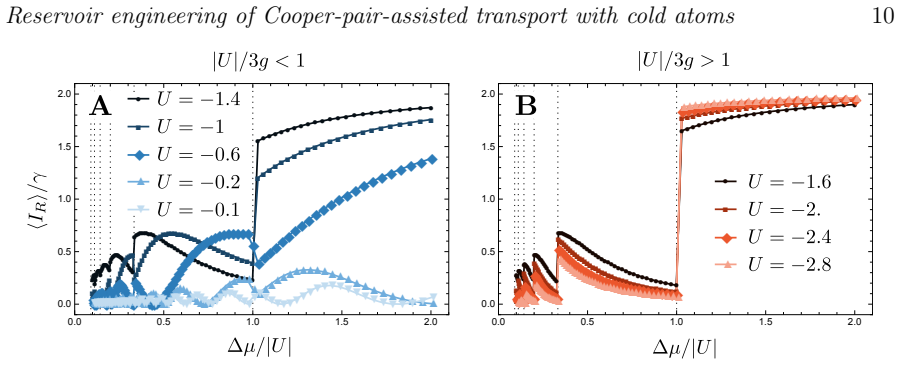
The central claim is that the steady-state particle current through a driven single-site junction connecting two normal, non-interacting Fermi reservoirs develops sharp resonances at chemical-potential bias \$\Delta$\mu = |U|/(2k+1), with k\in\mathbb{N}, where U<0 is the attractive on-site interaction. These peaks follow from the resonant condition \mu_L + k\$\Delta$\mu = |U|/2, which matches the energy of an incoming atom plus k times the energy supplied by converting a BEC molecule into a pair and back; each peak corresponds to a k-th-order multiple Andreev reflection. Because the reservoirs contain neither pairs nor interactions, the assisted current is generated entirely by the molecular BEC and the two radio-frequency drives, so the setup demonstrates that Cooper-pair-assisted transport can be engineered from scratch in cold atoms. The authors further find an optimal interaction strength |U|/3 \approx g for maximal, well-resolved peaks, that finite reservoir temperature broadens and eventually erases the peaks, and that the assisted current is comparatively insensitive to local particle losses.
Load-bearing premise
Everything rests on assuming the junction forgets its past quickly enough that a memory-free master equation gives the correct steady state; the paper offers this as an expectation rather than a quantitative check, so significant non-Markovian corrections would shift or blur the predicted current peaks.
Editorial extensions
If this is right
- At zero temperature the current-bias curve changes from a single step at \Delta\mu=|U| into a peak structure at \Delta\mu=|U|/(2k+1), so the junction conducts at biases well below the bare interaction threshold.
- Each peak can be labelled by the order k of multiple Andreev reflection, and increasing the BEC coupling strength g increases the peak amplitudes.
- Finite reservoir temperature broadens the peaks, and at high temperature the driven and undriven currents become indistinguishable, so the effect requires temperatures small compared with the junction frequency.
- There is an optimal interaction strength |U|/3 \approx g where the Andreev peaks are largest and best resolved; for larger |U| the assisted current is suppressed back toward the undriven value, modifying the common assumption that interaction always harms Andreev transport.
- The assisted current is comparatively insensitive to local particle loss even when the loss rate is comparable to the tunnelling rate, while the ordinary sequential-tunnelling current is reduced.
- The assisted current is comparatively insensitive to local particle loss even when the loss rate is comparable to the tunnelling rate, while the ordinary sequential-tunnelling current is reduced.
Reading between the lines
- A natural extension the authors do not pursue is to read the peak spacing as a direct in-situ measurement of the local interaction U: the k=0 peak sits at |U| and the higher peaks at |U|/3, |U|/5, so observing several peaks fixes both U and the bias scale without separate calibration.
- Because the assisted current survives particle loss that suppresses the sequential current, one could intentionally engineer losses to create a dissipative switch that passes only Andreev-assisted atoms; the paper models losses as a diagnostic but stops short of proposing this use.
- The bath correlation functions decay only algebraically at zero temperature, so non-Markovian corrections, if present, should show up first at the lowest-bias high-order peaks where \mu_L is small; a direct comparison with an exact memory-kernel calculation would test the authors' steady-state Redfield assumption.
Signed reviews
Editorial analysis
A structured set of objections, weighed in public.
Referee Report
Summary. The paper proposes a cold-atom realization of Cooper-pair-assisted transport. The model consists of two non-interacting fermionic reservoirs connected by a single-site junction that is also coupled to a molecular BEC via two radio-frequency drives tuned to twice the reservoir chemical potentials. The authors derive a Floquet-Redfield master equation for the junction, treating the on-site interaction exactly, and use it to compute the steady-state atomic current into the right reservoir. The central prediction is a series of current peaks at chemical-potential biases Δμ = |U|/(2k+1), which they interpret as multiple Andreev reflections assisted by molecular conversion. The paper also studies the effects of finite temperature, on-site interaction strength, and additional particle losses, and gives an experimental implementation estimate for 6Li.
Significance. If the central prediction holds, the paper is significant: it offers a concrete, falsifiable cold-atom analogue of Andreev transport without requiring pairing correlations in the reservoirs, and it provides a detailed open-quantum-system derivation with an exact treatment of the junction interaction. The explicit benchmark against the analytic undriven limit (Eq. 15), the convergence checks in Appendix B.4, and the concrete experimental parameters in Sec. 4 are notable strengths. The main quantitative claim, however, rests on approximations in the master equation that are acknowledged but not quantitatively controlled, so the paper as written does not yet fully establish Eq. (17).
major comments (2)
- [Appendix A.4, Eq. (A.24)] The Lamb shifts Ω_{l±}(E) are omitted with the argument that they are proportional to γ and therefore small. This is not quantitatively controlled near the higher-order peaks of Eq. (17). For the parameters of Fig. 2 (γ=0.01, |U|=2), the spacing between the k=3 and k=4 peaks is about 0.064, i.e., about 6.4γ, while the logarithmic Fermi-edge contribution (γ/π) ln(W/|E+μ_l|) can reach values of order 0.02 for a wide-band cutoff W≈100|U|. That is a non-negligible fraction of the inter-peak spacing. Since Eq. (17) is a quantitative prediction of peak positions, the authors should either include the imaginary parts in the rates or provide a numerical comparison of the current with and without Ω for the plotted parameters. As it stands, the central claim is not fully demonstrated.
- [Appendix A.4] The statement that non-Markovian memory effects are not expected to affect the steady state is an assertion rather than a demonstrated result. The Markov condition γ ≪ μ_l derived in Appendix A.2 becomes marginal at the low-bias peaks: for the k=5 peak in the Fig. 2 setup, μ_l = |U|/[2(2k+1)] ≈ 0.09 with γ=0.01, giving γ/μ_l ≈ 0.11. A quantitative check, for example a comparison with a time-nonlocal master equation or an explicit perturbative estimate of the memory correction for the parameters of Fig. 2, is needed to support the use of Eq. (8) for the peak positions.
minor comments (6)
- [Sec. 3.1] The sentence 'In that case, the current (15) becomes' should reference Eq. (14), since Eq. (15) is the displayed result that follows from it.
- [Sec. 3.3 and Fig. 3] The notation '|U|/3g' is ambiguous; it should be written as |U|/(3g) consistently, both in the text and in the figure caption.
- [Eq. (17)] The index set in 'k ∈ N' should be clarified: for k=0 the feature at Δμ=|U| is a step in the undriven limit rather than a peak, so the authors should specify whether k=0 is included or restrict to k≥1.
- [Appendix A.2, Eq. (A.12)] The notation B_z(a,b) for the incomplete beta function should be defined explicitly or the expression corrected, since the argument structure is not standard.
- [Fig. 2 caption] The caption says 'different driving amplitudes g' but does not list the numerical values; specifying the values would make the figure reproducible from the text alone.
- [Sec. 3.3] The claim that the optimal interaction regime |U|/3 ∼ g was confirmed for other values of g is supported only by 'not shown' data; this statement should either be removed or backed by a supplementary plot.
Circularity Check
No meaningful circularity: the Andreev-peak positions are derived from the Floquet-Redfield solution of the model Hamiltonian, not fitted; the cited formalism [30] is re-derived in the appendix and is non-load-bearing.
full rationale
The paper's central claim, Eq. (17), predicts current peaks at Δμ = |U|/(2k+1). These peak positions are not taken as inputs; they are derived by solving the periodically driven Anderson-impurity model. Appendix A contains a self-contained derivation of the Floquet-Redfield master equation from the Born-Markov approximation, the bath correlation functions of Eqs. (A.9), and the numerically computed Floquet quasienergies of Eqs. (A.13)-(A.16). The resonance condition of Eq. (18), μ_L + kΔμ = |U|/2, follows algebraically from the choice μ_L = -μ_R = Δμ/2 together with the Floquet sideband resonance condition, not from fitting the computed current. The undriven limit of Eq. (15) provides an independent analytic check against sequential tunneling. The self-citation to [30] for the Floquet-Redfield formalism is non-load-bearing because the formalism is re-derived in Appendix A, and the BEC-coupling term is motivated by [21] rather than assumed as an unexplained input. The appendix explicitly notes two limitations: the principal-value shifts Ω_{l±}(E) are neglected ('we anyway neglected these shifts'), and non-Markovian memory effects are dismissed as not significant in the steady state ('we do not expect significant memory effects in its steady state properties'). These are unquantified accuracy risks that could shift or broaden the predicted peaks, but they do not make the prediction equivalent to a fitted parameter or to a self-citation. No fitted input is renamed as a prediction, no uniqueness theorem is imported from the authors, and no ansatz is smuggled in solely through citation. The derivation is therefore self-contained for the purposes of the paper's central transport predictions, with the caveat about Markovian and Lamb-shift corrections noted as a correctness risk rather than a circular step.
Assumptions & free parameters
free parameters (4)
- U (interaction strength) =
-2 (with ω=-U/2)
- g (BEC pair-tunneling amplitude) =
0.5 (and varied 0.1-0.9 elsewhere)
- γ (reservoir tunnelling rate) =
1e-2 or 1e-3
- T (reservoir temperature) =
varied, with k_B T from 0 to values smearing peaks
assumptions (6)
- domain assumption Born-Markov approximation: total density matrix factorizes and memory effects are negligible
- domain assumption Weak coupling to reservoirs: expansion to second order in H_I
- domain assumption Molecular BEC is treated as an undepleted classical field with macroscopic occupation ⟨S⟩
- ad hoc to paper Particle-hole symmetry: 2ω+U=0
- domain assumption Reservoirs are non-interacting, normal Fermi gases in thermal states (Eq. 5)
- ad hoc to paper Lamb shifts (principal-value integrals Ω) are negligible and omitted
Cite this review
Pith. "Pith review of Reservoir engineering of Cooper-pair-assisted transport with cold atoms." pith.science (2026). https://pith.science/paper/ERXBGRQ3
@misc{pith2026190802061,
  author       = {Pith},
  title        = {Pith review of: Reservoir engineering of Cooper-pair-assisted transport with cold atoms},
  year         = {2026},
  howpublished = {\url{https://pith.science/paper/ERXBGRQ3}},
  note         = {Machine review of arXiv:1908.02061}
}
read the original abstract
We show how Cooper-pair-assisted transport, which describes the stimulated transport of electrons in the presence of Cooper-pairs, can be engineered and controlled with cold atoms, in regimes that are difficult to access for condensed matter systems. Our model is a channel connecting two cold atomic gases, and the mechanism to generate such a transport relies on the coupling of the channel to a molecular BEC, with diatomic molecules of fermionic atoms. Our results are obtained using a Floquet-Redfield master equation that accounts for an exact treatment of the interaction between atoms in the channel. We explore, in particular, the impact of the coupling to the BEC and the interaction between atoms in the junction on its transport properties, revealing non-trivial dependence of the produced particle current. We also study the effects of finite temperatures of the reservoirs and the robustness of the current against additional dissipation acting on the junction. Our work is experimentally relevant and has potential applications to dissipation engineering of transport with cold atoms, studies of thermoelectric effects, quantum heat engines, or Floquet Majorana fermions.
Figures


Figures from the paper (1 more)

Reference graph
Works this paper leans on
-
[1]
Reservoir engineering of Cooper-pair-assisted transport with cold atoms
Introduction Transport measurements between reservoirs connected by a channel are well-known tools to understand and study the static and dynamical properties of condensed matter systems. In this context, the development of cold atom platforms has offered possibilities to explore phenomena with strongly-interacting particles in transport setups. A key feat...
work page Pith review arXiv 1908
-
[2]
Model In this section, we summarise our model for a tunnel junction connecting two cold atom reservoirs. Figure 1 (A) shows a setup where two ultracold fermionic gases are connected together by a small junction. We consider two different spin states, labelled with s∈{↓ ,↑}. Transport of atoms through the junction is generated by preparing an initial chemic...
-
[3]
Transport properties Solving the master equation (8) allows us to compute the transport properties of the driven junction. We focus here on the steady state current of atoms leaving the junction to reach the right reservoir, which is defined as ⟨IR⟩ =− ∑ s=↑,↓ Tr [ c† scsLR [ρSS] ] , (13) whereLR[·] is the Liouvillian (9) for the right reservoir and ρSS th...
-
[4]
Proposed experimental implementation Here we address the details of the proposed experimental implementation and observation of the phenomena we discuss in this manuscript. We give examples of parameters currently available in experiments, basing values on 6Li atoms following [21, 1, 34, 4], and retain ℏ and kB in our expressions within this section. The ...
-
[5]
Conclusion We showed how transport of fermionic atoms through a junction connecting two cold gases can be assisted by molecular conversion with a BEC. We described such reservoir engineering using an open-system framework that we recently derived, which is able to capture the effects of finite temperature of the reservoirs, strong interaction and presence o...
-
[6]
S. Krinner, T. Esslinger, and J.-P. Brantut. Two-terminal transport measurements with cold atoms. Journal of Physics Condensed Matter , 29(34):343003, 2017
work page 2017
-
[7]
S. Krinner, D. Stadler, D. Husmann, J.-P. Brantut, and T. Esslinger. Observation of quantized conductance in neutral matter. Nature, 517(7532):64–67, 2015
work page 2015
-
[8]
D. Husmann, S. Uchino, S. Krinner, M. Lebrat, T. Giamarchi, T. Esslinger, and J.-P. Brantut. Connecting strongly correlated superfluids by a quantum point contact. Science, 350(6267):1498–1501, 2015
work page 2015
Show all 56 references
-
[9]
Lebrat, P
L. Lebrat, P. Griˇ sins, D. Husmann, S. H¨ ausler, L. Corman, T. Giamarchi, J.-P. Brantut, and T. Esslinger. Band and correlated insulators of cold fermions in a mesoscopic lattice. Phys. Rev. X, 8:011053, 2018
2018
-
[10]
Uchino, M
S. Uchino, M. Ueda, and J.-P. Brantut. Universal noise in continuous transport measurements of interacting fermions. Phys. Rev. A , 98:063619, 2018
2018
-
[11]
Wiseman and Gerard J
Howard M. Wiseman and Gerard J. Milburn. Quantum Measurement and Control . Cambridge University Press, 2009
2009
-
[12]
Gardiner and P
C. Gardiner and P. Zoller. The Quantum World of Ultra-Cold Atoms and Light Book II: The Physics of Quantum-Optical Devices . Imperial College Press, 2015
2015
-
[13]
H. J. Metcalf and P. van der Straten. Laser Cooling and Trapping . Springer, Berlin, 1999
1999
-
[14]
Gericke, P
T. Gericke, P. Wurtz, D. Reitz, T. Langen, and H. Ott. High-resolution scanning electron microscopy of an ultra- cold quantum gas. Nat. Phys. , 4:949, 2008
2008
-
[15]
Weitenberg, M
C. Weitenberg, M. Endres, J. Sherson, M. Cheneau, P. Schauß, T. Fukuhara, I. Bloch, and S. Kuhr. Single-spin addressing in an atomic mott insulator. Nature, 471:319–24, 2011
2011
-
[16]
W. S. Bakr, J. I. Gillen, A. Peng, S. F¨ olling, and M. Greiner. A quantum gas microscope for detecting single atoms in a hubbard-regime optical lattice. Nature, 462:74–7, 2009
2009
-
[17]
Sherson, C
J. Sherson, C. Weitenberg, M. Endres, M. Cheneau, I. Bloch, and S. Kuhr. Single-atom resolved fluorescence imaging of an atomic mott insulator. Nature, 467:68–72, 2010
2010
-
[18]
A. J. Daley. Quantum trajectories and open many-body quantum systems. Advances in Physics , 63(2):77–149, 2014
2014
-
[19]
H. P. L¨ uschen, P. Bordia, S. S. Hodgman, M. Schreiber, S. Sarkar, A. J. Daley, M. H. Fischer, E. Altman, I. Bloch, and U. Schneider. Signatures of Many-Body Localization in a Controlled Open Quantum System. Physical Review X , 7(1):011034, 2017. Reservoir engineering of Coop...
2017
-
[20]
Sarkar, S
S. Sarkar, S. Langer, J. Schachenmayer, and A. J. Daley. Light scattering and dissipative dynamics of many fermionic atoms in an optical lattice. Phys. Rev. A , 90(2):023618, 2014
2014
-
[21]
Pichler, A
H. Pichler, A. J. Daley, and P. Zoller. Nonequilibrium dynamics of bosonic atoms in optical lattices: Decoherence of many-body states due to spontaneous emission. Phys. Rev. A , 82(6):063605, 2010
2010
-
[22]
E. P. L. van Nieuwenburg, J. Yago Malo, A. J. Daley, and M. H. Fischer. Dynamics of many-body localization in the presence of particle loss. Quantum Science and Technology , 3(1):01LT02, 2018
2018
-
[23]
A. Andreev. Sov. Phys. JETP , 19:1228, 1964
1964
-
[24]
C. W. J. Beenakker. Random-matrix theory of quantum transport. Rev. Mod. Phys., 69:731–808, 1997
1997
-
[25]
Mart´ ın-Rodero and A
A. Mart´ ın-Rodero and A. Levy Yeyati. Josephson and andreev transport through quantum dots. Advances in Physics , 60(6):899–958, 2011
2011
-
[26]
Jiang, T
L. Jiang, T. Kitagawa, J. Alicea, A. R. Akhmerov, D. Pekker, G. Refael, J. I. Cirac, E. Demler, M. D. Lukin, and P. Zoller. Majorana fermions in equilibrium and in driven cold-atom quantum wires. Phys. Rev. Lett. , 106:220402, 2011
2011
-
[27]
Y. Yan, Z. L¨ u, and H. Zheng. Resonance fluorescence of strongly driven two-level system coupled to multiple dissipative reservoirs. Annals of Physics , 371:159–182, 2016
2016
-
[28]
Kohler, T
S. Kohler, T. Dittrich, and P. H¨ anggi. Floquet-Markovian description of the parametrically driven, dissipative harmonic quantum oscillator. Phys. Rev. E , 55(1):300–313, 1997
1997
-
[29]
Graham and R
R. Graham and R. Hubner. Generalized quasi-energies and floquet states for a dissipative system. Annals of Physics , 234(2):300 – 315, 1994
1994
-
[30]
Driven quantum tunneling
Milena Grifoni and Peter H¨ anggi. Driven quantum tunneling. Physics Reports, 304(5):229 – 354, 1998
1998
-
[31]
Lindblad
G. Lindblad. On the generators of quantum dynamical semigroups. Commun. Math. Phys. , 48(2):119–130, 1976
1976
-
[32]
Gorini, A
V. Gorini, A. Kossakowski, and E. C. G. Sudarshan. Completely positive dynamical semigroups of N-level systems. J. Math. Phys. , 17:821, 1976
1976
-
[33]
Breuer and F
H.-P. Breuer and F. Petruccione. The Theory of Open Quantum Systems . Oxford University Press, Oxford, 2006
2006
-
[34]
Blattmann, P
R. Blattmann, P. H¨ anggi, and S. Kohler. Qubit interference at avoided crossings: The role of driving shape and bath coupling. Phys. Rev. A , 91:042109, 2015
2015
-
[35]
Fran¸ cois Damanet, Eduardo Mascarenhas, David Pekker, and Andrew J. Daley. Controlling quantum transport via dissipation engineering. Phys. Rev. Lett. , 123:180402, Oct 2019
2019
-
[36]
Bruderer and W
M. Bruderer and W. Belzig. Mesoscopic transport of fermions through an engineered optical lattice connecting two reservoirs. Phys. Rev. A , 85:013623, 2012
2012
-
[37]
von der Linden, I
W. von der Linden, I. Morgenstern, and H. de Raedt. Quantum monte carlo study of quasiparticles in the hubbard model. Phys. Rev. B , 41:4669–4673, 1990
1990
-
[38]
Pasienski and B
M. Pasienski and B. DeMarco. A high-accuracy algorithm for designing arbitrary holographic atom traps. Opt. Express, 16(3):2176–2190, 2008
2008
-
[39]
Arunkumar, A
N. Arunkumar, A. Jagannathan, and J. E. Thomas. Designer Spatial Control of Interactions in Ultracold Gases. Phys. Rev. Lett. , 122:040405, 2019
2019
-
[40]
Jochim, M
S. Jochim, M. Bartenstein, A. Altmeyer, G. Hendl, S. Riedl, C. Chin, J. Hecker Denschlag, and R. Grimm. Bose-einstein condensation of molecules. Science, 302(5653):2101–2103, 2003
2003
-
[41]
Greiner, C
M. Greiner, C. A. Regal, and D. S. Jin. Emergence of a molecular bose-einstein condensate from a fermi gas. Nature, 426:537–40, 2004
2004
-
[42]
M. W. Zwierlein, C. A. Stan, C. H. Schunck, S. M. F. Raupach, S. Gupta, Z. Hadzibabic, and W. Ketterle. Observation of bose-einstein condensation of molecules. Phys. Rev. Lett. , 91:250401, 2003
2003
-
[43]
Holland, S
M. Holland, S. Kokkelmans, M. L. Chiofalo, and R. Walser. Resonance superfluidity in a quantum degenerate fermi gas. Physical review letters , 87:120406, 2001. Reservoir engineering of Cooper-pair-assisted transport with cold atoms 23
2001
-
[44]
This is in contrast with the solid-state where the bias between the leads that act as reservoirs can easily be conserved through the use of bias voltages
In cold atom experiments, the initial imbalance between the reservoirs is usually not maintained during the transport measurements. This is in contrast with the solid-state where the bias between the leads that act as reservoirs can easily be conserved through the use of bias voltages
-
[45]
The condition τR≫τB can also be fulfilled for single-mode environment that are damped by other means, as it is the case for an atomic system trapped in a single-mode lossy cavity [41]
-
[46]
Damanet, A
F. Damanet, A. J. Daley, and J. Keeling. Atom-only descriptions of the driven-dissipative dicke model. Phys. Rev. A , 99:033845, 2019
2019
-
[47]
C. Timm. Tunneling through molecules and quantum dots: Master-equation approaches. Phys. Rev. B, 77:195416, 2008
2008
-
[48]
Note that we observed a slower numerical convergence of the transport properties of the junction when decreasing the interaction strength|U|, in the sense that a higher cutoffkmax of the Fourier series appearing in (9) was required in this regime. This can be understood by the ...
-
[49]
We emphasise again that these effects can be directly modelled within the present framework, as done for the few examples presented in Sec. 3.4
-
[50]
Lebrat, S
M. Lebrat, S. H¨ ausler, P. Fabritius, D. Husmann, L. Corman, and T. Esslinger. Local spin manipulation of quantized atomic currents. arXiv e-prints , page arXiv:1902.05516, 2019
1902 arXiv
-
[51]
Grenier, C
C. Grenier, C. Kollath, and A. Georges. Thermoelectric transport and peltier cooling of cold atomic gases. Comptes Rendus Physique , 17(10):1161 – 1174, 2016
2016
-
[52]
Brantut, C
J.-P. Brantut, C. Grenier, J. Meineke, D. Stadler, S. Krinner, C. Kollath, T. Esslinger, and A. Georges. A thermoelectric heat engine with ultracold atoms. Science, 342(6159):713–715, 2013
2013
-
[53]
Sekera, C
T. Sekera, C. Bruder, and W. Belzig. Thermoelectricity in a junction between interacting cold atomic Fermi gases. Phys. Rev. A , 94:033618, 2016
2016
-
[54]
Benito and G
M. Benito and G. Platero. Floquet majorana fermions in superconducting quantum dots. Physica E: Low-dimensional Systems and Nanostructures , 74:608 – 613, 2015
2015
-
[55]
Y. Li, A. Kundu, F. Zhong, and B. Seradjeh. Tunable Floquet Majorana fermions in driven coupled quantum dots. Phys. Rev. B , 90(12):121401, 2014
2014
-
[56]
V. I. Yudin, A. V. Taichenachev, and M. Yu. Basalaev. Dynamic steady state of periodically driven quantum systems. Phys. Rev. A , 93:013820, 2016
2016
Reviewed August 14, 2026 · model on record in the stance chip above.
Discussion (0). Continue with ORCID to comment.