Beyond the Expressivity-Trainability Paradox: A Dynamical Lie Algebra Perspective on Navigating Barren Plateaus in Quantum Machine Learning
Pith reviewed 2026-07-01 06:26 UTC · model grok-4.3
The pith
The vast Hilbert space capacity of unstructured parameterized quantum circuits causes barren plateaus by driving exponential dynamical Lie algebra growth.
A machine-rendered reading of the paper's core claim, the machinery that carries it, and where it could break.
Core claim
Unstructured PQCs suffer from barren plateaus because their generators produce dynamical Lie algebras of exponential dimension, flattening the optimization landscape; embedding symmetry priors from group theory confines the DLA to polynomial dimension, which guarantees trainability without sacrificing essential expressivity for tasks such as binary classification.
What carries the argument
The dynamical Lie algebra (DLA) generated by the circuit's Hamiltonian terms, whose dimension determines the scaling of gradient variance.
If this is right
- Symmetry-preserving circuits avoid exponential gradient vanishing.
- Unstructured circuits exhibit quantum underfitting due to unscalable parameterization.
- Geometric priors enable trainability-by-design in quantum neural networks.
- The approach resolves the expressivity-trainability paradox by controlling algebraic growth.
Where Pith is reading between the lines
- Similar algebraic restrictions could improve trainability in other variational quantum algorithms.
- Empirical validation on larger systems would test if polynomial DLA suffices for complex tasks.
- Connections to classical symmetry constraints in machine learning models may emerge.
Load-bearing premise
Dynamical Lie algebra dimension is the main factor controlling whether gradients remain non-vanishing in parameterized quantum circuits.
What would settle it
Finding a circuit with polynomial-dimensional DLA that nevertheless shows exponentially small gradients on a classification task would disprove the link between DLA size and trainability.
Figures
read the original abstract
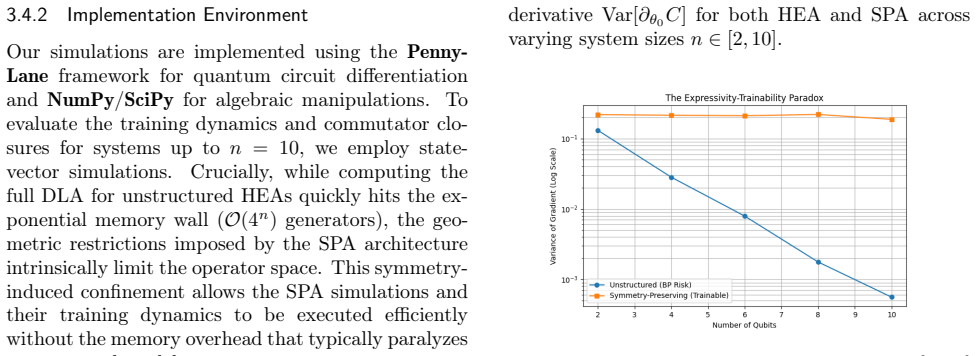
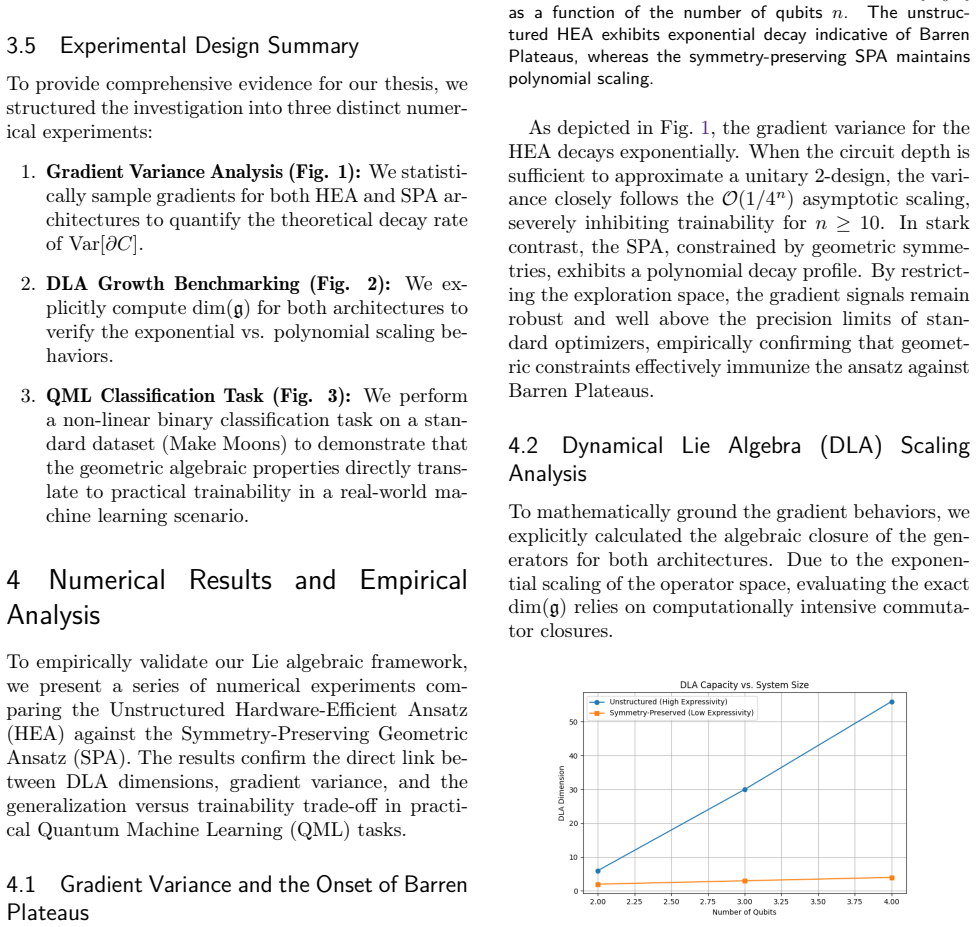
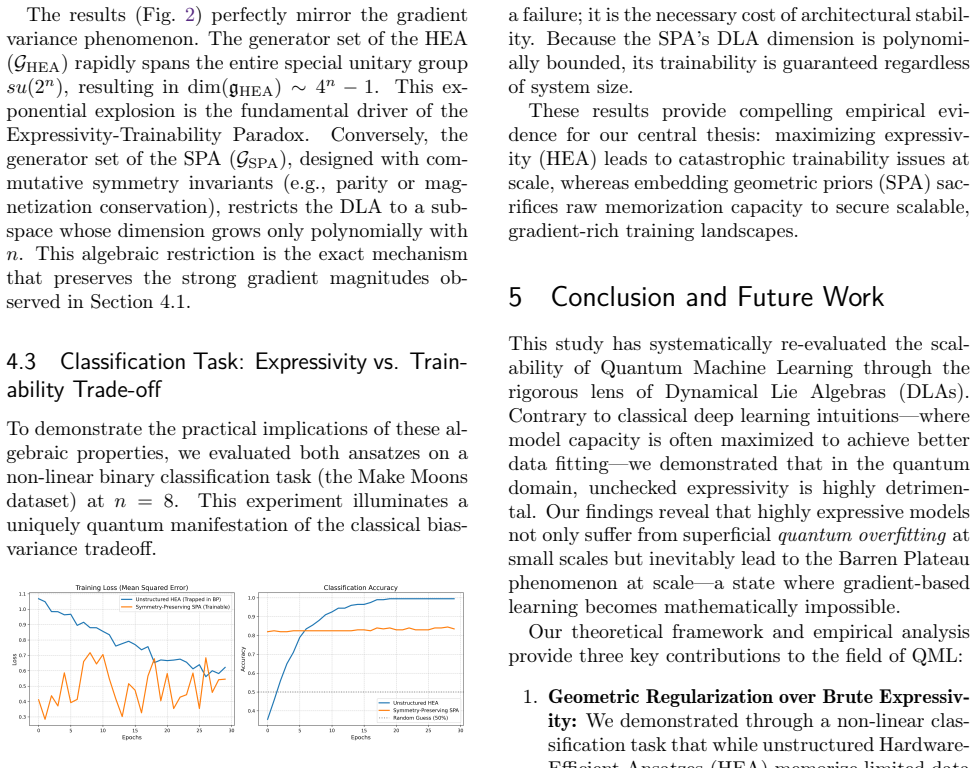
As Quantum Machine Learning (QML) transitions toward practical implementation, the field faces a critical architectural bottleneck that challenges the fundamental assumptions of classical statistical learning theory. In classical deep learning, increasing model capacity typically risks overfitting. However, this study advances a counter-intuitive paradigm: unstructured contemporary QML architectures suffer from a profound state of quantum underfitting, driven by the "expressivity-trainability paradox." We demonstrate that the vast Hilbert space capacity of Parameterized Quantum Circuits (PQCs)-traditionally chased as the source of quantum advantage is the direct mathematical cause of Barren Plateaus (BPs), where gradient landscapes become exponentially flat. By synthesizing recent breakthroughs in Dynamical Lie Algebras (DLAs) and Geometric QML, we establish a comprehensive framework linking the algebraic dimension of circuit generators to their optimization dynamics. Furthermore, we empirically validate this framework on a non-linear binary classification task, illuminating a uniquely quantum manifestation of the bias-variance tradeoff: while unstructured architectures achieve near-perfect training accuracy via unscalable parameterization (quantum overfitting), embedding group-theoretic geometric priors acts as a structural regularizer. By restricting the DLA growth to a polynomial regime, our symmetry-preserving approach sacrifices raw memorization capacity to guarantee scalable, gradient-rich training landscapes, offering a robust roadmap for "Trainability-by-Design" in scalable quantum neural networks.
Editorial analysis
A structured set of objections, weighed in public.
Referee Report
Summary. The paper claims that unstructured parameterized quantum circuits suffer from an expressivity-trainability paradox in which their vast Hilbert-space capacity directly induces barren plateaus via exponential growth of the dynamical Lie algebra (DLA) dimension; it proposes that embedding group-theoretic geometric priors restricts DLA growth to a polynomial regime, thereby acting as a structural regularizer that guarantees non-vanishing gradients while trading off raw memorization capacity, and reports empirical support on a single non-linear binary classification task.
Significance. If the claimed link between DLA dimension and gradient variance is rigorously established and the restricted algebras are shown to retain task-relevant expressivity, the framework would supply a concrete algebraic design principle for trainable QML models, directly addressing a central scalability obstacle.
major comments (2)
- [Abstract] Abstract and framework description: the assertion that polynomial DLA restriction 'guarantees scalable, gradient-rich training landscapes' while preserving sufficient expressivity for useful tasks is load-bearing yet unsupported by any quantitative bound or hardness benchmark; the single binary-classification experiment does not demonstrate that the restricted function class can solve problems whose solutions require super-polynomial effective dimension.
- [Empirical validation] Empirical validation paragraph: the reported 'near-perfect training accuracy' for unstructured circuits versus the symmetry-preserving approach is presented without controls, variance estimates, or comparison against a task whose solution provably requires exponential expressivity, leaving open whether any observed improvement reduces to post-hoc parameter choices rather than the DLA restriction itself.
minor comments (1)
- [Framework] Notation for the dynamical Lie algebra generators and their dimension is introduced without an explicit definition or reference to the standard construction in the geometric QML literature.
Simulated Author's Rebuttal
We thank the referee for the constructive feedback on our manuscript. We address the two major comments below, agreeing that the abstract language can be clarified and that the empirical section would benefit from additional controls and variance reporting. Revisions will be made to strengthen these aspects while preserving the core DLA-theoretic contribution.
read point-by-point responses
-
Referee: [Abstract] Abstract and framework description: the assertion that polynomial DLA restriction 'guarantees scalable, gradient-rich training landscapes' while preserving sufficient expressivity for useful tasks is load-bearing yet unsupported by any quantitative bound or hardness benchmark; the single binary-classification experiment does not demonstrate that the restricted function class can solve problems whose solutions require super-polynomial effective dimension.
Authors: We agree that 'guarantees' is too strong given the absence of explicit quantitative bounds linking polynomial DLA dimension to task-specific expressivity or hardness results. The manuscript establishes via DLA theory that polynomial dimension implies gradient variance bounded away from exponential decay in system size, but does not claim or prove sufficiency for arbitrary hard tasks. The binary classification experiment illustrates the trainability difference on a symmetry-aligned task. We will revise the abstract to replace 'guarantees' with 'enables' and add a limitations paragraph noting the need for future hardness benchmarks on problems with provably super-polynomial requirements. revision: partial
-
Referee: [Empirical validation] Empirical validation paragraph: the reported 'near-perfect training accuracy' for unstructured circuits versus the symmetry-preserving approach is presented without controls, variance estimates, or comparison against a task whose solution provably requires exponential expressivity, leaving open whether any observed improvement reduces to post-hoc parameter choices rather than the DLA restriction itself.
Authors: The empirical section is presented as an illustrative example rather than a comprehensive benchmark. We acknowledge the omission of variance estimates and explicit controls for hyperparameter selection. In revision we will report means and standard deviations over multiple random seeds, document the full experimental protocol to address potential post-hoc tuning concerns, and emphasize that the task was selected for its natural symmetry rather than as a hardness test. The primary claims rest on the algebraic analysis, not solely on these results. revision: yes
Circularity Check
No circularity: framework presented as conceptual synthesis without self-referential reductions
full rationale
The abstract and framework description link DLA algebraic dimension to barren plateaus and propose symmetry priors as a structural regularizer, but contain no equations, parameter-fitting procedures, or self-citations that reduce any claimed prediction or uniqueness result to the inputs by construction. The single mentioned empirical validation on a classification task is described at a high level without details that would allow assessment of fitted-input-called-prediction patterns. The derivation chain is therefore self-contained as a theoretical perspective drawing on external DLA and geometric QML literature rather than closing on its own fitted quantities or self-citations.
Axiom & Free-Parameter Ledger
Reference graph
Works this paper leans on
-
[1]
Rec- onciling modern machine-learning practice and the classical bias–variance trade-off,
M. Belkin, D. Hsu, S. Ma, and S. Mandal, “Rec- onciling modern machine-learning practice and the classical bias–variance trade-off,”Proceedings of the National Academy of Sciences, vol.116, no. 32, pp. 15849-15854, 2019
2019
-
[2]
Bias-variance trade- off in machine learning: Theoretical formulation and implications to structural engineering ap- plications,
X. Guan and H. Burton, “Bias-variance trade- off in machine learning: Theoretical formulation and implications to structural engineering ap- plications,”Structures, vol. 46, pp. 17-30, Dec. 2022
2022
-
[3]
Empirical Analysis of the Bias- Variance Tradeoff Across Machine Learning Models,
H. Ranglani, “Empirical Analysis of the Bias- Variance Tradeoff Across Machine Learning Models,”Machine Learning and Applications: An International Journal (MLAIJ), vol. 11, 2024
2024
-
[4]
Memorizing without overfitting: Bias, variance, and interpolation in overparameterized models,
J. W. Rocks and P. Mehta, “Memorizing without overfitting: Bias, variance, and interpolation in overparameterized models,”Physical Review Re- search, vol. 4, no. 1, p. 013201, 2022
2022
-
[5]
Be- yond the Bias Variance Trade-Off: A Mutual In- formation Trade-Off in Deep Learning,
X. Lan, B. Zhu, C. Boncelet, and K. Barner, “Be- yond the Bias Variance Trade-Off: A Mutual In- formation Trade-Off in Deep Learning,” in2021 IEEE 31st International Workshop on Machine Learning for Signal Processing (MLSP), pp. 1-6, Oct. 2021
2021
-
[6]
Rethinking bias-variance trade-off for gen- eralization of neural networks,
Z. Yang, Y. Yu, C. You, J. Steinhardt, and Y. Ma, “Rethinking bias-variance trade-off for gen- eralization of neural networks,” inInternational Conference on Machine Learning, pp. 10767- 10777, Nov. 2020
2020
-
[7]
An Introduction to Deep Learning and the Concept of Regularization,
N. Bosse, “An Introduction to Deep Learning and the Concept of Regularization,”Reading Process- ing Applying, vol. 23, 2020
2020
-
[8]
A review of tech- niques for regularization,
J. C. Obi and I. C. Jecinta, “A review of tech- niques for regularization,”International Journal of Research in Engineering and Science, vol. 11, no. 1, pp. 360-367, 2023
2023
-
[9]
Inter- pretable machine learning–a brief history, state- of-the-art and challenges,
C. Molnar, G. Casalicchio, and B. Bischl, “Inter- pretable machine learning–a brief history, state- of-the-art and challenges,” inJoint European Conference on Machine Learning and Knowledge Discovery in Databases, pp. 417-431, Sep. 2020
2020
-
[10]
Machinelearn- ing: Quantum vs classical,
T.M.KhanandA.Robles-Kelly, “Machinelearn- ing: Quantum vs classical,”IEEE Access, vol. 8, pp. 219275-219294, 2020
2020
-
[11]
Demonstration of quantum ad- vantage in machine learning,
D. Ristè, et al., “Demonstration of quantum ad- vantage in machine learning,”npj Quantum In- formation, vol. 3, no. 1, p. 16, 2017
2017
-
[12]
Quantum machine learning—an overview,
K. A. Tychola, T. Kalampokas, and G. A. Papakostas, “Quantum machine learning—an overview,”Electronics, vol. 12, no. 11, p. 2379, 2023
2023
-
[13]
Expressibility and entangling capabil- ity of parameterized quantum circuits for hybrid quantum-classical algorithms,
S. Sim, P. D. Johnson, and A. Aspuru- Guzik, “Expressibility and entangling capabil- ity of parameterized quantum circuits for hybrid quantum-classical algorithms,”Advanced Quan- tum Technologies, vol. 2, no. 12, p. 1900070, 2019
2019
-
[14]
Hardware-efficient varia- tional quantum eigensolver for small molecules and quantum magnets,
A. Kandala, et al., “Hardware-efficient varia- tional quantum eigensolver for small molecules and quantum magnets,”Nature, vol. 549, no. 7671, pp. 242-246, 2017
2017
-
[15]
Open source variational quan- tum eigensolver extension of the quantum learn- ing machine for quantum chemistry,
M. Haidar, et al., “Open source variational quan- tum eigensolver extension of the quantum learn- ing machine for quantum chemistry,”Wiley In- terdisciplinary Reviews: Computational Molecu- lar Science, vol. 13, no. 5, p. e1664, 2023
2023
-
[16]
High-throughput virtual screening for organic electronics: a comparative study of alternative strategies,
Ö. H. Omar, et al., “High-throughput virtual screening for organic electronics: a comparative study of alternative strategies,”Journal of Ma- terials Chemistry C, vol. 9, no. 39, pp. 13557- 13583, 2021
2021
-
[17]
High-throughput computational screening of nanoporous materials in targeted applications,
E. Ren, P. Guilbaud, and F. X. Coudert, “High-throughput computational screening of nanoporous materials in targeted applications,” Digital Discovery, vol.1, no.4, pp.355-374, 2022
2022
-
[18]
Barren plateaus in quan- tum neural network training landscapes,
J. R. McClean, et al., “Barren plateaus in quan- tum neural network training landscapes,”Nature Communications, vol. 9, no. 1, p. 4812, 2018. 7
2018
-
[19]
Noise-inducedbarrenplateausin variational quantum algorithms,
S.Wang, etal., “Noise-inducedbarrenplateausin variational quantum algorithms,”Nature Com- munications, vol. 12, no. 1, p. 6961, 2021
2021
-
[20]
Cost function dependent bar- ren plateaus in shallow parametrized quantum circuits,
M. Cerezo, et al., “Cost function dependent bar- ren plateaus in shallow parametrized quantum circuits,”Nature Communications, vol. 12, no. 1, p. 1791, 2021
2021
-
[21]
Connecting ansatz expressibility to gra- dient magnitudes and barren plateaus,
Z. Holmes, K. Sharma, M. Cerezo, and P. J. Coles, “Connecting ansatz expressibility to gra- dient magnitudes and barren plateaus,”PRX Quantum, vol. 3, no. 1, p. 010313, 2022
2022
-
[22]
Barrenplateausinvariational quantum computing,
M.Larocca, etal., “Barrenplateausinvariational quantum computing,”Nature Reviews Physics, pp. 1-16, 2025
2025
-
[23]
Escaping Bar- ren Plateaus in Variational Quantum Algorithms Using Negative Learning Rate in Quantum Inter- net of Things,
R. Rahman and D. C. Nguyen, “Escaping Bar- ren Plateaus in Variational Quantum Algorithms Using Negative Learning Rate in Quantum Inter- net of Things,”IEEE Internet of Things Journal, 2025
2025
-
[24]
Theory of overparametriza- tion in quantum neural networks,
M. Larocca, et al., “Theory of overparametriza- tion in quantum neural networks,”Nature Com- putational Science, vol. 3, no. 6, pp. 542-551, 2023
2023
-
[25]
A Lie algebraic theory of barren plateaus for deep parameterized quantum cir- cuits,
M. Ragone, B. N. Bakalov, F. Sauvage, A. F. Kemper, C. Ortiz Marrero, M. Larocca, and M. Cerezo, “A Lie algebraic theory of barren plateaus for deep parameterized quantum cir- cuits,”Nature Communications, vol. 15, no. 1, p. 7172, 2024
2024
-
[26]
Characterizing barren plateaus in quantum ansätze with the adjoint representation,
E. Fontana, D. Herman, S. Chakrabarti, N. Ku- mar, R. Yalovetzky, J. Heredge, S. H. Suresh- babu, and M. Pistoia, “Characterizing barren plateaus in quantum ansätze with the adjoint representation,”Nature Communications, vol. 15, no. 1, p. 7171, 2024
2024
-
[27]
Classification of dynamical Lie algebras of 2-local spin systems on linear, cir- cular and fully connected topologies,
R. Wiersema, et al., “Classification of dynamical Lie algebras of 2-local spin systems on linear, cir- cular and fully connected topologies,”npj Quan- tum Information, vol. 10, no. 1, p. 110, 2024
2024
-
[28]
The Lie alge- bra of XY-mixer topologies and warm starting QAOA for constrained optimization,
S. Kordonowy and H. Leipold, “The Lie alge- bra of XY-mixer topologies and warm starting QAOA for constrained optimization,”npj Quan- tum Information, 2026
2026
-
[29]
Solving Quan- tum Dynamics with a Lie-Algebra Decoupling Method,
S. Qvarfort and I. Pikovski, “Solving Quan- tum Dynamics with a Lie-Algebra Decoupling Method,”PRX Quantum, vol.6, no.1, p.010201, 2025
2025
-
[30]
Lie-algebraic classical simula- tions for quantum computing,
M. L. Goh, et al., “Lie-algebraic classical simula- tions for quantum computing,”Physical Review Research, vol. 7, no. 3, p. 033266, 2025
2025
-
[31]
Lie algebraic quantum phase reduction,
W. Setoyama and Y. Hasegawa, “Lie algebraic quantum phase reduction,”Physical Review Let- ters, vol. 132, no. 9, p. 093602, 2024
2024
-
[32]
Neumaier and D
A. Neumaier and D. Westra,Quantum Mechan- ics via Lie Algebras, vol. 55. Walter de Gruyter GmbH & Co KG, 2024
2024
-
[33]
Geometric quantum machine learning (GQML): concepts, challenges, and ap- plications,
A. K. Masta, “Geometric quantum machine learning (GQML): concepts, challenges, and ap- plications,”Sustainable Blind Quantum Comput- ing, p. 1, 2025
2025
-
[34]
Theory for equivariant quantum neural networks,
Q. T. Nguyen, et al., “Theory for equivariant quantum neural networks,”PRX Quantum, vol. 5, no. 2, p. 020328, 2024
2024
-
[35]
Theoretical guarantees for permutation-equivariant quantum neural net- works,
L. Schatzki, M. Larocca, Q. T. Nguyen, F. Sauvage, and M. Cerezo, “Theoretical guarantees for permutation-equivariant quantum neural net- works,”npj Quantum Information, vol. 10, no. 1, p. 12, 2024
2024
-
[36]
Geometric quantum ma- chine learning with horizontal quantum gates,
R. Wiersema, et al., “Geometric quantum ma- chine learning with horizontal quantum gates,” Physical Review Research, vol. 7, no. 1, p. 013148, 2025
2025
-
[37]
Symmetry group equivariantconvolutionsforrepresentationlearn- ing: asurvey,
R. Basheer and D. Mishra, “Symmetry group equivariantconvolutionsforrepresentationlearn- ing: asurvey,”International Journal of Data Sci- ence and Analytics, vol. 22, no. 1, p. 2, 2026
2026
-
[38]
A Geometric-Aware Perspec- tive and Beyond: Hybrid Quantum-Classical Machine Learning Methods,
A. Alavia, et al., “A Geometric-Aware Perspec- tive and Beyond: Hybrid Quantum-Classical Machine Learning Methods,”arXiv preprint arXiv:2504.06328, 2025. 8
discussion (0)
Sign in with ORCID, Apple, or X to comment. Anyone can read and Pith papers without signing in.