REVIEW 2 major objections 4 minor 1 cited by
Geometrically Frustrated Assembly at Finite Temperature: Phase Transitions from Self-Limiting to Bulk States
T0 review · 2 major / 4 minor · reviewed 2026-08-05 · deepseek-v4-flash
Pith's one-line read At strong frustration, concentration drives finite-width self-limiting domains through a percolation transition into a defect-hole sponge; at dilute concentration, translational entropy stabilizes the self-limiting state and lowers the crit
desk verdict A credible extension of frustrated assembly to the full concentration-frustration plane, with a genuinely parameter-free hole-density test that checks out; the entropy-driven phase boundary is the soft part, being a one-parameter fit with an unfinished placeholder. read the letter →
The pith
A machine-rendered reading of the paper's core claim, the machinery that carries it, and where it could break.
The reading
What carries the argument
The engine of the argument is the free-energy balance between two continuum morphologies of the lattice model: finite-width ribbon domains, of optimal width W* ~ (sigma/J)^{1/3} phi^{-2/3} and energy density epsilon_sla = C0 J^{1/3} sigma^{2/3} phi^{2/3}, and a bulk 'sponge' consisting of a triangular vortex array with voided circular cores, whose optimal hole size comes from the transcendental equation (29). The load-bearing identity is the free-energy difference per subunit between these states, eq. (34) with eq. (46): Delta F/(J A) = C0 (sigma/J)^{2/3} phi^{2/3} - C1 phi - CT (k_B T/sigma)(sigma/J)^{1/3} phi^{4/3}. The third term is the entropic stabilization: the specific translational e
What would settle it
Measure the critical frustration phi_c as a function of sigma/J at a fixed low reduced temperature k_B T/sigma on lattices large enough to satisfy the frustration periodicity at small f. The mean-field term predicts a crossover from phi_c ~ (sigma/J)^2 at low sigma/J to phi_c ~ (sigma/J)^{1/2} at high sigma/J (eqs. 47-48); observing only a single power law across two decades of sigma/J would falsify the dominance of the translational-entropy term. A complementary check: compute the specific translational entropy of the bulk condensate via eq. (42) at f/f_c < 1; if it is not negligible compared
Extended reading notes
Core claim
On its own terms, the paper establishes that the self-limiting state of geometrically frustrated assembly is not a dilute-curiosity; it is one corner of a single phase diagram that also contains a heterogeneous percolated network and a uniform 'holey' Abrikosov defect sponge. At fixed strong frustration, increasing concentration produces a percolation transition at Phi_perc in [0.4, 0.65] whose location shifts weakly upward with frustration and strongly with cohesion-to-stiffness ratio, followed by continuous evolution toward the bulk sponge at concentrations near 1 - Phi_hole, where Phi_hole is set by the optimal hole-size equation (29). At fixed dilute concentration, decreasing frustration
Load-bearing premise
The quantitative temperature shift of the critical frustration rests on the assumption that the entropy advantage of self-limiting aggregates comes almost entirely from the translational freedom of finite-sized clusters (one center-of-mass per cluster, scaling as 1/n*), while the bulk condensate has essentially none; if internal orientational fluctuations, edge fluctuations, or logarithmic corrections contribute comparably, the predicted crossover of phi_c changes.
Editorial extensions
If this is right
- At strong frustration and fixed cohesion-to-stiffness, self-limiting assembly cannot persist to high concentration; the equilibrium path to the bulk is percolation of finite-width domains into a network, not coarsening of individual aggregates.
- The percolation threshold is not universal: it rises with frustration because domains become narrower and more branched, and it shifts strongly with sigma/J; the measured values lie between standard bond (0.5) and site (~0.59) percolation thresholds.
- The bulk condensate at weak frustration is the same defect-sponge morphology as the high-concentration state, only phase-separated from a monomer gas: hole spacing is set by phi^{-1/2} and hole size by eq. (29).
- Finite temperature stabilizes self-limiting assembly relative to the condensed bulk, so phi_c decreases with temperature; the apparent linear dependence of phi_c on sigma/J in simulations is a crossover from phi_c ~ (sigma/J)^2 at low T to phi_c ~ (sigma/J)^{1/2} at high k_B T/sigma.
- The T=0 scaling phi_c = (sigma/J)^2 is likely out of reach for direct simulation because it requires sigma/J ~ 10^-3 and correspondingly tiny frustration with prohibitively large lattices.
Reading between the lines
- A testable extension the paper does not pursue: at fixed reduced temperature k_B T/sigma, the critical frustration should cross over from (sigma/J)^2 at low cohesion to (sigma/J)^{1/2} at high cohesion; measuring that exponent would isolate the translational-entropy mechanism from conformational contributions.
- The tree-to-cycle crossover that coincides with percolation suggests the heterogeneous network may be a coexistence regime of two local morphologies rather than a distinct thermodynamic phase; a hidden binodal or tricritical point, as the authors speculate, could be probed by finite-size scaling of the loop fraction near Phi_perc.
- As frustration approaches f = 1/2, the self-limiting width approaches one lattice spacing, so the model should cross over to branched lattice-animal statistics; if that holds, percolation and gelation observables in this limit would belong to the same universality class.
- The paper neglects the logarithmic factor ln(Phi_agg/n*) in eq. (45), absorbing it into the fitted prefactor CT; an extension would include that factor explicitly and test whether CT becomes constant across concentrations and frustration values.
Editorial analysis
A structured set of objections, weighed in public.
Referee Report
Summary. This paper studies a 2D lattice model of geometrically frustrated assembly (GF A) at finite temperature across the full concentration range. Using Monte Carlo simulations and continuum mean-field theory, it identifies two pathways from self-limiting assembly (SLA) to bulk defect states. At fixed strong frustration, increasing concentration drives a percolation transition of finite-width worm-like domains into a heterogeneous network mesophase, which then evolves into a quasi-uniform 'defect sponge' of holey Abrikosov vortices. At dilute concentration, decreasing frustration or temperature drives a transition from SLA to a phase-separated defect condensate; the paper argues that excess translational and conformational entropy of SLA stabilizes it relative to bulk, depressing the critical frustration below its zero-temperature value. The central quantitative result is Eq. (46), where an entropic term proportional to (kBT/σ)(σ/J)^{1/3}φ^{4/3} modifies the phase boundary, leading to the temperature-dependent φc curves in Fig. 11 and asymptotics in Eqs. (47)–(48). The authors also present parameter-free predictions for the hole density and energy of the bulk sponge (Eqs. (29), (31), (32)) that are compared to simulation.
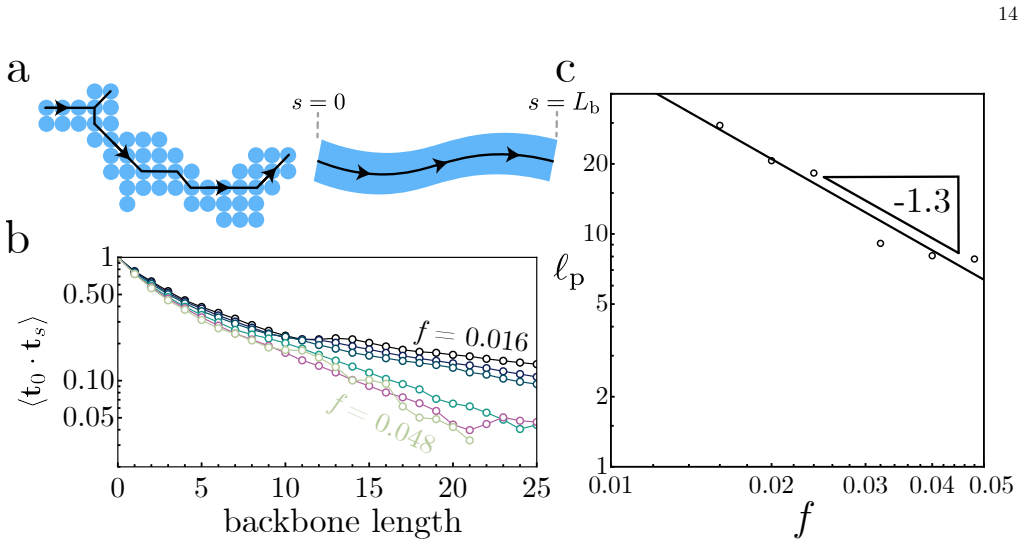
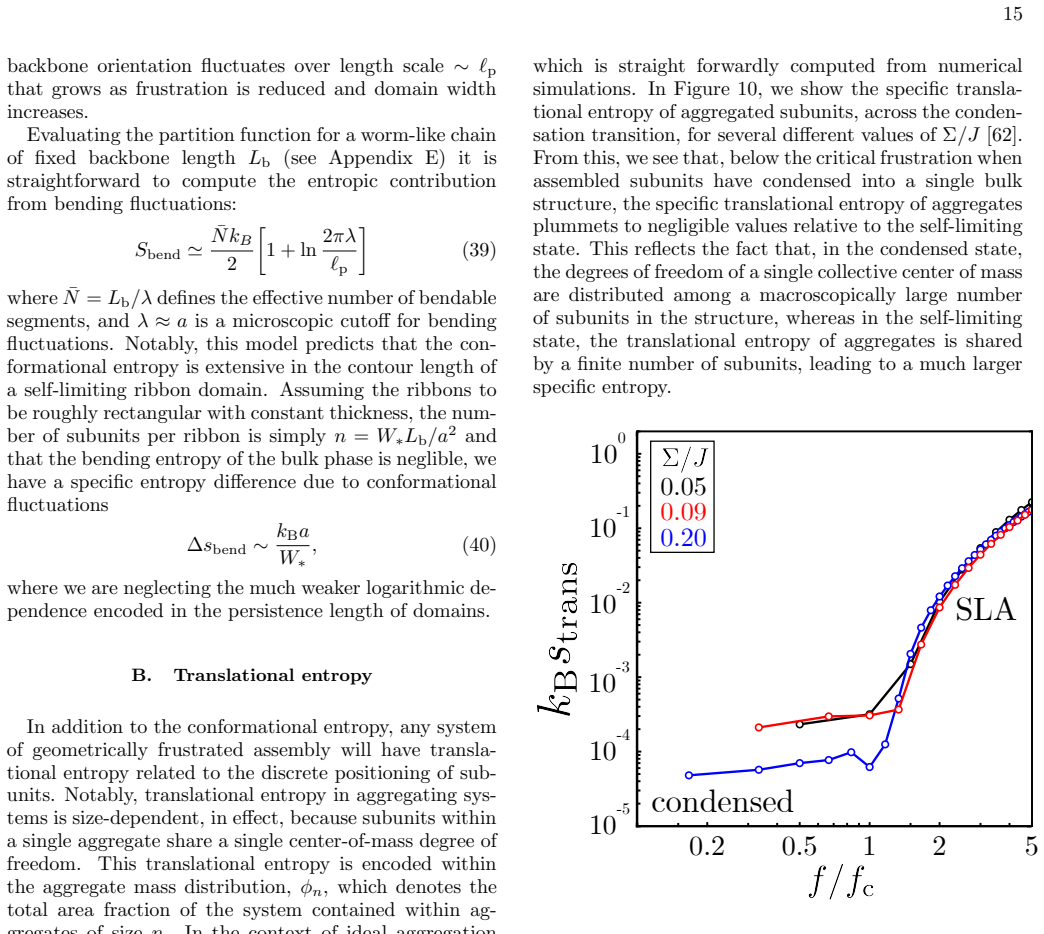
Significance. If the results hold, the paper provides the first complete frustration–concentration phase diagram for this minimal 2D model of frustrated assembly, unifying dilute self-limiting assembly, percolating network states, and bulk defect lattices. The strongest evidence is the parameter-free comparison of the hole-density prediction Φ_hole = 1 − Φ_min with simulation (Fig. 8b) and the corresponding bulk-energy comparison (Fig. 8c); these are clean, quantitative tests that support the circular-cell approximation for the bulk vortex sponge. The direct measurement of translational entropy from simulated mass distributions (Fig. 10) and the persistence-length scaling ℓp ∼ φ^{−4/3} (Fig. 9) independently support the physical mechanism that SLA carries excess entropy. The paper also carefully addresses potential compensating entropy sources (spin waves, capillary fluctuations) in Appendices B and C. The main weakness is that the quantitative φc(T, Σ/J) boundary, which is the load-bearing finite-temperature claim, depends on a fitted prefactor C_T and on approximations in the entropy calculation that are not fully justified.
major comments (2)
- [§V C, Eqs. (43)–(46), Fig. 11] The central quantitative statement that entropy depresses φc by the specific form in Eq. (46) is not a parameter-free prediction. Eq. (43) gives s_trans ≈ −(k_B/n*) ln(Φ_agg/n*), but Eq. (45) drops the logarithmic factor 'near the transition.' This logarithm is not small in the simulated regime: n* ∝ (W*/a)^2 varies by orders of magnitude as φ changes, and Φ_agg itself varies across the transition. The prefactor C_T ≈ 45 is then fitted to simulation, absorbing the dropped log, the breadth of the aggregate mass distribution, and any residual bulk entropy. In addition, the aggregation threshold n_m used to compute Φ_agg and s_trans is left unfinished in footnote [62] ('nm =??'). As written, Fig. 11 and the asymptotic laws (47)–(48) therefore do not constitute a derived prediction; they represent a one-parameter fit of an assumed scaling form. To make the central claim quantitative, the aut
- [§IV A, Fig. 4] The concentration-driven 'percolation transition' is characterized solely by the 50% spanning fraction at a single system size L = 250. No finite-size scaling, cluster-size distribution analysis, or dependence on L is reported. The claim that Φ_perc depends weakly on frustration and strongly on Σ/J is based on this operational definition. Percolation thresholds in finite systems shift with L, and the width of the percolation crossover can be comparable to the reported variation in Φ_perc (0.4 ≤ Φ_perc ≤ 0.65). To support the phase-boundary interpretation in Fig. 12, the authors should show either a finite-size scaling collapse of the spanning probability or a percolation order parameter and susceptibility (e.g., cluster-size distribution) that locates the threshold in the thermodynamic limit. If this is not feasible, the language should be softened to 'percolation crossover' at the simul
minor comments (4)
- [Footnote [62]] The aggregation threshold n_m is left as 'nm =??'. Since this threshold enters the computed translational entropy and thus the central entropy argument, the missing value must be supplied and its sensitivity tested.
- [Throughout] There are several typographical errors: 'in this this article' (page 3), 'scenerio' (page 18), and 'In this this article' (page 5). These should be corrected.
- [Fig. 12] The phase boundaries in the compiled diagram are drawn 'to guide the eye' between simulation points. Please state explicitly that these are not thermodynamic coexistence lines, particularly the dashed extension of the phase-separation binodal and the percolation boundary, and indicate the uncertainty associated with each boundary.
- [References [14] and [46]] References [14] and [46] appear to refer to the same work (Le Roy, Terzi, Lenz, arXiv:2308.04698). Please consolidate or distinguish them if they are different versions.
Circularity Check
Quantitative φ_c boundary is a one-parameter fit (C_T) to the same simulation data, though the qualitative entropic mechanism and scaling form are independently supported.
-
fitted input called prediction
[Sec. V C, Eq. (46) and Fig. 11]
"Here a value of CT ≃ 45 was chosen to best match the values extracted from simulation."
The entropic term in Eq. (46), which is the entire finite-temperature correction to the T=0 boundary, is multiplied by C_T fixed by matching the simulation values of φ_c that Fig. 11 then displays as the theory curves. Eq. (45) was itself obtained from Eq. (43) by dropping ln(Φagg/n*) and taking bulk translational entropy to zero, so C_T also absorbs the omitted logarithmic factor, the width of the aggregate mass distribution, and any residual bulk entropy. The plotted φ_c(Σ/J) curves are therefore not parameter-free predictions of the boundary; they are a one-parameter interpolation of it. The independent simulation measurements of translational entropy (Fig. 10) and persistence length (Fig. 9) do support the qualitative mechanism and the 4/3 scaling exponent, so the circularity is partia
full rationale
The concentration-driven percolation and sponge-filling results are not circular: Φ_perc, branch densities, cycle fractions, and hole spacings are direct simulation measurements, and the circular-cell continuum prediction for Φ_hole is parameter-free and agrees with simulation in Fig. 8b. The frustration-driven transition is more delicate. The claim that self-limiting aggregates carry excess entropy is independently measured from the mass distribution (Fig. 10) and tangent-tangent correlations (Fig. 9), and the n* ≈ (W*/a)^2 relation from the authors' prior work is a derived continuum result, not fitted here. However, the quantitative phase boundary in Eq. (46)/Fig. 11 uses C_T ≈ 45 chosen to match the very simulation boundary being 'predicted', so the numerical location of φ_c is a fit, not a derivation. The derivation also drops the logarithm in Eq. (43) and assumes zero bulk entropy, and the aggregation threshold is internally inconsistent: Sec. V B states 'we will take nm = 9', while footnote [62] reads 'nm =??', leaving the input to Eqs. (42)-(43) unfinished. This warrants a 6: one central quantitative prediction reduces to a fit, while the qualitative phase map and the scaling exponent retain independent support.
Assumptions & free parameters
free parameters (5)
- CT (entropic prefactor) =
~45
- lambda (bending segment cutoff) =
~10a
- nm (aggregate size threshold) =
9
- C1 (bulk vortex energy prefactor) =
~1
- cycle length threshold =
1.5x average optimal-sponge cycle length
assumptions (6)
- domain assumption Thermal spin fluctuations of bound clusters are weak (J/kBT >> 1), so spin degrees of freedom can be treated in their ground state
- domain assumption Divergence-free gauge choice A = pi*phi*(y xhat - x yhat) is representative for uniform frustration
- ad hoc to paper Hexagonal vortex cell approximated as a circle with an axisymmetric phase field
- domain assumption Bulk condensate has zero translational entropy and negligible backbone conformational entropy
- standard math Ideal aggregation mixing entropy applies to the aggregate mass distribution
- ad hoc to paper Neglect of ln(Phi_agg/n*) in the entropy scaling near the transition
Cite this review
Pith. "Pith review of Geometrically Frustrated Assembly at Finite Temperature: Phase Transitions from Self-Limiting to Bulk States." pith.science (2026). https://pith.science/paper/ETI6GJPX
@misc{pith2026250821688,
  author       = {Pith},
  title        = {Pith review of: Geometrically Frustrated Assembly at Finite Temperature: Phase Transitions from Self-Limiting to Bulk States},
  year         = {2026},
  howpublished = {\url{https://pith.science/paper/ETI6GJPX}},
  note         = {Machine review of arXiv:2508.21688}
}
read the original abstract
Geometric frustration is recognized to generate complex morphologies in self-assembling particulate and molecular systems. In bulk states, frustrated drives structured arrays of topological defects. In the dilute limit, these systems have been shown to form a novel state of self-limiting assembly, in which the equilibrium size of multi-particle domains are finite and well-defined. In this article, we employ Monte Carlo simulations of a recently developed 2D lattice model of geometrically frustrated assembly~\cite{HackneyPhysRevX.13.041010} to study the phase transitions between the self-limiting and defect bulk phase driven by two distinct mechanisms: (i) increasing concentration and (ii) decreasing temperature or frustration. The first transition is mediated by a concentration-driven percolation transition of self-limiting, worm-like domains into an intermediate heterogeneous network mesophase, which gradually fills in at high concentration to form a quasi-uniform defect bulk state. We find that the percolation threshold is weakly dependent on frustration and shifts to higher concentration as frustration is increased, but depends strongly on the ratio of cohesion to elastic stiffness in the model. The second transition takes place between self-limiting assembly at high-temperature/frustration and phase separation into a condensed bulk state at low temperature/frustration. We consider the competing influences that translational and conformational entropy have on the critical temperature/frustration and show that the self-limiting phase is stabilized at higher frustrations and temperatures than previously expected. Taken together, this understanding of the transition pathways from self-limiting to bulk defect phases of frustrated assembly allows us to map the phase behavior of this 2D minimal model over the full range of concentration.
Figures


Figures from the paper (14 more)




Forward citations
Cited by 1 Pith paper
-
Explosive connectivity and mechanical rigidity in cubic lattice structures
For 3D cubic lattices, the paper claims first-order finite-size signatures of explosive percolation for k≥2 and monotone rigidification efficiency with k, but the proof of the central theorem is arithmetically impossi...
Reference graph
Works this paper leans on
-
[62]
J. N. Israelachvili, D. J. Mitchell, and B. W. Ninham, Theory of self-assembly of hydrocarbon amphiphiles into micelles and bilayers, Journal of the Chemical Society, Faraday Transactions 2: Molecular and Chemical Physics 72, 1525 (1976)
work page 1976
-
[1]
+ 1 16 (φR2 0)2(1 + ¯r2) + 2 1 − ¯r2 ¯r ¯λ (28) which we have written in dimensionless form by in- troducing the scaled variables ¯ r = rc/R0 and ¯λ = (J/σ)R−1 0 ∝ ℓc/ℓv ∝ φ1/2. Observing that φR2 0 = 2s, we can minimize ϵ(¯r) with respect to ¯r to obtain a transcendental equation for the optimal dimensionless hole size ¯r∗: ¯λs2 = 1 + ¯r2 1 ¯r (1 − ¯r2)2...
-
[2]
N. W. Hackney, C. Amey, and G. M. Grason, Dispersed, condensed, and self-limiting states of geometrically frus- trated assembly, Phys. Rev. X 13, 041010 (2023)
work page 2023
-
[3]
J.-F. Sadoc and R. Mosseri, Geometrical frustration (Cambridge University Press, Cambridge, 2006)
work page 2006
-
[4]
J. Vannimenus and G. Toulouse, Theory of the frustra- tion effect. ii. ising spins on a square lattice, Journal of Physics C: Solid State Physics 10, L537 (1977)
work page 1977
-
[5]
G. H. Wannier, Antiferromagnetism. the triangular ising net, Phys. Rev. 79, 357 (1950)
1950
-
[6]
M. Franz and S. Teitel, Vortex-lattice melting in two- dimensional superconducting networks and films, Physi- cal Review B 51, 6551 (1995)
work page 1995
-
[7]
G. M. Grason, Perspective: Geometrically frustrated as- semblies, The Journal of Chemical Physics 145, 110901 (2016)
work page 2016
Show all 75 references
-
[8]
Lenz and T
M. Lenz and T. A. Witten, Geometrical frustration yields fibre formation in self-assembly, Nature physics 13, 1100 (2017)
2017
-
[9]
Meiri and E
S. Meiri and E. Efrati, Cumulative geometric frustration in physical assemblies, Phys. Rev. E 104, 054601 (2021)
2021
-
[10]
M. F. Hagan and G. M. Grason, Equilibrium mechanisms of self-limiting assembly, Reviews of Modern Physics 93, 025008 (2021)
2021
-
[11]
Bausch, M
A. Bausch, M. J. Bowick, A. Cacciuto, A. Dinsmore, M. Hsu, D. Nelson, M. Nikolaides, A. Travesset, and D. Weitz, Grain boundary scars and spherical crystal- lography, Science 299, 1716 (2003)
2003
-
[12]
Schneider and G
S. Schneider and G. Gompper, Shapes of crystalline do- mains on spherical fluid vesicles, EPL (Europhysics Let- ters) 70, 136 (2005)
2005
-
[13]
W. T. Irvine, V. Vitelli, and P. M. Chaikin, Pleats in crystals on curved surfaces, Nature 468, 947 (2010)
2010
-
[14]
G. Meng, J. Paulose, D. R. Nelson, and V. N. Manoha- ran, Elastic instability of a crystal growing on a curved surface, Science 343, 634 (2014)
2014
-
[15]
H. L. Roy, M. M. Terzi, et al., Collective deformation modes promote fibrous self-assembly in protein-like par- ticles, arXiv preprint arXiv:2308.04698 (2023)
2023 arXiv
-
[16]
I. R. Spivack, D. M. Hall, and G. M. Grason, Stress accu- mulation versus shape flattening in frustrated, warped- jigsaw particle assemblies, New Journal of Physics 24, 063023 (2022)
2022
-
[17]
P. W. A. Sch¨ onh¨ ofer, K. Sun, X. Mao, and S. C. Glotzer, Rationalizing euclidean assemblies of hard polyhedra from tessellations in curved space, Phys. Rev. Lett. 131, 258201 (2023)
2023
-
[18]
Serafin, J
F. Serafin, J. Lu, N. Kotov, K. Sun, and X. Mao, Frus- trated self-assembly of non-euclidean crystals of nanopar- ticles, Nature Communications 12, 4925 (2021)
2021
-
[19]
Aggeli, I
A. Aggeli, I. A. Nyrkova, M. Bell, R. Harding, L. Carrick, T. C. McLeish, A. N. Semenov, and N. Boden, Hierarchi- cal self-assembly of chiral rod-like molecules as a model for peptide β-sheet tapes, ribbons, fibrils, and fibers, Pro- ceedings of the National Academy of Science...
2001
-
[20]
D. M. Hall, I. R. Bruss, J. R. Barone, and G. M. Grason, Morphology selection via geometric frustration in chiral filament bundles, Nature materials 15, 727 (2016). 24
2016
-
[21]
Ghafouri and R
R. Ghafouri and R. Bruinsma, Helicoid to spiral ribbon transition, Physical review letters 94, 138101 (2005)
2005
-
[22]
Armon, H
S. Armon, H. Aharoni, M. Moshe, and E. Sharon, Shape selection in chiral ribbons: from seed pods to supramolec- ular assemblies, Soft matter 10, 2733 (2014)
2014
-
[23]
Zhang, D
M. Zhang, D. Grossman, D. Danino, and E. Sharon, Shape and fluctuations of frustrated self-assembled nano ribbons, Nature Communications 10, 3565 (2019)
2019
-
[24]
Tyukodi, F
B. Tyukodi, F. Mohajerani, D. M. Hall, G. M. Gra- son, and M. F. Hagan, Thermodynamic size control in curvature-frustrated tubules: Self-limitation with open boundaries, ACS nano 16, 9077 (2022)
2022
-
[25]
D. M. Hall, M. J. Stevens, and G. M. Grason, Build- ing blocks of non-euclidean ribbons: size-controlled self- assembly via discrete frustrated particles, Soft Matter19, 858 (2023)
2023
-
[26]
Vitelli and D
V. Vitelli and D. R. Nelson, Nematic textures in spherical shells, Physical Review E 74, 021711 (2006)
2006
-
[27]
Fern´ andez-Nieves, V
A. Fern´ andez-Nieves, V. Vitelli, A. S. Utada, D. R. Link, M. M´ arquez, D. R. Nelson, and D. A. Weitz, Novel de- fect structures in nematic liquid crystal shells, Phys. Rev. Lett. 99, 157801 (2007)
2007
-
[28]
Lopez-Leon, V
T. Lopez-Leon, V. Koning, K. Devaiah, V. Vitelli, and A. Fernandez-Nieves, Frustrated nematic order in spher- ical geometries, Nature Physics 7, 391 (2011)
2011
-
[29]
L. N. Carenza, G. Gonnella, D. Marenduzzo, G. Negro, and E. Orlandini, Cholesteric shells: two-dimensional blue fog and finite quasicrystals, Physical Review Let- ters 128, 027801 (2022)
2022
-
[30]
Niv and E
I. Niv and E. Efrati, Geometric frustration and compati- bility conditions for two-dimensional director fields, Soft matter 14, 424 (2018)
2018
-
[31]
Fern´ andez-Rico and R
C. Fern´ andez-Rico and R. P. Dullens, Hierarchical self- assembly of polydisperse colloidal bananas into a two- dimensional vortex phase, Proceedings of the National Academy of Sciences 118, e2107241118 (2021)
2021
-
[32]
Tanjeem, D
N. Tanjeem, D. M. Hall, M. B. Minnis, R. C. Hayward, and G. M. Grason, Focusing frustration for self-limiting assembly of flexible, curved particles, Physical Review Research 4, 033035 (2022)
2022
-
[33]
K. T. Sullivan, R. C. Hayward, and G. M. Grason, Self- limiting stacks of curvature-frustrated colloidal plates: Roles of intraparticle versus interparticle deformations, Physical Review E 110, 024602 (2024)
2024
-
[34]
J. F. Berengut, C. K. Wong, J. C. Berengut, J. P. K. Doye, T. E. Ouldridge, and L. K. Lee, Self-limiting poly- merization of dna origami subunits with strain accumu- lation, ACS Nano 14, 17428 (2020)
2020
-
[35]
Wang and G
M. Wang and G. Grason, Thermal stability and sec- ondary aggregation of self-limiting, geometrically frus- trated assemblies: Chain assembly of incommensurate polybricks, Physical Review E 109, 014608 (2024)
2024
-
[36]
C. I. Mendoza and D. Reguera, Shape selection and mis- assembly in viral capsid formation by elastic frustration, eLife 9, e52525 (2020)
2020
-
[37]
S. Li, P. Roy, A. Travesset, and R. Zandi, Why large icosahedral viruses need scaffolding proteins, Proceedings of the National Academy of Sciences 115, 10971 (2018)
2018
-
[38]
Kl´ eman, Curved crystals, defects and disorder, Ad- vances in Physics 38, 605 (1989)
M. Kl´ eman, Curved crystals, defects and disorder, Ad- vances in Physics 38, 605 (1989)
1989
-
[39]
Tarjus, S
G. Tarjus, S. A. Kivelson, Z. Nussinov, and P. Viot, The frustration-based approach of supercooled liquids and the glass transition: a review and critical assessment, Journal of Physics: Condensed Matter 17, R1143 (2005)
2005
-
[40]
M. S. Turner, R. W. Briehl, F. A. Ferrone, and R. Josephs, Twisted protein aggregates and disease: The stability of sickle hemoglobin fibers, Phys. Rev. Lett. 90, 128103 (2003)
2003
-
[41]
Esterlis, S
I. Esterlis, S. A. Kivelson, and G. Tarjus, Avoided criti- cality and slow relaxation in frustrated two-dimensional models, Physical Review B 96, 144305 (2017)
2017
-
[42]
Nelson and L
D. Nelson and L. Peliti, Fluctuations in membranes with crystalline and hexatic order, Journal de physique 48, 1085 (1987)
1987
-
[43]
M. J. Bowick and L. Giomi, Two-dimensional matter: order, curvature and defects, Advances in Physics 58, 449 (2009)
2009
-
[44]
Teitel and C
S. Teitel and C. Jayaprakash, Phase transitions in frus- trated two-dimensional XY models, Phys. Rev. B27, 598 (1983)
1983
-
[45]
Teitel and C
S. Teitel and C. Jayaprakash, Josephson-junction arrays in transverse magnetic fields, Physical review letters 51, 1999 (1983)
1999
-
[46]
V. Alba, A. Pelissetto, and E. Vicari, The uniformly frus- trated two-dimensional xy model in the limit of weak frustration, Journal of Physics A: Mathematical and The- oretical 41, 175001 (2008)
2008
- [47]
-
[48]
D. R. Nelson, Defects in superfluids, superconductors and membranes, arXiv preprint cond-mat/9502114 (1995)
1995 arXiv
-
[49]
Stauffer and A
D. Stauffer and A. Aharony, Introduction to percolation theory (Taylor & Francis, 2018)
2018
-
[50]
Derrida and D
B. Derrida and D. Stauffer, Corrections to scaling and phenomenological renormalization for 2-dimensional percolation and lattice animal problems, Journal de Physique 46, 1623 (1985)
1985
-
[51]
J. M. Ortiz-Tav´ arez, Z. Yang, N. Kotov, and X. Mao, Statistical mechanics of frustrated assemblies and incom- patible graphs, arXiv preprint arXiv:2407.18210 (2024)
2024 arXiv
-
[52]
B. H. Zimm and W. H. Stockmayer, The dimensions of chain molecules containing branches and rings, The Jour- nal of Chemical Physics 17, 1301 (1949)
1949
-
[53]
When counting looping spans of the graph, we employ an maximal cycle length corresponding to one and a half times the average cycle length measured in the optimal sponge phase corresponding to the energy density min- ima found in Figure 8, since the optimal vortex size sets a ...
-
[54]
D. S. Fisher, Flux-lattice melting in thin-film supercon- ductors, Physical Review B 22, 1190 (1980)
1980
-
[55]
Doniach and B
S. Doniach and B. Huberman, Topological excitations in two-dimensional superconductors, Physical Review Let- ters 42, 1169 (1979)
1979
-
[56]
Wheatley et al., Flux-lattice melting and depinning in the weakly frustrated two-dimensional xy model, Physi- cal Review B 51, 11951 (1995)
J. Wheatley et al., Flux-lattice melting and depinning in the weakly frustrated two-dimensional xy model, Physi- cal Review B 51, 11951 (1995)
1995
-
[57]
Frenkel and B
D. Frenkel and B. Smit, Understanding molecular simu- lation: from algorithms to applications(Elsevier, 2023)
2023
-
[58]
J. N. Israelachvili, Intermolecular and surface forces, 2nd ed. (Academic press, London San Diego New York [etc.], 1992)
1992
-
[59]
A. Y. Grosberg, A. R. Khokhlov, H. E. Stanley, A. J. Mallinckrodt, and S. McKay, Statistical physics of macro- molecules, Computers in Physics 9, 171 (1995). 25
1995
-
[60]
A. R. Khokhlov, A. Y. Grosberg, and V. S. Pande, Statis- tical physics of macromolecules, Vol. 1 (Springer, 1994)
1994
-
[61]
J. F. Marko and E. D. Siggia, Stretch- ing dna, Macromolecules 28, 8759 (1995), https://doi.org/10.1021/ma00130a008
1995 doi
-
[63]
For this analysis, we use a constant value of aggregation threshold of nm =??
-
[64]
Kotni, A
R. Kotni, A. Grau-Carbonell, M. Chiappini, M. Dijk- stra, and A. van Blaaderen, Splay-bend nematic phases of bent colloidal silica rods induced by polydispersity, Nature Communications 13, 7264 (2022)
2022
-
[65]
Subert, G
R. Subert, G. Campos-Villalobos, and M. Dijkstra, Achi- ral hard bananas assemble double-twist skyrmions and blue phases, Nature Communications 15, 6780 (2024)
2024
-
[66]
Zaccarelli, Colloidal gels: equilibrium and non- equilibrium routes, Journal of Physics: Condensed Mat- ter 19, 323101 (2007)
E. Zaccarelli, Colloidal gels: equilibrium and non- equilibrium routes, Journal of Physics: Condensed Mat- ter 19, 323101 (2007)
2007
-
[67]
Zhang, L
S. Zhang, L. Zhang, M. Bouzid, D. Z. Rocklin, E. Del Gado, and X. Mao, Correlated rigidity percolation and colloidal gels, Phys. Rev. Lett. 123, 058001 (2019)
2019
-
[68]
C. P. Royall, S. R. Williams, T. Ohtsuka, and H. Tanaka, Direct observation of a local structural mechanism for dynamic arrest, Nature Materials 7, 556–561 (2008)
2008
-
[69]
C. P. Royall, M. A. Faers, S. L. Fussell, and J. E. Hal- lett, Real space analysis of colloidal gels: triumphs, chal- lenges and future directions, Journal of Physics: Con- densed Matter 33, 453002 (2021)
2021
-
[70]
Blume, V
M. Blume, V. J. Emery, and R. B. Griffiths, Ising model for the λ transition and phase separation in he 3-he 4 mixtures, Physical review A 4, 1071 (1971)
1971
-
[71]
Berker and D
A. Berker and D. R. Nelson, Superfluidity and phase separation in helium films, Physical Review B 19, 2488 (1979)
1979
-
[72]
Lubensky and J
T. Lubensky and J. Isaacson, Statistics of lattice animals and dilute branched polymers, Physical Review A 20, 2130 (1979)
1979
-
[73]
Prestipino, F
S. Prestipino, F. Saija, and P. V. Giaquinta, Hexatic phase in the two-dimensional gaussian-core model, Phys- ical review letters 106, 235701 (2011)
2011
-
[74]
Kittel and P
C. Kittel and P. McEuen, Introduction to solid state physics (John Wiley & Sons, 2018)
2018
-
[75]
Pathria and P
R. Pathria and P. Beale, Statistical mechanics. [sl] (1996)
1996
Reviewed August 5, 2026 · model on record in the stance chip above.
Discussion (0). Continue with ORCID to comment.