REVIEW 3 major objections 5 minor 33 references
Thinking Globally, Acting Locally: Distantly Supervised Global-to-Local Knowledge Selection for Background Based Conversation
T0 review · 3 major / 5 minor · reviewed 2026-08-14 · deepseek-v4-flash
Pith's one-line read The paper claims that adding a globally supervised topic-selection step before token-by-token decoding improves knowledge selection in background based conversation, and that the step can be learned from word overlap with the response…
desk verdict Solid method-level contribution with an over-sold headline; worth reviewing, but the claims need to be scoped to the settings that actually work. read the letter →
The pith
A machine-rendered reading of the paper's core claim, the machinery that carries it, and where it could break.
The reading
What carries the argument
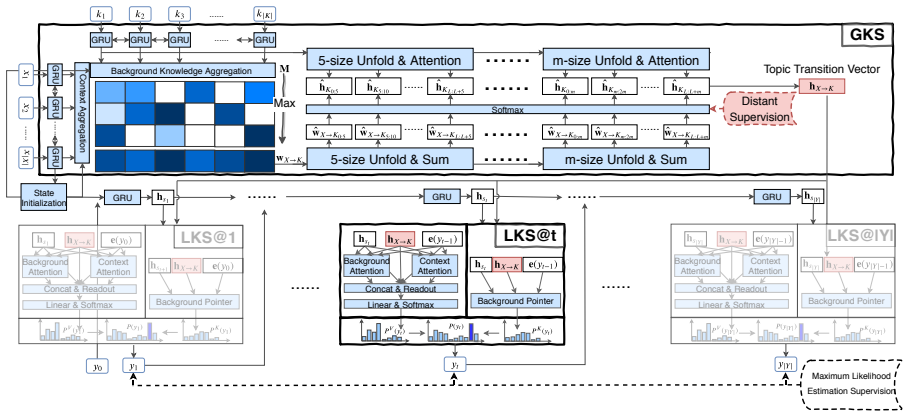
The load-bearing object is the topic transition vector $h_{X\to K}$, produced by the Global Knowledge Selection module. The module forms a matching matrix between background and context hidden states, max-pools over the context to get token transition weights, applies an $m$-size unfold-and-sum to aggregate adjacent weights into non-overlapping semantic units, and takes a soft weighted average of the corresponding attention-based unit representations. That vector is injected into the initial decoder state and into every decoding step's guidance vector, so it is the channel through which global knowledge choice steers local token selection and copying. The distant-supervision loss trains it with Jaccard word-overlap targets derived from the response, while the maximum causal entropy loss regularizes the noise in those targets.
What would settle it
Build a grounded-dialogue test set in which the correct background fragment is paraphrased in the response so it shares few or no words with it, then measure whether GLKS still selects the correct fragment and preserves ROUGE; if selection accuracy tracks the noisy Jaccard target instead of human judgments, the central claim fails.
Extended reading notes
Core claim
The paper's central claim is that, in Background Based Conversation, knowledge selection should be structured as global-to-local: first pick the semantic unit of the background that sets the topic of the next response, then let token-by-token decoding attend and copy from that background under the guidance of the global choice. The GLKS model computes a transition matching matrix between context and background, pools over context, sums adjacent background-token weights in non-overlapping $m$-size windows to form candidate text fragments, and averages their representations into a topic transition vector. That vector initializes and steers decoding, and a soft gate balances generating a word from the vocabulary against pointing to a background token. The vector is learned by combining token-level maximum likelihood with a distant-supervision loss that pushes the model's fragment-selection distribution toward the Jaccard similarity distribution between each fragment and the ground-truth response, plus a maximum causal entropy term that dampens noise in that proxy. On the Holl-E oracle and mixed-short settings, GLKS reports significant improvements over prior generation-based methods on all ROUGE metrics, and its ablation study attributes most of the gain to the global module and its distant-supervision loss.
Load-bearing premise
The distant-supervision target assumes that the background fragment with the largest word overlap with the human response is the knowledge the model should have selected; if that lexical proxy is wrong, the global module is trained toward the wrong target.
Editorial extensions
If this is right
- Global pre-selection before decoding improves knowledge selection: removing the GKS module or its distant-supervision loss lowers ROUGE by roughly 3 points on the mixed-short setting.
- The method scales to new BBC settings without extra annotation: unlike span-supervised RefNet or knowledge-grounded AKGCM, GLKS needs only the background, context, and response text.
- Longer backgrounds remain difficult: on the mixed-long 1,200-word setting GLKS and RefNet are comparable, and all models drop about 10 ROUGE points.
- The maximum causal entropy term matters: ablating it degrades results, consistent with noisy distant supervision.
- GLKS also improves over local-only baselines in human evaluation: it receives more votes for appropriateness and humanness, while RefNet receives the most votes for informativeness.
Reading between the lines
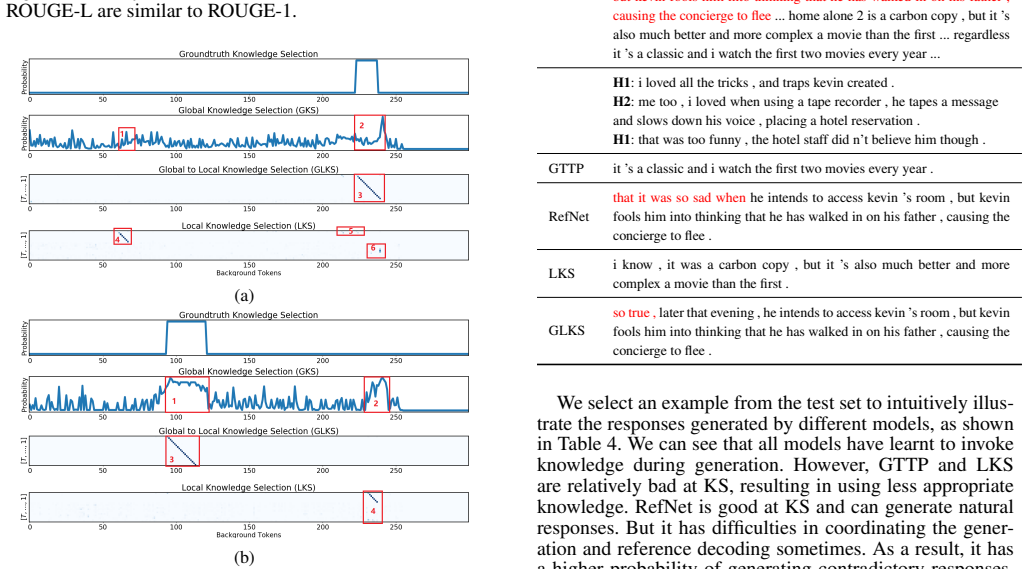
- Because the distant supervision is lexical, GLKS is likely to work best where the ground-truth response is constructed by copying or lightly editing the background, as in Holl-E; on datasets with freely paraphrased responses, the Jaccard target may point at the wrong fragment.
- Inferring from the paper's observed repetition failure, extending GLKS with a 'used-knowledge' tracker that masks already-selected fragments could reduce topic repetition in multi-turn grounded dialogue.
- The global-to-local design could transfer to other document-grounded generation tasks, such as long-form question answering or review generation, where the same local-attention failure mode occurs.
- A stronger test of the global-selection hypothesis would compare GLKS against a version that replaces the Jaccard target with human knowledge-selection labels on a dataset built for that purpose; the paper's ablation already suggests the distant-supervision signal, not just the global architecture, carries much of the gain.
Signed reviews
Editorial analysis
A structured set of objections, weighed in public.
Referee Report
Summary. The paper proposes GLKS, a Global-to-Local Knowledge Selection mechanism for background-based conversation. A global knowledge selection (GKS) module first computes a topic transition vector from the background and context, then a local knowledge selection (LKS) module uses this vector to guide token-level generation and copying. The GKS module is trained with a distant supervision loss based on Jaccard similarity between non-overlapping background windows and the ground-truth response, together with standard maximum likelihood estimation and a maximum causal entropy regularization. Experiments on the Holl-E dataset compare GLKS with several generation-based baselines under oracle, mixed-short, and mixed-long background settings, plus an ablation study and human evaluation. The central claims are that GLKS significantly outperforms state-of-the-art methods and achieves the best results on all metrics without extra annotations.
Significance. If the claims are supported, the paper makes a useful contribution: it introduces a simple, annotation-free way to inject a global knowledge-selection signal into grounded conversation generation, and it provides an architecture and ablation study that isolate the contribution of the global module, the distant supervision loss, and the entropy regularizer. Strengths include the clearly specified model equations, the publicly released code, the inclusion of three background settings, and the ablation evidence that each proposed component contributes. However, the headline claim of consistent state-of-the-art performance is only partially supported: the mixed-long background results in Table 1 show RefNet numerically better on ROUGE-2 with no significance tests, and the human evaluation in Table 2 shows GLKS lower than RefNet on Informativeness. Because the advertised central contribution is stated without qualification in the Abstract and Results, the paper needs a careful scoping of its claims before it can be accepted.
major comments (3)
- [Abstract; Results, Table 1] The Abstract and Results state that GLKS 'significantly outperforms state-of-the-art methods' and 'achieves the best results on all metrics,' but Table 1's mixed-long background rows contradict this: RefNet has higher ROUGE-2 (22.12 vs. 21.86 on SR; 29.74 vs. 29.35 on MR) and no significance markers are shown for this setting. The text itself says GLKS and RefNet are 'comparable' on mixed-long. Please either report significance tests for the mixed-long setting and revise the unqualified claims, or explicitly scope the claim to the oracle and mixed-short settings in the Abstract and Results.
- [Learning, Eq. (16); Evaluation metrics] The distant supervision signal is the Jaccard similarity between each non-overlapping background window and the ground-truth response Y, while the automatic evaluation is ROUGE, also computed against Y. Because both training supervision and evaluation reward lexical overlap with the same reference, the reported gains may partly reflect metric alignment rather than better knowledge selection. Please address this by reporting reference-free or diversity-oriented metrics, or by providing an analysis of whether GKS selects knowledge beyond simple lexical overlap; this is important for interpreting the 'significantly outperforms' claim as a genuine knowledge-selection improvement.
- [Results, Table 2] The human evaluation does not fully support the Abstract's claim of superiority in human evaluation: RefNet receives more votes than GLKS on Informativeness (411 vs. 401 at >=1; 244 vs. 199 at >=2), and no significance testing or inter-annotator agreement is reported. Please report significance for the human evaluation differences and either explain why Informativeness is not a key claim or soften the claim to the aspects where GLKS is best (Naturalness, Appropriateness, Humanness).
minor comments (5)
- [Global Knowledge Selection module, Eq. (2)] The formula for g_k has an apparent bracket mismatch: it reads 'b])' where the opening bracket is missing; please fix the notation.
- [State tracker, Eq. (8)] The sentence 'where Ws is the parameter and s is the bias' appears to contain a typo; it should likely refer to the bias as 'b' rather than 's.'
- [References] The reference to Vougiouklis et al. contains an unwanted space in 'V ougiouklis'; please correct the spelling.
- [Results, Human evaluation] The phrase 'Improved GTTP is equivalent to LKS in this paper' is confusing because it is not introduced as a separate baseline in Table 2; please clarify whether this is a re-implementation of GTTP with the local module only.
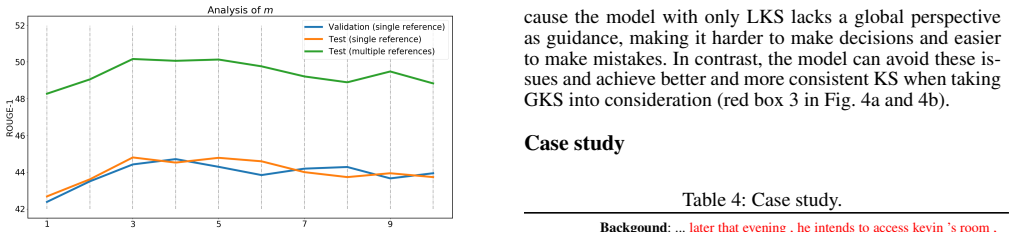
- [Hyper-parameter analysis, Figure 3] The text says 'The ROUGE scores increase and decrease within the scope of around 2% difference,' but it is unclear whether this refers to absolute percentage points or relative change; please make the unit explicit.
Circularity Check
No definitional circularity: GKS is trained with distant lexical-overlap labels and never sees the reference at inference; the self-citations are baseline comparisons, not load-bearing premises.
full rationale
GLKS's derivation is self-contained: the topic transition vector h_{X->K} (Eq. 7) is computed from the context and background only, and the distant supervision in Eq. 16 uses a softmax over Jaccard similarity between m-size background fragments and the ground-truth response Y. That label is available during training but is not an input at inference; the decoder (Eqs. 10-14) and the GKS module do not access Y at test time. Therefore the 'prediction' of knowledge selection is not a re-display of a fitted target. There is an objective-evaluation coupling: the DS target is lexical overlap with Y and the automatic metrics (ROUGE) also score overlap with Y, so training toward Jaccard can inflate ROUGE; but this is standard supervised-learning alignment, not an equation-level reduction, and nothing in the paper defines knowledge selection as 'the fragment maximizing ROUGE.' The self-citations (RefNet, CaKe) are used as comparison baselines with reported scores, not as the justification for GLKS's design; no uniqueness theorem or ansatz is smuggled in via those citations. The hyper-parameter m is tuned on validation, which is standard. The only substantive caveat is claim scoping: Table 1's mixed-long rows show RefNet numerically ahead on ROUGE-2 (22.12 vs. 21.86 SR; 29.74 vs. 29.35 MR), so the unqualified 'best on all metrics' statement is not supported in that setting; this is a correctness or scoping issue, not circularity.
Assumptions & free parameters
free parameters (2)
- m (unfold window size) =
4
- loss coefficients for L_mle, L_ds, L_mce =
1, 1, 1 (implicit)
assumptions (3)
- domain assumption The last context output h_x_|X| is a sufficient summary of the context for aggregating background and context representations.
- ad hoc to paper Jaccard similarity between a non-overlapping m-size background window and the ground-truth response is a valid distant supervision signal for knowledge selection.
- ad hoc to paper Clamping semantic units to non-overlapping fixed windows of size m does not destroy the boundaries of the knowledge fragments needed for the next response.
invented entities (2)
-
Topic transition vector h_X->K
-
Semantic units K_L:L+m (m-size unfold windows)
Cite this review
Pith. "Pith review of Thinking Globally, Acting Locally: Distantly Supervised Global-to-Local Knowledge Selection for Background Based Conversation." pith.science (2026). https://pith.science/paper/EW3IEC3M
@misc{pith2026190809528,
  author       = {Pith},
  title        = {Pith review of: Thinking Globally, Acting Locally: Distantly Supervised Global-to-Local Knowledge Selection for Background Based Conversation},
  year         = {2026},
  howpublished = {\url{https://pith.science/paper/EW3IEC3M}},
  note         = {Machine review of arXiv:1908.09528}
}
read the original abstract
Background Based Conversations (BBCs) have been introduced to help conversational systems avoid generating overly generic responses. In a BBC, the conversation is grounded in a knowledge source. A key challenge in BBCs is Knowledge Selection (KS): given a conversational context, try to find the appropriate background knowledge (a text fragment containing related facts or comments, etc.) based on which to generate the next response. Previous work addresses KS by employing attention and/or pointer mechanisms. These mechanisms use a local perspective, i.e., they select a token at a time based solely on the current decoding state. We argue for the adoption of a global perspective, i.e., pre-selecting some text fragments from the background knowledge that could help determine the topic of the next response. We enhance KS in BBCs by introducing a Global-to-Local Knowledge Selection (GLKS) mechanism. Given a conversational context and background knowledge, we first learn a topic transition vector to encode the most likely text fragments to be used in the next response, which is then used to guide the local KS at each decoding timestamp. In order to effectively learn the topic transition vector, we propose a distantly supervised learning schema. Experimental results show that the GLKS model significantly outperforms state-of-the-art methods in terms of both automatic and human evaluation. More importantly, GLKS achieves this without requiring any extra annotations, which demonstrates its high degree of scalability.
Figures

Figures from the paper (1 more)
Reference graph
Works this paper leans on
-
[1]
write newline
" write newline "" before.all 'output.state := FUNCTION fin.entry add.period write newline FUNCTION new.block output.state before.all = 'skip after.block 'output.state := if FUNCTION new.sentence output.state after.block = 'skip output.state before.all = 'skip after.sentence 'output.state := if if FUNCTION not #0 #1 if FUNCTION and 'skip pop #0 if FUNCTIO...
-
[2]
Bahdanau, D.; Cho, K.; and Bengio, Y. 2015. Neural machine translation by jointly learning to align and translate. In ICLR
2015
-
[3]
Chen, H.; Liu, X.; Yin, D.; and Tang, J. 2017. A survey on dialogue systems: Recent advances and new frontiers. ACM SIGKDD Explorations Newsletter 19(2):25--35
work page 2017
-
[4]
Cho, K.; van Merri \" e nboer, B.; Gulcehre, C.; Bahdanau, D.; Bougares, F.; Schwenk, H.; and Bengio, Y. 2014. Learning phrase representations using RNN encoder - decoder for statistical machine translation. In EMNLP , 1724--1734
work page 2014
-
[5]
Dinan, E.; Roller, S.; Shuster, K.; Fan, A.; Auli, M.; and Weston, J. 2019. Wizard of wikipedia: Knowledge-powered conversational agents. In ICLR
work page 2019
-
[6]
Ghazvininejad, M.; Brockett, C.; Chang, M.-W.; Dolan, B.; Gao, J.; Yih, W.-t.; and Galley, M. 2018. A knowledge-grounded neural conversation model. In AAAI , 5110--5117
work page 2018
-
[7]
He, S.; Liu, C.; Liu, K.; and Zhao, J. 2017. Generating natural answers by incorporating copying and retrieving mechanisms in sequence-to-sequence learning. In ACL , 199--208
work page 2017
-
[8]
Jiang, S.; Ren, P.; Monz, C.; and de Rijke, M. 2019. Improving neural response diversity with frequency-aware cross-entropy loss. In The Web Conference , 2879--2885
work page 2019
Show all 33 references
-
[9]
Li, J.; Galley, M.; Brockett, C.; Gao, J.; and Dolan, B. 2016. A diversity-promoting objective function for neural conversation models. In NAACL , 110--119
2016
-
[10]
Li, Z.; Niu, C.; Meng, F.; Feng, Y.; Li, Q.; and Zhou, J. 2019. Incremental transformer with deliberation decoder for document grounded conversations. In ACL , 12--21
2019
-
[11]
Lian, R.; Xie, M.; Wang, F.; Peng, J.; and Wu, H. 2019. Learning to select knowledge for response generation in dialog systems. arXiv
2019
-
[12]
Liu, S.; Chen, H.; Ren, Z.; Feng, Y.; Liu, Q.; and Yin, D. 2018. Knowledge diffusion for neural dialogue generation. In ACL , 1489--1498
2018
-
[13]
Liu, Z.; Niu, Z.-Y.; Wu, H.; and Wang, H. 2019. Knowledge aware conversation generation with explainable reasoning on augmented graph. arXiv
2019
-
[14]
V.; and Pineau, J
Lowe, R.; Pow, N.; Serban, I. V.; and Pineau, J. 2015. The ubuntu dialogue corpus: A large dataset for research in unstructured multi-turn dialogue systems. In SIGDIAL , 285--294
2015
-
[15]
Meng, C.; Ren, P.; Chen, Z.; Monz, C.; Ma, J.; and de Rijke, M. 2019. RefNet : A reference-aware network for background based conversation. arXiv
2019
-
[16]
Moghe, N.; Arora, S.; Banerjee, S.; and Khapra, M. M. 2018. Towards exploiting background knowledge for building conversation systems. In EMNLP , 2322--2332
2018
-
[17]
Moon, S.; Shah, P.; Kumar, A.; and Subba, R. 2019. Opendialkg: Explainable conversational reasoning with attention-based walks over knowledge graphs. In ACL , 845--854
2019
-
[18]
Qin, L.; Galley, M.; Brockett, C.; Liu, X.; Gao, X.; Dolan, B.; Choi, Y.; and Gao, J. 2019. Conversing by reading: Contentful neural conversation with on-demand machine reading. In ACL , 5427--5436
2019
-
[19]
J.; and Manning, C
See, A.; Liu, P. J.; and Manning, C. D. 2017. Get to the point: Summarization with pointer-generator networks. In ACL , 1073--1083
2017
-
[20]
Seo, M.; Kembhavi, A.; Farhadi, A.; and Hajishirzi, H. 2016. Bidirectional attention flow for machine comprehension. In ICLR
2016
-
[21]
V.; Sordoni, A.; Bengio, Y.; Courville, A
Serban, I. V.; Sordoni, A.; Bengio, Y.; Courville, A. C.; and Pineau, J. 2016. Building end-to-end dialogue systems using generative hierarchical neural network models. In AAAI , 3776--3784
2016
-
[22]
Shang, L.; Lu, Z.; and Li, H. 2015. Neural responding machine for short-text conversation. In ACL , 1577--1586
2015
-
[23]
K.; Greff, K.; and Schmidhuber, J
Srivastava, R. K.; Greff, K.; and Schmidhuber, J. 2015. Training very deep networks. In NeurIPS , 2377--2385
2015
-
[24]
Vougiouklis, P.; Hare, J.; and Simperl, E. 2016. A neural network approach for knowledge-driven response generation. In COLING , 3370--3380
2016
-
[25]
Xing, C.; Wu, W.; Wu, Y.; Liu, J.; Huang, Y.; Zhou, M.; and Ma, W.-Y. 2017. Topic aware neural response generation. In AAAI , 3351--3357
2017
-
[26]
Yan, R. 2018. Chitty-chitty-chat bot: Deep learning for conversational AI . In IJCAI , 5520--5526
2018
-
[27]
Young, T.; Cambria, E.; Chaturvedi, I.; Zhou, H.; Biswas, S.; and Huang, M. 2018. Augmenting end-to-end dialogue systems with commonsense knowledge. In AAAI , 4970--4977
2018
-
[28]
Zhang, S.; Dinan, E.; Urbanek, J.; Szlam, A.; Kiela, D.; and Weston, J. 2018a. Personalizing dialogue agents: I have a dog, do you have pets too? In ACL , 2204--2213
-
[29]
Zhang, Y.; Galley, M.; Gao, J.; Gan, Z.; Li, X.; Brockett, C.; and Dolan, B. 2018b. Generating informative and diverse conversational responses via adversarial information maximization. In NeurIPS , 1810--1820
-
[30]
Zhang, Y.; Ren, P.; and de Rijke, M. 2019. Improving background based conversation with context-aware knowledge pre-selection. In SCAI
2019
-
[31]
Zhao, T.; Zhao, R.; and Eskenazi, M. 2017. Learning discourse-level diversity for neural dialog models using conditional variational autoencoders. In ACL , 654--664
2017
-
[32]
Zhou, H.; Young, T.; Huang, M.; Zhao, H.; Xu, J.; and Zhu, X. 2018. Commonsense knowledge aware conversation generation with graph attention. In IJCAI , 4623--4629
2018
-
[33]
Zhou, K.; Prabhumoye, S.; and Black, A. W. 2018. A dataset for document grounded conversations. In EMNLP , 708--713
2018
Reviewed August 14, 2026 · model on record in the stance chip above.
Discussion (0). Continue with ORCID to comment.