REVIEW 3 major objections 5 minor 94 references
A single correction matrix undoes antenna-to-antenna coupling in dense radio arrays, all the way down to the measured visibilities.
Reviewed by Pith at T0; open to challenge. T0 means a machine referee read the full paper against a public rubric. the ladder, T0–T4 →
T0 review · deepseek-v4-flash
2026-08-02 06:53 UTC pith:EWKX6GLH
load-bearing objection Solid simulation study with an overstated central claim: the element-level C_F is never actually propagated to visibilities; the visibility validation uses a separately solved C_A. the 3 major comments →
Direct Primary Beam Correction: Untangling Mutual Coupling in 21-cm Cosmological Experiments with the SKA-Low Radio Telescope
The pith
A machine-rendered reading of the paper's core claim, the machinery that carries it, and where it could break.
Core claim
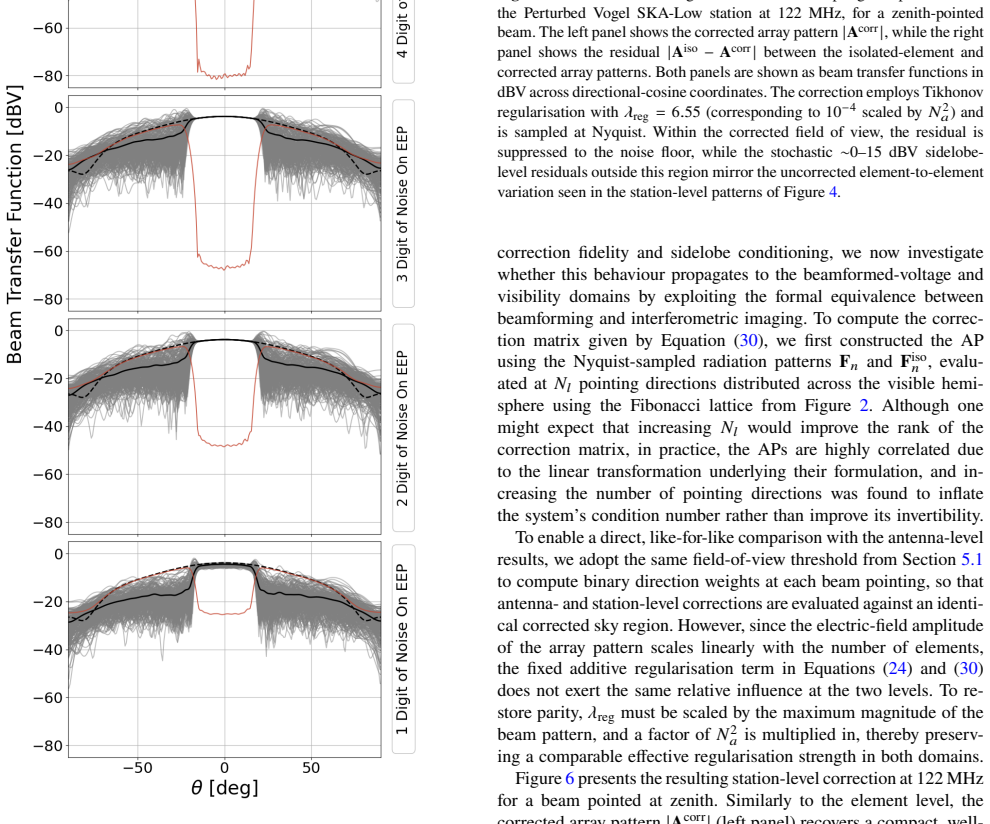
The central claim is that mutual coupling in a dense aperture array can be undone by a single linear operator, solved once from the embedded and isolated element patterns over a Nyquist-sampled, direction-weighted sky, and then propagated unchanged through beamforming into the visibility domain via the congruence transformation R_corr = C_A R C_A†. The paper proves this propagation by establishing the equivalence between beamforming and interferometric imaging, and validates it numerically: within a conditioned field of view, the corrected element pattern matches the isolated pattern to below -80 dB, and the same operator restores the array pattern and visibilities without recomputation. It
What carries the argument
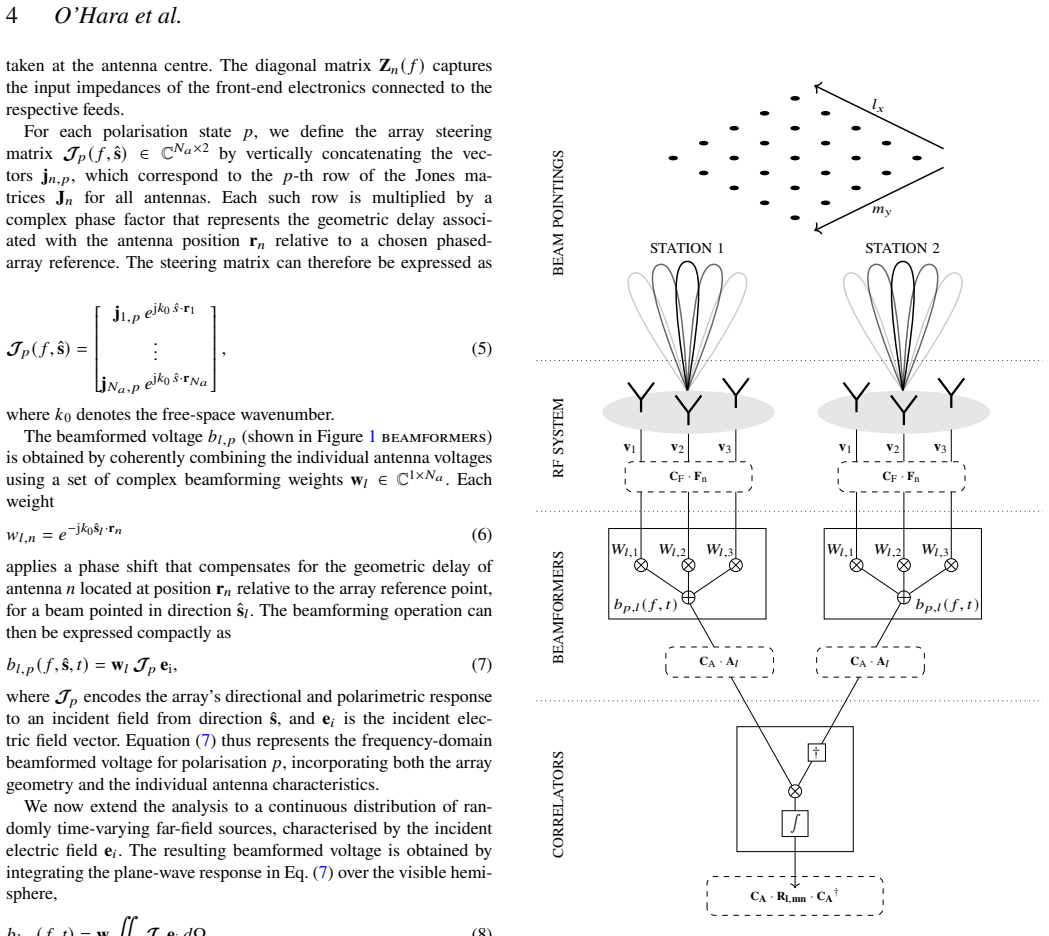
The load-bearing object is the correction matrix C_F, computed as a regularised, direction-weighted least-squares solution C_F = F_iso D (F D)^+ with Tikhonov regularisation, mapping embedded element patterns (EEPs) onto a chosen reference pattern—here the isolated element pattern (IEP). The propagation of this operator to the beam and visibility domains is carried by the matrix identity A = W F for beamformed array patterns and the congruence transformation R_corr = C_A R C_A† for visibilities, which the paper derives from the formal equivalence between beamforming and interferometric imaging. Direction weighting via the diagonal matrix D selects a conditioned field of view and ensures the
Load-bearing premise
The full-wave electromagnetic simulation of the SKALA4 element in the Perturbed Vogel station is assumed to represent the true as-built instrument response, so all validation is closed-loop against that simulation; if real embedded element patterns differ, the correction matrix built from simulation will not remove the real mutual coupling.
What would settle it
Measure the true embedded element pattern of a real SKA-Low station holographically, construct the correction matrix from that measured pattern, and apply it to actual visibilities of a bright calibrator; then examine the delay power spectrum for residual sub-MHz structure. If residual coupling-induced contamination comparable to the uncorrected case persists, the assumption that simulated EEPs suffice would be falsified.
If this is right
- Mutual-coupling correction can be performed exactly once at the element level, then applied for free to beamformed voltages or to stored visibilities, enabling real-time correction without downstream recomputation.
- Main-beam-only correction is not a safe default for 21-cm power-spectrum experiments; robust recovery of the EoR window requires either full-sky correction or explicit separation of main-beam and sidelobe contributions before forming the power spectrum.
- Mutual-coupling contamination is a fixed imprint of the array geometry, so longer integrations or more time samples will not average it away; only explicit correction or modelling can remove it.
- The fidelity of the correction is directly tied to the accuracy of the embedded-element-pattern model: reconstruction degrades noticeably when the model falls below roughly three significant figures, establishing a quantitative accuracy target for beam models.
- Because the framework is agnostic to both the distortion mechanism and the choice of reference pattern, the same operator construction applies to other direction-dependent effects, not only mutual coupling.
Where Pith is reading between the lines
- If the correction operator is approximately stationary over the 10-minute recomputation cycle the paper uses, one could interpolate or smooth correction matrices across frequency and time to suppress the channel-to-channel incoherence that causes the resonant sidelobe artefacts; this is a natural testable extension the paper does not pursue.
- The paper explicitly proposes holographic beam measurements as the anchor for the true as-built response; the practical implication is that the method's real-world value depends more on measurement fidelity than on the simulation fidelity demonstrated here.
- Pairing the correction with a tapered gridded estimator or image-domain apodisation could separate main-beam from sidelobe visibility contributions before the delay transform, potentially recovering the EoR window even when full-sky correction is impractical.
- The same theory could be applied to other temporally coherent, geometry-fixed direction-dependent effects, such as cable reflections or mutual coupling between stations, since the reference pattern in the inversion is arbitrary.
Editorial analysis
A structured set of objections, weighed in public.
Referee Report
Summary. The paper introduces 'Direct Primary Beam Correction,' a regularized, direction-weighted linear inversion framework that reconstructs a distorted antenna/array response (EEP) toward a reference response (IEP) in order to mitigate mutual coupling. The formalism is developed at three levels: an element-level correction matrix C_F (Eq. 24), a station/array-level matrix C_A (Eq. 30), and a visibility-domain congruence transformation R_corr = C_A R C_A^† (Eq. 32). The method is validated with full-wave FAST simulations of a perturbed Vogel SKA-Low station, showing sub-−80 dB residuals within a conditioned field of view at element, beam, and visibility level. The paper then applies the framework to a simulated 4-hour EoR0 observation and reports two implications: (i) main-beam correction restores the EoR window, but full-sky correction leaves severe resonant contamination from unconstrained sidelobes; (ii) mutual-coupling contamination is temporally coherent and does not average down with integration time. The conclusion argues that robust EoR recovery requires either full-sky correction or explicit separation of main-beam and sidelobe contributions.
Significance. If the headline propagation claim is repaired, the framework is a useful addition to the DD-correction toolbox for dense aperture arrays. The numerical validation is detailed and the sub-−80 dB residuals are impressive. The temporal-coherence result for mutual coupling is an important, potentially general caution for 21-cm power-spectrum analyses. However, the validation is closed-loop against the same full-wave simulation that provides both the distorted and reference patterns, and the EoR conclusions rely on a partially masked sky and hand-tuned regularization parameters. The central claim that element-level correction propagates 'unchanged' to visibilities is not currently supported, which reduces the paper's impact as stated. The paper is well organized and the underlying station-level correction concept is sound, so the issues are fixable within the manuscript's scope.
major comments (3)
- [§3.3, Eq. (32); §5.3; Conclusion (i)] The central claim that 'a correction matrix solved once at the element level propagates unchanged through the beamformed-voltage domain and into the visibility domain' is not supported by the derivation. The element-level relation is F_iso ≈ C_F F, while the station-level relation used for visibility correction is A_iso ≈ C_A A. The numerical validation in §5.3 solves for C_A via Eq. (30) with a Tikhonov parameter scaled by N_a^2; C_F is never applied to beamformed voltages or visibilities. To obtain the visibility correction from C_F one would need R_corr = (W C_F) R (W C_F)^†, not Eq. (32), unless C_A = W C_F W^+. This missing derivation makes conclusion (i) and the 'no recomputation required downstream' statement internally inconsistent. The authors should either prove the relation between C_F and C_A or reframe the claim as station-level single-solve propagation.
- [§4.2, Fig. 8, Conclusion (ii)] The 'full-sky' scenario is not full-sky. The diffuse Galactic component is masked to a 5° radius around the tracked field, and the bottom row of Fig. 8 includes the full GLEAM point-source population but not diffuse emission at large angles. Because the resonant contamination in the corrected-EEP full-sky panel is attributed to unconstrained sidelobes, omitting diffuse sky power beyond 5°—where sidelobe response is significant—could substantially alter both the amplitude and structure of the contamination. The conclusion that robust EoR recovery requires full-sky correction or main-beam/sidelobe separation is therefore not quantitatively established for a realistic full-sky foreground. The authors should either include the full-sky diffuse emission or justify that the point-source population alone is sufficient for the claimed effect.
- [§6.1, Fig. 8; §5.1 FoV definition] The comparison in Fig. 8 does not cleanly separate corrected and uncorrected sky regions. The correction FoV in §5.1 is a 16.2° radius (D=1), yet the main-beam row retains GLEAM sources only within 5° of the phase centre, while the full-sky row includes all sources, including those between 5° and 16.2° that are inside the corrected FoV. Thus the bottom-right panel mixes correctly corrected near-sidelobe directions with uncorrected far-sidelobe directions. The stated conclusion that 'restricting the correction to the main lobe and near sidelobes is inadequate' confounds these two populations. A clean test would separate sources with D=1 from those outside the correction FoV.
minor comments (5)
- [§3.1] Typo: 'frquency' should be 'frequency'. Also, the statement that the method is 'previously noted' in Section 2 lacks a citation.
- [§5.3] The scaling of λ_reg by N_a^2 is asserted without derivation. A brief explanation of why this restores parity between element-level and station-level regularization would aid reproducibility.
- [§4.2] The diffuse component is masked to a 5° radius while the 21cmFAST signal is generated over a 10°×10° field; the statement that these are 'matching' is approximate. Clarify the geometry.
- [§6.1, Fig. 8] The terms 'horizon limit' and 'beam limit' are used in the caption and text but not explicitly defined. Please define them, as the 'supra-horizon' leakage discussion relies on this distinction.
- [Data Availability] The statement that data and software 'will be shared on reasonable request' is weaker than standard practice; consider archiving the simulation and analysis scripts to enable reproduction.
Circularity Check
Correction 'validation' is an in-sample least-squares fit: C_F and C_A are solved from the same EEP/IEP data on which the noise-floor residuals are measured, and the visibility test uses the separately fitted C_A rather than the element-level C_F claimed to propagate unchanged.
specific steps
-
fitted input called prediction
[Section 5.1, Eqs. (21)-(24), Figures 3-4]
"Minimising this loss with respect to CF yields the closed-form weighted least-squares solution, CF=FisoD(FD)+ ... the Nyquist-sampled solution shown in the third panel down fully resolves the beam structure within the corrected field of view, enabling accurate reconstruction of the target response to numerical precision, with the residual saturating at −125dBV."
C_F is defined as the (regularized) weighted least-squares minimizer of ||C_F F D - F_iso D||. The residual quoted as 'reconstruction to numerical precision' is evaluated on the same F, F_iso, and D-weighted directions used to solve Eq. (24). The 'reconstruction' therefore measures in-sample training error, not an independent prediction; the near-zero residual is forced by construction.
-
fitted input called prediction
[Section 5.3, Eqs. (28)-(30), Figure 6]
"To compute the correction matrix given by Equation (30), we first constructed the array pattern using the Nyquist-sampled radiation patterns Fn and Fiso n, evaluated at Nl pointing directions distributed across the visible hemisphere using the Fibonacci lattice from Figure 2. ... Within the corrected field of view, the residual is suppressed to the noise floor"
C_A is solved by the same regularized least-squares procedure against A_iso using the very array patterns A and A_iso that are then used for the residual check. The claim that 'the antenna-level correction operator propagates coherently to the beamformed-voltage domain' is supported only by the in-sample fit residual of the station-level matrix, not by any out-of-sample or independent test.
-
self definitional
[Section 3.3, Eq. (32); Section 5.3; Section 7 conclusion (i)]
"By substituting the station-level correction relationship from Equation (27), the visibilities may be corrected given Rcorr mn = Aiso m I (Aiso n)^† ≃ CA Am I A†n C†A ≃ CA Rmn C†A. ... the same correction matrix applied to the station-level correction in Figure 6 is applied directly to the simulated visibilities Rl,mn"
The visibility-domain result is defined through the station-level matrix C_A, which was separately fitted to satisfy A_iso ≈ C_A A. Substituting that fit into R = A I A† makes the 'corrected' visibility equal the A_iso-based visibility by algebra, not by any empirical test. Moreover, C_A is not the element-level C_F of Eq. (24), so conclusion (i)'s claim that 'a correction matrix solved once at the element level propagates unchanged' into the visibility domain is not derived from the paper's own equations.
full rationale
The paper contains substantial non-circular content: the EoR-window analysis, the demonstration that main-beam-only correction leaves chromatic grating-lobe contamination, the channel-incoherent resonant structures from per-frequency regularized inverses, and the temporal coherence of mutual-coupling contamination are genuine simulation-based findings that do not reduce to the correction fits. However, the central validation of the correction operator is technically circular in the patterns the review targets. Equations (21)-(24) define C_F as the weighted least-squares solution minimizing the same residual that is then reported as 'reconstruction to numerical precision'; this is a fitted quantity presented as a validated recovery, not an out-of-sample prediction. The same holds for C_A at station level. The visibility-domain test of Section 5.3 does not propagate C_F: Eq. (32) applies the separately fitted C_A, so the agreement is a congruence-transformed version of the fit relation A_iso ≈ C_A A, again forced by construction. The paper itself flags the closed-loop limitation in Section 7 by proposing holographic measurements as an anchor to the true as-built response, and it acknowledges the sidelobe-correction tension in Section 6.1. These admissions are important but do not remove the in-sample nature of the claimed noise-floor validation. Self-citations, such as the four-significant-digit requirement from O'Hara et al. (2025c), are not load-bearing because the paper independently probes model precision in Section 5.2. On balance, the score is 6: one or more 'predictions' (the noise-floor reconstruction and its propagation) reduce by construction, while the paper still contains independent scientific results on EoR-window contamination.
Axiom & Free-Parameter Ledger
free parameters (3)
- Tikhonov regularisation parameter λ_reg =
1e-4 (element level); 6.55 (station level, scaled by N_a^2)
- Correction field-of-view cutoff angle =
16.2° at 122 MHz
- Diffuse sky mask radius =
5°
axioms (5)
- standard math Voltage-to-incident-field linearity (RIME, Eq. 3)
- domain assumption Linear mutual-coupling model F_iso ≈ C_F F (Eq. 19)
- domain assumption Nyquist spatial-sampling criterion (Section 5.1)
- domain assumption Full-wave simulation as ground truth (Section 4.1)
- domain assumption Discrete-source sky representation (Section 4.2)
read the original abstract
Mutual coupling between antennas has emerged as the dominant direction-dependent corruption in dense aperture arrays, imprinting pronounced sub-MHz spatial and spectral structure that compromises the time-gating and foreground-separation strategies used to isolate the faint 21-cm signal. In this work, we introduce \textit{Direct Primary Beam Correction}, a domain-agnostic framework for reconstructing the far-field radiation pattern relative to an arbitrary reference via a regularised, direction-weighted linear inversion of stacked Jones matrices, thereby enabling the removal of direction-dependent distortions such as mutual coupling. Using full-wave electromagnetic simulations of SKA-Low, we demonstrate that this framework reconstructs the radiation pattern down to the numerical noise floor within a suitably conditioned field of view, with the reconstruction accuracy governed by the regularised inversion and the fidelity of the underlying beam model. Applying the framework to a simulated 4-hour observation of the EoR0 field in the $122$--$134$~MHz band, we identify two principal implications for 21-cm power-spectrum analysis. First, restricting the correction to the main lobe and near sidelobes is inadequate: chromatic grating lobe contributions, whether left insufficiently or entirely uncorrected, continue to contaminate the EoR window. Second, mutual-coupling-induced contamination is temporally coherent and, being anchored to the fixed array geometry, does not average down across snapshots as the EoR field is tracked. Direct primary beam correction, therefore, provides a computationally efficient means of mitigating mutual coupling; however, robust recovery of the EoR window necessitates either full-sky correction or explicit separation of main-beam and sidelobe contributions prior to power-spectrum estimation.
Figures




Reference graph
Works this paper leans on
-
[1]
2017 , publisher=
Interferometry and synthesis in radio astronomy , author=. 2017 , publisher=
2017
-
[2]
Astronomy & astrophysics , volume=
LOFAR: The low-frequency array , author=. Astronomy & astrophysics , volume=. 2013 , publisher=
2013
-
[3]
Publications of the Astronomical Society of Australia , volume=
The Murchison widefield array: the square kilometre array precursor at low radio frequencies , author=. Publications of the Astronomical Society of Australia , volume=. 2013 , publisher=
2013
-
[4]
The Astrophysical Journal Supplement Series , volume=
An overview of chime, the canadian hydrogen intensity mapping experiment , author=. The Astrophysical Journal Supplement Series , volume=. 2022 , publisher=
2022
-
[5]
2015 International Conference on Electromagnetics in Advanced Applications (ICEAA) , pages=
Evolution of SKALA (SKALA-2), the log-periodic array antenna for the SKA-low instrument , author=. 2015 International Conference on Electromagnetics in Advanced Applications (ICEAA) , pages=. 2015 , organization=
2015
-
[6]
Monthly Notices of the Royal Astronomical Society , volume=
Spectral performance of SKA Log-periodic Antennas I: mitigating spectral artefacts in SKA1-LOW 21 cm cosmology experiments , author=. Monthly Notices of the Royal Astronomical Society , volume=. 2017 , publisher=
2017
-
[7]
and de Lera Acedo, Eloy and Wayth, Randall B
Trott, Cathryn M. and de Lera Acedo, Eloy and Wayth, Randall B. and Fagnoni, Nicolas and Sutinjo, Adrian T. and Wakley, Brett and Punzalan, Chris Ivan B. , year=. Spectral performance of Square Kilometre Array Antennas – II. Calibration performance , volume=. Monthly Notices of the Royal Astronomical Society , publisher=. doi:10.1093/mnras/stx1224 , number=
-
[8]
arXiv preprint arXiv:1912.12699 , year=
Anticipated Performance of the Square Kilometre Array--Phase 1 (SKA1) , author=. arXiv preprint arXiv:1912.12699 , year=
Pith/arXiv arXiv 1912
-
[9]
Publications of the Astronomical Society of the Pacific , volume=
Hydrogen epoch of reionization array (HERA) , author=. Publications of the Astronomical Society of the Pacific , volume=. 2017 , publisher=
2017
-
[10]
Annual review of astronomy and astrophysics , volume=
Reionization and Cosmology with 21-cm Fluctuations , author=. Annual review of astronomy and astrophysics , volume=. 2010 , publisher=
2010
-
[11]
and Hall, Peter J
Dewdney, Peter E. and Hall, Peter J. and Schilizzi, Richard T. and Lazio, T. Joseph L. W. , journal=. The Square Kilometre Array , year=
-
[12]
Radio Science , volume=
A review on array mutual coupling analysis , author=. Radio Science , volume=. 2011 , publisher=
2011
-
[13]
IEEE Transactions on Antennas and Propagation , volume=
Direct deterministic nulling techniques for large random arrays including mutual coupling , author=. IEEE Transactions on Antennas and Propagation , volume=. 2018 , publisher=
2018
-
[14]
2021 , publisher=
Mutual Coupling Between Antennas , author=. 2021 , publisher=
2021
-
[15]
IEEE Antennas and Wireless Propagation Letters , volume=
Mutual coupling calibration for microstrip antenna arrays via element pattern reconstruction method , author=. IEEE Antennas and Wireless Propagation Letters , volume=. 2013 , publisher=
2013
-
[16]
2020 XXXIIIrd General Assembly and Scientific Symposium of the International Union of Radio Science , pages=
Embedded element patterns in hierarchical calibration of large distributed arrays , author=. 2020 XXXIIIrd General Assembly and Scientific Symposium of the International Union of Radio Science , pages=. 2020 , organization=
2020
-
[17]
2019 international conference on electromagnetics in advanced applications (ICEAA) , pages=
Using embedded element patterns to improve aperture array calibration , author=. 2019 international conference on electromagnetics in advanced applications (ICEAA) , pages=. 2019 , organization=
2019
-
[18]
Monthly Notices of the Royal Astronomical Society , volume=
Uncovering the effects of array mutual coupling in 21-cm experiments with the SKA-Low radio telescope , author=. Monthly Notices of the Royal Astronomical Society , volume=. 2025 , publisher=
2025
-
[19]
2025 , eprint=
First Results from HERA Phase II , author=. 2025 , eprint=
2025
-
[20]
A full-sky Jones formalism , author=
Revisiting the radio interferometer measurement equation-I. A full-sky Jones formalism , author=. Astronomy & Astrophysics , volume=. 2011 , publisher=
2011
-
[21]
Calibration and direction-dependent effects , author=
Revisiting the radio interferometer measurement equation-II. Calibration and direction-dependent effects , author=. Astronomy & Astrophysics , volume=. 2011 , publisher=
2011
-
[22]
Addressing direction-dependent effects in 21 cm WSRT observations of 3C 147 , author=
Revisiting the radio interferometer measurement equation-III. Addressing direction-dependent effects in 21 cm WSRT observations of 3C 147 , author=. Astronomy & Astrophysics , volume=. 2011 , publisher=
2011
-
[23]
Astronomical Data Analysis Software and Systems XIV , volume=
W projection: A new algorithm for wide field imaging with radio synthesis arrays , author=. Astronomical Data Analysis Software and Systems XIV , volume=
-
[24]
Astronomy & Astrophysics , volume=
Correcting direction-dependent gains in the deconvolution of radio interferometric images , author=. Astronomy & Astrophysics , volume=. 2008 , doi =
2008
-
[25]
Astronomy & Astrophysics , volume=
Applying full polarization A-Projection to very wide field of view instruments: An imager for LOFAR , author=. Astronomy & Astrophysics , volume=. 2013 , publisher=
2013
-
[26]
Astronomy & Astrophysics , volume=
Faceting for direction-dependent spectral deconvolution , author=. Astronomy & Astrophysics , volume=. 2018 , publisher=
2018
-
[27]
Kazemi, S. and Yatawatta, S. and Zaroubi, S. and Lampropoulos, P. and de Bruyn, A. G. and Koopmans, L. V. E. and Noordam, J. , title =. Monthly Notices of the Royal Astronomical Society , volume =. 2011 , month =. doi:10.1111/j.1365-2966.2011.18506.x , url =
arXiv 2011
-
[28]
and Greenhill, Lincoln J
Mitchell, Daniel A. and Greenhill, Lincoln J. and Wayth, Randall B. and Sault, Robert J. and Lonsdale, Colin J. and Cappallo, Roger J. and Morales, Miguel F. and Ord, Stephen M. , journal=. Real-Time Calibration of the Murchison Widefield Array , year=
-
[29]
Monthly Notices of the Royal Astronomical Society , volume=
Calibration requirements for detecting the 21 cm epoch of reionization power spectrum and implications for the SKA , author=. Monthly Notices of the Royal Astronomical Society , volume=. 2016 , publisher=
2016
-
[30]
Monthly Notices of the Royal Astronomical Society , volume=
Robust direction-dependent gain-calibration of beam-modelling errors far from the target field , author=. Monthly Notices of the Royal Astronomical Society , volume=. 2025 , publisher=
2025
-
[31]
Astronomy & Astrophysics , volume=
Redundancy calibration of phased-array stations , author=. Astronomy & Astrophysics , volume=. 2012 , publisher=
2012
-
[32]
Physical Review D—Particles, Fields, Gravitation, and Cosmology , volume=
Fast Fourier transform telescope , author=. Physical Review D—Particles, Fields, Gravitation, and Cosmology , volume=. 2009 , publisher=
2009
-
[33]
Monthly Notices of the Royal Astronomical Society , volume=
An efficient feedback calibration algorithm for direct imaging radio telescopes , author=. Monthly Notices of the Royal Astronomical Society , volume=. 2017 , doi =
2017
-
[34]
Publications of the Astronomical Society of the Pacific , volume=
Enabling next-generation dark energy and epoch of reionization radio observatories with the moff correlator , author=. Publications of the Astronomical Society of the Pacific , volume=. 2011 , publisher=
2011
-
[35]
Radio Science , volume=
Holographic calibration of phased array telescopes , author=. Radio Science , volume=. 2021 , publisher=
2021
-
[36]
Monthly Notices of the Royal Astronomical Society , volume=
A generic and efficient E-field Parallel Imaging Correlator for next-generation radio telescopes , author=. Monthly Notices of the Royal Astronomical Society , volume=. 2017 , publisher=
2017
-
[37]
Publications of the Astronomical Society of Australia , volume=
Comparison of fast, hybrid imaging architectures for multi-scale, hierarchical aperture arrays , author=. Publications of the Astronomical Society of Australia , volume=. 2025 , publisher=
2025
-
[38]
Offringa, A. R. and McKinley, B. and Hurley-Walker, N. and Briggs, F. H. and Wayth, R. B. and Kaplan, D. L. and Bell, M. E. and Feng, L. and Neben, A. R. and Hughes, J. D. and Rhee, J. and Murphy, T. and Bhat, N. D. R. and Bernardi, G. and Bowman, J. D. and Cappallo, R. J. and Corey, B. E. and Deshpande, A. A. and Emrich, D. and Ewall-Wice, A. and Gaensle...
2014
-
[39]
Monthly Notices of the Royal Astronomical Society , volume=
Systematic biases in low-frequency radio interferometric data due to calibration: the LOFAR-EoR case , author=. Monthly Notices of the Royal Astronomical Society , volume=. 2016 , publisher=
2016
-
[40]
Cornwell, T. J. and Wilkinson, P. N. , title =. Monthly Notices of the Royal Astronomical Society , volume =. 1981 , month =. doi:10.1093/mnras/196.4.1067 , url =
-
[41]
Ground-based telescopes , volume=
LOFAR calibration challenges , author=. Ground-based telescopes , volume=. 2004 , organization=
2004
-
[42]
Astronomy & Astrophysics , volume=
Assessing the impact of two independent direction-dependent calibration algorithms on the LOFAR 21 cm signal power spectrum-And applications to an observation of a field flanking the north celestial pole , author=. Astronomy & Astrophysics , volume=. 2023 , publisher=
2023
-
[43]
Monthly Notices of the Royal Astronomical Society , volume =
Yatawatta, Sarod , title =. Monthly Notices of the Royal Astronomical Society , volume =. 2015 , month =. doi:10.1093/mnras/stv596 , url =
-
[44]
and van der Veen, Alle-Jan , journal=
van der Tol, Sebastiaan and Jeffs, Brian D. and van der Veen, Alle-Jan , journal=. Self-Calibration for the LOFAR Radio Astronomical Array , year=
-
[45]
Monthly Notices of the Royal Astronomical Society , volume=
Testing for calibration systematics in the EDGES low-band data using Bayesian model selection , author=. Monthly Notices of the Royal Astronomical Society , volume=. 2020 , publisher=
2020
-
[46]
Nature , volume=
An absorption profile centred at 78 megahertz in the sky-averaged spectrum , author=. Nature , volume=. 2018 , publisher=
2018
-
[47]
and Baartman, Rushelle and Barkana, Rennan and Berkhout, Lindsay M
Abdurashidova, Zuhra and Adams, Tyrone and Aguirre, James E. and Baartman, Rushelle and Barkana, Rennan and Berkhout, Lindsay M. and Bernardi, Gianni and Billings, Tashalee S. and Bizarria, Bruno B. and Bowman, Judd D. and Breitman, Daniela and Bull, Philip and Burba, Jacob and Byrne, Ruby and Carey, Steven and Chandra, Rajorshi Sushovan and Chen, Kai-Fen...
2026
-
[48]
Kern, Nicholas , number =. 2025 , journal =. doi:10.1093/MNRAS/STAF1007 , issn =
-
[49]
Monthly Notices of the Royal Astronomical Society , volume=
The effects of the antenna power pattern uncertainty within a global 21 cm experiment , author=. Monthly Notices of the Royal Astronomical Society , volume=. 2024 , publisher=
2024
-
[50]
The Astrophysical Journal , volume=
Ionospheric power-spectrum tomography in radio interferometry , author=. The Astrophysical Journal , volume=. 2010 , publisher=
2010
-
[51]
Proceedings of the Cray User Group , pages=
Isambard-ai: a leadership-class supercomputer optimised specifically for artificial intelligence , author=. Proceedings of the Cray User Group , pages=
-
[52]
Mitigating Zenith Blindness from Mutual Coupling in a Sunflower Phased Array , year=
Anstey, Dominic and Cumner, John and Gueuning, Quentin and O'Hara, Oscar and de Lera Acedo, Eloy and Brown, Anthony and Faulkner, Andrew and Dulwich, Fred and Scott, Paul , booktitle=. Mitigating Zenith Blindness from Mutual Coupling in a Sunflower Phased Array , year=
-
[53]
Optimising Array Layouts with Aperiodic Tiling to Reduce Beam Spectral Variations Caused by Mutual Coupling , year=
Mhaske, Ashish and Gueuning, Quentin and de Lera Acedo, Eloy and O'Hara, Oscar Sage David and Anstey, Dominic and Cumner, John and Brown, Anthony and Faulkner, Andrew and Dulwich, Fred , booktitle=. Optimising Array Layouts with Aperiodic Tiling to Reduce Beam Spectral Variations Caused by Mutual Coupling , year=
-
[54]
Monthly Notices of the Royal Astronomical Society , volume =
Bonaldi, A and Hartley, P and Braun, R and Purser, S and Acharya, A and Ahn, K and Aparicio Resco, M and Bait, O and Bianco, M and Chakraborty, A and Chapman, E and Chatterjee, S and Chege, K and Chen, H and Chen, X and Chen, Z and Conaboy, L and Cruz, M and Darriba, L and De Santis, M and Denzel, P and Diao, K and Feron, J and Finlay, C and Gehlot, B and...
2025
-
[55]
A Broadband Multipole Method for Accelerated Mutual Coupling Analysis of Large Irregular Arrays Including Rotated Antennas , year=
Gueuning, Quentin and de Lera Acedo, Eloy and Keith Brown, Anthony and Craeye, Christophe and O’Hara, Oscar , journal=. A Broadband Multipole Method for Accelerated Mutual Coupling Analysis of Large Irregular Arrays Including Rotated Antennas , year=
-
[56]
UAV-Based Measurement of Sharp Spectral Resonances in Mutually Coupled SKA-Low Elements , year=
Paonessa, Fabio and Ciorba, Lorenzo and Kyriakou, Georgios and Bolli, Pietro and Virone, Giuseppe , journal=. UAV-Based Measurement of Sharp Spectral Resonances in Mutually Coupled SKA-Low Elements , year=
-
[57]
Davidson, David B. and Bolli, Pietro and Bercigli, Mirko and Ninni, Paola Di and Monari, Jader and Perini, Federico and Sokolowski, Marcin and Tingay, Steven and Ung, Daniel and Virone, Giuseppe and Waterson, Mark and Wayth, Randall and Zerbi, Filippo M. , booktitle=. Electromagnetic modelling of the SKA-LOW AAVS2 prototype , year=
-
[58]
Davidson and Mirko Bercigli and Paola Di Ninni and Maria Grazia Labate and Daniel Ung and Giuseppe Virone , title =
Pietro Bolli and David B. Davidson and Mirko Bercigli and Paola Di Ninni and Maria Grazia Labate and Daniel Ung and Giuseppe Virone , title =. Journal of Astronomical Telescopes, Instruments, and Systems , number =. 2022 , doi =
2022
-
[59]
The Astrophysical Journal , volume=
Holographic beam measurements of the Canadian hydrogen intensity mapping experiment (CHIME) , author=. The Astrophysical Journal , volume=. 2024 , doi =
2024
-
[60]
Monthly Notices of the Royal Astronomical Society , volume =
Chokshi, A and Line, J L B and Barry, N and Ung, D and Kenney, D and McPhail, A and Williams, A and Webster, R L , title =. Monthly Notices of the Royal Astronomical Society , volume =. 2021 , month =. doi:10.1093/mnras/stab156 , url =
-
[61]
Beam Prediction Method for Antenna Arrays in Radio Astronomy via Artificial Neural Networks , year=
Kovaleva, Maria and Chen, Chuyan and Davidson, David , booktitle=. Beam Prediction Method for Antenna Arrays in Radio Astronomy via Artificial Neural Networks , year=
-
[62]
Monthly Notices of the Royal Astronomical Society , volume =
O’Hara, Oscar S D and Dulwich, Fred and de Lera Acedo, Eloy and Dhandha, Jiten and Gessey-Jones, Thomas and Anstey, Dominic and Fialkov, Anastasia , title =. Monthly Notices of the Royal Astronomical Society , volume =. 2024 , month =. doi:10.1093/mnras/stae1952 , url =
-
[63]
Monthly Notices of the Royal Astronomical Society , volume =
Bevins, Harry T J and Heimersheim, Stefan and Abril-Cabezas, Irene and Fialkov, Anastasia and de Lera Acedo, Eloy and Handley, William and Singh, Saurabh and Barkana, Rennan , title =. Monthly Notices of the Royal Astronomical Society , volume =. 2024 , month =. doi:10.1093/mnras/stad3194 , url =
-
[64]
Antenna design for the SKA1-LOW and HERA super radio telescopes , year=
de Lera Acedo, Eloy and Pienaar, Hardie and Fagnoni, Nicolas , booktitle=. Antenna design for the SKA1-LOW and HERA super radio telescopes , year=
-
[65]
O'Hara, Oscar , year=. The detection & study of low-level electromagnetic emission in the presence of strong noise signals , url=. doi:10.17863/CAM.128101 , school=
-
[66]
Monthly Notices of the Royal Astronomical Society , volume =
Liu, Yuchen and de Lera Acedo, Eloy and Sims, Peter H , title =. Monthly Notices of the Royal Astronomical Society , volume =. 2026 , month =. doi:10.1093/mnras/stag878 , url =
-
[67]
Monthly Notices of the Royal Astronomical Society , volume =
Mertens, F G and Mevius, M and Koopmans, L V E and Offringa, A R and Mellema, G and Zaroubi, S and Brentjens, M A and Gan, H and Gehlot, B K and Pandey, V N and Sardarabadi, A M and Vedantham, H K and Yatawatta, S and Asad, K M B and Ciardi, B and Chapman, E and Gazagnes, S and Ghara, R and Ghosh, A and Giri, S K and Iliev, I T and Jelić, V and Kooistra, ...
2020
-
[68]
Monthly Notices of the Royal Astronomical Society , volume =
Morales, Miguel F and Beardsley, Adam and Pober, Jonathan and Barry, Nichole and Hazelton, Bryna and Jacobs, Daniel and Sullivan, Ian , title =. Monthly Notices of the Royal Astronomical Society , volume =. 2019 , month =. doi:10.1093/mnras/sty2844 , url =
-
[69]
Monthly Notices of the Royal Astronomical Society , volume =
Sarkar, Shouvik and Elahi, Khandakar Md Asif and Choudhuri, Samir and Bharadwaj, Somnath and Chatterjee, Suman and Bhattacharyya, Baijayanta and Sethi, Shiv and Patwa, Akash Kumar , title =. Monthly Notices of the Royal Astronomical Society , volume =. 2026 , month =. doi:10.1093/mnras/stag801 , url =
-
[70]
Dulwich, Fred , title =
-
[71]
Fast and Accurate Simulation Technique for Large Irregular Arrays , year=
Bui-Van, Ha and Abraham, Jens and Arts, Michel and Gueuning, Quentin and Raucy, Christopher and González-Ovejero, David and de Lera Acedo, Eloy and Craeye, Christophe , journal=. Fast and Accurate Simulation Technique for Large Irregular Arrays , year=
-
[72]
The Astrophysical Journal , volume=
New limits on 21 cm epoch of reionization from paper-32 consistent with an x-ray heated intergalactic medium at z= 7.7 , author=. The Astrophysical Journal , volume=. 2014 , publisher=
2014
-
[73]
Antenna gain pattern blindness due to mutual coupling in broadband arrays , year=
Cumner, John and Cumner, John and Anstey, Dominic and Gueuning, Quentin and O’Hara, Oscar and Acedo, Eloy de Lera and Brown, Anthony and Faulkner, Andrew and Dulwich, Fred and Scott, Paul , booktitle=. Antenna gain pattern blindness due to mutual coupling in broadband arrays , year=
-
[75]
Monthly Notices of the Royal Astronomical Society , volume =
Hurley-Walker, N and Callingham, J R and Hancock, P J and Franzen, T M O and Hindson, L and Kapińska, A D and Morgan, J and Offringa, A R and Wayth, R B and Wu, C and Zheng, Q and Murphy, T and Bell, M E and Dwarakanath, K S and For, B and Gaensler, B M and Johnston-Hollitt, M and Lenc, E and Procopio, P and Staveley-Smith, L and Ekers, R and Bowman, J D ...
2017
-
[76]
Zheng, H. and Tegmark, M. and Dillon, J. S. and Kim, D. A. and Liu, A. and Neben, A. R. and Jonas, J. and Reich, P. and Reich, W. , title =. Monthly Notices of the Royal Astronomical Society , volume =. 2017 , month =. doi:10.1093/mnras/stw2525 , url =
-
[77]
The Astrophysical Journal , volume=
Toward epoch of reionization measurements with wide-field radio observations , author=. The Astrophysical Journal , volume=
-
[78]
Astronomy & Astrophysics , volume=
Fast gain calibration in radio astronomy using alternating direction implicit methods: Analysis and applications , author=. Astronomy & Astrophysics , volume=. 2014 , publisher=
2014
-
[79]
2026 , eprint=
Observations of the Cosmic Dawn and Epoch of Reionization with the SKAO: Observational Lessons Learned from Precursors and Pathfinder Instruments , author=. 2026 , eprint=
2026
-
[80]
O’Hara, Oscar S.D. and Gueuning, Quentin and De Lera Acedo, Eloy and Dulwich, Fred and Cumner, John and Anstey, Dominic and Brown, Anthony and Faulkner, Andrew and Horton, Maya and Mhaske, Ashish , booktitle=. Impact of Array Mutual Coupling on 21-cm Cosmology Experiments with the SKA-Low Telescope , year=
-
[81]
2026 , note =
Gueuning, Quentin , title =. 2026 , note =
2026
discussion (0)
Sign in with ORCID, Apple, or X to comment. Anyone can read and Pith papers without signing in.