Effect of the magnetic monopole charge on Dirac entanglement and Bell non-locality in Hayward spacetime
Pith reviewed 2026-06-26 01:09 UTC · model grok-4.3
The pith
Dirac field entanglement in Hayward spacetime stays nonzero at infinite Hawking temperature due to the Pauli principle.
A machine-rendered reading of the paper's core claim, the machinery that carries it, and where it could break.
Core claim
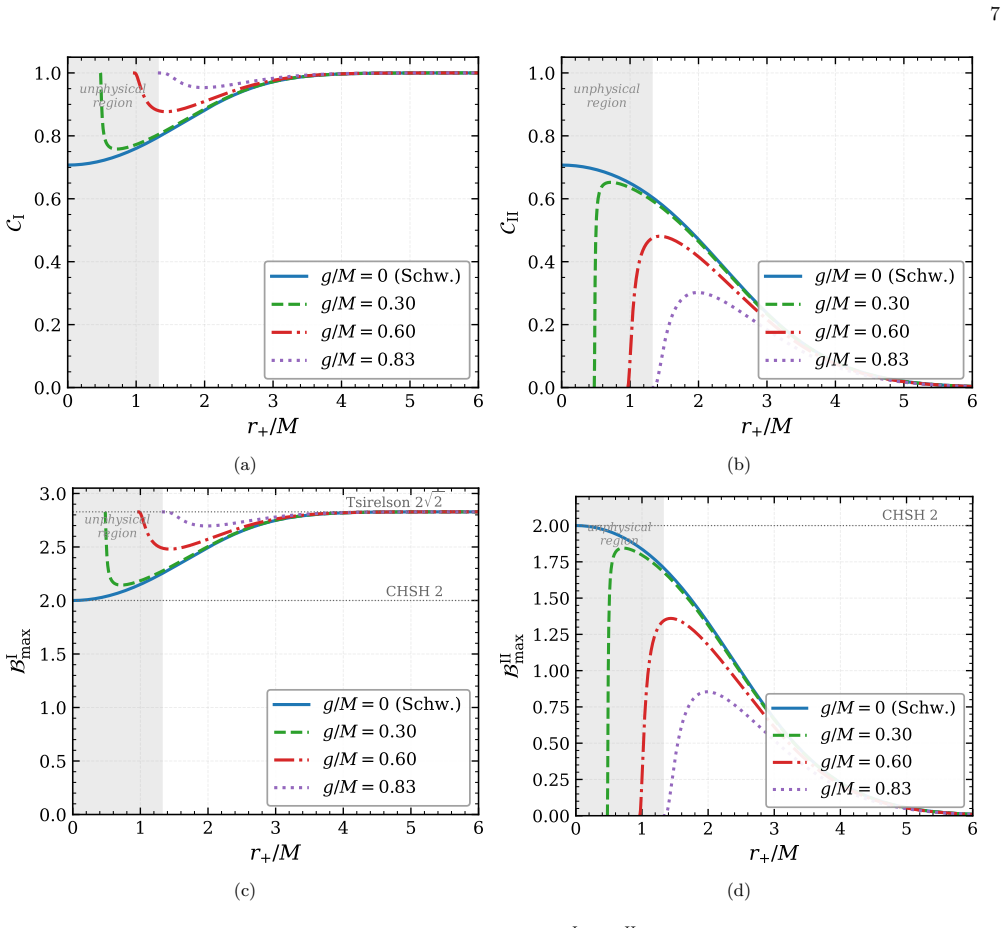
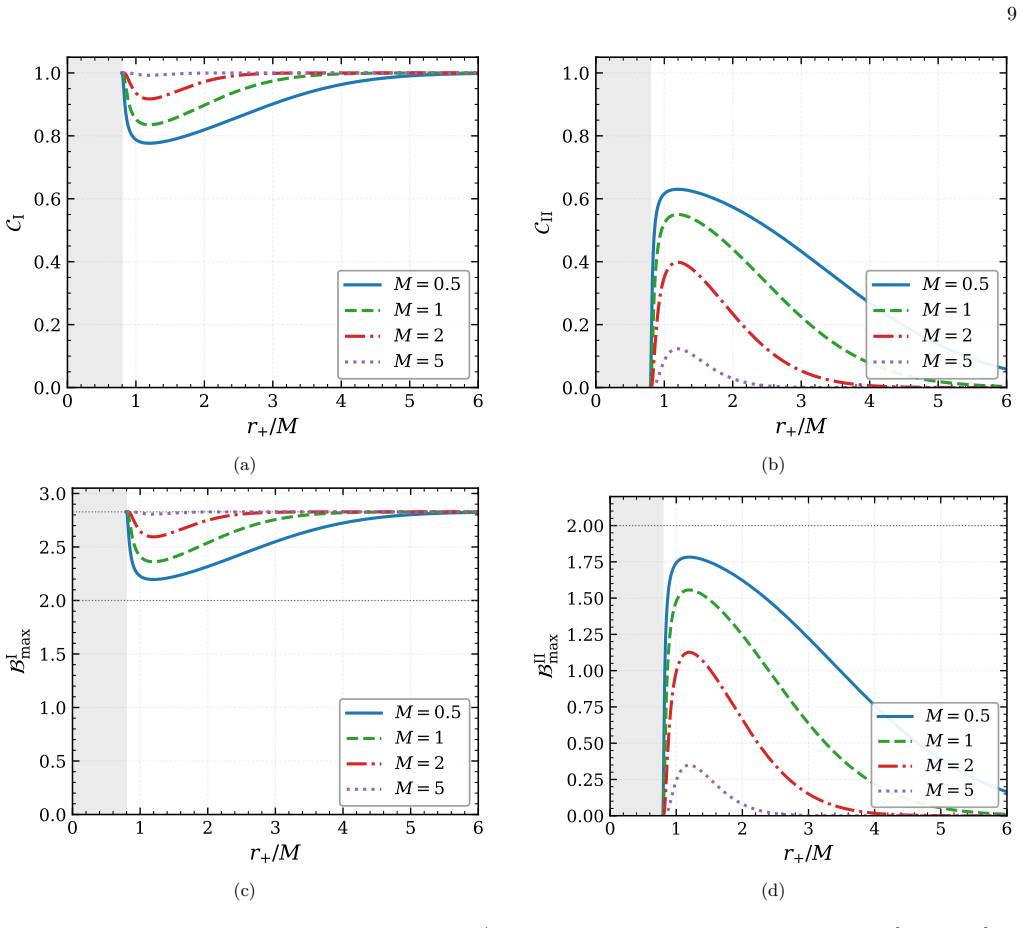
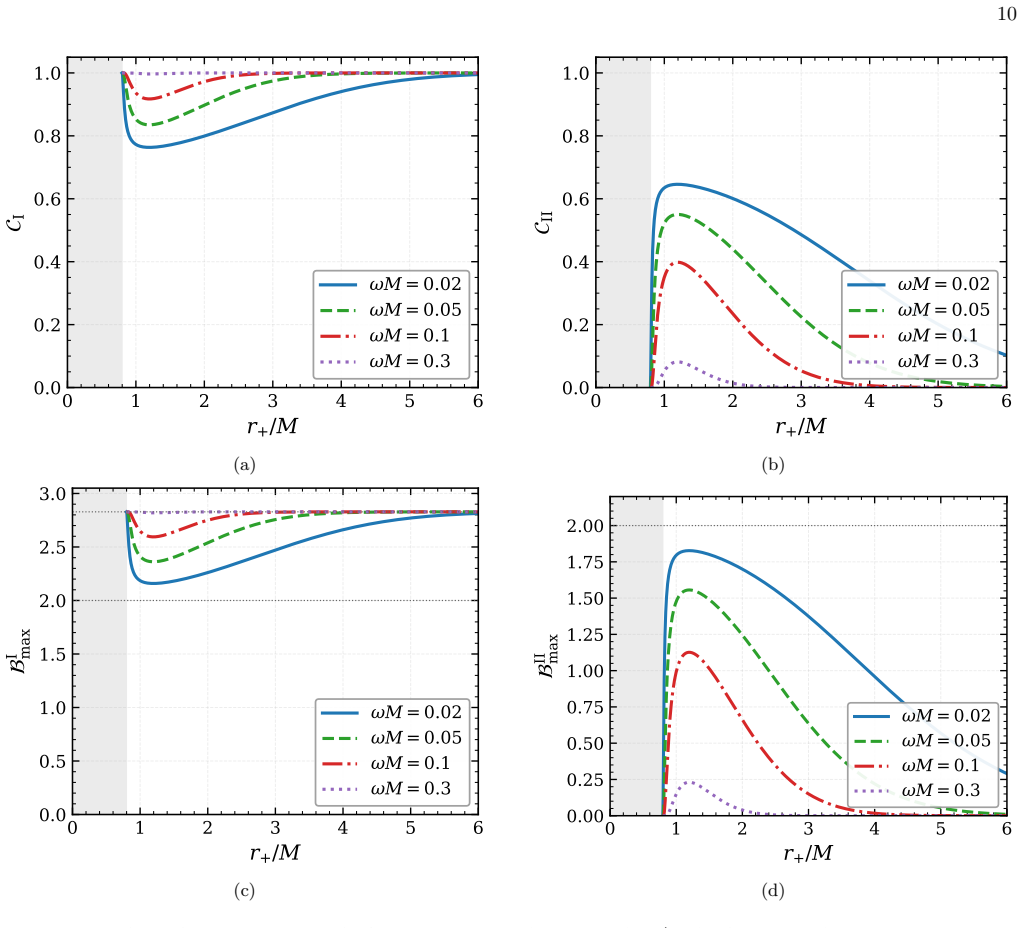
Using the Wootters concurrence and the CHSH Bell parameter on the entangled Dirac state, the calculation shows that accessible modes exhibit Bell nonlocality for every finite Hawking temperature while interior modes never violate the inequality. Fermionic correlations remain nonzero in the infinite-temperature limit owing to the Pauli exclusion principle, with part of the entanglement redistributed to inaccessible modes inside the horizon. The Hayward regularity parameter g affects the correlations only through the Hawking temperature, whose decrease with increasing g enhances preservation of quantum information.
What carries the argument
Wootters concurrence and CHSH Bell parameter applied to the Dirac entangled state, with the Hayward regularity parameter g entering exclusively through its effect on the Hawking temperature.
If this is right
- Accessible modes violate Bell's inequality at all finite Hawking temperatures.
- Interior modes never violate Bell's inequality.
- Fermionic correlations remain nonzero at infinite temperature, unlike the bosonic case.
- Increasing the Hayward parameter g lowers the Hawking temperature and thereby slows the loss of quantum correlations.
- Singularity resolution in regular black holes is tied to greater robustness of fermionic quantum information.
Where Pith is reading between the lines
- The temperature-only dependence may hold for other regular black-hole metrics whose surface gravity depends on a similar regularity parameter.
- Analog condensed-matter systems with tunable effective temperatures could test whether fermionic entanglement persists at high temperature.
- Quantum communication protocols near black holes could exploit regularity parameters to maintain correlations longer than in singular spacetimes.
Load-bearing premise
The standard Hawking temperature formula for the Hayward metric fully captures the effect on the chosen entangled Dirac state, with no additional back-reaction or mode-mixing terms required.
What would settle it
An explicit calculation of the concurrence or CHSH value that shows dependence on the Hayward parameter g at fixed Hawking temperature would falsify the claim that g acts only through temperature.
Figures
read the original abstract
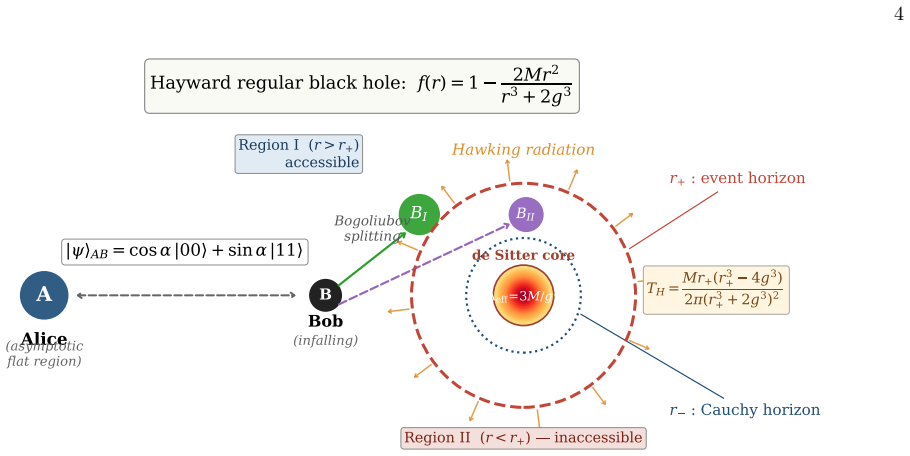
We investigate bipartite quantum correlations of Dirac fields in the spacetime of a Hayward regular black hole. Using the Wootters concurrence and the CHSH Bell parameter, we analyze the influence of Hawking radiation on an entangled state shared by an inertial observer and a near-horizon observer. We show that, unlike the bosonic case, fermionic correlations remain nonzero even in the infinite-temperature limit owing to the Pauli exclusion principle, while part of the entanglement is redistributed to inaccessible modes inside the horizon. The accessible modes exhibit Bell nonlocality for all finite Hawking temperatures, whereas the interior modes never violate Bell's inequality. The Hayward regularity parameter $g$ affects the correlations only through the Hawking temperature, whose decrease with increasing $g$ enhances the preservation of quantum information. These results suggest a close connection between singularity resolution and the robustness of fermionic quantum correlations in regular black-hole spacetimes.
Editorial analysis
A structured set of objections, weighed in public.
Referee Report
Summary. The manuscript investigates bipartite quantum correlations of Dirac fields in the Hayward regular black hole spacetime. It considers an initially entangled Dirac state shared between an inertial observer and a near-horizon observer, applies the Wootters concurrence and CHSH Bell parameter after tracing over inaccessible modes, and examines the effects of Hawking radiation. The central claims are that fermionic correlations remain nonzero in the infinite-temperature limit due to the Pauli exclusion principle (with part of the entanglement redistributed to interior modes), that accessible exterior modes exhibit Bell nonlocality for all finite Hawking temperatures while interior modes never violate the CHSH inequality, and that the regularity parameter g influences all results exclusively through the Hawking temperature (whose decrease with increasing g improves correlation preservation).
Significance. If the results hold, the work establishes a concrete connection between singularity resolution in regular black holes and the robustness of fermionic quantum information against Hawking radiation. It shows explicitly how the Pauli principle protects fermionic correlations at high temperatures in a manner absent for bosons, and demonstrates that the Hayward parameter g enters the final expressions only via the surface gravity at the outer horizon. The calculation follows the standard Bogoliubov transformation between Boulware and Hartle-Hawking modes for Dirac fields in a static spherically symmetric metric, yielding parameter-free predictions once the metric is fixed.
minor comments (3)
- [§3] §3 (or the section presenting the mode expansion): the explicit form of the Bogoliubov coefficients for the Dirac field in the Hayward metric should be written out, even if they reduce to the standard Fermi-Dirac factor; this would make the claim that g enters solely through T fully transparent.
- [Figures in §4/5] Figure captions (likely in §4 or §5): the range of g values and corresponding Hawking temperatures used in the plots should be stated explicitly, together with the precise definition of the initial entangled state (including any normalization constants).
- [Abstract and §5] The abstract states that interior modes 'never violate Bell's inequality'; the corresponding CHSH value should be shown to remain below 2 for all T, perhaps with a short analytic argument in addition to numerics.
Simulated Author's Rebuttal
We thank the referee for the careful reading and positive recommendation of minor revision. The provided summary accurately captures the scope, methods, and central claims of the manuscript.
Circularity Check
No significant circularity; derivation is self-contained standard QFT calculation
full rationale
The paper computes Dirac field correlations via standard Bogoliubov transformations between Boulware and Hartle-Hawking modes in the Hayward metric. The Hawking temperature T = κ/2π is obtained directly from the surface gravity at the outer horizon (with g entering the metric and thus κ in the usual way), and all reported quantities (concurrence, CHSH) are explicit functions of this T and the fermionic mode structure. No parameters are fitted to data and then relabeled as predictions; no uniqueness theorems or ansatzes are imported via self-citation; the Pauli-exclusion and interior/exterior redistribution results follow algebraically from the two-mode fermionic vacuum without reducing to the input state by construction. The central claims are therefore independent of the paper's own fitted values or prior self-referential results.
Axiom & Free-Parameter Ledger
axioms (2)
- domain assumption Hawking temperature is obtained from the surface gravity of the Hayward metric in the usual semiclassical way.
- domain assumption The initial state is a standard entangled Dirac pair with one observer inertial and one near the horizon.
Reference graph
Works this paper leans on
-
[1]
4 below, in line with the dilatonic [37] and the RN [12] analyses
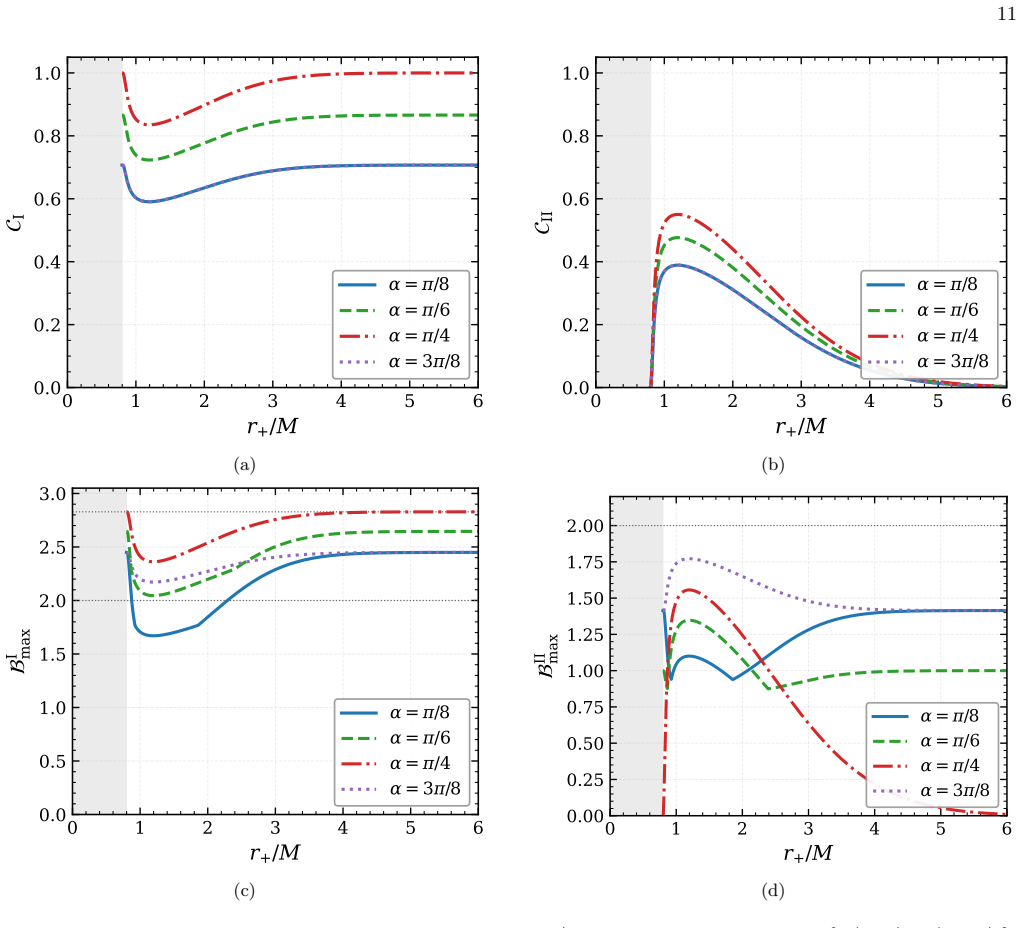
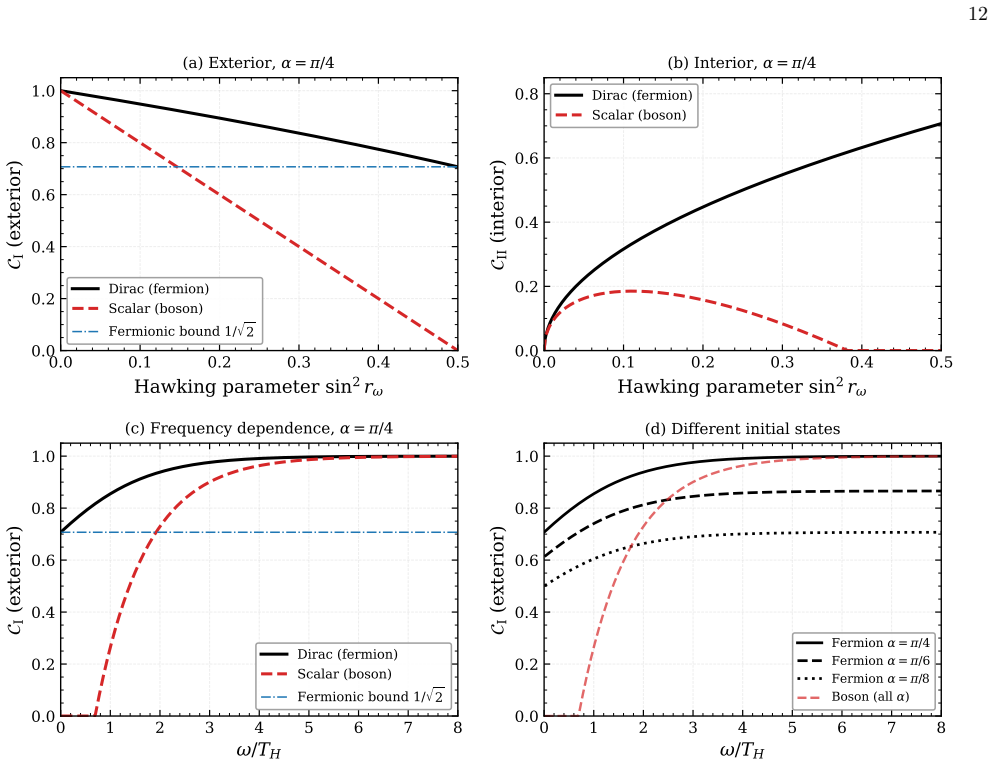
These two analytical limits explain quantitatively both the low-frequency plateau and the high-frequency enhancement that will be seen in Fig. 4 below, in line with the dilatonic [37] and the RN [12] analyses. Fermionic lower bound.The plateau value sin(2α)/ √ 2 is the universal lower bound of the accessible fermionic concurrence in the present setting: C...
-
[2]
For an X-state with real off-diagonals, T11 = 2(ϱ14 +ϱ 23), T22 = 2(ϱ23 −ϱ 14),(29) T33 =ϱ 11 −ϱ 22 −ϱ 33 +ϱ 44
For a generic two-qubit stateϱ, the Horodecki criterion gives Bmax(ϱ) = 2 p M(ϱ), M(ϱ) =t 2 i +t 2 j ,(28) wheret 2 i , t2 j are the two largest ofT 2 11, T2 22, T2 33, andT ii = tr[ϱ σi⊗σi] are the diagonal components of the correlation tensor. For an X-state with real off-diagonals, T11 = 2(ϱ14 +ϱ 23), T22 = 2(ϱ23 −ϱ 14),(29) T33 =ϱ 11 −ϱ 22 −ϱ 33 +ϱ 44...
-
[3]
Stephen W. Hawking. Particle creation by black holes. Communications in Mathematical Physics, 43(3):199– 220, 1975
1975
-
[4]
Stephen W. Hawking. Breakdown of predictability in gravitational collapse.Physical Review D, 14(10):2460– 2473, 1976
1976
-
[5]
Alsing and G
Paul M. Alsing and G. J. Milburn. Teleportation with a uniformly accelerated partner.Physical Review Letters, 91(18):180404, 2003
2003
-
[6]
Ivette Fuentes-Schuller and Robert B. Mann. Alice falls into a black hole: Entanglement in noninertial frames. Physical Review Letters, 95(12):120404, 2005
2005
-
[7]
Entanglement of dirac fields in noninertial frames
Gerardo Adesso, Ivette Fuentes-Schuller, and Marie Eric- sson. Entanglement of dirac fields in noninertial frames. Physical Review A, 76(6):062112, 2007
2007
-
[8]
Projective measurements and generation of entangled Dirac par- ticles in Schwarzschild spacetime.Annals of Physics, 325(6):1190–1197, 2010
Jieci Wang, Qiyuan Pan, and Jiliang Jing. Projective measurements and generation of entangled Dirac par- ticles in Schwarzschild spacetime.Annals of Physics, 325(6):1190–1197, 2010
2010
-
[9]
Prob- ing the quantum correlation and Bell non-locality for Dirac particles with Hawking effect in the background of Schwarzschild black hole.Physics Letters B, 733:1–5, 2014
Shuai Xu, Xue-ke Song, Jia-dong Shi, and Liu Ye. Prob- ing the quantum correlation and Bell non-locality for Dirac particles with Hawking effect in the background of Schwarzschild black hole.Physics Letters B, 733:1–5, 2014
2014
-
[10]
How the Hawking effect affects multipartite entanglement of Dirac particles in the background of a Schwarzschild black hole.Physical Review D, 89(6):065022, 2014
Shuai Xu, Xue-ke Song, Jia-dong Shi, and Liu Ye. How the Hawking effect affects multipartite entanglement of Dirac particles in the background of a Schwarzschild black hole.Physical Review D, 89(6):065022, 2014
2014
-
[11]
Property of various correlation measures of open Dirac system with Hawking effect in Schwarzschild space-time.Physics Let- ters B, 740:322–328, 2015
Juan He, Shuai Xu, Yang Yu, and Liu Ye. Property of various correlation measures of open Dirac system with Hawking effect in Schwarzschild space-time.Physics Let- ters B, 740:322–328, 2015
2015
-
[12]
Measurement-induced- nonlocality for Dirac particles in Garfinkle–Horowitz– Strominger dilation space-time.Physics Letters B, 756:278–282, 2016
Juan He, Shuai Xu, and Liu Ye. Measurement-induced- nonlocality for Dirac particles in Garfinkle–Horowitz– Strominger dilation space-time.Physics Letters B, 756:278–282, 2016
2016
-
[13]
Quantum entanglement of bosonic fields beyond the single-mode approxima- tion in schwarzschild spacetime.Physical Review A, 82(3):032324, 2010
Jieci Wang and Jiliang Jing. Quantum entanglement of bosonic fields beyond the single-mode approxima- tion in schwarzschild spacetime.Physical Review A, 82(3):032324, 2010
2010
-
[14]
Quantum entangle- ment in the Dirac field quantization around charged black holes.Physics Letters B, page 140629, 2026
Abdessamie Chhieb, Chaimae Banouni, Saliha Ab- dessamie, and Mohamed Ouchrif. Quantum entangle- ment in the Dirac field quantization around charged black holes.Physics Letters B, page 140629, 2026
2026
-
[15]
Sean A. Hayward. Formation and evaporation of nonsin- gular black holes.Physical Review Letters, 96(3):031103, 2006
2006
-
[16]
J. M. Bardeen. Non-singular general relativistic gravita- tional collapse. InProceedings of the International Con- ference GR5, Tbilisi, USSR, page 174, 1968
1968
-
[17]
Vacuum nonsingular black hole.Gen- eral Relativity and Gravitation, 24(3):235–242, 1992
Irina Dymnikova. Vacuum nonsingular black hole.Gen- eral Relativity and Gravitation, 24(3):235–242, 1992
1992
-
[18]
Regular black hole in general relativity coupled to nonlinear electrodynam- ics.Physical Review Letters, 80(23):5056–5059, 1998
Eloy Ay´ on-Beato and Alberto Garc´ ıa. Regular black hole in general relativity coupled to nonlinear electrodynam- ics.Physical Review Letters, 80(23):5056–5059, 1998
1998
-
[19]
Valeri P. Frolov. Information loss problem and a ‘black hole’ model with a closed apparent horizon.Journal of High Energy Physics, 2014(5):49, 2014
2014
-
[20]
Phenomenological aspects of black holes beyond general relativity.Physical Review D, 98(12):124009, 2018
Raul Carballo-Rubio, Francesco Di Filippo, Stefano Liberati, and Matt Visser. Phenomenological aspects of black holes beyond general relativity.Physical Review D, 98(12):124009, 2018
2018
-
[21]
Inner hori- zon instability and the unstable cores of regular black holes.Journal of High Energy Physics, 2022(05):132, 2022
Raul Carballo-Rubio, Francesco Di Filippo, Stefano Liberati, Costantino Pacilio, and Matt Visser. Inner hori- zon instability and the unstable cores of regular black holes.Journal of High Energy Physics, 2022(05):132, 2022
2022
-
[22]
Wootters
William K. Wootters. Entanglement of formation of an arbitrary state of two qubits.Physical Review Letters, 80(10):2245–2248, 1998
1998
-
[23]
Clauser, Michael A
John F. Clauser, Michael A. Horne, Abner Shimony, and Richard A. Holt. Proposed experiment to test lo- cal hidden-variable theories.Physical Review Letters, 14 23(15):880–884, 1969
1969
-
[24]
Horodecki, P
R. Horodecki, P. Horodecki, and M. Horodecki. Violating Bell inequality by mixed spin- 1 2 states: Necessary and sufficient condition.Physics Letters A, 200(5):340–344, 1995
1995
-
[25]
Damour and R
T. Damour and R. Ruffini. Black-hole evaporation in the Klein–Sauter–Heisenberg–Euler formalism.Physical Review D, 14(2):332–334, 1976
1976
-
[26]
Hawking radiation of the Dirac field via an anomalous method.Physical Review D, 70(6):065004, 2004
Jiliang Jing. Hawking radiation of the Dirac field via an anomalous method.Physical Review D, 70(6):065004, 2004
2004
-
[27]
Unruh effect in quantum information beyond the single-mode approximation.Physical Review A, 82(4):042332, 2010
David Edward Bruschi, Jorma Louko, Eduardo Mart´ ın- Mart´ ınez, Andrzej Dragan, and Ivette Fuentes. Unruh effect in quantum information beyond the single-mode approximation.Physical Review A, 82(4):042332, 2010
2010
-
[28]
Entangle- ment in noninertial frames: Foundational issues.Physical Review A, 81(3):032320, 2010
Eduardo Mart´ ın-Mart´ ınez and Ivette Fuentes. Entangle- ment in noninertial frames: Foundational issues.Physical Review A, 81(3):032320, 2010
2010
-
[29]
Brill and John A
Dieter R. Brill and John A. Wheeler. Interaction of neutrinos and gravitational fields.Reviews of Modern Physics, 29(3):465–479, 1957
1957
-
[30]
William G. Unruh. Notes on black hole evaporation. Physical Review D, 14(4):870–892, 1976
1976
-
[31]
Thermo-field dynamics of black holes
Werner Israel. Thermo-field dynamics of black holes. Physics Letters A, 57(2):107–110, 1976
1976
-
[32]
Hartle and Stephen W
James B. Hartle and Stephen W. Hawking. Path-integral derivation of black-hole radiance.Physical Review D, 13(8):2188–2203, 1976
1976
-
[33]
N. D. Birrell and P. C. W. Davies.Quantum Fields in Curved Space. Cambridge University Press, 1984
1984
-
[34]
Alsing, Ivette Fuentes-Schuller, Robert B
Paul M. Alsing, Ivette Fuentes-Schuller, Robert B. Mann, and Tracey E. Tessier. Entanglement of Dirac fields in non-inertial frames.Physical Review A, 74(3):032326, 2006
2006
-
[35]
Fermionic en- tanglement that survives a black hole.Physical Review A, 80(4):042318, 2009
Eduardo Mart´ ın-Mart´ ınez and Juan Le´ on. Fermionic en- tanglement that survives a black hole.Physical Review A, 80(4):042318, 2009
2009
-
[36]
Progress of Theoret- ical Physics Supplement, 1986
Shin Takagi.Vacuum noise and stress induced by uniform acceleration: Hawking–Unruh effect in Rindler manifold of arbitrary dimension, volume 88. Progress of Theoret- ical Physics Supplement, 1986
1986
-
[37]
S. M. Hashemi Rafsanjani, M. Huber, C. J. Broadbent, and J. H. Eberly. Genuinely multipartite concurrence of N-qubitX-matrices.Physical Review A, 86(6):062303, 2012
2012
-
[38]
Pan and J
Q. Pan and J. Jing. Hawking radiation of Dirac particles via tunneling from the Reissner–Nordstr¨ om black hole. Modern Physics Letters A, 23(1):25–34, 2008
2008
-
[39]
Entangle- ment in non-inertial frames: degradation and survival
Eduardo Mart´ ın-Mart´ ınez and Ivette Fuentes. Entangle- ment in non-inertial frames: degradation and survival. Physical Review A, 83(5):052306, 2011
2011
-
[40]
B. S. Cirel’son. Quantum generalizations of Bell’s in- equality.Letters in Mathematical Physics, 4(2):93–100, 1980
1980
-
[41]
Mann and Timothy C
Robert B. Mann and Timothy C. Ralph. Relativistic quantum information.Classical and Quantum Gravity, 29(22):220301, 2012
2012
-
[42]
Relativistic quan- tum metrology: Exploiting relativity to improve quan- tum measurement technologies.Scientific Reports, 4:4996, 2014
Mehdi Ahmadi, David Edward Bruschi, Carlos Sab´ ın, Gerardo Adesso, and Ivette Fuentes. Relativistic quan- tum metrology: Exploiting relativity to improve quan- tum measurement technologies.Scientific Reports, 4:4996, 2014
2014
-
[43]
Asher Peres and Daniel R. Terno. Quantum informa- tion and relativity theory.Reviews of Modern Physics, 76(1):93–123, 2004
2004
-
[44]
States, effects, and operations: Fundamental notions of quantum theory.Lecture Notes in Physics, 190, 1983
Karl Kraus. States, effects, and operations: Fundamental notions of quantum theory.Lecture Notes in Physics, 190, 1983
1983
discussion (0)
Sign in with ORCID, Apple, or X to comment. Anyone can read and Pith papers without signing in.