REVIEW 3 major objections 5 minor 1 cited by
Facet: highly efficient E(3)-equivariant networks for interatomic potentials
T0 review · 3 major / 5 minor · reviewed 2026-08-15 · deepseek-v4-flash
Pith's one-line read Facet shows that a 270K-parameter equivariant network can match far larger interatomic-potential models in accuracy while training in under 10% of the compute.
desk verdict The spline-filter observation is a genuine, transferable finding and the architecture is sound, but the headline accuracy-versus-compute claim rests on a leaky same-split baseline and needs a clean comparison before it convinces. read the letter →
The pith
A machine-rendered reading of the paper's core claim, the machinery that carries it, and where it could break.
The reading
What carries the argument
The load-bearing pieces are (1) a spline filter $W(r)$ formed by a linear combination of eight trainable Bessel basis functions, replacing the MLP filter used in NequIP-style equivariant convolution; (2) the S2-MLP-Mixer, which projects irreps to functions on the sphere $S^2$, samples them on an 18x17 grid, applies a standard MLP channel-wise, and projects back into the irrep basis; and (3) message normalization by estimated degree $k(r_{\max})^{0.7}$ with a trainable cutoff radius $r_{\max}$. Together these reduce the most expensive parts of message passing while preserving E(3)-equivariance.
What would settle it
Retrain SevenNet-0 from scratch on the same 10:1:1 trajectory split used for Facet, with the same 25-epoch budget on the same GPU, and measure held-out formation-energy MAE; if it reaches a test MAE at or below Facet-Small's 28.6 meV/atom, the claimed efficiency advantage of the architecture collapses.
Extended reading notes
Core claim
The central discovery is that two expensive components of steerable graph neural network potentials can be replaced or reworked without sacrificing accuracy. First, the MLP that maps interatomic distances to convolution filter weights is effectively a spline: a linear combination of eight Bessel basis functions fits SevenNet-0's learned filters with $R^{2}$ > 0.99, so the MLP mostly wastes parameters and compute. Second, a node-update layer that projects irreps onto a discretized sphere, applies a channel-wise MLP, and projects back offers a middle ground between MACE's costly tensor products and SevenNet's cheaper gate activations. With these changes, Facet-Small reaches 28.6 meV/atom test MAE after 25 epochs with 270K parameters, and the three-model ensemble reaches 23.1 meV/atom, close to SevenNet-Streamlined's 20.7 while using far less training compute. The paper also reports that Facet runs about twice as fast as MACE models on crystal relaxation tasks.
Load-bearing premise
The efficiency claim assumes the reported GPU-days are genuinely comparable, meaning two days on an RTX 3090 can be mapped onto 90 days on an A100, and that SevenNet-Streamlined, fine-tuned from a checkpoint that already trained on all of MPTrj, honestly represents SevenNet-0's error on new structures.
Editorial extensions
If this is right
- A competitive universal interatomic potential can be trained on a single consumer GPU in about two days rather than months on data-center GPUs.
- Existing steerable models can drop over 25% of their parameters by replacing MLP distance filters with splines, with negligible change in accuracy.
- Facet's faster inference, about 1.35x faster than SevenNet and 2.35-2.93x faster than MACE variants, directly accelerates crystal-structure-prediction searches that use the potential as a screening function.
- Element embeddings learned from scratch outperform pretrained embeddings for this backbone, suggesting that strong architectures do not need external embedding priors.
- The same architecture choices should scale to larger models, larger datasets, and additional training objectives such as force prediction.
Reading between the lines
- If splines can replace MLP filters in SevenNet, the same replacement likely transfers to other steerable potentials whose filters are also MLPs, such as MACE and EquiformerV2, potentially cutting their training costs too.
- The S2-MLP-Mixer is a general equivariant nonlinearity that could be dropped into non-atomistic equivariant networks, e.g., point-cloud or molecular models, wherever tensor products are too expensive and gates too weak.
- The trainable cutoff radius and the degree-normalization exponent p=0.7 are plausibly reusable as drop-in modifications for other pretrained potentials, though the paper only demonstrates them in models trained with these settings.
- A direct same-hardware, same-epoch head-to-head against a from-scratch SevenNet trained on the same held-out split would cleanly separate architecture gains from optimizer, data-split, and hardware-mapping effects.
Signed reviews
Editorial analysis
A structured set of objections, weighed in public.
Referee Report
Summary. The paper introduces Facet, an E(3)-equivariant graph neural network architecture for machine-learning interatomic potentials. The main design changes are replacing MLP distance filters with Bessel-spline filters, introducing an S2-MLP-Mixer node self-interaction layer based on spherical grid projection, and making the cutoff radius and message-normalization exponent learnable/tunable. The authors train Facet-Small on the MPTrj dataset using a 10:1:1 trajectory-level split and report formation-energy MAEs of 28.6 meV for a single model and 23.1 meV for a three-model ensemble, claiming accuracy comparable to larger baselines such as SevenNet-0 and MACE-MP-0 with far fewer parameters and less than 10% of their training compute. The paper also reports a relaxation-speed benchmark against MACE and SevenNet, an analysis showing SevenNet-0's filter MLPs are well approximated by splines, and a reduction of SevenNet-0's parameter count by over 25% with negligible accuracy change.
Significance. If the efficiency claims hold, Facet is a practically valuable contribution: it offers a substantially cheaper training path for universal interatomic potentials, and the released code and repeated-seed training curves support reproducibility. The held-out evaluation of Facet itself appears methodologically sound, and the spline-filter analysis is an interesting and credible architectural insight. However, the headline claim of parity with SevenNet is currently underwritten by a baseline that was fine-tuned from a checkpoint pretrained on the entire MPTrj dataset, including the test structures, and by external baseline numbers from different training setups. The significance is therefore conditional: the architecture is promising, but the central comparative claim is not yet established as reported.
major comments (3)
- [Model Performance, Table 1] The only same-split performance baseline, SevenNet-Streamlined, is produced by modifying and fine-tuning the SevenNet-0 checkpoint, which the authors state was trained on the entire MPTrj dataset with no held-out data. The test structures used to compute the 20.1 meV number were therefore present in the pretraining corpus, so this number is not an unbiased estimate of a from-scratch model's held-out error. Since the paper's central claim that Facet is comparable to SevenNet is judged against this number, the comparison is not established. Please provide a from-scratch baseline trained on the same 10:1:1 trajectory split with the same formation-energy objective, or otherwise present a clean held-out comparison.
- [Table 1 and surrounding text] The statement that 'all models are trained with the same training set' is inaccurate. EquiformerV2-S (ref. 42) is an OMat24 model, and MACE-MP-0 and SevenNet-0 report results from the original authors' splits and training objectives, which are not the same as Facet's trajectory-level 10:1:1 split. The external rows therefore do not provide a controlled comparison. To support the claim that Facet 'matches leading models,' either retrain the baselines on the same split and objective or clearly restrict the headline comparison to the same-split baselines and label the external rows as context rather than direct competitors.
- [Table 1, Model Performance] The phrase 'All computing costs are mapped to a single GPU' is never defined. The paper does not specify the conversion between A100 and RTX 3090, whether the mapping is based on theoretical peak FLOPs, measured utilization, or wall-clock time, or whether preprocessing, checkpointing, and the ensemble's three training runs are included in the six-day figure. Since the central efficiency claim ('less than 10% of training compute') depends on this accounting, the conversion methodology must be stated explicitly and the per-component costs itemized.
minor comments (5)
- [Methods, Message Generation] The equation reference in the message-generation paragraph appears as '(??)'; the citation should be completed or removed.
- [Figure 5] The relaxation-timing comparison reports median per-step times but no confidence intervals or per-configuration variability, despite the text noting persistent outliers; please add error bars or a variance measure.
- [Methods, S2-MLP-Mixer] The claim that the equivariance error is 'less than 1%' should specify the rotation sampling protocol, the number of test configurations, and the dataset used for the measurement.
- [Facet Learns Informative Element Embeddings From Scratch] The ct-UAE comparison reports a single run with no uncertainty estimate; please state whether these numbers are averaged over seeds and whether the ensemble variant was also tested.
- [Table 1] Please clarify the MACE-MP-0 training-cost entry: the text says the model was trained on a cluster of 80 A100 GPUs for 250 epochs, while the table lists '310 days w/ A100'; state whether this is the estimated single-GPU-equivalent time.
Circularity Check
No circular derivation found: Facet's accuracy claims rest on held-out MPTrj splits, and the fitted spline and normalization exponent are fit to baseline model statistics, not to the predicted labels.
full rationale
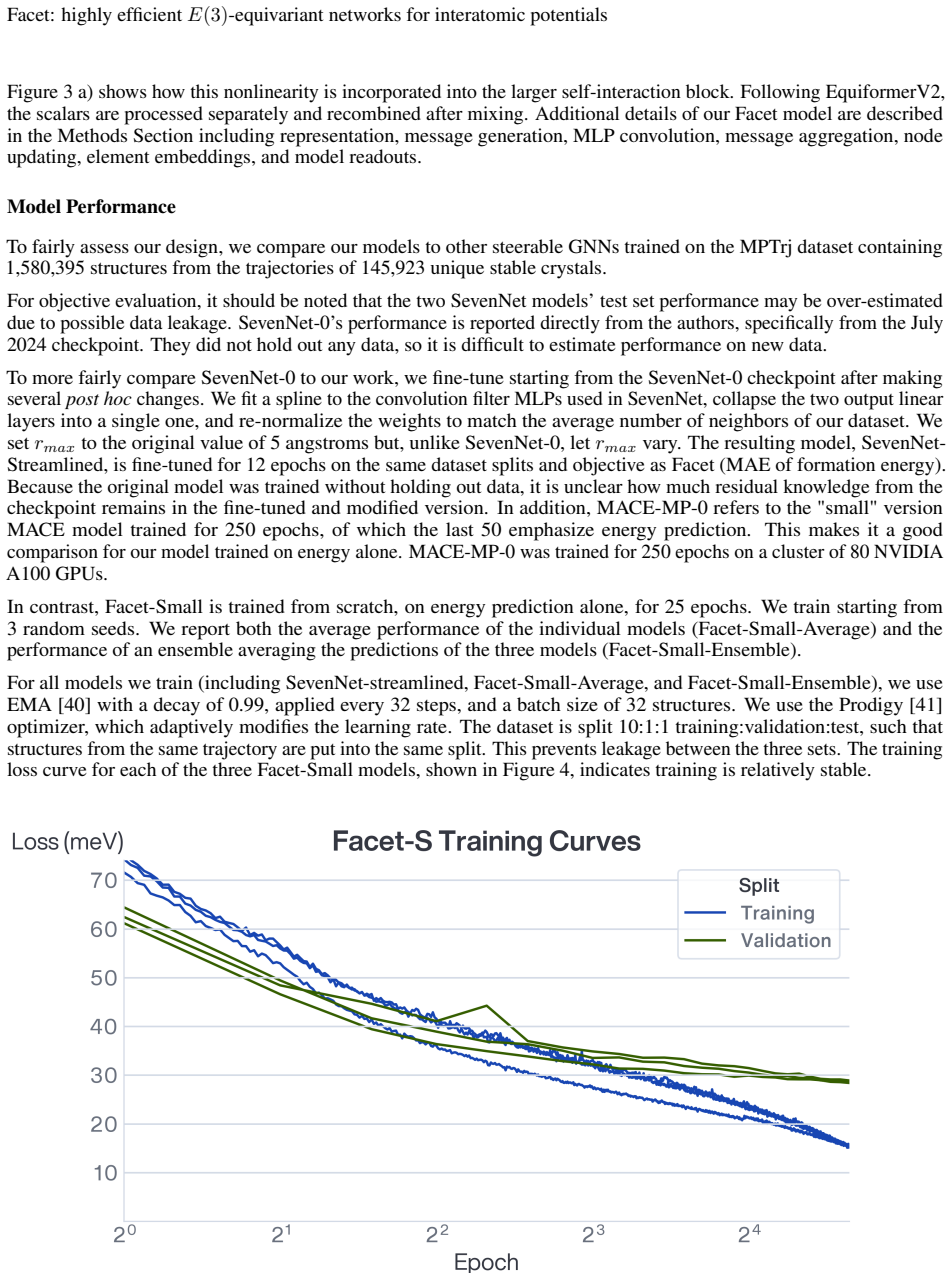
Facet-Small is trained from scratch on a 10:1:1 trajectory-aware split, with test MAE (28.6 meV single-model, 23.1 meV ensemble) reported directly from held-out data, so the central performance claim does not reduce by construction to any fitted input. The spline filter is fitted to SevenNet-0's existing message-filter MLP with R2 > 0.99; this is a post-hoc compression of the baseline's own weights, not a fit to energy labels, and Facet is then trained from scratch using the spline filter. The normalization exponent p = 0.7 is estimated from the correlation structure of messages in the trained SevenNet-0 model, an internal baseline statistic, and is used as a fixed hyperparameter rather than a fitted predictor of test error. The SevenNet-Streamlined baseline is derived from the SevenNet-0 checkpoint trained on the full MPTrj, and the authors explicitly acknowledge the resulting data leakage ("it is unclear how much residual knowledge from the checkpoint remains"); that is a benchmark-validity concern, not circularity, because Facet's own test numbers are produced by a from-scratch model on a clean split. No load-bearing argument reduces to a self-citation: the S2-MLP-Mixer layer is grounded in externally cited spherical-CNN and EquiformerV2 work, and the architecture is evaluated empirically against external baselines such as MACE and SevenNet. The claimed "spline in disguise" result is a characterization of a trained model rather than a derivation that assumes its conclusion.
Assumptions & free parameters
free parameters (5)
- message normalization exponent p =
0.7
- spline basis count =
8
- spherical grid resolution (NA, NB) =
18, 17
- number of GNN blocks =
3
- input embedding dimension =
128
assumptions (4)
- standard math Spherical harmonics form an orthogonal basis of functions on S2; projecting irreps to a discrete spherical grid and applying an MLP approximates an equivariant function within measured quadrature error (reported below 1%).
- standard math The Clebsch-Gordan tensor product captures all equivariant linear maps between SO(3) irreps, and using only even tensors with standard parity rules preserves equivariance.
- domain assumption Messages to a node can be approximated as zero-mean Gaussian variables with a common pairwise correlation rho, so the summed-message variance scales as k^p with p between 0.5 and 1.
- domain assumption Splitting MPTrj by trajectory into 10:1:1 train/validation/test prevents leakage between sets.
Cite this review
Pith. "Pith review of Facet: highly efficient E(3)-equivariant networks for interatomic potentials." pith.science (2026). https://pith.science/paper/EXHSRXFQ
@misc{pith2026250908418,
  author       = {Pith},
  title        = {Pith review of: Facet: highly efficient E(3)-equivariant networks for interatomic potentials},
  year         = {2026},
  howpublished = {\url{https://pith.science/paper/EXHSRXFQ}},
  note         = {Machine review of arXiv:2509.08418}
}
read the original abstract
Computational materials discovery is limited by the high cost of first-principles calculations. Machine learning (ML) potentials that predict energies from crystal structures are promising, but existing methods face computational bottlenecks. Steerable graph neural networks (GNNs) encode geometry with spherical harmonics, respecting atomic symmetries -- permutation, rotation, and translation -- for physically realistic predictions. Yet maintaining equivariance is difficult: activation functions must be modified, and each layer must handle multiple data types for different harmonic orders. We present Facet, a GNN architecture for efficient ML potentials, developed through systematic analysis of steerable GNNs. Our innovations include replacing expensive multi-layer perceptrons (MLPs) for interatomic distances with splines, which match performance while cutting computational and memory demands. We also introduce a general-purpose equivariant layer that mixes node information via spherical grid projection followed by standard MLPs -- faster than tensor products and more expressive than linear or gate layers. On the MPTrj dataset, Facet matches leading models with far fewer parameters and under 10% of their training compute. On a crystal relaxation task, it runs twice as fast as MACE models. We further show SevenNet-0's parameters can be reduced by over 25% with no accuracy loss. These techniques enable more than 10x faster training of large-scale foundation models for ML potentials, potentially reshaping computational materials discovery.
Figures


Figures from the paper (3 more)


Forward citations
Cited by 1 Pith paper
-
VASP Plugins: Linking the Vienna ab-initio Simulation Package with Python
A C++/pybind11 shared-memory plugin layer exposes VASP SCF and ionic data as NumPy arrays so Python can modify structure, forces, local potential, and occupancies in place.
Reference graph
Works this paper leans on
-
[1]
G., Chan, Y .-H., da Jornada, F
Louie, S. G., Chan, Y .-H., da Jornada, F. H., Li, Z. & Qiu, D. Y . Discovering and understanding materials through computation.Nature Materials20,728–735 (2021)
work page 2021
-
[2]
Oganov, A. R., Pickard, C. J., Zhu, Q. & Needs, R. J. Structure prediction drives materials discovery.Nature Reviews Materials4,331–348 (2019)
work page 2019
-
[3]
Neugebauer, J. & Hickel, T. Density functional theory in materials science.Wiley Interdisciplinary Reviews: Computational Molecular Science3,438–448 (2013)
work page 2013
-
[4]
Omee, S. S., Wei, L., Hu, M. & Hu, J. Crystal structure prediction using neural network potential and age-fitness Pareto genetic algorithm.Journal of Materials Informatics(2024)
work page 2024
-
[5]
12 Facet: highly efficientE(3)-equivariant networks for interatomic potentials
Wang, G.et al.Machine learning interatomic potential: Bridge the gap between small-scale models and realistic device-scale simulations.Iscience(2024). 12 Facet: highly efficientE(3)-equivariant networks for interatomic potentials
work page 2024
-
[6]
Omee, S. S., Wei, L., Dey, S. & Hu, J. Polymorphism Crystal Structure Prediction with Adaptive Space Group Diversity Control.arXiv preprint arXiv:2506.11332(2025)
arXiv 2025
-
[7]
Deringer, V . L., Caro, M. A. & Csányi, G. Machine learning interatomic potentials as emerging tools for materials science.Advanced Materials31,1902765 (2019)
work page 2019
- [8]
Show all 53 references
-
[9]
& Aspuru-Guzik, A
Friederich, P., Häse, F., Proppe, J. & Aspuru-Guzik, A. Machine-learned potentials for next-generation matter simulations.Nature Materials20,750–761 (2021)
2021
-
[10]
& Friederich, P
Ruff, R., Reiser, P., Stühmer, J. & Friederich, P. Connectivity Optimized Nested Line Graph Networks for Crystal Structures.Digital Discovery3,594–601. (2024) (2024)
2024
-
[11]
& Smidt, T
Liao, Y .-L. & Smidt, T. Equiformer: Equivariant Graph Attention Transformer for 3D Atomistic Graphs. (2024) (2022)
2024
-
[12]
Nature Communications13,2453.ISSN: 2041-1723
Batzner, S.et al.E(3)-Equivariant Graph Neural Networks for Data-Efficient and Accurate Interatomic Potentials. Nature Communications13,2453.ISSN: 2041-1723. (2024) (May 2022)
2024
-
[13]
A F oundation Model for Atomistic Materials ChemistryMar
Batatia, I.et al. A F oundation Model for Atomistic Materials ChemistryMar. 2024. arXiv:2401.00096. (2024)
2024 arXiv
-
[14]
& Han, S
Park, Y ., Kim, J., Hwang, S. & Han, S. Scalable Parallel Algorithm for Graph Neural Network Interatomic Potentials in Molecular Dynamics Simulations.Journal of Chemical Theory and Computation20,4857–4868. ISSN: 1549-9618 (June 2024)
2024
-
[15]
& Zurek, E
Belli, F. & Zurek, E. Efficient modelling of anharmonicity and quantum effects in PdCuH2 with machine learning potentials.npj Computational Materials11,87 (2025)
2025
-
[16]
Roberts, J.et al.Machine learned interatomic potentials for ternary carbides trained on the AFLOW database.npj Computational Materials10,142 (2024)
2024
-
[17]
Wang, Y .et al.Enhancing geometric representations for molecules with equivariant vector-scalar interactive message passing.Nature Communications15,313 (2024)
2024
-
[18]
Nature Reviews Chemistry6,653–672 (2022)
Fedik, N.et al.Extending machine learning beyond interatomic potentials for predicting molecular properties. Nature Reviews Chemistry6,653–672 (2022)
2022
-
[19]
& Ong, S
Chen, C. & Ong, S. P. A universal graph deep learning interatomic potential for the periodic table.Nature Computational Science2,718–728 (2022)
2022
-
[20]
J.,et al.Deep potentials for materials science.Materials Futures1, 022601 (2022)
Wen, T., Zhang, L., Wang, H., Srolovitz, D. J.,et al.Deep potentials for materials science.Materials Futures1, 022601 (2022)
2022
-
[21]
Yang, Z.et al.Efficient equivariant model for machine learning interatomic potentials.npj Computational Materials11,49 (2025)
2025
-
[22]
arXiv preprint arXiv:2308.14920(2023)
Riebesell, J.et al.Matbench Discovery–A framework to evaluate machine learning crystal stability predictions. arXiv preprint arXiv:2308.14920(2023)
2023 arXiv
-
[23]
Fu, X.et al.Learning smooth and expressive interatomic potentials for physical property prediction.arXiv preprint arXiv:2502.12147(2025)
2025 arXiv
-
[24]
& Cheng, Y
Han, B. & Cheng, Y . Benchmarking Universal Machine Learning Interatomic Potentials for Real-Time Analysis of Inelastic Neutron Scattering Data.arXiv preprint arXiv:2506.01860(2025)
2025 arXiv
-
[25]
Guo, D.et al.Deepseek-r1: Incentivizing reasoning capability in llms via reinforcement learning.arXiv preprint arXiv:2501.12948(2025)
2025 arXiv
-
[26]
& Kantarcioglu, M
Wang, C. & Kantarcioglu, M. A review of DeepSeek models’ key innovative techniques.arXiv preprint arXiv:2503.11486(2025)
2025 arXiv
-
[27]
IEEE/CAA Journal of Automatica Sinica12,872–893 (2025)
Deng, Z.et al.Exploring DeepSeek: A Survey on Advances, Applications, Challenges and Future Directions. IEEE/CAA Journal of Automatica Sinica12,872–893 (2025)
2025
-
[28]
& Zavadlav, J
Fuchs, P., Chen, W., Thaler, S. & Zavadlav, J. chemtrain-deploy: A parallel and scalable framework for machine learning potentials in million-atom MD simulations.arXiv preprint arXiv:2506.04055(2025)
2025 arXiv
-
[29]
Han, K., Deng, B., Farimani, A. B. & Ceder, G. DistMLIP: A Distributed Inference Platform for Machine Learning Interatomic Potentials.arXiv preprint arXiv:2506.02023(2025)
2025
-
[30]
Yan, K., Liu, Y ., Lin, Y . & Ji, S. Periodic Graph Transformers for Crystal Material Property Prediction.Advances in Neural Information Processing Systems35,15066–15080. (2024) (Dec. 2022)
2024
-
[31]
& Grossman, J
Xie, T. & Grossman, J. C. Crystal Graph Convolutional Neural Networks for an Accurate and Interpretable Prediction of Material Properties.Physical Review Letters120,145301.ISSN: 0031-9007, 1079-7114. (2025) (Apr. 2018)
2025
-
[32]
& Jegelka, S.How Powerful are Graph Neural Networks?inInternational Conference on Learning Representations(2019).https://openreview.net/forum?id=ryGs6iA5Km
Xu, K., Hu, W., Leskovec, J. & Jegelka, S.How Powerful are Graph Neural Networks?inInternational Conference on Learning Representations(2019).https://openreview.net/forum?id=ryGs6iA5Km. 13 Facet: highly efficientE(3)-equivariant networks for interatomic potentials
2019
-
[33]
Gasteiger, J., Giri, S., Margraf, J. T. & Günnemann, S.Fast and Uncertainty-Aware Directional Message Passing for Non-Equilibrium MoleculesinMachine Learning for Molecules Workshop, NeurIPS(2020)
2020
-
[34]
& Günnemann, S.GemNet: Universal Directional Graph Neural Networks for Molecules inAdvances in Neural Information Processing Systems34(Curran Associates, Inc., 2021), 6790–6802
Gasteiger, J., Becker, F. & Günnemann, S.GemNet: Universal Directional Graph Neural Networks for Molecules inAdvances in Neural Information Processing Systems34(Curran Associates, Inc., 2021), 6790–6802. (2025)
2025
-
[35]
& DeCost, B
Choudhary, K. & DeCost, B. Atomistic Line Graph Neural Network for Improved Materials Property Predictions. npj Computational Materials7,185.ISSN: 2057-3960. (2025) (Nov. 2021)
2025
-
[36]
(2025) (Dec
Merchant, A.et al.Scaling Deep Learning for Materials Discovery.Nature624,80–85.ISSN: 1476-4687. (2025) (Dec. 2023)
2025
-
[37]
& Smidt, T
Liao, Y .-L., Wood, B., Das, A. & Smidt, T. EquiformerV2: Improved Equivariant Transformer for Scaling to Higher-Degree Representations. (2024) (2023)
2024
-
[38]
S., Geiger, M., Köhler, J
Cohen, T. S., Geiger, M., Köhler, J. & Welling, M.Spherical CNNsinInternational Conference on Learning Representations(Feb. 2018). (2025)
2025
-
[39]
The Design Space of E(3)-Equivariant Atom-Centered Interatomic PotentialsNov
Batatia, I.et al. The Design Space of E(3)-Equivariant Atom-Centered Interatomic PotentialsNov. 2022. arXiv: 2205.06643. (2024)
2024 arXiv
-
[40]
& Juditsky, A
Polyak, B. & Juditsky, A. B. Acceleration of stochastic approximation by averaging.Siam Journal on Control and Optimization30,838–855.https://api.semanticscholar.org/CorpusID:3548228(1992)
1992
-
[41]
& Defazio, A.Prodigy: An Expeditiously Adaptive Parameter-Free LearnerinF orty-First International Conference on Machine Learning(2024)
Mishchenko, K. & Defazio, A.Prodigy: An Expeditiously Adaptive Parameter-Free LearnerinF orty-First International Conference on Machine Learning(2024)
2024
-
[42]
Open Materials 2024 (OMat24) Inorganic Materials Dataset and ModelsOct
Barroso-Luque, L.et al. Open Materials 2024 (OMat24) Inorganic Materials Dataset and ModelsOct. 2024. arXiv:2410.12771. (2025)
2025 arXiv
-
[43]
FastCHGNet: Training One Universal Interatomic Potential to 1.5 Hours with 32 GPUsDec
Zhou, Y .et al. FastCHGNet: Training One Universal Interatomic Potential to 1.5 Hours with 32 GPUsDec. 2024. arXiv:2412.20796. (2025)
2025 arXiv
-
[44]
eprint: https : / / academic
Wang, J.et al.MAGUS: machine learning and graph theory assisted universal structure searcher.National Science Review10,nwad128.ISSN: 2095-5138. eprint: https : / / academic . oup . com / nsr / article - pdf/10/7/nwad128/50709989/nwad128.pdf.https://doi.org/10.1093/nsr/nwad128(...
-
[45]
(2025) (Jan
Jin, L.et al.Transformer-Generated Atomic Embeddings to Enhance Prediction Accuracy of Crystal Properties with Machine Learning.Nature Communications16,1210.ISSN: 2041-1723. (2025) (Jan. 2025)
2025
-
[46]
& Melville, J.UMAP: Uniform Manifold Approximation and Projection for Dimension ReductionSept
McInnes, L., Healy, J. & Melville, J.UMAP: Uniform Manifold Approximation and Projection for Dimension ReductionSept. 2020. arXiv:1802.03426. (2025)
2025 arXiv
-
[47]
& Krishnapriyan, A
Qu, E. & Krishnapriyan, A. S.The Importance of Being Scalable: Improving the Speed and Accuracy of Neural Network Interatomic Potentials Across Chemical Domainsin (Oct. 2024). (2024)
2024
-
[48]
S.et al.Scalable deeper graph neural networks for high-performance materials property prediction
Omee, S. S.et al.Scalable deeper graph neural networks for high-performance materials property prediction. Patterns3(2022)
2022
-
[49]
& Wang, Y
Cai, C. & Wang, Y . A note on over-smoothing for graph neural networks.arXiv preprint arXiv:2006.13318(2020)
2020 arXiv
-
[50]
Kostelec, P. J. & Rockmore, D. N. FFTs on the Rotation Group.Journal of F ourier Analysis and Applications14, 145–179.ISSN: 1531-5851. (2025) (Apr. 2008)
2025
-
[51]
JAX: Composable Transformations of Python+NumPy Programshttp://github.com/jax-ml/jax
Bradbury, J.et al. JAX: Composable Transformations of Python+NumPy Programshttp://github.com/jax-ml/jax. 2018
2018
-
[52]
Euclidean Neural Networks: E3nnhttps://doi.org/10.5281/zenodo.6459381
Geiger, M.et al. Euclidean Neural Networks: E3nnhttps://doi.org/10.5281/zenodo.6459381. Apr. 2022
2022 doi
-
[53]
Flax: A Neural Network Library and Ecosystem for JAXhttp://github.com/google/flax
Heek, J.et al. Flax: A Neural Network Library and Ecosystem for JAXhttp://github.com/google/flax. 2024. Acknowledgement The research reported in this work was supported in part by National Science Foundation under the grant and 2110033, 2311202, 2320292, and OAC-2311203. The v...
2024
Reviewed August 15, 2026 · model on record in the stance chip above.
Discussion (0). Continue with ORCID to comment.