REVIEW 4 major objections 5 minor 171 references
Sun sensor calibration algorithms: A systematic mapping and survey
T0 review · 4 major / 5 minor · reviewed 2026-08-06 · deepseek-v4-flash
Pith's one-line read This paper claims to be the first systematic mapping of sun sensor modeling and calibration algorithms, organizing 128 studies into a taxonomy of model representations, feature extraction techniques, sensor architectures, and performance…
desk verdict Useful first systematic map of a niche field, undermined by a thin search protocol; still worth refereeing and citing. read the letter →
The pith
A machine-rendered reading of the paper's core claim, the machinery that carries it, and where it could break.
The reading
What carries the argument
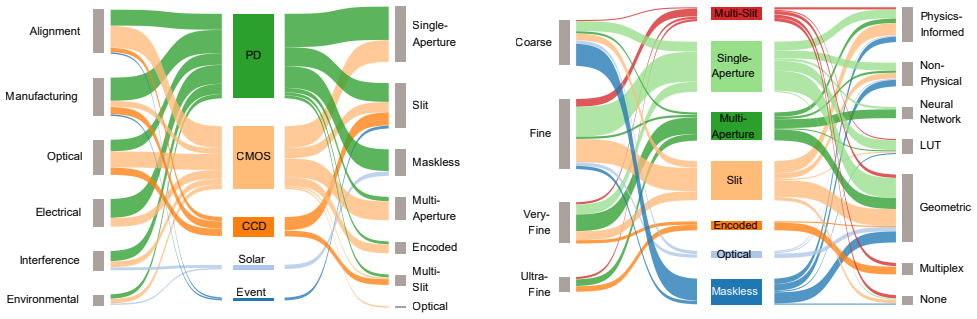
The machinery that carries the argument is the systematic mapping itself: a literature dataset of 128 papers, screened through stated inclusion criteria, classified into the taxonomy of Table 1, and visualized through Sankey diagrams that trace flows from error sources, performance bins, and design requirements to detectors, masks, model representations, and feature extraction techniques. The taxonomy and the associated decision flow of Figure 1 are the named working objects: they translate a qualitative survey into a structured selection guide and a gap analysis. The central mapping at work is the relationship between the five taxonomy dimensions and the requirements that drive sensor choice, namely accuracy, cost, field of view, latency, power, precision, and volume.
What would settle it
A concrete check would be to rerun the search across additional databases and query variants, such as 'digital sun sensor calibration', 'analog sun sensor error compensation', 'sun sensor modeling', and venues not indexed by the first database, screening with the same inclusion criteria; if any qualifying paper published from 2002 onward is absent from the 128-study dataset, the claim of systematic coverage fails.
Extended reading notes
Core claim
The paper's central claim is that this is the first systematic mapping and survey of sun sensor modeling and calibration algorithms, based on 128 studies meeting explicit inclusion criteria. It asserts that the field can be structured by a five-part taxonomy, namely model representation, sensor goals, feature extraction, architecture, and performance, and that cross-analyzing these dimensions with Sankey diagrams reveals recurring decision patterns: accuracy-driven designs tend to pair CMOS detectors with multi-aperture or encoded masks and geometric or neural-network models; cost-driven designs favor photodiodes with single-aperture or maskless configurations; geometric models are the most widely implemented model representation; thresholded centroid detection is the most common feature extraction technique; and alignment, manufacturing, and optical errors dominate the literature while environmental and interference errors are underrepresented. The paper also claims to identify five concrete gaps: missing public datasets, architecture-tight models requiring manual error characterization, limited adaptive online calibration, diminishing returns in centroid feature extraction, and a lack of adversarial-attack research. On the strength of this mapping it recommends future directions spanning learned feature spaces, multiplexing masks, event-based sensors, hybrid Kalman-neural filters, and adversarial defense.
Load-bearing premise
The survey's completeness rests on one literature search of a single database using the query string 'sun sensor calibration', screening the first twenty pages of results by title, and then snowballing until no further relevant papers were found; if the query or the database missed relevant papers, the taxonomy, trend statistics, and gap analysis would be biased.
Editorial extensions
If this is right
- A newcomer can use the taxonomy and decision flow to choose a model representation and feature extraction method from reported sensor requirements, without reading all 128 studies.
- The error-to-architecture Sankey gives practitioners a first-pass prediction of which error sources a given detector-and-mask combination will need to compensate, such as alignment errors for CMOS multi-aperture systems and electrical errors for photodiodes.
- If the gap analysis is right, the next productive research targets are mask-agnostic models, deep feature extraction for digital sensors, adaptive online calibration, and adversarial-hardened digital sun sensors.
- The survey's accuracy-bin definitions, from coarse at 0.5 degrees or worse down to arcsecond-level ultra-fine, provide a common vocabulary that future papers can use to report performance.
- The finding that thresholded centroid detection dominates despite diminishing returns implies that classical single-frame centroiding is not where performance gains will come from.
Reading between the lines
- Because the survey couples algorithms to detector and mask configurations, its taxonomy could transfer to other optical attitude sensors, such as star trackers and Earth horizon sensors, where centroiding and model-representation choices follow the same shape.
- The reported absence of public datasets suggests an immediately testable extension: a standardized benchmark suite of sun sensor images, voltages, and ground-truth angles, built from the 128 studies' reported accuracy bins, would allow subsequent calibration papers to be compared quantitatively for the first time.
- If thresholded centroiding has indeed reached diminishing returns, a concrete next experiment is to compare time-domain energy filtering or learned feature extraction against basic thresholding variants on the same hardware and noise conditions; the survey points to this direction without claiming it.
- The survey's own inclusion criteria imply that its trend statistics describe a specific slice of the literature, namely English-language, 2002-onward studies with detailed implementation reporting, so older or sparsely documented work may be underrepresented in those trends.
Signed reviews
Editorial analysis
A structured set of objections, weighed in public.
Referee Report
Summary. This paper presents itself as the first systematic mapping and comprehensive survey of sun sensor modeling and calibration algorithms, based on an analysis of 128 studies. It develops a taxonomy across five dimensions (model representation, sensor goals, feature extraction, architecture, and performance), visualizes relationships among these attributes with Sankey diagrams, and discusses representative case studies with equations and pseudocode. The paper also identifies five research gaps and recommends future directions. The central claim is that no prior systematic survey exists in this specific niche and that the compiled dataset represents the relevant literature.
Significance. If the search methodology were sound, this would be a genuinely useful resource: the taxonomy is coherent, the case studies are detailed, the pseudocode for feature extraction methods (Algorithms 1–22) gives reproducible implementation detail, and the authors make the compiled dataset publicly available on Zenodo and Tableau. The gap analysis and practitioner recommendations are reasonable and largely follow from the surveyed material. However, the paper's central claim of comprehensiveness is not yet supported by the reported search protocol, which is the key load-bearing weakness.
major comments (4)
- [Section 3.2] The literature search protocol is not reproducible and does not justify the 'comprehensive' claim. The initial set was obtained from a single database (Ex Libris Primo) using the single query 'sun sensor calibration', with title screening of only the first twenty pages and a stopping rule described only as 'saturation'. Backward/forward snowballing cannot recover papers that are not in the reference lists or citation graphs of the seed set. Since the paper's central contribution is the claim of being 'the first systematic mapping' of 128 studies, and the gap analysis in Section 7 (RQ4) depends on the representativeness of this set, the protocol must be substantially strengthened: report all search strings, use multiple databases, give the search date, and provide a PRISMA-style flow diagram. Alternatively, the authors should soften the claim to a scoping review of a sample.
- [Section 3.3, criterion I4] Inclusion criterion I4 requires that papers explicitly report the sensor task, final performance metrics, and architectural configuration. This will systematically exclude many calibration studies that report only a subset of these details, potentially biasing the taxonomy and the performance and architecture Sankey analyses in Section 4. The manuscript does not report the number of papers screened, the number excluded by each criterion, or the number that failed I4. Without this information, the reader cannot judge whether the 128-study set is a biased subsample of the literature.
- [Section 4, performance bins] The accuracy bins (coarse, fine, very-fine, ultra-fine) are central to the performance Sankey diagram and to the RQ1 findings, but the mapping of individual studies to these bins is not shown. The qualitative definitions are given (e.g., fine is better than 0.5°; very-fine is better than one arcminute), yet no table or appendix lists each study's reported accuracy and assigned bin. Without this traceability, the claimed correlations between architecture, model representation, and performance cannot be verified by the reader.
- [Appendix A and Section 3.4] The full list of the 128 included studies is not present in the manuscript; the authors point to external repositories on Zenodo and Tableau. For a survey whose central claim is comprehensiveness and whose classifications are the main scientific output, the study list should be included as an appendix or supplementary table within the paper itself. Relying on external links makes it difficult for reviewers and readers to verify the inclusion set, and external links can become inaccessible over time.
minor comments (5)
- [Section 3.3] There is a typo in the inclusion criteria: 'explicity' should be 'explicitly'.
- [Section 5.6] In the opening sentence, 'neutral network-based model' should be 'neural network-based model'.
- [Figures 3–6 captions] The figure captions list citations as '[2,15,16,18–144]'; this citation range is unusual because the dataset reference [16] is not a primary study, and the range skips 17. Please clarify which references are intended.
- [Algorithm 10, line 7] The formula for the minimum number of thresholds, 'N_TH > sigma / sqrt(e) / Delta_x_m', is typeset ambiguously; please use parentheses to make the expression unambiguous.
- [Table 4] The legend for the feature-extraction assessment table reads 'G #= partially provides feature', but the table rows use a combination of symbols that are not all explained; a clearer legend or explicit cell entries would improve readability.
Circularity Check
No significant circularity: the survey's taxonomy and trend analyses are descriptive frames over 128 collected studies, not derivations that reduce to their own inputs.
full rationale
This is a systematic mapping and survey, so there is no derivation chain whose outputs could reduce to its inputs. The central claim — that this is the first systematic survey of sun sensor modeling and calibration algorithms — is an epistemic claim about prior literature, supported by comparison with the two named earlier surveys (Salgado-Conrado [13] and Díaz Salazar et al. [14]) and qualified by 'to the best of the authors' knowledge.' It does not rest on a self-citation or on a definition of the survey in terms of its own conclusions. The taxonomy (Table 1) is a frame imposed on the collected studies: the authors define model-representation, feature-extraction, architecture, and performance categories and assign each of the 128 papers to them. The resulting trend statements (e.g., 'geometric model representations are the most widely implemented in the literature') are descriptive aggregations of those assignments, not quantities fitted to data and then renamed as predictions. The case-study equations reproduced in Section 5 (e.g., Eq. 2 from de Boer et al. [25], Eq. 3 from Rufino et al. [63], Eq. 12 from Saleem et al. [42]) are presented as examples drawn from the surveyed literature, not derived by the present authors, so there is no constructed equivalence between an input and an output. The only self-references are the authors' own data repositories (Zenodo [16] and Tableau Public [17]) used for data availability, which are not load-bearing on any argument. The gap analysis (RQ4) is interpretive: recommendations such as 'we recommend further research into model-based approaches to detect and mitigate spoofing attacks on sun sensors' follow from the authors' assessment of the collected set, not from a forced or definitional reduction. The completeness of the 128-study set depends on a single-database, single-query search with a twenty-page title screen (Section 3.2) and on inclusion criterion I4, which requires papers to report task, performance metrics, and architecture; if relevant studies were missed, the trend statistics and gap analysis could be biased. That is a correctness or reproducibility concern about the input set, not a circularity, and it does not make any claim equivalent to its own inputs by construction. No circular step meets the evidentiary bar of quoted text plus explicit reduction, so the circularity score is 0.
Assumptions & free parameters
assumptions (4)
- domain assumption The 128 included studies are representative of the full sun sensor calibration literature.
- domain assumption Inclusion criteria I1-I5 are appropriate for defining the field.
- ad hoc to paper The taxonomy categories are exhaustive and mutually exclusive.
- ad hoc to paper The accuracy bins (coarse, fine, very-fine, ultra-fine) are meaningful thresholds.
Cite this review
Pith. "Pith review of Sun sensor calibration algorithms: A systematic mapping and survey." pith.science (2026). https://pith.science/paper/EXKJRUQH
@misc{pith2026250721541,
  author       = {Pith},
  title        = {Pith review of: Sun sensor calibration algorithms: A systematic mapping and survey},
  year         = {2026},
  howpublished = {\url{https://pith.science/paper/EXKJRUQH}},
  note         = {Machine review of arXiv:2507.21541}
}
read the original abstract
Attitude sensors determine the spacecraft attitude through the sensing of an astronomical object, field or other phenomena. The Sun and fixed stars are the two primary astronomical sensing objects. Attitude sensors are critical components for the survival and knowledge improvement of spacecraft. Of these, sun sensors are the most common and important sensor for spacecraft attitude determination. The sun sensor measures the Sun vector in spacecraft coordinates. The sun sensor calibration process is particularly difficult due to the complex nature of the uncertainties involved. The uncertainties are small, difficult to observe, and vary spatio-temporally over the lifecycle of the sensor. In addition, the sensors are affected by numerous sources of uncertainties, including manufacturing, electrical, environmental, and interference sources. This motivates the development of advanced calibration algorithms to minimize uncertainty over the sensor lifecycle and improve accuracy. Although modeling and calibration techniques for sun sensors have been explored extensively in the literature over the past two decades, there is currently no resource that consolidates and systematically reviews this body of work. The present review proposes a systematic mapping of sun sensor modeling and calibration algorithms across a breadth of sensor configurations. It specifically provides a comprehensive survey of each methodology, along with an analysis of research gaps and recommendations for future directions in sun sensor modeling and calibration techniques.
Figures


Figures from the paper (3 more)


Reference graph
Works this paper leans on
-
[1]
Zhu, Epet 400: Spacecraft mission epet 400: Spacecraft mission design design, 2022
F. Zhu, Epet 400: Spacecraft mission epet 400: Spacecraft mission design design, 2022
2022
-
[2]
X. Ke-Qiang, X. Meng, W. Jun, L. Ji-Xin, Z. Sheng, L. Bao-Jun, L.Gan-Hua, Erroranalysisandcompensationforsatellitesunsensor ofsatellite, in:2020IEEE4thInformationTechnology,Networking, ElectronicandAutomationControlConference(ITNEC),volume1, 2020, pp. 1450–1455. doi:10.1109/ITNEC48623.2020.9085041
arXiv 2020
-
[3]
Zapevalin, A
P. Zapevalin, A. Novoselov, V. Zharov, Artificial neural network for star tracker centroid computation, Advances in Space Research (2022)
2022
-
[4]
Mastrofini, I
M. Mastrofini, I. Agostinelli, F. Curti, Design and validation of a u-net-based algorithm for star sensor image segmentation, Applied Sciences 13 (2023)
2023
-
[5]
H. Zhao, M. F. Lembeck, A. Zhuang, R. Shah, J. Wei, Real-time convolutional neural network-based star detection and centroiding methodforcubesatstartracker,2024.URL: https://arxiv.org/abs/ 2404.19108. arXiv:2404.19108
work page Pith review arXiv 2024
-
[6]
Yatsu, S
S.Koizumi,Y.Kikuya,K.Sasaki,Y.Masuda,Y.Iwasaki,K.Watan- abe, Y. Yatsu, S. Matsunaga, Development of attitude sensor using deep learning, 2018
2018
-
[7]
Kikuya, K
Y. Kikuya, K. Ohta, Y. Iwasaki, T. Ozawa, K. Watanabe, Y. Yatsu, S. Matunaga, Development and in-orbit operation of deep learning attitude sensor, Journal of Spacecraft and Rockets 60 (2023) 1400– 1409
2023
-
[8]
Phisannupawong, P
T. Phisannupawong, P. Kamsing, P. Torteeka, S. Channumsin, U. Sawangwit, W. Hematulin, T. Jarawan, T. Somjit, S. Yooyen, D. Delahaye, P. Boonsrimuang, Vision-based spacecraft pose esti- mation via a deep convolutional neural network for noncooperative docking operations, Aerospace 7 (2020) 1–22
2020
Show all 171 references
-
[9]
Tomita, K
K. Tomita, K. Ho, Adaptive Hazard Detection and Avoidance for Planetary Landing via Bayesian Semantic Segmentation, 2022. URL: https://arc.aiaa.org/ doi/abs/10.2514/6.2022-2207. doi: 10.2514/6.2022-2207. arXiv:https://arc.aiaa.org/doi/pdf/10.2514/6.2022-2207
2022 doi
-
[10]
Sharma, S
S. Sharma, S. D’Amico, Pose estimation for non-cooperative ren- dezvous using neural networks (2019)
2019
-
[11]
Sharma, S
S. Sharma, S. D’Amico, Neural network-based pose estimation for noncooperative spacecraft rendezvous, IEEE Transactions on Aerospace and Electronic Systems 56 (2020) 4638–4658
2020
-
[12]
Pasqualetto Cassinis, T
L. Pasqualetto Cassinis, T. Park, N. Stacey, S. D’Amico, A. Menicucci, E. Gill, I. Ahrns, M. Sanchez-Gestido, Leveraging neural network uncertainty in adaptive unscented kalman filter for spacecraft pose estimation, Advances in Space Research 71 (2023)
2023
-
[13]
L.Salgado-Conrado, Areviewonsunpositionsensorsusedinsolar applications, RenewableandSustainableEnergyReviews82(2018) 2128–2146
2018
-
[14]
Díaz Salazar, N
M. Díaz Salazar, N. Kondratiuk, A. Moreno, M. Martínez Bogado, S. Pavoni Oliver, M. Tamasi, Design and simulation of sun position sensors for space applications: A comparative study, Review of Scientific Instruments 95 (2024) 075104
2024
-
[15]
C.Liebe,S.Mobasser,Y.Bae,C.Wrigley,J.Schroeder,A.Howard, Micro sun sensor, in: Proceedings, IEEE Aerospace Conference, volume 5, 2002, pp. 5–5. doi:10.1109/AERO.2002.1035393
2002 arXiv
-
[16]
Herman, O
M. Herman, O. Pinon Fischer, D. N. Mavris, Sun sensor calibration algorithms: Survey dataset (version 1.0), 2025. URL:https://doi. org/10.5281/zenodo.15784429. doi: 10.5281/zenodo.15784429, [Data set]
2025 doi
-
[17]
Herman, O
M. Herman, O. Pinon Fischer, D. N. Mavris, Sun sensor calibration algorithms, 2025. URL: https://public.tableau.com/app/profile/ herman.michael/viz/SunSensorCalibrationAlgorithms/Dashboard, [Interactive dashboard]
2025
-
[18]
N. Xie, A. J. Theuwissen, X. Wang, J. Leijtens, H. Hakkesteegt, H. Jansen, A cmos image sensor with row and column profiling means, in: SENSORS, 2008 IEEE, 2008, pp. 1356–1359. doi:10. 1109/ICSENS.2008.4716697
2008
-
[19]
Saleem, S
R. Saleem, S. Lee, J. Kim, A cost-effective micro sun sensor based on black sun effect, in: 2017 IEEE SENSORS, 2017, pp. 1–3. doi:10.1109/ICSENS.2017.8234366
2017
-
[20]
L. He, Y. Hu, A fast algorithm of attitude measurement for aps- based digital sun sensors, in: 2006 1st International Symposium on Systems and Control in Aerospace and Astronautics, 2006, pp. 3 pp.–41. doi:10.1109/ISSCAA.2006.1627698
2006 arXiv
-
[21]
D. A. Coutinho, A. A. da Conceição, A. A. F. Junior, E. C. V. Boas, A fast centroiding algorithm for digital sun sensors for nanosatellite applications, IEEE Sensors Letters 6 (2022) 1–4
2022
-
[22]
Massari, L
N. Massari, L. Gonzo, M. Gottardi, A. Simoni, A fast cmos optical positionsensorwithhighsubpixelresolution, IEEETransactionson Instrumentation and Measurement 53 (2004) 116–123
2004
-
[23]
M. Wei, F. Xing, Z. You, A highly accurate wireless digital sun sensor based on profile detecting and detector multiplexing technologies, MechanicalSystemsandSignalProcessing82(2017) 56–67
2017
-
[24]
M. A. Post, J. Li, R. Lee, A low-cost photodiode sun sensor for cubesat and planetary microrover, International Journal of Aerospace Engineering 2013 (2013) 549080
2013
-
[25]
B. M. de Boer, M. Durkut, A low-power and high-precision miniaturized digital sun sensor, in: E. W. Taylor, D. A. Cardimona (Eds.),NanophotonicsandMacrophotonicsforSpaceEnvironments VII, volume 8876, International Society for Optics and Photonics, SPIE, 2013, p. 88760F. URL:ht...
2013 doi
-
[26]
Rufino, M
G. Rufino, M. Grassi, V. Pulcino, A. Degtyarev, et al., A micro sun sensor for earth-observation nanosatellites flying in formation, in: Proceedings of 5th IAA International Symposium on Small Satellites for Earth Observation, 2005, pp. 353–360
2005
-
[27]
D. H. Zhuo, A. Rai, S. Vosoogh-Grayli, G. W. Leach, B. Bahreyni, A micromachined vector light sensor, Sensors and Actuators A: Michael Herman et al.:Preprint submitted to Elsevier Page 43 of 47 Physical 311 (2020) 112045
2020
-
[28]
N.Xie,A.J.P.Theuwissen, Aminiaturizedmicro-digitalsunsensor by means of low-power low-noise cmos imager, IEEE Sensors Journal 14 (2014) 96–103
2014
-
[29]
Ortega, G
P. Ortega, G. López-Rodríguez, J. Ricart, M. Domínguez, L. M. Castañer, J. M. Quero, C. L. Tarrida, J. García, M. Reina, A. Gras, M. Angulo, A miniaturized two axis sun sensor for attitude control of nano-satellites, IEEE Sensors Journal 10 (2010) 1623–1632
2010
-
[30]
Farian, P
L. Farian, P. Häfliger, J. A. Leñero-Bardallo, A miniaturized two-axis ultra low latency and low-power sun sensor for attitude determinationofmicrospaceprobes, IEEETransactionsonCircuits and Systems I: Regular Papers 65 (2018) 1543–1554
2018
-
[31]
F.Delgado,P.Ortega,C.L.Tarrida,J.García,M.Angulo,J.Quero, Anewdesignofhighprecisionsolarmicrosensorforsatelliteaplica- tions, in: SENSORS, 2010 IEEE, 2010, pp. 552–556. doi:10.1109/ ICSENS.2010.5690486
2010
-
[32]
C. Jing, T. Liang, Q. Lei, A new kind of miniature sun sensor design, in: 2016 IEEE International Conference on Electronic Information and Communication Technology (ICEICT), 2016, pp. 219–222. doi:10.1109/ICEICT.2016.7879687
2016
-
[33]
Y.-K.Chang,M.-Y.Yun,B.-H.Lee, Anewmodelingandvalidation of two-axis miniature fine sun sensor, Sensors and Actuators A: Physical 134 (2007) 357–365
2007
-
[34]
F.Xing,Z.You,G.Zhang,J.Sun, Anovelactivepixelssensor(aps) basedsunsensorbasedonafeatureextractionandimagecorrelation (feic) technique, Measurement Science and Technology 19 (2008) 125203
2008
-
[35]
C. W. D. Boom, N. V. D. Heiden, A novel digital sun sensor: Development and qualification for flight, volume 1, 2003, pp. 747–
2003
-
[36]
Z. You, J. Sun, F. Xing, G.-F. Zhang, A novel multi-aperture based sun sensor based on a fast multi-point meanshift (fmms) algorithm, Sensors 11 (2011) 2857–2874
2011
-
[37]
X. Lü, Y. Tao, K. Xie, S. Wang, X. Li, W. Bao, R. Chen, A photodiode based miniature sun sensor, Measurement Science and Technology 28 (2017) 055104
2017
-
[38]
J. Chum, J. Vojta, J. Baše, F. Hruška, A simple low cost digital sun sensor for micro-satellites, in: Small Satellites for Earth Obser- vation, International Academy of Astronautics (IAA), Wissenschaft und Technik Verlag, Berlín, 2003, pp. s. 311–314
2003
-
[39]
J.Wang,X.Wang,J.Y.Yang,Asunsensorbasedonregularpyramid sensor arrays, Journal of Physics: Conference Series 1207 (2019) 012010
2019
-
[40]
J. A. Leñero-Bardallo, J. M. Guerrero-Rodríguez, L. Farian, R.Carmona-Gálaín,Rodríguez-Vázquez,Asunsensorimplemented with an asynchronous luminance vision sensor, in: ESSCIRC 2017 - 43rd IEEE European Solid State Circuits Conference, 2017, pp. 67–70. doi:10.1109/ESSCIRC.2017.8094527
2017
-
[41]
H.-J.Kim,Asun-trackingcmosimagesensorwithblack-sunreadout scheme, IEEE Transactions on Electron Devices 68 (2021) 1115– 1120
2021
-
[42]
Saleem, S
R. Saleem, S. Lee, Accurate and cost-effective micro sun sensor based on cmos black sun effect, Sensors 19 (2019)
2019
-
[43]
F. J. Delgado, J. M. Quero, J. Garcia, C. L. Tarrida, P. R. Ortega, S. Bermejo, Accurate and wide-field-of-view mems-based sun sensor for industrial applications, IEEE Transactions on Industrial Electronics 59 (2012) 4871–4880
2012
-
[44]
M. A. Arshad, A. Nasir, M. M. Gulzar, M. Fayyaz, J. K. Qureshi, A. Saeed, Active pixel digital sun sensor for satellites, in: 2018 International Conference on Electrical Engineering (ICEE), 2018, pp. 1–7. doi:10.1109/ICEE.2018.8566743
2018
-
[45]
Enright, Godard, Advanced sun-sensor processing and design for super-resolution performance, in: 2006 IEEE Aerospace Confer- ence, 2006, pp
J. Enright, Godard, Advanced sun-sensor processing and design for super-resolution performance, in: 2006 IEEE Aerospace Confer- ence, 2006, pp. 14 pp.–. doi:10.1109/AERO.2006.1655910
2006 arXiv
-
[46]
Enright, D
J. Enright, D. Sinclair, Algorithm enhancements for the ss-411 digital sun sensor (2007)
2007
-
[47]
N. Xie, A. J. P. Theuwissen, An autonomous low-power high- resolution micro-digital sun sensor, in: M. Ikeda, N. Wu, G. Zhang, K.Ai(Eds.),InternationalSymposiumonPhotoelectronicDetection and Imaging 2011: Advances in Imaging Detectors and Applica- tions, volume 8194, Internati...
2011 doi
-
[48]
N. Xie, A. J. P. Theuwissen, An autonomous microdigital sun sensor by a cmos imager in space application, IEEE Transactions on Electron Devices 59 (2012) 3405–3410
2012
-
[49]
Q.yunFan,X.fengTan, Anerrorcompensationmethodforalinear array sun sensor with a v-shaped slit, Measurement Science and Technology 26 (2015) 115009
2015
-
[50]
M. Wei, F. Xing, Z. You, An implementation method based on ers imagingmodeforsunsensorwith1khzupdaterateand1"precision level, Opt. Express 21 (2013) 32524–32533
2013
-
[51]
F. Chen, J. Feng, Analogue sun sensor based on the optical nonlinearcompensationmeasuringprinciple, MeasurementScience and Technology 18 (2007) 2111
2007
-
[52]
Grassi,G.Rufino, Aps-basedminiature sunsen- sorforearthobservationnanosatellites, ActaAstronautica56(2005) 139–145
M.Buonocore,M. Grassi,G.Rufino, Aps-basedminiature sunsen- sorforearthobservationnanosatellites, ActaAstronautica56(2005) 139–145. 4th IAA International Symposium on Small Satellites for Earth Observation
2005
-
[53]
Bolshakov, F
K. Bolshakov, F. K. Diriker, R. Clark, R. Lee, H. Podmore, Array- based digital sun-sensor design for cubesat application, Acta Astro- nautica 178 (2021) 81–88
2021
-
[54]
Armandillo, N
E.Boslooper,N.vanderHeiden,D.Naron,R.Schmits,J.J.vander Velde,J.vanWakeren, BepiColombofinesunsensor, in:B.Cugny, E. Armandillo, N. Karafolas (Eds.), International Conference on Space Optics — ICSO 2012, volume 10564, International Society for Optics and Photonics, SPIE, 2017,...
2012 doi
-
[55]
Farian, P
L. Farian, P. Fernández-Peramo, P. Häfliger, J. A. Leñero-Bardallo, Centroid estimation method with sub-pixel resolution for event- based sun sensors, in: 2022 17th Conference on Ph.D Research in Microelectronics and Electronics (PRIME), 2022, pp. 117–120. doi:10.1109/PRIME550...
2022
-
[56]
S. E. Allgeier, M. Mahin, N. G. Fitz-Coy, Design and analysis of a coarse sun sensor for pico-satellites, American Institute of Aeronautics and Astronautics Inc., 2009. doi:10.2514/6.2009-1837
2009 doi
-
[57]
Trebi-Ollennu, T
A. Trebi-Ollennu, T. Huntsberger, Y. Cheng, E. Baumgartner, B. Kennedy, P. Schenker, Design and analysis of a sun sensor for planetary rover absolute heading detection, IEEE Transactions on Robotics and Automation 17 (2001) 939–947
2001
-
[58]
P.M.Rodrigues,P.M.Ramos,Designandcharacterizationofasun sensor for the sseti-eseo project, 2006
2006
-
[59]
A. Maji, H. R. Prabhamani, V. John, H. S. Ravindra, K. Subhalak- shmi, A. S. Laxmiprasad, Design and development of two axes micro digital sun sensor using linear cmos detector, in: 2015 2nd International Symposium on Physics and Technology of Sensors (ISPTS), 2015, pp. 187–19...
2015
-
[60]
Meynart, S
H.Liang,J.Zhang,Z.Lv,C.Yu,J.Jia, Designandrealizationoflin- ear APS-based sun sensor, in: R. Meynart, S. P. Neeck, H. Shimoda (Eds.),Sensors, Systems,andNext-GenerationSatellites XVII,vol- ume 8889, International Society for Optics and Photonics, SPIE, 2013,p.88891T.URL: https...
2013 doi
-
[61]
J.P.Enright,Godard, Designoptimizationofadigitalsunsensorfor usewithparametricprocessing, IEEETransactionsonInstrumenta- tion and Measurement 57 (2008) 2188–2195
2008
-
[62]
J. A. Bahrampoor, A. Naghash, Design, fabrication, and test of a low-cost mems-based sun sensor, in: 2018 6th RSI International ConferenceonRoboticsandMechatronics(IcRoM),2018,pp.364–
2018
-
[63]
G.Rufino,M.Grassi,A.Perrotta,etal., Developmentandvalidation ofamoderncmosdigitalsunsensoratunina, in:Proceedingsofthe 6 th International Conference on Dynamics and Control of Systems and Structures in Space, 2004, pp. 427–436
2004
-
[64]
S.-H. Rhee, J. Lyou, Development of a fine digital sun sensor for stsat-2, InternationalJournalofAeronauticalandSpaceSciences13 Michael Herman et al.:Preprint submitted to Elsevier Page 44 of 47 (2012) 260–265
2012
-
[65]
O’Neill, N
J. O’Neill, N. Bressan, G. McSorley, N. Krouglicof, Development of a high-accuracy low-cost sun sensor for cubesat application, AeronauticsandAerospaceOpenAccessJournal4(2020)142–146
2020
-
[66]
Maqsood, T
I. Maqsood, T. Akram, Development of a low cost sun sensor using quadphotodiode, in: IEEE/ION Position, Location and Navigation Symposium, 2010, pp. 639–644. doi:10.1109/PLANS.2010.5507186
2010
-
[67]
Antonello, L
A. Antonello, L. Olivieri, A. Francesconi, Development of a low- cost sun sensor for nanosatellites, Acta Astronautica 144 (2018) 429–436
2018
-
[68]
Chang, B.-H
Y.-K. Chang, B.-H. Lee, Development of high-accuracy image centroiding algorithm for cmos-based digital sun sensors, Sensors and Actuators A: Physical 144 (2008) 29–37
2008
-
[69]
S.-J.Kim,S.-O.Kim,B.-Y.Moon,Y.-K.Chang,H.-S.Oh, Develop- ment of Ultra-Light 2-Axes Sun Sensor for Small Satellite, Journal of Astronomy and Space Sciences 22 (2005) 47–58
2005
-
[70]
F. Chen, J. Feng, Z. Hong, Digital sun sensor based on the optical verniermeasuringprinciple, MeasurementScienceandTechnology 17 (2006) 2494
2006
-
[71]
Rufino, M
G. Rufino, M. Grassi, Digital sun sensor multi-spot operation, Sensors 12 (2012) 16451–16465
2012
-
[72]
W.-Y.Li,G.-F.Zhang,Z.You,F.Xing, Errorcompensationforarea digital sun sensor, Sensors 12 (2012) 11798–11810
2012
-
[73]
Q. Fan, G. Zhang, J. Li, X. Wei, X. Li, Error modeling and calibration for encoded sun sensors, Sensors 13 (2013) 3217–3231
2013
-
[74]
F. J. Delgado, J. García, C. L. Tarrida, J. M. Quero, Fabrication of a mems based high precision solar sensor for satellite applications using cmos technology, in: Proceedings of the 8th Spanish Confer- ence on Electron Devices, CDE’2011, 2011, pp. 1–4. doi:10.1109/ SCED.2011.5744237
2011
-
[75]
Yousefian, M
P. Yousefian, M. Durali, B. Rashidian, M. A. Jalali, Fabrication, characterization,anderrormitigationofnon-flatsunsensor, Sensors and Actuators A: Physical 261 (2017) 243–251
2017
-
[76]
Mobasser, C
S. Mobasser, C. Liebe, A. Howard, Fuzzy image processing in sun sensor, in: 10th IEEE International Conference on Fuzzy Systems. (Cat. No.01CH37297), volume 3, 2001, pp. 1337–1342 vol.2. doi:10.1109/FUZZ.2001.1008905
2001 arXiv
-
[77]
Y.-K.Chang,S.-J.Kang,B.-H.Lee, High-accuracyimagecentroid- ing algorithm for cmos-based digital sun sensors, in: SENSORS, 2007 IEEE, 2007, pp. 329–336. doi:10.1109/ICSENS.2007.4388403
2007
-
[78]
Pelemeshko, A
A. Pelemeshko, A. Kolesnikova, A. Melkov, V. Prokopyev, A. Zadorozhny, High-precision cubesat sun sensor coupled with infrared earth horizon detector, IOP Conference Series: Materials Science and Engineering 734 (2020) 012012
2020
-
[79]
Zhang, F
L. Zhang, F. Xing, High-resolution measurement method based on array fov and coded apertures, in: 2021 IEEE 16th International Conference on Nano/Micro Engineered and Molecular Systems (NEMS), 2021, pp. 382–385. doi:10.1109/NEMS51815.2021.9451513
2021
-
[80]
Kohli, A
T. Kohli, A. Maji, Y. Vijaya, H. Ravindra, Implementation and realisation of micro digital sun sensor processing in fpga, INCOSE International Symposium 29 (2019) 71–85
2019
-
[81]
Abhilash, S
M. Abhilash, S. Kumar, S. Sandya, T. V. Sridevi, H. R. Prab- hamani, Implementation of the mems-based dual-axis sun sen- sor for nano satellites, in: 2014 IEEE Metrology for Aerospace (MetroAeroSpace),2014,pp.190–195.doi: 10.1109/MetroAeroSpace. 2014.6865918
2014
-
[82]
F.K.Diriker,A.Frias,K.H.Keum,R.S.K.Lee, Improvedaccuracy ofasingle-slitdigitalsunsensordesignforcubesatapplicationusing sub-pixel interpolation, Sensors 21 (2021)
2021
-
[83]
Delgado, J
F. Delgado, J. García, C. Tarrida, J. Quero, P. Ortega, L. Terés, F. Serra-Graells, E. Cabruja, Integrated design of a smart analog sun sensor with cmos technology, in: 2012 IEEE International Conference on Industrial Technology, 2012, pp. 184–188. doi:10. 1109/ICIT.2012.6209935
2012
-
[84]
M.-S.Wei,F.Xing,B.Li,Z.You, Investigationofdigitalsunsensor technology with an n-shaped slit mask, Sensors 11 (2011) 9764– 9777
2011
-
[85]
Rufino, A
G. Rufino, A. Perrotta, M. Grassi, Laboratory test of an APS-based sun sensor prototype, in: J. Costeraste, E. Armandillo (Eds.), Inter- nationalConferenceonSpaceOptics—ICSO2004,volume10568, International Society for Optics and Photonics, SPIE, 2017, p. 105680Z. URL: https://d...
2017 doi
-
[86]
A. Ali, F. Tanveer, Low-cost design and development of 2-axis digital sun sensor, Journal of Space Technology 1 (2011) 1–5
2011
-
[87]
N.Xie,A.J.P.Theuwissen, Low-powerhigh-accuracymicro-digital sunsensorbymeansofaCMOSimagesensor, JournalofElectronic Imaging 22 (2013) 033030
2013
-
[88]
S. N. Sozen, M. Gokce, C. Yavuzyilmaz, F. Gulmammadov, H. E. Soken, Measurement correction of a set of analog sun sensors via neural network, in: 2021 IEEE 8th International Workshop on Metrology for AeroSpace (MetroAeroSpace), 2021, pp. 1–6. doi:10.1109/MetroAeroSpace51421.20...
2021
-
[89]
Mobasser, C
S. Mobasser, C. Liebe, Mems based sun sensor on a chip, in: Proceedings of 2003 IEEE Conference on Control Applications,
2003
-
[90]
Liebe, S
C. Liebe, S. Mobasser, Mems based sun sensor, in: 2001 IEEE AerospaceConferenceProceedings(Cat.No.01TH8542),volume3, 2001, pp. 3/1565–3/1572 vol.3. doi:10.1109/AERO.2001.931388
2001
-
[91]
J. G. Ortega, C. L. Tarrida, J. M. Quero, F. J. Delgado, P. Ortega, L. Castaner, M. Reina, M. Angulo, Y. Morilla, J. G. Lopez, Mems solar sensor testing for satellite applications, in: 2009 Spanish Conference on Electron Devices, 2009, pp. 345–348. doi:10.1109/ SCED.2009.4800503
2009
-
[92]
Q.-y.Fan,J.-w.Peng,X.-y.Gao, Microdigitalsunsensorwithlinear detector, Review of Scientific Instruments 87 (2016) 075003
2016
-
[93]
amatchboxmiracle
C. De Boom, J. Leijtens, N. Van Der Heiden, Micro digital sun sensor:"amatchboxmiracle", in:Guidance,NavigationandControl Systems, volume 606, 2006
2006
-
[94]
N. Xie, A. J. Theuwissen, B. Büttgen, H. Hakkesteegt, H. Jasen, J. Leijtens, Micro-digital sun sensor: An imaging sensor for space applications, in: 2010 IEEE International Symposium on Industrial Electronics, 2010, pp. 3362–3365. doi:10.1109/ISIE.2010.5637993
2010
-
[95]
L.Farian,P.Häfliger,J.A.Leñero-Bardallo,Miniaturizedsunsensor with in-pixel processing for attitude determination of micro space probes, in: 2015 International Conference on Event-based Control, Communication, and Signal Processing (EBCCSP), 2015, pp. 1–6. doi:10.1109/EBCCSP.2...
2015
-
[96]
B.M.deBoer,M.Durkut,E.Laan,H.Hakkesteegt,A.Theuwissen, N. Xie, J. L. Leijtens, E. Urquijo, P. Bruins, MiniDSS: a low-power and high-precision miniaturized digital sun sensor, in: B. Cugny, E. Armandillo, N. Karafolas (Eds.), International Conference on Space Optics — ICSO 2012...
2012 doi
-
[97]
J.Enright,A.Yam,C.Li, Modellingandtestingoftwo-dimensional sun-sensors, in: 2007 IEEE Aerospace Conference, 2007, pp. 1–11. doi:10.1109/AERO.2007.353010
2007
-
[98]
G.Rufino,M.Grassi,Multi-aperturecmossunsensorformicrosatel- lite attitude determination, Sensors 9 (2009) 4503–4524
2009
-
[99]
M. Wei, F. Xing, Z. You, G. Wang, Multiplexing image detector method for digital sun sensors with arc-second class accuracy and large fov, Opt. Express 22 (2014) 23094–23107
2014
-
[100]
J.Miao,T.Liang,Newkindofself-poweredwirelessdigitalsunsen- sor, in: 2017 IEEE 3rd Information Technology and Mechatronics Engineering Conference (ITOEC), 2017, pp. 276–281. doi:10.1109/ ITOEC.2017.8122435
2017
-
[101]
Enright, Optimization of a sun-sensor illumination pattern using genetic algorithms, in: 2006 Canadian Conference on Electrical and Computer Engineering, 2006, pp
Godard, J. Enright, Optimization of a sun-sensor illumination pattern using genetic algorithms, in: 2006 Canadian Conference on Electrical and Computer Engineering, 2006, pp. 1437–1441. doi:10.1109/CCECE.2006.277606
2006
-
[102]
Faizullin, K
D. Faizullin, K. Hiraki, H.-I. Team, M. Cho, Optimization of a sun vector deermination for pinhole type sun sensor, International Journal of Research-Granthaalayah 5 (2017) 436–449. Michael Herman et al.:Preprint submitted to Elsevier Page 45 of 47
2017
-
[103]
B. A. Alvi, N. Abbas, A. Israr, M. Asif, Optimized design of sun sensor and centroid algorithm for small satellite mission, in: 2014 4th International Conference on Wireless Communications, Vehic- ular Technology, Information Theory and Aerospace & Electronic Systems (VITAE), ...
2014
-
[104]
Enright, A
J. Enright, A. Yam, C. Li, Parametric processing for two- dimensionaldigitalsunsensors:Algorithms,modelling,andtesting, Journal of Spacecraft and Rockets 45 (2008) 359–369
2008
-
[105]
D.J.Richie,J.Sobers,D.Michael,N.C.LengFrederick,T.C.Sian, Photocells for Small Satellite, Single-axis Attitude Determination, Journal of Small Satellites 4 (2015) 285–299
2015
-
[106]
G. Wang, F. Xing, M. Wei, Z. You, Precision enhancement method for multiplexing image detector-based sun sensor with varying and coded apertures, Appl. Opt. 54 (2015) 10467–10472
2015
-
[107]
Zhang, H
L. Zhang, H. Zhan, X. Liu, F. Xing, Z. You, A wide-field and high- resolution lensless compound eye microsystem for real-time target motion perception, Microsystems & Nanoengineering 8 (2022) 83
2022
-
[108]
Rufino, M
G. Rufino, M. Grassi, M. Rolfi, Preliminary calibration results for a high-precision cmos sun sensor, 2008. doi:10.2514/6.2008-7319
2008 doi
-
[109]
Unlimited Conference, 2009, p
G.Rufino,M.Grassi,F.Esposito,D.Paltro, Real-timeperformance analysis of the unina aps-based micro sun sensor, in: AIAA In- fotech@ Aerospace Conference and AIAA Unmanned... Unlimited Conference, 2009, p. 1838
2009
-
[110]
F. J. Delgado, J. M. Quero, J. García, C. L. Tarrida, J. M. Moreno, A.G.Sáez,P.Ortega, Sensosol:Multifov4-quadranthighprecision sun sensor for satellite attitude control, in: 2013 Spanish Confer- enceonElectronDevices,2013,pp.123–126.doi: 10.1109/CDE.2013. 6481358
2013 doi
-
[111]
Liebe, Solar compass chip, IEEE Sensors Journal 4 (2004) 779– 786
C. Liebe, Solar compass chip, IEEE Sensors Journal 4 (2004) 779– 786
2004
-
[112]
Nurgizat, G
Y. Nurgizat, G. Balbayev, D. Galayko, Solar sensor for cubesat attitudedetermination, in:202128thIEEEInternationalConference on Electronics, Circuits, and Systems (ICECS), 2021, pp. 1–5. doi:10.1109/ICECS53924.2021.9665513
2021
-
[113]
Frezza, F
L. Frezza, F. Santoni, F. Piergentili, Sun direction determination improvementbyalbedoinputestimationcombiningphotodiodesand magnetometer, Acta Astronautica 190 (2022) 134–148
2022
-
[114]
J. A. Leñero-Bardallo, L. Farian, J.-M. Guerrero-Rodríguez, R. Carmona-Galán, Á. Rodríguez-Vázquez, Sun sensor based on a luminance spiking pixel array, IEEE Sensors Journal 17 (2017) 6578–6588
2017
-
[115]
W.Dong,L.Lin,Z.Sitong,T.Luyang, Sunsensordesignandtestof a micro satellite, Journal of Measurements in Engineering 4 (2016) 148–155
2016
-
[116]
X. Lü, Y. Tao, K. Xie, X. Li, S. Wang, W. Bao, R. Chen, Sun sensor using a nanosatellites solar panels by means of time-division multiplexing, IET Science, Measurement & Technology 11 (2017) 489–494
2017
-
[117]
Enright, Superresolution techniques for sun-sensor processing, IEEE Transactions on Aerospace and Electronic Systems 44 (2008) 400–408
J. Enright, Superresolution techniques for sun-sensor processing, IEEE Transactions on Aerospace and Electronic Systems 44 (2008) 400–408
2008
-
[118]
16th Annual AIAA/USU Conference on Small Satellites ; Conference date: 12-08-2002 Through 15-08-2002
J.Hales,M.Pedersen,Two-axismoemssunsensorforpicosatellites, in:Proceedingsofthe16thAnnualAIAA/USUConferenceonSmall Satellites, 2002. 16th Annual AIAA/USU Conference on Small Satellites ; Conference date: 12-08-2002 Through 15-08-2002
2002
-
[119]
Strietzel, Two-dimensional calibration of a sun attitude sensor, IFAC Proceedings Volumes 35 (2002) 259–264
R. Strietzel, Two-dimensional calibration of a sun attitude sensor, IFAC Proceedings Volumes 35 (2002) 259–264. 15th IFAC World Congress
2002
-
[120]
Tsuno, S
K. Tsuno, S. Wada, T. Ogawa, T. Shimizu, T. Hasegawa, M. Kubo, H. Murao, S. Mizumoto, S. Fujishima, K. Toyonaga, UFSS (ultra fine sun sensor): CCD sun sensor with sub-arc second accuracy for the next solar observing satellite SOLAR-C, in: Z. Sodnik, N. Karafolas, B. Cugny (Eds...
2018 doi
-
[121]
Kondo, D
Y. Kondo, D. Yamasaki, M. Yoshida, A. Tei, M. Uchiyama, T. Shimizu, Development and characterization of a testing system for the Ultra Fine Sun Sensor (UFSS) onboard SOLAR-C, in: R.Navarro,R.Jedamzik(Eds.),AdvancesinOpticalandMechanical TechnologiesforTelescopesandInstrumentat...
2024 doi
-
[122]
C. Liu, F. Yang, K. B. Ariyur, Interval-based celestial geolocation using a camera array, IEEE Sensors Journal 16 (2016) 5964–5973
2016
-
[123]
M.M.Arturo,G.P.Alejandro, Highprecisionsolartrackingsystem, in:ProceedingsoftheWorldCongressonEngineering,London,UK, volume 2, 2010
2010
-
[124]
Barnes, C
J. Barnes, C. Liu, K. Ariyur, A hemispherical sun sensor for orientationandgeolocation, IEEESensorsJournal14(2014)4423– 4433
2014
-
[125]
Gomez-Merchan, M
R. Gomez-Merchan, M. López-Carmona, J. A. Leñero-Bardallo, Á. Rodríguez-Vázquez, A high-speed low-power sun sensor with solarcellsandcontinuousoperation,in:ESSDERC2021-IEEE51st European Solid-State Device Research Conference (ESSDERC), 2021, pp. 147–150. doi:10.1109/ESSDERC534...
2021
-
[126]
Leijtens, S
J. Leijtens, S. Schmidt, D. Broekmans, J. Uittenhout, Qualification and flight of a cutting edge sunsensor for constellation applications (2020)
2020
-
[127]
Q. Sun, J. L. R. Gutiérrez, X. Yu, Deep neural network-based 4-quadrant analog sun sensor calibration, Space: Science & Technology 3 (2023) 0024
2023
-
[128]
Á. L. Porras Hermoso, D. Alfonso Corcuera, J. Piqueras, E. Roibás Millán, J. Cubas Cano, J. Pérez Álvarez, S. Pindado Car- rion, Design and calibration process of solar sensors for small satellite missions, in: 4th Symposium on Space Educational Activ- ities (4th SSEA), Univer...
2022
-
[129]
Gomez-Merchan, J
R. Gomez-Merchan, J. A. Leñero-Bardallo, M. López-Carmona, Á. Rodríguez-Vázquez, A low-latency, low-power cmos sun sen- sor for attitude calculation using photovoltaic regime and on-chip centroid computation, IEEE Transactions on Instrumentation and Measurement 72 (2023) 1–12
2023
-
[130]
Porras-Hermoso, J
A. Porras-Hermoso, J. Cubas, S. Pindado, Use of spacecraft solar panels and sun sensors for estimation of the sun-pointing direction in the upmsat-2 mission, Measurement 204 (2022) 112061
2022
-
[131]
Zhang, Y
Q. Zhang, Y. Zhang, Design and verification of an integrated panoramic sun sensor atop a small spherical satellite, Sensors 22 (2022)
2022
-
[132]
Zhang, Z
W. Zhang, Z. Luo, X. Liu, Z. He, Y. Jin, Research on solar vector determination method based on mbd technology, in: 2023 6th International Symposium on Autonomous Systems (ISAS), 2023, pp. 1–5. doi:10.1109/ISAS59543.2023.10164589
2023
-
[133]
Pentke, J
N. Pentke, J. Schaefer, T. K.-H. Schwarz, M. T. Koller, S. Gaisser, S. Klinkner, Comparison of the low-cost sun sensors of the source and eive cubesats (2022)
2022
-
[134]
H. E. Soken, S. N. Sozen, M. Gokce, C. Yavuzyilmaz, F. Gulmam- madov, Analog sun sensor measurement correction using deep neural network, Acta Astronautica 211 (2023) 808–817
2023
-
[135]
S.A.O’Keefe,H.Schaub, Consider-filter-basedon-orbitcoarsesun sensor calibration sensitivity, Journal of Guidance, Control, and Dynamics 40 (2017) 1296–1299
2017
-
[136]
Rahdan, H
A. Rahdan, H. Bolandi, M. Abedi, Design of on-board calibration methods for a digital sun sensor based on levenberg–marquardt algorithm and kalman filters, Chinese Journal of Aeronautics 33 (2020) 339–351
2020
-
[137]
Porras-Hermoso, D
A. Porras-Hermoso, D. Alfonso-Corcuera, J. Piqueras, E. Roibás- Millán, J. Cubas, J. Pérez-Álvarez, S. Pindado, Design, ground testing and on-orbit performance of a sun sensor based on cots photodiodes for the upmsat-2 satellite, Sensors 21 (2021)
2021
-
[138]
Fan, J.-w
Q.-y. Fan, J.-w. Peng, In-orbit calibration method for sun sensor based on sun ephemeris and star sensor, in: H. P. Urbach, G. Zhang (Eds.), 3rd International Symposium of Space Optical Instruments Michael Herman et al.:Preprint submitted to Elsevier Page 46 of 47 and Applicat...
2017
-
[139]
S.-F. Wu, W. Steyn, In-orbit modelling and calibration of the sun sensors on uosat-12 and tsinghua-1 satellites (2001)
2001
-
[140]
S.-F. Wu, W. H. Steyn, Modelling and in-orbit calibration practice of a miniature 2-axis analogue sun sensor, Aerospace Science and Technology 6 (2002) 423–433
2002
-
[141]
J. C. Springmann, J. W. Cutler, On-orbit calibration of photodiodes for attitude determination, Journal of Guidance, Control, and Dynamics 37 (2014) 1808–1823
2014
-
[142]
F. Duan, J. Liu, R. Li, D. Li, Real-time attitude-independent sun- sensor/magnetometer calibration algorithm for micro-satellite, in: C.Wang,S.Zhong,X.Hu(Eds.),InternationalConferenceonSpace Information Technology, volume 5985, International Society for Optics and Photonics, S...
2006 doi
-
[143]
M. Mafi, S. Saki, H. Bolandi, In-orbit calibration of the pyramid coarse sun sensor using lyapunov-based conical maneuvers of the satellite: A new framework, Transactions of the Institute of Mea- surement and Control 45 (2023) 2712–2724
2023
-
[144]
L. C. Pita, S. E. S. Roman, J. M. Giron-Sierra, J. R. Barriga, P. D. de Vicente, M. A. Jerez, Getting more performance from inta nanosat-1b truncated pyramid sun sensors, IEEE Sensors Journal 14 (2014) 1867–1877
2014
-
[145]
Allgeier, M
S. Allgeier, M. Mahin, N. Fitz-Coy, Design and analysis of a coarse sun sensor for pico-satellites, AIAA Infotech@Aerospace Conference (2009)
2009
-
[146]
Jerram, K
P. Jerram, K. Stefanov, 9 - cmos and ccd image sensors for space applications, in: D. Durini (Ed.), High Performance Silicon Imaging (Second Edition), Woodhead Publishing Series in Electronic and Optical Materials, second edition ed., Woodhead Publishing, 2020, pp. 255–287. UR...
2020 doi
-
[147]
Bhanderi, Spacecraft Attitude Determination with Earth Albedo Corrected Sun Sensor Measurements, Ph.D
D. Bhanderi, Spacecraft Attitude Determination with Earth Albedo Corrected Sun Sensor Measurements, Ph.D. thesis, 2005. doi:10. 13140/RG.2.2.15490.53441
2005
-
[148]
R. O. Duda, P. E. Hart, Use of the hough transformation to detect linesandcurvesinpictures, CommunicationsoftheACM15(1972) 11–15
1972
-
[149]
Kimme, D
C. Kimme, D. Ballard, J. Sklansky, Finding circles by an array of accumulators, Commun. ACM 18 (1975) 120–122
1975
-
[150]
S.Adatrao,M.Mittal, Erroranalysisindeterminingthecentroidsof circular objects in images, Computing and Visualization in Science 18 (2017)
2017
-
[151]
Y. Lee, D. Yang, H. Kang, H. Han, H. K. Nam, T. Kim, H. Kim, H. Yoon, J. Lee, Y.-J. Kim, Laser-induced graphene (lig) based diffraction optical systems and implementation of higher pre- cision attitude measurement sensor, in: 2024 Conference on LasersandElectro-OpticsPacificRi...
2024
-
[152]
G. Qiao, N. Ning, Y. Zuo, P. Zhou, M. Sun, S. Hu, Q. Yu, Y. Liu, Spatio-temporal fusion spiking neural network for frame-based and event-based camera sensor fusion, IEEE Transactions on Emerging Topics in Computational Intelligence 8 (2024) 2446–2456
2024
-
[153]
C. C. Liebe, N. Murphy, L. Dorsky, N. Udomkesmalee, Three- axis sun sensor for attitude determination, IEEE Aerospace and Electronic Systems Magazine 31 (2016) 6–11
2016
- [154]
-
[155]
Mukhopadhyay, G
A. Mukhopadhyay, G. S. R. Reddy, S. Ghosh, M. L R D, P. Biswas, Validating social distancing through deep learning and vr-based digital twins, 2021, pp. 1–2. doi:10.1145/3489849.3489959
2021
-
[156]
F. Mata, A. Gijón, M. Molina-Solana, J. Gómez-Romero, Physics- informed neural networks for data-driven simulation: Advantages, limitations,andopportunities, PhysicaA:StatisticalMechanicsand its Applications 610 (2022) 128415
2022
-
[157]
Schaefer, D
S. Schaefer, D. Gehrig, D. Scaramuzza, Aegnn: Asynchronous event-based graph neural networks, in: Proceedings of the IEEE/CVFConferenceonComputerVisionandPatternRecognition (CVPR), 2022, pp. 12371–12381
2022
-
[158]
F. J. Yu, J. Lazar, C. A. Argüelles, Trigger-level event reconstruc- tion for neutrino telescopes using sparse submanifold convolutional neural networks, Phys. Rev. D 108 (2023) 063017
2023
-
[159]
Bulut, O
Y. Bulut, O. Bayat, Kalman filtering with model uncertainties, volume 5, 2012. doi:10.1007/978-1-4614-2425-3_42
2012 doi
-
[160]
Y.Bai,B.Yan,C.Zhou,T.Su,X.Jin,Stateofartonstateestimation: Kalman filter driven by machine learning, Annual Reviews in Control 56 (2023) 100909
2023
-
[161]
S.Feng,X.Li,S.Zhang,Z.Jian,H.Duan,Z.Wang, Areview:state estimation based on hybrid models of kalman filter and neural net- work, Systems Science & Control Engineering 11 (2023) 2173682
2023
-
[162]
Revach, N
G. Revach, N. Shlezinger, X. Ni, A. L. Escoriza, R. J. G. van Sloun, Y. C. Eldar, Kalmannet: Neural network aided kalman filtering for partiallyknowndynamics, IEEETransactionsonSignalProcessing 70 (2022) 1532–1547
2022
-
[163]
X. Ni, G. Revach, N. Shlezinger, Adaptive kalmannet: Data-driven kalman filter with fast adaptation, 2024. URL:https://arxiv.org/ abs/2309.07016. arXiv:2309.07016
2024 arXiv
-
[164]
Buchnik, G
I. Buchnik, G. Revach, D. Steger, R. Sloun, T. Routtenberg, N. Shlezinger, Latent-kalmannet: Learned kalman filtering for tracking from high-dimensional signals, IEEE Transactions on Signal Processing PP (2023) 1–15
2023
-
[165]
I.Buchnik,D.Steger,G.Revach,R.J.G.vanSloun,T.Routtenberg, N. Shlezinger, Learned kalman filtering in latent space with high- dimensional data, in: ICASSP 2023 - 2023 IEEE International Conference on Acoustics, Speech and Signal Processing (ICASSP), 2023, pp. 1–5. doi:10.1109/I...
2023
-
[166]
Becker, H
P. Becker, H. Pandya, G. Gebhardt, C. Zhao, J. Taylor, G. Neu- mann, Recurrent kalman networks: Factorized inference in high- dimensional deep feature spaces, 2019. URL:https://arxiv.org/ abs/1905.07357. arXiv:1905.07357
2019 arXiv
-
[167]
J. Bao, H. Zhan, T. Sun, F. Xing, Z. You, Adaptive energy filtering method based on time-domain image sequences for high-accuracy spot target localization, Appl. Opt. 61 (2022) 3034–3047
2022
-
[168]
Cyr, Characterizing Laser Signal Injection and its Impact on the Security of Cyber-Physical Systems, Ph.D
B. Cyr, Characterizing Laser Signal Injection and its Impact on the Security of Cyber-Physical Systems, Ph.D. thesis, 2023. Michael Herman et al.:Preprint submitted to Elsevier Page 47 of 47
2023
-
[368]
doi:10.1109/ICRoM.2018.8657499
2018
-
[756]
doi:10.2514/6.iac-03-a.p.20
-
[2003]
1483–1487 vol.2
CCA 2003., volume 2, 2003, pp. 1483–1487 vol.2. doi:10. 1109/CCA.2003.1223233
2003 arXiv
Reviewed August 6, 2026 · model on record in the stance chip above.
Discussion (0). Continue with ORCID to comment.