REVIEW 5 major objections 6 minor 40 references
Contribution of expert aggregation to temperature prediction part II: Second order bounds with sleeping experts
T0 review · 5 major / 6 minor · reviewed 2026-08-15 · deepseek-v4-flash
Pith's one-line read Sleeping experts can make temperature forecasts more reactive without hurting their average accuracy.
desk verdict Online sleeping-expert BOA with a weak GBRT trigger: the 0.01°C Q95 gain is plausible but statistically under-supported. read the letter →
The pith
A machine-rendered reading of the paper's core claim, the machinery that carries it, and where it could break.
The reading
What carries the argument
The carrying object is the Sleeping Expert Framework together with the abstention trick: a sleeping expert is forced to predict exactly what the awake aggregation predicts, so it receives the aggregation's loss and never influences today's forecast, after which the usual BOA update runs on these modified losses. On top sits a three-class wake-up rule in which a gradient-boosted regression tree predicts whether the base aggregation's error $\hat e_t$ is at most $-2.5°C$, between $-2.5°C$ and $2.5°C$, or at least $2.5°C$, waking Q70/Q90, no specialized expert, or Q10/Q30 respectively. The regret identity $R^s_T(i^T)=\sum_{t=1}^T(\ell_t(w^s_t)-\ell_t(\delta_{i_t}))\mathbf{1}_{i_t\in E_t}$ then rewrites the bound as a sum over wake-up categories weighted by the counts of wake-up mistakes, making the quality of the wake-up predictor part of the theoretical guarantee.
What would settle it
Run the identical online protocol with the wake-up rule inverted (wake Q10/Q30 when the tree predicts too-cold, Q70/Q90 when too-hot). If the reported Q95 improvement or the Chamonix cold-spell gain persists, the improvement is not caused by waking the sign-appropriate specialized experts; if the gain turns into a loss, the wake-up signal is what carries the result.
Extended reading notes
Core claim
In the paper's own terms, the earlier BOA aggregation competes with the best fixed convex combination of experts under a second-order regret bound, but in practice it quickly drives the weights of biased quantile experts (Q10, Q30, Q70, Q90) to zero, so it cannot react to short cold spells or heat waves where only those quantiles are right. The discovery is that running BOA inside the Sleeping Expert Framework, with sleeping experts forced to copy the aggregation's prediction and a gradient-boosted regression tree deciding each day whether to wake the low quantiles, the high quantiles, or none, makes the aggregation sharply more reactive. The theoretical result is a second-order regret bound in the sleeping-expert setting whose slack is a sum over three error categories of how often the wake-up rule is wrong, so a perfect wake-up rule recovers the BOA bound and an imperfect one pays a controlled price. Empirically the improvement is concentrated in the tail: the global 95th percentile of absolute error falls slightly, the Chamonix December 2021 cold spell is predicted much better, and root mean squared error is unchanged.
Load-bearing premise
The whole gain rests on the gradient-boosted trees being able to detect, from the ensemble's current spread and the difference between first-lead-time observations and predictions, the rare moments when the base aggregation is about to miss by more than 2.5°C and with which sign; the paper's own skill scores (0.11) and hit rates (0.15 and 0.12) show that signal is weak on average.
Editorial extensions
If this is right
- An expert aggregation that is already optimal on average can be made reactive to short extreme events without sacrificing RMSE: global Q95 of absolute error falls from 2.53°C to 2.52°C, and the Chamonix cold-spell Q95 falls from 3.53°C to 3.06°C.
- A regularized follow-the-leader meta-aggregation over BOA and BOAs removes most of the noise the sleeping-expert framework adds when its wake-up signal is weak, giving RMSE 1.23°C and Q95 2.51°C overall.
- Oracle experiments bound the remaining headroom: perfect wake-up predictions would give RMSE 1.08°C and Q95 2.12°C, while perfectly specialized experts would give 1.16°C and 2.38°C, so imperfect timing of wake-ups is the dominant source of residual tail error.
- The regret bound shows that second-order aggregation with sleeping experts does not require knowing the awake set in advance; the theory pays for each wake-up mistake explicitly through the counts $n_{\hat b_k,k}$.
- The procedure is fully online: the tree model is retrained at every iteration, and at the tested scale it still completes a station–lead-time pair in less than half an hour.
Reading between the lines
- Nothing in the abstention trick, the wake-up rule, or the regret bound is temperature-specific, so the same construction is a candidate for wind, precipitation, or any post-processed ensemble output once a threshold and a wake-up signal for extremes are defined.
- The two oracle scores suggest the bottleneck is knowing when, not which expert to wake; a confidence-weighted awakening in which the specialized expert's weight is scaled by the predicted error magnitude is a natural next experiment.
- Because the global gains are small and concentrated in a few difficult stations and lead times, an operational deployment question is whether the added online-training complexity pays for itself outside those cases; the regularized FTL-BOA already implements a cautious version of that choice.
- A stronger external test would be an independent cold-spell or heat-wave season, or the larger operational station grid, since the average wake-up skill score of 0.11 indicates the method's value may be concentrated in exactly the places where the ensemble spread and first-lead-time observations carry a clear signal.
Signed reviews
Editorial analysis
A structured set of objections, weighed in public.
Referee Report
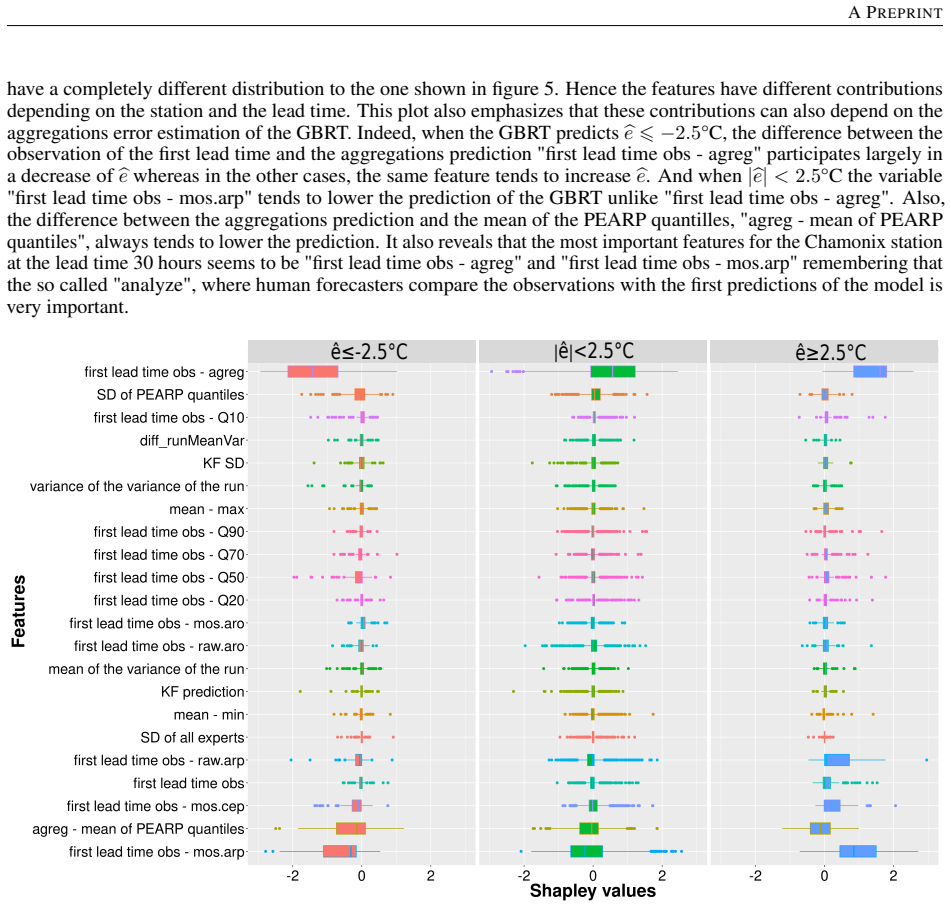
Summary. The paper proposes combining the Sleeping Expert Framework (SEF) with the second-order expert aggregation BOA, using gradient boosted regression trees (GBRT) to decide when to wake specialized quantile experts (Q10, Q30, Q70, Q90) in order to reduce large temperature forecast errors while preserving average performance. The authors give a regret bound for BOA in the SEF with unknown activation sets, and present experiments over 33 stations and 18 lead times, reporting that BOAs maintains the RMSE of BOA (1.24°C) while lowering the pooled 95th percentile of absolute error from 2.53°C to 2.52°C, and that a meta-aggregation FTL-BOA further improves Q95|e| to 2.51°C. A case study in Chamonix (lead time 48h) shows a larger improvement during a cold-spell event (RMSE 1.54 vs 1.68°C, Q95 3.06 vs 3.53°C).
Significance. If the central empirical claims were statistically robust, the paper would offer a practical mechanism for making expert aggregation more reactive to extreme events without sacrificing average skill, which is a genuinely useful goal in temperature forecasting. The paper is careful to describe an entirely online procedure for the GBRT once hyperparameters are fixed, and it makes code and data available on GitHub, which are strengths. The theoretical part adapts existing second-order bounds to the SEF, but the stated bound is conditional on the activation set containing the best expert and is expressed in terms of the GBRT's confusion counts, so it is not a standard sublinear regret guarantee. The empirical evidence for the flagship improvement is thin: the pooled Q95 gain is 0.01°C, the GBRT's skill is weak (ESS 0.11, hit rates 0.15 and 0.12 for large positive and negative errors), and no confidence intervals or permutation controls are given. The significance is therefore currently more methodological and potential than demonstrated.
major comments (5)
- [§3 (Explaining the predictions of the GBRTs); Figures 8 and 10] The central empirical claim, that BOAs reduces the pooled Q95|e| from 2.53°C to 2.52°C while keeping RMSE at 1.24°C, rests on a 0.01°C difference over roughly 740,000 pooled predictions, with no confidence intervals, significance test, or adjustment for the 594 station–lead-time pairs shown in Figures 8 and 10. The paper's own diagnostics—ESS 0.11, hit rates of 0.15 for ê ≥ 2.5°C and 0.12 for ê ≤ −2.5°C—indicate that the GBRT misses most of the large-error events it is designed to detect, so the observed global Q95 gain is well within what a random or fixed-rate awakening schedule with the same base rate could produce. The authors should report bootstrap confidence intervals for the Q95 differences and run a permutation test comparing the GBRT-based awakening rule against a randomized awakening schedule to show that the learned trigger contributes beyond chance.
- [§3 (GBRT hyperparameters); Figure 2] The GBRT hyperparameters are tuned on training data from 2023-09-04 to 2025-02-03, which is strictly after the test period (2020-03-30 to 2023-09-03) on which all reported scores are computed. This lookahead contradicts the paper's claim that the procedure is 'fully online' and could bias the comparison in favor of BOAs, because the hyperparameter choice is optimized using future information relative to the test period. The authors should either re-run the experiments with a chronological split (tuning on a period before the test set) or demonstrate insensitivity of the qualitative results to the hyperparameter grid, for example by reporting the Q95 and RMSE for several near-optimal hyperparameter configurations.
- [§2, Eqs. (8), (11)–(18)] The regret bound is stated conditionally on the assumption that the activation set E_t contains the best expert i_t for every t, which is exactly the property that the GBRT is supposed to learn and is not verified in the experiments. The bound in Eq. (16) is expressed in terms of the confusion counts n^T_{b_k,k} of the GBRT, so it is an oracle bound that scales with how often the wake-up rule makes mistakes; when the GBRT is unskilled (as the reported ESS suggests), the bound is not a useful sublinear regret guarantee. The derivation should be made fully rigorous with proofs or precise references for each inequality, especially the step from Eq. (13) to Eq. (14), and the price paid for the unknown activation times should be stated explicitly rather than hidden by the assumption that the activation set contains the best expert.
- [§3 (A special case study); Figure 8] The Chamonix improvement (RMSE 1.54 vs 1.68°C, Q95 3.06 vs 3.53°C for lead time 48h) is presented as a highlight, but this station–lead-time pair is selected from the 594 pairs displayed in Figure 8, and no multiple-comparison correction or out-of-sample replication is provided. Without such a control, the case study is anecdotal; the authors should report the full distribution of per-pair Q95 improvements, state how many pairs show a statistically significant improvement after correction, and ideally validate the Chamonix finding on a hold-out period not used in any part of the analysis.
- [§3 (FTL-BOA); Algorithm 2] The regularized FTL-BOA uses a regularization constant of 0.0025 in the comparison of cumulative losses, but the paper does not state how this value was chosen, whether it was tuned on the training period, or how sensitive the conclusions are to it. Additionally, the reported overall gains of FTL-BOA (Q95 2.51°C, RMSE 1.23°C) again lack uncertainty quantification; given the weak GBRT signal, the difference from BOA's 2.53/1.24 could easily be sampling noise. A sensitivity analysis for the regularization parameter and a significance test for the Q95 difference would be needed to support the claim that the meta-aggregation 'almost completely avoids noise.'
minor comments (6)
- [Figure 8 and surrounding text] There are several cross-reference mismatches in the text and captions (e.g., references to 'Fig. 9' and 'Fig. 10' that do not match the actual figure numbering); please proofread all figure references.
- [Algorithm 2] The timing in Algorithm 2 is inconsistent: step 5 says the true outcome y_t is observed before step 6 chooses between BOA and BOAs, while step 7 then says the environment reveals y_t again; clarify the ordering of steps.
- [Eq. (6) and notation] The regret definitions use both L^s_t and L^s_T interchangeably in places; please make the time index consistent throughout Section 2.
- [Introduction and references] The paper refers to 'Part I' without giving a citation or arXiv identifier for it; add a reference so the reader can locate the companion paper.
- [Appendix: List of variables] The variable list contains duplicate entries ('Standard deviation of all experts' appears twice); remove the redundancy.
- [Throughout] There are occasional typos and punctuation errors (e.g., inconsistent spacing around mathematical expressions and an apparent missing word in the discussion of the abstention trick); a careful copyedit is recommended.
Circularity Check
No circularity: the sleeping-expert regret bound is stated conditionally and the empirical GBRT/SEF evaluation is fully online with no lookahead.
full rationale
The derivation chain is not circular. The SEF regret bound (Eq. 8) is imported from Adamskiy et al. (2012), Gaillard et al. (2014), and Wintenberger (2024, Thm 3.3); although Wintenberger is an author, the cited theorem is a published mathematical result with stated assumptions (convex loss, gradient trick) and does not assume the empirical Q95 improvement, so it is independent support rather than a forced conclusion. The bound's application explicitly assumes the activation set contains the best expert ('From now on the activation set Et is assumed to contain the best expert it, t≥1'), making the guarantee conditional rather than self-fulfilling. The GBRT wake-up rule is trained online on past test data only ('we used only the past test data available for the couple (station, lead time)'), hyperparameters are tuned on a separate training period, and the comparison of BOAs vs BOA is a direct out-of-sample evaluation without lookahead. The paper's own diagnostics (ESS = 0.11, hit rates 0.15 and 0.12) indicate the GBRT signal is weak, but weakness is a performance/correctness concern, not circularity. The Chamonix case is a selected station/lead-time example without multiple-comparison control, again a statistical-strength issue, not a definitional reduction. No equation equates the claimed prediction to a fitted input, and no load-bearing premise reduces to a self-citation.
Assumptions & free parameters
free parameters (5)
- Large-error threshold =
plus or minus 2.5 degrees Celsius
- Warm-up size =
100 iterations
- Oversampling factor =
5
- FTL regularization constant =
0.0025
- GBRT hyperparameters =
Selected by cross-validation on training data, ESS 0.08
assumptions (5)
- standard math The regret bound for BOA in the SEF follows from the generic reduction of Adamskiy et al. (2012) and Gaillard et al. (2014); the paper does not prove it here.
- ad hoc to paper The activation set E_t contains the best expert i_t for every t.
- standard math Sleeping experts incur the aggregation's own loss at iterations where they are asleep (abstention trick).
- standard math The quadratic loss function is convex in its first argument.
- domain assumption The GBRT features contain predictive signal for large aggregation errors.
Cite this review
Pith. "Pith review of Contribution of expert aggregation to temperature prediction part II: Second order bounds with sleeping experts." pith.science (2026). https://pith.science/paper/EZNFZZYM
@misc{pith2026250615216,
  author       = {Pith},
  title        = {Pith review of: Contribution of expert aggregation to temperature prediction part II: Second order bounds with sleeping experts},
  year         = {2026},
  howpublished = {\url{https://pith.science/paper/EZNFZZYM}},
  note         = {Machine review of arXiv:2506.15216}
}
read the original abstract
In this paper we improve on the temperature predictions made with (online) Expert Aggregation (EA) [Cesa-Bianchi and Lugosi, 2006] in Part I. In particular, we make the aggregation more reactive, whilst maintaining at least the same root mean squared error and reducing the number of large errors. We have achieved this by using the Sleeping Expert Framework (SEF) [Freund et al., 1997, Devaine et al., 2013], which allows the more efficient use of biased experts (bad on average but which may be good at some point). To deal with the fact that, unlike in Devaine et al. [2013], we do not know in advance when to use these biased experts, we resorted to gradient boosted regression trees [Chen and Guestrin, 2016] and provide regret bounds against sequences of experts [Mourtada and Maillard, 2017] which take into account this uncertainty. We applied this in a fully online way on BOA [Wintenberger, 2024], an adaptive aggregation with second order regret bounds, which had the best results in Part I. Finally, we made a meta-aggregation with the EA follow the leader. This chooses whether or not to use the SEF in order to limit the possible noise added by the SEF.
Figures


Figures from the paper (8 more)




Reference graph
Works this paper leans on
-
[1]
Prediction, Learning , and Games
Nicolo Cesa-Bianchi and Gabor Lugosi. Prediction, Learning , and Games . Cambridge University Press, March 2006. ISBN 978-1-139-45482-7. Google-Books-ID: zDnRBlazhfYC
work page 2006
-
[2]
Schapire, Yoram Singer, and Manfred K
Yoav Freund, Robert E. Schapire, Yoram Singer, and Manfred K. Warmuth. Using and combining predictors that specialize. In Proceedings of the twenty-ninth annual ACM symposium on Theory of computing , STOC '97, pages 334--343, New York, NY, USA, May 1997. Association for Computing Machinery. ISBN 978-0-89791-888-6. doi:10.1145/258533.258616. URL https://do...
arXiv 1997
-
[3]
Forecasting electricity consumption by aggregating specialized experts
Marie Devaine, Pierre Gaillard, Yannig Goude, and Gilles Stoltz. Forecasting electricity consumption by aggregating specialized experts. Machine Learning, 90 0 (2): 0 231--260, February 2013. ISSN 1573-0565. doi:10.1007/s10994-012-5314-7. URL https://doi.org/10.1007/s10994-012-5314-7
-
[4]
XGBoost : A Scalable Tree Boosting System
Tianqi Chen and Carlos Guestrin. XGBoost : A Scalable Tree Boosting System . In Proceedings of the 22nd ACM SIGKDD International Conference on Knowledge Discovery and Data Mining , KDD '16, pages 785--794, New York, NY, USA, August 2016. Association for Computing Machinery. ISBN 978-1-4503-4232-2. doi:10.1145/2939672.2939785. URL https://doi.org/10.1145/2...
arXiv 2016
-
[5]
Efficient tracking of a growing number of experts
Jaouad Mourtada and Odalric-Ambrym Maillard. Efficient tracking of a growing number of experts. arXiv:1708.09811 [cs, stat], August 2017. URL http://arxiv.org/abs/1708.09811. arXiv: 1708.09811
work page Pith review arXiv 2017
-
[6]
Stochastic online convex optimization
Olivier Wintenberger. Stochastic online convex optimization. Application to probabilistic time series forecasting. Electronic Journal of Statistics, 18 0 (1): 0 429--464, January 2024. ISSN 1935-7524, 1935-7524. doi:10.1214/23-EJS2208. URL https://projecteuclid.org/journals/electronic-journal-of-statistics/volume-18/issue-1/Stochastic-online-convex-optimi...
-
[7]
Maxime Taillardat and Olivier Mestre. From research to applications – examples of operational ensemble post-processing in France using machine learning. Nonlinear Processes in Geophysics, 27 0 (2): 0 329--347, May 2020. ISSN 1023-5809. doi:10.5194/npg-27-329-2020. URL https://npg.copernicus.org/articles/27/329/2020/. Publisher: Copernicus GmbH
-
[8]
Adaptive Algorithms for Online Decision Problems
Elad Hazan and Comandur Seshadhri. Adaptive Algorithms for Online Decision Problems . 2007
work page 2007
Show all 40 references
-
[9]
Improved Strongly Adaptive Online Learning using Coin Betting
Kwang-Sung Jun, Francesco Orabona, Stephen Wright, and Rebecca Willett. Improved Strongly Adaptive Online Learning using Coin Betting . In Proceedings of the 20th International Conference on Artificial Intelligence and Statistics , pages 943--951. PMLR, April 2017. URL https:/...
2017
-
[10]
Mark Herbster and Manfred K. Warmuth. Tracking the Best Expert . Machine Learning, 32 0 (2): 0 151--178, August 1998. ISSN 1573-0565. doi:10.1023/A:1007424614876. URL https://doi.org/10.1023/A:1007424614876
1998 doi
-
[11]
Empirical Support for Winnow and Weighted - Majority Algorithms : Results on a Calendar Scheduling Domain
Avrim Blum. Empirical Support for Winnow and Weighted - Majority Algorithms : Results on a Calendar Scheduling Domain . Machine Learning, 26 0 (1): 0 5--23, January 1997. ISSN 1573-0565. doi:10.1023/A:1007335615132. URL https://doi.org/10.1023/A:1007335615132
1997 doi
-
[12]
Prediction with Expert Evaluators ’ Advice
Alexey Chernov and Vladimir Vovk. Prediction with Expert Evaluators ’ Advice . In Ricard Gavaldà, Gábor Lugosi, Thomas Zeugmann, and Sandra Zilles, editors, Algorithmic Learning Theory , Lecture Notes in Computer Science , pages 8--22, Berlin, Heidelberg, 2009. Springer. ISBN ...
2009 doi
-
[13]
From External to Internal Regret
Avrim Blum and Yishay Mansour. From External to Internal Regret . Journal of Machine Learning Research, 8 0 (47): 0 1307--1324, 2007. ISSN 1533-7928. URL http://jmlr.org/papers/v8/blum07a.html
2007
-
[14]
A Second -order Bound with Excess Losses
Pierre Gaillard, Gilles Stoltz, and Tim van Erven. A Second -order Bound with Excess Losses . Conference on Learning Theory. PMLR., page 21, 2014
2014
-
[15]
Koolen, Alexey Chernov, and Vladimir Vovk
Dmitry Adamskiy, Wouter M. Koolen, Alexey Chernov, and Vladimir Vovk. A Closer Look at Adaptive Regret . In Nader H. Bshouty, Gilles Stoltz, Nicolas Vayatis, and Thomas Zeugmann, editors, Algorithmic Learning Theory , Lecture Notes in Computer Science , pages 290--304, Berlin,...
2012 doi
-
[16]
Factors Affecting the Weakening Rate of Tropical Cyclones over the Western North Pacific
Rong Fei, Jing Xu, Yuqing Wang, and Chi Yang. Factors Affecting the Weakening Rate of Tropical Cyclones over the Western North Pacific . Monthly Weather Review, 148 0 (9): 0 3693--3712, September 2020. ISSN 1520-0493, 0027-0644. doi:10.1175/MWR-D-19-0356.1. URL https://journal...
2020 doi
-
[17]
Toward Predicting Flood Event Peak Discharge in Ungauged Basins by Learning Universal Hydrological Behaviors with Machine Learning
Akhil Sanjay Potdar, Pierre-Emmanuel Kirstetter, Devon Woods, and Manabendra Saharia. Toward Predicting Flood Event Peak Discharge in Ungauged Basins by Learning Universal Hydrological Behaviors with Machine Learning . Journal of Hydrometeorology, 22 0 (11): 0 2971--2982, Nove...
2021 doi
-
[18]
Evaluating Foehn Occurrence in a Changing Climate Based on Reanalysis and Climate Model Data Using Machine Learning
Christoph Mony, Lukas Jansing, and Michael Sprenger. Evaluating Foehn Occurrence in a Changing Climate Based on Reanalysis and Climate Model Data Using Machine Learning . Weather and Forecasting, 36 0 (6): 0 2039--2055, December 2021. ISSN 1520-0434, 0882-8156. doi:10.1175/WAF...
2021 doi
-
[19]
Flora, Corey K
Montgomery L. Flora, Corey K. Potvin, Patrick S. Skinner, Shawn Handler, and Amy McGovern. Using Machine Learning to Generate Storm - Scale Probabilistic Guidance of Severe Weather Hazards in the Warn -on- Forecast System . Monthly Weather Review, 149 0 (5): 0 1535--1557, May ...
2021 doi
-
[20]
Silva, Christoph A
Sam J. Silva, Christoph A. Keller, and Joseph Hardin. Using an Explainable Machine Learning Approach to Characterize Earth System Model Errors : Application of SHAP Analysis to Modeling Lightning Flash Occurrence . Journal of Advances in Modeling Earth Systems, 14 0 (4): 0 e20...
2022 doi
-
[21]
Correction of Overestimation in Observed Land Surface Temperatures Based on Machine Learning Models
Fa Liu, Xunming Wang, Fubao Sun, Hong Wang, Lifeng Wu, Xuanze Zhang, Wenbin Liu, and Huizheng Che. Correction of Overestimation in Observed Land Surface Temperatures Based on Machine Learning Models . Journal of Climate, 35 0 (16): 0 5359--5377, August 2022. ISSN 0894-8755, 15...
2022 doi
-
[22]
Aliva Nanda, Sumit Sen, Awshesh Nath Sharma, and K. P. Sudheer. Soil Temperature Dynamics at Hillslope Scale — Field Observation and Machine Learning - Based Approach . Water, 12 0 (3): 0 713, March 2020. ISSN 2073-4441. doi:10.3390/w12030713. URL https://www.mdpi.com/2073-444...
2020 doi
-
[23]
Prediction of outdoor air temperature and humidity using Xgboost
Xiaoming Ma, Cong Fang, and Junping Ji. Prediction of outdoor air temperature and humidity using Xgboost . IOP Conference Series: Earth and Environmental Science, 427 0 (1): 0 012013, January 2020. ISSN 1755-1315. doi:10.1088/1755-1315/427/1/012013. URL https://dx.doi.org/10.1...
2020 doi
-
[24]
Opera: Online Prediction by Expert Aggregation , 2016
Pierre Gaillard and Yannig Goude. Opera: Online Prediction by Expert Aggregation , 2016. URL http://pierre.gaillard.me/opera.html
2016
-
[25]
Joseph P. Gerrity. A Note on Gandin and Murphy 's Equitable Skill Score . Monthly Weather Review, 120 0 (11): 0 2709--2712, November 1992. ISSN 1520-0493, 0027-0644. doi:10.1175/1520-0493(1992)120<2709:ANOGAM>2.0.CO;2. URL https://journals.ametsoc.org/view/journals/mwre/120/11...
1992 doi
-
[26]
Manual on the Global Data - Processing and Forecasting System
WMO. Manual on the Global Data - Processing and Forecasting System . World Meteorological Organization, 0 (485), 2010
2010
-
[27]
Nadia Burkart and Marco F. Huber. A Survey on the Explainability of Supervised Machine Learning . Journal of Artificial Intelligence Research, 70: 0 245--317, January 2021. ISSN 1076-9757. doi:10.1613/jair.1.12228. URL https://www.jair.org/index.php/jair/article/view/12228
2021 doi
-
[28]
A value for n-person games
Lloyd S Shapley. A value for n-person games. Contribution to the Theory of Games, 2, 1953
1953
-
[29]
A Deep Learning Model for Estimating Tropical Cyclone Wind Radius from Geostationary Satellite Infrared Imagery
Chong Wang and Xiaofeng Li. A Deep Learning Model for Estimating Tropical Cyclone Wind Radius from Geostationary Satellite Infrared Imagery . Monthly Weather Review, 151 0 (2): 0 403--417, January 2023. ISSN 1520-0493, 0027-0644. doi:10.1175/MWR-D-22-0166.1. URL https://journa...
2023 doi
-
[30]
Lundberg and Su-In Lee
Scott M. Lundberg and Su-In Lee. Consistent feature attribution for tree ensembles, February 2018. URL http://arxiv.org/abs/1706.06060. arXiv:1706.06060 [cs, stat]
2018 arXiv
-
[31]
Follow the Leader If You Can , Hedge If You Must
Steven de Rooij, Tim van Erven, Peter D Grünwald, and Wouter M Koolen. Follow the Leader If You Can , Hedge If You Must . page 36, 2014
2014
-
[32]
A Modern Introduction to Online Learning , May 2023
Francesco Orabona. A Modern Introduction to Online Learning , May 2023. URL http://arxiv.org/abs/1912.13213. arXiv:1912.13213 [cs, math, stat]
2023 arXiv
-
[33]
Mondrian Forests : Efficient Online Random Forests
Balaji Lakshminarayanan, Daniel M Roy, and Yee Whye Teh. Mondrian Forests : Efficient Online Random Forests . In Advances in Neural Information Processing Systems , volume 27. Curran Associates, Inc., 2014. URL https://proceedings.neurips.cc/paper/2014/hash/d1dc3a8270a6f9394f8...
2014
-
[34]
AMF : Aggregated Mondrian Forests for Online Learning
Jaouad Mourtada, Stéphane Gaïffas, and Erwan Scornet. AMF : Aggregated Mondrian Forests for Online Learning . Journal of the Royal Statistical Society Series B: Statistical Methodology, 83 0 (3): 0 505--533, July 2021. ISSN 1369-7412. doi:10.1111/rssb.12425. URL https://doi.or...
2021 doi
-
[35]
Pangu- Weather : A 3D High - Resolution Model for Fast and Accurate Global Weather Forecast , November 2022
Kaifeng Bi, Lingxi Xie, Hengheng Zhang, Xin Chen, Xiaotao Gu, and Qi Tian. Pangu- Weather : A 3D High - Resolution Model for Fast and Accurate Global Weather Forecast , November 2022. URL http://arxiv.org/abs/2211.02556. arXiv:2211.02556 [physics]
2022 arXiv
-
[36]
Gupta, and Aditya Grover
Tung Nguyen, Johannes Brandstetter, Ashish Kapoor, Jayesh K. Gupta, and Aditya Grover. ClimaX : A foundation model for weather and climate, February 2023. URL http://arxiv.org/abs/2301.10343. arXiv:2301.10343 [cs]
2023 arXiv
-
[37]
Simon Lang, Mihai Alexe, Matthew Chantry, Jesper Dramsch, Florian Pinault, Baudouin Raoult, Mariana C. A. Clare, Christian Lessig, Michael Maier-Gerber, Linus Magnusson, Zied Ben Bouallègue, Ana Prieto Nemesio, Peter D. Dueben, Andrew Brown, Florian Pappenberger, and Florence ...
2024 arXiv
-
[38]
Fortin, M
V. Fortin, M. Abaza, F. Anctil, and R. Turcotte. Why Should Ensemble Spread Match the RMSE of the Ensemble Mean ? Journal of Hydrometeorology, 15 0 (4): 0 1708--1713, August 2014. ISSN 1525-7541, 1525-755X. doi:10.1175/JHM-D-14-0008.1. URL https://journals.ametsoc.org/view/jou...
2014 doi
-
[39]
Viking: Variational Bayesian Variance Tracking , November 2021
Joseph de Vilmarest and Olivier Wintenberger. Viking: Variational Bayesian Variance Tracking , November 2021. URL http://arxiv.org/abs/2104.10777. arXiv:2104.10777 [cs]
2021 arXiv
-
[40]
State- Space Models for Online Post - Covid Electricity Load Forecasting Competition
Joseph De Vilmarest and Yannig Goude. State- Space Models for Online Post - Covid Electricity Load Forecasting Competition . IEEE Open Access Journal of Power and Energy, 9: 0 192--201, 2022. ISSN 2687-7910. doi:10.1109/OAJPE.2022.3141883. URL https://ieeexplore.ieee.org/abstr...
2022
Reviewed August 15, 2026 · model on record in the stance chip above.
Discussion (0). Continue with ORCID to comment.