REVIEW 4 major objections 5 minor 67 references
First interferometric survey resolves six wide hot-subdwarf binaries, setting the scale for 3D orbits and model-independent masses.
Reviewed by Pith at T0; open to challenge. T0 means a machine referee read the full paper against a public rubric. the ladder, T0–T4 →
T0 review · deepseek-v4-flash
2026-08-01 01:35 UTC pith:EZSPFMTZ
load-bearing objection First interferometric sample of wide sdO/B binaries; six resolved with GRAVITY, with solid detections but statistical-only error bars that look optimistic for at least two targets. the 4 major comments →
Toward 3D orbits of wide sdO/B binaries I. Six composite systems spatially resolved with VLTI/GRAVITY
The pith
A machine-rendered reading of the paper's core claim, the machinery that carries it, and where it could break.
Core claim
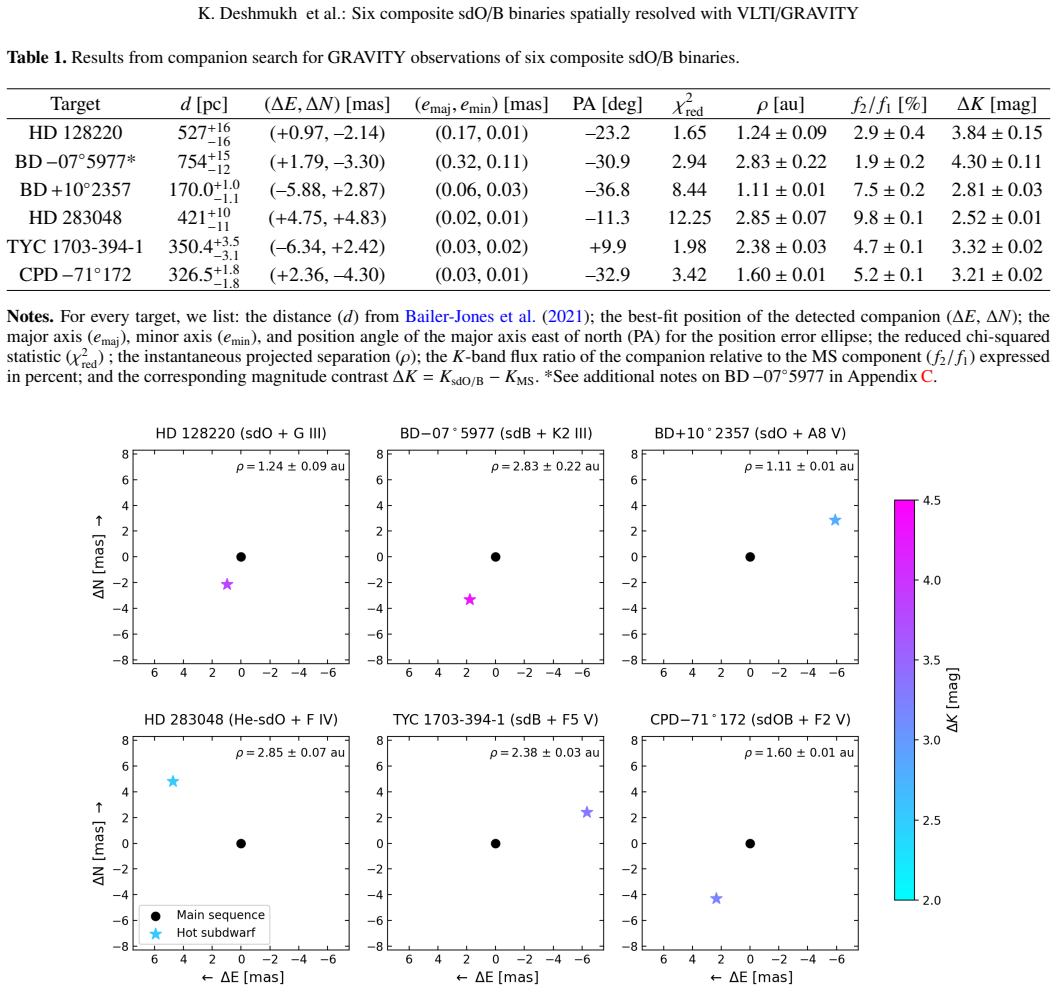
All six targeted composite sdO/B+MS binaries are spatially resolved with GRAVITY, yielding precise relative astrometry (angular separations of about 1–7 mas) and K-band flux ratios. Projected physical separations are 1.11–2.85 au with uncertainties between 1% and 8%. Two systems with known spectroscopic orbits (HD 128220 and BD−07 5977) now have a direct geometric scale; the other four await spectroscopic orbits. This is the first demonstration that long-baseline interferometry can resolve wide sdO/B binaries, providing the missing observable for full orbital and mass determination.
What carries the argument
The central mechanism is long-baseline interferometry with VLTI/GRAVITY: visibility amplitudes and closure phases are fit with a two-component model (both stars as 0.2-mas uniform disks, the main-sequence star fixed at the origin) using a grid search over the sky plane. The fit yields the sdO/B companion's relative position, flux ratio, and error ellipse. The key enabling assumption is that flat-spectrum unresolved disk models are adequate for these few-hundred-parsec targets.
Load-bearing premise
The relative astrometry and its 1–8% uncertainties assume that the simple two-component model (flat-spectrum 0.2-mas uniform disks, MS at origin) is unaffected by calibration systematics visible in the data, such as |V|>1 on some baselines and reduced chi-squared values up to 12.
What would settle it
Re-observing any of these six targets at a later epoch and testing whether the position changes consistently with the known or future orbit; or a single GRAVITY observation with a different array configuration that produces residuals well above the assumed noise would falsify the claimed precision.
If this is right
- If these detections hold, the measured separations set the physical scale for the two systems with known orbits, directly converting angular separation to au and enabling combined fits with RV data.
- For the four systems without orbits, these positions provide the first epoch of relative astrometry; one or two more epochs will permit preliminary 3D orbit constraints.
- The flux ratios and inferred K-band magnitudes offer a model-independent cross-check on SED-based component parameters, which currently carry systematic uncertainties.
- The candidate tertiary in BD+10 2357, if confirmed, would make it a triple system and affect interpretation of its binary parameters and formation history.
Where Pith is reading between the lines
- The demonstrated ability to resolve systems at 1–3 au with ~1–5% precision suggests that a larger interferometric sample could map the period–eccentricity–mass-ratio correlations of stable mass transfer more directly than spectroscopy alone.
- If Gaia DR4 provides photocenter orbits for many such binaries, the combination with single-epoch interferometric positions may yield 3D orbits without waiting for multi-epoch interferometry, as long as the flux-ratio ambiguity is broken.
- The marginal BD−07 5977 detection and the high chi-squared values in two other targets indicate that the true systematic floor of this method may be larger than the quoted statistical errors; this can be tested by re-observing the same targets at a different epoch and comparing residuals.
Editorial analysis
A structured set of objections, weighed in public.
Referee Report
Summary. The Letter reports VLTI/GRAVITY K-band observations of six composite sdO/B + MS binaries. Using the CANDID algorithm in PMOIRED, the authors fit two-component models (MS component fixed at the origin, sdO/B as the faint companion) to visibility amplitudes and closure phases. They report that all six binaries are spatially resolved, with projected physical separations of 1.11–2.85 au, K-band flux ratios of 1.9–9.8%, and a tentative tertiary candidate in BD+10 2357. They compare the GRAVITY-derived K-band magnitudes with independent SED fits and discuss how the measured relative positions, combined with Gaia DR4 astrometry and radial-velocity monitoring, can lead to 3D orbits and model-independent masses.
Significance. If the measurements are reliable, this is the first interferometrically resolved sample of wide hot-subdwarf binaries and provides the geometric scale needed to convert spectroscopic orbits into masses. The paper is a measurement paper, and the analysis is transparent: a well-defined grid search, individual target notes, SED cross-checks, and an appropriately cautious treatment of the BD+10 2357 tertiary candidate. The detection claim itself is credible because it is based on visibility amplitudes and closure phases, and the SED comparison provides an independent consistency check. The main weakness is that the headline precision claim ('uncertainties between 1–8%') rests on statistical-only error bars in the presence of calibration artifacts, and one target's position relies on an external orbital prior to break a degeneracy.
major comments (4)
- [§3, Table 1; Appendix C and E] The central precision claim, 'uncertainties between 1–8%', rests on error ellipses that Appendix E explicitly labels 'statistical only'. Two targets have poor reduced chi-squared values: χ²_red = 8.44 for BD+10 2357 and 12.25 for HD 283048, attributed in Appendix C to |V|>1 calibration artifacts. If the 1σ uncertainties are naively rescaled by √χ²_red, HD 128220's 7.3% and HD 283048's 2.5% separation errors become ~9.4% and ~8.8%, outside the abstract's range. More importantly, correlated calibration errors could shift the best-fit positions beyond the quoted ellipses. The detection claim may survive because closure phases are less affected, but the 1–8% precision claim is not yet supported. Please (a) add a systematic error budget or quote rescaled uncertainties; (b) perform a restricted-wavelength fit for HD 283048, analogous to the 2.1–2.35 µm sanity check reported for BD+10 2357; and
- [§3 (flat-spectrum model)] Both components are modeled as flat-spectrum sources with a single K-band flux ratio. For a hot subdwarf plus an A/F/K main-sequence companion, the flux ratio f2/f1 is wavelength-dependent across 1.97–2.45 µm; a variation of several tens of percent is plausible for typical temperatures. Since closure phases and visibilities are fitted as functions of wavelength, ignoring this spectral slope could bias the relative position and flux ratio at the claimed precision. Please test a wavelength-dependent flux-ratio model using the SED-derived slopes, or provide a quantitative justification for the flat-spectrum assumption, and show whether the recovered positions shift by more than the quoted error ellipses.
- [Appendix C (BD−07 5977)] The reported position for BD−07 5977 is one of two near-identical-fit minima; the other corresponds to ρ≈6.1 au and is discarded because it exceeds the literature a(1+e)≈3.1 au. The authors do not report the Δχ² between the two solutions or the actual detection significance; the text calls the detection 'marginal but significant' without a number. Because the selection uses the literature orbit as an external prior, the position is not uniquely determined by the GRAVITY data alone. Please provide a 2D χ² map or the Δχ² between the minima, state the detection significance quantitatively, and clarify how the result depends on the validity of the literature orbit.
- [§3 (8σ detection criterion)] The '8σ detection level' is introduced but never defined in terms of the fitted statistic. Is σ a Δχ² relative to the single-star model, a significance in the companion flux, or a S/N of the position peak? Without this definition and per-target Δχ² values between the single-star and binary models, the uniform 8σ threshold cannot be verified, and statements such as 'marginal but significant' for BD−07 5977 and TYC 1703-394-1 are not assessable. Please report the detection statistic for each target.
minor comments (5)
- [Abstract and Table 1] The abstract states 'uncertainties between 1–8%', but Table 1 contains entries with 0.6% (CPD−71 172) and 0.9% (BD+10 2357) relative separation errors. Please adjust the range to '0.6–8%' or 'up to 8%'.
- [Table 1] The distances listed are asymmetric (e.g., 527 +16/−16 pc), yet the projected physical separation uncertainties are quoted as symmetric. Please describe how the asymmetric distance posteriors were propagated, e.g., via a Monte Carlo draw over the Bailer-Jones distance distribution, or state the separate astrometric and distance contributions.
- [Appendix D] For the BD+10 2357 three-component fit, please state explicitly whether the binary parameters (position and flux ratio) were allowed to vary jointly with the third component or were fixed to the two-component solution. This affects the interpretation of the candidate tertiary and its possible influence on the reported binary astrometry.
- [Figures C.1–C.6] The data-model comparison panels are dense and the small fonts make them hard to read, especially the visibility-amplitude sub-panels. Consider enlarging the figures or splitting them into separate panels.
- [Table E.1] The SED vs. GRAVITY sdO/B K-band magnitudes differ by up to ~0.5 mag (e.g., TYC 1703-394-1: 14.6 vs 15.1; CPD−71 172: 14.4 vs 15.1). The text calls these 'broadly consistent'; please specify the comparison metric or add a brief discussion of the expected SED-model uncertainty for the sdO/B component.
Circularity Check
No circularity: the paper is a direct interferometric measurement study with external priors used only for disambiguation and cross-checks.
full rationale
The paper's central claim is that six wide sdO/B+MS binaries are spatially resolved with VLTI/GRAVITY, with projected separations of 1–3 au and 1–8% statistical uncertainties. This is a measurement result, not a derivation from a model whose outputs equal its inputs. Companion positions and flux ratios are obtained by fitting a two-component uniform-disk model directly to GRAVITY visibility amplitudes and closure phases (Section 3); distances from Bailer-Jones et al. (2021) and literature orbital elements for HD 128220 and BD−07 5977 enter as external inputs, not as quantities fitted to the interferometric data. The BD−07 5977 degeneracy is handled by selecting the solution consistent with the literature orbit's a(1+e) limit; this is a physically motivated prior used to choose between two equally good fits, not a prediction manufactured from the fit. The SED analysis in Appendix E is explicitly an independent comparison and shows differences from the GRAVITY flux ratios, strengthening the non-circular character. The high reduced chi-squared values and 'statistical only' error ellipses noted in Appendix C and E are real limitations concerning uncertainty calibration, but they are not circularity: they concern accuracy of the quoted errors, not a reduction of the claimed result to its inputs. Self-citations such as Deshmukh et al. (2024) support an adopted modeling assumption but are not load-bearing for the detection or separation claims. No equation in the paper reduces to itself by construction, and no fitted parameter is renamed as a prediction. The paper is self-contained as an observational campaign and its central result is not circular.
Axiom & Free-Parameter Ledger
free parameters (3)
- Companion sky offset (ΔE, ΔN) per target =
Table 1: e.g. HD 128220 (+0.97, -2.14) mas
- K-band flux ratio f2/f1 per target =
Table 1: 1.9-9.8%
- Uniform disk angular diameter of both components =
0.2 mas
axioms (5)
- domain assumption Both binary components are unresolved and can be treated as flat-spectrum uniform disks of 0.2 mas
- domain assumption The binary configuration is constant during each observation run
- domain assumption Bailer-Jones et al. (2021) geometric distances with Gaussian errors correctly convert angular separations to au
- ad hoc to paper The 8σ detection threshold guarantees genuine companion detections
- domain assumption Literature orbits for HD 128220 and BD-07 5977 are reliable enough to break the BD-07 5977 position degeneracy
invented entities (1)
-
Potential tertiary companion in BD+10 2357
no independent evidence
read the original abstract
Hot subdwarf stars (sdO/Bs) are widely considered to be products of binary evolution. A significant fraction of them are found in long-period or wide binaries ($P>500$ d) with main sequence (MS) companions, likely resulting from a stable mass transfer episode where the MS companion stripped the hydrogen envelope of the sdO/B progenitor. Consequently, wide sdO/B binaries represent a key population in our pursuit of understanding stable mass transfer. They exhibit a modest range of orbital periods and eccentricities as revealed by long-term spectroscopic campaigns, though the component masses are not well constrained. In this Letter, we present the first long-baseline interferometry campaign to observe wide sdO/B + MS binaries and take the first step toward determining their 3-dimensional (3D) orbits and model-independent component masses. We target six composite sdO/B + MS systems with VLTI/GRAVITY and spatially resolve all of them. The projected physical separations range between $1-3$ au, with uncertainties between $1-8$%. When combined with complementary information from spectroscopic or astrometric observations, our precise measurements will be crucial to constrain 3D orbits for these systems. Additionally, we also identify a potential third component in BD+10 2357, although additional data will be necessary for confirmation. In light of continued spectroscopic monitoring and the imminent Gaia Data Release 4, we strongly encourage expanding the interferometric sample presented here to establish new, precise orbital and mass constraints for this key population of binary interaction products.
Figures
Reference graph
Works this paper leans on
-
[1]
1966, in Stellar Evolution, ed.\ R
Baker, N. 1966, in Stellar Evolution, ed.\ R. F. Stein,& A. G. W. Cameron (Plenum, New York) 333
1966
-
[2]
1988, A&A, 200, 58
Balluch, M. 1988, A&A, 200, 58
1988
-
[3]
Cox, J. P. 1980, Theory of Stellar Pulsation (Princeton University Press, Princeton) 165
1980
-
[4]
N.,& Stewart, J
Cox, A. N.,& Stewart, J. N. 1969, Academia Nauk, Scientific Information 15, 1
1969
-
[5]
1980, Prog
Mizuno H. 1980, Prog. Theor. Phys., 64, 544
1980
-
[6]
Tscharnuter W. M. 1987, A&A, 188, 55
1987
-
[7]
1992, in ASP Conf
Terlevich, R. 1992, in ASP Conf. Ser. 31, Relationships between Active Galactic Nuclei and Starburst Galaxies, ed. A. V. Filippenko, 13
1992
-
[8]
Yorke, H. W. 1980a, A&A, 86, 286
-
[9]
F., Tytler, D
Zheng, W., Davidsen, A. F., Tytler, D. & Kriss, G. A. 1997, preprint
1997
-
[10]
The origin of subdwarf B stars - I. The formation channels. , keywords =. doi:10.1046/j.1365-8711.2002.05752.x , archivePrefix =. astro-ph/0206130 , primaryClass =
arXiv 2002
-
[11]
The origin of subdwarf B stars - II. , keywords =. doi:10.1046/j.1365-8711.2003.06451.x , archivePrefix =. astro-ph/0301380 , primaryClass =
arXiv 2003
-
[12]
SkyMapper Southern Survey: Data release 4. , keywords =. doi:10.1017/pasa.2024.53 , archivePrefix =. 2402.02015 , primaryClass =
arXiv 2024
-
[13]
Photometric content and validation
Gaia Early Data Release 3. Photometric content and validation. , keywords =. doi:10.1051/0004-6361/202039587 , archivePrefix =. 2012.01916 , primaryClass =
Pith/arXiv arXiv 2012
-
[14]
VizieR Online Data Catalog: AAVSO Photometric All Sky Survey (APASS) DR9 (Henden+, 2016)
2016
-
[15]
AAS Meeting Abstracts , year = 2015, series =
APASS - The Latest Data Release. AAS Meeting Abstracts , year = 2015, series =
2015
-
[16]
VizieR Online Data Catalog: The DENIS database
-
[17]
, keywords =
The Tycho-2 catalogue of the 2.5 million brightest stars. , keywords =
-
[18]
The IUE INES System: Improved data extraction procedures for IUE. , keywords =. doi:10.1051/aas:1999388 , adsurl =
-
[19]
Pan-STARRS Photometric and Astrometric Calibration. , keywords =. doi:10.3847/1538-4365/abb82a , archivePrefix =. 1612.05242 , primaryClass =
-
[20]
Revised Catalog of GALEX Ultraviolet Sources. I. The All-Sky Survey: GUVcat\_AIS. , keywords =. doi:10.3847/1538-4365/aa7053 , archivePrefix =. 1704.05903 , primaryClass =
-
[21]
The unWISE Catalog: Two Billion Infrared Sources from Five Years of WISE Imaging. , keywords =. doi:10.3847/1538-4365/aafbea , archivePrefix =. 1901.03337 , primaryClass =
Pith/arXiv arXiv 1901
-
[22]
VizieR Online Data Catalog: The DENIS database. 2005
2005
-
[23]
The Two Micron All Sky Survey (2MASS). , keywords =. doi:10.1086/498708 , adsurl =
-
[24]
, year = 2009, month = sep, volume =
Hot Subdwarf Stars. , year = 2009, month = sep, volume =. doi:10.1146/annurev-astro-082708-101836 , adsurl =
-
[25]
Hot Subluminous Stars. , keywords =. doi:10.1088/1538-3873/128/966/082001 , archivePrefix =. 1604.07749 , primaryClass =
-
[26]
Alone but not lonely: Observational evidence that binary interaction is always required to form hot subdwarf stars. , keywords =. doi:10.1051/0004-6361/202038473 , archivePrefix =. 2008.07522 , primaryClass =
Pith/arXiv arXiv 2008
-
[27]
Orbital and atmospheric parameters
Wide B-type hot subdwarf binaries: I. Orbital and atmospheric parameters. , keywords =. doi:10.1051/0004-6361/202659320 , adsurl =
-
[28]
Explaining the orbital period-mass ratio relation in wide hot subdwarf binaries
Observed binary populations reflect the Galactic history. Explaining the orbital period-mass ratio relation in wide hot subdwarf binaries. , keywords =. doi:10.1051/0004-6361/201937195 , archivePrefix =. 2003.05665 , primaryClass =
Pith/arXiv arXiv 2003
-
[29]
The Spectroscopic Orbit and Evolution of HD 128220, A System Containing an O Subdwarf. , keywords =. doi:10.1086/132716 , adsurl =
-
[30]
The orbits of subdwarf B + main-sequence binaries. I. The sdB+G0 system PG 1104+243. , keywords =. doi:10.1051/0004-6361/201219723 , archivePrefix =. 1210.1969 , primaryClass =
Pith/arXiv arXiv 1969
-
[31]
The orbits of subdwarf-B + main-sequence binaries. II. Three eccentric systems; BD +29 3070, BD +34 1543 and Feige 87. , keywords =. doi:10.1051/0004-6361/201322200 , archivePrefix =. 1309.7143 , primaryClass =
-
[32]
PG 1018-047: the longest period subdwarf B binary. , keywords =. doi:10.1111/j.1365-2966.2012.20483.x , archivePrefix =. 1111.3576 , primaryClass =
arXiv 2012
-
[33]
The orbits of subdwarf-B + main-sequence binaries. III. The period-eccentricity distribution. , keywords =. doi:10.1051/0004-6361/201730958 , archivePrefix =. 1706.02286 , primaryClass =
-
[34]
Testing Models for Fully and Partially Stripped Low-mass Stars with Gaia: Implications for Hot Subdwarfs, Binary RR Lyrae, and Black Hole Impostors. , keywords =. doi:10.1088/1538-3873/ae5f48 , archivePrefix =. 2602.21289 , primaryClass =
-
[35]
First light for GRAVITY: Phase referencing optical interferometry for the Very Large Telescope Interferometer. , keywords =. doi:10.1051/0004-6361/201730838 , archivePrefix =. 1705.02345 , primaryClass =
-
[36]
Optical and Infrared Interferometry IV , year = 2014, editor =
GRAVITY data reduction software. Optical and Infrared Interferometry IV , year = 2014, editor =. doi:10.1117/12.2056850 , adsurl =
-
[37]
Adaptive data reduction workflows for astronomy: The ESO Data Processing System (EDPS). , keywords =. doi:10.1051/0004-6361/202347651 , archivePrefix =. 2311.03822 , primaryClass =
-
[38]
SearchCal: a Virtual Observatory tool for searching calibrators in optical long-baseline interferometry. II. The faint-object case. , keywords =. doi:10.1051/0004-6361/201015124 , adsurl =
-
[39]
The population of hot subdwarf stars studied with Gaia. IV. Catalogues of hot subluminous stars based on Gaia EDR3. , keywords =. doi:10.1051/0004-6361/202243337 , archivePrefix =. 2203.07938 , primaryClass =
-
[40]
The CANDID algorithm and an application to six binary Cepheids
Robust high-contrast companion detection from interferometric observations. The CANDID algorithm and an application to six binary Cepheids. , keywords =. doi:10.1051/0004-6361/201525917 , archivePrefix =. 1505.02715 , primaryClass =
-
[41]
Optical and Infrared Interferometry and Imaging VIII , year = 2022, editor =
Flexible spectro-interferometric modelling of OIFITS data with PMOIRED. Optical and Infrared Interferometry and Imaging VIII , year = 2022, editor =. doi:10.1117/12.2626700 , archivePrefix =. 2207.11047 , primaryClass =
Pith/arXiv arXiv 2022
-
[42]
The population of hot subdwarf stars studied with Gaia. II. The Gaia DR2 catalogue of hot subluminous stars. , keywords =. doi:10.1051/0004-6361/201834236 , archivePrefix =. 1810.09321 , primaryClass =
-
[43]
The CHARA Array Interferometric Program on the Multiplicity of Classical Be Stars: New Detections and Orbits of Stripped Subdwarf Companions. , keywords =. doi:10.3847/1538-4357/ad13ec , archivePrefix =. 2312.08252 , primaryClass =
-
[44]
VLTI/GRAVITY enables the determination of the first dynamical masses of a classical Be + stripped and bloated pre-subdwarf binary. , keywords =. doi:10.1051/0004-6361/202453248 , archivePrefix =. 2501.04103 , primaryClass =
-
[45]
Binary Stars Take What They Get: Evidence for Efficient Mass Transfer from Stripped Stars with Rapidly Rotating Companions. , keywords =. doi:10.3847/2041-8213/adfdd4 , archivePrefix =. 2505.14780 , primaryClass =
Pith/arXiv arXiv 2041
-
[46]
HR6819: a puffed-up stripped star system challenging stable mass transfer theory. , keywords =. doi:10.1051/0004-6361/202556556 , archivePrefix =. 2509.21521 , primaryClass =
-
[47]
A 500 pc volume-limited sample of hot subluminous stars. I. Space density, scale height, and population properties. , keywords =. doi:10.1051/0004-6361/202348319 , archivePrefix =. 2403.15513 , primaryClass =
-
[48]
Estimating Distances from Parallaxes. V. Geometric and Photogeometric Distances to 1.47 Billion Stars in Gaia Early Data Release 3. , keywords =. doi:10.3847/1538-3881/abd806 , archivePrefix =. 2012.05220 , primaryClass =
Pith/arXiv arXiv 2012
-
[49]
The orbital period-mass ratio relation of wide sdB+MS binaries and its application to the stability of RLOF. , keywords =. doi:10.1093/mnras/sty3017 , archivePrefix =. 1811.00285 , primaryClass =
-
[50]
The Messenger , keywords =
CPD -71 172, a new binary with a hot subdwarf. The Messenger , keywords =
-
[51]
Long period sdB + MS binaries with Mercator
Long Period sdB + MS Binaries with Mercator. 6th Meeting on Hot Subdwarf Stars and Related Objects , year = 2014, editor =. doi:10.48550/arXiv.1310.0189 , archivePrefix =. 1310.0189 , primaryClass =
work page internal anchor Pith review Pith/arXiv arXiv doi:10.48550/arxiv.1310.0189 2014
-
[52]
The population of hot subdwarf stars studied with Gaia. I. The catalog of known hot subdwarf stars. , keywords =. doi:10.1051/0004-6361/201630135 , archivePrefix =. 1612.02995 , primaryClass =
-
[53]
Discovery of new TESS pulsating hot subdwarfs. , keywords =. doi:10.1051/0004-6361/202142860 , archivePrefix =. 2204.01604 , primaryClass =
-
[54]
A hot subluminous star: HDE 283048. , keywords =. doi:10.1086/155765 , adsurl =
-
[55]
Summary of the content and survey properties
Gaia Data Release 3. Summary of the content and survey properties. , keywords =. doi:10.1051/0004-6361/202243940 , archivePrefix =. 2208.00211 , primaryClass =
-
[56]
Stellar multiplicity, a teaser for the hidden treasure
Gaia Data Release 3. Stellar multiplicity, a teaser for the hidden treasure. , keywords =. doi:10.1051/0004-6361/202243782 , archivePrefix =. 2206.05595 , primaryClass =
-
[57]
A quantitative in-depth analysis of the prototype sdB+BD system SDSS J08205+0008 revisited in the Gaia era. , keywords =. doi:10.1093/mnras/staa3661 , archivePrefix =. 2011.10013 , primaryClass =
Pith/arXiv arXiv 2011
-
[58]
A preliminary look at the empirical mass distribution of hot B subdwarf stars. , keywords =. doi:10.1051/0004-6361/201118220 , adsurl =
-
[59]
Atmospheric parameters, mass distribution, and kinematics
A 500 pc volume-limited sample of hot subluminous stars: II. Atmospheric parameters, mass distribution, and kinematics. , keywords =. doi:10.1051/0004-6361/202558123 , archivePrefix =. 2601.02250 , primaryClass =
-
[60]
, keywords =
A sample of new hot subluminous stars taken from the list of ultraviolet objects detected by the S2/68 sky survey experiment. , keywords =
-
[61]
Investigating 39 Galactic Wolf-Rayet stars with VLTI/GRAVITY: Uncovering a long-period binary desert. , keywords =. doi:10.1051/0004-6361/202452352 , archivePrefix =. 2409.15212 , primaryClass =
-
[62]
, keywords =
NLTE analysis of sublimous O stars : the hot subdwarf in the binary system HD 128220. , keywords =
-
[63]
Single and Composite Hot Subdwarf Stars in the Light of 2MASS Photometry. , keywords =. doi:10.1086/377017 , archivePrefix =. astro-ph/0305511 , primaryClass =
-
[64]
Spectral energy distributions and colours of hot subluminous stars. Open Astronomy , keywords =. doi:10.1515/astro-2018-0008 , archivePrefix =. 1712.06546 , primaryClass =
Pith/arXiv arXiv 2018
-
[65]
Identification of new hot subdwarf binary systems by means of Virtual Observatory tools. , keywords =. doi:10.1093/mnras/stac1597 , archivePrefix =. 2206.03791 , primaryClass =
-
[66]
Hot Subdwarf Stars. arXiv e-prints , keywords =. doi:10.48550/arXiv.2410.11663 , archivePrefix =. 2410.11663 , primaryClass =
-
[67]
Reframing the Wide Eccentric Binary Problem: Eccentricity as a Probe of Mass-transfer Physics
Eccentricity as a probe of mass-transfer physics. Eccentric mass transfer as a solution to the wide eccentric binary problem. arXiv e-prints , keywords =. doi:10.48550/arXiv.2606.09464 , archivePrefix =. 2606.09464 , primaryClass =
work page internal anchor Pith review Pith/arXiv arXiv doi:10.48550/arxiv.2606.09464
discussion (0)
Sign in with ORCID, Apple, or X to comment. Anyone can read and Pith papers without signing in.