REVIEW 2 major objections 4 minor 102 references
Population synthesis and detection prospects for Galactic long-period transients with LISA
T0 review · 2 major / 4 minor · reviewed 2026-08-06 · deepseek-v4-flash
Pith's one-line read This paper estimates that between roughly 0.05% and 6% of Galactic long-period radio transients would be detectable by LISA within four years if the radio pulse period tracks the orbital period, and that the recovered gravitational-wave…
desk verdict First population-scale LISA forecast for long-period transients, genuinely useful, but the headline 0.05–6% detectability is really about the phase-locked subpopulation, not all LPTs. read the letter →
The pith
A machine-rendered reading of the paper's core claim, the machinery that carries it, and where it could break.
The reading
What carries the argument
The load-bearing identity is the phase-locking condition $P_{\rm pulse}\approx P_{\rm orb}$, which sets the gravitational-wave frequency $f_{\rm GW}=2/P_{\rm orb}$ and maps every radio-detected period into a LISA-band search frequency. The population synthesis is driven by two period distributions: a power-law fit to the observed sample (Population I, $\alpha\approx 1/2$) and a steeper distribution corresponding to unipolar-inductor-dominated decay (Population II, $\alpha\approx 10/3$). Companion masses are selected by enforcing two conditions, no Roche-lobe overflow and a maximum spin-orbit slippage $\delta_{\max}=0.01$ that keeps the system phase-locked, and each catalogue entry is injected into a LISA noise model with iterative source subtraction to compute signal-to-noise ratios and Fisher-matrix parameter errors.
What would settle it
Measure the orbital periods of a sample of short-period LPTs from spectroscopy or eclipses and compare them with the radio pulse periods: if the two systematically disagree, the $f_{\rm GW}=2/P_{\rm orb}$ mapping breaks and the LISA forecasts collapse. Alternatively, a four-year LISA survey that resolves none of the roughly 6000 Population I sources predicted at SNR at least 7 would rule out the optimistic period distribution and the assumed phase-locked abundance.
Extended reading notes
Core claim
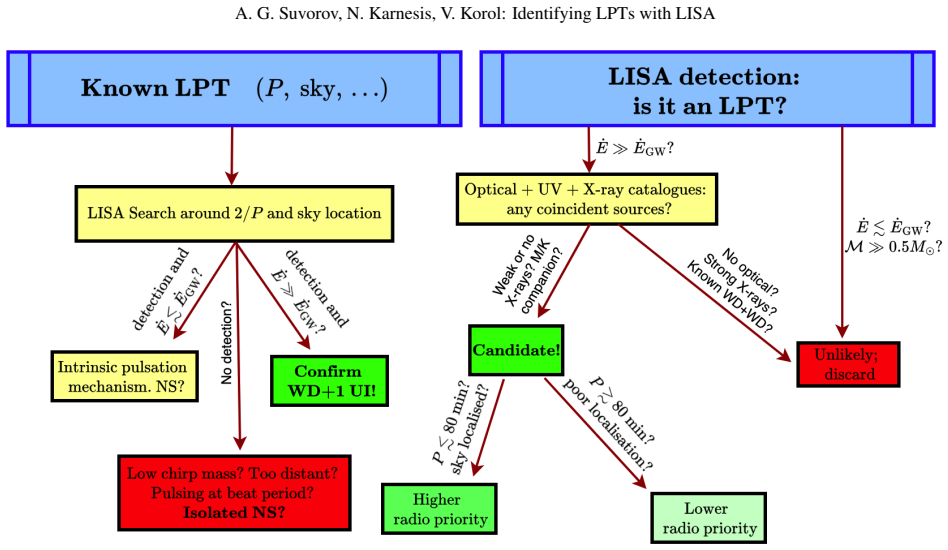
The central claim is that a non-negligible subset of the Galactic long-period transient population is detectable by LISA, with the detectable fraction ranging from roughly 0.05% to 6% depending on how LPT periods are distributed. Under the phase-locking hypothesis, each source radiates gravitational waves at $f_{\rm GW}=2/P_{\rm orb}$, so the radio period directly sets the millihertz-frequency signal. The optimistic Population I, built by extrapolating the periods of known sources, yields about 6000 resolvable sources with SNR at least 7; the conservative Population II, in which unipolar-inductor (electromotive) losses dominate orbital decay, yields about 50. For resolvable sources the injected frequency is recovered to one part in ~$10^{5}$, amplitudes to within a factor ~2, and sky positions to within ~30 square degrees, enough to guide radio follow-up. The paper also shows that comparing the measured frequency derivative with the gravitational-wave decay prediction can reveal whether electromotive losses power the radio emission.
Load-bearing premise
The load-bearing premise is that the radio pulse period equals the orbital period, so the gravitational-wave frequency is set by the radio period; if phase-locking holds only for a minority of LPTs, the forecast applies only to that minority and the derived fractions would not describe the whole class.
Editorial extensions
If this is right
- If the optimistic population is right, LISA should resolve roughly six thousand Galactic LPTs in four years, turning a radio-only curiosity into a multimessenger sample.
- A LISA detection at SNR at least 7 localizes the source to tens of square degrees, within the field of view of wide-field radio telescopes, so radio surveys can be directed to confirm the pulse period.
- Frequency recovery to about one part in 10^5 means the measured gravitational-wave frequency can pin down the pulse period precisely, helping to fold sparse radio pulses.
- Measuring the frequency derivative and chirp mass lets observers compare the orbital decay rate with the gravitational-wave prediction, so a mismatch would indicate electromotive (unipolar-inductor) losses and identify the radio emission mechanism.
- Even undetected LPTs contribute a confusion foreground between roughly 0.7 and 3 mHz that must be accounted for in LISA analyses of other sources.
Reading between the lines
- If phase-locking holds only for a minority of LPTs, the detectable fraction should scale down roughly with that minority; the 0.05% to 6% range describes the phase-locked subpopulation, not necessarily all LPTs.
- The synthesis treats short- and long-period LPTs as separate channels without an evolutionary link, so a future evolutionary model connecting pre-polar systems to AM CVn-like systems would sharpen the predicted period distribution and could be tested against LISA's frequency histogram.
- The radio duty-cycle estimates of 10^-3 to 10^-1 imply that many LISA-detected candidates may be radio-dormant during follow-up, requiring monitoring campaigns of about 40 days per source to test the association.
- A LISA detection of an LPT-like signal with no radio counterpart could identify a previously missed phase-locked binary, effectively discovering LPTs from the gravitational-wave side.
Editorial analysis
A structured set of objections, weighed in public.
Referee Report
Summary. The paper constructs synthetic Galactic populations of long-period radio transients (LPTs) under the hypothesis that their coherent radio pulses are phase-locked to the orbital motion of a white-dwarf binary, so that the gravitational-wave frequency is f_GW = 2/P_orb (Eq. 7). Two period distributions are considered: Population I is a tapered power law fitted to the 13 observed LPT periods (Eq. 12, alpha ~ 1/2), and Population II uses alpha ~ 10/3, as expected if unipolar-inductor torques dominate orbital decay. For each of N = 10^5 sources, the authors draw WD primary and companion masses subject to Roche-lobe overflow and phase-locking/slippage constraints, generate circular-orbit LISA waveforms, and run an iterative SNR/subtraction pipeline plus Fisher-matrix parameter estimation. They find ~6% of Population I and ~0.05% of Population II sources are resolvable at SNR > 7, with frequency recovery to ~10^-5, amplitudes to within a factor ~2, and sky localization to tens of square degrees. They further argue that LISA can distinguish GW-driven from electromotive orbital decay and can guide radio follow-up observations.
Significance. If the phase-locking premise holds for a substantial fraction of LPTs, this is a timely and useful forecast. The paper's main strengths are its use of standard LISA noise and data-analysis methodology (Karnesis et al. 2021; Korol et al. 2022), its explicit and reproducible catalogue construction, and its unusually transparent statement of assumptions and caveats. The conditional predictions—detection fraction, parameter-recovery accuracy, and orbital-decay discrimination—are in principle falsifiable with LISA data. The principal limitation is that the quantitative upper bound inherits the phase-locking assumption and a weakly constrained empirical period distribution; this does not invalidate the analysis, but it restricts the population to which the headline percentages apply.
major comments (2)
- [Abstract and Sec. 5.1] The abstract states that "between ~0.05% and ~6% of long-period transients will be detectable within four years", and Sec. 5.1 presents the ~6% and ~0.05% fractions as properties of the LPT population as a whole. This is not supported by the model's own scope. Section 2.2 states that phase-locking is verified for only three of the sources in Table 1 and explicitly notes that Ar Scorpii, J191213.72-441045.1, and SDSS J230641.47+244055.8 are not phase-locked, while Sec. 3.2 defines N=10^5 as the "total phase-locked LPT-like population". The computed fractions therefore refer to the phase-locked subpopulation. If the phase-locked fraction of all LPTs is f_lock (on the order of 3/13 from the current sample), the all-LPT detection fraction is f_lock times the quoted values, i.e., ~1.5% rather than ~6% for the upper end. I ask that the abstract, Sec. 5.1, and Sec. 6 be rephrased to read "phase-locked LPTs", or that the all-LPT fraction be stated with an explicit f_lock scaling.
- [Sec. 3.1, Eq. (12), Fig. 6] The Population I period distribution that drives the 6% result is fitted to the full 13-source sample in Table 1, which includes systems the paper itself regards as not phase-locked. The confirmed phase-locked systems (ILT J1101+5521, GLEAM-X J0704-37, and ASKAP J174508.9-505149) all have periods >~82 min, whereas several of the shorter-period sources in Table 1 are exactly those for which spin-powering or non-phase-locked interpretations remain open. Since the resolvable Population I count in Fig. 6 is dominated by the f_GW >= 1 mHz tail, a phase-locked-only fit would likely shift Eq. (12) toward longer periods and suppress that high-frequency tail, lowering the upper-end fraction. Please either refit Eq. (12) on the phase-locked subsample or explicitly quantify the sensitivity of the 5911-source estimate to contamination by non-phase-locked sources; at minimum, the text should state that the upper bound is not robust to this sample mixture.
minor comments (4)
- [Sec. 3.4 and Sec. 5.1] There are small typographical errors: "catagory" in Sec. 3.4 should be "category", and "chirp mases" in Sec. 5.1 should be "chirp masses".
- [Eq. (13)] The tapering is described as Gaussian, but the second exponential depends only on (P - P_L)^2, so the taper acts only near the lower cutoff. Please clarify whether the intended form should also suppress pile-up near P_U, or adjust the wording.
- [Sec. 3.2 and Sec. 5.1] The absolute detection counts (~5911 and ~49) are linearly proportional to N, which is fixed as the midpoint of a two-order-of-magnitude range (10^-8 to 10^-6 pc^-3; Sec. 3.2). The paper sometimes reports "~6000 sources" without reminding the reader of this linear scaling; a sentence stating that absolute numbers scale with the uncertain total N would be helpful.
- [Sec. 3.3, Eq. (19)] The ad hoc frequency-derivative scatter factor b=5 is not constrained by the mostly upper-limit Pdot values in Table 1. The authors acknowledge this in principle, but Sec. 5.2's parameter-recovery discussion should carry a reminder that the fdot distribution is a chosen prior rather than a measurement-based input.
Circularity Check
No circularity: the LISA detectability estimates are conditional forward-model outputs from an explicitly stated period-distribution fit plus an independent LISA SNR and Fisher pipeline, not quantities that reduce to the fitted inputs by construction.
full rationale
The paper's central estimate (between ~0.05% and ~6% of long-period transients detectable by LISA) is a forward-model result, not a repackaged input. For Population I, the period CDF (Eq. 12-13) is fitted to the observed LPT sample in Table 1, but that CDF is only the prior for drawing orbital periods; the predicted detectability is then computed by converting periods to GW frequencies via Eq. (7), amplitudes via Eq. (22), and SNRs with the external LISA noise model and iterative subtraction pipeline of Karnesis et al. (2021) and Babak et al. (2021). The paper is explicit that the ~6% figure is a consequence of the empirical period distribution (Sec. 5.1: 'the empirical construction with alpha=1/2 leads to a pileup of resolvable systems'), which is transparent conditional modeling rather than equation-level circularity. The phase-locking relation f_GW=2/P_orb is introduced as an explicitly stated assumption (Sec. 2.2), and the paper immediately warns that the resulting estimates 'may thus not apply to the entire LPT population'; an assumption is not a circular step. The Fisher-matrix parameter-recovery results (Sec. 5.2) are self-consistent checks on injected signals, again using standard external methods, so they are not predictions of the model's inputs. Self-citations to Suvorov et al. (2025) appear only as motivation and for sample-selection criteria; the present analysis independently constructs catalogues and runs its own recovery pipelines, so these citations are not load-bearing. The known limitations of the study, such as selection effects in the observed LPT sample, uncertain total source count N, and the Fisher approximation, are correctness and robustness risks, not circularity. The paper even provides a second, theoretically motivated population (Population II) and a broken power-law cross-check, which independently bound the result. No derived quantity is equivalent, by construction or by fitted-parameter renaming, to the input data or to an unverified self-citation.
Assumptions & free parameters
free parameters (9)
- Total LPT population N =
1e5
- Pop I period power-law index alpha =
0.5
- Pop II period power-law index alpha =
10/3
- Period cutoffs P_L, P_U =
7 min, 4 hr
- Tapering steepness s =
100 min^-2
- Maximum spin-orbit slippage delta_max =
0.01
- Frequency-derivative scatter b =
5
- WD primary mass mean/std =
0.77, 0.1 M_sun
- Detection SNR threshold =
7
assumptions (6)
- domain assumption Radio pulse period equals orbital period (phase-locking) for the modeled LPT population.
- domain assumption No active accretion: companion radius is strictly inside its Roche lobe (R_c < R_L).
- domain assumption Circular orbits with zero eccentricity.
- domain assumption M/K dwarf mass-radius relation for P>80 min and degenerate Nauenberg relation for P<80 min.
- ad hoc to paper Period distribution is a tapered power-law with index alpha = 1/2 (Pop I) or 10/3 (Pop II).
- domain assumption Galactic spatial distribution follows the exponential disc model of Korol et al. (2022).
Cite this review
Pith. "Pith review of Population synthesis and detection prospects for Galactic long-period transients with LISA." pith.science (2026). https://pith.science/paper/F2EVVM67
@misc{pith2026260804628,
  author       = {Pith},
  title        = {Pith review of: Population synthesis and detection prospects for Galactic long-period transients with LISA},
  year         = {2026},
  howpublished = {\url{https://pith.science/paper/F2EVVM67}},
  note         = {Machine review of arXiv:2608.04628}
}
abstract
The recently-discovered long-period radio transients represent a puzzling new class of astrophysical sources, some of which are thought to be compact binary systems emitting a pulse once per orbit. If this interpretation is correct, the orbital period--and therefore the gravitational-wave frequency--is directly encoded in the radio signal, which typically lies in the millihertz band. In this work, we explore whether these systems can be detected by the Laser Interferometer Space Antenna (LISA). Assuming that this phase-locking between radio pulses and orbital motion applies broadly across the population, we construct synthetic source catalogues informed by both observations and theoretical models of related systems, such as cataclysmic variables. We estimate that between $\sim 0.05\%$ and $\sim 6\%$ of long-period transients will be detectable within four years of observation with LISA, depending on astrophysical assumptions. For detectable systems, we find injected frequencies are recoverable to one part in $\sim 10^{5}$, amplitudes to within a factor $\sim 2$, and the sky positions to within $\sim$30 square degrees. Our results demonstrate that gravitational-wave observations can provide direct evidence for the binary nature of these sources and, importantly, can guide future radio surveys by predicting pulse periods, sky positions, and orbital properties. The mismatch between extracted frequency derivatives and that imposed by gravitational-wave decay is also computed to show that the likelihood of electromotive losses driving orbital evolution can be assessed for each detectable candidate.
Figures


Figures from the paper (6 more)


Reference graph
Works this paper leans on
-
[1]
Abbott, B. P. et al. 2008, , 683, L45
2008
-
[2]
D., Biryukov , A
Afonina , M. D., Biryukov , A. V., & Popov , S. B. 2023, Astronomy Letters, 49, 553
2023
-
[3]
D., Biryukov , A
Afonina , M. D., Biryukov , A. V., & Popov , S. B. 2024, , 41, e014
2024
-
[4]
2023, Living Reviews in Relativity, 26, 2
Amaro-Seoane , P., Andrews , J., Arca Sedda , M., et al. 2023, Living Reviews in Relativity, 26, 2
2023
-
[5]
L., Rea , N., et al
Anumarlapudi , A., Kaplan , D. L., Rea , N., et al. 2025, , 542, 1208
2025
-
[6]
Babak, S., Petiteau, A., & Hewitson, M. 2021 [ [arXiv] 2108.01167 ]
arXiv 2021
-
[7]
Babak, S. et al. in prep
-
[8]
& Cutler , C
Barack , L. & Cutler , C. 2004, , 69, 082005
2004
Show all 102 references
-
[9]
2023, , 520, 1872
Beniamini , P., Wadiasingh , Z., Hare , J., et al. 2023, , 520, 1872
2023
-
[10]
S., et al
Bethapudi , S., Kerr , M., Ray , P. S., et al. 2021, Research Notes of the American Astronomical Society, 5, 46
2021
-
[11]
K., Bassa , C
Bloot , S., Vedantham , H. K., Bassa , C. G., et al. 2025, , 699, A341
2025
-
[12]
L., et al
Caleb , M., Lenc , E., Kaplan , D. L., et al. 2024, Nature Astronomy, 8, 1159
2024
-
[13]
R., & Sopuerta , C
Canizares , P., Gair , J. R., & Sopuerta , C. F. 2012, , 86, 044010
2012
-
[14]
T., et al
Castro Segura , N., Pelisoli , I., G \"a nsicke , B. T., et al. 2025, , 543, 2116
2025
-
[15]
2018, , 863, 48
CHIME/FRB Collaboration , Amiri , M., Bandura , K., et al. 2018, , 863, 48
2018
-
[16]
2024, arXiv e-prints, arXiv:2402.07571
Colpi , M., Danzmann , K., Hewitson , M., et al. 2024, arXiv e-prints, arXiv:2402.07571
2024 arXiv
-
[17]
J., Cotton , W
Condon , J. J., Cotton , W. D., Greisen , E. W., et al. 1998, , 115, 1693
1998
-
[18]
Cooper , A. J. & Wadiasingh , Z. 2024, , 533, 2133
2024
-
[19]
Cornish, N. J. & Littenberg, T. B. 2007, Phys. Rev. D, 76, 083006
2007
-
[20]
& Bulik , T
Cury o , M. & Bulik , T. 2022, , 660, A68
2022
-
[21]
L., & Stella , L
Dall'Osso , S., Israel , G. L., & Stella , L. 2007, , 464, 417
2007
-
[22]
2010, in ISKAF2010 Science Meeting, 5
de Blok, E., Booth, R., Jonas, J., & Fanaroff, B. 2010, in ISKAF2010 Science Meeting, 5
2010
-
[23]
M., Bassa , C
de Ruiter , I., Rajwade , K. M., Bassa , C. G., et al. 2025, Nature Astronomy, 9, 672
2025
-
[24]
G., & Kokkotas , K
Destounis , K., Suvorov , A. G., & Kokkotas , K. D. 2020, , 102, 064041
2020
-
[25]
2013, Document number SKA-TEL-SKO-DD-001 Revision, 1
Dewdney, P., Turner, W., Millenaar, R., et al. 2013, Document number SKA-TEL-SKO-DD-001 Revision, 1
2013
-
[26]
A., Clarke , T
Dong , F. A., Clarke , T. E., Curtin , A., et al. 2025 a , , 990, L49
2025
-
[27]
A., Shin , K., Law , C., et al
Dong , F. A., Shin , K., Law , C., et al. 2025 b , , 988, L29
2025
-
[28]
Eggleton , P. P. 1983, , 268, 368
1983
-
[29]
2023, , 522, 5358
Finch , E., Bartolucci , G., Chucherko , D., et al. 2023, , 522, 5358
2023
-
[30]
Finn , L. S. & Thorne , K. S. 2000, , 62, 124021
2000
-
[31]
Fisher , R. A. 1935, Journal of the royal statistical society, 98, 39
1935
-
[32]
2023, , 519, 2552
Georgousi , M., Karnesis , N., Korol , V., Pieroni , M., & Stergioulas , N. 2023, , 519, 2552
2023
-
[33]
& Suvorov , A
Glampedakis , K. & Suvorov , A. G. 2021, , 508, 2399
2021
-
[34]
& Lynden-Bell , D
Goldreich , P. & Lynden-Bell , D. 1969, , 156, 59
1969
-
[35]
Hamers , A. S. 2021, RNAAS, 5, 275
2021
-
[36]
E., Keane , E
Hassall , T. E., Keane , E. F., & Fender , R. P. 2013, , 436, 371
2013
-
[37]
J., & Morgan , J
Horv \'a th , C., Hurley-Walker , N., McSweeney , S., Galvin , T. J., & Morgan , J. 2025, , 42, e129
2025
-
[38]
J., Bahramian , A., et al
Hurley-Walker , N., McSweeney , S. J., Bahramian , A., et al. 2024, , 976, L21
2024
-
[39]
J., et al
Hurley-Walker , N., Rea , N., McSweeney , S. J., et al. 2023, , 619, 487
2023
-
[40]
2022, , 601, 526
Hurley-Walker , N., Zhang , X., Bahramian , A., et al. 2022, , 601, 526
2022
-
[41]
Hyman et al. , S. D. 2009, , 696, 280
2009
-
[42]
L., et al
Imbrogno , M., Veresvarska , M., Wang , Y. L., et al. 2026, , 710, L27
2026
-
[43]
J., & Gupta , N
Johnston , S., Feain , I. J., & Gupta , N. 2009, in Astronomical Society of the Pacific Conference Series, Vol. 407, The Low-Frequency Radio Universe, ed. D. J. Saikia , D. A. Green , Y. Gupta , & T. Venturi , 446
2009
-
[44]
2021, , 104, 043019
Karnesis , N., Babak , S., Pieroni , M., Cornish , N., & Littenberg , T. 2021, , 104, 043019
2021
-
[45]
L., Karnesis , N., Korsakova , N., Gair , J
Katz , M. L., Karnesis , N., Korsakova , N., Gair , J. R., & Stergioulas , N. 2025, , 111, 024060
2025
-
[46]
Kavanagh , R. D. & Vedantham , H. K. 2023, , 524, 6267
2023
-
[47]
& Weigert , A
Kippenhahn , R. & Weigert , A. 1994, Stellar Structure and Evolution
1994
-
[48]
2022, , 511, 5936
Korol , V., Hallakoun , N., Toonen , S., & Karnesis , N. 2022, , 511, 5936
2022
-
[49]
P., Toonen, S., et al
Korol, V., Igoshev, A. P., Toonen, S., et al. 2024, Mon. Not. Roy. Astron. Soc., 530, 844
2024
-
[50]
2012, , 757, L3
Lai , D. 2012, , 757, L3
2012
-
[51]
2026, The Astrophysical Journal Letters, 997, L7
Lander, S., Gourgouliatos, K., Wadiasingh, Z., & Antonopoulou, D. 2026, The Astrophysical Journal Letters, 997, L7
2026
-
[52]
Lee , Y. W. J., Caleb , M., Murphy , T., et al. 2025, Nature Astronomy, 9, 393
2025
-
[53]
Lee , Y. W. J., Wang , Y., Caleb , M., et al. 2026, , 545, staf2008
2026
-
[54]
& Maoz , D
Loeb , A. & Maoz , D. 2022, Research Notes of the American Astronomical Society, 6, 27
2022
-
[55]
Lorimer , D. R. & Kramer , M. 2012, Handbook of Pulsar Astronomy
2012
-
[56]
2016, Classical and Quantum Gravity, 33, 035010
Luo , J., Chen , L.-S., Duan , H.-Z., et al. 2016, Classical and Quantum Gravity, 33, 035010
2016
-
[57]
Lyman et al. , J. D. 2025, , 538, 925
2025
-
[58]
N., Lyne , A
Manchester , R. N., Lyne , A. G., Camilo , F., et al. 2001, , 328, 17
2001
-
[59]
a nsicke , B. T., H \
Marsh , T. R., G \"a nsicke , B. T., H \"u mmerich , S., et al. 2016, , 537, 374
2016
-
[60]
D., et al
McMillan, J., Ingram, A., Brown, C. D., et al. 2026, Monthly Notices of the Royal Astronomical Society, stag117
2026
-
[61]
J., Hurley-Walker , N., Horv \'a th , C., et al
McSweeney , S. J., Hurley-Walker , N., Horv \'a th , C., et al. 2025, , 542, 203
2025
-
[62]
2026, Science China Physics, Mechanics, and Astronomy, 69, 269512
Men , Y., Barr , E., Qu , Y., et al. 2026, Science China Physics, Mechanics, and Astronomy, 69, 269512
2026
-
[63]
J., Finch , E., Klein , A., et al
Moore , C. J., Finch , E., Klein , A., et al. 2024, , 531, 2817
2024
-
[64]
& Kaplan , D
Murphy , T. & Kaplan , D. L. 2026, , 43, e006
2026
-
[65]
1972, , 175, 417
Nauenberg , M. 1972, , 175, 417
1972
-
[66]
F., Verbunt , F., & Yungelson , L
Nelemans , G., Portegies Zwart , S. F., Verbunt , F., & Yungelson , L. R. 2001, , 368, 939
2001
-
[67]
R., & Portegies Zwart , S
Nelemans , G., Yungelson , L. R., & Portegies Zwart , S. F. 2004, , 349, 181
2004
-
[68]
& Sienkiewicz , R
Paczynski , B. & Sienkiewicz , R. 1981, , 248, L27
1981
-
[69]
R., Buckley , D
Pelisoli , I., Marsh , T. R., Buckley , D. A. H., et al. 2023, Nature Astronomy, 7, 931
2023
-
[70]
2024, , 527, 3826
Pelisoli , I., Sahu , S., Lyutikov , M., et al. 2024, , 527, 3826
2024
-
[71]
2026, , 114, 023022
Perego , A., Bonetti , M., Sesana , A., Toonen , S., & Korol , V. 2026, , 114, 023022
2026
-
[72]
Peters , P. C. 1964, Physical Review, 136, 1224
1964
-
[73]
Peters , P. C. & Mathews , J. 1963, Physical Review, 131, 435
1963
-
[74]
2021, Universe, 8, 9
Pilia , M. 2021, Universe, 8, 9
2021
-
[75]
2026, Publications of the Astronomical Society of Australia, 1
Pritchard, J., Murphy, T., Dobie, D., et al. 2026, Publications of the Astronomical Society of Australia, 1
2026
-
[76]
& Zhang , B
Qu , Y. & Zhang , B. 2025, , 981, 34
2025
-
[77]
S., Allard , F., Teixeira , G
Rajpurohit , A. S., Allard , F., Teixeira , G. D. C., et al. 2018, , 610, A19
2018
-
[78]
Ramsay , G., Brocksopp , C., Wu , K., Slee , B., & Saxton , C. J. 2007, , 382, 461
2007
-
[79]
2026, Journal of High Energy Astrophysics, 100566
Rea, N., Hurley-Walker, N., & Caleb, M. 2026, Journal of High Energy Astrophysics, 100566
2026
-
[80]
E., Heinke , C
Ridder , M. E., Heinke , C. O., Sivakoff , G. R., & Hughes , A. K. 2023, , 519, 5922
2023
-
[81]
Rodriguez , A. C. 2025, , 695, L8
2025
-
[82]
C., El-Badry , K., de Ruiter , I., et al
Rodriguez , A. C., El-Badry , K., de Ruiter , I., et al. 2026, arXiv e-prints, arXiv:2604.18688
2026 arXiv
-
[83]
2026, Nature Astronomy
Rose , K., Pritchard , J., Murphy , T., et al. 2026, Nature Astronomy
2026
-
[84]
2020, International Journal of Modern Physics A, 35, 2050075
Ruan , W.-H., Guo , Z.-K., Cai , R.-G., & Zhang , Y.-Z. 2020, International Journal of Modern Physics A, 35, 2050075
2020
-
[85]
B., et al
Scaringi , S., Breivik , K., Littenberg , T. B., et al. 2023, , 525, L50
2023
-
[86]
Shapiro , S. L. & Teukolsky , S. A. 1983, Black holes, white dwarfs and neutron stars. The physics of compact objects
1983
-
[87]
W., Heinke , C
Shaw , A. W., Heinke , C. O., Mukai , K., et al. 2020, , 498, 3457
2020
-
[88]
Solheim , J. E. 2010, Pub. Astron. Soc. Pac., 122, 1133
2010
-
[89]
W., Hessels , J
Stappers , B. W., Hessels , J. W. T., Alexov , A., et al. 2011, , 530, A80
2011
-
[90]
A., Littlefield , C., Garnavich , P., et al
Stiller , R. A., Littlefield , C., Garnavich , P., et al. 2018, , 156, 150
2018
-
[91]
G., Dehman , C., & Pons , J
Suvorov , A. G., Dehman , C., & Pons , J. A. 2025, , 991, 134
2025
-
[92]
Suvorov , A. G. & Glampedakis , K. 2026, , 114, 023036
2026
-
[93]
G., Kuan , H.-J., & Kokkotas , K
Suvorov , A. G., Kuan , H.-J., & Kokkotas , K. D. 2024, Universe, 10, 441
2024
-
[94]
Suvorov , A. G. & Melatos , A. 2023, , 520, 1590
2023
-
[95]
J., Goeke , R., Bowman , J
Tingay , S. J., Goeke , R., Bowman , J. D., et al. 2013, , 30, e007
2013
-
[96]
& Dhurandhar, S
Tinto, M. & Dhurandhar, S. V. 2005, Living Rev. Rel., 8, 4
2005
-
[97]
Townsley , D. M. & Bildsten , L. 2003, , 596, L227
2003
-
[98]
2025, , 642, 583
Wang , Z., Rea , N., Bao , T., et al. 2025, , 642, 583
2025
-
[99]
& Shen , R.-F
Xiao , X. & Shen , R.-F. 2024, , 972, 60
2024
-
[100]
2026, , 997, 124
Yang , Y.-P. 2026, , 997, 124
2026
-
[101]
2026, The Astrophysical Journal Letters, 1004, L46
Zhan, Y., Wang, D., & Wang, F.-Y. 2026, The Astrophysical Journal Letters, 1004, L46
2026
-
[102]
& Most , E
Zhong , Y. & Most , E. R. 2026, , 999, L2
2026
Reviewed August 6, 2026 · model on record in the stance chip above.
Discussion (0). Sign in to comment.