Hyperon-pair spin tomography beyond scalar spin correlations
Pith reviewed 2026-06-25 23:09 UTC · model grok-4.3
The pith
Scalar spin correlation in Lambda pairs leaves degeneracy between separable and entangled states.
A machine-rendered reading of the paper's core claim, the machinery that carries it, and where it could break.
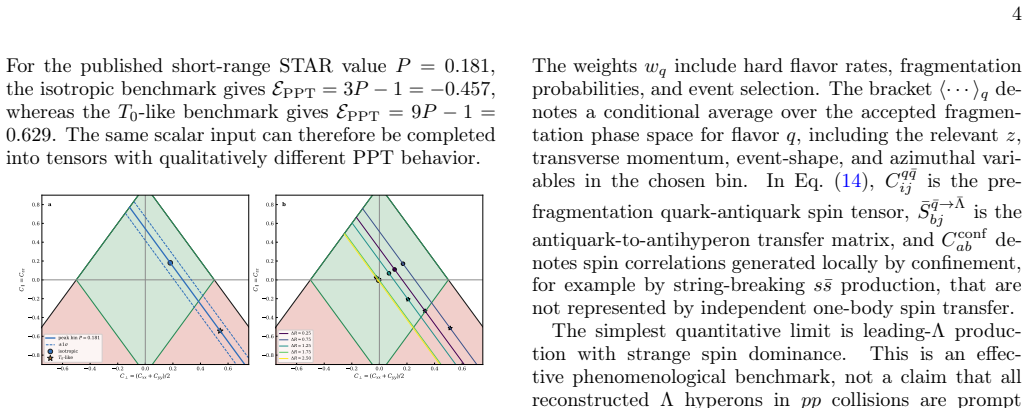
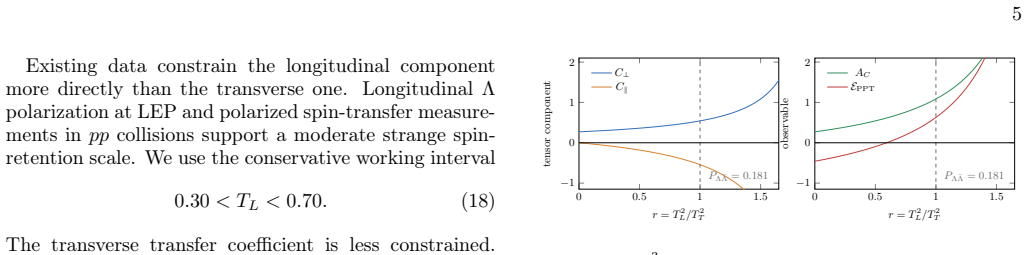
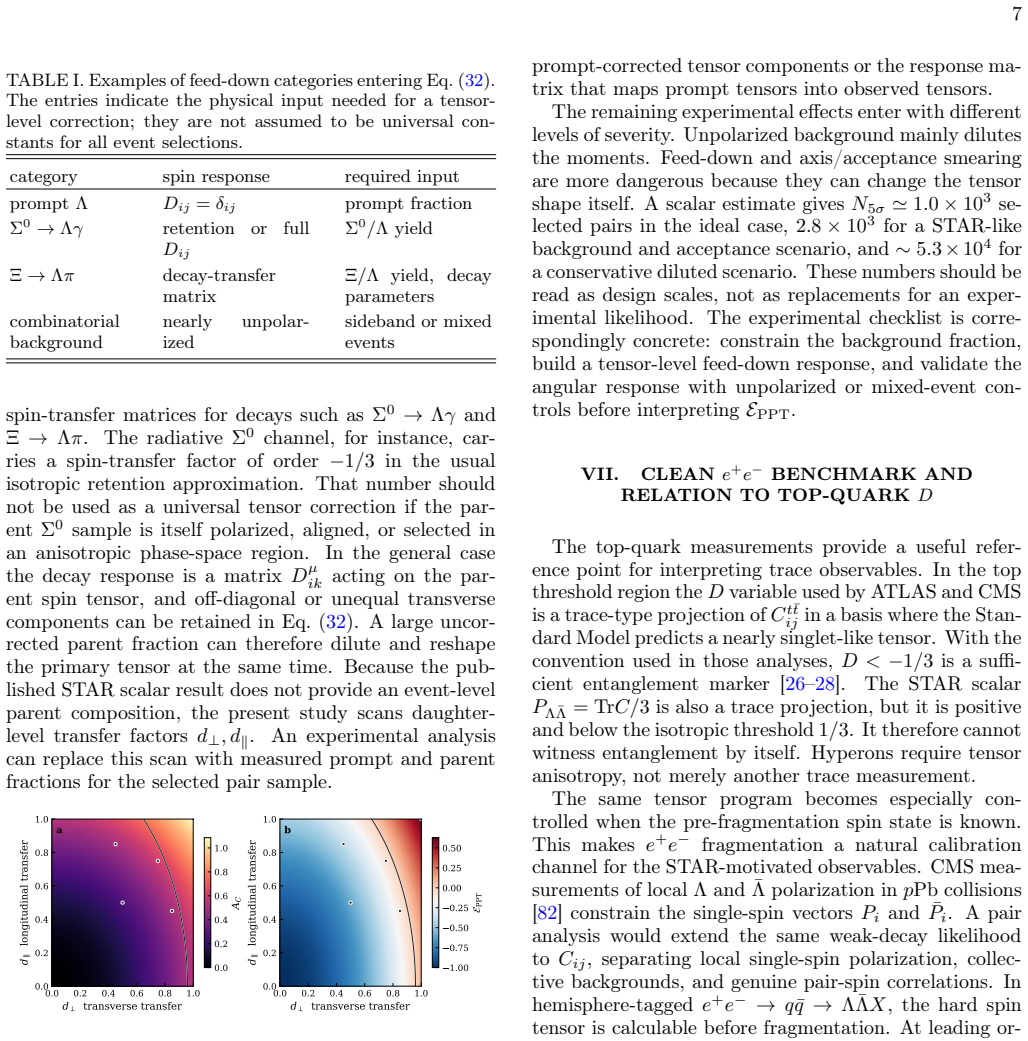
Core claim
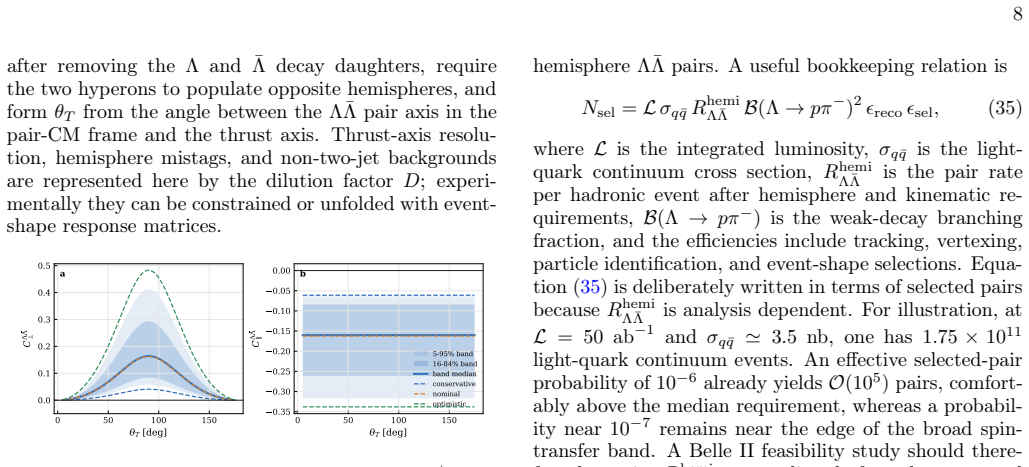
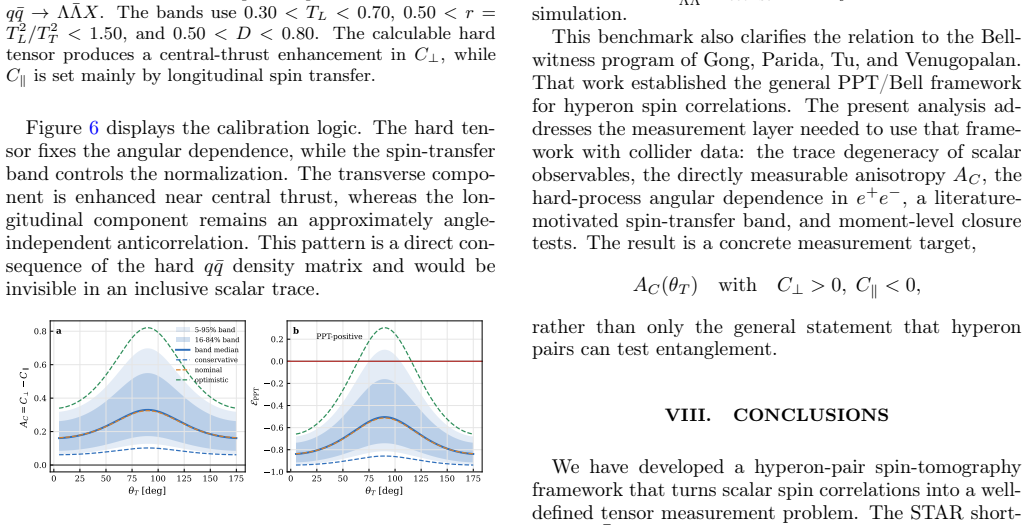
The published scalar P_ΛΛ̄ leaves a continuous density-matrix degeneracy: separable tensor completions and completions that violate the positive-partial-transpose criterion can have the same trace. The missing observables are the transverse and longitudinal tensor components and their anisotropy A_C. A local ³P₀ string-breaking benchmark turns the STAR trace into the falsifiable pattern C_⊥>0, C_∥<0, and A_C>0. Feed-down must be treated as a tensor response rather than as a universal scalar dilution. A claim of entanglement requires the reconstructed two-spin density matrix, not the scalar trace alone, to violate the PPT bound.
What carries the argument
Two-spin tensor tomography in which the weak-decay angles of the Lambda and anti-Lambda determine the full density matrix components.
If this is right
- Transverse and longitudinal tensor components plus the anisotropy A_C become the observables required to resolve the density-matrix degeneracy.
- Feed-down corrections must be applied as a tensor response rather than a scalar dilution factor.
- The ³P₀ string-breaking model converts the STAR scalar value into the specific pattern C_⊥>0, C_∥<0, A_C>0.
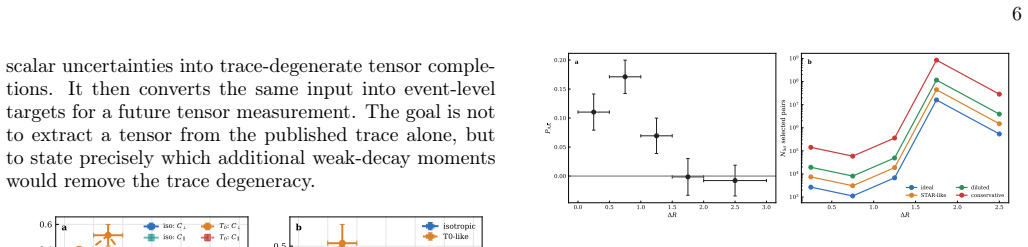
- In Belle II e+e- kinematics the benchmark predicts a centrally enhanced A_C of order 0.3 measurable with roughly 10^4 selected pairs.
Where Pith is reading between the lines
- The tomography framework could be applied to other hyperon-pair channels to map how spin information survives hadronization.
- If the reconstructed matrix violates the PPT bound, it would indicate that entanglement can persist through the confinement process in a measurable way.
- Comparison of the predicted anisotropy pattern against data from different collision energies would test the local ³P₀ assumption against alternative production mechanisms.
Load-bearing premise
The weak-decay angles of the Lambda and anti-Lambda fully determine the two-spin tensor components without additional model-dependent corrections beyond the stated feed-down treatment.
What would settle it
A measurement in the short-range STAR region that finds C_⊥ ≤ 0 or C_∥ ≥ 0 or A_C ≤ 0 would falsify the local ³P₀ benchmark applied to the existing scalar trace.
Figures

read the original abstract
Spin correlations measured after hadronization probe how quantum information is transported through confinement. We formulate a process-independent spin-tomography framework for $\Lambda\bar{\Lambda}$ pairs in which the weak-decay angles determine the full two-spin tensor rather than only its scalar trace. Applied to the short-range STAR correlation in unpolarized $pp\to\Lambda\bar{\Lambda}X$, the framework shows that the published scalar $P_{\Lambda\bar{\Lambda}}$ leaves a continuous density-matrix degeneracy: separable tensor completions and completions that violate the positive-partial-transpose (PPT) criterion can have the same trace. The missing observables are the transverse and longitudinal tensor components and their anisotropy $A_C=C_\perp-C_\parallel$. A local ${}^{3}P_0$ string-breaking benchmark turns the STAR trace into the falsifiable pattern $C_\perp>0$, $C_\parallel<0$, and $A_C>0$. We further show that feed-down must be treated as a tensor response rather than as a universal scalar dilution. In the complementary $e^+e^-$ calibration channel, the same benchmark predicts a centrally enhanced $A_C$ of order $0.3$ in Belle II kinematics, measurable with about $10^4$ selected pairs for nominal spin-transfer parameters. A claim of entanglement requires the reconstructed two-spin density matrix, not the scalar trace alone, to violate the PPT bound.
Editorial analysis
A structured set of objections, weighed in public.
Referee Report
Summary. The paper formulates a process-independent spin-tomography framework for ΛΛ̄ pairs in which weak-decay angles are used to reconstruct the full two-spin density matrix (including transverse/longitudinal components C_⊥, C_∥ and anisotropy A_C) rather than only the scalar trace P_ΛΛ̄. Applied to STAR pp data, it shows that the published scalar correlation permits a continuous degeneracy between separable and PPT-violating tensor completions; a ³P₀ string-breaking benchmark supplies falsifiable sign predictions (C_⊥>0, C_∥<0, A_C>0) and a central A_C≈0.3 expectation for Belle II e⁺e⁻ kinematics. Feed-down is required to be treated as a tensor response rather than scalar dilution. Entanglement claims are stated to require the reconstructed matrix, not the trace alone.
Significance. If the angular-to-tensor mapping is robust, the work usefully demonstrates that scalar hyperon-pair correlations are insufficient for entanglement claims and supplies concrete, falsifiable predictions from an external ³P₀ benchmark together with a tensorial feed-down prescription. These elements strengthen the manuscript’s utility for guiding analyses at existing and future facilities.
major comments (1)
- [Abstract and reconstruction section] Abstract and the reconstruction section: the central degeneracy argument (that the scalar trace P_ΛΛ̄ alone permits both separable and PPT-violating completions) is load-bearing and rests on the claim that the nine independent tensor components are fully and model-independently determined by the weak-decay angles after the stated feed-down treatment. No explicit inversion, acceptance-corrected angular distributions, or sensitivity matrix is shown that would confirm all components (including the transverse/longitudinal split) are independently accessible; residual production-mechanism or polarization-transfer dependence would leave the reconstructed matrix under-determined and preserve the degeneracy in practice.
minor comments (1)
- The definition and normalization of the anisotropy A_C = C_⊥ − C_∥ should be stated explicitly with the range of possible values under positivity and PPT constraints.
Simulated Author's Rebuttal
We thank the referee for the careful reading and for highlighting the need to strengthen the explicit demonstration of the reconstruction procedure. We address the major comment below and will incorporate the requested material in a revised manuscript.
read point-by-point responses
-
Referee: [Abstract and reconstruction section] Abstract and the reconstruction section: the central degeneracy argument (that the scalar trace P_ΛΛ̄ alone permits both separable and PPT-violating completions) is load-bearing and rests on the claim that the nine independent tensor components are fully and model-independently determined by the weak-decay angles after the stated feed-down treatment. No explicit inversion, acceptance-corrected angular distributions, or sensitivity matrix is shown that would confirm all components (including the transverse/longitudinal split) are independently accessible; residual production-mechanism or polarization-transfer dependence would leave the reconstructed matrix under-determined and preserve the degeneracy in practice.
Authors: We agree that an explicit demonstration of the angular-to-tensor mapping strengthens the manuscript. The joint decay angular distribution for a ΛΛ̄ pair is given by the standard form 1 + α_Λ P_Λ · n_Λ + α_Λ̄ P_Λ̄ · n_Λ̄ + α_Λ α_Λ̄ n_Λ · C · n_Λ̄ (with known decay parameters α), which directly encodes the full 3×3 correlation tensor C. Because this relation follows solely from the decay matrix elements and the definition of the rest-frame decay directions, the mapping from observed angles to the nine tensor components is model-independent and does not depend on the production mechanism; the latter only sets the numerical values of C. The transverse/longitudinal decomposition is obtained by projecting C onto the beam axis after boosting to the appropriate frames. To address the referee’s concern we will add an appendix containing (i) the explicit linear inversion from binned angular moments to the elements of C, (ii) the acceptance-corrected distributions used for the STAR analysis, and (iii) a sensitivity matrix demonstrating that all nine components remain independently accessible once statistics exceed a few thousand pairs. We will also clarify in the text that any residual polarization-transfer effects are absorbed into the measured values of C and do not render the reconstruction under-determined. These additions will be included in the revised version. revision: yes
Circularity Check
No circularity; derivation uses external benchmark and standard density-matrix properties
full rationale
The paper's central steps consist of (i) formulating a tomography framework in which weak-decay angles reconstruct the full two-spin tensor, (ii) observing that the published scalar trace P_ΛΛ̄ mathematically permits a continuous family of tensor completions (some separable, some PPT-violating), and (iii) feeding the STAR trace into an external 3P0 string-breaking model to obtain falsifiable signs for C_⊥, C_∥ and A_C. None of these steps reduces by definition or by self-citation to the input data; the 3P0 benchmark is invoked as an independent, testable model rather than a fit, and the degeneracy statement follows directly from the properties of two-qubit density matrices. No load-bearing equation equates a derived quantity to a fitted parameter or to a prior result by the same author.
Axiom & Free-Parameter Ledger
axioms (1)
- domain assumption Weak-decay angles determine the full two-spin tensor rather than only its scalar trace
Reference graph
Works this paper leans on
-
[1]
A pair analysis would extend the same weak-decay likelihood toC ij, separating local single-spin polarization, collec- tive backgrounds, and genuine pair-spin correlations
constrain the single-spin vectorsPi and ¯Pi. A pair analysis would extend the same weak-decay likelihood toC ij, separating local single-spin polarization, collec- tive backgrounds, and genuine pair-spin correlations. In hemisphere-taggede +e− →q¯q→Λ ¯ΛX, the hard spin tensor is calculable before fragmentation. At leading or- der for photon exchange, C e+...
-
[2]
Einstein, B
A. Einstein, B. Podolsky, and N. Rosen, Phys. Rev.47, 777 (1935)
1935
-
[3]
Schrödinger, Math
E. Schrödinger, Math. Proc. Cambridge Philos. Soc.31, 555 (1935)
1935
-
[4]
J. S. Bell, Physics1, 195 (1964)
1964
-
[5]
J. F. Clauser, M. A. Horne, A. Shimony, and R. A. Holt, Phys. Rev. Lett.23, 880 (1969)
1969
-
[6]
R. F. Werner, Phys. Rev. A40, 4277 (1989)
1989
-
[7]
Peres, Phys
A. Peres, Phys. Rev. Lett.77, 1413 (1996)
1996
-
[8]
Horodecki, P
M. Horodecki, P. Horodecki, and R. Horodecki, Phys. Lett. A223, 1 (1996)
1996
-
[9]
W. K. Wootters, Phys. Rev. Lett.80, 2245 (1998)
1998
-
[10]
M. A. Nielsen and I. L. Chuang,Quantum Computation and Quantum Information(Cambridge University Press, 2000)
2000
-
[11]
R. Horodecki, P. Horodecki, M. Horodecki, and K. Horodecki, Rev. Mod. Phys.81, 865 (2009), arXiv:quant-ph/0702225
Pith/arXiv arXiv 2009
-
[12]
O. Gühne and G. Tóth, Phys. Rept.474, 1 (2009), arXiv:0811.2803 [quant-ph]
Pith/arXiv arXiv 2009
-
[13]
Hradil, Phys
Z. Hradil, Phys. Rev. A55, R1561 (1997)
1997
-
[14]
D. F. V. James, P. G. Kwiat, W. J. Munro, and A. G. White, Phys. Rev. A64, 052312 (2001)
2001
-
[15]
G. Tóth, W. Wieczorek, D. Gross, R. Krischek, C. Schwemmer, and H. Weinfurter, Phys. Rev. Lett.105, 250403 (2010), arXiv:1005.3313 [quant-ph]
Pith/arXiv arXiv 2010
-
[16]
G.MahlonandS.J.Parke,Phys.Rev.D53,4886(1996), arXiv:hep-ph/9512264
Pith/arXiv arXiv 1996
-
[17]
W. Bernreuther, A. Brandenburg, Z. G. Si, and P. Uwer, Phys. Rev. Lett.87, 242002 (2001), arXiv:hep- ph/0107086
arXiv 2001
-
[18]
W. Bernreuther and Z.-G. Si, Nucl. Phys. B837, 90 (2010), arXiv:1003.3926 [hep-ph]
Pith/arXiv arXiv 2010
-
[19]
ATLAS Collaboration, Phys. Rev. Lett.108, 212001 (2012), arXiv:1203.4081 [hep-ex]
Pith/arXiv arXiv 2012
-
[20]
CMSCollaboration,Phys.Rev.Lett.112,182001(2014), arXiv:1311.3924 [hep-ex]
Pith/arXiv arXiv 2014
-
[21]
ATLAS Collaboration, Eur. Phys. J. C80, 754 (2020), arXiv:1903.07570 [hep-ex]
arXiv 2020
-
[22]
Y. Afik and J. R. M. de Nova, Eur. Phys. J. Plus136, 907 (2021), arXiv:2003.02280 [quant-ph]
arXiv 2021
-
[23]
M. Fabbrichesi, R. Floreanini, and G. Panizzo, Phys. Rev. Lett.127, 161801 (2021), arXiv:2102.11883 [hep- ph]
arXiv 2021
- [24]
-
[25]
J. A. Aguilar-Saavedra and J. A. Casas, Eur. Phys. J. C 82, 666 (2022), arXiv:2205.00542 [hep-ph]
arXiv 2022
-
[26]
M. Fabbrichesi, R. Floreanini, L. Marzola, and G. Panizzo, Phys. Rev. D109, L031104 (2024), arXiv:2302.00683 [hep-ph]
arXiv 2024
-
[27]
A. J. Barr, M. Fabbrichesi, R. Floreanini, E. Gabrielli, and L. Marzola, arXiv e-prints (2024), arXiv:2402.07972 [hep-ph]
arXiv 2024
-
[28]
ATLAS Collaboration, Nature633, 542 (2024)
2024
-
[29]
CMS Collaboration, Rept. Prog. Phys.87, 117801 (2024), arXiv:2406.03976 [hep-ex]
arXiv 2024
- [30]
-
[31]
M. Fucilla, Y. Hatta, and B.-W. Xiao, arXiv e-prints (2026), arXiv:2604.11697 [hep-ph]
Pith/arXiv arXiv 2026
-
[32]
T. D. Lee and C. N. Yang, Phys. Rev.108, 1645 (1957)
1957
-
[33]
Jacob and G
M. Jacob and G. C. Wick, Annals Phys.7, 404 (1959)
1959
-
[34]
J. W. Cronin and O. E. Overseth, Phys. Rev.129, 1795 (1963)
1963
-
[35]
J. F. Donoghue and S. Pakvasa, Phys. Rev. Lett.55, 162 (1985)
1985
-
[36]
J. Tandean and G. Valencia, Phys. Rev. D67, 056001 (2003), arXiv:hep-ph/0211165
Pith/arXiv arXiv 2003
-
[37]
N. A. Törnqvist, Found. Phys.11, 171 (1981)
1981
-
[38]
Belle Collaboration, Phys. Rev. D72, 091101 (2005), arXiv:hep-ex/0507063
Pith/arXiv arXiv 2005
-
[39]
BESIII Collaboration, Nature Phys.15, 631 (2019)
2019
-
[40]
BESIII Collaboration, Nature606, 64 (2022)
2022
-
[41]
BESIII Collaboration, Phys. Rev. Lett.129, 131801 (2022), arXiv:2204.11058 [hep-ex]
arXiv 2022
-
[42]
BESIII Collaboration, Phys. Rev. D108, L031106 (2023), arXiv:2306.02025 [hep-ex]
arXiv 2023
-
[43]
W. Zheng, A. Kupsc, S. Pacetti, F. Rosini, N. Salone, X. Wang, and S.-s. Fang, Chin. Phys. Lett.42, 041201 (2025), arXiv:2501.11205 [hep-ex]
Pith/arXiv arXiv 2025
-
[44]
H.-B. Li and H.-F. Shen, inProceedings of the Inter- national Conference on Hadron Spectroscopy and Struc- ture (HADRON2025),Proc.Sci.(2025)arXiv:2509.06304 [hep-ex]
arXiv 2025
-
[45]
G. L. Kane, J. Pumplin, and W. Repko, Phys. Rev. Lett. 41, 1689 (1978)
1978
-
[46]
Burkardt and R
M. Burkardt and R. L. Jaffe, Phys. Rev. Lett.70, 2537 10 (1993)
1993
-
[47]
R. L. Jaffe, Phys. Rev. D54, R6581 (1996), arXiv:hep- ph/9605456
arXiv 1996
-
[48]
D. de Florian, M. Stratmann, and W. Vogelsang, Phys. Rev. D57, 5811 (1998), arXiv:hep-ph/9711387
Pith/arXiv arXiv 1998
-
[49]
Artru and M
X. Artru and M. Mekhfi, Z. Phys. C45, 669 (1990)
1990
-
[50]
P. J. Mulders and R. D. Tangerman, Nucl. Phys. B461, 197 (1996), arXiv:hep-ph/9510301
Pith/arXiv arXiv 1996
-
[51]
D. Boer, R. Jakob, and P. J. Mulders, Nucl. Phys. B504, 345 (1997), arXiv:hep-ph/9702281
Pith/arXiv arXiv 1997
-
[52]
D. Boer, P. J. Mulders, and F. Pijlman, Nucl. Phys. B 667, 201 (2003), arXiv:hep-ph/0303034
Pith/arXiv arXiv 2003
-
[53]
A. Bacchetta, M. Diehl, K. Goeke, A. Metz, P. J. Mul- ders, and M. Schlegel, JHEP2007(02), 093, arXiv:hep- ph/0611265
-
[54]
A. Metz and A. Vossen, Prog. Part. Nucl. Phys.91, 136 (2016), arXiv:1607.02521 [hep-ex]
Pith/arXiv arXiv 2016
-
[55]
BelleCollaboration,Phys.Rev.Lett.122,042001(2019), arXiv:1808.05000 [hep-ex]
Pith/arXiv arXiv 2019
-
[56]
U. D’Alesio, F. Murgia, and M. Zaccheddu, Phys. Rev. D102, 054001 (2020), arXiv:2003.01128 [hep-ph]
arXiv 2020
-
[57]
U. D’Alesio, F. Murgia, and M. Zaccheddu, Phys. Rev. D104, 054006 (2021), arXiv:2104.01146 [hep-ph]
arXiv 2021
-
[58]
M. Anselmino, R. Kishore, and A. Mukherjee, Phys. Rev. D100, 014029 (2019), arXiv:1905.02777 [hep-ph]
arXiv 2019
-
[59]
Micu, Nucl
L. Micu, Nucl. Phys. B10, 521 (1969)
1969
-
[60]
Le Yaouanc, L
A. Le Yaouanc, L. Oliver, O. Pène, and J.-C. Raynal, Hadron Transitions in the Quark Model(Gordon and Breach, 1988)
1988
-
[61]
R. D. Field and R. P. Feynman, Nucl. Phys. B136, 1 (1978)
1978
-
[62]
Artru and G
X. Artru and G. Mennessier, Nucl. Phys. B70, 93 (1974)
1974
-
[63]
Casher, J
A. Casher, J. B. Kogut, and L. Susskind, Phys. Rev. D 10, 732 (1974)
1974
-
[64]
Andersson, G
B. Andersson, G. Gustafson, G. Ingelman, and T. Sjös- trand, Phys. Rept.97, 31 (1983)
1983
-
[65]
Andersson, G
B. Andersson, G. Gustafson, and B. Söderberg, Z. Phys. C20, 317 (1983)
1983
-
[66]
Andersson,The Lund Model(Cambridge University Press, 1998)
B. Andersson,The Lund Model(Cambridge University Press, 1998)
1998
-
[67]
T.Sjöstrand, S.Ask, J.R.Christiansen, R.Corke, N.De- sai, P. Ilten, S. Mrenna, S. Prestel, C. O. Rasmussen, and P. Z. Skands, Comput. Phys. Commun.191, 159 (2015), arXiv:1410.3012 [hep-ph]
Pith/arXiv arXiv 2015
-
[68]
OPAL Collaboration, Eur. Phys. J. C2, 49 (1998), arXiv:hep-ex/9708027
Pith/arXiv arXiv 1998
-
[69]
A. Kotzinian, A. Bravar, and D. von Harrach, Eur. Phys. J. C2, 329 (1998), arXiv:hep-ph/9701384
Pith/arXiv arXiv 1998
-
[70]
Z.-t.LiangandC.Boros,Phys.Rev.D61,117503(2000), arXiv:hep-ph/9803225
Pith/arXiv arXiv 2000
-
[71]
STAR Collaboration, Phys. Rev. D98, 112009 (2018), arXiv:1808.07634 [hep-ex]
Pith/arXiv arXiv 2018
-
[72]
STAR Collaboration, Phys. Rev. D109, 012004 (2024), arXiv:2309.14220 [hep-ex]
arXiv 2024
-
[73]
STAR Collaboration, Phys. Rev. D98, 091103 (2018), arXiv:1808.08000 [hep-ex]
Pith/arXiv arXiv 2018
-
[74]
D. Callos, Z.-B. Kang, and J. Terry, Phys. Rev. D102, 096007 (2020), arXiv:2003.04828 [hep-ph]
arXiv 2020
-
[75]
U. D’Alesio, F. Murgia, and M. Zaccheddu, JHEP2022 (10), 078, arXiv:2209.11670 [hep-ph]
-
[76]
STAR Collaboration, Nature650, 65 (2026), arXiv:2506.05499 [hep-ex]
arXiv 2026
-
[77]
S. A. Voloshin, arXiv e-prints (2004), arXiv:nucl- th/0410089
arXiv 2004
-
[78]
Z.-t. Liang and X.-N. Wang, Phys. Rev. Lett.94, 102301 (2005), arXiv:nucl-th/0410079
Pith/arXiv arXiv 2005
-
[79]
F. Becattini, L. P. Csernai, and D. J. Wang, Phys. Rev. C88, 034905 (2013), arXiv:1304.4427 [nucl-th]
Pith/arXiv arXiv 2013
-
[80]
STAR Collaboration, Nature548, 62 (2017)
2017
discussion (0)
Sign in with ORCID, Apple, or X to comment. Anyone can read and Pith papers without signing in.