REVIEW 3 major objections 2 minor 38 references
Density-aware Sample-specific Attack
T0 review · 3 major / 2 minor · reviewed 2026-06-29 · grok-4.3
Pith's one-line read Placing backdoor triggers in low-density regions optimizes both success rate and resistance to post-training defenses.
desk verdict The paper derives a low-density criterion for sample-specific backdoor triggers from a Bayes-optimal model and reports strong resistance to fine-tuning and pruning, but the transfer to SGD-trained networks is not shown. read the letter →
The pith
A machine-rendered reading of the paper's core claim, the machinery that carries it, and where it could break.
The reading
What carries the argument
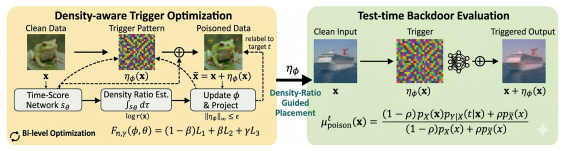
bilevel optimization framework that estimates density ratios via conditional time-score matching and optimizes a mixture-model objective to place triggered samples in sparse regions
What would settle it
Finding that an attack with triggers not steered to low-density regions achieves similar post-defense performance on the same datasets would falsify the central claim.
Extended reading notes
Core claim
Both attack success and clean-accuracy preservation are simultaneously optimized when triggered samples are steered into low-density regions of the clean data distribution, a distributional condition that controls all moments of the poisoned distribution at once rather than a handful of input-space summary statistics. We introduce a bilevel optimization framework that estimates density ratios via conditional time-score matching and optimizes a mixture-model objective to place triggered samples in these sparse regions.
Load-bearing premise
The victim's training process follows a Bayes-optimal model, which is used to derive the criteria for optimal trigger construction.
Editorial extensions
If this is right
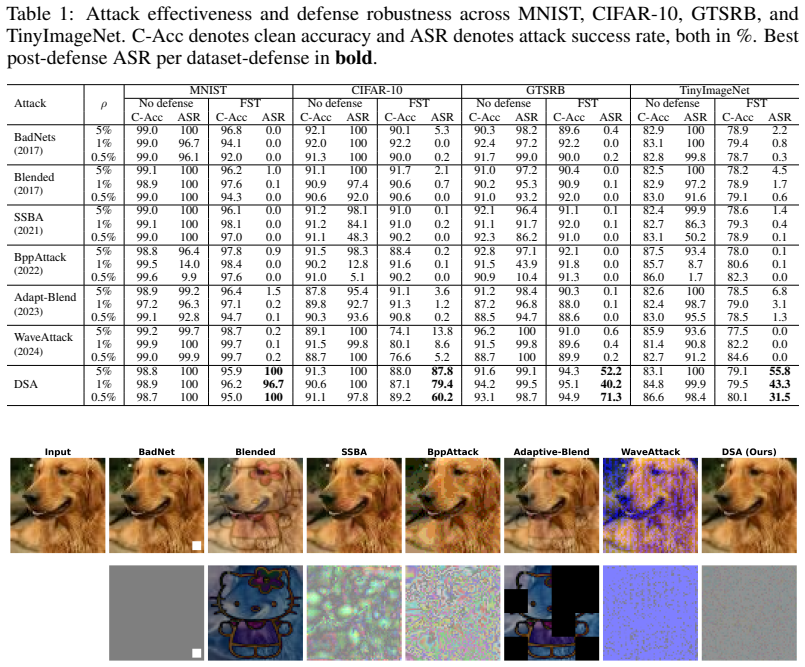
- The method achieves above 99% attack success rate before defense.
- It retains 50--85 percentage points higher post-defense ASR than the strongest baselines under fine-tuning defenses.
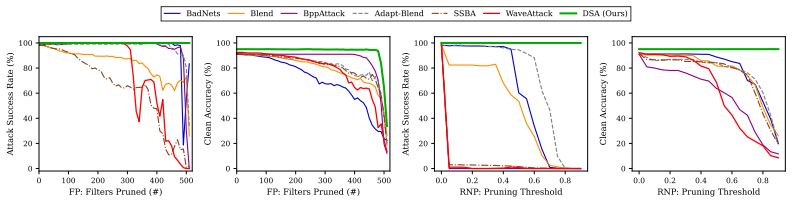
- The attack exhibits complete immunity to neuron-pruning defenses, with zero neurons identified for removal across all pruning thresholds.
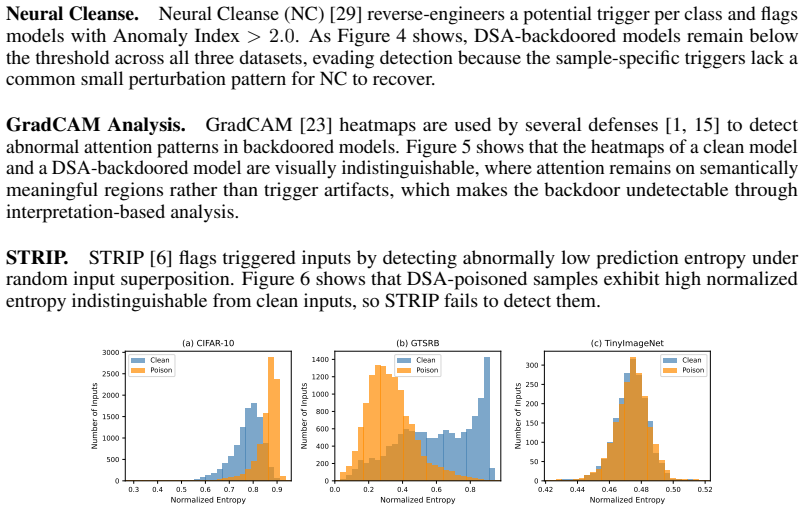
- These results indicate that current defenses fail when triggers lie outside the support of the clean distribution.
Reading between the lines
- Defenses operating only on the support of the clean distribution are likely to be bypassed by such density-aware attacks.
- The approach could be extended to other types of data poisoning by targeting low-density areas.
- Testing the method on additional model architectures or non-image domains would reveal its broader applicability.
Editorial analysis
A structured set of objections, weighed in public.
Referee Report
Summary. The paper derives principled criteria for optimal sample-specific backdoor triggers under a Bayes-optimal victim model, showing that steering triggers into low-density regions of the clean distribution simultaneously maximizes attack success rate (ASR) and preserves clean accuracy by controlling all moments of the poisoned distribution. It introduces a bilevel optimization that estimates density ratios via conditional time-score matching and optimizes a mixture-model objective, reporting >99% pre-defense ASR and 50-85pp higher post-fine-tuning ASR than baselines on MNIST/CIFAR-10/GTSRB/TinyImageNet, plus complete immunity to neuron pruning.
Significance. If the transfer from the Bayes-optimal derivation to practical SGD training holds and the density-ratio estimates are shown independent of the reported ASR numbers, the result would identify a structural limitation in current post-training defenses that rely on support or moment-matching assumptions, motivating new defense paradigms that explicitly address low-density poisoning.
major comments (3)
- [Abstract, §3] Abstract (first paragraph) and §3 (Bayes-optimal derivation): the optimality criteria are obtained by analyzing the effect of low-density placement on a Bayes-optimal classifier; no section demonstrates that the same distributional condition remains optimal under the non-convex SGD dynamics used in the MNIST/CIFAR experiments, leaving the central claim dependent on an unverified modeling assumption.
- [§4, experimental results] §4 (bilevel optimization) and experimental section: the density-ratio estimator is learned via conditional time-score matching and appears inside the mixture-model objective, yet no ablation or sensitivity analysis shows that the final ASR numbers are independent of the estimator's hyperparameters or training data; the reported 99% ASR and defense immunity therefore rest on unquantified estimation error.
- [Table 2, Figure 4] Table 2 / Figure 4 (post-defense ASR): the method claims 50-85pp gains over baselines under fine-tuning, but the abstract and results provide neither error bars across random seeds nor verification that the Bayes-optimal derivation was checked on the actual trained models, so the cross-method comparison cannot be assessed for statistical reliability.
minor comments (2)
- [§4.1] Notation for the conditional time-score matching loss is introduced without an explicit equation reference in the main text; adding the precise objective (currently only in appendix) would improve readability.
- [experimental results] The claim of 'complete immunity' to neuron pruning (zero neurons identified) should be accompanied by the exact pruning thresholds and identification criterion used, rather than a single summary sentence.
Simulated Author's Rebuttal
We thank the referee for the constructive comments. Below we respond point-by-point to the major comments, indicating planned revisions where appropriate.
read point-by-point responses
-
Referee: [Abstract, §3] Abstract (first paragraph) and §3 (Bayes-optimal derivation): the optimality criteria are obtained by analyzing the effect of low-density placement on a Bayes-optimal classifier; no section demonstrates that the same distributional condition remains optimal under the non-convex SGD dynamics used in the MNIST/CIFAR experiments, leaving the central claim dependent on an unverified modeling assumption.
Authors: The Bayes-optimal derivation is presented as a theoretical motivation that identifies low-density placement as simultaneously controlling attack success and all moments of the poisoned distribution. We do not claim a formal optimality guarantee under SGD; the manuscript relies on this condition as a guiding principle whose practical utility is validated empirically. In revision we will add an explicit discussion paragraph in §3 clarifying the modeling assumption and noting that transfer to SGD-trained models is supported by the reported results rather than proven. revision: partial
-
Referee: [§4, experimental results] §4 (bilevel optimization) and experimental section: the density-ratio estimator is learned via conditional time-score matching and appears inside the mixture-model objective, yet no ablation or sensitivity analysis shows that the final ASR numbers are independent of the estimator's hyperparameters or training data; the reported 99% ASR and defense immunity therefore rest on unquantified estimation error.
Authors: We agree that additional sensitivity analysis would increase confidence in the results. In the revised version we will add an ablation subsection reporting ASR under varied hyperparameters of the conditional time-score matching estimator and under different subsets of training data used for density-ratio estimation. revision: yes
-
Referee: [Table 2, Figure 4] Table 2 / Figure 4 (post-defense ASR): the method claims 50-85pp gains over baselines under fine-tuning, but the abstract and results provide neither error bars across random seeds nor verification that the Bayes-optimal derivation was checked on the actual trained models, so the cross-method comparison cannot be assessed for statistical reliability.
Authors: We acknowledge the lack of error bars. In revision we will rerun all experiments with at least five random seeds and report means and standard deviations in Table 2 and Figure 4. Verification that the Bayes-optimal condition holds exactly on the trained (non-Bayes-optimal) models was not performed; we will add a short paragraph in the discussion section explaining that such verification lies outside the current scope and is left for future work. revision: partial
Circularity Check
No circularity: derivation rests on explicit external Bayes-optimal assumption
full rationale
The paper states its core criteria are derived under a Bayes-optimal model of the victim's training (abstract). This is presented as an external modeling choice used to analyze the effect of low-density placement on the poisoned distribution. No equations or steps in the provided text reduce the claimed optimality condition to a fitted parameter, self-citation, or input by construction. The subsequent bilevel optimization (density-ratio estimation via time-score matching) is a separate implementation step whose outputs are not shown to be tautological with the final ASR metrics. The derivation chain is therefore self-contained; the transferability concern to SGD training is a question of assumption validity, not circularity.
Assumptions & free parameters
free parameters (1)
- density ratio estimator parameters
assumptions (1)
- domain assumption Victim's training follows a Bayes-optimal model
Cite this review
Pith. "Pith review of Density-aware Sample-specific Attack." pith.science (2026). https://pith.science/paper/F2UQ2L6Q
@misc{pith2026260527809,
  author       = {Pith},
  title        = {Pith review of: Density-aware Sample-specific Attack},
  year         = {2026},
  howpublished = {\url{https://pith.science/paper/F2UQ2L6Q}},
  note         = {Machine review of arXiv:2605.27809}
}
read the original abstract
Despite recent progress in backdoor attacks, existing methods remain susceptible to post-training defenses that erase the backdoor through fine-tuning or pruning. We revisit the core objectives of backdoor attacks and derive principled criteria characterizing optimal sample-specific trigger construction under a Bayes-optimal model of the victim's training. Our analysis reveals that both attack success and clean-accuracy preservation are simultaneously optimized when triggered samples are steered into low-density regions of the clean data distribution, a distributional condition that controls all moments of the poisoned distribution at once rather than a handful of input-space summary statistics. We introduce a bilevel optimization framework that estimates density ratios via conditional time-score matching and optimizes a mixture-model objective to place triggered samples in these sparse regions. Extensive evaluations on MNIST, CIFAR-10, GTSRB, and TinyImageNet demonstrate that our method achieves above 99\% attack success rate before defense and retains 50--85 percentage points higher post-defense ASR than the strongest baselines under fine-tuning defenses. Against neuron-pruning defenses, the method exhibits complete immunity, with zero neurons identified for removal across all pruning thresholds. These results expose a fundamental gap in current defense paradigms and underscore the need for defenses that operate beyond the support of the clean distribution.
Figures
Figures from the paper (2 more)
Reference graph
Works this paper leans on
-
[1]
H. Chen, C. Fu, J. Zhao, and F. Koushanfar. DeepInspect: A black-box trojan detection and mitigation framework for deep neural networks. InIJCAI, volume 2, page 8, 2019
2019
-
[2]
X. Chen, C. Liu, B. Li, K. Lu, and D. Song. Targeted backdoor attacks on deep learning systems using data poisoning.arXiv preprint arXiv:1712.05526, 2017
work page Pith review arXiv 2017
-
[3]
J. Deng, W. Dong, R. Socher, L.-J. Li, K. Li, and L. Fei-Fei. ImageNet: A large-scale hierarchical image database. In2009 IEEE conference on computer vision and pattern recognition, pages 248–255. Ieee, 2009
2009
-
[4]
K. Doan, Y . Lao, W. Zhao, and P. Li. Lira: Learnable, imperceptible and robust backdoor attacks. InProceedings of the IEEE/CVF international conference on computer vision, pages 11966–11976, 2021
2021
-
[5]
Franceschi, P
L. Franceschi, P. Frasconi, S. Salzo, R. Grazzi, and M. Pontil. Bilevel programming for hyperparameter optimization and meta-learning. InInternational conference on machine learning, pages 1568–1577. PMLR, 2018
2018
-
[6]
Y . Gao, C. Xu, D. Wang, S. Chen, D. C. Ranasinghe, and S. Nepal. STRIP: A defence against trojan attacks on deep neural networks. InProceedings of the 35th annual computer security applications conference, pages 113–125, 2019
2019
-
[7]
T. Gu, B. Dolan-Gavitt, and S. Garg. BadNets: Identifying vulnerabilities in the machine learning model supply chain.arXiv preprint arXiv:1708.06733, 2017
work page Pith review arXiv 2017
-
[8]
K. He, X. Zhang, S. Ren, and J. Sun. Deep residual learning for image recognition. In Proceedings of the IEEE conference on computer vision and pattern recognition, pages 770– 778, 2016
2016
Show all 38 references
-
[9]
Jiang, H
W. Jiang, H. Li, G. Xu, and T. Zhang. Color backdoor: A robust poisoning attack in color space. InProceedings of the IEEE/CVF conference on computer vision and pattern recognition, pages 8133–8142, 2023
2023
-
[10]
Krizhevsky, G
A. Krizhevsky, G. Hinton, et al. Learning multiple layers of features from tiny images, 2009
2009
-
[11]
LeCun, L
Y . LeCun, L. Bottou, Y . Bengio, and P. Haffner. Gradient-based learning applied to document recognition.Proceedings of the IEEE, 86(11):2278–2324, 1998
1998
-
[12]
Y . Li, Y . Li, B. Wu, L. Li, R. He, and S. Lyu. Invisible backdoor attack with sample-specific triggers. InProceedings of the IEEE/CVF international conference on computer vision, pages 16463–16472, 2021
2021
-
[13]
Y . Li, X. Lyu, X. Ma, N. Koren, L. Lyu, B. Li, and Y .-G. Jiang. Reconstructive neuron pruning for backdoor defense. InInternational Conference on Machine Learning, pages 19837–19854. PMLR, 2023
2023
-
[14]
K. Liu, B. Dolan-Gavitt, and S. Garg. Fine-pruning: Defending against backdooring attacks on deep neural networks. InInternational symposium on research in attacks, intrusions, and defenses, pages 273–294. Springer, 2018
2018
-
[15]
Liu, W.-C
Y . Liu, W.-C. Lee, G. Tao, S. Ma, Y . Aafer, and X. Zhang. Abs: Scanning neural networks for back-doors by artificial brain stimulation. InProceedings of the 2019 ACM SIGSAC conference on computer and communications security, pages 1265–1282, 2019
2019
-
[16]
Z. Liu, Y . Lin, Y . Cao, H. Hu, Y . Wei, Z. Zhang, S. Lin, and B. Guo. Swin transformer: Hierarchical vision transformer using shifted windows. InProceedings of the IEEE/CVF international conference on computer vision, pages 10012–10022, 2021. 10
2021
-
[17]
Lorraine, P
J. Lorraine, P. Vicol, and D. Duvenaud. Optimizing millions of hyperparameters by implicit differentiation. InInternational conference on artificial intelligence and statistics, pages 1540–1552. PMLR, 2020
2020
-
[18]
R. Min, Z. Qin, L. Shen, and M. Cheng. Towards stable backdoor purification through feature shift tuning.Advances in Neural Information Processing Systems, 36:75286–75306, 2023
2023
-
[19]
Nguyen and A
A. Nguyen and A. Tran. Wanet–imperceptible warping-based backdoor attack.arXiv preprint arXiv:2102.10369, 2021
2021
-
[20]
T. A. Nguyen and A. Tran. Input-aware dynamic backdoor attack.Advances in Neural Information Processing Systems, 33:3454–3464, 2020
2020
-
[21]
B. A. Pearlmutter. Fast exact multiplication by the hessian.Neural computation, 6(1):147–160, 1994
1994
-
[22]
X. Qi, T. Xie, Y . Li, S. Mahloujifar, and P. Mittal. Revisiting the assumption of latent separability for backdoor defenses. InThe eleventh international conference on learning representations, 2023
2023
-
[23]
R. R. Selvaraju, M. Cogswell, A. Das, R. Vedantam, D. Parikh, and D. Batra. Grad-CAM: Visual explanations from deep networks via gradient-based localization. InProceedings of the IEEE international conference on computer vision, pages 618–626, 2017
2017
-
[24]
J. R. Shewchuk et al. An introduction to the conjugate gradient method without the agonizing pain, 1994
1994
-
[25]
Stallkamp, M
J. Stallkamp, M. Schlipsing, J. Salmen, and C. Igel. The german traffic sign recognition benchmark: a multi-class classification competition. InThe 2011 international joint conference on neural networks, pages 1453–1460. IEEE, 2011
2011
-
[26]
B. Tran, J. Li, and A. Madry. Spectral signatures in backdoor attacks.Advances in neural information processing systems, 31, 2018
2018
-
[27]
Turner, D
A. Turner, D. Tsipras, and A. Madry. Label-consistent backdoor attacks.arXiv preprint arXiv:1912.02771, 2019
1912
-
[28]
P. Vincent. A connection between score matching and denoising autoencoders.Neural compu- tation, 23(7):1661–1674, 2011
2011
-
[29]
B. Wang, Y . Yao, S. Shan, H. Li, B. Viswanath, H. Zheng, and B. Y . Zhao. Neural cleanse: Identifying and mitigating backdoor attacks in neural networks. In2019 IEEE symposium on security and privacy (SP), pages 707–723. IEEE, 2019
2019
-
[30]
T. Wang, Y . Yao, F. Xu, S. An, H. Tong, and T. Wang. An invisible black-box backdoor attack through frequency domain. InEuropean Conference on Computer Vision, pages 396–413. Springer, 2022
2022
-
[31]
Z. Wang, J. Zhai, and S. Ma. BppAttack: Stealthy and efficient trojan attacks against deep neural networks via image quantization and contrastive adversarial learning. InProceedings of the IEEE/CVF conference on computer vision and pattern recognition, pages 15074–15084, 2022
2022
-
[32]
Wu and Y
D. Wu and Y . Wang. Adversarial neuron pruning purifies backdoored deep models. In M. Ranzato, A. Beygelzimer, Y . Dauphin, P. Liang, and J. W. Vaughan, editors,Advances in Neural Information Processing Systems, volume 34, pages 16913–16925. Curran Associates, Inc., 2021
2021
-
[33]
J. Xia, Z. Yue, Y . Zhou, Z. Ling, Y . Shi, X. Wei, and M. Chen. WaveAttack: Asymmetric frequency obfuscation-based backdoor attacks against deep neural networks.Advances in Neural Information Processing Systems, 37:43549–43570, 2024
2024
-
[34]
Y . Yang, C. Jia, D. Yan, M. Hu, T. Li, X. Xie, X. Wei, and M. Chen. SampDetox: Black-box backdoor defense via perturbation-based sample detoxification.Advances in Neural Information Processing Systems, 37:121236–121264, 2024. 11
2024
-
[35]
H. Yu, A. Klami, A. Hyvärinen, A. Korba, and O. Chehab. Density ratio estimation with conditional probability paths. InForty-second International Conference on Machine Learning, 2025
2025
-
[36]
Y . Zeng, S. Chen, W. Park, Z. M. Mao, M. Jin, and R. Jia. Adversarial unlearning of backdoors via implicit hypergradient.arXiv preprint arXiv:2110.03735, 2021
2021
-
[37]
M. Zhu, S. Wei, L. Shen, Y . Fan, and B. Wu. Enhancing fine-tuning based backdoor defense with sharpness-aware minimization. InProceedings of the IEEE/CVF international conference on computer vision, pages 4466–4477, 2023. 12 A Implementation Details A.1 Our Algorithm Algorith...
2023
-
[38]
to just 12.87% (Level 5), and FST similarly reduces ASR from 87.12% to 43.92%. This suggests that when the trigger optimization relies on a weaker clean classifier, the resulting backdoor becomes more entangled with limited feature representations, hence is easier to disrupt t...
Reviewed June 29, 2026 · model on record in the stance chip above.
Discussion (0). Sign in to comment.