REVIEW 4 major objections 7 minor 65 references
Random long-range hopping forces volume-law entanglement in monitored 1D free fermions for any measurement strength when the hop decays slowly enough.
Reviewed by Pith at T0; open to challenge. T0 means a machine referee read the full paper against a public rubric. the ladder, T0–T4 →
T0 review · grok-4.5
2026-07-30 13:44 UTC pith:F3KPCEBX
load-bearing objection Solid α–γ phase diagram for monitored PRBM fermions; the “area law for any γ when α>3/2” leg is asserted harder than the weak-γ data support. the 4 major comments →
Entanglement transitions and multifractality in monitored free-fermions with random long-range hopping
The pith
A machine-rendered reading of the paper's core claim, the machinery that carries it, and where it could break.
Core claim
For monitored free complex fermions with random power-law hopping of exponent α, the steady-state entanglement entropy is sub-volume (tending to volume law for α ≲ 1/2) for any monitoring strength when α ≲ 1, is strictly area-law for any monitoring strength when α > 3/2, and undergoes a measurement-induced transition between those phases when 1 < α ≲ 3/2; at the critical line the entropy is logarithmic and the density-density correlator is multifractal.
What carries the argument
The density-density correlator C(r) = |D_{i+r,i}|^2 extracted from the Gaussian correlation matrix, whose power-law decay C(r) ∝ r^{-(α+1/2)} is derived from the trajectory-averaged Itô equation for D and directly controls the second particle-number cumulant and hence the entanglement entropy via the cumulant expansion.
Load-bearing premise
The analytic decay of correlations assumes that off-diagonal unitary terms cancel and that the time derivative of the correlation matrix can be dropped, approximations the authors themselves say fail both for very long-range hops and for ordinary diffusion.
What would settle it
Measure the half-chain entanglement entropy versus system size for fixed weak monitoring (γ ≲ 0.3) at α = 1.6 and α = 1.4; if the former remains size-independent while the latter grows as a power of L, the claimed phase boundary at α = 3/2 is confirmed.
If this is right
- Superdiffusive classical hopping alone is sufficient to protect volume-law entanglement against arbitrary local monitoring in one dimension.
- The critical line 1 < α_c(γ) ≲ 3/2 is a continuous family of multifractal fixed points whose singularity spectrum peak α_0 rises with monitoring strength.
- For α > 3/2 the monitored long-range model collapses to the same area-law physics already known for short-range free fermions.
- Any future analytic theory (e.g., nonlinear sigma model) must reproduce the explicit relation a_s ≃ 3/2 − α for the entanglement exponent in the sub-volume phase.
Where Pith is reading between the lines
- The same α = 3/2 boundary that separates power-law localization from ordinary Anderson insulation in the unmonitored PRBM spectrum reappears as the boundary beyond which monitoring can enforce an area law, suggesting a deeper link between single-particle localization length and measurement-induced entanglement.
- Because the derivation never uses fermionic statistics beyond Gaussianity, an analogous volume-law protection should appear for monitored bosonic or spin models with the same random long-range couplings.
- Finite-size drifts at weak γ may still hide a very weak MIPT for α slightly above 3/2; larger-scale GPU simulations or an NLSM treatment would settle the issue.
Editorial analysis
A structured set of objections, weighed in public.
Referee Report
Summary. The manuscript studies the steady-state entanglement of continuously monitored (QSD protocol) one-dimensional free complex fermions with random power-law hopping t_ij ~ |i-j|^{-α} (the PRBM ensemble). Using mutual-information crossings with finite-size collapse (L up to 3200), bipartite EE scaling, the density-density correlator C(r), and a multifractal singularity-spectrum analysis, the authors construct a phase diagram in the (α, γ) plane: sub-volume (approaching volume-law) EE scaling for any monitoring when α ≲ 1, an α-dependent MIPT line for 1 < α ≲ 3/2 with logarithmic EE and multifractal C(r) at criticality, and a claimed area-law phase for any γ when α > 3/2. An analytic treatment of the averaged Itô equation for the correlation matrix, under a steady-state and off-diagonal-cancellation approximation, yields C(r) ~ r^{-(α+1/2)} and hence S ~ L^{3/2-α}, in good agreement with the fitted exponents in the stated window of validity.
Significance. If the phase diagram holds, this is a useful and timely contribution: it is, to my knowledge, the first systematic entanglement phase diagram for monitored free fermions with random long-range hopping, and it cleanly connects the static PRBM classification (extended / power-law-localized / short-range-like at α = 1, 3/2) to the monitored dynamics. The work has several concrete strengths: multiple independent diagnostics (I_2 crossings and collapse, EE and I_2 L-scaling, C(r) exponents, P(ln I_2) scale invariance, f(α_q)) are mutually consistent; system sizes are large for this type of simulation; time-step convergence is checked explicitly (Fig. 11(a)); the critical exponent relation a_r = α + 1/2 is derived rather than fitted, and the data in Fig. 8(c) track it over three decades of γ; and the authors are unusually candid about the non-universality and instability of the extracted ν. The analytic derivation, while approximate, is transparent about its assumptions and produces a falsifiable, γ-independent exponent prediction that the numerics confirm within its stated window.
major comments (4)
- [§III.A, Fig. 12(a,b) and Fig. 1] The phase diagram's α > 3/2 leg — area law for *any* γ > 0 — is contradicted at face value by the paper's own weak-monitoring crossings: α_c = 1.59 ± 0.01 (γ = 0.1) and α_c = 1.52 ± 0.01 (γ = 0.3), with α_c monotonically increasing as γ decreases below 0.5 (α_c = 1.49 at γ = 0.5). The text attributes this to finite-size effects and notes that γ ≲ 0.3 is 'numerically challenging', but no analysis demonstrating the crossing actually drifts below 3/2 with increasing L is shown. Since the sizes used at γ = 0.1, 0.3 (L = 512–3200) are the same as those used to establish the transition at γ = 0.5, an unsupported drift assumption is doing load-bearing work for one of the three regions of Fig. 1. The authors should either (i) provide a crossing-drift analysis (α_c vs. minimum L in the collapse window, or vs. L directly), or an estimate of the crossover length near α → 3/2⁺ (where PRBM power-law-
- [§III.D, Eqs. (14)–(28), Fig. 9] The analytic derivation of C(r) ~ r^{-(α+1/2)} rests on three approximations whose support in the manuscript is thin: (a) dD_ij/dt ≈ 0 is justified only by Fig. 9 at a single system size L = 128 and a single parameter point (γ = 0.1, α = 1.5), which the caption itself describes as 'effectively the superdiffusive regime' at this size; (b) the cancellation of off-diagonal unitary terms (used both above Eq. (14) and in Eq. (17)) is asserted, not checked; (c) μ is treated as a positive constant, yet μ ∝ 1/γ, so the steady-state balance in Eq. (26) must fail as γ → 0 at fixed α — the regime where, per comment 1, the numerics are already most delicate. Given that the exponent prediction is compared against data across 1/2 < α ≲ α_c and is one of the paper's headline results, the authors should at minimum show Fig. 9-type diagnostics across the α window (including near α ≈ 1/2 where they state
- [§III.D, Eq. (30) and Fig. 8(a)] The EE prediction S ~ L^{3/2-α} is obtained by truncating the cumulant expansion Eq. (9) at second order. Appendix B (Fig. 11(b)) validates this truncation only at γ = 0.5, L = 2048, and the agreement is described as holding 'around the critical values of α'. Since the truncation is used to convert Eq. (28) into the sub-volume-law exponent that is then compared to fits over the whole superdiffusive region (and at γ = 0.1 and 2.0 in Fig. 8(a)), the validity of S ≈ (π²/3) C^(2) should be demonstrated in the sub-volume phase and at strong/weak monitoring, not only near criticality. This is presumably a straightforward extension of existing data but is currently a gap in the chain from Eq. (28) to Fig. 8(a).
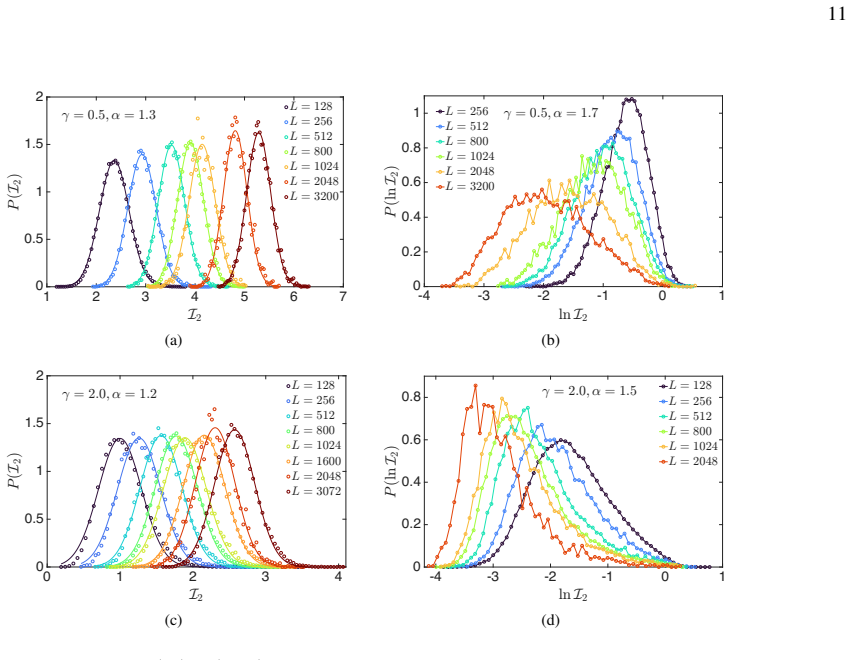
- [§III.C and Appendix D, Eqs. (D1)–(D5)] The multifractal analysis defines τ(q) = q(d+1) + Δ_q, so that the claim 'Δ_{q=1} ≈ 0 confirms C(r) ~ r^{-2}' is partially tautological: the (d+1) offset is chosen using the average C(r) exponent, and Fig. 15 then reports Δ_{q=1} = 0.02 ± 0.017, i.e., consistent with zero by construction of the reference. The genuinely non-trivial content is the curvature of τ(q) (equivalently α_0 > 2d in the parabolic fit). The presentation should be tightened to make clear which parts of the analysis are self-consistency checks and which constitute independent evidence of multifractality; error bars on f(α_q) away from q = 1 would also strengthen Fig. 7.
minor comments (7)
- [Fig. 9 caption] The statement 'the scale of ln D_ij is more than 20 times larger than ln dD_ij/dt' is misleading as phrased: the colorbars show ln D_ij ∈ (−12, −4) vs. ln dD_ij/dt ∈ (−12, −7), so the magnitudes of the logarithms differ by less than a factor of 2 in places. What matters is the ratio of the quantities themselves (e^Δln). Please reword and label the colorbars.
- [Fig. 8(b)] There is a stray trailing token in the legend ('a_p = 1.13 − 0.59α, 2.12' for γ = 2.0); presumably a fit-range annotation that should be cleaned up.
- [§III.D, after Eq. (27)] Typo: 'balance the terms in the right size of Eq. (26)' → 'right-hand side'.
- [Notation] α is overloaded for the hopping exponent and the singularity-spectrum variable α_q (Fig. 7, Appendix D); consider α → a or f(α_q) → f(ϑ) in the multifractal sections to avoid confusion, especially since both appear in the same figure discussion.
- [References] Ref. [55] is the same paper as Ref. [28] (Szyniszewski, Lunt, Pal, PRB 108, 165126) and should be merged. Refs. [47, 48, 61, 62] are 2026 preprints; the important input that short-range monitored disordered complex fermions are always area-law (used for the α > 3/2 leg) currently rests on the preprint [48] — a pointer to any peer-reviewed version would strengthen the citation.
- [§II] Please state how the saturation time t_f scales with L and α near criticality, and confirm that the largest systems (L = 2048–3200) were evolved well beyond the t_f estimated at L = 128; this matters for the reliability of the crossings used in Fig. 12.
- [Fig. 2 / Appendix A] The collapse ansatz y(x) = I_2(α, L) with no L-dependent rescaling of y assumes exact scale invariance of I_2 at criticality; a brief note on how sensitive α_c is to allowing a subleading correction (e.g., I_2 = I_2^* + c L^{-ω}) would be useful, given the acknowledged instability of ν.
Circularity Check
No significant circularity: phase boundaries and C(r)∼r^{-(α+1/2)} are independently obtained from numerics and an Itô derivation under stated approximations; only a minor non-load-bearing self-citation supports the α>3/2 analogy.
specific steps
-
self citation load bearing
[Sec. III.D, paragraph on α>3/2; also Introduction/Conclusion phase-diagram claims]
"In the region α>3/2, the system crosses over to classical diffusion and the approximations leading to Eq. (28) no longer apply. The long-range tail is then irrelevant at long distances, and therefore the monitored dynamics is similar to that of monitored free fermions with short range hopping which results [48] in the absence of a MIPT."
The strong claim that the system is area-law for any γ when α>3/2 is partly propped by citation [48] (Yin–Fan–García-García, overlapping authors) that short-range monitored 1d complex fermions have no MIPT. This is a minor supporting analogy, not a definitional circle or uniqueness import: the long-range numerics and the Itô derivation are independent, and [48] is a separate numerical study. Raises score only to 1.
full rationale
The central results—finite-size I₂ crossings locating α_c(γ), EE and MI power-law/log/area scalings, C(r) decay exponents, and the parabolic multifractal spectrum—are extracted directly from the monitored PRBM trajectories and are not forced by construction from their inputs. The analytic chain in Sec. III.D starts from the averaged QSD equation for D_ij, imposes explicit approximations (neglect ∂_t D_ij off-diagonal, cancel off-diagonal unitary pieces, treat μ as a positive constant, power-law ansatz f_n∼n^{-z}), and balances powers to obtain z=α+1/2 and S∼L^{3/2-α}; these steps are derivations under stated assumptions that the paper itself flags as breaking down outside 1/2≲α≲α_c, and the resulting exponent is then compared to independent fits rather than fitted to force the claim. The short-range area-law analogy used for α>3/2 cites overlapping-author work [48], but that is ordinary supporting literature for a separate model, not a uniqueness theorem or a definitional reduction of the long-range phase diagram. Standard data-collapse fits for (α_c,ν) and parabolic f(α_q) fits are results, not circular predictions. Correctness concerns about weak-γ crossings sitting slightly above 3/2 are evidence/finite-size issues, not circularity. Score 1 only for the minor self-citation on the α>3/2 leg.
Axiom & Free-Parameter Ledger
free parameters (4)
- α_c(γ) =
e.g. 1.49±0.01 (γ=0.5), 1.36±0.01 (γ=2.0)
- ν (finite-size exponent) =
≈3–5.5 depending on γ
- α_0 (singularity-spectrum peak) =
2.17±0.02 (γ=0.5), 2.49±0.02 (γ=2.0)
- μ (occupation inhomogeneity prefactor)
axioms (5)
- domain assumption Continuous QSD monitoring of local occupation preserves Gaussianity of free-fermion states, so the correlation matrix D_ij fully determines the EE.
- domain assumption Single-particle PRBM eigenstate regimes (extended/multifractal/localized) are controlled solely by α, independent of disorder strength.
- ad hoc to paper In the dynamical steady state, dD_ij/dt≈0 for i≠j and off-diagonal unitary contributions cancel, leaving D_ij≈(i H_ij/γ)(D_ii−D_jj).
- domain assumption Leading EE scaling is captured by the second particle-number cumulant, S≈(π²/3)C^{(2)}.
- ad hoc to paper For α>3/2 the long-range tail is irrelevant and the monitored dynamics reduces to short-range free fermions (always area-law).
read the original abstract
We study the entanglement dynamics of a one-dimensional chain of monitored non-interacting complex fermions with random power-law hopping characterized by a decay exponent $\alpha$. For $\alpha \lesssim 1$, in stark contrast with the case of hopping to nearest neighbors, the scaling of the entanglement entropy (EE) of the steady state with system size $L$ is faster than logarithmic for any monitoring or disorder strength and it tends towards a linear (volume-law) scaling for sufficiently small $\alpha \lesssim 1/2$. For $\alpha > 3/2$, the EE is in the area-law phase, namely, no scaling with $L$, for any monitoring strength. For $1 < \alpha \lesssim 3/2$, we identify an $\alpha$-dependent measurement-induced phase transition (MIPT) at a critical value of the monitoring strength separating the mentioned area-law and sub-volume-law phases. At this critical point, the EE scales logarithmically with system size, and the density-density correlation function, closely related to the EE, exhibits multifractal features. These results highlight the importance of superdiffusive classical hopping in the entanglement dynamic of quantum many-body systems and also help differentiate its role with respect to conventional sources of entanglement such as genuine quantum non-locality.
Figures



Reference graph
Works this paper leans on
-
[1]
Asαincreases, the exponenta s decreases approximately linearly, followinga s ≃3/2−αand ap- proaches zero asα→3/2, see Fig
More specifically, forα≲0.5,a s ∼1, so the scaling is volume-law. Asαincreases, the exponenta s decreases approximately linearly, followinga s ≃3/2−αand ap- proaches zero asα→3/2, see Fig. 8(a). Forα≈3/2, the scaling becomes logarithmicS(ℓ A =L/2)∼ln(L), which is characteristic of(1 + 1)-dimensional conformal field theories (CFTs) [58, 59]. For largerα, t...
2048
-
[2]
To propagate the statistical errors in the original data into uncertainties onα c andν, we then employ the Monte Carlo samplings
MinimizingRover(α, ν)gives our best estimates for αc andν. To propagate the statistical errors in the original data into uncertainties onα c andν, we then employ the Monte Carlo samplings. We generate1×10 4 synthetic data sets by adding independent Gaussian noise to eachI 2(α, L), with variance equal to the corresponding variance of the original data. For...
2048
-
[3]
P. W. Anderson, Absence of diffusion in certain random lat- tices, Phys. Rev.109, 1492 (1958)
1958
-
[4]
Abrahams, P
E. Abrahams, P. W. Anderson, D. C. Licciardello, and T. V . Ramakrishnan, Scaling theory of localization: Absence of quantum diffusion in two dimensions, Phys. Rev. Lett.42, 673 (1979)
1979
-
[5]
Evers and A
F. Evers and A. D. Mirlin, Anderson transitions, Rev. Mod. Phys.80, 1355 (2008)
2008
-
[6]
A. M. Garc ´ıa-Garc´ıa, Semiclassical theory of the anderson transition, Phys. Rev. Lett.100, 076404 (2008)
2008
-
[7]
Castellani and L
C. Castellani and L. Peliti, Multifractal wavefunction at the localisation threshold, Journal of Physics A: Mathematical and General19, L429 (1986)
1986
-
[8]
Schreiber and H
M. Schreiber and H. Grussbach, Multifractal wave functions at the anderson transition, Phys. Rev. Lett.67, 607 (1991)
1991
-
[9]
Rodriguez, L
A. Rodriguez, L. J. Vasquez, K. Slevin, and R. A. R ¨omer, Multifractal finite-size scaling and universality at the ander- son transition, Phys. Rev. B84, 134209 (2011)
2011
-
[10]
A. M. Garc ´ıa-Garc´ıa and E. Cuevas, Dimensional depen- dence of the metal-insulator transition, Phys. Rev. B75, 174203 (2007)
2007
-
[11]
Wegner, The mobility edge problem: continuous symme- try and a conjecture, Zeitschrift f¨ur Physik B35, 207 (1979)
F. Wegner, The mobility edge problem: continuous symme- try and a conjecture, Zeitschrift f¨ur Physik B35, 207 (1979)
1979
-
[12]
B. I. Shklovskii, B. Shapiro, B. R. Sears, P. Lambrianides, and H. B. Shore, Statistics of spectra of disordered systems near the metal-insulator transition, Phys. Rev. B47, 11487 (1993)
1993
-
[13]
E. B. Bogomolny, U. Gerland, and C. Schmit, Models of intermediate spectral statistics, Phys. Rev. E59, R1315 (1999)
1999
-
[14]
V . E. Kravtsov, I. V . Lerner, B. L. Altshuler, and A. G. Aronov, Universal spectral correlations at the mobility edge, Phys. Rev. Lett.72, 888 (1994)
1994
-
[15]
A. M. Garc ´ıa-Garc´ıa and J. J. M. Verbaarschot, Critical statistics in quantum chaos and calogero-sutherland model at finite temperature, Phys. Rev. E67, 046104 (2003)
2003
-
[16]
A. D. Mirlin, Y . V . Fyodorov, F.-M. Dittes, J. Quezada, and T. H. Seligman, Transition from localized to extended eigenstates in the ensemble of power-law random banded matrices, Phys. Rev. E54, 3221 (1996)
1996
-
[17]
A. D. Mirlin, Statistics of energy levels and eigenfunctions in disordered systems, Physics Reports326, 259 (2000)
2000
-
[18]
X. Cao, A. Tilloy, and A. De Luca, Entanglement in a fermion chain under continuous monitoring, SciPost Phys. 7, 024 (2019)
2019
-
[19]
Turkeshi, A
X. Turkeshi, A. Biella, R. Fazio, M. Dalmonte, and M. Schir `o, Measurement-induced entanglement transitions in the quantum Ising chain: From infinite to zero clicks, Phys. Rev. B103, 224210 (2021)
2021
-
[20]
Le Gal, X
Y . Le Gal, X. Turkeshi, and M. Schir `o, Entanglement dy- namics in monitored systems and the role of quantum jumps, PRX Quantum5, 030329 (2024)
2024
-
[21]
Buchhold, Y
M. Buchhold, Y . Minoguchi, A. Altland, and S. Diehl, Ef- fective theory for the measurement-induced phase transition of Dirac fermions, Phys. Rev. X11, 041004 (2021)
2021
-
[22]
M. Fava, L. Piroli, T. Swann, D. Bernard, and A. Nahum, Nonlinear sigma models for monitored dynamics of free fermions, Phys. Rev. X13, 041045 (2023)
2023
-
[23]
M. Fava, L. Piroli, D. Bernard, and A. Nahum, Monitored fermions with conservedu(1)charge, Phys. Rev. Res.6, 043246 (2024)
2024
-
[24]
Poboiko, P
I. Poboiko, P. P ¨opperl, I. V . Gornyi, and A. D. Mirlin, Theory of free fermions under random projective measure- ments, Phys. Rev. X13, 041046 (2023)
2023
-
[25]
Chahine and M
K. Chahine and M. Buchhold, Entanglement phases, local- ization, and multifractality of monitored free fermions in two dimensions, Phys. Rev. B110, 054313 (2024)
2024
-
[26]
Poboiko, I
I. Poboiko, I. V . Gornyi, and A. D. Mirlin, Measurement- induced phase transition for free fermions above one dimen- sion, Phys. Rev. Lett.132, 110403 (2024)
2024
-
[27]
Poboiko, I
I. Poboiko, I. V . Gornyi, and A. D. Mirlin, Mesoscopic fluctuations and multifractality at and across measurement- induced phase transitions, Phys. Rev. B112, L220202 (2025)
2025
-
[28]
Altland, M
A. Altland, M. Buchhold, S. Diehl, and T. Micklitz, Dynam- ics of measured many-body quantum chaotic systems, Phys. Rev. Research4, L022066 (2022)
2022
-
[29]
Lunt and A
O. Lunt and A. Pal, Measurement-induced entanglement transitions in many-body localized systems, Phys. Rev. Re- search2, 043072 (2020)
2020
-
[31]
Alberton, M
O. Alberton, M. Buchhold, and S. Diehl, Entanglement tran- sition in a monitored free-fermion chain: From extended criticality to area law, Phys. Rev. Lett.126, 170602 (2021)
2021
-
[32]
Jian, Y .-Z
C.-M. Jian, Y .-Z. You, R. Vasseur, and A. W. W. Ludwig, Measurement-induced criticality in random quantum cir- cuits, Phys. Rev. B101, 104302 (2020)
2020
-
[33]
C.-M. Jian, H. Shapourian, B. Bauer, and A. W. W. Ludwig, Measurement-induced entanglement transitions in quan- tum circuits of non-interacting fermions: Born-rule ver- sus forced measurements (2023), arXiv:2302.09094 [cond- mat.stat-mech]
Pith/arXiv arXiv 2023
-
[34]
M. P. Fisher, V . Khemani, A. Nahum, and S. Vijay, Ran- dom quantum circuits, Annual Review of Condensed Matter Physics14, 335 (2023). 13
2023
-
[35]
Poboiko, P
I. Poboiko, P. P ¨opperl, I. V . Gornyi, and A. D. Mirlin, Measurement-induced transitions for interacting fermions, Phys. Rev. B111, 024204 (2025)
2025
-
[36]
Y . Li, X. Chen, and M. P. A. Fisher, Quantum Zeno effect and the many-body entanglement transition, Phys. Rev. B 98, 205136 (2018)
2018
-
[37]
Skinner, J
B. Skinner, J. Ruhman, and A. Nahum, Measurement- induced phase transitions in the dynamics of entanglement, Phys. Rev. X9, 031009 (2019)
2019
-
[38]
Nahum, S
A. Nahum, S. Roy, B. Skinner, and J. Ruhman, Measure- ment and entanglement phase transitions in all-to-all quan- tum circuits, on quantum trees, and in Landau-Ginsburg the- ory, PRX Quantum2, 010352 (2021)
2021
-
[39]
Ippoliti, M
M. Ippoliti, M. J. Gullans, S. Gopalakrishnan, D. A. Huse, and V . Khemani, Entanglement phase transitions in measurement-only dynamics, Phys. Rev. X11, 011030 (2021)
2021
-
[40]
Y . Li, X. Chen, and M. P. A. Fisher, Measurement-driven entanglement transition in hybrid quantum circuits, Phys. Rev. B100, 134306 (2019)
2019
-
[41]
Carisch, A
C. Carisch, A. Romito, and O. Zilberberg, Quantifying measurement-induced quantum-to-classical crossover using an open-system entanglement measure, Phys. Rev. Res.5, L042031 (2023)
2023
-
[42]
Szyniszewski, A
M. Szyniszewski, A. Romito, and H. Schomerus, Entangle- ment transition from variable-strength weak measurements, Phys. Rev. B100, 064204 (2019)
2019
-
[43]
Szyniszewski, A
M. Szyniszewski, A. Romito, and H. Schomerus, Universal- ity of entanglement transitions from stroboscopic to contin- uous measurements, Phys. Rev. Lett.125, 210602 (2020)
2020
-
[44]
Turkeshi, R
X. Turkeshi, R. Fazio, and M. Dalmonte, Measurement- induced criticality in(2 + 1)-dimensional hybrid quantum circuits, Phys. Rev. B102, 014315 (2020)
2020
-
[45]
Turkeshi, M
X. Turkeshi, M. Dalmonte, R. Fazio, and M. Schir `o, En- tanglement transitions from stochastic resetting of non- Hermitian quasiparticles, Phys. Rev. B105, L241114 (2022)
2022
-
[46]
Y . L. Gal, X. Turkeshi, and M. Schir`o, V olume-to-area law entanglement transition in a non-Hermitian free fermionic chain, SciPost Phys.14, 138 (2023)
2023
-
[47]
R. D. Soares, Y . Le Gal, and M. Schir`o, Entanglement tran- sition due to particle losses in a monitored fermionic chain, Phys. Rev. B111, 064313 (2025)
2025
-
[48]
Efetov, Supersymmetry and theory of disordered metals, Advances in Physics32, 53 (1983)
K. Efetov, Supersymmetry and theory of disordered metals, Advances in Physics32, 53 (1983)
1983
-
[49]
B. Fan, C. Yin, and A. M. Garc´ıa-Garc´ıa, Entanglement dy- namics of monitored noninteracting fermions on graphics processing units, Phys. Rev. B113, 094317 (2026)
2026
-
[50]
C. Yin, F. Bo, and A. M. Garc ´ıa-Garc´ıa, No mea- surement induced phase transition in the entanglement dynamics of monitored non-interacting one-dimensional fermions in a disordered or quasiperiodic potential (2026), arXiv:2605.10758 [quant-ph]
Pith/arXiv arXiv 2026
-
[51]
Minato, K
T. Minato, K. Sugimoto, T. Kuwahara, and K. Saito, Fate of measurement-induced phase transition in long-range inter- actions, Phys. Rev. Lett.128, 010603 (2022)
2022
-
[52]
T. Muller, S. Diehl, and M. Buchhold, Measurement- induced dark state phase transitions in long-ranged fermion systems, Physical Review Letters128, 10.1103/phys- revlett.128.010605 (2022)
doi:10.1103/phys- 2022
-
[53]
A. D. Mirlin and F. Evers, Multifractality and critical fluc- tuations at the anderson transition, Phys. Rev. B62, 7920 (2000)
2000
-
[54]
D. A. Vega-Oliveros, J. A. M ´endez-Berm´udez, and F. A. Rodrigues, Multifractality in random networks with power- law decaying bond strengths, Phys. Rev. E99, 042303 (2019)
2019
-
[55]
Mølmer, Y
K. Mølmer, Y . Castin, and J. Dalibard, Monte carlo wave- function method in quantum optics, J. Opt. Soc. Am. B10, 524 (1993)
1993
-
[56]
Zoller, M
P. Zoller, M. Marte, and D. F. Walls, Quantum jumps in atomic systems, Phys. Rev. A35, 198 (1987)
1987
-
[57]
Szyniszewski, O
M. Szyniszewski, O. Lunt, and A. Pal, Disordered moni- tored free fermions, Phys. Rev. B108, 165126 (2023)
2023
-
[58]
Klich and L
I. Klich and L. Levitov, Quantum noise as an entanglement meter, Phys. Rev. Lett.102, 100502 (2009)
2009
-
[59]
Burmistrov, K
I. Burmistrov, K. Tikhonov, I. Gornyi, and A. Mirlin, En- tanglement entropy and particle number cumulants of dis- ordered fermions, Annals of Physics (NY)383, 140 (2017)
2017
-
[60]
Calabrese and J
P. Calabrese and J. Cardy, Entanglement entropy and quan- tum field theory, Journal of Statistical Mechanics: Theory and Experiment2004, P06002 (2004)
2004
-
[61]
Calabrese and J
P. Calabrese and J. Cardy, Entanglement entropy and con- formal field theory, Journal of Physics A: Mathematical and Theoretical42, 504005 (2009)
2009
-
[62]
A. B. Chhabra, C. Meneveau, R. V . Jensen, and K. R. Sreenivasan, Direct determination of the f(α) singularity spectrum and its application to fully developed turbulence, Phys. Rev. A40, 5284 (1989)
1989
-
[63]
B. Fan, C. Yin, and A. M. Garc ´ıa-Garc´ıa, Destruction and recovery of the entanglement entropy of a many-body quan- tum system after a single measurement, Phys. Rev. B113, 054304 (2026)
2026
-
[64]
Y . Liao, M. Matheussen, and X. Zhang, Measurement- induced phase transitions in disordered fermions (2026), arXiv:2605.05306 [cond-mat.stat-mech]
Pith/arXiv arXiv 2026
-
[65]
E. A. Novikov, Functionals and the random-force method in turbulence theory, Sov. Phys. JETP20, 1290 (1965)
1965
-
[66]
X. Chen, Y . Li, M. P. A. Fisher, and A. Lucas, Emergent conformal symmetry in nonunitary random dynamics of free fermions, Phys. Rev. Research2, 033017 (2020)
2020
discussion (0)
Sign in with ORCID, Apple, or X to comment. Anyone can read and Pith papers without signing in.