REVIEW 3 major objections 4 minor 4 cited by
This paper claims that generalized contextuality is typical, not exceptional, in randomly sampled qubit prepare-and-measure experiments: with only seven pure states and eight projective measurements, over 99% of random scenarios are context
Reviewed by Pith at T0; open to challenge. T0 means a machine referee read the full paper against a public rubric. the ladder, T0–T4 →
T0 review · deepseek-v4-flash
2026-08-04 08:24 UTC pith:F3MD5YF3
load-bearing objection A genuinely new and mostly solid numerical study of how often random qubit prepare-and-measure scenarios are contextual, but the headline numbers rest on an LP oracle whose false-positive rate is calibrated at only one classical point and on an unrefereed same-group preprint. the 3 major comments →
Typicality of Contextuality
The pith
A machine-rendered reading of the paper's core claim, the machinery that carries it, and where it could break.
Core claim
The central claim is that generalized contextuality, not classicality, is the generic behavior of qubit fragments. Concretely, for pure states and projective measurements, numerical simulations with N=10^6 samples give t(n=7,m=8,d=2)>99%, and every reported t≈100% value has a Wilson lower bound ensuring the true typicality is at least 99.999% with 99% confidence. Linear dependence among pure states is the analytical trigger: below n=d^2 states typicality is provably zero (Lemma 1), while above it, in the limit of many measurements, typicality tends to one (Prop. 3). The paper's message is that stumbling onto a nonclassical resource requires no careful engineering, but obtaining a large resou
What carries the argument
The linear-programming test for simplex embeddability, which computes the robustness of contextuality r, the minimal amount of depolarizing noise needed to make the sampled fragment admit a generalized-noncontextual model. Any sample with r>10^-7 is labelled contextual, and the threshold is calibrated at the provably classical point (n=4,m=2). The analytical backbone is Lemma 1 (n≤d^2 linearly independent states are never contextual) and Prop. 3 (for n>d^2 pure states, typicality tends to 1 as m→∞), which together set the phase boundary in (n,m) space.
Load-bearing premise
The argument depends on trusting the numerical linear program with its r>10^-7 cutoff as a correct oracle for generalized noncontextuality at every probed parameter point, calibrated only at the provably classical (n=4,m=2) scenario, and on an unrefereed companion theorem identifying pure-state linear dependence as necessary and sufficient for contextuality when all measurements are allowed.
What would settle it
Run an exact-arithmetic or independently implemented noncontextuality test on the same n=7,m=8 pure-qubit samples: if even 1% of the samples the paper classifies as contextual were found to admit a generalized-noncontextual model, the claimed >99% typicality would be false; equivalently, feeding in deliberately constructed classical fragments at those parameter values and observing r>10^-7 in more than one in a thousand cases would expose a false-positive rate sufficient to undermine the result.
If this is right
- With seven random pure qubit states and eight random projective measurements, over 99% of experiments are already contextual; near-100% typicality means the true fraction is certified above 99.999% with 99% confidence.
- For n>d^2, typicality approaches 1 as the number of measurements grows, and monotonicity means adding either states or measurements can push typicality to any level below 1.
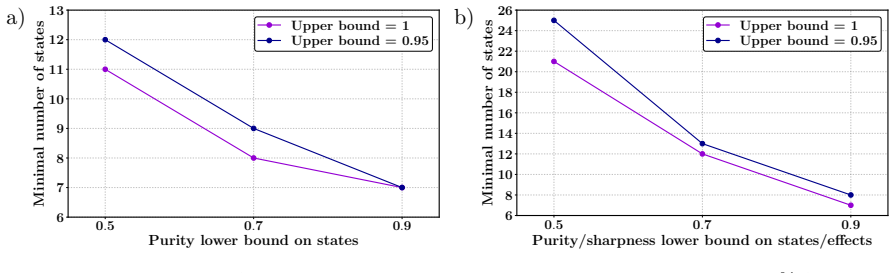
- Typicality survives realistic noise: with purity and sharpness lowered, reaching 99% typicality requires only single-digit to low-double-digit numbers of preparations, for example n=7 for purity in 0.9–1 and n=25 for unconstrained POVMs.
- Contextuality is a more accessible nonclassical resource than Bell nonlocality: its typicality saturates much faster for comparable resources.
- High typicality does not imply high advantage: in parity-oblivious multiplexing with random projective measurements, contextuality occurs in 98.6% of samples but the average advantage is only about 8% over the optimal classical strategy, compared with 18.3% for the optimal strategy.
Where Pith is reading between the lines
- The n>d^2 threshold suggests a sharp typicality transition in random fragments: below it classical explanation is guaranteed almost surely, above it nonclassicality is generic. One could test whether this transition sharpens with dimension in higher-dimensional random qudit experiments.
- If the result generalizes to higher dimensions, contextuality would be not just common but the default state of unengineered quantum experiments, strengthening the case that quantum advantages in communication and computation are easier to find than to quantify.
- A practical extension: using the toolbox to map the purity, sharpness, n, and m boundary for a specific laboratory's noise profile could let experimenters deliberately hit t>99% without engineering special states, provided the linear-program oracle remains reliable outside its calibration point.
- Editorial inference: the gap between typicality and average advantage suggests that resource-theoretic measures such as robustness or success rate, rather than mere existence of contextuality, are the quantities that predict practical quantum advantage.
Editorial analysis
A structured set of objections, weighed in public.
Referee Report
Summary. The paper studies how often randomly sampled qubit prepare-and-measure fragments are contextual in the generalized (Spekkens) sense. It defines a numerical typicality t(n,m,d;N) as the fraction of N samples for which the simplex-embedding linear program of Ref. [32] returns robustness r > 10^-7. For pure states and projective measurements the authors report t > 99% for (n=7,m=8), with many cells at t≈100% over N=10^6 samples, and use Wilson confidence intervals to claim the true typicality is at least 99.999% with 99% confidence. They also study mixed states and POVMs, constraints on purity/sharpness, compare with Bell nonlocality, and apply the framework to parity-oblivious multiplexing. Analytical results include: Lemma 1 (t=0 for n≤d^2), Proposition 2 (t<1 for any finite scenario), and Proposition 3 (asymptotically t→1 for n>d^2 or m>d^2 in certain limits). An open-source toolbox is provided.
Significance. If the numerical oracle is faithful, the paper makes a substantial quantitative contribution: it shows that generalized contextuality is generic in modest random qubit experiments rather than requiring careful engineering, and it provides an open-source toolbox for experiment design. The statistical treatment using Wilson intervals and the sanity check at the provably classical (n=4,m=2) point are commendable. The POM analysis usefully separates typicality of contextuality from typicality of quantum advantage. The comparison with Bell nonlocality is interesting and clearly caveated. The paper is therefore potentially important for both foundations and experimental practice, provided the computational certification can be independently validated at the probed parameter points.
major comments (3)
- [§1.2 and Appendix C] The linear-program decision procedure that underlies all numerical claims is calibrated only at the single provably classical point (n=4,m=2,d=2). The paper itself notes that the r-threshold 'may depend on the scenario, the solver employed... and the internal optimization settings', yet the headline cells of Fig. 2(a) — e.g., (n=7,m=8), (n=10,m=6), (n=19,m=20) — are far from this calibration point. A scenario-dependent tendency of the pipeline to return r>10^-7 for noncontextual fragments would directly inflate the reported t≈100% values and would be invisible in the (4,2) calibration. Please add false-positive calibrations at the high-(n,m) cells, for example by feeding the LP provably noncontextual fragments with comparable n,m (e.g., states confined to a simplex and effects from its dual, or sufficiently depolarized states/effects), and report the resulting false-positive rates and th
- [Appendix D, Prop. 3 and Lemma 1] The asymptotic statements (Prop. 3 and Eq. (7)) and the interpretation of the m=92 numerical results depend on the theorem from the unreviewed same-group preprint Ref. [33] that, for pure states, linear dependence is necessary and sufficient for contextuality when all measurements are available. Since this is a load-bearing input and not an independent check, the paper should either include a self-contained proof of this theorem in an appendix or explicitly state that Prop. 3 and the associated asymptotic claims are conditional on Ref. [33]. This issue does not affect the finite-numerical results themselves, but it affects the analytical framework in which those results are interpreted.
- [§1.2 and §2.1] The claim that t(n,m,d;N)≈100% 'ensures' that true typicality is at least 99.999% with 99% confidence conflates binomial sampling confidence with correctness of the LP oracle. The Wilson interval only bounds sampling error conditional on the oracle being exact at the probed (n,m). The caveat 'assuming that all 10^6 trials were unproblematic' appears only in Appendix C; it should be stated prominently in the main text and linked to the calibration requirement raised above. As written, the abstract and §2.1 could be read as asserting an unconditional certification that the LP does not provide.
minor comments (4)
- [Abstract and §2.1] The abstract states that contextuality arises with probability over 99% in experiments with 'a modest number of random preparations and measurements'. This is not the case for the mixed-state/POVM sampling of Fig. 2(b), where the maximum in the scanned range is 97.7%. Please qualify the central claim by specifying that it holds for pure/sharp or sufficiently constrained ensembles.
- [Eq. (9)] Equation (9) would be clearer with parentheses, e.g., s = (r/2 - s_NC)/(r-1). As printed, the fraction is ambiguous.
- [§2.1, fixed measurement set] The counting of the fixed measurement set is confusing: the text refers to 'm=92 distinct projectors' and then to '184 distinct effects' after including antipodal points. Please clarify whether m denotes the number of binary measurements, the number of projectors, or the number of POVM effects, so that the reader can reproduce the exact set.
- [Appendix D, Prop. 2] The proof of Prop. 2 invokes Lebesgue volume for the mixed-state sampling, whereas the numerical sampling uses the Hilbert-Schmidt measure (and rejection). The argument still works because both measures are absolutely continuous with respect to Lebesgue measure, but this should be stated explicitly.
Circularity Check
Analytical boundary results are imported from a same-group preprint, but the main numerical typicality claim rests on the published LP and is not reduced to a fitted input by construction.
specific steps
-
self citation load bearing
[Section 2.1, Lemma 1 proof (page 7)]
"As shown in Ref. [33], if a set of states is linearly independent, then there are no prepare-and-measure experiments where one can witness contextuality, even if all measurements are considered. In other words, the fragment ({ρ_i}^n_{i=1}, E_all) admits of a noncontextual model, where E_all denotes the set of all effects."
The low-n boundary of the paper's typicality picture is not derived here; it is taken as an established theorem from Ref. [33], an unreviewed arXiv preprint whose author list overlaps with the present paper. Lemma 1, the n>=4 cut used in all simulations, and the n=4 sanity check in Appendix C all treat this imported necessary condition as fact. The analytical claim is therefore load-bearing on a same-group citation rather than on a proof contained in this manuscript.
-
self citation load bearing
[Appendix D, proof of Proposition 3]
"From Ref. [33], any set Ω_n of n>d^2 randomly sampled states will be such that the fragment (Ω_n, E) does not admit of a simplex embedding."
Proposition 3, which is used to claim that typicality tends to 1 and that t grows monotonically, delegates its key impossibility statement to the same unreviewed preprint by overlapping authors. The asymptotic 'prediction' is essentially a corollary of Ref. [33]'s necessary-and-sufficient boundary, so the analytical headline is not independently established within this paper.
full rationale
The central numerical claim — that t(n,m,d=2;N=10^6) exceeds 99% for modest numbers of random qubit preparations and measurements — is an empirical frequency of outputs of the linear program of Ref. [32]. That LP is a published, parameter-free decision procedure for simplex embeddability, and the paper's use of it is not circular: the threshold r>10^-7 is a numerical tolerance chosen so that the provably classical (n=4,m=2) point returns r=0, and the reported typicalities are counts of LP outputs above that tolerance. A scenario-dependent false-positive rate in the LP would be a correctness or calibration concern, not a by-construction reduction of the predicted quantity to a fitted parameter. The Wilson-score certification is likewise a standard binomial confidence statement. However, the analytic scaffolding is less clean: Lemma 1 and Proposition 3 both import their key theorem from Ref. [33], an unreviewed arXiv preprint co-authored by one of the present authors. The paper does not prove or independently verify that theorem, yet it uses it to set the n>=4 boundary, to justify the n=4 numerical calibration, and to establish the asymptotic typicality result. That is a load-bearing self-citation. Because the numerical typicality results remain independently generated by the published LP, the circularity is partial rather than total.
Axiom & Free-Parameter Ledger
free parameters (3)
- classicality threshold r_thresh =
10^-7
- fixed-effect discretization grid (jπ/20, kπ/5) =
92 dichotomic projectors (184 effects)
- sampling measure for mixed states/POVMs =
Hilbert-Schmidt (Ginibre) with rejection on purity/sharpness
axioms (5)
- domain assumption Generalized noncontextuality is equivalent to simplex-embeddability of the associated GPT fragment (Spekkens 2005; Schmid et al. 2021 [29]; Selby et al. 2024 [32]).
- domain assumption Linear independence of a set of states implies noncontextuality with all effects; linear dependence of pure states implies contextuality with all effects (Ref [33]).
- domain assumption Haar-uniform sampling over pure states/unitaries and Ginibre full-rank sampling define 'randomness'; purity-constrained ensembles are generated by rejection sampling.
- domain assumption The robustness-to-success map s = f(r) for parity-oblivious multiplexing (Eq. 9, from Refs [5, 9]) and s_NC = (1+1/k)/2.
- domain assumption cdd (double-description) and cvxpy solvers return cone certificates accurate at the 10^-7 level for all probed scenarios.
invented entities (1)
-
none
no independent evidence
Cite this review
Pith. "Pith review of Typicality of Contextuality." pith.science (2026). https://pith.science/paper/F3MD5YF3
@misc{pith2026251020722,
  author       = {Pith},
  title        = {Pith review of: Typicality of Contextuality},
  year         = {2026},
  howpublished = {\url{https://pith.science/paper/F3MD5YF3}},
  note         = {Machine review of arXiv:2510.20722}
}
read the original abstract
Identifying when observed statistics cannot be explained by any reasonable classical model is a central problem in quantum foundations. A principled and universally applicable approach to defining and identifying nonclassicality is given by the notion of generalized noncontextuality. Here, we study the typicality of contextuality -- namely, the likelihood that randomly chosen quantum preparations and measurements produce nonclassical statistics. Using numerical linear programs to test for the existence of a generalized-noncontextual model, we find that contextuality is fairly common: even in experiments with only a modest number of random preparations and measurements, contextuality arises with probability over 99%. We also show that while typicality of contextuality decreases as the purity (sharpness) of the preparations (measurements) decreases, this dependence is not especially pronounced, so contextuality is fairly typical even in settings with realistic noise. Finally, we show that although nonzero contextuality is quite typical, quantitatively high degrees of contextuality are not as typical, and so large quantum advantages (like for parity-oblivious multiplexing, which we take as a case study) are not as typical. We provide an open-source toolbox that outputs the typicality of contextuality as a function of tunable parameters (such as lower and upper bounds on purity and other constraints on states and measurements). This toolbox can inform the design of experiments that achieve the desired typicality of contextuality for specified experimental constraints.
Figures




Forward citations
Cited by 4 Pith papers
-
Decoupling local classicality from classical explainability: A noncontextual model for bilocal classical theory and a locally-classical but contextual theory
Bilocal classical theory has a classical ontological model, but some locally-classical latent theories do not, so local classicality and classical explainability are logically independent.
-
How rare are Markovian quantum dynamics?
Random sampling shows Markovian two-step qubit dynamics form only a small fraction of the total space under multiple non-Markovianity witnesses.
-
Commutativity from a single Bargmann invariant equality
Two quantum states ρ₁ and ρ₂ commute exactly when tr(ρ₁²ρ₂²) = tr(ρ₁ ρ₂ ρ₁ ρ₂).
-
Warring Contextualities -- Provably Classical vs Provably Nonclassical
Kochen-Specker contextuality generalizes nonclassicality while Spekkens' noncontextuality generalizes classicality, reconciling the two as successive stages in a hierarchy of classicality.
Reference graph
Works this paper leans on
-
[1]
On the Einstein Podolsky Rosen paradox
J. S. Bell. “On the Einstein Podolsky Rosen paradox”. Physics Physique Fizika1, 195– 200 (1964). 18
1964
-
[2]
The problem of hidden variables in quantum mechanics
S. Kochen and E. P. Specker. “The problem of hidden variables in quantum mechanics”. J. Math. Mech.17, 59–87 (1967)
1967
-
[3]
Contextuality for preparations, transformations, and unsharp measure- ments
R. W. Spekkens. “Contextuality for preparations, transformations, and unsharp measure- ments”. Phys. Rev. A71, 052108 (2005)
2005
-
[4]
A strong no-go theorem on the Wigner’s friend paradox
Kok-Wei Bong, An ´ ıbal Utreras-Alarc´ on, Farzad Ghafari, Yeong-Cherng Liang, Nora Tis- chler, Eric G Cavalcanti, Geoff J Pryde, and Howard M Wiseman. “A strong no-go theorem on the Wigner’s friend paradox”. Nature Physics16, 1199–1205 (2020)
2020
-
[5]
Preparation Contextuality Powers Parity-Oblivious Multiplexing
R. W. Spekkens, D. H. Buzacott, A. J. Keehn, B. Toner, and G. J. Pryde. “Preparation Contextuality Powers Parity-Oblivious Multiplexing”. Phys. Rev. Lett.102, 010401 (2009)
2009
-
[6]
Preparation contextuality as an essential feature underlying quantum communication advantage
D. Saha and A. Chaturvedi. “Preparation contextuality as an essential feature underlying quantum communication advantage”. Phys. Rev. A100, 022108 (2019)
2019
-
[7]
Robust certification of unsharp instruments through sequential quantum advantages in a prepare-measure communication game
Abhyoudai S. S., S. Mukherjee, and A. K. Pan. “Robust certification of unsharp instruments through sequential quantum advantages in a prepare-measure communication game”. Phys. Rev. A107, 012411 (2023)
2023
-
[8]
Quantum vs noncontextual semi-device-independent randomness certification
C. Roch i Carceller, K. Flatt, H. Lee, J. Bae, and J. B. Brask. “Quantum vs noncontextual semi-device-independent randomness certification”. Phys. Rev. Lett.129, 050501 (2022)
2022
-
[9]
Robustness of contextuality under different types of noise as quantifiers for parity-oblivious multiplexing tasks
A. M. Fonseca, V. P. Rossi, R. D. Baldij˜ ao, J. H. Selby, and A. B. Sainz. “Robustness of contextuality under different types of noise as quantifiers for parity-oblivious multiplexing tasks”. Phys. Rev. A111, 022217 (2025)
2025
-
[10]
Uniqueness of Noncontextual Models for Stabilizer Subtheories
D. Schmid, H. Du, J. H. Selby, and M. F. Pusey. “Uniqueness of Noncontextual Models for Stabilizer Subtheories”. Phys. Rev. Lett.129(2022)
2022
-
[11]
Contextuality and inductive bias in quantum machine learning
J. Bowles, V. J. Wright, M. Farkas, N. Killoran, and M. Schuld. “Contextuality and inductive bias in quantum machine learning”. Preprint inarXiv, arXiv:2302.01365 (2023)
Pith/arXiv arXiv 2023
-
[12]
Parity Oblivious d-Level Random Access Codes and Class of Noncontextuality Inequalities
A. Ambainis, M. Banik, A. Chaturvedi, D. Kravchenko, and A. Rai. “Parity Oblivious d-Level Random Access Codes and Class of Noncontextuality Inequalities”. Preprint in arXiv, arXiv:1607.05490 (2016)
Pith/arXiv arXiv 2016
-
[13]
Optimal bounds for parity-oblivious random access codes
A. Chailloux, I. Kerenidis, S. Kundu, and J. Sikora. “Optimal bounds for parity-oblivious random access codes”. New J. Phys.18, 045003 (2016)
2016
-
[14]
Contextuality in entanglement-assisted one-shot classical communication
S. A. Yadavalli and R. Kunjwal. “Contextuality in entanglement-assisted one-shot classical communication”. Quantum6, 839 (2022)
2022
-
[15]
Certifying Quantum Signatures in Thermodynamics and Metrology via Contextuality of Quantum Linear Response
M. Lostaglio. “Certifying Quantum Signatures in Thermodynamics and Metrology via Contextuality of Quantum Linear Response”. Phys. Rev. Lett.125, 230603 (2020)
2020
-
[16]
Contextual advantage for state-dependent cloning
M. Lostaglio and G. Senno. “Contextual advantage for state-dependent cloning”. Quantum 4, 258 (2020)
2020
-
[17]
Contextual advantage for state discrimination
D. Schmid and R. W. Spekkens. “Contextual advantage for state discrimination”. Phys. Rev. X8, 011015 (2018)
2018
-
[18]
Quantum Contextual Advantage Depending on Nonzero Prior Probabilities in State Discrimination of Mixed Qubit States
J. Shin, D. Ha, and Y. Kwon. “Quantum Contextual Advantage Depending on Nonzero Prior Probabilities in State Discrimination of Mixed Qubit States”. Entropy23, 1583 (2021)
2021
-
[19]
Contextual Advantages and Certification for Maximum-Confidence Discrimination
K. Flatt, H. Lee, C. Roch I Carceller, J. B. Brask, and J. Bae. “Contextual Advantages and Certification for Maximum-Confidence Discrimination”. PRX Quantum3, 030337 (2022)
2022
-
[20]
Discriminating three mirror-symmetric states with a restricted contextual advantage
S. Mukherjee, S. Naonit, and A. K. Pan. “Discriminating three mirror-symmetric states with a restricted contextual advantage”. Phys. Rev. A106, 012216 (2022)
2022
-
[21]
Specker’s parable of the overprotective seer: A road to contextuality, nonlocality and complementarity
Y. C. Liang, R. W. Spekkens, and H. M. Wiseman. “Specker’s parable of the overprotective seer: A road to contextuality, nonlocality and complementarity”. Physics Reports506, 1– 39 (2011)
2011
-
[22]
All the noncontextuality inequalities for arbitrary prepare-and-measure experiments with respect to any fixed set of operational equivalences
D. Schmid, R. W. Spekkens, and E. Wolfe. “All the noncontextuality inequalities for arbitrary prepare-and-measure experiments with respect to any fixed set of operational equivalences”. Phys. Rev. A97, 062103 (2018). 19
2018
-
[23]
Invertible map between bell nonlocal and contextuality scenarios
V. J. Wright and M. Farkas. “Invertible map between bell nonlocal and contextuality scenarios”. Phys. Rev. Lett.131, 220202 (2023)
2023
-
[24]
Anomalous weak values and contextuality: Robustness, tightness, and imaginary parts
R. Kunjwal, M. Lostaglio, and M. F. Pusey. “Anomalous weak values and contextuality: Robustness, tightness, and imaginary parts”. Phys. Rev. A100, 042116 (2019)
2019
-
[25]
Contextuality in Anoma- lous Heat Flow
N. E. Comar, D. Cius, L. F. Santos, R. Wagner, and B. Amaral. “Contextuality in Anoma- lous Heat Flow”. PRX Quantum6, 030359 (2025)
2025
-
[26]
Negativity and Contextuality are Equivalent Notions of Nonclassicality
R. W. Spekkens. “Negativity and Contextuality are Equivalent Notions of Nonclassicality”. Phys. Rev. Lett.101, 020401 (2008)
2008
-
[27]
A structure theorem for generalized-noncontextual ontological models
D. Schmid, J. H. Selby, M. F. Pusey, and R. W. Spekkens. “A structure theorem for generalized-noncontextual ontological models”. Quantum8, 1283 (2024)
2024
-
[28]
R. W. Spekkens. “The ontological identity of empirical indiscernibles: Leibniz’s method- ological principle and its significance in the work of Einstein”. Preprint inarXiv, arXiv:1909.04628 (2023)
Pith/arXiv arXiv 1909
-
[29]
Characterization of Noncontextuality in the Framework of Generalized Probabilistic Theories
D. Schmid, J. H. Selby, E. Wolfe, R. Kunjwal, and R. W. Spekkens. “Characterization of Noncontextuality in the Framework of Generalized Probabilistic Theories”. PRX Quantum 2, 010331 (2021)
2021
-
[30]
Emergence of Noncontextuality under Quantum Darwinism
R. D. Baldij˜ ao, R. Wagner, C. Duarte, B. Amaral, and M. T. Cunha. “Emergence of Noncontextuality under Quantum Darwinism”. PRX Quantum2, 030351 (2021)
2021
-
[31]
A review and reformulation of macroscopic realism: resolving its deficiencies using the framework of generalized probabilistic theories
D. Schmid. “A review and reformulation of macroscopic realism: resolving its deficiencies using the framework of generalized probabilistic theories”. Quantum8, 1217 (2024)
2024
-
[32]
Linear Program for Testing Nonclassicality and an Open-Source Implementation
J. H. Selby, E. Wolfe, D. Schmid, A. B. Sainz, and V. P. Rossi. “Linear Program for Testing Nonclassicality and an Open-Source Implementation”. Phys. Rev. Lett.132, 050202 (2024)
2024
-
[33]
Reassessing the boundary be- tween classical and nonclassical for individual quantum processes
Y. Zhang, D. Schmid, Y. Y ¯ ıng, and R. W. Spekkens. “Reassessing the boundary be- tween classical and nonclassical for individual quantum processes”. Preprint inarXiv, arXiv:2503.05884 (2025)
arXiv 2025
-
[34]
Quantifiers and witnesses for the non- classicality of measurements and of states
Y. Zhang, D. Schmid, Y. Y ¯ ıng, and R. W. Spekkens. “Quantifiers and witnesses for the non- classicality of measurements and of states”. Preprint inarXiv, arXiv:2504.02944 (2025)
Pith/arXiv arXiv 2025
-
[35]
A combinatorial approach to nonlocality and contextuality
A. Ac ´ ın, T. Fritz, A. Leverrier, and A. B. Sainz. “A combinatorial approach to nonlocality and contextuality”. Commun. Math. Phys.334, 533–628 (2015)
2015
-
[36]
Quantum theory from five reasonable axioms
L. Hardy. “Quantum theory from five reasonable axioms”. Preprint inarXiv, arXiv:quant– ph/0101012 (2001)
arXiv 2001
-
[37]
Information processing in generalized probabilistic theories
J. Barrett. “Information processing in generalized probabilistic theories”. Phys. Rev. A 75, 032304 (2007)
2007
-
[38]
Quantum Theory from First Principles: An Informational Approach
G. M. D’Ariano, G. Chiribella, and P. Perinotti. “Quantum Theory from First Principles: An Informational Approach”. Cambridge University Press. (2017)
2017
-
[39]
Unscrambling the omelette of causa- tion and inference: The framework of causal-inferential theories
D. Schmid, J. H. Selby, and R. W. Spekkens. “Unscrambling the omelette of causa- tion and inference: The framework of causal-inferential theories”. Preprint inarXiv, arXiv:2009.03297 (2020)
Pith/arXiv arXiv 2009
-
[40]
eliewolfe/SimplexEmbedding: Initial Release
E. Wolfe. “eliewolfe/SimplexEmbedding: Initial Release”.https://zenodo.org/record/ 7709974(2023). GitHub repository. Licensed under CC-BY-NC-SA 4.0
2023
-
[41]
pjcavalcanti/SimplexEmbeddingGPT: Release 1.0.0
P. Cavalcanti, V. P. Rossi, and J. H. Selby. “pjcavalcanti/SimplexEmbeddingGPT: Release 1.0.0”.https://zenodo.org/record/10955995(2023). MIT License
arXiv 2023
-
[42]
Probable Inference, the Law of Succession, and Statistical Inference
E. B. Wilson. “Probable Inference, the Law of Succession, and Statistical Inference”. J. Am. Stat. Assoc.22, 209–212 (1927)
1927
-
[43]
Qutip 5: The quantum toolbox in python
N. Lambert, E. Gigu` ere, P. Menczel, B. Li, P. Hopf, G. Su´ arez, M. Gali, J. Lishman, R. Gadhvi, R. Agarwal, A. Galicia, N. Shammah, P. Nation, J. R. Johansson, S. Ahmed, S. Cross, A. Pitchford, and F. Nori. “Qutip 5: The quantum toolbox in python”. Preprint inarXiv, arXiv:2412.04705 (2024). 20
Pith/arXiv arXiv 2024
-
[44]
Random quantum opera- tions
W. Bruzda, V. Cappellini, H. Sommers, and K. ˙Zyczkowski. “Random quantum opera- tions”. Phys. Lett. A373, 320–324 (2009)
2009
-
[45]
Geometry of quantum states: An introduction to quan- tum entanglement
I. Bengtsson and K. ˙Zyczkowski. “Geometry of quantum states: An introduction to quan- tum entanglement”. Cambridge University Press. (2017)
2017
-
[46]
Generating random quantum channels
R. Kukulski, I. Nechita, L. Pawela, Z. Pucha la, and K. ˙Zyczkowski. “Generating random quantum channels”. J. Math. Phys.62, 062201 (2021)
2021
-
[47]
Robust preparation noncontextuality inequalities in the simplest scenario
M. F. Pusey. “Robust preparation noncontextuality inequalities in the simplest scenario”. Phys. Rev. A98, 022112 (2018)
2018
-
[48]
Alternative robust ways of witnessing nonclassi- cality in the simplest scenario
M. Khoshbin, L. Catani, and M. Leifer. “Alternative robust ways of witnessing nonclassi- cality in the simplest scenario”. Phys. Rev. A109, 032212 (2024)
2024
-
[49]
Contex- tuality without incompatibility
J. H. Selby, D. Schmid, E. Wolfe, A. B. Sainz, R. Kunjwal, and R. W. Spekkens. “Contex- tuality without incompatibility”. Phys. Rev. Lett.130, 230201 (2023)
2023
-
[50]
I. Marvian. “Inaccessible information in probabilistic models of quantum systems, non- contextuality inequalities and noise thresholds for contextuality”. Preprint inarXiv, arXiv:2003.05984 (2020)
Pith/arXiv arXiv 2003
-
[51]
From the Kochen-Specker Theorem to Noncontextuality Inequalities without Assuming Determinism
R. Kunjwal and R. W. Spekkens. “From the Kochen-Specker Theorem to Noncontextuality Inequalities without Assuming Determinism”. Phys. Rev. Lett.115, 110403 (2015)
2015
-
[52]
How difficult is it to prepare a quantum state?
D. Girolami. “How difficult is it to prepare a quantum state?”. Phys. Rev. Lett.122, 010505 (2019)
2019
-
[53]
Ideal projective measurements have infinite re- source costs
Y. Guryanova, N. Friis, and M. Huber. “Ideal projective measurements have infinite re- source costs”. Quantum4, 222 (2020)
2020
-
[54]
V. P. Rossi.https://github.com/RossiVinicius/TypicalityOfContextuality(2025). GitHub repository
2025
-
[55]
Bell nonlocality
N. Brunner, D. Cavalcanti, S. Pironio, V. Scarani, and S. Wehner. “Bell nonlocality”. Rev. Mod. Phys.86, 419–478 (2014)
2014
-
[56]
Small violations of full-correlation Bell inequalities for multipartite pure random states
R. C. Drumond and R. I. Oliveira. “Small violations of full-correlation Bell inequalities for multipartite pure random states”. Phys. Rev. A86, 012117 (2012)
2012
-
[57]
Multipartite nonlocality and random measurements
A. de Rosier, J. Gruca, F. Parisio, T. V´ ertesi, and W. Laskowski. “Multipartite nonlocality and random measurements”. Phys. Rev. A96(2017)
2017
-
[58]
Towards an equivalence between max- imal entanglement and maximal quantum nonlocality
V. Lipinska, F. J. Curchod, A. M´ attar, and A. Ac ´ ın. “Towards an equivalence between max- imal entanglement and maximal quantum nonlocality”. New J. Phys.20, 063043 (2018)
2018
-
[59]
Small violations of Bell inequalities for multipartite pure random states
R. C. Drumond, C. Duarte, and R. I. Oliveira. “Small violations of Bell inequalities for multipartite pure random states”. J. Math. Phys.59, 052202 (2018)
2018
-
[60]
Strength and typi- cality of nonlocality in multisetting and multipartite bell scenarios
A. de Rosier, J. Gruca, F. Parisio, T. V´ ertesi, and W. Laskowski. “Strength and typi- cality of nonlocality in multisetting and multipartite bell scenarios”. Phys. Rev. A101, 012116 (2020)
2020
-
[61]
Relationship between semi- and fully-device-independent protocols
H. Li, P. Mironowicz, M. Paw lowski, Z. Yin, Y. Wu, S. Wang, W. Chen, H. Hu, G. Guo, and Z. Han. “Relationship between semi- and fully-device-independent protocols”. Phys. Rev. A87(2013)
2013
-
[62]
Shadows and subsystems of generalized probabilistic theories: when tomographic incompleteness is not a loophole for contextuality proofs
D. Schmid, J. H. Selby, V. P. Rossi, R. D. Baldij˜ ao, and A. B. Sainz. “Shadows and subsystems of generalized probabilistic theories: when tomographic incompleteness is not a loophole for contextuality proofs”. Quantum9, 1880 (2025)
2025
-
[63]
Generalized probability theories: what determines the structure of quantum theory?
P. Janotta and H. Hinrichsen. “Generalized probability theories: what determines the structure of quantum theory?”. J. Phys. A: Math. Theo.47, 323001 (2014)
2014
-
[64]
Acces- sible fragments of generalized probabilistic theories, cone equivalence, and applications to witnessing nonclassicality
J. H. Selby, D. Schmid, E. Wolfe, A. B. Sainz, R. Kunjwal, and R. W. Spekkens. “Acces- sible fragments of generalized probabilistic theories, cone equivalence, and applications to witnessing nonclassicality”. Phys. Rev. A107, 062203 (2023)
2023
-
[65]
Double description method revisited
K. Fukuda and A. Prodon. “Double description method revisited”. Page 91–111. Springer Berlin Heidelberg. (1996). 21
1996
-
[66]
cddlib Reference Manual
K. Fukuda. “cddlib Reference Manual”. cddlib Project / ETH Zurich. Zurich. (2021). url:https://people.inf.ethz.ch/fukudak/cdd_home/cddlibman2021.pdf
2021
-
[67]
How to generate random matrices from the classical compact groups
F. Mezzadri. “How to generate random matrices from the classical compact groups”. Preprint inarXiv, arXiv:math–ph/0609050 (2006)
arXiv 2006
-
[68]
Random unitary matrices
K. Zyczkowski and M. Kus. “Random unitary matrices”. J. Phys. A: Math. Gen.27, 4235–4245 (1994)
1994
-
[69]
Statistical ensembles of complex, quaternion, and real matrices
J. Ginibre. “Statistical ensembles of complex, quaternion, and real matrices”. J. Math. Phys.6, 440–449 (1965)
1965
-
[70]
Monte Carlo Statistical Methods
C. P. Robert and G. Casella. “Monte Carlo Statistical Methods”. Springer New York. (2004)
2004
-
[71]
Mutually unbiased mea- surements with arbitrary purity
M. Salehi, S. J. Akhtarshenas, M. Sarbishaei, and H. Jaghouri. “Mutually unbiased mea- surements with arbitrary purity”. Quantum Inf. Process.20, 401 (2021)
2021
-
[72]
Ex- perimentally bounding deviations from quantum theory for a photonic three-level system using theory-agnostic tomography
M. J. Grabowecky, C. A. J. Pollack, A. R. Cameron, R. W. Spekkens, and K. J. Resch. “Ex- perimentally bounding deviations from quantum theory for a photonic three-level system using theory-agnostic tomography”. Phys. Rev. A105, 032204 (2022)
2022
-
[73]
Experimental certification of contextuality, coherence, and dimension in a programmable universal photonic processor
T. Giordani, R. Wagner, C. Esposito, A. Camillini, F. Hoch, G. Carvacho, C. Pentan- gelo, F. Ceccarelli, S. Piacentini, A. Crespi, N. Spagnolo, R. Osellame, E. F. Galv˜ ao, and F. Sciarrino. “Experimental certification of contextuality, coherence, and dimension in a programmable universal photonic processor”. Sci. Adv.9, eadj4249 (2023)
2023
-
[74]
A. Aloy, M. Fadel, T. D. Galley, C. L. Jones, and M. P. Mueller. “Theory-independent monitoring of the decoherence of a superconducting qubit with generalized contextuality”. Preprint inarXiv, arXiv:2411.13421 (2024). A Simplex embedding linear program The linear program provided in Ref. [32] relies on the equivalence between the existence of a noncontext...
arXiv 2024
discussion (0)
Sign in with ORCID, Apple, or X to comment. Anyone can read and Pith papers without signing in.