REVIEW 4 major objections 5 minor 20 references
LinguistAgent Technical Report: A Reflective Multi-Model Platform for Automated Linguistic Annotation
T0 review · 4 major / 5 minor · reviewed 2026-08-03 · deepseek-v4-flash
Pith's one-line read This paper claims that adding a reviewer LLM alongside an annotator LLM consistently raises metaphor-annotation F1 scores across all tested paradigms.
desk verdict A useful no-code annotation platform with a plausible reviewer loop, but the headline F1 improvements are not yet demonstrated because the evaluation pipeline is under-specified and possibly biased. read the letter →
The pith
A machine-rendered reading of the paper's core claim, the machinery that carries it, and where it could break.
The reading
What carries the argument
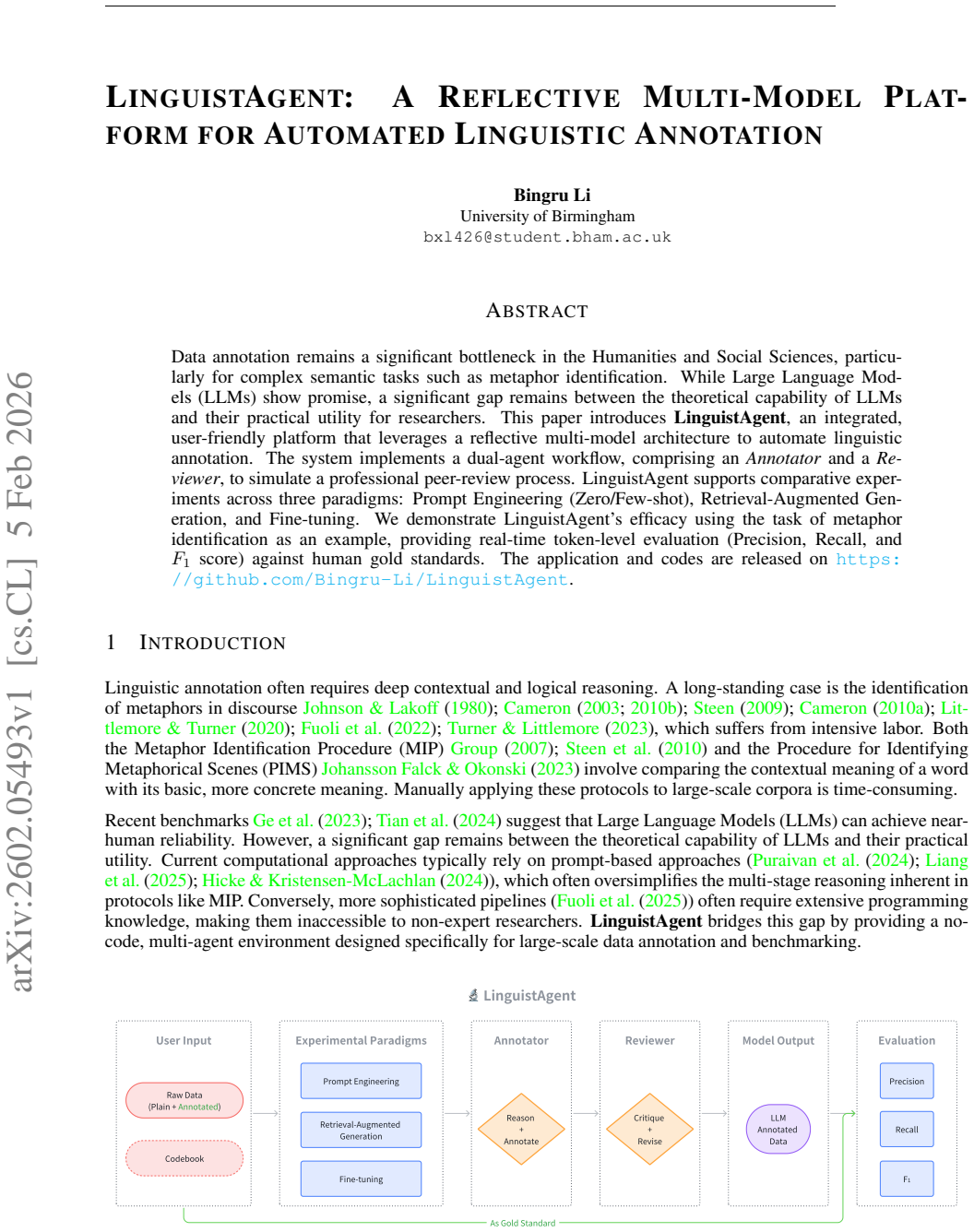
The central mechanism is the two-agent reflective loop: an Annotator agent receives raw text plus an optional codebook and labels metaphors by wrapping spans in <Metaphor>...</Metaphor> tags with a textual reasoning field; a Reviewer agent, activated in Reviewer Mode, reads the same text and the annotator's output, writes a critique, and produces a Revised Text. Evaluation is token-level: gold and predicted spans are both flattened into binary 1/0 token sequences, and precision, recall, and F1 are computed against the human gold standard. The platform bundles this loop with three experiment paradigms (zero/few-shot prompting, full-context RAG, and fine-tuning), live streaming charts, and a p
What would settle it
Re-run the same six configurations on the full IMDb metaphor dataset and score with span-level matching aligned to character offsets rather than LLM tokens; if Reviewer-On no longer beats Reviewer-Off, or if the few-shot examples are found inside the test set, the reported advantage is an artifact of the evaluation instead of a real annotation gain.
Extended reading notes
Core claim
The paper reports a direct empirical comparison: on a small sample drawn from the IMDb metaphor dataset, qwen3-30b-a3b-thinking-2507 and gemini-3-flash-preview each annotate metaphors alone and then with themselves acting as reviewer. In all six configurations, the Reviewer-On F1 exceeds Reviewer-Off F1. The paper attributes the improvement to the reviewer re-evaluating the annotator's XML-wrapped metaphor tags against the codebook, catching false positives and missed metaphors, and issuing a revised text. It positions this as evidence that a reflective multi-agent workflow can turn LLMs into more rigorous annotation instruments for the humanities and social sciences.
Load-bearing premise
The load-bearing premise is that the small, unreported sample from the IMDb metaphor dataset is representative, and that flattening gold and predicted metaphor spans into token-level 1/0 sequences with mismatched tokenizers yields a valid F1 measure of annotation quality.
Editorial extensions
If this is right
- If the reported comparison holds, any researcher using the platform can improve metaphor-identification quality without changing models or writing code, simply by enabling Reviewer Mode.
- The same annotate-review-evaluate cycle is available under zero-shot, few-shot, and RAG paradigms, so a user can compare the F1 of each paradigm on their own dataset before committing to a full annotation campaign.
- Because the reviewer is a separate model slot, users can pair a cheaper annotator with a stronger reviewer, and the debug logs show which critique produced which correction.
- The downloadable CSV with per-sample pre- and post-review metrics gives a traceable record of exactly where the reviewer changed the annotation, supporting error analysis in metaphor research.
Reading between the lines
- The two-pass loop is task-agnostic, so the same architecture would plausibly transfer to other sequence-labeling annotation tasks such as stance detection, offensive-language tagging, or named-entity recognition; the paper only demonstrates metaphor identification.
- The six gains are uneven across models (qwen's are small, Gemini's are larger), which suggests the reviewer advantage may depend on the base annotator's one-pass competence; a fair test would hold the annotator constant and vary only the reviewer.
- A sharper evaluation would use span-level matching aligned to human tokenization rather than binary token sequences; if reviewer gains shrink under exact-span metrics, part of the improvement may be boundary artifacts.
- The extra API cost of a reviewer pass is nontrivial, so cost-aware researchers might reserve Reviewer Mode for a random sample or for low-confidence annotations rather than the full corpus.
Editorial analysis
A structured set of objections, weighed in public.
Referee Report
Summary. LinguistAgent is a Streamlit-based platform for automated linguistic annotation that combines an Annotator LLM and an optional Reviewer LLM in a reflective loop. It supports three experimental paradigms—prompt engineering (zero/few-shot), RAG, and fine-tuning—with live token-level evaluation against gold standards. The paper demonstrates the platform on a small sample of the IMDb metaphor dataset using Qwen3 and Gemini 3, reporting F1 scores for Annotator-only and Reviewer-Mode settings. The central empirical claim is that Reviewer Mode consistently outperforms Annotator-only mode across all conditions in Table 1.
Significance. If the reviewer-mode improvement is real, a second LLM pass offers a simple, practical way to improve annotation quality in under-resourced humanities settings, and the open-source platform would be a useful contribution. The system's attention to traceability—real-time reasoning logs, persistent debug logs, and structured JSON output—is a genuine strength and makes failures diagnosable. However, the strength of the evidence is currently far below what is needed to establish the central claim: the evaluation pipeline is underspecified, the sample is unreported and small, no uncertainty quantification is provided, and the so-called RAG paradigm is not retrieval. The platform itself may be sound, but the empirical demonstration must be substantially strengthened.
major comments (4)
- [§2.4, Evaluation] The conversion of XML-tagged spans into 'binary sequences where 1 represents a tagged unit' is not described. LLM subword tokenizers (Qwen3, Gemini) do not align with the gold-standard tokenization, and no method is given for resolving span-to-token boundary mismatches. A one-token shift can convert a true positive into a false positive plus a false negative, which can easily produce F1 differences larger than some reported gains (e.g., qwen3 zero-shot: 0.2803→0.2837). Without specifying the tokenizer and alignment rules, the six positive deltas in Table 1 cannot be distinguished from token-boundary artifacts.
- [§4, Case Study / Table 1] The paper describes the benchmark as 'a small set of data' from the IMDb metaphor dataset but reports no sample size, no per-sample distribution, no error bars, and no significance tests. The largest gain (gemini RAG: +0.1063) and the smallest (qwen3 zero-shot: +0.0034) have no attached uncertainty. A paired test (e.g., bootstrap or Wilcoxon over samples) and multiple runs are needed before claiming that Reviewer Mode 'consistently outperforms' Annotator-only mode. As is, the evidence is a single table of point estimates.
- [§2.3, RAG (Full-Context)] The 'RAG' paradigm is defined as integrating the entire codebook into the system instruction, which is context stuffing, not retrieval-augmented generation. This is not RAG: there is no retrieval step, no external index, and no query-based selection. Therefore the 'RAG' column in Table 1 does not evaluate RAG, and the paper's claim to support three distinct paradigms is overstated. The paradigm should be renamed (e.g., 'full-context prompting') or true RAG must be implemented.
- [§2.3, Few-shot; §4, Case Study] The few-shot examples are not described. If they are drawn from the same IMDb metaphor dataset as the evaluation samples, the few-shot and RAG results are potentially leaked and inflated. The paper must state where the examples come from, whether they are disjoint from the test samples, and ideally use a separate source. As it stands, the risk of label leakage undermines the generalization claim of the platform.
minor comments (5)
- [Abstract] The abstract mentions 'Cohen's kappa' in addition to F1, but Section 4 and Table 1 report only F1. Either report kappa or remove it from the abstract.
- [§2.3] The term 'RAG' is used before its redefinition as 'Full-Context' in the same section. The reader first encounters RAG in the abstract and introduction with the standard meaning, causing confusion. Clarify the terminology.
- [§2.1] The Codebook is said to be provided 'under the RAG experiment,' but the description of prompt engineering and fine-tuning does not clarify whether the codebook is also used there. Clarify which paradigms use the codebook.
- [§4] The model identifiers 'qwen3-30b-a3b-thinking-2507' and 'gemini-3-flash-preview' are not accompanied by publication or version citations, making it hard to reproduce results. Please provide specific checkpoint or API documentation links.
- [Throughout] There are minor typographical and formatting issues, e.g., inconsistent capitalization in 'Session State' and the unexpanded abstract acronyms. A careful proofread is recommended.
Circularity Check
No significant circularity: the central claim is an empirical comparison against an external human gold standard; evaluation-metric concerns are validity issues, not definitional reductions.
full rationale
This paper makes no formal derivation; its central claim is an empirical comparison between Annotator-only and Reviewer Mode configurations, evaluated against a human gold standard from the IMDb metaphor dataset (Fuoli et al., 2025). The Annotator and Reviewer receive raw text, the codebook, and the Annotator's prior output—not the gold labels—so the Reviewer-On result is not constructed from the benchmark. No parameter is fitted to the evaluation subset and then reported as a prediction; no uniqueness theorem or ansatz is imported from the author's own prior work; and the only self-references are ordinary citations to model technical reports (Gemini, Qwen3), which are not load-bearing for the empirical claim. The small, unreported sample and underspecified token-level conversion in §2.4 are threats to the validity of the comparison, but they do not make the claim reduce to its inputs by definition or by self-citation. Under the hard rules requiring a specific exhibited reduction, no circular step can be identified, so the appropriate finding is no significant circularity.
Assumptions & free parameters
assumptions (4)
- domain assumption The IMDb metaphor dataset and its gold annotations (from Fuoli et al., 2025) are a valid benchmark for metaphor identification.
- domain assumption Token-level binary-sequence comparison is a valid evaluation metric even when LLM tokenization differs from human tokenization.
- domain assumption The Reviewer LLM's self-correction generally improves annotation accuracy.
- ad hoc to paper Full-context prompting (entire codebook in the system prompt) is equivalent to retrieval-augmented generation.
Cite this review
Pith. "Pith review of LinguistAgent Technical Report: A Reflective Multi-Model Platform for Automated Linguistic Annotation." pith.science (2026). https://pith.science/paper/F473PYQS
@misc{pith2026260205493,
  author       = {Pith},
  title        = {Pith review of: LinguistAgent Technical Report: A Reflective Multi-Model Platform for Automated Linguistic Annotation},
  year         = {2026},
  howpublished = {\url{https://pith.science/paper/F473PYQS}},
  note         = {Machine review of arXiv:2602.05493}
}
read the original abstract
Data annotation remains a significant bottleneck in the field of humanities and social sciences, particularly for complex linguistic tasks such as metaphor identification. While Large Language Models (LLMs) show promise, a significant gap remains between the theoretical capability of LLMs and their practical utility for researchers. This paper introduces LinguistAgent, an integrated, user-friendly platform that leverages a reflective multi-model architecture to automate linguistic annotation. The platform comprises an Annotator and an optional Reviewer to simulate a peer-review process. This platform supports comparative experiments across three main paradigms: Prompt Engineering (Zero-shot/Few-shot/Chain-of-thought), Retrieval-Augmented Generation, and Fine-tuning. We demonstrate LinguistAgent's efficacy by replicating the task of metaphor identification from a published study, which provides real-time token-level evaluation (F1 and Cohen's kappa) against human gold standards. The application and codes are released on https://github.com/Bingru-Li/LinguistAgent.
Figures


Figures from the paper (2 more)


Reference graph
Works this paper leans on
-
[1]
write newline
" write newline "" before.all 'output.state := FUNCTION n.dashify 't := "" t empty not t #1 #1 substring "-" = t #1 #2 substring "--" = not "--" * t #2 global.max substring 't := t #1 #1 substring "-" = "-" * t #2 global.max substring 't := while if t #1 #1 substring * t #2 global.max substring 't := if while FUNCTION format.date year duplicate empty "emp...
-
[2]
Metaphor in educational discourse
Lynne Cameron. Metaphor in educational discourse. A&C Black, 2003
2003
-
[3]
What is metaphor and why does it matter
Lynne Cameron. What is metaphor and why does it matter. Metaphor analysis: Research practice in applied linguistics, social sciences and the humanities, pp.\ 3--25, 2010 a
2010
-
[4]
Responding to the risk of terrorism: the contribution of metaphor
Lynne Cameron. Responding to the risk of terrorism: the contribution of metaphor. DELTA: Documenta c \ a o de Estudos em Ling \"u \' stica Te \'o rica e Aplicada , 26: 0 587--614, 2010 b
2010
-
[5]
Sunken ships and screaming banshees: Metaphor and evaluation in film reviews
Matteo Fuoli, Jeannette Littlemore, and Sarah Turner. Sunken ships and screaming banshees: Metaphor and evaluation in film reviews. English Language & Linguistics, 26 0 (1): 0 75--103, 2022
2022
-
[6]
Matteo Fuoli, Weihang Huang, Jeannette Littlemore, Sarah Turner, and Ellen Wilding. Metaphor identification using large language models: A comparison of rag, prompt engineering, and fine-tuning. arXiv preprint arXiv:2509.24866, 2025
arXiv 2025
-
[7]
A survey on computational metaphor processing techniques: From identification, interpretation, generation to application
Mengshi Ge, Rui Mao, and Erik Cambria. A survey on computational metaphor processing techniques: From identification, interpretation, generation to application. Artificial Intelligence Review, 56 0 (Suppl 2): 0 1829--1895, 2023
2023
-
[8]
Mip: A method for identifying metaphorically used words in discourse
Pragglejaz Group. Mip: A method for identifying metaphorically used words in discourse. Metaphor and symbol, 22 0 (1): 0 1--39, 2007
2007
Show all 20 references
-
[9]
Science is exploration: computational frontiers for conceptual metaphor theory
Rebecca MM Hicke and Ross Deans Kristensen-McLachlan. Science is exploration: computational frontiers for conceptual metaphor theory. arXiv preprint arXiv:2410.08991, 2024
2024 arXiv
-
[10]
Procedure for identifying metaphorical scenes (pims): The case of spatial and abstract relations
Marlene Johansson Falck and Lacey Okonski. Procedure for identifying metaphorical scenes (pims): The case of spatial and abstract relations. Metaphor and Symbol, 38 0 (1): 0 1--22, 2023
2023
-
[11]
Metaphors we live by, volume 1
Mark Johnson and George Lakoff. Metaphors we live by, volume 1. University of Chicago press Chicago, 1980
1980
-
[12]
Using gpt-4 for conventional metaphor detection in english news texts
Jiahui Liang, Aletta G Dorst, Jelena Prokic, and Stephan Raaijmakers. Using gpt-4 for conventional metaphor detection in english news texts. Computational Linguistics in the Netherlands Journal, 14: 0 307--341, 2025
2025
-
[13]
Metaphors in communication about pregnancy loss
Jeannette Littlemore and Sarah Turner. Metaphors in communication about pregnancy loss. Metaphor and the Social World, 10 0 (1): 0 45--75, 2020
2020
-
[14]
Metaphor identification and interpretation in corpora with chatgpt
Eduardo Puraivan, Irene Renau, and Nicol \'a s Riquelme. Metaphor identification and interpretation in corpora with chatgpt. SN Computer Science, 5 0 (8): 0 976, 2024
2024
-
[15]
Three kinds of metaphor in discourse: A linguistic taxonomy
Gerard Steen. Three kinds of metaphor in discourse: A linguistic taxonomy. Metaphor and discourse, pp.\ 25--39, 2009
2009
-
[16]
A method for linguistic metaphor identification
Gerard J Steen, Aletta G Dorst, Tina Krennmayr, Anna A Kaal, and J Berenike Herrmann. A method for linguistic metaphor identification. 2010
2010
-
[17]
Gemini-3, 2025
Google DeepMind Team. Gemini-3, 2025. URL https://deepmind.google/models/gemini/
2025
-
[18]
A theory guided scaffolding instruction framework for llm-enabled metaphor reasoning
Yuan Tian, Nan Xu, and Wenji Mao. A theory guided scaffolding instruction framework for llm-enabled metaphor reasoning. In Proceedings of the 2024 Conference of the North American Chapter of the Association for Computational Linguistics: Human Language Technologies (Volume 1: ...
2024
-
[19]
Literal or metaphorical? conventional or creative? contested metaphoricity in intense emotional experiences
Sarah Turner and Jeannette Littlemore. Literal or metaphorical? conventional or creative? contested metaphoricity in intense emotional experiences. Metaphor and the Social World, 13 0 (1): 0 37--58, 2023
2023
-
[20]
Qwen3 technical report
An Yang, Anfeng Li, Baosong Yang, Beichen Zhang, Binyuan Hui, Bo Zheng, Bowen Yu, Chang Gao, Chengen Huang, Chenxu Lv, et al. Qwen3 technical report. arXiv preprint arXiv:2505.09388, 2025
2025 arXiv
Reviewed August 3, 2026 · model on record in the stance chip above.
Discussion (0). Continue with ORCID to comment.