REVIEW 3 major objections 2 minor 1 cited by
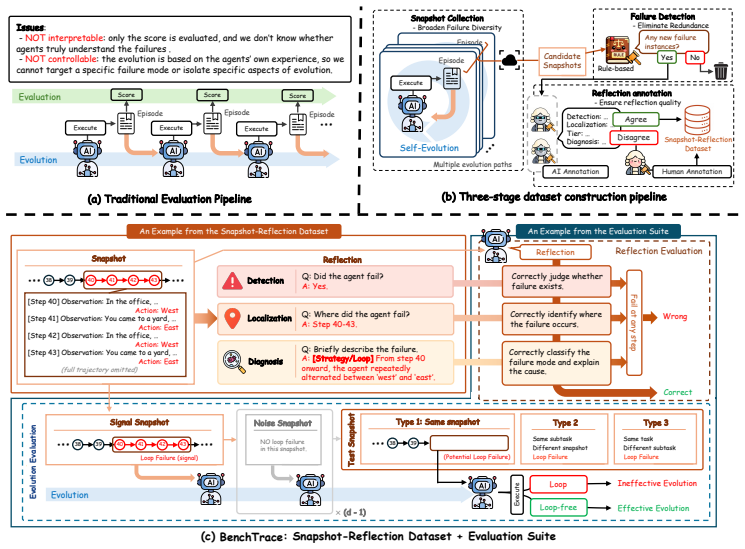
BenchTrace benchmark shows LLM agents reflect on failures below 30 percent success and fail to generalize self-evolution across contexts.
Reviewed by Pith at T0; open to challenge. T0 means a machine referee read the full paper against a public rubric. the ladder, T0–T4 →
T0 review · grok-4.3
2026-06-29 07:55 UTC pith:F4EGOHLG
load-bearing objection BenchTrace gives a controlled benchmark for testing agent reflection quality and whether it leads to actual failure avoidance, separate from live episode runs. the 3 major comments →
BenchTrace: A Benchmark for Testing Reflection Ability and Controlled Evolution in LLM Agents
The pith
A machine-rendered reading of the paper's core claim, the machinery that carries it, and where it could break.
Core claim
BenchTrace is built on a snapshot-reflection dataset of 1,821 annotated episodes and comprises a Reflection Evaluation that probes failure identification through targeted QA tasks, and an Evolution Evaluation that tests whether past failure experience translates into avoidance behavior in a controlled self-evolution simulation. Experiments with Qwen3-32B and GPT-4.1 reveal that both models fall below a 30 percent end-to-end pass rate on reflection evaluation, with diagnosis as the primary bottleneck. Evolution evaluation shows that self-evolution methods generally improve FAR over the non-evolving baseline, but agents forget early lessons as noise episodes accumulate, and agents fail to gene
What carries the argument
BenchTrace benchmark that separates reflection evaluation via targeted QA on annotated episodes from evolution evaluation that measures failure avoidance rate in a controlled self-evolution simulation.
Load-bearing premise
The 1,821 annotated episodes accurately represent the failure patterns that matter for real self-evolution and the controlled simulation isolates reflection effects without confounding factors from the agent's own episode generation.
What would settle it
An experiment in which agents achieve high failure avoidance rates even with partially correct or incorrect reflections across multiple task contexts would falsify the reported correlation between full reflection correctness and performance gains.
If this is right
- Self-evolution methods raise failure avoidance rate over non-evolving baselines.
- Agents forget early lessons as additional noise episodes accumulate.
- Reflections fail to generalize beyond the specific context and produce negative transfer across tasks.
- Only fully correct reflections correlate strongly with higher failure avoidance rates.
Where Pith is reading between the lines
- Persistent memory mechanisms could mitigate the observed forgetting of early lessons during self-evolution.
- The benchmark could be adapted to test whether multi-step reasoning chains help agents retain and apply reflections over longer horizons.
- Partial-credit systems for reflections may not support reliable long-term improvement if only fully correct ones drive gains.
Editorial analysis
A structured set of objections, weighed in public.
Referee Report
Summary. The paper introduces BenchTrace, a benchmark built on a snapshot-reflection dataset of 1,821 annotated episodes across six tasks. It defines a Reflection Evaluation (targeted QA for failure identification) and an Evolution Evaluation (controlled simulation measuring whether supplied reflections produce avoidance behavior). The authors propose the failure avoidance rate (FAR) metric and report that Qwen3-32B and GPT-4.1 both achieve <30% end-to-end pass rates on reflection (diagnosis is the main bottleneck), that self-evolution methods raise FAR relative to a non-evolving baseline but suffer from forgetting as noise episodes accumulate and from negative transfer across contexts, and that only fully correct reflections correlate strongly with higher FAR.
Significance. If the dataset faithfully samples relevant failure modes and the controlled simulation isolates reflection effects, BenchTrace would supply a model-agnostic, reproducible framework for diagnosing reflection quality separately from end-task scores and for testing self-evolution claims. The explicit correlation result between reflection correctness and FAR is a concrete, falsifiable contribution that could guide future agent designs.
major comments (3)
- [§3, §4.1] §3 (Dataset Construction) and §4.1 (Annotation Process): no inter-annotator agreement statistics, selection criteria for the 1,821 episodes, or quantitative checks on whether the annotated failure patterns match the distribution of failures that arise in actual self-evolution runs are provided. Without these, the claim that the benchmark targets the failure modes that matter for self-evolution cannot be evaluated.
- [§5.2] §5.2 (Evolution Evaluation Setup): the controlled simulation supplies the reflection to the agent but does not report ablations that rule out confounding cues (episode ordering, formatting artifacts, or implicit task signals). If such cues are present, the reported FAR gains, forgetting effect, and negative-transfer result cannot be attributed specifically to reflection quality.
- [Table 2, §6] Table 2 and §6 (Correlation Analysis): the statement that "only a fully correct reflection is strongly associated with higher FAR" is presented without the underlying contingency table, p-values, or controls for task difficulty and model identity. The strength of this central correlation claim therefore cannot be assessed from the reported numbers alone.
minor comments (2)
- [§3] The six tasks are named but their individual statistics (episode counts, difficulty distributions) are not broken out in any table; this makes it hard to judge whether results generalize or are driven by a subset of tasks.
- [Appendix A] The prompt templates used in the Reflection Evaluation QA tasks are not reproduced in the appendix, preventing exact replication of the <30% pass-rate numbers.
Simulated Author's Rebuttal
We thank the referee for the constructive and detailed feedback. We address each major comment point by point below, indicating the revisions we will incorporate.
read point-by-point responses
-
Referee: [§3, §4.1] §3 (Dataset Construction) and §4.1 (Annotation Process): no inter-annotator agreement statistics, selection criteria for the 1,821 episodes, or quantitative checks on whether the annotated failure patterns match the distribution of failures that arise in actual self-evolution runs are provided. Without these, the claim that the benchmark targets the failure modes that matter for self-evolution cannot be evaluated.
Authors: We agree these elements strengthen the benchmark's validity. Section 3 already describes the selection criteria (sampling episodes from six tasks to cover representative failure modes identified in preliminary runs). In the revision we will add inter-annotator agreement statistics (Cohen's kappa) from the annotation process and a quantitative table comparing the distribution of annotated failure patterns against those observed in our self-evolution experiments. revision: yes
-
Referee: [§5.2] §5.2 (Evolution Evaluation Setup): the controlled simulation supplies the reflection to the agent but does not report ablations that rule out confounding cues (episode ordering, formatting artifacts, or implicit task signals). If such cues are present, the reported FAR gains, forgetting effect, and negative-transfer result cannot be attributed specifically to reflection quality.
Authors: We acknowledge the value of explicit ablations. The current setup randomizes ordering and uses fixed formatting, but to isolate reflection effects more rigorously we will add ablation results in the revision that vary episode order, formatting, and task signals while holding reflection content constant. revision: yes
-
Referee: [Table 2, §6] Table 2 and §6 (Correlation Analysis): the statement that "only a fully correct reflection is strongly associated with higher FAR" is presented without the underlying contingency table, p-values, or controls for task difficulty and model identity. The strength of this central correlation claim therefore cannot be assessed from the reported numbers alone.
Authors: We agree that full statistical transparency is needed. The revised manuscript will include the contingency table, associated p-values, and explicit description of controls (stratification by task and separate per-model reporting) so readers can evaluate the correlation strength directly. revision: yes
Circularity Check
No circularity: benchmark and empirical metric introduced independently of fitted derivations
full rationale
The paper constructs BenchTrace from an externally annotated snapshot-reflection dataset of 1,821 episodes and defines FAR as the fraction of test cases avoiding a target failure. Reflection and evolution evaluations are performed via targeted QA and controlled simulation on held-out models (Qwen3-32B, GPT-4.1). No equations, parameter fits, or self-citations are used to derive the central claims; results are direct experimental measurements. Correlation analysis between reflection correctness and FAR is reported as an observed association, not a definitional reduction. The derivation chain is therefore self-contained against external benchmarks and does not reduce to its own inputs.
Axiom & Free-Parameter Ledger
axioms (1)
- domain assumption The six diverse tasks and their annotated episodes represent the failure patterns relevant to self-evolving LLM agents.
read the original abstract
Self-evolving agents improve over time by reflecting on past failures, but existing evaluation is limited in two ways: it measures only task scores, leaving reflection quality unknown, and it relies on agents' own episode runs, offering no mechanism to target specific failure patterns. We present \textbf{BenchTrace}, a benchmark for evaluating self-evolution ability in LLM agents. BenchTrace is built on a snapshot-reflection dataset of 1,821 annotated episodes spanning six diverse tasks, and comprises a \textbf{Reflection Evaluation} that probes failure identification through targeted QA tasks, and an \textbf{Evolution Evaluation} that tests whether past failure experience translates into avoidance behavior in a controlled self-evolution simulation. Building on BenchTrace, we propose \textbf{failure avoidance rate (FAR)}, a new evaluation metric measuring the fraction of test cases in which the agent successfully avoids the target failure instance. Experiments with Qwen3-32B and GPT-4.1 reveal that both models fall below a 30\% end-to-end pass rate on reflection evaluation, with diagnosis as the primary bottleneck. Evolution evaluation shows that self-evolution methods generally improve FAR over the non-evolving baseline, but agents forget early lessons as noise episodes accumulate, and agents fail to generalize their reflections beyond the specific context, causing negative transfer across task contexts. Our correlation analysis further reveals that only a fully correct reflection is strongly associated with higher FAR. BenchTrace exposes concrete limits of current self-evolution approaches and provides a controlled, model-agnostic framework for targeted evaluation.
Figures


Forward citations
Cited by 1 Pith paper
-
Self-Evolving Agent Harnesses via Gated Semantic Quality-Diversity
A gated, statistically-checked self-evolution loop improves frozen agents' harnesses by +9 to +15.5 points on sealed tests across six benchmarks, retaining 86-147% of the training gain.
Reference graph
Works this paper leans on
-
[1]
EvoTest: Evolutionary Test-Time Learning for Self-Improving Agentic Systems
Evotest: Evolutionary test-time learning for self-improving agentic systems.arXiv preprint arXiv:2510.13220. Zexue He, Yu Wang, Churan Zhi, Yuanzhe Hu, Tzu- Ping Chen, Lang Yin, Ze Chen, Tong Arthur Wu, Siru Ouyang, Zihan Wang, and 1 others. 2026. Mem- oryarena: Benchmarking agent memory in interde- pendent multi-session agentic tasks.arXiv preprint arXiv...
work page internal anchor Pith review Pith/arXiv arXiv 2026
-
[2]
arXiv preprint arXiv:2603.15255 , year =
Sage: Multi-agent self-evolution for llm rea- soning.arXiv preprint arXiv:2603.15255. Noah Shinn, Federico Cassano, Ashwin Gopinath, Karthik Narasimhan, and Shunyu Yao. 2023. Re- flexion: Language agents with verbal reinforcement learning.Advances in neural information processing systems, 36:8634–8652. Mohit Shridhar, Xingdi Yuan, Marc-Alexandre Côté, Yon...
-
[3]
Qwen3 technical report.arXiv preprint arXiv:2505.09388. Yutao Yang, Junsong Li, Qianjun Pan, Bihao Zhan, Yux- uan Cai, Lin Du, Jie Zhou, Kai Chen, Qin Chen, Xin Li, and 1 others. 2026. Autoskill: Experience- driven lifelong learning via skill self-evolution.arXiv preprint arXiv:2603.01145. Shunyu Yao, Jeffrey Zhao, Dian Yu, Nan Du, Izhak Shafran, Karthik ...
work page internal anchor Pith review Pith/arXiv arXiv 2026
-
[4]
After examining, GET the object if possible, to add it to your inventory.3
When given an object by an NPC, immediately EXAMINE it to learn more.2. After examining, GET the object if possible, to add it to your inventory.3. READ any documents or papers you acquire for essential clues.4. Follow explicit instructions from characters or the environment.5. Upon entering a new area, use LOOK to review surroundings and exits.6. Choose ...
discussion (0)
Sign in with ORCID, Apple, or X to comment. Anyone can read and Pith papers without signing in.