REVIEW 2 major objections 4 minor 4 references
ART watches the running attention result inside the kernel and stops fetching more KV cache once that result stabilizes, speeding long-context decoding by up to 20% without replacing existing cache policies.
Reviewed by Pith at T0; open to challenge. T0 means a machine referee read the full paper against a public rubric. the ladder, T0–T4 →
ART early-terminates FlashAttention-style KV block traversal when intermediate attention outputs stabilize in scale and direction, speeding decoding up to ~20% atop existing KV methods.
T0 review reviewed 2026-07-12 challenge →
load-bearing objection Solid systems paper: kernel-level output-stability early exit that composes with existing KV methods and delivers real ~10–20% throughput, with theory correctly scoped to mass-regulated traversal. the 2 major comments →
ART: Attention Run-time Termination for Efficient Large Language Model Decoding
The pith
A machine-rendered reading of the paper's core claim, the machinery that carries it, and where it could break.
The reading
Core claim
Intermediate attention outputs in FlashAttention-style block kernels often stabilize well before the full KV cache is traversed, so a lightweight stability check on a probe of the accumulator can safely terminate remaining block accesses. ART is a composable run-time termination layer over existing dense or sparse KV policies: the base method defines the candidate set and traversal order, while ART decides at run time when further traversal is unnecessary. Dual monitoring of scale and direction, plus consecutive-block patience, captures joint key–value influence that key-only pruning misses, and a conditional truncation bound relates residual error to the scale tolerance, probe quality, and
What carries the argument
Attention Run-time Termination (ART): a stability criterion on a cheap probe of the streaming attention accumulator that measures both magnitude change and directional change, then stops after p consecutive stable steps. It converts observed output convergence into early exit from KV-block traversal without changing the attention formula.
Load-bearing premise
Early stop is safe only if, after the output has looked stable, the remaining cache blocks keep contributing less and less attention mass—which requires that the important blocks were already visited.
What would settle it
Place a critical needle far from the recent window, run full-KV ART with recency-first order, and measure whether accuracy collapses while speed still rises; then re-run with a retrieval-aware order that still terminates early—if accuracy recovers without losing the speedup, the mass-regulated premise is confirmed, and if it does not, the central safety claim fails.
If this is right
- Existing dense and sparse KV methods can gain roughly 10% lower time-per-token and up to 20% higher large-batch throughput on LongBench with only small score changes when ART is stacked on them.
- Attention kernels need not be treated as atomic: intermediate outputs can drive run-time decisions that cut memory traffic at the source.
- Value-aware early exit becomes practical without offline predictors or extra precomputation.
- On retrieval-sensitive tasks, speedups remain quality-preserving only when the base traversal already surfaces critical evidence early.
- Under mass-regulated residual mass, truncation error is controlled by the scale tolerance, probe fidelity, and ln(T/t*).
Where Pith is reading between the lines
- Per-layer adaptive thresholds or learned patience could shrink the remaining accuracy gap on needle tasks when recency-first order fails.
- Serving stacks that keep attention atomic may unlock larger end-to-end gains once output-stability checks are exposed to the scheduler.
- The same intermediate-output monitoring pattern could transfer to other block-streaming long-context kernels beyond attention.
- If mass-regulated early exposure becomes a design goal, future KV policies may prioritize ordering high-mass blocks first rather than only deciding what to retain.
Editorial analysis
A structured set of objections, weighed in public.
Referee Report
Summary. The paper proposes ART, a composable run-time early-termination layer for FlashAttention-style kernels. During block-wise KV traversal it monitors a lightweight probe of the intermediate attention accumulator and stops once scale and direction changes remain below thresholds for p consecutive blocks. ART is intended to sit on top of dense or sparse KV policies rather than replace them. A conditional truncation bound (Eq. 4 / Theorems 1–2) relates residual error to the scale tolerance, probe quality, residual mass, and ln(T/t*) under a mass-regulated traversal assumption. Empirically, ART reduces TPOT by roughly 10% and raises large-batch throughput by up to 20% on LongBench with small score drops when composed with Baseline, StreamingLLM, SnapKV, and PyramidKV; on RULER NIAH the quality impact is small only when the base policy is retrieval-aware.
Significance. If the systems claim holds under the stated scope, ART is a useful and orthogonal acceleration primitive: it opens the attention kernel to output-space early exit, captures joint key–value influence without offline predictors, and composes with existing KV managers. Strengths include a clear composability design, a probe–oracle consistency study (Appendix B), an ablation of scale/direction/patience (Table 3), measured kernel overhead of ~1.3% when termination is disabled, and an explicit (if conditional) truncation analysis. The work is primarily systems/empirical; the theory correctly caveats its assumptions rather than overclaiming universality.
major comments (2)
- [Abstract / §1 / Table 2] Abstract and §1 claim ART increases throughput “without compromising the result quality.” Table 2 (RULER NIAH, full KV+ART) shows large accuracy drops (e.g., 99.34% → 78.65% at 32K). The body correctly scopes ART as a termination layer whose safety depends on traversal (Assumption 1, §3.2–3.3), but the abstract/intro overstate quality preservation. Please qualify the claim to match Table 2 and the mass-regulated-traversal precondition.
- [Appendix A, Assumption 1 / Eq. (4)] The truncation bound (Eq. 4, Theorems 1–2) and the safety of early stop both rest on Assumption 1 (mass-regulated residual mass ℓ_j/A_j ≤ μ/j after the final stable window) and on a traversal that has already exposed dominant contributors. The paper demonstrates the failure mode under naïve recency-first full KV on NIAH, yet does not report how often residual mass actually decays under the default reverse-temporal order on LongBench, nor any diagnostic of residual attention mass at termination. A short empirical check (or layer-wise residual-mass plot) would make the theory–practice link load-bearing rather than only conditional.
minor comments (4)
- [Abstract] Typo in abstract: “provideds” → “provides”.
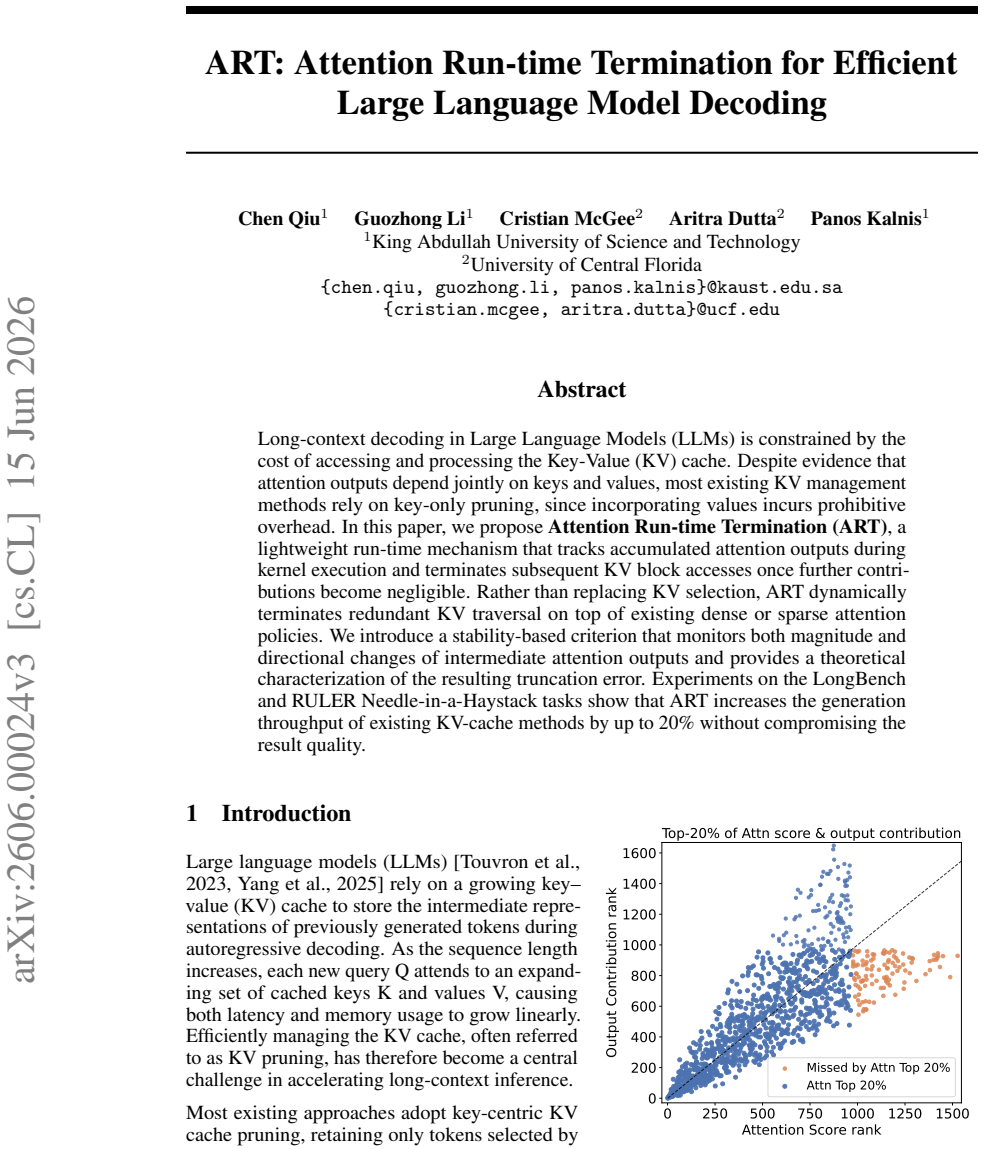
- [Figure 1] Figure 1 caption and legend are dense; a short sentence clarifying that orange points are high-contribution tokens missed by top-20% attention-score ranking would help.
- [§4.1 / Appendix F] Default thresholds (τ=10^{-5}, ϕ=10^{-3}, p=5) are stated in §4.1; a one-line pointer in the main text to the sensitivity plots in Appendix F would improve reproducibility without forcing readers into the appendix first.
- [§3.2 / Appendix A] Notation for the probe map P and the constant ν appears only in the appendix; a brief forward reference in §3.2 would connect the algorithm to the bound.
Circularity Check
No significant circularity: empirical systems method with free-parameter thresholds and a conditional truncation bound under explicit assumptions; results measured on external benchmarks.
full rationale
The paper's central claims are (i) a run-time early-termination rule inside FlashAttention-style kernels that monitors a probe of the accumulating attention output for joint scale/direction stability over p consecutive blocks, and (ii) measured TPOT/throughput gains (up to ~20%) on LongBench when the rule is composed with existing dense or sparse KV policies, with only marginal score change. The stability thresholds τ, φ and patience p are free hyperparameters selected by sensitivity sweeps (Appendix F) and ablated (Table 3); they do not redefine the reported LongBench or RULER metrics, which remain external. The truncation-error bound (Eq. 4 / Theorems 1-2) is derived from the FlashAttention recurrence under two stated assumptions (mass-regulated residual mass decay after the final stable window, and a non-degenerate linear probe); the paper itself scopes the bound as conditional and demonstrates the failure mode when the traversal assumption is violated (naïve recency-first full-KV on RULER NIAH, Table 2). Probe fidelity is checked empirically against an oracle (Appendix B). There is no self-definitional loop, no fitted quantity re-labeled as a prediction of a closely related target, no load-bearing uniqueness theorem imported from overlapping authors, and no renaming of a known empirical pattern. The derivation chain is therefore self-contained against external benchmarks and does not reduce by construction to its inputs.
Axiom & Free-Parameter Ledger
free parameters (3)
- scale threshold τ
- direction threshold ϕ
- patience p
axioms (4)
- domain assumption FlashAttention-style streaming block accumulation correctly implements (or approximates within FP non-associativity) scaled dot-product attention.
- ad hoc to paper Mass-regulated traversal: after stable window start b, residual blocks satisfy ℓ_j ≤ ℓ̂ and A_j ≥ h j with ℓ̂/h=μ, hence ℓ_j/A_j ≤ μ/j.
- ad hoc to paper Probe map P is non-degenerate on relevant update directions: ν‖z‖ ≤ ‖Pz‖ for z in the span of successive output updates.
- domain assumption Recency-first or importance-first ordering tends to expose high-contribution blocks early enough for residual mass to decay.
invented entities (2)
-
ART stability probe x^(t) from warp-0 MMA leading elements
no independent evidence
-
Decoupled scale/direction stability + patience termination rule
no independent evidence
Cite this review
Pith. "Pith review of ART: Attention Run-time Termination for Efficient Large Language Model Decoding." pith.science (2026). https://pith.science/paper/F5IXOUZU
@misc{pith2026260600024,
  author       = {Pith},
  title        = {Pith review of: ART: Attention Run-time Termination for Efficient Large Language Model Decoding},
  year         = {2026},
  howpublished = {\url{https://pith.science/paper/F5IXOUZU}},
  note         = {Machine review of arXiv:2606.00024}
}
read the original abstract
Long-context decoding in Large Language Models (LLMs) is constrained by the cost of accessing and processing the Key-Value (KV) cache. Despite evidence that attention outputs depend jointly on keys and values, most existing KV management methods rely on key-only pruning, since incorporating values incurs prohibitive overhead. In this paper, we propose Attention Run-time Termination (ART), a lightweight run-time mechanism that tracks accumulated attention outputs during kernel execution and terminates subsequent KV block accesses once further contributions become negligible. Rather than replacing KV selection, ART dynamically terminates redundant KV traversal on top of existing dense or sparse attention policies. We introduce a stability-based criterion that monitors both magnitude and directional changes of intermediate attention outputs and provideds a theoretical characterization of the resulting truncation error. Experiments on the LongBench and RULER Needle-in-a-Haystack tasks show that ART increases the generation throughput of existing KV-cache methods by up to 20%, without compromising the result quality.
Figures


Reference graph
Works this paper leans on
-
[1]
URLhttp://arxiv.org/abs/2503.07518
doi: 10.48550/arXiv.2503.07518. URLhttp://arxiv.org/abs/2503.07518. Yushi Bai, Xin Lv, Jiajie Zhang, Hongchang Lyu, Jiankai Tang, Zhidian Huang, Zhengxiao Du, Xiao Liu, Aohan Zeng, Lei Hou, Yuxiao Dong, Jie Tang, and Juanzi Li. LongBench: A bilingual, multitask benchmark for long context understanding. InProceedings of the 62nd Annual Meeting of the Assoc...
-
[2]
URLhttp://arxiv.org/abs/2406.12335
doi: 10.48550/arXiv.2406.12335. URLhttp://arxiv.org/abs/2406.12335. Chi Han, Qifan Wang, Hao Peng, Wenhan Xiong, Yu Chen, Heng Ji, and Sinong Wang. Lm-infinite: Zero-shot extreme length generalization for large language models. InProceedings of the 2024 Conference of the North American Chapter of the Association for Computational Linguistics: Human Langua...
-
[3]
URLhttp://arxiv.org/abs/2310.06825
doi: 10.48550/arXiv.2310.06825. URLhttp://arxiv.org/abs/2310.06825. Woosuk Kwon, Zhuohan Li, Siyuan Zhuang, Ying Sheng, Lianmin Zheng, Cody Hao Yu, Joseph Gonzalez, Hao Zhang, and Ion Stoica. Efficient memory management for large language model serving with pagedattention. InProceedings of the 29th symposium on operating systems principles, pages 611–626,...
-
[4]
perplexity surge
We evaluate both the effect of sequence length and the effect of layer depth. In the sequence length study, we fix the last layer and place the needle at the middle of the context. Across sequence lengths from 1K to 8K tokens, the probe almost exactly matches the oracle decision. In particular, the agreement remains 100.00% up to 4K tokens and 99.88% at 8...
2024
This paper was first reviewed by grok-4.5 on July 12, 2026.
discussion (0)
Sign in with ORCID, Apple, or X to comment. Anyone can read and Pith papers without signing in.