REVIEW 3 major objections 6 minor 29 references
Compositeness relations for near-threshold p-wave bound states
T0 review · 3 major / 6 minor · reviewed 2026-08-15 · deepseek-v4-flash
Pith's one-line read This paper derives explicit p-wave compositeness relations that let scattering measurements determine the molecular-versus-elementary composition of a near-threshold state.
desk verdict Correct single-channel p-wave compositeness relations and useful Feynman rules, but the central Z-interpretation is scheme-dependent and the p-wave result itself is not new. read the letter →
The pith
A machine-rendered reading of the paper's core claim, the machinery that carries it, and where it could break.
The reading
What carries the argument
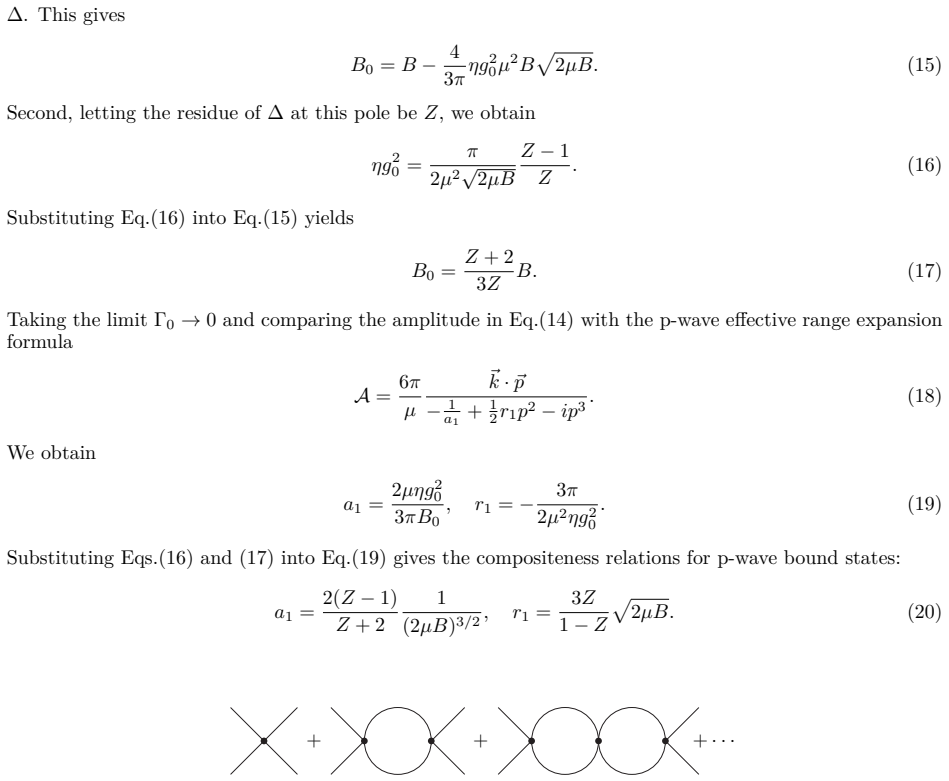
The machinery is the pair of matching conditions applied to the resummed propagator: the pole condition fixes the bare mass shift in terms of the binding energy, and the residue condition fixes the bare coupling $g_0^2$ in terms of $Z$. For p-wave scattering, the derivative interaction in Eq. (11) makes the one-loop self-energy proportional to $(-2\mu E)^{3/2}$, and comparing the resummed amplitude with the p-wave effective range expansion $A = \frac{6\pi}{\mu}\frac{\vec{k}\cdot\vec{p}}{-1/a_1 + \tfrac12 r_1 p^2 - i p^3}$ closes the derivation. The $Z\to0$ limit is checked against the equivalent contact-interaction theory, and the $Z=1$ limit reduces the general propagator to a nonrelativistic Breit-Wigner form.
What would settle it
Fit the p-wave $D\bar D$ or $D^*\bar D$ line shape of a candidate state with the general propagator in Eq. (36) and the vertex $-2ig_0 p_i$, extract $a_1$ and $r_1$ from data, and check whether Eq. (20) can reproduce them for any $Z$ between 0 and 1. If $a_1$ comes out positive, or if the measured pair $(a_1,r_1)$ is incompatible with the predicted relation by more than the quoted uncertainties, the single-channel derivative-coupling picture is falsified.
Extended reading notes
Core claim
The paper claims that for a near-threshold p-wave bound state described by one bare state coupled to one two-body channel through the leading derivative interaction, the p-wave effective range expansion parameters are not independent: they are determined entirely by $B$ and $Z$ through Eq. (20). The derivation reformulates the original compositeness relations as two conditions—the full propagator has a pole at $E=-B$ and its residue there equals $Z$—and applies these conditions in a nonrelativistic effective field theory with the p-wave derivative vertex. In the molecular limit $Z\to0$, $a_1$ tends to $-1/(2\mu B)^{3/2}$ and $r_1$ tends to zero, while in the elementary limit $Z\to1$, $a_1$ tends to zero and $r_1$ diverges. The paper also argues that the negative-norm property of p-wave bound states seen in the minimal-subtraction scheme is a renormalization artifact: with the power-divergence subtraction scheme and a suitably chosen scale, the sign of the coupling is positive and the norm can be taken positive, so the negative norm need not signal unphysical states.
Load-bearing premise
The entire extraction rests on assuming that the physical state is exactly one bare field coupled to one two-body channel through the leading p-wave derivative coupling, with all other interactions—additional channels, meson exchange, higher-derivative contact terms—negligible at leading order.
Editorial extensions
If this is right
- Measuring the p-wave scattering length and effective range of a near-threshold candidate determines $Z$ through Eq. (20), turning composition from a model assumption into an extracted observable.
- The molecular limit $Z\to0$ produces a finite negative scattering length with vanishing effective range, while the elementary limit $Z\to1$ drives $a_1$ to zero and $r_1$ to infinity; these limits give sharp, testable signatures.
- The general propagator of Eq. (36) remains well defined at $Z=0$, so it can be used to fit exotic-state lineshapes without encountering the infinite bare parameters of the Flatté form.
- The same pole-and-residue reformulation recovers the original s-wave relations, indicating the method extends to any partial wave with the appropriate loop function.
Reading between the lines
- The paper leaves implicit that Eq. (20) imposes a one-parameter consistency constraint connecting $a_1$, $r_1$, and $B$; a dataset that cannot satisfy it for any $Z\in(0,1)$ would indicate missing degrees of freedom, such as coupled channels.
- A direct application would be to fit the reported $G(3900)$ lineshape with Eq. (36); the extracted $Z$ then decides between a molecular and an elementary multiquark reading of that structure.
- The renormalization-scheme logic suggests the same negative-norm artifact will appear for higher partial waves, and that a power-divergence subtraction with a suitable scale should cure it there as well.
Signed reviews
Editorial analysis
A structured set of objections, weighed in public.
Referee Report
Summary. This paper generalizes Weinberg's compositeness relations from s-wave to p-wave near-threshold bound states within a nonrelativistic effective field theory (NREFT). The authors reformulate the s-wave derivation as two conditions, namely that the full propagator has a pole at the bound-state energy E=-B and that its residue is Z, and then apply the same conditions to a p-wave state with a derivative coupling to a two-body channel. They derive Eq. (20), which relates the p-wave scattering volume a1 and effective range r1 to the binding energy B and the field renormalization constant Z, discuss the negative-norm issue that appears in the minimal subtraction scheme, and argue that a power divergence subtraction scheme can restore a positive-norm bare state. They also provide Feynman rules for near-threshold p-wave states, including a Flatté-like propagator that remains finite in the Z=0 limit. The abstract claims these relations can distinguish a molecular state from an elementary state.
Significance. If the central claim were fully valid, Eq. (20) would provide a simple, parameter-free way to extract the elementary-state probability from p-wave scattering data, which is timely given recent near-threshold p-wave candidates such as G(3900). The algebraic derivation in Sec. III is internally consistent: the pole and residue conditions do reproduce the stated a1 and r1, and the matching to the p-wave effective range expansion is correct. The proposed Feynman rules are also well defined and could be practically useful. However, the advertised physical interpretation is weakened substantially by the scheme dependence of Z, which the paper itself acknowledges in Sec. V but does not resolve. The significance of the paper would improve considerably if the authors either provided a scheme-independent definition of compositeness or explicitly framed Eq. (20) as a relation among Lagrangian parameters in a chosen scheme rather than as a determination of a physical probability.
major comments (3)
- [Secs. III–V, Eqs. (20), (25), (26)] The compositeness relations are not scheme independent. Repeating the same pole-and-residue construction in the PDS scheme with η=+1 and Λ>3γ/2, where γ=√(2μB), gives a1=(1-Z)/(2μB(Λ-γ(1+Z/2))) and r1=(3γZ-2Λ)/(1-Z), which differ from Eq. (20) and depend on the subtraction scale Λ. Since a1 and r1 are physical, scheme-independent quantities, Eq. (20) cannot determine a scheme-independent Z from data; the extraction relies on an arbitrary choice of renormalization scheme. Section V explicitly states that Z depends on Λ and that Eq. (20) is defined at Λ=0, but this is not reconciled with the abstract's claim that the relations distinguish molecular from elementary states.
- [Sec. IV, Eqs. (27)–(33)] The probability interpretation of Z is not established. In the MS scheme, the bare state has η=-1, so the coefficient √Z in the wavefunction expansion in Eq. (27) does not correspond to a positive-norm component, and the residue condition together with η=-1 undermines the standard probabilistic reading of Z. The PDS discussion changes the sign of the squared coupling, but, as noted above, it also changes the functional relations between a1, r1 and Z. Thus the PDS scheme does not rescue the probability interpretation of the Z appearing in Eq. (20). The paper needs either a scheme-independent definition of compositeness, for example based on a positivity-preserving renormalization condition tied to an observable amplitude residue, or a clear disclaimer that Z in Eq. (20) is a Lagrangian parameter rather than a physical probability.
- [Sec. III, I and Refs. [11,16,17]] The paper does not compare its p-wave relations with the existing generalizations of compositeness relations cited as Refs. [11,16,17]. Since those works already treat p-wave and higher partial waves, the authors should show explicitly how Eq. (20) relates to the known results, including any differences in convention or renormalization scheme. Without this comparison, the novelty and validity of the claimed 'generalization' of Weinberg's relations are difficult to assess.
minor comments (6)
- [Abstract and Sec. I] The word 'appliecable' should be 'applicable'.
- [Sec. III] The phrases 'we use the same notion' and 'to amphasize' should be 'we use the same notation' and 'to emphasize'.
- [Sec. II, Eq. (11)] In the description of the creation and annihilation operators, 'crates' should be 'creates'.
- [Sec. V, Eqs. (36)–(37)] It should be clarified whether the g appearing in Σ(E) in Eq. (36) is the bare coupling g0 from Sec. III or the redefined coupling g of Eq. (37). The vertex rule later uses g0, so the notation should be made unambiguous.
- [References] The DOIs for Refs. [4] and [6] appear malformed; please verify and correct them.
- [Sec. III, Eq. (12)] The minimal subtraction of the D→4 pole in the loop integral is not shown explicitly; citing Ref. [15] is probably sufficient, but a one-sentence explanation of the subtraction would improve readability.
Circularity Check
No significant circularity: the p-wave compositeness relations are derived from pole and residue conditions and reduce to an algebraic reparameterization, not to a fitted input renamed as a prediction.
full rationale
The central derivation in Sec. III starts from the bare propagator (Eq. 13) and the p-wave effective range expansion amplitude (Eq. 18), imposes two independent conditions—pole at E = -B and residue Z—and solves for B0 and eta g0^2 (Eqs. 15-17). Substitution into the expressions for a1 and r1 (Eq. 19) yields Eq. (20) algebraically. The output quantities (a1, r1) are not among the inputs (B, Z, mu); they are independent ERE parameters obtained from the amplitude. This is a reparameterization of the same two-parameter low-energy amplitude, which is what compositeness relations are, not a circular prediction. The s-wave section (Sec. II) recovers Weinberg's relations by the same two conditions, providing a nontrivial cross-check. The cited framework and Lagrangian from Refs. [12,15,21] include self-citations, but the Lagrangian is written out explicitly in Eq. (11) and the loop integrals are computed in the text, so the self-citations are not load-bearing for the derivation. The negative-norm and renormalization-scheme discussion in Sec. IV concedes a limitation of interpreting Z as probability in the MS scheme; that is a physical or correctness concern about the compositeness interpretation, not a circularity. No step of the derivation reduces to its own input by construction.
Assumptions & free parameters
assumptions (3)
- standard math The p-wave effective range expansion for the scattering amplitude takes the form A = (6π/µ) k·p / (-1/a1 + 1/2 r1 p^2 - i p^3) (Eq.18).
- domain assumption The bare bound state couples to the D Dbar channel only through the derivative interaction in Eq.(11), and no other interactions contribute at leading order.
- ad hoc to paper The two conditions (pole at E=-B and residue Z) are sufficient to determine the compositeness relations.
Cite this review
Pith. "Pith review of Compositeness relations for near-threshold p-wave bound states." pith.science (2026). https://pith.science/paper/F5TPCURP
@misc{pith2026260725744,
  author       = {Pith},
  title        = {Pith review of: Compositeness relations for near-threshold p-wave bound states},
  year         = {2026},
  howpublished = {\url{https://pith.science/paper/F5TPCURP}},
  note         = {Machine review of arXiv:2607.25744}
}
read the original abstract
We generalize Weinberg's compositeness relations to near-threshold p-wave bound states and derive the relations between the p-wave effective range expansion parameters, binding energy B, and the field renormalization constant Z. We also provide the corresponding Feynman rules which are appliecable regardless of whether the near-threshold state is a pure molecular state or an elementary multiquark state.
Figures


Reference graph
Works this paper leans on
-
[1]
To resolve this, we adopt the PDS scheme, which remove the D = 2 pole in Eq.(32)
The origin of the issue is clear: the integral I ′ is positive by definition, but the MS scheme has subtracts too much, rendering it negative. To resolve this, we adopt the PDS scheme, which remove the D = 2 pole in Eq.(32). This gives I ′ = µ2 π (Λ − 3 2 √ 2µB). (34) For Λ> 3 2 √2µB, I ′ is positive. Substituting Eq.(34) into Eq.(31) yields g2 0 = 3π 4µ2...
-
[2]
become infinite in the limit Z → 0, as is evident from Eq.(16) and (17). We therefore recommend using Eq.(36) to fit the lineshape data, since DEFT (E) remains well-defined in the limit Z → 0. This is particularly important because most near-threshold exotic states are commonly identified as molecular states, i.e., Z = 0 . One can also readily see that fo...
-
[3]
M. Ablikim et al. [BESIII], Phys. Rev. Lett. 133 (2024) no.8, 081901 doi:10.1103/PhysRevLett.133.081901 [arXiv:2402.03829 [hep-ex]]
arXiv 2024
-
[4]
B. Aubert et al. [BaBar], Phys. Rev. D 76 (2007), 111105 doi:10.1103/PhysRevD.76.111105 [arXiv:hep- ex/0607083 [hep-ex]]. 7
-
[5]
P. Pakhlov et al. [Belle], Phys. Rev. Lett. 100 (2008), 202001 doi:10.1103/PhysRevLett.100.202001 [arXiv:0708.3812 [hep-ex]]
arXiv 2008
-
[6]
X. X. Chen, Z. M. Ding and J. He, Phys. Rev. D 111 (2025) no.11, 11 doi:10.1103/36vy-r2z8 [arXiv:2504.15534 [hep-ph]]
arXiv 2025
-
[7]
Z. Y. Lin, J. Z. Wang, J. B. Cheng, L. Meng and S. L. Zhu, Phys. Rev. Lett. 133 (2024) no.24, 241903 doi:10.1103/PhysRevLett.133.241903 [arXiv:2403.01727 [hep-ph]]
arXiv 2024
-
[8]
Q. Ye, Z. Zhang, M. L. Du, U. G. Meißner, P. Y. Niu and Q. Wang, Phys. Rev. D 112 (2025) no.1, 016015 doi:10.1103/qq61-ncln [arXiv:2504.17431 [hep-ph]]
arXiv 2025
Show all 29 references
-
[9]
V. C. Premoli, P. Brandão, Y. W. Pan, L. S. Geng and L. M. Abreu, [arXiv:2606.09397 [hep-ph]]
- [10]
- [11]
-
[12]
V. Baru, J. Haidenbauer, C. Hanhart, Y. Kalashnikova and A. E. Kudryavtsev, Phys. Lett. B 586 (2004), 53-61 doi:10.1016/j.physletb.2004.01.088 [arXiv:hep-ph/0308129 [hep-ph]]
2004 arXiv
-
[13]
Aceti and E
F. Aceti and E. Oset, Phys. Rev. D 86 (2012), 014012 doi:10.1103/PhysRevD.86.014012 [arXiv:1202.4607 [hep- ph]]
2012 arXiv
-
[14]
G. Y. Chen, W. S. Huo and Q. Zhao, Chin. Phys. C 39 (2015) no.9, 093101 doi:10.1088/1674-1137/39/9/093101 [arXiv:1309.2859 [hep-ph]]
2015 arXiv
-
[15]
Sekihara, T
T. Sekihara, T. Hyodo and D. Jido, PTEP 2015 (2015), 063D04 doi:10.1093/ptep/ptv081 [arXiv:1411.2308 [hep-ph]]
2015 arXiv
-
[16]
Z. H. Guo and J. A. Oller, Phys. Rev. D 93 (2016) no.9, 096001 doi:10.1103/PhysRevD.93.096001 [arXiv:1508.06400 [hep-ph]]
2016 arXiv
-
[17]
H. Xu, N. Yu, Z. Zhang and G. Chen, JHEP 01 (2025), 102 doi:10.1007/JHEP01(2025)102 [arXiv:2401.03373 [hep-ph]]
2025 arXiv
-
[18]
Kinugawa and T
T. Kinugawa and T. Hyodo, Eur. Phys. J. A 61 (2025) no.7, 154 doi:10.1140/epja/s10050-025-01548-y [arXiv:2411.12285 [hep-ph]]
2025
-
[19]
P. C. Bruns, [arXiv:2502.08413 [nucl-th]]
-
[20]
D. B. Kaplan, M. J. Savage and M. B. Wise, Nucl. Phys. B 534 (1998), 329-355 doi:10.1016/S0550-3213(98)00440- 4 [arXiv:nucl-th/9802075 [nucl-th]]
1998 arXiv
-
[21]
C. A. Bertulani, H. W. Hammer and U. Van Kolck, Nucl. Phys. A 712 (2002), 37-58 doi:10.1016/S0375- 9474(02)01270-8 [arXiv:nucl-th/0205063 [nucl-th]]
2002 arXiv
-
[22]
P. F. Bedaque, H. W. Hammer and U. van Kolck, Phys. Lett. B 569 (2003), 159-167 doi:10.1016/j.physletb.2003.07.049 [arXiv:nucl-th/0304007 [nucl-th]]
2003 arXiv
-
[23]
G. Y. Chen and Q. Zhao, Phys. Lett. B 718 (2013), 1369-1374 doi:10.1016/j.physletb.2012.12.015 [arXiv:1209.6268 [hep-ph]]
2013 arXiv
-
[24]
Lurie and A.J
D. Lurie and A.J. Macfarlane, Phys. Rev., 1964, 136: B816
1964
-
[25]
Nishida, Phys
Y. Nishida, Phys. Rev. A 86 (2012), 012710 doi:10.1103/PhysRevA.86.012710 [arXiv:1111.6961 [cond-mat.quant- gas]]
2012 arXiv
-
[26]
Braaten, P
E. Braaten, P. Hagen, H. W. Hammer and L. Platter, Phys. Rev. A 86 (2012), 012711 doi:10.1103/PhysRevA.86.012711 [arXiv:1110.6829 [cond-mat.quant-gas]]
2012 arXiv
-
[27]
W. S. Huo and G. Y. Chen, Eur. Phys. J. C 76 (2016) no.3, 172 doi:10.1140/epjc/s10052-016-4013-0 [arXiv:1501.02189 [hep-ph]]
2016 arXiv
-
[28]
H. Xu, N. Yu and Z. Zhang, Eur. Phys. J. C 85 (2025) no.8, 827 doi:10.1140/epjc/s10052-025-14520-3 [arXiv:2401.00411 [hep-ph]]
2025 arXiv
-
[29]
S. M. Flatte, Phys. Lett. B 63 (1976), 224-227 doi:10.1016/0370-2693(76)90654-7 8
1976 doi
Reviewed August 15, 2026 · model on record in the stance chip above.
Discussion (0). Continue with ORCID to comment.