REVIEW 4 major objections 6 minor 1 cited by
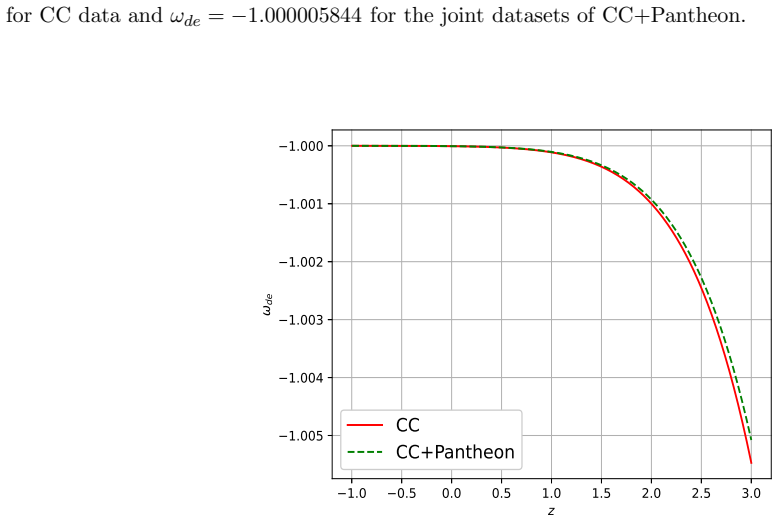
A non-linear f(R,T,L_m) gravity model fits a transit universe that turns from deceleration to acceleration at z≈0.62, with a dark-energy equation of state ω_de≈-1.000006 approaching the phantom side of a cosmological constant.
Reviewed by Pith at T0; open to challenge. T0 means a machine referee read the full paper against a public rubric. the ladder, T0–T4 →
T0 review · deepseek-v4-flash
2026-08-04 18:20 UTC pith:F6TCAQMN
load-bearing objection A tidy MCMC exercise in a previously studied f(R,T,L_m) model, but the claimed phantom signal is tiny and the solution never checks the second Friedmann equation. the 4 major comments →
Transit dark energy cosmological models in generalized matter-geometry coupling theory using a non-linear form of f(R,T,L_(m)) function
The pith
A machine-rendered reading of the paper's core claim, the machinery that carries it, and where it could break.
Core claim
On its own terms, the paper establishes that the specific non-linear f(R,T,L_m) model with f=αR+(βT+γL_m)R−η yields a closed-form Hubble function H(z) whose best fit to the combined CC+Pantheon dataset describes a transit universe. The deceleration parameter crosses from positive to negative at z_t=0.618, the current deceleration is q0=-0.555, the effective equation of state is ω_eff=-0.703, and the dark-energy equation of state is ω_de=-1.000006, i.e., phantom but indistinguishable from -1. The model passes the Om diagnostic (phantom behaviour), the causality test (0≤c_s²/c²≤1), and all energy conditions except the strong one, which is violated only below the transition redshift, as expecte
What carries the argument
The central object is the non-linear Lagrangian f(R,T,L_m)=αR+βRT+γRL_m−η, which upon variation gives modified field equations recast into an effective Friedmann form with an effective gravitational constant G_eff and a dark-energy density and pressure. Substituting the perfect-fluid relations T=−ρ+3p, L_m=−ρ, and R=6(Ḣ+2H²) leads to a single closed-form expression for the Hubble function H(z) in terms of H0, Ω_m0, Ω_r0, Ω_η, β, and γ. This H(z) is the load-bearing object: it is fit to the data, and every derived diagnostic—deceleration parameter, effective and dark-energy equations of state, density parameters, Om function, sound speed, and energy conditions—is computed from it. The viabili
Load-bearing premise
Everything rests on the assumption that matter and radiation obey the unchanged conservation equations ρ̇_m+3Hρ_m=0 and ρ̇_r+4Hρ_r=0 even though the modified theory is non-conservative; if those equations gain extra coupling terms, the Hubble function and all fitted parameters change.
What would settle it
Solve the full non-conservative field equations without imposing the standard continuity assumption and compare the resulting H(z) at the same parameter values with Eq. (31); a mismatch larger than the reported 1σ uncertainties would falsify the model. Alternatively, if high-precision growth-rate data fσ8 at z<1 rule out the background expansion and perturbation growth predicted by this model, the viability claim fails.
If this is right
- If the model is correct, late-time acceleration can be produced by matter-geometry coupling terms βRT and γRL_m, removing the need for a vacuum-energy cosmological constant or an explicit scalar field.
- The fitted dark-energy equation of state ω_de≈-1.000006 places the model on the phantom side but so close to -1 that current and near-future distance measurements likely cannot distinguish it from ΛCDM; the Om diagnostic slope indicates phantom evolution.
- The transition redshift z_t≈0.62 agrees with independent estimates from supernovae, cosmic chronometers, and gamma-ray bursts, supporting the model's consistency with the standard expansion history.
- The derived age t0≈13.8 Gyr and density parameters Ω_m≈0.27, Ω_de≈0.71 broadly match Planck-era values, making the model a viable background-level alternative to ΛCDM.
- The causality condition 0≤c_s²/c²≤1 and the energy-condition behaviour (all except SEC satisfied) corroborate the physical stability and acceptability of the solution.
Where Pith is reading between the lines
- The derivation of H(z) assumes matter and radiation obey their standard conservation equations even though the modified theory is non-conservative; a natural extension is to solve the full non-conservative system and test whether the fitted H(z) and parameters shift.
- The paper assumes β=γ because the two coupling constants are degenerate; breaking this degeneracy with growth-rate data (fσ8) or CMB lensing could confirm or change the phantom-side conclusion.
- The phantom behaviour is an effective property of the dark-energy sector reconstructed from the coupling terms, not a fundamental phantom field; a testable extension is to compute solar-system or binary-pulsar effects of the modified G_eff and see whether the couplings leave observable signatures.
- The model is currently background-only: it has not been tested against linear perturbations or CMB anisotropies. Deriving the perturbation equations and comparing the predicted growth rate with redshift-space distortion data would provide a decisive test.
Editorial analysis
A structured set of objections, weighed in public.
Referee Report
Summary. The paper studies a flat FLRW cosmological model in f(R,T,L_m) gravity with the non-linear Lagrangian f(R,T,L_m)=αR+βRT+γRL_m−η. The authors derive an expression for the Hubble function H(z) from the 00 field equation, impose the standard matter and radiation scaling laws ρ_m ∝ (1+z)^3 and ρ_r ∝ (1+z)^4, and constrain the model parameters by MCMC using 31 cosmic-chronometer H(z) points and 1048 Pantheon SNe Ia magnitudes. They then compute the deceleration parameter, effective and dark-energy equations of state, density parameters, universe age, and perform Om, causality, and energy-condition tests. The paper claims to find a transit universe with current acceleration and past deceleration, with a phantom-like dark-energy equation of state ω_de ≈ −1.000006, and a low-redshift transition z_t ≈ 0.62.
Significance. If correct, the model would provide a phenomenologically viable example of a non-linear f(R,T,L_m) theory consistent with late-time cosmic acceleration and a deceleration–acceleration transition. The work is in a well-populated area of modified-gravity cosmology, and the fits use standard public datasets. However, the significance is weakened by three features: (i) the solution is constructed only from the 00 Friedmann equation and is not checked against the full system; (ii) the standard conservation laws are imposed ad hoc in a non-conservative theory; and (iii) the best-fit coupling β ≈ −5×10^{−9} is extremely small and only marginally resolved from zero, making the claimed phantom behaviour statistically fragile. The paper does not compare against ΛCDM with a model-selection statistic, so its added value over the standard model is not established.
major comments (4)
- [Section 3, Eqs. (19)–(31)] The Hubble function (31) is obtained from the 00 Friedmann equation (19) after inserting Eq. (26). The spatial (11) equation (20) is never imposed. In this theory, once one imposes the standard conservation laws (27), the generalized equation of motion (24) is a nontrivial extra constraint, not an identity. Thus H(z) from Eq. (31) is not guaranteed to be a solution of the full f(R,T,L_m) field equations. The authors should substitute Eq. (31), Eq. (28), and the definitions of G_eff and p_de into Eqs. (20) and (24) and show explicitly whether the residuals vanish. If they do not, all derived quantities (q0, z_t, ω_de, Ω_de, age, energy conditions) are not predictions of the theory but artifacts of an incomplete reduction. This is a load-bearing point for the paper's central claim.
- [Section 3, Eq. (27)] The sentence before Eq. (27) acknowledges that the theory is non-conservative, yet the analysis assumes ρ_m ∝ a^{−3} and ρ_r ∝ a^{−4}. The equation of motion (24) would generally imply a modified continuity equation, and imposing ordinary conservation is an extra ansatz. The paper does not derive the compatibility conditions under which Eq. (24) is consistent with Eq. (27). If the two are incompatible, the H(z) used in the MCMC fits does not follow from the theory. At minimum, the authors must show that Eq. (24) is satisfied by their solution after imposing Eq. (27), or state the additional constraints on the model parameters that make it so.
- [Table 1 and Section 5, Eq. (49)] The phantom claim rests entirely on the fitted coupling β. With the CC+Pantheon data, 10^7 β = −0.052^{+0.025}_{−0.039}, i.e., β ≈ (−5.2±3)×10^{−9} at 1σ, which is only about 1.7σ away from zero. The reported dark-energy EoS ω_de ≈ −1.000006 deviates from −1 by an amount of the same order as |β|. No ΛCDM comparison (Δχ², AIC, or BIC) is provided, so the data cannot be claimed to prefer a phantom phase or the f(R,T,L_m) model over ΛCDM. The authors should quote a model-selection statistic and propagate the MCMC uncertainties to q0, z_t, and ω_de before claiming a discovery of a phantom dark-energy phase.
- [Section 5, Eqs. (46)–(53)] The derived cosmological quantities are evaluated at the best-fit parameters only, with no error bars. For example, q0 = −0.5547 and z_t = 0.6177 are quoted to four digits, and t0H0 = 0.9697 is converted to an age t0 = 13.82^{+0.17}_{−0.11} Gyr using point estimates of Ω_m0, Ω_r0, Ω_η, and β. Given the wide 1σ ranges in Table 1 (e.g., Ω_m0 = 0.266^{+0.11}_{−0.091}), these diagnostics should be presented as posterior distributions or at least with propagated errors. Otherwise the reported precision is not meaningful.
minor comments (6)
- [Title] The title contains a typo: “mat ter-geometry” should be “matter-geometry”.
- [Section 4, after Fig. 2] The degeneracy between β and γ is used to set β=γ. This degeneracy-breaking ansatz should be justified or displayed; the posterior for (β,γ) is not shown, so the reader cannot assess how strongly β is determined once γ is fixed.
- [Eq. (36)] The luminosity distance formula uses “M pc”; should be “Mpc”.
- [Eq. (53)] The integrand is written with (1+z)^3 and (1+z)^4 inside the square root, but the integration variable is z′. This is a typographical error that makes the equation confusing.
- [Section 6.2, Eq. (57)] The squared sound speed c_s^2 is defined for the effective fluid, but no derivation of Eq. (57) from the effective pressure in Eq. (44) is given. Please add a derivation or a reference.
- [Data Availability] The statement “No data is associated in the manuscript” is inconsistent with the use of the 31-point CC sample and the 1048-point Pantheon sample. The datasets should be cited with accessible repositories.
Circularity Check
No significant circularity: H(z) is fitted to external CC+Pantheon data, and q0, z_t, and ωde are derived consequences of that fitted H(z), not fitted inputs or self-citation imports.
full rationale
The paper's derivation chain is not circular in the sense of the rubric. The Hubble function H(z) in Eq. (31) is obtained from the 00 field equation (19) after explicitly assuming the standard matter/radiation scalings stated before Eq. (27) ('we assume the perfect fluid source as matter and radiations that may be derived from rho_m(dot)+3H rho_m=0 and rho_r(dot)+4H rho_r=0'). The MCMC fit then constrains H0, Ωm0, Ωr0, Ωη, and β against external cosmic-chronometer and Pantheon data. Derived quantities such as q0, z_t, ωde, Ωm, Ωde, and the age are algebraically computed from the fitted H(z) and the same parameter values; reporting them is standard post-fit interpretation, not a fitted parameter renamed as a prediction. The continuity assumption is an input, and if it is wrong the model changes, but that is model risk rather than equivalence between output and input. The skeptic's concern that the 11 field equation (20) is never imposed is a consistency/completeness issue, not a circularity: the paper may fail to give a full solution of the theory, but H(z) is not defined in terms of the quantities it is used to predict. Self-citations are present (e.g., refs. [71,72,74]) for prior use of the same Lagrangian and for comparison, but the theoretical framework is from the external reference [70], the MCMC sampler is external, and the datasets are external; no load-bearing argument reduces to a self-citation. The Om, causality, and energy-condition tests are properties of the fitted model rather than independent confirmations, but the paper does not present them as independently fitted data. Therefore no circular step can be identified.
Axiom & Free-Parameter Ledger
free parameters (8)
- α =
1.03 (CC), 0.986 (CC+Pantheon)
- β =
(-0.047±0.028)x10^-7 (CC), (-0.052+0.025-0.039)x10^-7 (CC+Pantheon)
- γ =
assumed equal to β
- Ωη =
0.69+0.26-0.16 (CC), 0.70+0.27-0.14 (CC+Pantheon)
- Ωm0 =
0.29±0.13 (CC), 0.266+0.11-0.091 (CC+Pantheon)
- Ωr0 =
0.020±0.011 (CC), 0.020+0.013-0.012 (CC+Pantheon)
- H0 =
67.9±3.1 (CC), 68.6±1.9 (CC+Pantheon)
- M =
23.809±0.011 (CC+Pantheon)
axioms (8)
- domain assumption Field equations of f(R,T,L_m) gravity as derived by Haghani and Harko [70], Eq. (11).
- domain assumption Flat FLRW metric with zero spatial curvature, Eq. (14).
- domain assumption Perfect fluid stress-energy tensor, Eq. (13), with matter EoS ωm=0 and radiation EoS ωr=1/3.
- ad hoc to paper Matter Lagrangian L_m = -ρ.
- ad hoc to paper Standard conservation laws rho_m ∝ a^-3 and rho_r ∝ a^-4 hold even though the theory is non-conservative.
- ad hoc to paper Specific Lagrangian f = αR + βRT + γRL_m - η, Eq. (17).
- ad hoc to paper β = γ due to degeneracy.
- ad hoc to paper Viability conditions f>0, ∂f/∂R>0, ∂f/∂ρ>0 imposed, giving α>0, β<0, γ<0, η>0.
read the original abstract
We have investigated the cosmological consequences of the model in the recently developed gravity theory [Haghani and Harko, \textit{Eur. Phys. J. C} \textbf{81} (2021) 615.] using a non-linear form of the $f(R,T,L_{m})$ function and the latest observational datasets. For flat Friedman-Lema\^{\i}tre-Robertson-Walker (FLRW) spacetime and $f(R,T,L_{m})= \alpha\,R+\beta\,RT+\gamma\,RL_{m}-\eta$ with $\alpha$, $\beta$, $\gamma$, and $\eta$ as coupling constants, we have solved the modified field equations to get the Hubble function $H(z)$ in terms of $H_{0}$, $\Omega_{m0}$, $\Omega_{r0}$, $\Omega_{\eta}$, $\beta$, and $\gamma$. To ensure that the model is consistent with the physically observed universe, we constrained the model parameters using Monte Carlo Markov Chain (MCMC) analysis on joint datasets of cosmic chronometer and Pantheon samples. Using these approximated model parameter values, we investigated the universe's cosmic evolution history, including the deceleration parameter, effective equation of state, dark energy equation of state, total dark energy density parameters, universe age, and so on. In addition, to assess the physical acceptability and stability of the generated model, we conducted the Om diagnostic test, causality test, and energy conditions test.
Figures




Forward citations
Cited by 1 Pith paper
-
Evolutionary Phase of Universe in $f(R,L_m,T)$ Gravity: The Dynamical System Analysis
Dynamical systems analysis in f(R,L_m,T) gravity identifies stable critical points that describe different evolutionary phases of the Universe.
Reference graph
Works this paper leans on
-
[1]
Supernova Cosmology Project Collab. (S. Perlmutter et a l.), Discovery of a supernova explosion at half the age of the universe and its cosmological implications, Nature 391 (1998) 51. 17
1998
-
[2]
Supernova Cosmology Project Collab. (S. Perlmutter et a l.), Measurements of Ω and Λ from 42 high-redshift supernovae, Astrophys. J. 517 (1999) 565
1999
-
[3]
High-Z Supernova Search Team (A. G. Riess et al.), Observ ational evidence from supernovae for an accelerating universe and a cosmological constant, Astron. J. 116 (1998) 1009
1998
-
[4]
High-Z Supernova Search Team (A. G. Riess et al.), Type Ia supernova discoveries at z > 1 from the Hubble space telescope: Evidence for past Deceleration and constr aints on dark energy evolution, Astrophys. J. 607 (2004) 665
2004
-
[5]
A. G. Riess et al., New Hubble space telescope discoverie s of type Ia supernovae at z > 1 : Narrowing constraints on the early behavior of dark energy, Astrophys. J. 659 (2007) 98
2007
-
[6]
G. F. Smoot, COBE observations and results, AIP Conf. Proc. 476 (1999) 1, [arXiv: astro-ph/9902027]
Pith/arXiv arXiv 1999
-
[7]
C. L. Bennett et al., First year wilkinson microwave anis otropy probe (WMAP) observations: Preliminary maps and basic results, Astrophys. J. Suppl. 148 (2003) 1
2003
-
[8]
D. N. Sergel et al., Three-year wilkinson microwave anis otropy probe (WMAP) observations: Implications for cosmology, Astrophys. J. Suppl. 170 (2007) 377
2007
-
[9]
Komatsu et al., Five-year wilkinson microwave anisot ropy probe (WMAP) observations: Cosmological interpretation, Astrophys
D. Komatsu et al., Five-year wilkinson microwave anisot ropy probe (WMAP) observations: Cosmological interpretation, Astrophys. J. Suppl. Series 180 (2009) 330
2009
-
[10]
Colless et al., The 2dF galaxy redshift survey: Spect ra and redshifts, Mon
M. Colless et al., The 2dF galaxy redshift survey: Spect ra and redshifts, Mon. Not. Roy. Astron. Soc. 328 (2001) 1039, arXiv: astro-ph/0106498
Pith/arXiv arXiv 2001
-
[11]
Sahni and A
V. Sahni and A. Starobinsky, The case for a positive cosm ological Λ-term, Int. J. Mod. Phys. D 9 373 (2000)
2000
-
[12]
S. M. Carroll, The cosmological constant, Living Rev. Rel. 4 1 (2001)
2001
-
[13]
P. J. E. Peebles and B. Ratra, The cosmological constant and dark energy, Rev. Mod. Phys. 75 559 (2003)
2003
-
[14]
Weinberg, The cosmological constant problem, Rev
S. Weinberg, The cosmological constant problem, Rev. Mod. Phys. 61 1 (1989)
1989
-
[15]
Padmanabhan, Cosmological constant-the weight of t he vacuum, Phys
T. Padmanabhan, Cosmological constant-the weight of t he vacuum, Phys. Rept. 380 235 (2003)
2003
-
[16]
P. Salucci, N. Turini, and C. Di Paolo, Paradigms and sce narios for the dark matter phenomenon, Universe 6 (2020) 118, [arXiv:2008.04052 [astro-ph.CO]]
Pith/arXiv arXiv 2020
-
[17]
S. Alam, M. Ata, S. Bailey, et al. (BOSS Collaboration), The clustering of galaxies in the completed SDSS- III Baryon Oscillation Spectroscopic Survey: cosmologica l analysis of the DR12 galaxy sample, Mon. Not. R. Astron. Soc. 470 (2017) 2617-2652, [arXiv:1607.03155 [astro-ph.CO]]
Pith/arXiv arXiv 2017
-
[18]
T. M. C. Abbott, F. B. Abdalla, A. Alarcon, et al. (DES Col laboration), Dark Energy Survey year 1 re- sults: Cosmological constraints from galaxy clustering an d weak lensing, Phys. Rev. D 98 (2018) 043526, [arXiv:1708.01530 [astro-ph.CO]]
Pith/arXiv arXiv 2018
-
[19]
Tanabashi, K
M. Tanabashi, K. Hagiwara, K. Hikasa, et al. (Particle D ata Group), Review of Particle Physics: particle data groups, Phys. Rev. D 98 (2018) 030001
2018
-
[20]
N. Aghanim, Y. Akrami, M. Ashdown, et al. (Planck Collab oration), Planck 2018 results. VI. Cosmological parameters, Astron. Astrophys. 641 (2020) A6, [arXiv:1807.06209 [astro-ph.CO]]
Pith/arXiv arXiv 2018
-
[21]
T. Harko, S. Shahidi, Coupling matter and curvature in W eyl geometry: Conformally invariant f (R, Lm) gravity, Eur. Phys. J. C 82 (219) (2022) 22 pages. [arXiv:2202.06349 [gr-qc]]. 18
Pith/arXiv arXiv 2022
-
[22]
Singh, G
T. Singh, G. P. Singh, Lyra’s Geometry and Cosmology: A R eview, Fortschritte der Physik/Progress of Physics 41 (8) (1993) , 737-764
1993
-
[23]
J. B. Jim´ enez, L. Heisenberg, T. Koivisto, The couplin g of matter and spacetime geometry, Classical Quant. Grav. 37 (2020) 195013
2020
-
[24]
H. A. Buchdahl, Non-linear Lagrangians and cosmologic al theory, Mon. Not. R. Astron. Soc. 150 (1970) 1-8
1970
-
[25]
W. Hu, I. Sawicki, Models of f (R) cosmic acceleration that evade solar system tests, Phys. Rev. D 76 (2007) 064004, [arXiv:0705.1158 [astro-ph]]
Pith/arXiv arXiv 2007
-
[26]
S. A. Appleby, R. A. Battye, Do consistent F (R) models mimic general relativity plus Λ?, Phys. Lett. B 654 (2007) 7-12, [arXiv:0705.3199 [astro-ph]]
Pith/arXiv arXiv 2007
-
[27]
C. G. B¨ ohmer, T. Harko, F. S. N. Lobo, Dark matter as a geo metric effect in f (R) gravity, Astropart. Phys. 29 (2008) 386-392, [arXiv:0709.0046 [gr-qc]]
Pith/arXiv arXiv 2008
-
[28]
S. Chakraborty, K. MacDevette, P. Dunsby, A Model indep endent approach to the study of f (R) cosmologies with expansion histories close to ΛCDM, Phys. Rev. D 103 (2021) 124040, [arXiv:2103.02274 [gr-qc]]
Pith/arXiv arXiv 2021
-
[29]
S. Nojiri and S. D. Odintsov, Modified gravity with negat ive and positive powers of the curvature: Unification of the inflation and of the cosmic acceleration, Phys. Rev. D 68 (2003) 123512, [arXiv:hep-th/0307288 [hep-th]]
Pith/arXiv arXiv 2003
-
[30]
S. Nojiri and S. D. Odintsov, Modified f (R) gravity consistent with realistic cosmology: From matter domi- nated epoch to dark energy universe, Phys. Rev. D 74 (2006) 086005, [arXiv:hep-th/0608008 [hep-th]]
Pith/arXiv arXiv 2006
-
[31]
O. Bertolami, C. G. Boehmer, T. Harko, F. S. N. Lobo, Extr a force in f (R) modified theories of gravity, Phys. Rev. D 75 (2007) 104016, [arXiv:0704.1733 [gr-qc]]
Pith/arXiv arXiv 2007
-
[32]
T. P. Sotiriou, V. Faraoni, f (R) theories of gravity, Rev. Mod. Phys. 82 (2010) 451, [arXiv:0805.1726 [gr-qc]]
Pith/arXiv arXiv 2010
-
[33]
A. De Felice, S. Tsujikawa, f (R) theories, Living Rev. Relativ. 13 (2010) 3, [arXiv:1002.4928 [gr-qc]]
Pith/arXiv arXiv 2010
-
[34]
Harko, Modified gravity with arbitrary coupling betw een matter and geometry, Phys
T. Harko, Modified gravity with arbitrary coupling betw een matter and geometry, Phys. Lett. B 669 (2008) 376, [arXiv:0810.0742 [gr-qc]]
Pith/arXiv arXiv 2008
-
[35]
T. Harko, F. S. N. Lobo, f (R, Lm) gravity, Eur. Phys. J. C 70 (2010) 373, [arXiv:1008.4193 [gr-qc]]
Pith/arXiv arXiv 2010
-
[36]
J. Wang, K. Liao, Energy conditions in f (R, Lm) gravity, Class. Quantum Gravity 29 (2012) 215016, [arXiv:1212.4656 [physics.gen-ph]]
Pith/arXiv arXiv 2012
-
[37]
Bahamonde, Generalised non-minimally gravity-mat ter coupled theory, Eur
S. Bahamonde, Generalised non-minimally gravity-mat ter coupled theory, Eur. Phys. J. C 78 (2018) 326, [arXiv:1709.05319 [gr-qc]]
Pith/arXiv arXiv 2018
-
[38]
R. March, O. Bertolami, M. Muccino, et al. , Constraining a non-minimally coupled curvature-matter g ravity model with ocean experiments, Phys. Rev. D 100 (2019) 042002, [arXiv:1904.12789 [gr-qc]]
Pith/arXiv arXiv 2019
-
[39]
G. Allemandi, A. Borowiec, M. Francaviglia and S. D. Odi ntsov, Dark energy dominance and cosmic accel- eration in first order formalism, Phys. Rev. D 72 (2005) 063505, [arXiv:gr-qc/0504057 [gr-qc]]
Pith/arXiv arXiv 2005
-
[40]
L. V. Jaybhaye, Study of curvature-matter coupling in m odified gravity, arXiv:2505.24470 [gr-qc]
-
[41]
A. Pradhan, D. C. Maurya, G. K. Goswami, A. Beesham, Mode ling Transit Dark Energy in F (R, Lm)-gravity, Int. J. Geom. Meth. Mod. Phys. 20(06) (2023) 2350105, [arXiv:2209.14269 [gr-qc]]
Pith/arXiv arXiv 2023
-
[42]
D. C. Maurya, Accelerating scenarios of massive univer se in f (R, Lm)-gravity, New Astronomy 100 (2023) 101974. 19
2023
-
[43]
D. C. Maurya, Exact Cosmological Models in Modified F (R, Lm)-Gravity with Observational Constraints, Grav. & Cosmo. 29(3) (2023) 315-325
2023
-
[44]
D. C. Maurya, Bianchi-I dark energy cosmological model in f (R, Lm)-Gravity, Int. J. Geom. Meth. Mod. Phys. 21(04) (2024) 2450072-194
2024
-
[45]
D. C. Maurya, Constrained ΛCDM Dark Energy Models in Hig her Derivative F (R, Lm)-Gravity Theory, Phys. Dark Universe 42 (2023) 101373
2023
-
[46]
T. Harko, F. S. N. Lobo, S. Nojiri, S. D. Odintsov, f (R, T ) gravity, Phys. Rev. D 84 (2011) 024020, [arXiv:1104.2669 [gr-qc]]
Pith/arXiv arXiv 2011
-
[47]
Katırcı and M
N. Katırcı and M. Kavuk, f (R, TµνT µν) gravity and Cardassian-like expansion as one of its conseq uences, Eur. Phys. J. Plus 129 (2014) 163
2014
-
[48]
Roshan and F
M. Roshan and F. Shojai, Energy-momentum squared gravi ty, Phys. Rev. D 94, 044002 (2016)
2016
-
[49]
Akarsu, N
¨O. Akarsu, N. Katırcı, and S. Kumar, Cosmic acceleration in a dust only universe via energy-momentum powered gravity, Phys. Rev. D 97 (2018) 024011
2018
-
[50]
C. V. R. Board and J. D. Barrow, Cosmological models in en ergy-momentum-squared gravity, Phys. Rev. D 96 (2017) 123517
2017
-
[51]
Haghani, T
Z. Haghani, T. Harko, F. S. N. Lobo, H. R. Sepangi and S. Sh ahidi, Further matters in space-time geometry: f (R, T, RµνT µν) gravity, Phys. Rev. D 88 (2013) 044023
2013
-
[52]
S. D. Odintsov and D. Saez-Gmez, f (R, TµνT µν) gravity phenomenology and ΛCDM universe Phys. Lett. B 725 (2013) 437
2013
-
[53]
Haghani, T
Z. Haghani, T. Harko, H. R. Sepangi, and S. Shahidi, Matt er may matter, Int. J. Mod. Phys. D 23 (2014) 1442016
2014
-
[54]
Ayuso, J.B
I. Ayuso, J.B. Jim´ enez, ´Alvaro de la Cruz-Dombriz, Consistency of universally non- minimally coupled f (R, T, RµνT µν) theories, Phys. Rev. D 91 (2015) 104003
2015
-
[55]
Lacombe, S
O. Lacombe, S. Mukohyama, J. Seitz, Are f (R, M atter) theories really relevant to cosmology?, JCAP 2024 (2024) 064
2024
-
[56]
Harko, M.A.S
T. Harko, M.A.S. Pinto, S. Shahidi, Matter really does m atter, or Why f (R, M atter) type theories are significant for gravitational physics and cosmology, Phys. Dark Univ. 48 (2025) 101863
2025
-
[57]
E. H. Baffou, M. J. S. Houndjo, M. E. Rodrigues, et al. , Cosmological evolution in f (R, T ) theory with collisional matter, Phys. Rev. D 92 (2015) 084043, [arXiv:1504.05496 [gr-qc]]
Pith/arXiv arXiv 2015
-
[58]
T. Harko, Thermodynamic interpretation of the general ized gravity models with geometry-matter coupling, Phys. Rev. D 90 (2014) 044067, [arXiv:1408.3465 [gr-qc]]
Pith/arXiv arXiv 2014
-
[59]
T. B. Gon¸ calves, J. L. Rosa, F. S. N. Lobo, Cosmology in s calar-tensor f (R, T ) gravity, Phys. Rev. D 105 (2022) 064019, [arXiv:2112.02541 [gr-qc]]
Pith/arXiv arXiv 2022
-
[60]
H. Velten, T. R. P. Caramˆ es, Cosmological inviability of f (R, T ) gravity, Phys. Rev. D 95 (2017) 123536, [arXiv:1702.07710 [gr-qc]]
Pith/arXiv arXiv 2017
-
[61]
H. Shabani, A.H. Ziaie, Stability of the Einstein stati c universe in f (R, T ) gravity, Eur. Phys. J. C 77 (2017) 31, [arXiv:1606.07959 [gr-qc]]. 20
Pith/arXiv arXiv 2017
-
[62]
P. H. R. S. Moraes, R. A. C. Correa, G. Ribeiro, Evading th e non-continuity equation in the f (R, T ) cosmology, Eur. Phys. J. C 78 (2018) 192
2018
-
[63]
S. K. Maurya, A. Errehymy, Ksh. Newton Singh, et al. , Gravitational decoupling minimal geometric defor- mation model in modified f (R, T ) gravity theory, Phys. Dark Universe 30 (2020) 100640
2020
-
[64]
R. Zia, D. C. Maurya, A. Pradhan, Transit dark energy str ing cosmological models with perfect fluid in F (R, T )-gravity, Int. J. Geom. Meth. Mod. Phys. 15(10) (2018) 1850168
2018
-
[65]
D. C. Maurya, A. Pradhan, A. Dixit, Domain walls and quar k matter in Bianchi type-V universe with observational constraints in F (R, T ) gravity, Int. J. Geom. Meth. Mod. Phys. 17(01) (2020) 2050014
2020
-
[66]
D. C. Maurya, Transit cosmological model with specific H ubble parameter in F (R, T ) gravity, New Astronomy 77 (2020) 101355
2020
-
[67]
D. C. Maurya, J. singh, L. K. Gaur, Dark Energy Nature in L ogarithmic f (R, T ) Cosmology, Int. J. Geom. Meth. Mod. Phys. 20(11) (2023) 2350192
2023
-
[68]
G. P. Singh, N. Hulke, A. Singh, Cosmological study of pa rticle creation in higher derivative theory, Indian J. Phys. 94 (2020) 127-141
2020
-
[69]
Hulke, G
N. Hulke, G. P. Singh, B. K. Bishi, A. Singh, Variable Cha plygin gas cosmologies in f (R, T ) gravity with particle creation, New Astronomy 77 (2020) 101357
2020
-
[70]
Harko, Generalizing the coupling betwe en geometry and matter: f (R, Lm, T ) gravity, Eur
Z Haghani and T. Harko, Generalizing the coupling betwe en geometry and matter: f (R, Lm, T ) gravity, Eur. Phys. J. C 81 (2021) 615
2021
-
[71]
D. C. Maurya, Late-time accelerating cosmological mod els in f (R, Lm, T )-gravity with observational con- straints, Phys. Dark Universe 46 (2024) 101722
2024
-
[72]
D. C. Maurya, Constrained transit cosmological models in f (R, Lm, T )-gravity, Int. J. Geom. Meth. Mod. Phys., (2025) 2550028, https://doi.org/10.1142/S02198878255 00288. [arXiv:2409.14024 [gr-qc]]
Pith/arXiv arXiv 2025
-
[73]
A. Pradhan, M. Zeyauddin, A. Dixit, and S. Krishnannair , Dust-fluid accelerating flat cosmological mod- els in f (R, T, Lm)-gravity with observational constraints, Int. J. Geom. Meth. Mod. Phys. , (2024) 2550060, https://doi.org/10.1142/S0219887825500604
-
[74]
D. C. Maurya, R. Zia, Phantom Dark Energy Cosmological M odels in f (R, T, Lm) Gravity, J. High Energy Astrophys. 47 (2025) 100392
2025
-
[75]
Stefancic, Generalized phantom energy, Phys
H. Stefancic, Generalized phantom energy, Phys. Lett. B 586 (2004) 5-10, [arXiv:astro-ph/0310904]
Pith/arXiv arXiv 2004
-
[76]
M. P. Dabrowski, T. Stachowiak, M. Szydlowski. Phantom cosmologies, Phys. Rev. D 68 (2003) 103519, [arXiv:hep-th/0307128]
Pith/arXiv arXiv 2003
-
[77]
E. Elizalde, S. Nojiri, S. D. Odintsov, D. S´ aez-G´ omez , V. Faraoni, Reconstructing the universe history, from inflation to acceleration, with phantom and canonical s calar fields, Phys. Rev. D 77 (2008) 106005, [arXiv:0803.1311 [hep-th]]
Pith/arXiv arXiv 2008
-
[78]
Yi-Fu Cai, Tao-tao Qiu, Jun-Qing Xia, Xinmin Zhang, A mo del of inflationary cosmology without Singularity, Phys. Rev. D 79 (2009) 021303, [arXiv:0808.0819v1 [astro-ph]]
Pith/arXiv arXiv 2009
-
[79]
L. D. Landau, E. M. Lifshitz,The Classical Theory of Fie lds (Butterworth-Heinemann, Oxford, 1998)
1998
-
[80]
E. J. Copeland, M. Sami, S. Tsujikawa, Dynamics of dark e nergy, Int. J. Mod. Phys. D 15 (2006) 1753-1935. 21
2006
discussion (0)
Sign in with ORCID, Apple, or X to comment. Anyone can read and Pith papers without signing in.