REVIEW 2 major objections 4 minor 45 references
Holographic Bound of Casimir Effect in General Dimensions
T0 review · 2 major / 4 minor · reviewed 2026-08-10 · deepseek-v4-flash
Pith's one-line read The paper proposes that holography sets a universal lower bound on the Casimir effect for boundary conformal field theories in any dimension $d$, with the bound given explicitly by eq.
desk verdict The strip bound is a solid, well-tested conjecture in general d; the wedge section has an algebraic error in its headline exact relation, so the paper is conditionally ready for refereeing. read the letter →
The pith
A machine-rendered reading of the paper's core claim, the machinery that carries it, and where it could break.
The reading
What carries the argument
The load-bearing object is the ratio $(-\kappa_1/C_D)$, and the device that computes it is the AdS/BCFT construction with an end-of-the-world brane. For a strip, the bulk dual is the AdS soliton with brane embedding $\theta=S(z)$; the strip width $L$ is obtained by integrating the embedding, and the displacement norm $C_D$ follows from the two-point function of the displacement operator. The universal value emerges in the limit $x=\mathrm{sech}^2(\rho)\to0$, i.e. $T\to-(d-1)$, where the leading terms of the width and $C_D$ lose their dependence on the DGP coupling $\lambda$ and the Gauss-Bonnet coupling $\alpha$, leaving the coupling-independent expression in eq. (2). For the wedge, the same limit is implemented through an opening-angle integral, giving the exact relations (96) for $d=2,4$.
What would settle it
Compute $(-\kappa_1/C_D)$ at finite brane tension for a holographic model in, say, $d=5$ with DGP coupling in the normal phase $0\le\lambda<1/8$, scanning the full allowed $\rho$ range. If the curve ever falls below the right-hand side of eq. (2), the universal bound fails; finding any unitary BCFT whose ratio lies below the holographic value would also refute it.
Extended reading notes
Core claim
On its own terms, the paper's discovery is that the inequality eq. (2) holds in general dimensions: $(-\kappa_1/C_D)$ is never smaller than a universal holographic value, and equality is reached by holographic models only in the limit $T\to-(d-1)$. Here $\kappa_1$ is the dimensionless amplitude in the strip expectation value $\langle T^i_j\rangle_{\rm strip} = (\kappa_1/L^d)\,\mathrm{diag}(1,-(d-1),1,\ldots,1)$, and $C_D$ is the positive norm defined by $\langle D(y)D(0)\rangle = C_D/|y|^{2d}$ for the displacement operator that measures the breaking of translation invariance normal to the boundary. The author verifies the bound in Einstein, DGP, Gauss-Bonnet, and GB-DGP gravity, and tests it against free scalars, fermions, Maxwell theory, and $O(N)$ models in the $\epsilon$ expansion. The same minimal-tension limit gives a holographic lower bound for a wedge, with exact relations for $d=2,4$ and numerical results for other dimensions. The conclusion is that AdS/BCFT with minimal brane tension is the universal minimizer of the Casimir ratio.
Load-bearing premise
The paper assumes that the ratio $(-\kappa_1/C_D)$ decreases monotonically toward its asymptotic value as the brane tension approaches $-(d-1)$, so that no finite-tension configuration ever dips below the limit; this monotonicity is illustrated in plots for selected dimensions and couplings but is not proven for general $d$, $\lambda$, and $\alpha$.
Editorial extensions
If this is right
- If the bound is correct, any strip Casimir device built from a unitary BCFT in any dimension is limited: the ratio $(-\kappa_1/C_D)$ can never fall below eq. (2).
- The wedge bound (83) extends the constraint to corner geometries, so the result is not an artifact of parallel plates.
- All tested free and interacting theories lie above the bound and saturate only at $d=2$, so a proposed BCFT that violates the bound would signal non-unitarity or a computational error.
- In the large-$d$ limit the holographic value tends to zero, so the bound becomes less restrictive at high dimensions and strongest in low dimensions.
Reading between the lines
- If the monotonicity in the brane tension were proven analytically, eq. (2) would become a theorem for every ghost-free higher-derivative gravity dual, not only the three models computed here.
- The same minimal-tension logic should extend to curved boundaries: combined with the Weyl-anomaly relation (98), the finite part of the Casimir energy near any smooth boundary should obey a holographically fixed ratio, giving testable bootstrap and lattice predictions.
- Massive deformations suppress the Casimir energy while leaving $C_D$ unchanged at short distances, so non-BCFT massive theories are expected to satisfy the bound with room to spare; quantifying that suppression is a natural follow-up.
- At fixed displacement-operator norm, the largest possible Casimir force occurs when the ratio equals the holographic value, so the bound doubles as a benchmark for maximal Casimir forces in plate and wedge geometries.
Formalized claims in Lean
-
Claim #1: On its own terms, the paper's discovery is that the inequality eq. (2) holds in general dimensions: $(-\kappa_1/C_D)$ is never smaller than a universal holographic value, and equality is reached by holographic models only in the limit $T\to-(d-1)$. Here $\kappa_1$ is the dimensionless amplitude in the strip expectation value $\langle T^i_j\rangle_{\rm strip} = (\kappa_1/L^d)\,\mathrm{diag}(1,-(d-1
/-- @claim 1 On its own terms, the paper's discovery is that the inequality eq. (2) holds in general dimensions: $(-\kappa_1/C_D)$ is never smaller than a universal holographic value, and equality is reached by holographic models only in the limit $T\to-(d-1)$. Here $\kappa_1$ is the dimensionless amplitude in the strip expectation value $\langle T^i_j\rangle_{\rm strip} = (\kappa_1/L^d)\,\mathrm{diag}(1,-(d-1 -/
def central_claim : Prop :=
Signed reviews
Editorial analysis
A structured set of objections, weighed in public.
Referee Report
Summary. The paper generalizes a recent proposal that holography imposes a universal lower bound on the Casimir effect of BCFTs. For a strip in d dimensions, it computes the ratio (-kappa_1/C_D) of the Casimir amplitude to the displacement operator norm in three holographic setups - DGP gravity, Gauss-Bonnet gravity, and GB-DGP gravity - and shows that in the limit of minimal brane tension T -> -(d-1) the ratio tends to the same dimension-dependent expression, Eq. (2). It tests the bound against free scalars, fermions, Maxwell fields and the O(N) model in the epsilon expansion, all of which satisfy the inequality. It then extends the analysis to a wedge, deriving a holographic lower-bound curve for the ratio (-f(Omega)/C_D), and claims this indicates a bound for general boundary shapes.
Significance. The paper contains a clean, nontrivial result: in each of the three holographic models, the ratio (-kappa_1/C_D) computed on the AdS soliton background has a finite, coupling-independent limit as the brane tension approaches its minimal value T -> -(d-1). The expressions (32), (53) and (66) are derived analytically and agree, which is a strong indication of universality. The free-field and O(N) tests in Section 5 provide independent support for the proposed inequality, and the d=2 coincidence and d -> infinity behavior are appealing. The main weakness is that the paper does not prove that the computed limit is a global lower bound: monotonicity in the tension is read off from figures. The wedge analysis has the same gap, and the formula (96) needs a typesetting correction. If the monotonicity can be established, this would be a significant contribution; in its present form the claim is a well-supported conjecture rather than a theorem.
major comments (2)
- [Section 2.1, Eq. (2) and Eq. (32)] The central claim that Einstein, DGP, and GB gravity set a universal lower bound on (-kappa_1/C_D) is not established by the derivation. The analytic calculation in Section 2.2 (Eq. (32)) yields only the value of the ratio in the limit rho -> -infinity (x -> 0). The statement that this endpoint is the minimum relies on the observation in Section 2.1 (Fig. 3) that 'the ratio increases with the tension rho' and that all curves 'converge to the same lower bound from above'. No proof of monotonicity in rho is given for general d, lambda, alpha; Sections 3 and 4 (Figs. 4 and 5) rely on the same kind of numerical evidence. If a valid model admitted a value of the ratio below the rho -> -(d-1) limit at finite rho, Eq. (2) would fail. I ask the authors either to prove the inequality for all allowed rho in each model or to present the bound explicitly as a conjecture supported by numerics, with the abstract and title adjusted to match.
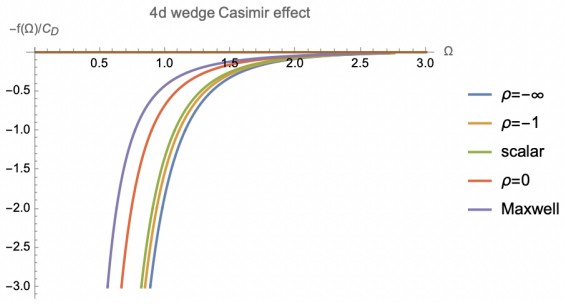
- [Section 6, Eqs. (83) and (96)] The wedge analysis inherits the same gap: Eqs. (90)-(95) compute the ratio only in the T -> -(d-1) limit, and Figs. 7-8 show that selected finite-tension curves lie above the limiting curve, but no monotonicity proof is given for general dimensions. Since the wedge is the basis for the 'general boundary shapes' claim, this claim is not proven beyond the asymptotic limit. In addition, the d=2 line of Eq. (96) as typeset is ambiguous: read literally as pi^(3/2)/(sqrt(pi) - 12 r_a), it contradicts the inversion of Eqs. (92) and (95), which gives pi^(3/2)/sqrt(pi - 12 r_a). Please correct the typesetting (parenthesize the denominator) and confirm that the curves in Figs. 7-8 use the corrected expression; if the printed version is intended as written, the wedge lower-bound relation is unverified.
minor comments (4)
- [Throughout] There are several typos: 'trip' should be 'strip' in Section 2; 'cannnot' should be 'cannot' in Section 2.1; 'Kovtun-Son-Starinet' should be 'Kovtun-Son-Starinets' in the Introduction.
- [Section 5, Eq. (78)] The expression for the O(N) ratio has unbalanced parentheses in the log term; please check the typesetting of log(2 sqrt(pi)).
- [Section 6, Eq. (96)] To avoid ambiguity, write the d=2 result as \frac{\pi^{3/2}}{\sqrt{\pi - 12 r_a}} and the d=4 result with explicit parentheses around the square-root arguments.
- [Section 7] The paper would benefit from an explicit statement of which parts are proven and which are conjectural; the final section's call for a 'proof or counterexample' suggests the authors also view the bound as a conjecture, which should be reflected earlier.
Circularity Check
No significant circularity: the holographic bounds are derived analytically and independently tested; self-citations are supportive, not load-bearing (with a separate algebraic issue in Eq. (96)).
full rationale
The central derivation is self-contained rather than circular. For the strip, the paper computes κ1 from the AdS-soliton stress tensor and CD from holographic two-point functions; taking the analytic limit x=sech^2ρ→0 turns Eqs. (30)-(31), (51)-(52), and (64)-(65) into the finite, coupling-independent ratios (32), (53), and (66). No parameter is fitted to the bound, and the free-scalar, fermion, Maxwell, and O(N) values in Section 5 are external inputs that independently lie above Eq. (2). The wedge bound is likewise obtained by taking the same limit in Eqs. (91)-(95), not by assuming Eq. (83). The paper does rely on the author's prior formulas for CD and brane-tension parameterizations ([21], [24], [25], [31]), but these are explicit derivations with stated assumptions and do not presuppose the proposed inequality, so the self-citations are real supporting evidence rather than a circular chain. The score of 2 reflects only the prominence of these self-citations, not a reduction to identity. Two non-circularity concerns deserve record: the global minimum at ρ→−∞ is checked numerically rather than proven for all d and couplings, so the inequality step in Eqs. (2)/(6) has an unproven monotonicity input; and the d=2 case of Eq. (96) does not follow algebraically from (91)-(95)—inverting z0=1/√(1−12ra/π) gives Ω=π^{3/2}/√(π−12ra), not π^{3/2}/(√π−12ra)—which is an internal consistency problem for the exact wedge formula, not a circularity.
Assumptions & free parameters
free parameters (4)
- brane tension T (parametrized by rho) =
T -> -(d-1), rho -> -infinity
- DGP coupling lambda =
0 <= lambda <= 1/(d-2)
- Gauss-Bonnet coupling alpha =
-1/(4(d^2-2d-2)) <= alpha <= 1/8
- GB-DGP coupling lambda (d=4) =
-2 alpha tanh(rho)/(12 alpha + 1) <= lambda < (1 + 16 alpha)/(4(1 + 12 alpha))
assumptions (4)
- domain assumption AdS/BCFT with end-of-the-world branes and Neumann boundary conditions is the correct holographic dual for strip and wedge Casimir energies.
- domain assumption The holographic formulas for the displacement operator norm CD and the energy density in AdS soliton backgrounds are correct.
- ad hoc to paper Negative brane tension down to T = -(d-1) is physical and yields a stable holographic model.
- domain assumption The free-field and O(N) results for kappa1 and CD cited from [39], [40], [41], [42] are correct.
Cite this review
Pith. "Pith review of Holographic Bound of Casimir Effect in General Dimensions." pith.science (2026). https://pith.science/paper/F7WZ7FPP
@misc{pith2026250109886,
  author       = {Pith},
  title        = {Pith review of: Holographic Bound of Casimir Effect in General Dimensions},
  year         = {2026},
  howpublished = {\url{https://pith.science/paper/F7WZ7FPP}},
  note         = {Machine review of arXiv:2501.09886}
}
abstract
Recently, it has been proposed that holography imposes a universal lower bound on the Casimir effect for 3d BCFTs. This paper generalizes the discussions to higher dimensions. We find Einstein gravity, DGP gravity, and Gauss-Bonnet gravity sets a universal lower bound of the strip Casimir effect in general dimensions. We verify the holographic bound by free theories and $O(N)$ models in the $\epsilon$ expansions. We also derive the holographic bound of the Casimir effect for a wedge and confirm free theories obey it. It implies holography sets a lower bound of the Casimir effect for general boundary shapes, not limited to the strip. Finally, we briefly comment on the impact of mass and various generalizations and applications of our results.
Figures


Figures from the paper (5 more)


Reference graph
Works this paper leans on
- [1]
- [2]
-
[3]
G. L. Klimchitskaya, U. Mohideen and V. M. Mostepanenko, Rev. Mod. Phys. 81, 1827- 1885 (2009)
work page 2009
-
[4]
H. B. G. Casimir, Indag. Math. 10, no.4, 261-263 (1948)
work page 1948
- [5]
- [6]
-
[7]
K. A. Milton, J. Phys. A 37, R209 (2004)
work page 2004
- [8]
Show all 45 references
-
[9]
S. Wang, Y. Wang and M. Li, Phys. Rept. 696, 1-57 (2017)
2017
-
[10]
Vepstas, A
L. Vepstas, A. D. Jackson and A. S. Goldhaber, Phys. Lett. B 140, 280-284 (1984)
1984
-
[11]
M. S. Morris, K. S. Thorne and U. Yurtsever, Phys. Rev. Lett. 61, 1446-1449 (1988)
1988
-
[12]
Maldacena and A
J. Maldacena and A. Milekhin, Phys. Rev. D 103, no.6, 066007 (2021) 25
2021
-
[13]
Kovtun, D
P. Kovtun, D. T. Son and A. O. Starinets, Phys. Rev. Lett. 94, 111601 (2005)
2005
-
[14]
R. X. Miao, [arXiv:2412.04122 [hep-th]]
-
[15]
J. M. Maldacena, Int. J. Theor. Phys. 38, 1113 (1999) [Adv. Theor. Math. Phys. 2, 231 (1998)]
1999
-
[16]
Policastro, D
G. Policastro, D. T. Son and A. O. Starinets, Phys. Rev. Lett. 87, 081601 (2001)
2001
-
[17]
Brigante, H
M. Brigante, H. Liu, R. C. Myers, S. Shenker and S. Yaida, Phys. Rev. D 77, 126006 (2008)
2008
-
[18]
Kats and P
Y. Kats and P. Petrov, JHEP 01, 044 (2009)
2009
-
[19]
Brigante, H
M. Brigante, H. Liu, R. C. Myers, S. Shenker and S. Yaida, Phys. Rev. Lett. 100, 191601 (2008)
2008
-
[20]
Bill` o, V
M. Bill` o, V. Gonccalves, E. Lauria and M. Meineri, JHEP 04, 091 (2016)
2016
-
[21]
R. X. Miao, JHEP 06, 084 (2024)
2024
-
[22]
G. R. Dvali, G. Gabadadze and M. Porrati, Phys. Lett. B 485, 208-214 (2000)
2000
-
[23]
Takayanagi, Phys
T. Takayanagi, Phys. Rev. Lett. 107 (2011) 101602 [arXiv:1105.5165 [hep-th]]
2011 arXiv
-
[24]
R. X. Miao, JHEP 06, 043 (2024)
2024
-
[25]
R. X. Miao, JHEP 07, 098 (2019)
2019
-
[26]
Fujita, T
M. Fujita, T. Takayanagi and E. Tonni, JHEP 11, 043 (2011)
2011
-
[27]
de Haro, S
S. de Haro, S. N. Solodukhin and K. Skenderis, Commun. Math. Phys. 217, 595-622 (2001)
2001
-
[28]
Miyaji, T
M. Miyaji, T. Takayanagi and T. Ugajin, JHEP 06, 023 (2021)
2021
-
[29]
We thank Takayanagi for valuable comments on negative brane tension and its irrelevance to conical singularity
-
[30]
Jensen and A
K. Jensen and A. O’Bannon, Phys. Rev. Lett. 116, no.9, 091601 (2016)
2016
-
[31]
Q. L. Hu, D. Li, R. X. Miao and Y. Q. Zeng, JHEP 09, 037 (2022)
2022
-
[32]
Buchel, J
A. Buchel, J. Escobedo, R. C. Myers, M. F. Paulos, A. Sinha and M. Smolkin, JHEP 03, 111 (2010)
2010
-
[33]
Sen and A
K. Sen and A. Sinha, JHEP 07, 098 (2014)
2014
-
[34]
Bueno, H
P. Bueno, H. Casini, O. L. Andino and J. Moreno, Phys. Rev. Lett. 131, no.17, 171601 (2023)
2023
-
[35]
Hogervorst, S
M. Hogervorst, S. Rychkov and B. C. van Rees, Phys. Rev. D 93, no.12, 125025 (2016) 26
2016
-
[36]
F. P. Toldin and M. A. Metlitski, Phys. Rev. Lett. 128, no.21, 215701 (2022)
2022
-
[37]
Parisen Toldin, S
F. Parisen Toldin, S. Dietrich, J.Stat.Mech. 2010 P11003
2010
-
[38]
Hasenbusch, Phys.Rev.B 82 (2010) 104425
M. Hasenbusch, Phys.Rev.B 82 (2010) 104425
2010
-
[39]
Romeo and A
A. Romeo and A. A. Saharian, J. Phys. A 35, 1297-1320 (2002)
2002
-
[40]
Bellucci and A
S. Bellucci and A. A. Saharian, Phys. Rev. D 80, 105003 (2009)
2009
-
[41]
Krech, The Casimir Effect in Critical Systems (World Scientific, London, 1994)
M. Krech, The Casimir Effect in Critical Systems (World Scientific, London, 1994)
1994
-
[42]
D. M. McAvity and H. Osborn, Nucl. Phys. B 406, 655-680 (1993)
1993
-
[43]
H. W. J. Bloete, J. L. Cardy and M. P. Nightingale, Phys. Rev. Lett. 56, 742-745 (1986)
1986
-
[44]
R. C. Myers and A. Sinha, JHEP 01, 125 (2011)
2011
-
[45]
R. X. Miao and C. S. Chu, JHEP 1803, 046 (2018) 27
2018
Reviewed August 10, 2026 · model on record in the stance chip above.
Discussion (0). Continue with ORCID to comment.