Observation of A Solar Like Magnetic Reconnection Event in an AGN Corona with XRISM
Pith reviewed 2026-06-25 20:16 UTC · model grok-4.3
The pith
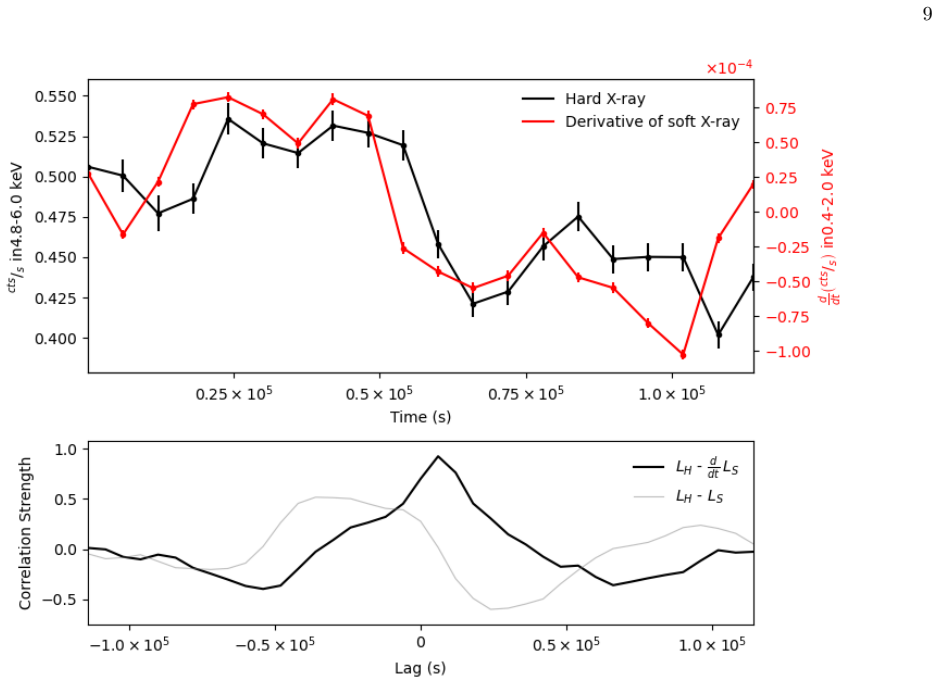
A flare in the AGN NGC 3783 exhibits the Neupert effect, providing the first direct evidence that its corona is powered by magnetic reconnection like the Sun.
A machine-rendered reading of the paper's core claim, the machinery that carries it, and where it could break.
Core claim
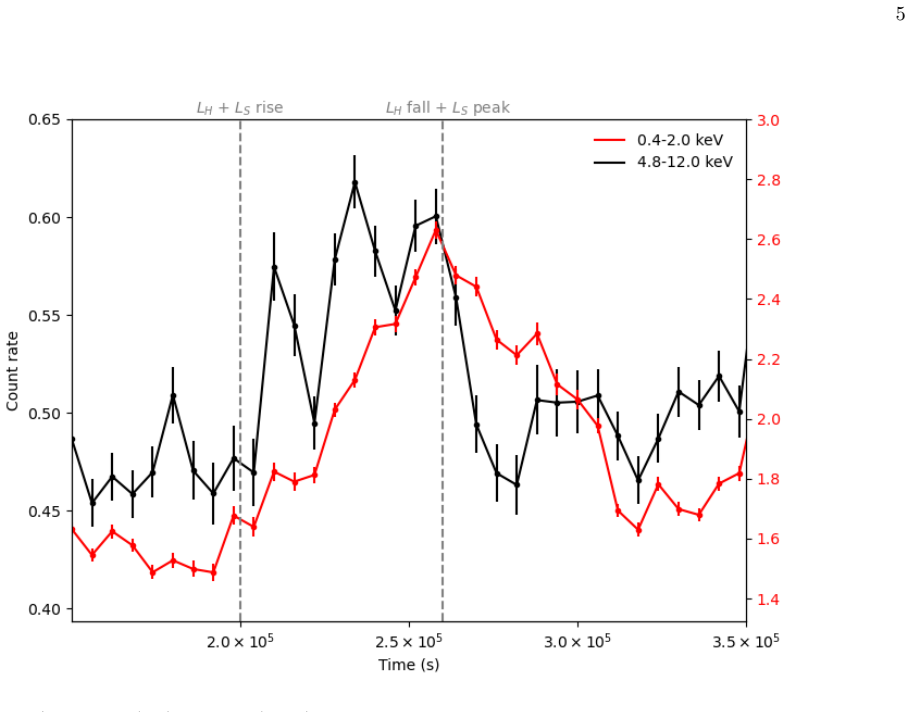
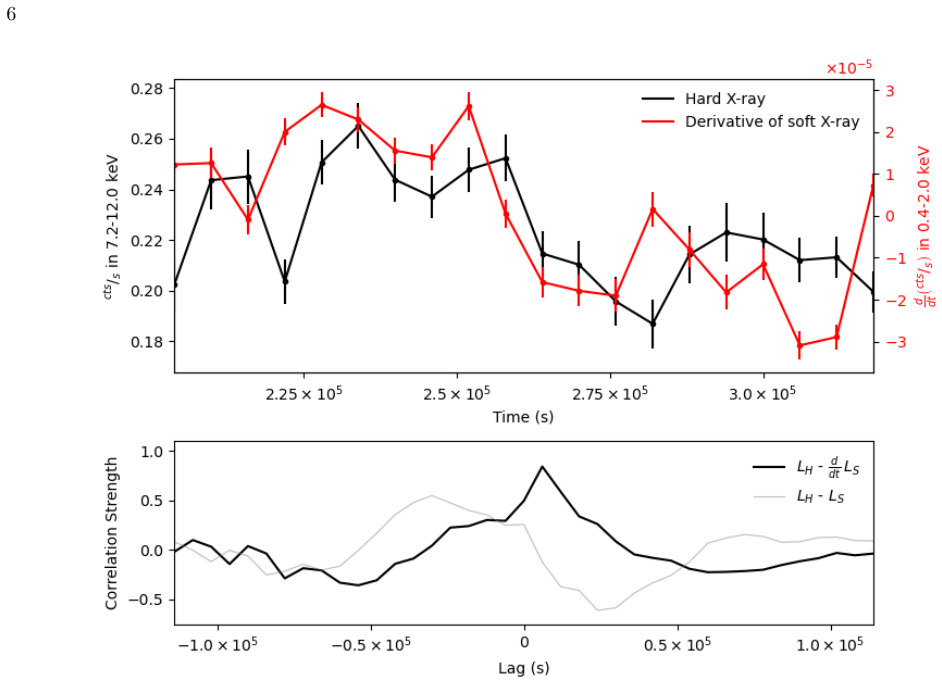
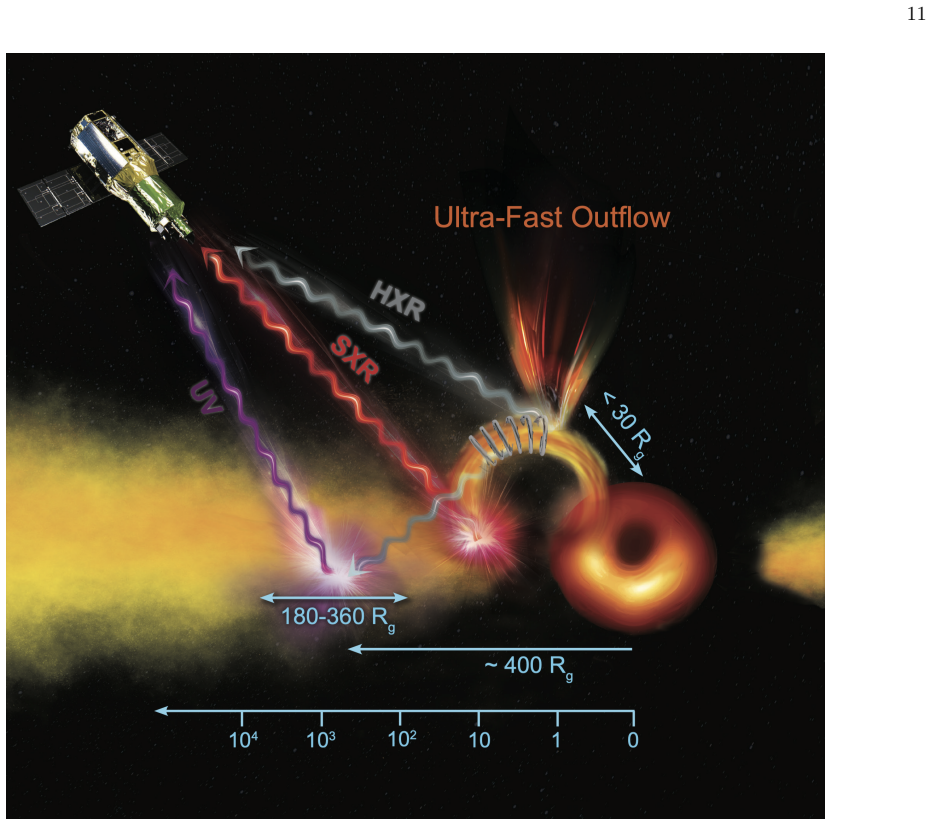
The authors present a flare in NGC 3783 whose soft and hard X-ray light curves display the Neupert effect, demonstrating that the energy release is powered by magnetic reconnection. An ultra-fast outflow is detected simultaneously and plays the role analogous to a solar coronal mass ejection. The flare originates in a magnetic loop whose height is limited to an upper bound of 30 gravitational radii. Energy considerations yield a lower limit of 1.3 times 10^4 G on the magnetic field that is annihilated, while a dynamical argument gives a momentary field of approximately 500 G during the reconnection.
What carries the argument
The Neupert effect, the observed relation in which soft X-ray flux tracks the time integral of hard X-ray flux, together with the simultaneous ultra-fast outflow, used to identify magnetic reconnection as the flare driver.
If this is right
- Magnetic reconnection supplies the energy that heats AGN coronae.
- Ultra-fast outflows can be launched by reconnection events near the black hole.
- Magnetic field strengths in AGN coronae reach at least 10,000 gauss.
- The reconnection site lies within tens of gravitational radii of the central black hole.
- The same timing signature can be used to identify reconnection flares in other AGN.
Where Pith is reading between the lines
- Similar flares in other AGN could be monitored to test whether reconnection is the dominant coronal heating process across the AGN population.
- The derived field values could be compared with predictions from magnetohydrodynamic simulations of accretion-disk coronae.
- Detection of repeated Neupert-effect flares would allow statistical study of loop sizes and field strengths as functions of black-hole mass and accretion rate.
- The solar-AGN analogy raises the possibility that other coronal phenomena, such as quasi-periodic oscillations or flare cycles, might also appear in AGN X-ray light curves.
Load-bearing premise
That the Neupert effect and ultra-fast outflow seen in this AGN flare are produced by the same magnetic reconnection mechanism that operates in the solar corona.
What would settle it
A high-cadence X-ray observation of a similar AGN flare in which the soft X-ray rise does not match the time integral of the hard X-ray light curve would falsify the reconnection interpretation.
Figures
read the original abstract
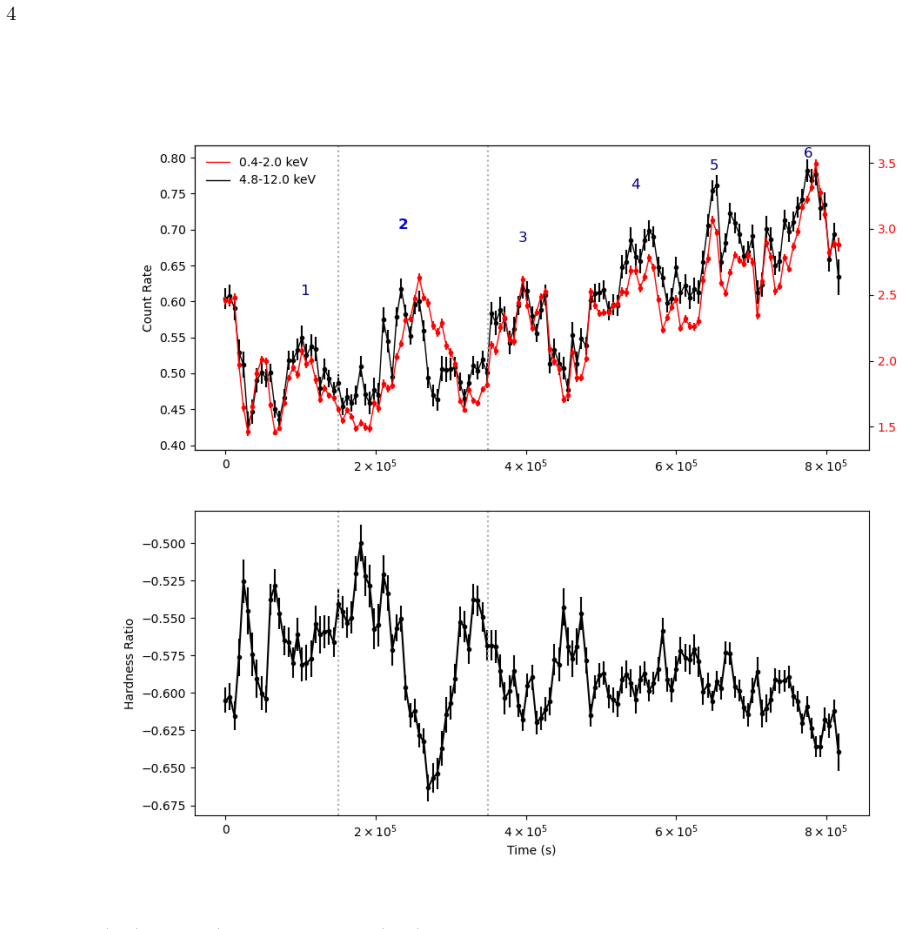
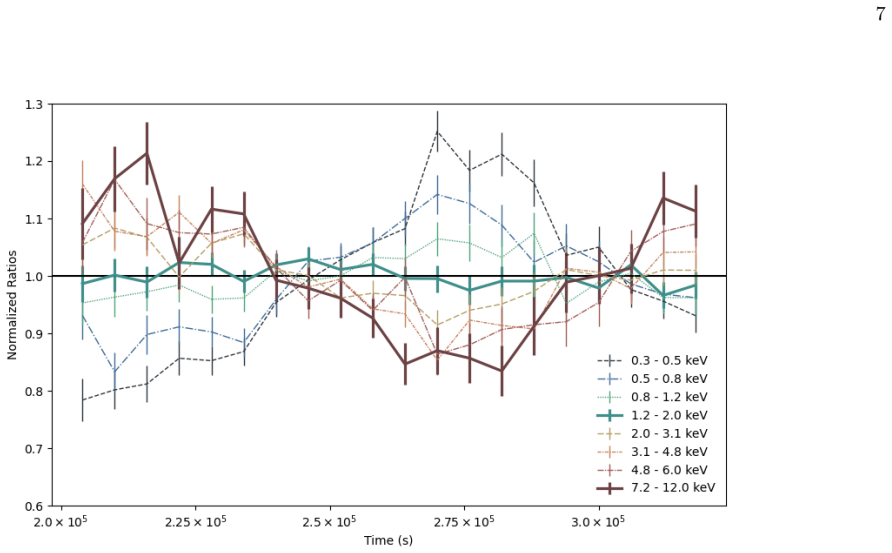
The X-ray source in AGN is commonly referred to as the corona by analogy to stellar coronae. The similarities between the two suggest that the heating mechanism of AGN coronae is magnetic reconnection -- as in cool stars -- but this has not yet been directly observed. This work presents the first observational evidence for a magnetic reconnection flare in an AGN corona. We report on a flare in NGC 3783, which was observed with XRISM/Xtend and XMM-Newton/EPIC-PN exhibiting distinct temporal evolution in soft ($<2.0\,$keV) and hard ($>2.0\,$keV) X-rays. An Ultra-Fast Outflow (UFO) was detected during the event. The flare features the Neupert effect -- a temporal signature widely observed in the Sun, which shows that the flare is powered by magnetic reconnection, with the UFO playing a role analogous to a solar Coronal Mass Ejection (CME). We derive an upper limit of $30 \, R_g$ on the height of the magnetic loop from which the flare originates. Using the UFO's measured properties to characterize the magnetic field, we obtain $B > 1.3 \times 10^4\,$G for the field annihilated during the flare from total energy considerations, and $B \approx 500\,$G for the momentary magnetic field during reconnection from a dynamical consideration.
Editorial analysis
A structured set of objections, weighed in public.
Referee Report
Summary. The manuscript claims the first direct observational evidence for magnetic reconnection in an AGN corona, based on a flare in NGC 3783 observed with XRISM/Xtend and XMM-Newton/EPIC-PN. It reports distinct soft (<2 keV) and hard (>2 keV) X-ray temporal evolution, detection of an ultra-fast outflow (UFO), the Neupert effect indicating the flare is powered by reconnection (with the UFO analogous to a solar CME), an upper limit of 30 R_g on the originating magnetic loop height, and magnetic field strengths B > 1.3 × 10^4 G (energy) and B ≈ 500 G (dynamics).
Significance. If the Neupert-effect interpretation and solar analogy hold after addressing the noted concerns, the result would be significant for establishing magnetic reconnection as the heating mechanism in AGN coronae, extending the stellar corona analogy with quantitative B-field constraints that could test corona models.
major comments (2)
- [Abstract] Abstract: The central claim that the observed soft/hard X-ray timing constitutes the Neupert effect (demonstrating reconnection) assumes the same non-thermal-to-thermal energy-release chain as in solar flares; however, both bands in the AGN corona arise from the same Comptonizing electron distribution, and the manuscript does not demonstrate that alternatives such as variable optical depth or seed-photon fluctuations are ruled out.
- [Abstract] Abstract: The B-field limits (B > 1.3 × 10^4 G from total energy and B ≈ 500 G from dynamics) are derived only after adopting solar scaling relations for loop height, ejected mass, and reconnection rate; any deviation in these scalings for the AGN environment would collapse the numerical results, and the manuscript should test robustness explicitly.
minor comments (1)
- The full light-curve data, spectral fitting details, and error analysis should be presented to allow independent verification of the timing signature and UFO properties.
Simulated Author's Rebuttal
We thank the referee for their constructive comments, which help clarify the presentation of our results on the first observational evidence for magnetic reconnection in an AGN corona. We address each major comment below and will revise the manuscript to incorporate additional discussion and analysis.
read point-by-point responses
-
Referee: [Abstract] Abstract: The central claim that the observed soft/hard X-ray timing constitutes the Neupert effect (demonstrating reconnection) assumes the same non-thermal-to-thermal energy-release chain as in solar flares; however, both bands in the AGN corona arise from the same Comptonizing electron distribution, and the manuscript does not demonstrate that alternatives such as variable optical depth or seed-photon fluctuations are ruled out.
Authors: We agree that the emission physics in AGN coronae differs fundamentally from solar flares, with both soft and hard X-rays arising from the same Comptonizing electron population. The Neupert effect is invoked here as an empirical timing signature of impulsive energy release rather than a direct mapping of the solar non-thermal-to-thermal chain. In the revised manuscript we will add a dedicated subsection discussing why variable optical depth or seed-photon fluctuations are disfavored by the observed light-curve morphology, the simultaneous UFO detection, and the lack of correlated spectral changes that would be expected from those alternatives. We will also explicitly state the limits of the solar analogy. revision: yes
-
Referee: [Abstract] Abstract: The B-field limits (B > 1.3 × 10^4 G from total energy and B ≈ 500 G from dynamics) are derived only after adopting solar scaling relations for loop height, ejected mass, and reconnection rate; any deviation in these scalings for the AGN environment would collapse the numerical results, and the manuscript should test robustness explicitly.
Authors: We acknowledge that the quoted B-field values rest on solar-derived scaling relations whose applicability to the AGN environment is not guaranteed. In the revised version we will add an explicit robustness section that varies loop height, ejected mass, and reconnection rate over ranges consistent with existing AGN corona models (e.g., 10–100 R_g, mass-loading factors 0.1–10 times solar, reconnection rates 0.01–0.1 v_A). The resulting B-field ranges will be reported to show which conclusions remain stable under plausible deviations. revision: yes
Circularity Check
No circularity; claims rest on direct timing observations and external solar analogies
full rationale
The paper reports an observed Neupert effect from soft/hard X-ray light curves and a detected UFO, then computes B-field values from energy balance and dynamical equations that take the measured UFO velocity, column, and flare energy as direct inputs. No equation reduces a derived quantity back to a parameter fitted from the same dataset, no self-citation supplies a load-bearing uniqueness theorem, and the solar scaling relations are invoked as external analogies rather than internal definitions. The derivation chain is therefore self-contained against the presented observations.
Axiom & Free-Parameter Ledger
axioms (2)
- domain assumption The Neupert effect is a temporal signature of magnetic reconnection powering the flare
- domain assumption The detected UFO plays a role analogous to a solar CME
Reference graph
Works this paper leans on
-
[1]
Aschwanden, M. J. 2005, Physics of the Solar Corona. An Introduction with Problems and Solutions (2nd edition), doi: 10.1007/3-540-30766-4
-
[2]
Aschwanden, M. J., Caspi, A., Cohen, C. M. S., et al. 2017, ApJ, 836, 17, doi: 10.3847/1538-4357/836/1/17
-
[3]
Balbus, S. A., & Hawley, J. F. 1991, ApJ, 376, 214, doi: 10.1086/170270
-
[4]
Bentz, M. C., Williams, P. R., Street, R., et al. 2021, ApJ, 920, 112, doi: 10.3847/1538-4357/ac19af
-
[5]
Blandford, R., Meier, D., & Readhead, A. 2019, Annual Review of Astronomy and Astrophysics, 57, 467, doi: https://doi.org/10.1146/annurev-astro-081817- 051948
-
[6]
Wallace, J. M., & Blad´ e, I. 1999, Journal of Climate, 12, 1990 , doi: 10.1175/1520-0442(1999)012⟨1990: TENOSD⟩2.0.CO;2
-
[7]
Brown, J. C. 1972, SoPh, 26, 441, doi: 10.1007/BF00165286
-
[8]
Chen, B., Shen, C., Gary, D. E., et al. 2020, Nature Astronomy, 4, 1140, doi: 10.1038/s41550-020-1147-7 del Palacio, S., Yang, C., Aalto, S., et al. 2025, A&A, 701, A41, doi: 10.1051/0004-6361/202554936 di Matteo, T. 1998, Monthly Notices of the Royal Astronomical Society, 299, L15, doi: 10.1046/j.1365-8711.1998.01950.x
-
[9]
Field, G. B., & Rogers, R. D. 1993, ApJ, 403, 94, doi: 10.1086/172185
-
[10]
J., et al
Gabriel, C., Denby, M., Fyfe, D. J., et al. 2004, in Astronomical Society of the Pacific Conference Series, Vol. 314, Astronomical Data Analysis Software and Systems (ADASS) XIII, ed. F. Ochsenbein, M. G. Allen, & D. Egret, 759
2004
-
[11]
Galeev, A. A., Rosner, R., & Vaiana, G. S. 1979, ApJ, 229, 318, doi: 10.1086/156957 Gonz´ alez-Mart´ ın, O., & Vaughan, S. 2012, A&A, 544, A80, doi: 10.1051/0004-6361/201219008
-
[12]
Gou, T., Reeves, K. K., Young, P. R., et al. 2026, Nature Astronomy, doi: 10.1038/s41550-026-02872-z
-
[13]
2025, A&A, 704, A146, doi: 10.1051/0004-6361/202557189
Gu, L., Fukumura, K., Kaastra, J., et al. 2025, A&A, 704, A146, doi: 10.1051/0004-6361/202557189
-
[14]
Guedel, M., & Benz, A. O. 1993, ApJL, 405, L63, doi: 10.1086/186766
-
[15]
Guedel, M., Benz, A. O., Schmitt, J. H. M. M., & Skinner, S. L. 1996, ApJ, 471, 1002, doi: 10.1086/178027 G¨ udel, M., Audard, M., Smith, K. W., et al. 2002, The Astrophysical Journal, 577, 371, doi: 10.1086/342122
-
[16]
Harris, C. R., Millman, K. J., van der Walt, S. J., et al. 2020, Nature, 585, 357, doi: 10.1038/s41586-020-2649-2
-
[17]
Hawley, S. L., Fisher, G. H., Simon, T., et al. 1995, ApJ, 453, 464, doi: 10.1086/176408
-
[18]
Holman, G. D. 2016, Journal of Geophysical Research: Space Physics, 121, 11,667, doi: https://doi.org/10.1002/2016JA022651
-
[19]
Hu, Q., Qiu, J., Dasgupta, B., Khare, A., & Webb, G. M. 2014, ApJ, 793, 53, doi: 10.1088/0004-637X/793/1/53
-
[20]
Igarashi, T., Takahashi, H. R., Kawashima, T., et al. 2024, ApJ, 968, 121, doi: 10.3847/1538-4357/ad4703
-
[21]
Inoue, S., Iwakiri, W. B., Kimura, T., et al. 2026, The Astrophysical Journal, 1002, 65, doi: 10.3847/1538-4357/ae2be0
-
[22]
2025, ARA&A, 63, 379, doi: 10.1146/annurev-astro-071221-052844
Kara, E., & Garc´ ıa, J. 2025, ARA&A, 63, 379, doi: 10.1146/annurev-astro-071221-052844
-
[23]
Laor, A., & Behar, E. 2008, Monthly Notices of the Royal Astronomical Society, 390, 847, doi: 10.1111/j.1365-2966.2008.13806.x
-
[24]
Mapping of the accretion flow with Fe K emission lines
Li, C., Kaastra, J. S., Gu, L., et al. 2026, A&A, 706, A255, doi: 10.1051/0004-6361/202557710
-
[25]
Liu, H. T., Bai, J. M., Zhao, X. H., & Ma, L. 2008, The Astrophysical Journal, 677, 884, doi: 10.1086/529361
-
[26]
Kinematic and ionization structure of the highly ionized outflows
Mehdipour, M., Kaastra, J. S., Eckart, M. E., et al. 2025, A&A, 699, A228, doi: 10.1051/0004-6361/202555623
-
[27]
Miller, K. A., & Stone, J. M. 2000, The Astrophysical Journal, 534, 398, doi: 10.1086/308736
-
[28]
Morgan, C. W., Hainline, L. J., Chen, B., et al. 2012, The Astrophysical Journal, 756, 52, doi: 10.1088/0004-637X/756/1/52 14 Nasa High Energy Astrophysics Science Archive Research Center (Heasarc). 2014, HEAsoft: Unified Release of FTOOLS and XANADU,, Astrophysics Source Code Library, record ascl:1408.004 http://ascl.net/1408.004
-
[29]
Neupert, W. M. 1968, ApJL, 153, L59, doi: 10.1086/180220
-
[30]
B., & Lightman, A
Rybicki, G. B., & Lightman, A. P. 1986, Radiative Processes in Astrophysics
1986
-
[31]
Shapiro, A. I., Solanki, S. K., Krivova, N. A., et al. 2014, A&A, 569, A38, doi: 10.1051/0004-6361/201323086
-
[32]
Sun, X., Hoeksema, J. T., Liu, Y., et al. 2012, The Astrophysical Journal, 748, 77, doi: 10.1088/0004-637X/748/2/77
-
[33]
Veronig, A., Vrˇ snak, B., Dennis, B. R., et al. 2002, A&A, 392, 699, doi: 10.1051/0004-6361:20020947
-
[34]
SciPy 1.0: Fundamental Algorithms for Scientific Computing in Python
Virtanen, P., Gommers, R., Oliphant, T. E., et al. 2020, Nature Methods, 17, 261, doi: 10.1038/s41592-019-0686-2 Xrism Collaboration, Audard, M., Awaki, H., et al. 2025, A&A, 702, A147, doi: 10.1051/0004-6361/202556000
-
[35]
2026, Monthly Notices of the Royal Astronomical Society, 548, stag599, doi: 10.1093/mnras/stag599
Xu, H. 2026, Monthly Notices of the Royal Astronomical Society, 548, stag599, doi: 10.1093/mnras/stag599
-
[36]
2014, Nature Communications, 5, 4774, doi: 10.1038/ncomms5774
Yamada, M., Yoo, J., Jara-Almonte, J., et al. 2014, Nature Communications, 5, 4774, doi: 10.1038/ncomms5774
-
[37]
Delving into the depths of NGC 3783 with XRISM: V. Broad-band modeling of ionized outflows
Zhao, K., Kaastra, J. S., Gu, L., et al. 2026, arXiv e-prints, arXiv:2604.21710, doi: 10.48550/arXiv.2604.21710
work page internal anchor Pith review Pith/arXiv arXiv doi:10.48550/arxiv.2604.21710 2026
discussion (0)
Sign in with ORCID, Apple, or X to comment. Anyone can read and Pith papers without signing in.