REVIEW 3 major objections 6 minor 9 cited by
The paper claims that proactive problem-solving in LLM agents can be decomposed into search, identification, and execution, and that even the best models achieve only a 40% end-to-end success rate on a new benchmark, PROBE.
Reviewed by Pith at T0; open to challenge. T0 means a machine referee read the full paper against a public rubric. the ladder, T0–T4 →
On PROBE, a new synthetic benchmark for proactive workplace problem solving, the strongest LLM agents reach only ~40% end-to-end success, with root-cause identification as the main failure point.
T0 review reviewed 2026-08-04 challenge →
load-bearing objection Useful benchmark with a plausible 40% ceiling, but the headline number is not yet disentangled from LLM-generation artifacts; worth reviewing, not yet citable as a settled result. the 3 major comments →
Beyond Reactivity: Measuring Proactive Problem Solving in LLM Agents
The pith
A machine-rendered reading of the paper's core claim, the machinery that carries it, and where it could break.
The reading
Core claim
The paper's central claim is that existing LLM agents fail at proactive problem solving when the problem is not handed to them. PROBE operationalizes proactivity as a three-stage pipeline — searching over a datastore, identifying the bottleneck, and executing the resolution — and generates 1,000 samples in which evidence for a hidden bottleneck is scattered across several documents amid about 75 distractors, with exactly one of about 25 actions being the right fix. Under this protocol, the best reported end-to-end performance is 40% (GPT-5 and Claude Opus-4.1), with best search F1 0.65, best bottleneck-identification score 0.43, and best task-execution score 0.40. The paper also reports that
What carries the argument
PROBE (Proactive Resolution of Bottlenecks), a synthetic benchmark built by a multi-model generation pipeline. From real LinkedIn-derived personas, it constructs a world model, then generates a bottleneck, a set of true-positive documents whose combined evidence reveals it, a large set of plausible distractor documents, and an action space with exactly one correct action and its required parameters. The paper's innovation is that the three output components — retrieved documents, bottleneck description, and action plus parameters — are scored separately, so a model's failure at any stage can be localized, and the pipeline's multi-model data generation and adversarial filtering are meant to p
Load-bearing premise
The benchmark's ground truth — the gold bottleneck labels, true-positive document sets, and the single correct action/parameter set — is generated and scored by LLMs (GPT-4.1 generation with GPT-5 adversarial filtering, plus LLM-as-a-judge), so if those labels carry systematic model-family bias, the 40% ceiling measures artifact compatibility rather than proactivity; the paper's human validation covers only 26 samples and 50 judge pairs.
What would settle it
Run the evaluation again on a version of PROBE where the gold true-positive documents are supplied directly to the models, removing the search stage. If end-to-end success jumps far above 40%, the measured ceiling is a retrieval problem rather than a proactivity ceiling; if it stays near 40%, the limit is in bottleneck identification and task execution, confirming the paper's pipeline decomposition.
If this is right
- If correct, current state-of-the-art agents cannot be trusted to autonomously act on unstated user problems; human supervision remains necessary for such tasks.
- The three-stage decomposition means progress can be tracked per stage; improving retrieval alone will not fix identification or execution, since the best scores on those stages are independently low (0.43 and 0.40).
- Agentic frameworks such as ReACT, Reflexion, and ReWOO, at least with tool-based retrieval, underperform plain frontier LLMs in this setup, suggesting that retrieval-tool design is a current bottleneck for agent architectures.
- Growing the context from 50 to 100 distractor items degrades performance, implying that long-context, high-noise settings are a specific weakness to target.
- The low identification ceiling (0.43) despite imperfect-but-substantial retrieval points to a need for evidence-grounded reasoning that cites documents before committing to a diagnosis.
Where Pith is reading between the lines
- If the 40% ceiling is taken at face value, a natural design implication not explored in the paper is that proactive agents should be built around an explicit retrieval-and-verification loop that cites evidence before acting, rather than single-pass reasoning over a long context.
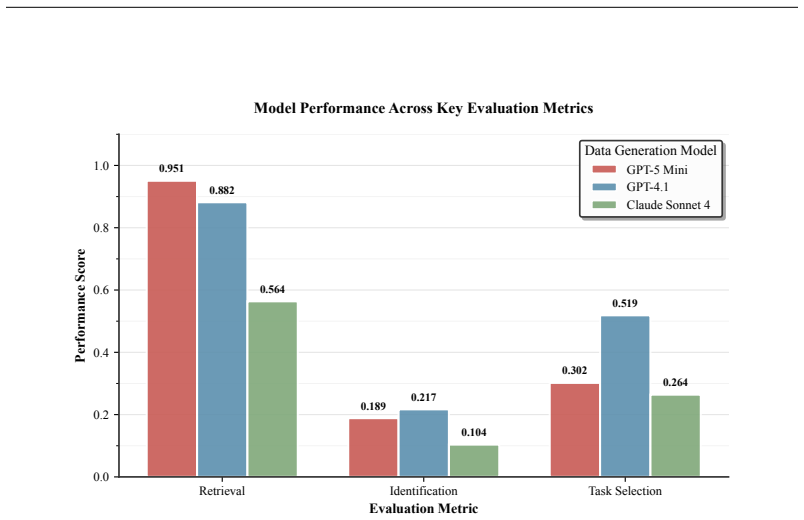
- The paper's own cross-family data-generation results (GPT-5 scores 0.951 retrieval F1 on GPT-family data vs 0.564 on Claude-generated data) suggest that any single-family benchmark, including this one, may overstate family-specific capabilities; a fully held-out, human-written test set would be the cleaner check.
- Because the benchmark assumes a fixed world model and single-action resolution, the findings likely understate the difficulty of real proactive assistance; dynamic world models and multi-step resolutions would be a harder, more realistic extension.
- The fact that human annotators also largely failed suggests the task tests a genuine difficulty rather than an LLM-specific artifact, but it also raises the question of what 'reasonable' proactive performance should be — a question the paper leaves open.
Editorial analysis
A structured set of objections, weighed in public.
Referee Report
Summary. The paper introduces PROBE, a benchmark of 1,000 synthetic workplace-datastore instances designed to measure proactive problem solving in LLM agents. Proactivity is decomposed into three stages: searching for unspecified issues, identifying the specific bottleneck, and executing the appropriate resolution. The authors generate each instance from LinkedIn-derived personas using LLM-based world models, bottleneck injection, true-positive/distractor document construction, and action/parameter generation, with GPT-4.1 as the primary generator and GPT-5 adversarial filtering. They evaluate several frontier closed- and open-source LLMs plus three agentic frameworks (ReACT, Reflexion, ReWOO) under a common protocol, and report that the best end-to-end task-execution score is 0.40, achieved by GPT-5 and Claude Opus 4.1. The paper also presents error analyses, a context-size ablation, and a generator-diversity ablation. The central claim is that even state-of-the-art models struggle on this benchmark, exposing a capability gap in autonomous proactive behavior.
Significance. If the benchmark is valid, PROBE is a useful contribution: it operationalizes a relatively under-studied capability (proactivity) into three measurable sub-skills, uses realistic multi-document workplace scenarios, and releases code and data, with a thoughtful multi-model generation pipeline and adversarial filtering. The paper also provides one of the first direct comparisons of task-execution success across LLMs and agentic frameworks in this setting. However, the headline empirical claims currently outrun the evidence: the ground-truth labels and evaluation judges are LLM-generated, human validation is very small, and the reported 40% ceiling is not tied to a disclosed composition of generator families. These issues do not invalidate the benchmark as a proposal, but they do mean the paper's central quantitative conclusions are not yet established.
major comments (3)
- [§3.4, §5.2, Table 3, Figure 4] The headline 'best end-to-end performance of 40%' is underdetermined by the reported data. Table 3 reports task-execution 0.40 for GPT-5 and Claude Opus 4.1 on the full 1,000 samples, but §5.2/Figure 4 shows GPT-5's end-to-end score is 51.9% on GPT-4.1-generated data, 30.2% on GPT-5-mini-generated data, and 26.4% on Claude Sonnet 4-generated data (all with 75 distractors). Section 2.4 says GPT-4.1 is the primary generator, while §5.2 says the full benchmark mixes three families, but no per-sample generator assignments or mixture proportions are reported. The aggregate 40% is therefore an average over an undisclosed weighting; the same model could score from about 26% to 52% depending on the mixture. Please report the generator distribution in the full benchmark, give per-generator results for all evaluated models, and either restate the ceiling as mix-specific or show that the headline n
- [§2.4, §3.1, §3.2, Appendix B.6] The benchmark's ground truth and scoring are LLM-generated, and the validation is too thin to certify label quality across 1,000 samples. The gold true-positive document sets, bottleneck descriptions, and the single correct action/parameter set are produced by GPT-4.1 with GPT-5 adversarial filtering; bottleneck-identification and parameter scores are assigned by LLM-as-a-judge. Human validation covers only 26 full samples (Table 2) and 50 judge pairs (Section 3.2), with no reported breakdown by generator family or error analysis of gold labels. Figure 4's large family-dependent swing (GPT-5 search F1 0.951 on GPT-5-mini data vs 0.564 on Claude data) shows that family-specific artifacts are real; mixing generators is a reasonable mitigation but is not demonstrated for the full benchmark. Please provide human-validated results on a held-out subset, per-family judge agreement, and a label-
- [§5.1, Figure 3] The context-size ablation is difficult to interpret and inconsistent with the main setup. The main benchmark is described as using 75 distractor documents per sample (§2.4, Table 1), but §5.1 and Figure 3 label 50 as the 'baseline' and plot k=50, 75, 100 while the caption says performance degrades 'from 50 (baseline) to 100'. Additionally, the y-axis is labeled 'Performance Score' without specifying which of the three metrics (search F1, bottleneck identification, task execution) is plotted. Please specify the metric, reconcile the baseline with the 75-distractor main configuration, and clarify whether the 100-sample ablation uses the full benchmark pipeline or a simplified variant.
minor comments (6)
- [Table 2] The 'Realistic Artifacts' column is not defined in the caption or text; clarify whether a green check means both realism questions received 'yes' and how the binary answer was elicited.
- [Table 3 note] The note says GPT-5-mini results are removed 'for brevity' despite GPT-5-mini being used as the base model for agentic frameworks. Report these results in an appendix or provide a public link to the full table.
- [§2.4] Adversarial filtering 'on a small sample set (of 5 datapoints)' is described, but it is unclear how five datapoints can validate that no artifact-based shortcuts remain in the final 1,000 samples. Clarify the procedure and sample size.
- [References] Lu et al. 2024a and 2024b are the same paper (Proactive Agent: Shifting LLM Agents from Reactive Responses to Active Assistance) with different identifiers; consolidate the citation or clearly distinguish the two uses.
- [Figure 4] The caption uses 'Retrieval F1' while the text refers to 'search performance' and 'end-to-end success rates'; use consistent metric names and state which metric is on the y-axis.
- [Section 4 / Table 5] The footnote marker after 'Root Cause Identification remains the primary challenge' appears to be mis-numbered (footnote 5 refers to Table 5 but is placed in body text before the table).
Circularity Check
No circular derivation; PROBE's scores are direct measurements with human-validated judge prompts, not predictions fitted to the benchmark.
full rationale
The paper makes no fitted-parameter claim: Table 3 reports measured search F1, bottleneck identification scores, and task-execution scores from executing models on a fixed dataset. There is no equation in which an output is defined as an input, and no parameter is fit to a subset and then 'predicted' on a closely related quantity. Ground truth (T, b, a*, P) is constructed by the generation pipeline (Section 2.4) and scores compare model outputs against that gold via structured matching for search and action labels, and via LLM-as-a-judge for bottleneck/parameter quality. The judge prompt (Appendix B.6) receives the actual gold bottleneck and expected parameters, so it is a measurement oracle, not a learned predictor of the benchmark. The paper validates this oracle with human annotators (Section 3.2: 80% human-LLM agreement, 84% inter-annotator agreement). Human annotation (Table 2) independently corroborates difficulty, so the 'even state-of-the-art models struggle' claim does not rest on a self-citation. There are no self-citations at all: references to Ayoobi et al. (personas), Jiang et al. (adversarial filtering), and Zheng et al. (LLM-as-judge) are external. The closest validity concern is Section 5.2/Figure 4, where GPT-5 scores 0.951 F1 on GPT-5-mini-generated data vs 0.564 on Claude Sonnet 4 data; the paper itself presents this as evidence FOR multi-model generation and does not hide it. The undisclosed mixture proportions in the 1,000-sample set make the aggregate 40% ceiling underdetermined, but underdetermination is a correctness/transparency risk, not a circular reduction of the result to its inputs. No step in the paper's derivation chain is equivalent by construction to its inputs.
Axiom & Free-Parameter Ledger
free parameters (1)
- Baseline distractor count (k=75) =
75 (baseline); Table 1 reports mean 79.3 documents per sample
axioms (5)
- domain assumption A single bottleneck is associated with each sample, and the true-positive set T is unique to that sample (Section 2.1).
- domain assumption Exactly one action in A resolves the bottleneck; all other actions are plausible but suboptimal (Section 2.3).
- domain assumption LLM-as-a-judge scores for bottleneck identification and parameter quality are a valid proxy for human judgment.
- domain assumption Synthetic world models built from LinkedIn personas with GPT-4.1 generate realistic workplace datastores and correct ground-truth bottleneck labels.
- domain assumption Mixing data from three LLM families (GPT-5-mini, GPT-4.1, Claude Sonnet 4) removes model-family artifacts enough for fair cross-model evaluation.
Cite this review
Pith. "Pith review of Beyond Reactivity: Measuring Proactive Problem Solving in LLM Agents." pith.science (2026). https://pith.science/paper/FADONVWV
@misc{pith2026251019771,
  author       = {Pith},
  title        = {Pith review of: Beyond Reactivity: Measuring Proactive Problem Solving in LLM Agents},
  year         = {2026},
  howpublished = {\url{https://pith.science/paper/FADONVWV}},
  note         = {Machine review of arXiv:2510.19771}
}
read the original abstract
LLM-based agents are increasingly moving towards proactivity: rather than awaiting instruction, they exercise agency to anticipate user needs and solve them autonomously. However, evaluating proactivity is challenging; current benchmarks are constrained to localized context, limiting their ability to test reasoning across sources and longer time horizons. To address this gap, we present PROBE (Proactive Resolution Of BottlEnecks). PROBE decomposes proactivity as a pipeline of three core capabilities: (1) searching for unspecified issues, (2) identifying specific bottlenecks, and (3) executing appropriate resolutions. We apply PROBE to evaluate leading LLMs and popular agentic frameworks, showing that even state-of-the-art models struggle to solve this benchmark. Computing our consistent measurements across frontier LLMs and agents, we find that the best end-to-end performance of 40% is achieved by both GPT-5 and Claude Opus-4.1. Additionally, we demonstrate the relative capabilities of each model and analyze mutual failure modes. Our results highlight the current limitations of autonomous action in agentic systems, and expose promising future research directions.
Figures


Forward citations
Cited by 9 Pith papers
-
ProactBench: Beyond What The User Asked For
ProactBench measures LLM conversational proactivity in three phases using 198 multi-agent dialogues and finds recovery behavior hard to predict from existing benchmarks.
-
ProEvent: An Event-centric Benchmark for Proactive Agents
ProEvent is a benchmark showing LLM agents keep a user's event timetable from chats poorly, with the best fully-correct score at 27.2%.
-
Just A Rather Very Intelligent Spoken Agent
JarvisBench, a two-track benchmark with a reference spoken mediator, shows mediation can raise WildClaw task scores by up to 11.78 points and improve trace-grounded user answers.
-
AURA: Intent-Directed Probing for Implicit-Need Surfacing in Situated LLM Agents
AURA improves implicit-need coverage by 0.07 over ReAct baselines on a 100-query benchmark by inserting an intent inference step controlled by a gap score, while cutting probes 82% on factual tasks.
-
Agentic Coding Needs Proactivity, Not Just Autonomy
Coding agents require a three-level proactivity taxonomy (Reactive, Scheduled, Situation Aware) evaluated by insight policy quality using Insight Decision Quality, Context Grounding Score, and Learning Lift.
-
Dive into Claude Code: The Design Space of Today's and Future AI Agent Systems
Claude Code answers recurring agent design questions with a thin model loop wrapped in dense safety, context, extensibility, and persistence harnesses, and those same questions get different answers in OpenClaw and Hermes.
-
Knowing Isn't Understanding: Re-grounding Generative Proactivity with Epistemic and Behavioral Insight
Proactive AI should be grounded in the user's epistemic state, not just in action prediction, so that commitment scales with warranted understanding rather than confidence.
-
TIDE: Proactive Multi-Problem Discovery via Template-Guided Iteration
TIDE combines iterative batch discovery conditioned on prior findings with reusable thought templates to uncover multiple hidden problems in context, showing gains over single-shot baselines in workspaces and repositories.
-
Dive into Claude Code: The Design Space of Today's and Future AI Agent Systems
Claude Code centers on a model-tool while-loop surrounded by permission systems, context compaction, extensibility hooks, subagent delegation, and session storage; the same design questions yield different answers in ...
Reference graph
Works this paper leans on
-
[1]
Generate exactly {{ num_actions }} proactive actions total
-
[2]
Binfeng Xu, Zhiyuan PENG, Bowen Lei, Subhabrata Mukherjee, and Dongkuan Xu
URLhttps://arxiv.org/abs/2507.09313. Binfeng Xu, Zhiyuan PENG, Bowen Lei, Subhabrata Mukherjee, and Dongkuan Xu. DE- COUPLING REASONING FROM OBSERV ATIONS FOR EFFICIENT AUGMENTED LAN- GUAGE MODELS, 2024. URLhttps://openreview.net/forum?id=CpgoO6j6W1. Bufang Yang, Lilin Xu, Liekang Zeng, Kaiwei Liu, Siyang Jiang, Wenrui Lu, Hongkai Chen, Xiaofan Jiang, Guo...
Pith/arXiv arXiv 2024
-
[3]
The remaining actions should be realistic and detailed workplace actions that DON’T solve any of the bottlenecks
-
[4]
**EXACTLY ONE ACTION** should solve each bottleneck - no more, no less
-
[5]
actions" array. Each action should follow this structure: {
**NO NAMED ENTITIES**: Actions must NOT contain specific person names, company names, or proper nouns from the bottlenecks ## ACTION CATEGORIES: - send_email: Send new emails to individuals or groups - reply_email: Reply to existing email threads - schedule_meeting: Create new meetings or events - reschedule_meeting: Move or modify existing meetings - can...
-
[6]
Make it clear which action solves which bottleneck through the action’s description and parameters
-
[7]
Never mentions other bottlenecks The document should read like an authentic workplace artifact that someone would search for when investigating the bottleneck. 25 Listing 11: generate_document_evidence.j2 B.4.5 GENERATEDYNAMICSOURCES Usage Context This prompt identifies additional data sources or systems where evidence might be found, expanding beyond the...
-
[8]
Each bottleneck has EXACTLY ONE action that can solve it, all other actions should certainly not solve the bottleneck
-
[9]
The action description of the correct action should address the bottleneck, but without mentioning the bottleneck, keywords, or its details in any way
-
[10]
Other actions are detailed and realistic but explicitly DON’T solve any of the listed bottlenecks
-
[11]
Total number of actions equals {{ num_actions }}
-
[12]
It’s one of the first prompts exe- cuted to establish the professional environment
**CRITICAL**: The actions should not include any mention of the people or situations involved in the bottleneck Listing 1: generate_actions_for_bottleneck.j2 18 B.1.2 GENERATEORGANIZATIONSTRUCTURE Usage Context This prompt generates the organizational context around a persona, including company struc- ture, team composition, reporting lines, and key proce...
-
[13]
Company name and type
-
[14]
Department structure
-
[15]
Reporting relationships
-
[16]
company_name
Key processes and workflows The organization should be realistic for someone in their role and location. Provide your response as a JSON object with this structure: { "company_name": "Name of the company", "company_type": "Type of company (startup, enterprise, etc.)", "department": "Their department name", "team_size": 5, "direct_reports": 2, "reporting_t...
-
[17]
Work style and preferences
-
[18]
Current goals and priorities
-
[19]
Time constraints and challenges
-
[20]
Communication preferences
-
[21]
easy" %} Keep the context simple with straightforward preferences and minimal constraints. {% elif difficulty ==
Tools and systems they use {% if difficulty == "easy" %} Keep the context simple with straightforward preferences and minimal constraints. {% elif difficulty == "medium" %} Include moderate complexity with some competing priorities and constraints. {% elif difficulty == "hard" %} Create complex context with multiple competing priorities, significant const...
-
[22]
The person’s full name
-
[23]
Type of relationship (colleague, client, manager, stakeholder, collaborator)
-
[24]
How they interact with {{ persona.name }}
-
[25]
relationships
Current status of the relationship Provide your response as a JSON object with this structure: { "relationships": [ { "name": "Full name", "role": "Their job title", "type": "colleague|client|manager|stakeholder|collaborator", "interaction": "Description of how they work together", "status": "Current state of the relationship", "frequency": "How often the...
-
[26]
References REAL NAMES from the relationships
-
[27]
Mentions SPECIFIC documents, meetings, or deadlines
-
[28]
Has a clear timeline or urgency
-
[29]
Can be discovered through search/investigation
-
[30]
easy" %} Make it straightforward with clear cause and solution. {% elif difficulty ==
Is solvable through proactive action {% if difficulty == "easy" %} Make it straightforward with clear cause and solution. {% elif difficulty == "medium" %} Include some complexity and multiple stakeholders. {% elif difficulty == "hard" %} Make it complex with competing priorities and hidden dependencies. {% endif %} The bottleneck should be 2-3 sentences ...
-
[31]
Each references REAL NAMES from the relationships
-
[32]
Mentions SPECIFIC artifacts (documents, meetings, systems)
-
[33]
Has clear urgency or timeline
-
[34]
Can be discovered through search
-
[35]
easy" %} Make them straightforward with clear causes. {% elif difficulty ==
Is solvable through action 21 ENSURE VARIETY: - Different types of problems (delays, missing info, conflicts, etc.) - Different people involved - Different urgency levels - Different solutions needed {% if difficulty == "easy" %} Make them straightforward with clear causes. {% elif difficulty == "medium" %} Include moderate complexity. {% elif difficulty ...
-
[36]
Each document should contain a different aspect/angle of the bottleneck
-
[37]
Together they should tell the complete story
-
[38]
Avoid ANY mention of other bottlenecks
-
[39]
evidence_distribution
Make evidence discoverable but not too obvious Provide your response as a JSON object: { "evidence_distribution": [ { "document_type": "email|calendar|document", "evidence_role": "What aspect this covers", "key_information": "Specific info to include", 23 "sender_or_creator": "Who creates this", "discoverability": "How someone would find this" } ] } Listi...
-
[40]
Contains clear evidence of the bottleneck
-
[41]
Fits the evidence role specified
-
[42]
Includes realistic email metadata
-
[43]
Uses actual names from relationships
-
[44]
Avoids any mention of other bottlenecks
-
[45]
Sounds natural and professional The email should be substantial (200-400 words) and include: - Proper email headers (From, To, CC, Subject, Date) - Natural greeting and sign-off - Specific details that reveal bottleneck information - Realistic workplace communication style Format as: From: sender@company.com To: recipient@company.com CC: others@company.co...
-
[46]
Reveals important timing/scheduling aspects of the bottleneck
-
[47]
Includes realistic attendees from relationships
-
[48]
Has detailed agenda or description
-
[49]
Shows urgency or conflicts if relevant
-
[50]
Completely avoids other bottlenecks Include: - Title: Specific and professional - Date/Time: Realistic and relevant to bottleneck - Duration: Appropriate for the meeting type - Location: Physical or virtual - Attendees: Mix of required and optional - Agenda/Description: Detailed and revealing bottleneck evidence - Any attached documents or pre-reads Forma...
-
[51]
Has proper header (title, date, author, recipients)
-
[52]
Contains multiple sections with clear headings
-
[53]
Embeds bottleneck evidence naturally throughout
-
[54]
References real people and specific details
-
[55]
Maintains professional tone and formatting
-
[56]
Includes actionable information
-
[58]
Name the specific system/platform
-
[59]
What evidence would be found there
-
[60]
How to search/access it
-
[61]
Provide specific names and identifiers, not generic categories
Why it’s relevant to this bottleneck Examples: JIRA tickets, Confluence pages, Slack channels, CRM records, Github PRs, etc. Provide specific names and identifiers, not generic categories. Listing 12: generate_dynamic_sources.j2 B.4.6 REVIEWEVIDENCE Usage Context This prompt is used to review generated evidence for quality, ensuring it properly supports t...
-
[62]
Does the evidence clearly support discovering this bottleneck?
-
[63]
Is it discoverable through realistic search queries?
-
[64]
Does it avoid ALL mentions of other bottlenecks?
-
[65]
Is it natural and realistic for the workplace context?
-
[66]
Are all names, dates, and details consistent? Provide:
-
[67]
Quality score (1-10)
-
[68]
Strengths of the evidence
-
[69]
Any issues or contamination found
-
[70]
Suggested improvements
-
[71]
quality_score
Search queries that would find this evidence Format as JSON: { "quality_score": 8, "strengths": ["Clear timeline", "Specific names"], "issues": ["Might be too obvious"], "improvements": ["Add more context about..."], "search_queries": ["Michael Park ENG-4521", "Q3 roadmap review"] 26 } Listing 13: review_evidence.j2 B.5 DISTRACTORGENERATIONPROMPTS These p...
-
[72]
Emails must be completely unrelated to any bottleneck
-
[73]
Should be realistic workplace communications
-
[74]
Vary the types: updates, requests, FYIs, discussions
-
[75]
Use different senders and recipients
-
[76]
Include realistic dates and subjects
-
[77]
Format each email with proper headers (From, To, Subject, Date) followed by the body
Length: 150-300 words each Generate diverse emails about: - Routine status updates - General team communications - Company announcements - Non-critical planning - Social/cultural events - Training or development - General process discussions Ensure NONE of the emails could be interpreted as evidence for any bottleneck. Format each email with proper header...
-
[78]
Regular recurring meetings (1-on-1s, team standups)
-
[79]
Training or development sessions
-
[80]
Planning sessions (unrelated to bottlenecks)
-
[81]
Reviews or retrospectives Each event needs: - Title: Professional and specific - Date/Time: Spread across different days/times - Duration: Realistic for the meeting type - Attendees: Appropriate mix of people - Location/Link: Physical or virtual - Description: Detailed agenda that contains NO bottleneck evidence Make them indistinguishable from real impor...
This paper was first reviewed by deepseek-v4-flash on August 4, 2026.
discussion (0)
Sign in with ORCID, Apple, or X to comment. Anyone can read and Pith papers without signing in.