[Preprint] Dynamic Modeling, Gait Synthesis, and Control of a Novel Subsurface Bore Propagator
Pith reviewed 2026-07-02 11:42 UTC · model grok-4.3
The pith
The five-module subsurface robot anchors like an earthworm and advances 30 mm after three gait cycles in simulation.
A machine-rendered reading of the paper's core claim, the machinery that carries it, and where it could break.
Core claim
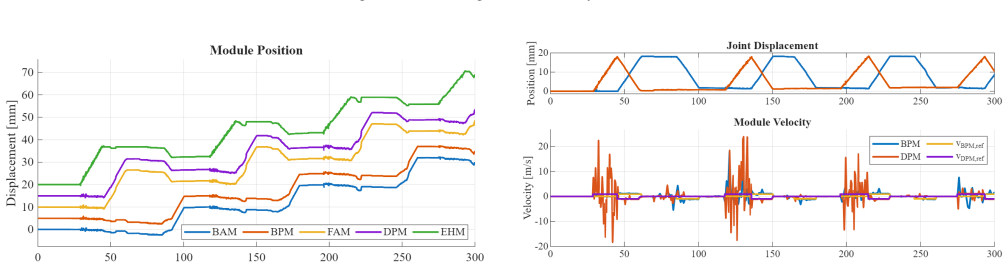
The proposed design, controllers and the gait synthesis strategy together are capable of anchoring the robot in place and creating a total advancement of 30 mm into the soil after completing 3 gait cycles.
What carries the argument
The five-module assembly (drill head, two anchor modules, two propagation modules) coordinated by a centralized state machine for gait synthesis.
If this is right
- Decoupled Euler-Lagrange models enable independent feedback control of anchoring and propulsion phases.
- The state machine gait ensures sequential operation without interference between modules.
- ROS-integrated simulation supports direct transfer of the trained controllers to hardware.
- Repeated cycles produce cumulative advancement, allowing deeper penetration over time.
Where Pith is reading between the lines
- The modular separation could allow swapping the drill head for other excavation tools without redesigning the gait logic.
- Soil property variations would require retuning simulation parameters to maintain the reported advancement distance.
- The approach might extend to granular materials other than soil if the contact dynamics are modeled similarly.
Load-bearing premise
The Unity physics simulation with the CAD model accurately represents real soil-robot interactions and dynamics.
What would settle it
A physical robot test in soil that fails to anchor or advances less than 30 mm after three gait cycles would falsify the performance claim.
Figures



read the original abstract
In this article, we present dynamic modeling, gait synthesis, and feedback control design for a modular novel subsurface robot, designed for human-free subsurface exploration and excavation. The subsurface propagator design is based on two major aspects: 1) anchor and propel movement like an earthworm and 2) excavation similar to tunnel boring machines. This design is decoupled into five separate modules: one drill head to excavate and create cavity for propagation, two modules to anchor the robot, and two modules to enable propagation of the body. In order to design a controller for each of the modules, dynamic models using the Euler-Lagrange framework are developed. These mathematical models are used as a baseline to design controlled decoupled operation of the different joint movements. The operation of robotic assembly is constructed via a centralized state machine for gait synthesis with integration of the designed feedback controller. The controllers are tested on the real robot geometry to aid sim-to-real integration: A physics-based Unity simulation using a CAD model of the robot and integration of the trained controller via ROS verifies the performance of the robot. The experimental results demonstrate that the proposed design, controllers and the gait synthesis strategy together are capable of anchoring the robot in place and creating an total advancement of 30\,mm into the soil after completing 3 gait cycles.
Editorial analysis
A structured set of objections, weighed in public.
Referee Report
Summary. The paper presents a modular subsurface robot with five modules (drill head, two anchors, two propagators) inspired by earthworm anchoring and tunnel boring. It derives Euler-Lagrange dynamic models for decoupled module operation, designs feedback controllers from those models, implements gait synthesis via a centralized state machine, and evaluates the integrated system in a Unity physics simulation of the CAD model, claiming that the design, controllers, and gait enable anchoring and 30 mm total advancement into soil after three gait cycles.
Significance. The decoupled modeling and control strategy, combined with a state-machine gait, offers a structured approach to coordinating anchoring, excavation, and propulsion in a confined subsurface environment. If the Unity soil-contact model were calibrated and validated against physical data, the 30 mm advancement result would provide a concrete, falsifiable benchmark for sim-to-real transfer in bio-inspired burrowing robots. The absence of such validation currently confines the contribution to an untested simulation study.
major comments (2)
- [Abstract] Abstract and simulation results section: The headline claim that the system 'is capable of anchoring the robot in place and creating a total advancement of 30 mm into the soil after completing 3 gait cycles' rests exclusively on an unvalidated Unity rigid-body simulation. No soil-model parameters, contact calibration against measured properties, sensitivity analysis, baseline comparisons, or physical-robot experiments are reported, so the quantitative result cannot be taken as evidence of real-world capability.
- [Simulation and Results] Simulation description: The manuscript states that the Unity simulation 'verifies the performance' and aids 'sim-to-real integration,' yet supplies no quantitative metrics (RMS error, contact-force correlation, etc.) comparing the decoupled Euler-Lagrange models to the coupled simulated dynamics or to any empirical soil data. This gap directly affects the load-bearing performance claim.
minor comments (2)
- [Dynamic Modeling] Notation: The Euler-Lagrange equations for the individual modules are presented without an explicit statement of the generalized coordinates or the form of the inertia, Coriolis, and gravity terms; adding these would improve traceability from model to controller.
- [Gait Synthesis] Figure clarity: The state-machine diagram and the CAD renderings lack labels for the five modules and the soil boundary conditions used in Unity; this makes it difficult to map the gait sequence to the reported 30 mm displacement.
Simulated Author's Rebuttal
We thank the referee for their thoughtful comments on our manuscript. We address the major comments point by point below, clarifying the simulation-based nature of the study and outlining planned revisions.
read point-by-point responses
-
Referee: [Abstract] Abstract and simulation results section: The headline claim that the system 'is capable of anchoring the robot in place and creating a total advancement of 30 mm into the soil after completing 3 gait cycles' rests exclusively on an unvalidated Unity rigid-body simulation. No soil-model parameters, contact calibration against measured properties, sensitivity analysis, baseline comparisons, or physical-robot experiments are reported, so the quantitative result cannot be taken as evidence of real-world capability.
Authors: We agree that the reported 30 mm advancement is obtained from the Unity simulation without any physical validation, soil calibration, or sensitivity analysis. The paper focuses on the development of dynamic models, controllers, and gait synthesis, with the simulation serving to demonstrate the integrated performance in a virtual setting as a step toward sim-to-real transfer. We will revise the abstract and the simulation results section to explicitly indicate that the advancement is a simulated result and to include a clearer statement of the study's limitations regarding real-world applicability. revision: yes
-
Referee: [Simulation and Results] Simulation description: The manuscript states that the Unity simulation 'verifies the performance' and aids 'sim-to-real integration,' yet supplies no quantitative metrics (RMS error, contact-force correlation, etc.) comparing the decoupled Euler-Lagrange models to the coupled simulated dynamics or to any empirical soil data. This gap directly affects the load-bearing performance claim.
Authors: The Euler-Lagrange models were derived for controller design, and the Unity simulation tests the closed-loop behavior of those controllers on the full robot model. No direct quantitative comparison metrics between the analytical models and the simulated dynamics are provided in the current manuscript. We will incorporate such metrics in the revised version, for instance by reporting the discrepancy between model-predicted trajectories and those observed in simulation under the same control inputs, to better substantiate the modeling approach. revision: yes
Circularity Check
No circularity; standard modeling pipeline with independent simulation output.
full rationale
The derivation begins with Euler-Lagrange equations applied to the robot modules (standard first-principles), proceeds to controller synthesis from those equations, and gait synthesis via an independent state machine. The 30 mm advancement is reported as an output of the Unity simulation of the CAD model; it is not obtained by fitting parameters to the target metric, redefining inputs, or invoking self-citations. No step reduces by construction to its own inputs, and the simulation step is external to the analytic chain.
Axiom & Free-Parameter Ledger
axioms (1)
- domain assumption The dynamics of each robot module can be modeled independently using the Euler-Lagrange framework
invented entities (1)
-
Modular subsurface propagator with drill, anchor, and propagation modules
no independent evidence
Reference graph
Works this paper leans on
-
[1]
Excavation by snake robots with fins and a drill,
H. Yoshida, T. Yamazaki, M. Nakajima, and M. Tanaka, “Excavation by snake robots with fins and a drill,”Advanced Robotics, vol. 37, no. 14, pp. 942–958, 2023-07-18. [Online]. Available: https://doi.org/10.1080/01691864.2023.2223261
-
[2]
Fundamentals of burrowing in soft animals and robots,
K. M. Dorgan and K. A. Daltorio, “Fundamentals of burrowing in soft animals and robots,”Frontiers in Robotics and AI, vol. 10, 2023-01-30, publisher: Frontiers. [Online]. Available: https://doi.org/10.3389/frobt.2023.1057876
-
[4]
In: 2020 IEEE/RSJ International Conference on Intelligent Robots and Systems (IROS)
J. Lee, C. Tirtawardhana, and H. Myung, “Development and analysis of digging and soil removing mechanisms for mole- bot: Bio-inspired mole-like drilling robot,” in2020 IEEE/RSJ International Conference on Intelligent Robots and Systems (IROS), 2020-07, pp. 7792–7799, ISSN: 2153-0866. [Online]. Available: https://doi.org/10.1109/IROS45743.2020.9341230
-
[5]
Mole-inspired robot burrowing with forelimbs for planetary soil exploration,
T. Zhang, H. Wei, H. Zheng, Z. Liang, H. Yang, Y . Zhang, H. Zhu, Y . Guan, X. Ding, K. Wang, and K. Xu, “Mole-inspired robot burrowing with forelimbs for planetary soil exploration,”Advanced Intelligent Systems, vol. 6, no. 6, p. 2300392, 2024. [Online]. Available: https://doi.org/10.1002/aisy.202300392 Fig. 10. Block diagram of the Unity simulation Fig....
-
[6]
An earthworm-like modular soft robot for locomotion in multi-terrain environments,
R. Das, S. P. M. Babu, F. Visentin, S. Palagi, and B. Mazzolai, “An earthworm-like modular soft robot for locomotion in multi-terrain environments,”Scientific Reports, vol. 13, no. 1, p. 1571, Jan. 2023. [Online]. Available: https://doi.org/10.1038/s41598-023-28873-w
-
[7]
An underground explorer robot based on peristaltic crawling of earthworms,
K. J. Waldron, H. Omori, T. Nakamura, and T. Yada, “An underground explorer robot based on peristaltic crawling of earthworms,”Industrial Robot: the international journal of robotics research and application, vol. 36, no. 4, pp. 358–364, 06 2009. [Online]. Available: https://doi.org/10.1108/01439910910957129
-
[8]
Design and Gait Planning of a Worm-inspired Metameric Robot for Pipe Crawling,
Y . Liu, Q. Shi, and Z. Chen, “Design and Gait Planning of a Worm-inspired Metameric Robot for Pipe Crawling,”Journal of Bionic Engineering, vol. 21, no. 3, pp. 1265–1277, May 2024, publisher: Springer Science and Business Media LLC. [Online]. Available: https://link.springer.com/10.1007/s42235-024-00497-4
-
[9]
Development of a mole-like drilling robot system for shallow drilling,
J. Kim, H. W. Jang, J.-U. Shin, J.-W. Hong, and H. Myung, “Development of a mole-like drilling robot system for shallow drilling,”IEEE Access, vol. 6, pp. 76 454–76 463, 2018. [Online]. Available: https://doi.org/10.1109/ACCESS.2018.2884495
-
[10]
Concept design for mole-like excavate robot and its localization method,
J. Lee, H. Lim, S. Song, and H. Myung, “Concept design for mole-like excavate robot and its localization method,” in2019 7th International Conference on Robot Intelligence Technology Fig. 13. Joint displacement and module velocity of the PMs and Applications (RiTA), 2019-08, pp. 56–60. [Online]. Available: https://doi.org/10.1109/RITAPP.2019.8932732
-
[11]
Application of Snake-Like Robot in Pipeline Inspection
J. Mai, “Application of Snake-Like Robot in Pipeline Inspection.”
-
[12]
Modeling, gait sequence design, and control architecture of BADGER underground robot,
P. Vartholomeos, P. Marantos, G. Karras, E. Menendez, M. Rodriguez, S. Martinez, and C. Balaguer, “Modeling, gait sequence design, and control architecture of BADGER underground robot,”IEEE Robotics and Automation Letters, vol. 6, no. 2, pp. 1160–1167, 2021-04. [Online]. Available: https://doi.org/10.1109/LRA.2021.3056068
-
[13]
Continuum dynamics of rectilinear locomotion of a metameric earthworm-like robot,
R. Shi, H. Fang, and J. Xu, “Continuum dynamics of rectilinear locomotion of a metameric earthworm-like robot,” Multibody System Dynamics, Jan. 2026. [Online]. Available: https://link.springer.com/10.1007/s11044-026-10142-z
-
[14]
A. Kandhari, Y . Wang, H. J. Chiel, R. D. Quinn, and K. A. Daltorio, “An Analysis of Peristaltic Locomotion for Maximizing Velocity or Minimizing Cost of Transport of Earthworm-Like Robots,”Soft Robotics, vol. 8, no. 4, pp. 485–505, Aug. 2021. [Online]. Available: https://journals.sagepub.com/doi/full/10.1089/soro.2020.0021
-
[15]
Efficient worm-like locomotion: slip and control of soft-bodied peristaltic robots,
K. A. Daltorio, A. S. Boxerbaum, A. D. Horchler, K. M. Shaw, H. J. Chiel, and R. D. Quinn, “Efficient worm-like locomotion: slip and control of soft-bodied peristaltic robots,”Bioinspiration & Biomimetics, vol. 8, no. 3, p. 035003, Aug. 2013. [Online]. Available: https://iopscience.iop.org/article/10.1088/1748-3182/8/3/035003
-
[16]
A CPG-Based Versatile Control Framework for Metameric Earthworm-Like Robotic Locomotion,
Q. Zhou, J. Xu, and H. Fang, “A CPG-Based Versatile Control Framework for Metameric Earthworm-Like Robotic Locomotion,” Advanced Science, vol. 10, no. 14, p. 2206336, 2023. [Online]. Available: https://doi.org/10.1002/advs.202206336
- [17]
-
[18]
M. V . Mark W. Spong, Seth Hutchinson,Robot Modeling and Control. Wiley, 2020, vol. 2
work page 2020
-
[19]
An enhanced cylindrical contact force model,
C. Pereira, A. Ramalho, and J. Ambrosio, “An enhanced cylindrical contact force model,”Multibody System Dynamics, vol. 35, no. 3, pp. 277–298, Nov. 2015. [Online]. Available: http://link.springer.com/10.1007/s11044-015-9463-x
-
[20]
P. Flores and H. M. Lankarani,Contact Force Models for Multibody Dynamics, ser. Solid Mechanics and Its Applications. Cham: Springer International Publishing, 2016, vol. 226. [Online]. Available: http://link.springer.com/10.1007/978-3-319-30897-5
-
[21]
Drilling Formulas and Definitions
Sandvik Coromant AB, “Drilling Formulas and Definitions.” [Online]. Available: https://www.sandvik.coromant.com/en- us/knowledge/machining-formulas-definitions/drilling-formulas- definitions
discussion (0)
Sign in with ORCID, Apple, or X to comment. Anyone can read and Pith papers without signing in.